Risks of AI-Generated Marketing Content: Where the Limits Are and How to Manage Them (2026)
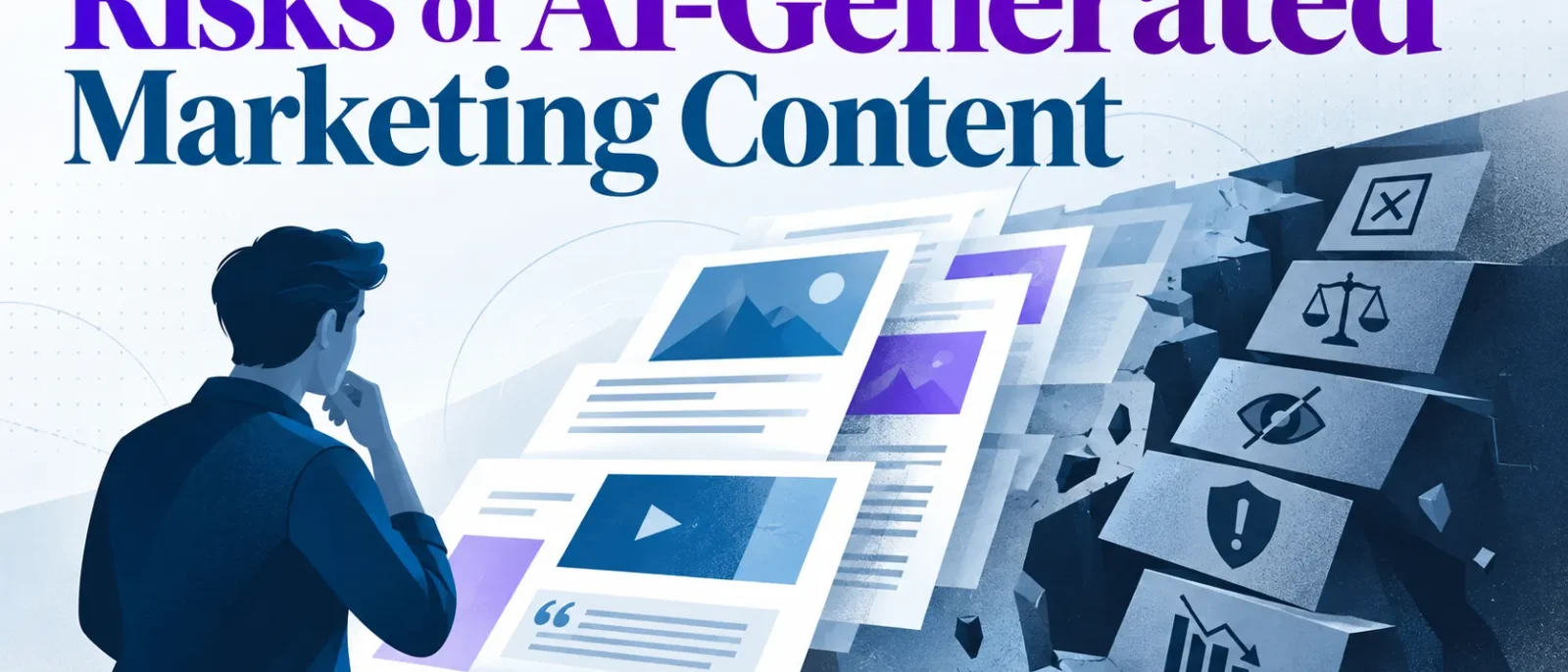
Risks of AI-generated marketing content come mainly from accuracy errors, legal exposure, brand dilution and weak search performance. Language models produce fluent text whether or not the facts behind it are true, so these risks are built into how the tools work. A better prompt or a final proofread will not remove them. Treat AI as a drafting aid under a human verification layer, not as an autonomous publisher.
This article argues for a sharper rule: budget verification cost per claim type, not per article. A pricing claim, a competitor comparison and a stylistic rewrite carry very different consequences, so they need very different checks. The sections below show where the limits sit and how a small team can set up a review process without a dedicated legal function.
Key Takeaways
- AI marketing drafts fail in predictable places. Fabricated statistics, unsupported comparative claims and invented citations come from how language models work, so every factual claim needs a check against a primary source.
- Accuracy is only one of four risk types. Legal exposure, brand dilution and loss of differentiation can each occur even when the copy is factually correct.
- Consequence and verifiability set the workflow. Pricing, health or financial claims and competitor comparisons need full review and source sign-off.
- Advertisers stay responsible for what they publish. The source of a draft does not transfer liability under FTC rules on deceptive advertising.
- Sameness is a strategic cost. Competitors using the same tools can produce near-identical copy, so distinct evidence and expertise carry the differentiation.
- Keep a human in the loop. Small teams can manage risk with a triage step, a named approver and a log of sources.
Table of Contents
- What AI-Generated Marketing Content Can and Cannot Do Reliably
- The Accuracy Problem: Hallucinated Claims, Stats and Citations
- Legal and Regulatory Exposure in the United States
- Brand Voice Drift, Sameness and Eroded Trust
- Search, Ranking and Platform Policy Risks
- Bias, Exclusion and Sensitive-Category Mistakes
- Conclusion and Summary
What AI-Generated Marketing Content Can and Cannot Do Reliably
AI is good at some parts of marketing production and unreliable at others. Teams that treat the tool as uniformly capable tend to find the gaps after a draft is live. Separate tasks where errors are cheap and easy to see from tasks where errors are costly and hard to spot.
Where generative AI performs well in marketing production
AI is strongest where output is easy to check and a miss is cheap. These are first-pass tasks a person will read anyway:
- Variant generation: headline, subject line and ad copy variations for testing, where a team needs twenty options and will pick two.
- Reformatting and repurposing: turning a webinar transcript into a blog outline, a LinkedIn post and a short email, using material that is already approved.
- Structural drafting: outlines and first drafts that a writer will rebuild around original material.
- Tone adaptation: rewriting approved copy for a different reading level or channel without changing the facts.
In each case the model works from material a person has already supplied and verified. The human judges fit and quality.
Where output quality breaks down under real conditions
Quality falls apart when the task needs knowledge the model lacks or claims that must be exact. Three conditions cause most of the trouble:
- Proprietary or current information. The model does not know your latest pricing, roadmap or a regulation that changed last month unless you supply it. It fills the gap with plausible language.
- Comparative and competitive claims. Statements such as “faster than” or “the only platform that” need evidence the model cannot reliably produce.
- Specific, checkable detail. Dates, figures, named studies and customer outcomes are where fluent prose hides errors. The sentence reads well, so the error is easy to miss.
The pattern to watch is confidence. The output rarely signals uncertainty, so a skimming reviewer passes a wrong number as readily as a correct one. Check every claim against a source before publication.
Why “good enough” drafts create hidden cleanup costs
The most expensive AI output is not the obviously bad draft, which gets rejected quickly. It is the draft that is mostly right, reads smoothly and gets lightly edited before going live. The cleanup cost appears later:
- A correction request from a customer about an incorrect feature claim.
- A rewrite of a campaign after a legal or brand review flags unsupported language.
- Ranking or trust losses on pages that repeat generic phrasing across the site.
- Senior staff hours spent re-verifying content a junior colleague assumed was checked.
Use the following template to model this for your own team. Fill every field from your own project logs, not from estimates:
| Cost line | Your figure (from project logs) |
|---|---|
| Total hours to publishable asset | Sum of the above |
If the total for the AI route exceeds the total for the manual route, the draft is not saving time. Compare on the same page type, so the comparison is fair.
Measure total time to a publishable, verified asset, not time to first draft. A draft is only cheap if it does not create downstream work.
The Accuracy Problem: Hallucinated Claims, Stats and Citations
Risks of AI-generated marketing content are most costly when they reach the reader as fact. AI drafts read as finished. The sentences are fluent, the tone is confident and the structure looks like a professional brief. None of that shows whether a single number, date or source is real.
How language models produce confident but false statements
A language model does not check facts before it writes. It predicts the next likely word based on the words before it. When a draft needs a figure, such as the share of shoppers who prefer a feature, the model produces a number that fits the sentence. That number may have appeared in similar text during training, or it may be invented. The output sounds equally certain either way.
Hallucination is a built-in property of the tool, not an occasional glitch. Prompts such as “only use accurate statistics” reduce errors but give the model no way to verify them. Treat every specific claim as unverified until someone has traced it to a primary source.
Error rates vary by model and task, and the figures published so far are not uniform. Test your own tools on your own content types rather than relying on general reputation. The claims most at risk are:
- Percentages, sample sizes and survey results
- Named studies, publication years and author names
- Product specifications, certifications and awards
- Pricing, availability and “industry-leading” comparisons
- Quotes attributed to executives or experts
Fabricated sources and statistics: how they get into published copy
Fabricated citations are the most damaging form of error because they look like diligence. A draft might cite “a 2024 study by a well-known research firm” with a plausible headline and no link. Or it might give a full reference, with a real-sounding journal, author list and DOI, that resolves to nothing. Writers under deadline often keep these references because they strengthen the copy.
They reach publication along a predictable path. A writer asks the tool for evidence, receives a tidy statistic and pastes it in. An editor reviews the prose for tone and grammar, not sourcing. The statistic then appears in a social post, a sales deck or a press release, and each reuse makes it look more established. By the time someone questions it, the claim has travelled far from its origin.
Fabricated and real statistics often sit side by side in the same paragraph. A statistic is not verified until someone has opened the cited source, found the exact figure and confirmed it says what the copy claims. Checking that the source exists is not enough.
A verification workflow for every factual claim
Verifying every sentence is impractical, so the workflow has to be targeted. Mark each factual claim, then sort it by how easily a reader or regulator could check it and how much harm an error would cause. The Marketing AI Risk Triage Matrix sets the thresholds for that sorting.
| Consequence if wrong | Verifiability | Review level required |
|---|---|---|
| High (named claim, price, legal or health statement) | Hard to check | Primary source traced and matched before publication, second reviewer sign-off |
| High | Easy to check | Primary source traced and matched before publication |
| Low (general tone or description) | Hard to check | Editor review for accuracy and removal of unsupported claims |
| Low | Easy to check | Spot check during editing |
Use this sequence for each marked claim:
- Extract. Highlight every number, date, named source, superlative, quote and comparison. Log the claim, its location and its status.
- Trace. Find the primary source: the original study, the regulator’s page, the company’s filing or the product documentation. A secondary article repeating the figure does not count.
- Match. Confirm that the exact figure, date and population match the copy. A survey of US adults is not a survey of marketers, and a 2019 figure should not appear as current.
- Record. Save the link, the access date and the checker’s name. This record is your evidence if a claim is later challenged.
- Remove or soften. If no primary source exists, delete the claim or rewrite it as an observation you can support, such as what your own customers reported in your own data.
- Re-check after edits. A rewrite can change a claim’s meaning, so verify it again before sign-off.
For a small team, the log can be a spreadsheet with four columns: claim, source link, verified by and status. The effort is modest compared with the cost of a correction, and the log becomes reusable when the same claims recur across campaigns.
Legal and Regulatory Exposure in the United States
Generative AI does not change who is responsible for a marketing claim. The brand that publishes the copy owns it, whether a person, an agency or a model wrote the first draft. Regulators apply this principle consistently, so an “the AI wrote it” defense does not protect a brand from liability. The risks of AI-generated marketing content are therefore a legal risk for the brand, not just a tool problem for the team.
Truth-in-advertising obligations under FTC rules and guidance
The Federal Trade Commission treats advertising claims the same way regardless of how they were produced. Under Section 5 of the FTC Act, an advertisement is deceptive if it contains a material representation or omission likely to mislead a reasonable consumer. The FTC expects advertisers to have a reasonable basis for objective claims before publishing them. Its substantiation standard, often described as “competent and reliable evidence,” requires that evidence to exist before the claim goes live, not after a complaint arrives.
For AI-drafted copy, this creates a specific problem. A model can produce a sentence such as “clinically proven to reduce wrinkles by 40%” with no study behind it. The FTC does not care that the sentence was generated. It cares that the claim was published without substantiation. Liability rests with the advertiser, not the tool.
Map each objective claim in a draft to the evidence that supports it, and keep that evidence on file. Claims about price, speed, performance, safety, savings and comparisons to competitors need the closest attention, because consumers rely on them most. Verify the current FTC advertising guidance directly on ftc.gov before building your review process, since guidance is updated over time.
Disclosure requirements for AI-generated endorsements, testimonials and reviews
The FTC’s Endorsement Guides, published at 16 CFR Part 255 and updated in 2023, govern testimonials and endorsements. They apply whether a review was written by a customer, a paid influencer or a generative model. A few points carry the most risk:
- Fabricated testimonials are deceptive. A review invented by a model, or a “customer quote” that no real customer gave, violates the rules even if it sounds plausible.
- Material connections must be disclosed. If a brand pays for or supplies a product to a person who posts about it, that relationship needs clear disclosure.
- Synthetic reviews create liability for the brand. Using AI to generate reviews at scale and publish them as customer feedback is one of the clearest examples of deceptive practice the FTC has addressed.
The FTC does not currently require a specific label for AI-written marketing copy, but deception rules still apply to what the copy says. Disclosure is required wherever the omission would mislead, such as a review presented as a real customer’s experience. A testimonial must come from a real person who had the experience described. If AI helped edit a real customer’s words for length or clarity, keep the original and the meaning intact, and record the source.
Copyright and ownership: what the U.S. Copyright Office says about AI-authored material
The U.S. Copyright Office has stated that copyright protects human authorship. Its 2023 registration guidance explained that works generated by AI without sufficient human creative control are not protectable, while human-authored selection, arrangement and modification of AI output can be. Check the Office’s current guidance at copyright.gov before relying on any specific position, because the rules have been developing through registration decisions. This position was checked against the Office’s published guidance at the time of writing, but it changes, so confirm it against the current primary document before acting on it.
For marketing teams, the implications are concrete:
- A tagline or slogan generated entirely by a model may not be protectable, which weakens your ability to stop a competitor from copying it.
- Your logo, campaign identity and core brand copy should be shaped by documented human creative decisions to be defensible.
- Ownership of a tool’s output is a separate question from copyrightability. Read the terms of service of each AI tool to see what rights it grants you and what it reserves.
Record who made the creative decisions on any asset you intend to protect, and keep drafts that show human revision.
Privacy and data-use risks when prompts contain customer information
Pasting customer data into a public AI tool creates exposure that has nothing to do with the output. A support ticket, a CRM export or a list of purchase histories sent to a third-party model may be retained, used for training or exposed through a vendor breach. The FTC has used consent decrees, lawsuits and rulemaking to address unfair or deceptive data practices, and misstating how data is used can itself be a deceptive claim.
Set one rule and enforce it: no customer personal information goes into a tool unless the tool’s contract covers it. Use enterprise or business accounts that exclude prompts from training, strip identifiers before drafting, and use synthetic or anonymized examples for prompt templates.
State-level laws and industry self-regulation to track
Federal rules set the baseline, but states add obligations. Several states have passed consumer privacy laws, and some have considered or enacted rules on automated decision-making and AI disclosure in consumer contexts. Because this area changes quickly, check the status of laws in each state where you advertise or hold customer data, and ask counsel to confirm applicability.
Industry self-regulation matters too. The National Advertising Division reviews advertising in any industry and advertising format, and it often addresses cutting-edge advertising issues before regulatory guidance is available. Platform policies from major ad networks restrict certain claims and synthetic media. Advertising platforms can reject or remove content that breaks their rules even when the content is technically legal, so treat platform policy as a binding constraint on your campaigns.
Triage note: Any claim involving money, health, safety, comparisons or customer data is high-consequence. Those claims need documented substantiation and sign-off before publication, regardless of how the draft was produced.
Brand Voice Drift, Sameness and Eroded Trust
Most teams that adopt AI for marketing copy notice the speed gain first. Few notice the quieter cost: their pages start to sound like everyone else’s. The problem rarely shows up in one paragraph. It shows up across a hundred landing pages, when the same rhythm, the same hedges and the same “unlock your potential” framing make the brand hard to tell apart from its competitors. That loss of distinctiveness is a strategic risk, not a copy-editing problem, and it deserves its own governance.
Why models converge on generic phrasing
Language models predict the most probable next word given their training data and your prompt. Probable phrasing is the phrasing that appears most often across the internet. When a model drafts a product description, it pulls toward the average of thousands of similar descriptions. The result is copy that is clean and plausible but statistically median.
Three forces push output toward sameness:
- Shared training patterns: Most major models learned from overlapping corpora, so they reach for overlapping structures.
- Prompt similarity: Teams often prompt with the same generic brief (“write a friendly, professional product description”), which yields the same register across brands.
- Low-cost iteration: A competitor can generate a page in seconds with the same tool, so the baseline output becomes available to everyone at once.
A generic brief produces generic copy. Adding adjectives to the prompt rarely fixes this, because words such as “bold” or “authentic” are common and trigger the same stock phrasing.
Detecting AI-sounding copy and when audiences notice
Readers respond to patterns they may not name. Common markers include stacked triads (“faster, smarter, simpler”), formulaic openings that restate the question, and vague superlatives with no supporting detail. A simple test is to read a draft aloud and ask whether a specific customer, product or decision could be identified from the text. If not, the copy is probably generic.
Audiences notice most in three places: product pages where a buyer compares options, long-form content where a reader expects original insight, and brand communications after a trust incident. Detection is not the same as rejection. Many readers never say they can tell copy is AI-written. They disengage instead, which shows up as lower time on page and weaker conversion rather than complaints.
Published survey research on consumer attitudes toward AI-generated content is still limited and varies by category and wording, so treat any single attitude figure with caution and check its method before relying on it. The more reliable signal is behavioral: a page that reads as interchangeable tends to lose the comparison shopper first.
Run a lightweight audit before publication:
- Flag any sentence that could appear unchanged on a competitor’s site.
- Count stock phrases and replace each with a concrete detail, a number or a customer example.
- Check that at least one passage contains a claim, observation or fact that only your organization could make.
Protecting a distinct brand voice with style constraints and human editing
A distinct voice has to be specified and then enforced. Vague guidance (“be friendly”) gives a model nothing to work with. A usable constraint is concrete. It sets sentence length limits, banned words, preferred terms, a point of view the brand takes, and examples of phrasing that sound like the company.
A workable process has four steps:
- Write a voice specification with 5 to 10 rules, each testable. For example: “No sentence opens with a question,” “Name the customer segment in the first paragraph,” “Avoid the words ‘seamless’, ‘unlock’ and ‘elevate’.”
- Supply reference passages written by people on the team, so the model imitates real brand copy rather than a description of it.
- Edit for voice after factual review, not before. The factual pass catches errors. The voice pass catches sameness.
- Keep a rejection log of phrases removed in editing, and feed recurring ones back into the banned list.
Human editing carries the weight here. An editor who knows the brand can recognize when a sentence is correct but interchangeable, and rewrite it around a specific fact, opinion or customer situation. This judgment is hard to automate, and it is the main defense against convergence.
Counterpoint: Some teams argue that strict voice rules are unnecessary if the brand is already well known, because recognition comes from the brand name, not the prose. That holds for established brands with strong distribution. For newer or competitive categories, where buyers compare several similar options, distinctive copy still affects which option gets chosen.
Search, Ranking and Platform Policy Risks
Marketing teams often ask whether AI-written pages will rank. A more useful question is what happens after they rank, and whether the ad network or marketplace hosting them will keep accepting them. Search engines and ad platforms judge content by what it does for the reader, not by how it was produced. The risks of AI-generated marketing content appear here because AI makes it easy to produce many pages that do very little for anyone.
How search engines evaluate AI-produced pages under helpful-content principles
Google’s guidance on creating helpful, reliable, people-first content makes clear that the production method is not the test. The question is whether the page shows experience, expertise, authoritativeness and trustworthiness, and whether a reader leaves satisfied. A well-edited AI draft can meet that standard. A generic one usually does not, because it restates what the top results already say.
Pages with no original material are the most exposed. Marketing content tends to fail in three predictable ways:
- No first-hand input. The page describes a product or category without testing, data, customer evidence or a named expert view.
- Interchangeable claims. The same benefits and structure appear across many pages in a category, so search engines have little reason to prefer one.
- Outdated or unverifiable detail. Old figures, unnamed studies and unsupported comparisons weaken the credibility signals the guidance asks you to show.
Read the people-first guidance and run each draft through its self-assessment questions before publishing. If the honest answer to “would someone who had not seen this page find it useful?” is no, the problem is not the tool. The problem is the lack of material that only your organization could supply.
Scaled content abuse and thin-page patterns to avoid
Google’s spam policies name “scaled content abuse” as generating large numbers of pages mainly to manipulate rankings, whether or not automation is involved. AI makes this cheap, which is why it draws attention. The risk is not having many pages. It is having many pages that differ only by a keyword, a city or a product attribute, wrapped in the same template text.
Thin-page patterns to avoid include:
- Location or variant pages with swapped nouns. “Plumbing in Austin” and “Plumbing in Dallas” with identical body copy and only the city changed.
- Glossary or FAQ farms. Hundreds of short definitions built to capture long-tail queries, none reviewed by anyone who knows the subject.
- Product pages that paraphrase the manufacturer’s specification sheet without adding use cases, comparisons or limitations.
- Comparison pages with unsupported verdicts. “Best” rankings with no stated method or evidence.
A simple test: could a reader tell which page was generated for which variant without looking at the URL? If not, consolidate the pages or add real variant-specific material, such as local pricing in dollars, actual inventory data or first-hand observations.
Ad platform and marketplace restrictions on synthetic content
Advertising platforms and marketplaces such as retail and app stores set their own rules on synthetic media, misleading claims and endorsements. These rules are separate from search ranking. They can remove an ad or listing even when the underlying page is acceptable. Check the current policy pages for each platform you use, including Google Ads, Meta and any marketplace where you sell, because wording and enforcement change. AI-generated images of people, testimonial-style copy and before-and-after claims are the areas most often tightened. Treat any AI creative that depicts real people or outcomes as higher risk until the platform’s rules are confirmed.
Counterpoint. Some teams argue that because search engines do not penalize AI use as such, platform risk is overstated. That is partly right. The ranking risk from AI drafting is usually the risk of undifferentiated content, which is a quality problem, not a detection problem. Platform enforcement is different. An ad can be rejected for a claim it contains however well its landing page ranks. Review must cover every surface a piece of content appears on.
Bias, Exclusion and Sensitive-Category Mistakes
Most bias in AI-generated marketing copy is not obvious. Nobody prompts for a stereotype. The model fills gaps in a brief with the most common assumptions in its training data, and those assumptions are often narrow, dated or wrong. When the gap is a customer persona, the copy aims at a stereotype rather than a real buyer. When the gap is a health or money claim, the result can sound authoritative while breaking the rules for that category.
Stereotyped audiences and skewed persona assumptions
A model asked for “a persona for a home coffee grinder” will usually return a suburban parent or a young professional, often with a gendered name, a job title and a set of hobbies. These outputs look plausible, and that is the trap. The persona reflects the average of the training material, not the people who bought from you last quarter. If your real buyers skew older, rural or male, the copy speaks to a shopper who does not exist and quietly excludes the people who do.
The same pattern appears in imagery prompts, tone and offers. A model may default to younger faces for a fitness brand, assume one household structure for a grocery promotion, or link certain jobs to certain genders. None of this needs bad intent. It needs only a brief that left the audience unspecified.
Practical fixes:
- Build personas from first-party data, such as CRM records, survey responses and support tickets. Paste the summary into the prompt. Do not ask the model to invent the persona.
- Ask the model to list the assumptions it made about the audience, then check each one against your data.
- Review every named person, role and family structure in the draft against your actual customer base.
Health, financial and other regulated-category claims
Regulated categories are where a fluent draft does the most damage. Health supplements, medical devices, loans, insurance, investment products and weight-loss programs all carry specific claim rules. A model does not know which claims your product can support in your market. It will readily write “clinically proven to reduce anxiety” or “guaranteed returns,” because that phrasing is common in its training data.
The Federal Trade Commission applies its truth-in-advertising standard to every advertiser, whether a person or a model wrote the copy. Its position is that an advertiser needs a reasonable basis for objective claims before making them, and that the net impression of an ad counts, not just its literal words. Check current guidance directly on ftc.gov before relying on any specific rule, because enforcement priorities and guides change. Other federal agencies, such as the U.S. Food and Drug Administration for health products, set their own requirements. This article does not attempt to summarize them.
For regulated categories, treat every quantitative or outcome claim as a hard stop:
- Mark each sentence containing a number, a comparative word (“best,” “fastest,” “only”), an outcome (“cures,” “prevents,” “guarantees”) or a return or savings figure.
- Require a named substantiation document for each marked claim, stored with the campaign file.
- If no substantiation exists, delete the claim. Do not soften it with “may help” unless your substantiation supports that wording.
Review checkpoints for sensitive campaigns
Not every campaign needs the same scrutiny. A seasonal email subject line and a retirement-savings ad carry very different consequences, so review depth should match sensitivity. Each checkpoint below produces a record you can point to later.
| Checkpoint | Question to answer | Who signs off |
|---|---|---|
| Audience check | Does the copy assume anything about age, gender, income, health or household that the data does not support? | Campaign owner |
| Claim check | Is every number, comparison and outcome traceable to a document? | Subject-matter expert |
| Category check | Does the product fall in a regulated category with specific claim or disclosure rules? | Compliance or legal reviewer |
| Imagery and examples | Do images, names and case examples avoid stereotyping, and are any testimonials real and disclosed? | Brand or creative lead |
| Impression check | Read the ad as a skeptical customer would. Does the overall message imply a claim you cannot support? | Second reviewer who did not write the draft |
Two rules make these checkpoints work. First, the person checking claims should not be the one who wrote the prompt, since prompt authors tend to read their own intent into the output. Second, log the outcome of each checkpoint in the campaign record, including what was removed. That log is your evidence if a claim is later questioned, and it shows which failure modes recur, so you can tighten the brief next time.
Conclusion and Summary
AI-generated marketing content is fast and cheap, so its risks need a plan. The main risks are factual error, brand dilution, legal exposure and loss of differentiation. A better prompt does not remove them. They follow from how language models work: a model produces probable text from patterns in its training data. It has no built-in check on whether a claim is true, and it does not sound like any particular brand.
The practical position is to treat AI as a drafting aid, with a human verification layer between the draft and the audience. Use the table below to set how much review each piece needs:
| Consequence | Verifiability | Review level required |
|---|---|---|
| High (pricing, health, financial, named competitors) | Hard to verify | Full review. Every claim signed off against a primary source |
| High | Easy to verify | Full review with a named sign-off |
| Low (headline variants, internal summaries) | Hard to verify | Targeted check of any factual statement |
| Low | Easy to verify | Spot check before release |
Budget verification cost per claim type, not per article. A single pricing claim can take longer to trace than a whole blog section, so a flat review fee per piece misprices the risk.
Some teams argue that better prompts and a rigorous editing pass remove most of the risk. Editing removes many factual and tonal errors, and it is worth doing. It does not remove the strategic problem. If competitors use the same tools on similar prompts, the output converges. Human expertise, first-hand experience and original data make content hard to copy, and the people publishing remain responsible for supplying them.
Three recommendations to carry into your next content review:
- Separate accuracy from differentiation. A draft can be factually correct and still read like a competitor’s page, so review them as two tasks.
- Make verification specific. Trace each factual claim to a named source before publication, and record that trace.
- Keep governance running. Assign who signs off, log what was checked, and monitor published pages over time.
Is AI-generated marketing content legal to publish in the United States?
Yes. No federal rule bans publishing AI-drafted marketing copy. The U.S. Federal Trade Commission (FTC) judges the claims themselves, not the tool that produced them. A false, unsubstantiated or misleading AI-written claim is a violation, and the advertiser remains responsible for it. Check the current FTC guidance on deceptive advertising before relying on any specific rule, because the agency updates its guidance over time.
Do I have to disclose that marketing copy was written with AI?
Not in general. The FTC does not currently require a label saying a text ad or web page was drafted with AI. Disclosure duties come from the substance of the message. If an endorsement, testimonial or review is presented as coming from a real customer or expert, it must reflect that person’s genuine experience, and any material connection must be disclosed. Labelling AI involvement is a trust decision, not a blanket legal duty. Some teams choose it for brand reasons even where the law does not require it.
Will Google penalize pages written with AI?
No. Google’s public guidance says it evaluates content by quality and helpfulness, not by how it was produced. The risk comes from patterns Google treats as spam, such as mass-produced pages with little original value and scaled content created mainly to manipulate rankings. A well-edited, accurate, useful AI-assisted page is judged on the same criteria as any other. Review Google’s search documentation on helpful content for the current position.
Who owns the copyright to AI-generated marketing copy?
The U.S. Copyright Office has stated that copyright protects human authorship. Text generated entirely by an AI system without sufficient human creative control is generally not protected, so others may copy it. Material a person authored, selected, arranged or substantially edited can be protected, but only the human-contributed parts. Document who wrote and revised each piece. Check the Copyright Office’s AI guidance before assuming ownership of a campaign.
How do I stop AI tools from inventing statistics in my content?
You cannot stop the tool from inventing statistics, so you control the result at the review stage. Build a claim map that lists every number, date, named study, price and comparison in the draft. Trace each one to a primary source you have opened and read yourself. Remove or rewrite as a qualitative statement anything you cannot trace. Never accept a citation the model supplies without visiting it, because fabricated references often look correct. Log each verified claim with its source and date so the file can be audited later.
Can AI-generated ads or reviews create liability for my brand?
Yes. The advertiser is responsible for every claim an ad makes, whether a person or AI wrote it. AI-written reviews or testimonials carry higher risk. Presenting invented customer reviews as genuine violates FTC endorsement principles and damages trust if discovered. Set a rule that reviews and testimonials come only from real customers, and that AI may help edit them but may not invent them. Build sign-off for every paid ad, since platform policies can lead to rejection or removal.
Disclosure: digitalmarketingtools.ai is sponsored by Digimetrics.ai. Sponsored Highlights are clearly labelled advertising. Our reviews, comparisons and guides are written to be useful and fair regardless of who sponsors the site. Read the full disclosure.