
Guide to SEO Competitor Analysis Tools: Identify Gaps and Win Market Share

An SEO competitor analysis tool shows you what your competitors rank for, how they build authority, and where your organic search strategy falls short. Instead of guessing what works in your niche, you see real data: their keywords, backlinks, top-performing content, and technical strengths. This guide teaches you how to use these tools to uncover ranking opportunities, close the gap with stronger competitors, and build a defensible SEO advantage.
What Is an SEO Competitor Analysis Tool?
An SEO competitor analysis tool is software that collects and displays data about your competitors’ organic search performance, backlink profiles, content strategies, and technical infrastructure. Unlike general business competitive intelligence (which tracks pricing, features, or market messaging), these tools focus exclusively on what makes a site rank: keywords they target, pages that drive traffic, sites that link to them, and on-page optimization choices.
The core value is visibility into competitor strategies without guesswork. Instead of wondering which keywords a competitor prioritizes or how they attract backlinks, you enter their domain into a tool and see the answer in minutes. Tools generate traffic estimates, rank all their keywords, profile their backlinks, and flag content gaps.
Key capabilities of leading SEO competitor analysis tools include:
- Keyword ranking tracking across competitors with search volume and difficulty scoring
- Backlink profile analysis showing linking domains, anchor text, and link quality metrics
- Traffic estimation based on ranking position and search volume data
- Content performance comparison identifying top-performing pages and content types
- On-page optimization audits comparing title tags, meta descriptions, heading structure, and content depth
- Technical SEO assessment of site speed, mobile responsiveness, and indexation status
- Competitive gap identification revealing keywords competitors rank for that you don’t
In 2024, platforms like SEMrush, Ahrefs, and SimilarWeb provide these core functions across multiple data sources. Each tool maintains its own crawler infrastructure and clickstream data models, which means estimates and rankings can vary between platforms. Traffic estimates, in particular, are modeled calculations rather than confirmed figures; all tools include methodology documentation explaining their estimation approach and inherent limitations.
The distinction matters because SEO competition is not always business competition. A B2B SaaS company selling project management software competes with other SaaS vendors in the market, but on Google, they also compete with review sites, comparison blogs, and YouTube tutorials. An SEO competitor analysis tool reveals SEO competitors (sites ranking for your keywords) separately from business rivals. Your biggest organic search threat may not be your biggest business threat.
Why Competitor Analysis Is Critical for Organic Search
Organic search is highly competitive. According to Google Search Central documentation, search engine results pages (SERPs) vary in layout: traditional organic listings may include ten positions, but modern SERPs also display featured snippets, knowledge panels, image carousels, and other SERP features that reduce the visible real estate for standard blue links. If a competitor ranks in position three for a high-intent keyword, or occupies a featured snippet position, you cannot also hold that same position. This makes competitor visibility essential to strategy. You must know not just what keywords exist, but which ones your competitors have already claimed and which ones remain winnable.
Competitors reveal what actually works in your industry or niche. Generic SEO advice (write good content, get backlinks) is necessary but not sufficient. Your competitors show you the specific keywords, content formats, and link sources that move the needle in your market. A B2B SaaS company selling project management software learns more from analyzing how other SaaS companies rank than from a generic SEO case study about e-commerce.
Real ranking patterns are invisible without competitor data. You might assume a keyword is too competitive to target, but a competitor analysis tool shows you exactly how competitive it is: how many results rank, what domain authority those sites have, and what content they use. Many keywords that look hard are actually winnable if you target them correctly. Conversely, some keywords that sound easy are actually owned by established authorities. Only data tells the truth.
Lacking competitor visibility creates concrete risks. You might spend three months creating content for a keyword that competitors already dominate with high-authority pages you cannot outrank in the short term. You might miss entire categories of keywords that competitors are ranking for with minimal effort. You might build backlinks from weak sources while competitors link from high-authority publications you never knew about. These are not theoretical problems: they happen regularly to teams that skip competitive research.
The ROI case is direct: knowing what competitors rank for is knowing what you could rank for. If a competitor generates 5,000 monthly organic visits from a keyword you don’t target, that’s 5,000 visits your business is leaving on the table. Competitor analysis tools quantify that opportunity. They turn “I think we’re missing something” into “We’re leaving $100K in annual revenue on the table by not targeting these 12 keywords.” That precision drives action.
Identifying Your True SEO Competitors
SEO competitors are not always the same as business competitors. Your direct business rival might rank poorly for the keywords your target audience searches. Meanwhile, a website you’ve never heard of might rank higher than your rival for those same keywords. An SEO competitor analysis tool reveals both types, forcing you to expand your competitive set beyond the obvious names.
The criterion for an SEO competitor is ranking for your keywords, not selling your product. A SaaS accounting platform might have two business competitors in the direct category. But when you search “best accounting software for small business,” the top results include comparison sites, review sites, and industry blogs that are not your direct competitors but are competing for your audience’s attention and clicks. These content competitors matter for SEO strategy.
Identify SEO competitors through keyword overlap. Start with 10 to 15 keywords your business cares about: high-intent queries your sales team hears, high-volume terms your marketing should own, and long-tail keywords your ideal customers search. Run these keywords through a competitor analysis tool. The domains consistently ranking in the top five to ten across these keywords are your true SEO competitors. Some will be business rivals. Others will surprise you.
Audience targeting and overlap matter more than industry category. A large e-commerce retailer selling office supplies might find that multiple marketplaces and retailers all compete for keywords in their category. All three are SEO competitors if they rank for keywords your audience searches.
Tools uncover competitors you would not discover manually. Your direct sales team knows your direct business competitors. But they do not know about the industry blog that ranks for “how to choose your product category” with 10,000 monthly searches. They do not know about the emerging competitor startup that launched last year and is now ranking for long-tail variations you had not yet considered. An automated tool running your keyword set reveals these hidden competitors, expanding your competitive landscape and teaching you where the real ranking battles are.
Keyword Research and Gap Analysis
An SEO competitor analysis tool transforms competitor keyword data into a strategic roadmap for your own content and optimization efforts. Rather than guessing which keywords matter, tools let you see exactly which search terms competitors rank for, how much traffic those keywords likely generate, and where gaps exist between their coverage and yours.
Start by running your top three to five competitors through a keyword analysis. The tool will generate a list of keywords each competitor ranks for, sorted by search volume, difficulty score, and estimated traffic. This is your gap analysis foundation: compare the competitor’s keyword list to your own. Any keyword a competitor ranks for but you don’t is a potential opportunity. The gap reveals where audience demand exists and you’re currently invisible.
Not all gaps are equal. A keyword competitor ranks for with 50 monthly searches and a difficulty score of 75 out of 100 is not worth your time. A keyword with 500+ monthly searches and a difficulty of 40 to 50 is a low-hanging fruit candidate. Use volume and difficulty filters to narrow the gap list to actionable targets. Tools let you export these filtered gaps directly into a spreadsheet for mapping to your content roadmap.
Long-tail opportunities and content angles are often hidden in competitor gaps. A competitor ranking for “best project management software” might not rank for “best project management software for remote teams” or “project management software for nonprofits.” These longer, more specific phrases typically have lower difficulty, face less competition, and convert better because they signal clearer search intent. Scan the gap list for three to five-word phrases that competitors ignore but that your audience likely searches for.
The gap analysis also reveals content angle opportunities. If a competitor ranks for “what is agile methodology” but you don’t, that’s a keyword gap. But it’s also a content opportunity: you could create a guide on agile methodology that addresses a different angle (agile for small teams, agile in regulated industries, agile vs. waterfall comparison) and target the same keyword or related terms. You’re not copying their content; you’re addressing an audience need they partially serve.
Prioritize gaps by business impact using keyword intent filtering. A commercial or transactional keyword (containing “buy,” “pricing,” “best,” “software”) typically converts higher than informational keywords (containing “what is,” “how to”). If your business is SaaS, prioritizing commercial keyword gaps over informational ones will drive faster ROI. Informational gaps still matter for authority and organic reach, but commercial gaps pay faster.
Export your final gap list with volume, difficulty, estimated traffic, and intent tags. Group gaps by topic cluster (for example, “Agile methodology,” “Project management software comparison,” “Agile tools”). This clustering makes content planning easier: one comprehensive guide can target multiple related keywords instead of scattered single posts.
The discipline here is actionability. A gap is only useful if you commit to targeting it with content. If you identify 200 keyword gaps but only have capacity for 12 content pieces per quarter, you’ve wasted the analysis. Filter ruthlessly: aim for 20 to 40 target gaps per quarter, prioritized by volume, difficulty, and business fit. Assign each gap to a content calendar slot, and measure traffic and rankings 60 to 90 days after publishing.
Backlink Analysis and Competitive Link Strategy
Backlink analysis is where competitor tools reveal your authority gap most clearly. Domain Rating (DR), a metric developed by Ahrefs, and Domain Authority (DA), maintained by Moz, both estimate site authority based on backlink profile analysis. These scores reflect the quantity, quality, and topical relevance of linking domains. The methodologies differ between platforms, so a site’s DR on Ahrefs may not match its DA on Moz. Both tools publish their calculation methodology in official documentation, allowing users to understand scoring assumptions and limitations.
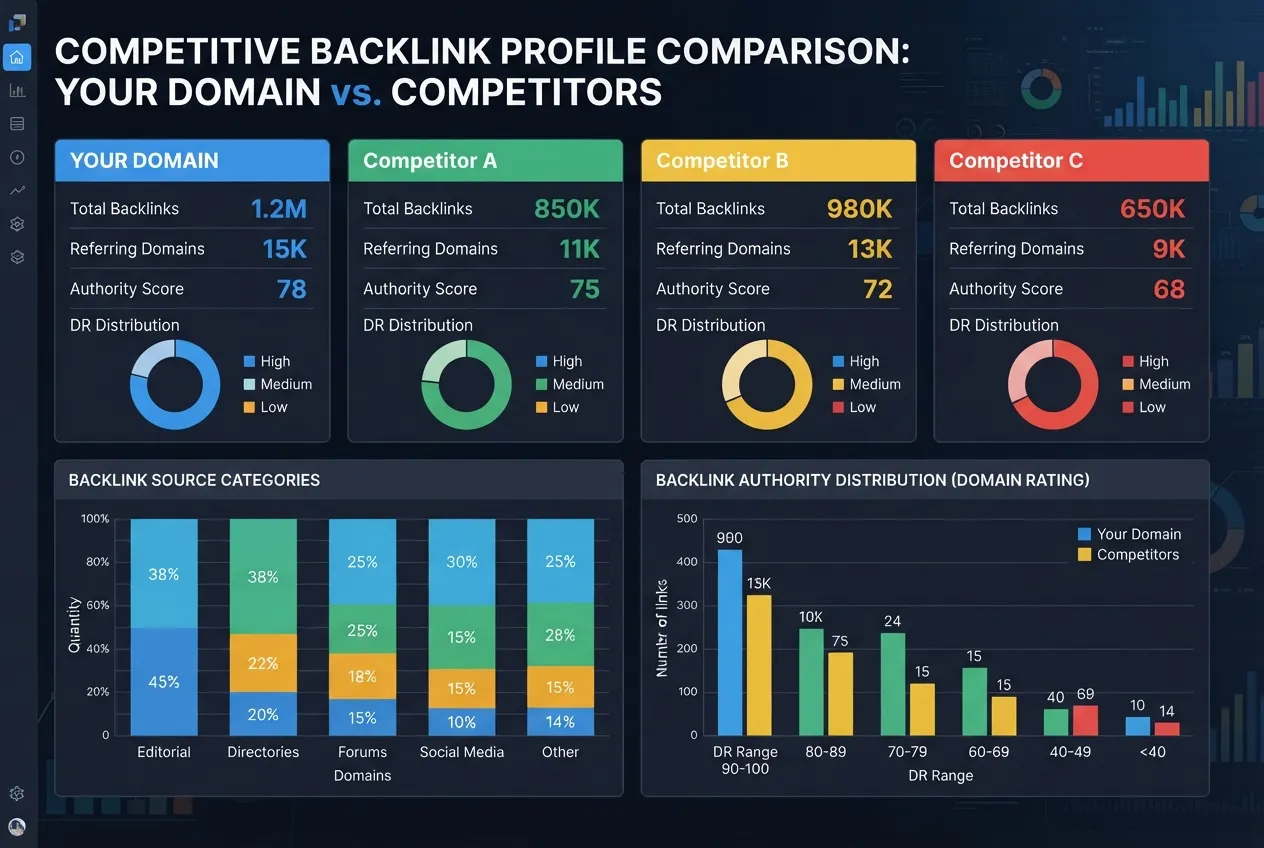
Run your top three competitors through the backlink analysis feature. The tool shows you which external sites link to them, the anchor text used, the authority of those linking sites, and whether the link came from a relevant topical context. You’ll see patterns: certain publications, industry directories, or partner sites appear repeatedly as link sources for your competitors.
Identify link gap targets by comparing your backlink profile to competitors’. If three competing domains all have links from the same industry publication, but you don’t, that publication becomes a prospecting target for your own outreach. If competitors link from relevant blogs, directories, or resource pages in your industry, those same sources likely accept links from you.
Categorize discovered links by type: editorial links (earned from journalists or bloggers), directory links (from industry directories or resource lists), partnership links (from partners, vendors, or complementary businesses), and self-created links (comments, profile links, or forum posts). Most weight in ranking comes from editorial and authority links. Focus your outreach on sources that match the types and authority levels your competitors use.
Build a competitive link intelligence document listing 20 to 30 prospecting targets based on competitor link patterns. Include the linking domain, target URL on the competitor site, link type, and estimated DR/DA. Prioritize domains with DR/DA scores above 40 and topical relevance to your industry. These become your outreach and content partnership targets.
On-Page SEO and Content Evaluation
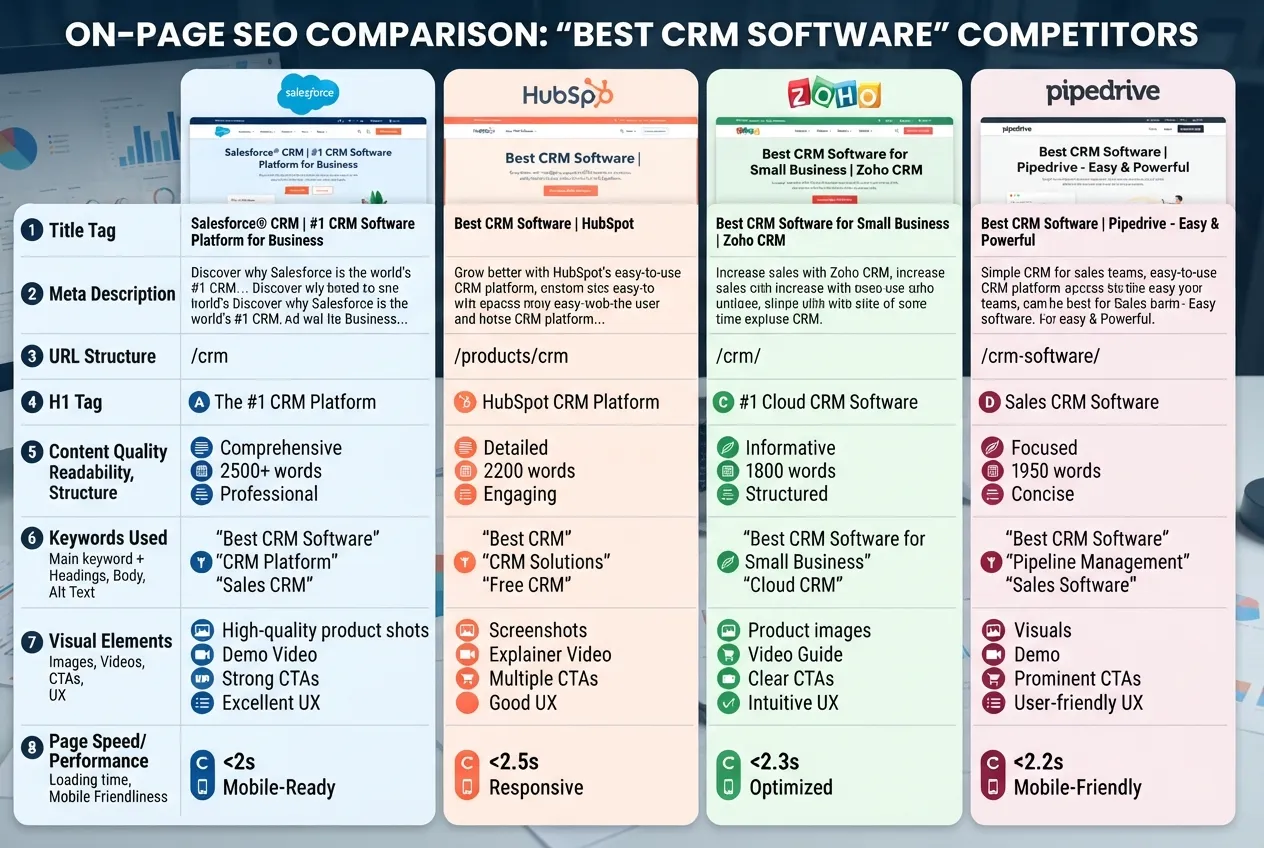
Competitor tools reveal on-page optimization choices that support ranking. Compare your top-ranking pages to competitor pages ranking for the same keywords. Note differences in title tag length, meta description approach, heading structure, word count, and content depth. If competitors consistently use longer titles (60+ characters), include modifiers in meta descriptions, or organize content with H2 and H3 headers in specific patterns, these patterns reflect successful on-page optimization in your competitive set.
Content evaluation extends beyond on-page tags. Tools highlight which competitor pages drive the most estimated traffic, indicating which content topics and formats resonate with your audience. If a competitor’s “how-to” guide for a particular topic generates 5,000 monthly estimated visits and you have no content in that space, that’s a content gap with proven audience demand.
Technical SEO assessment matters as well. Tools scan competitor sites for mobile responsiveness, Core Web Vitals performance, SSL certificate implementation, and site structure clarity. If competitors consistently achieve fast load times and mobile optimization while your site lags, technical improvements become part of your competitive strategy.
Backlink Analysis and Competitive Link Strategy
Backlinks form the backbone of Google’s ranking algorithm. A single high-authority link from a trusted domain can improve your rankings more significantly than dozens of low-quality links. An SEO competitor analysis tool reveals which sites link to your competitors, why those links matter, and which opportunities you have missed. This is where competitor analysis shifts from insight to competitive advantage.
When you analyze a competitor’s backlink profile, you’re answering a critical question: “Who trusts them enough to link to them, and why?” Tools assign domain rating (DR) or domain authority (DA) scores to each linking domain. According to Ahrefs’ official documentation, DR uses a 0-100 scale calculated from backlink data, helping you distinguish between a link from a major news outlet and a link from an obscure directory. A competitor with 50 links from authority sites typically outranks a competitor with 500 links from low-quality sources.
Identifying link gap opportunities
A link gap analysis compares your backlink profile to your competitors’. The tool shows you sites linking to them but not to you. These are your immediate outreach targets. For example, if three competitors all have links from industry review sites, trade publications, or resource directories that you lack, those gaps represent concrete outreach opportunities.
Prioritize links based on two criteria: relevance and authority. A link from a site in your industry with a DR of 45 or higher is worth far more than a link from an unrelated site with DR of 20. The tool’s filtering features let you narrow results by domain rating, referring domain country, and anchor text relevance. Export the list and segment it by difficulty. Links from sites that have already linked to your competitors are often easier to secure than cold outreach to untouched domains.
Learning from competitor link patterns
Competitors’ backlink profiles reveal their content and brand-building strategies. A competitor with dozens of links from tech blogs probably creates technical content or partners with tech communities. A competitor with links from podcasts or media outlets likely invests in PR and thought leadership. These patterns show you which channels work in your space.
Look beyond individual links to the source categories. Are most competitor links coming from industry directories, blog mentions, press coverage, or partnerships? This tells you where to invest your own effort. If a competitor’s top 10 referring domains include three industry associations, you now know those associations are worth joining or sponsoring.
Avoiding toxic and low-quality links
Not all backlinks help. Low-quality, spammy, or irrelevant links can reduce your domain authority and potentially trigger manual actions from Google. By studying competitor profiles, you can see which link sources are credible and which are best avoided. If a competitor has hundreds of links from low-authority, unrelated sites, that is a warning sign of aggressive, low-quality link building.
Tools flag suspicious link patterns: sudden spikes in linking activity, links from private blog networks (PBNs), or links from unrelated content farms. Use these insights defensively. If a competitor’s profile shows signs of manipulation, you can report it or avoid replicating their tactics. Your link profile should reflect genuine relationships and quality content.
Actionable next steps
Extract competitor backlink lists and create a spreadsheet with the following columns: domain name, DR/DA, relevance to your niche, and outreach difficulty. Start with high-authority, high-relevance links that competitors have secured. Reach out to those sites with a value-first pitch, not a demand for a link. Mention that they have linked to similar content from competitors and that your resource offers additional depth or a different angle.
Secondary targets are domains linking to competitors but not yet to anyone in your immediate market. These sites are already open to your niche. Tertiary targets are unlinked domains in your industry worth outreach based on their audience and authority, regardless of competitor activity.
On-Page SEO and Content Evaluation
Your competitors’ top-performing pages reveal exactly what search engines reward in your niche. An SEO competitor analysis tool surfaces the on-page elements and content strategies that drive their rankings so you can understand the pattern without reverse-engineering by hand.
What on-page SEO metrics matter
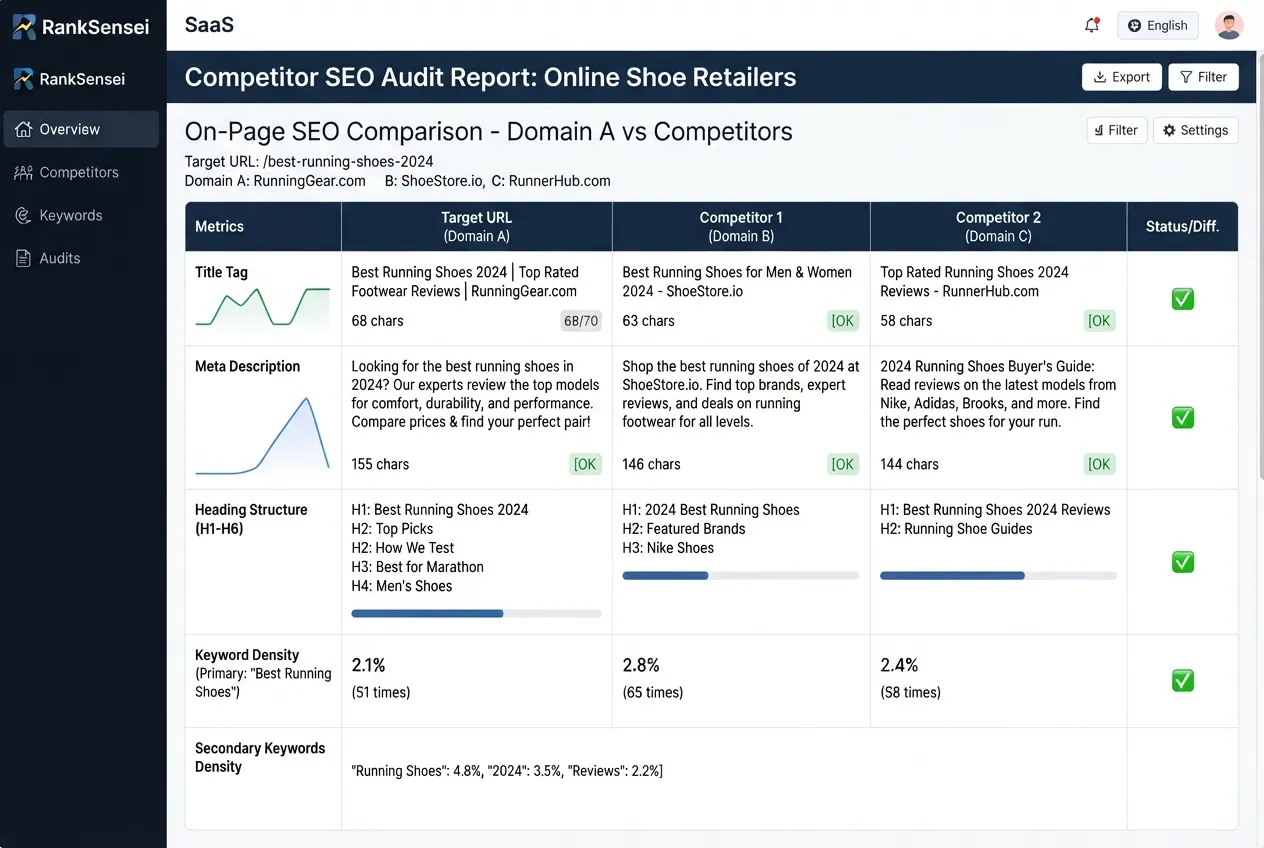
Start with the fundamentals: title tags, meta descriptions, H1 and heading hierarchy, keyword placement in the first 100 words, and keyword density across the body. Tools extract these elements automatically from competitor pages, showing you whether top-ranking competitors use the target keyword in the title, how many times they mention it in the body, and where they place it structurally.
For example, if three competitors ranking in positions 1, 3, and 5 all use a specific keyword variant in their H2 subheadings but not in the body, that is a pattern worth noting. If they all include FAQ schema markup, or if they structure their content with 2,000 to 2,500 words before the first call-to-action, those are clues about what the search algorithm favors for that query.
Content strategy patterns: Format, angle, and structure
Beyond individual tags, competitor analysis tools show you the architecture of successful content in your space. Which competitors use listicles, how-to guides, or comparison posts? Do top-ranking pages include video embeds, tables, or interactive elements? What is the word count of pages ranking in the top 10, and how many of them break content into subsections?
Tools reveal which topics competitors cover exhaustively, with long-form comprehensive pages, and which they treat briefly with short-form introductory content. If a competitor ranks for “best SEO tools” with a 4,000-word comparison guide and ranks for “SEO tool pricing” with a 1,200-word reference post, you now know the audience expects depth on one query and brevity on the other.
Content angle is equally important. A competitor may rank for “SEO competitor analysis” by focusing on the business case and ROI, while another ranks by offering a technical, step-by-step methodology. Neither is incorrect, but the tool shows you which angles exist and which may be underserved. If every top-ranking page takes a “here is how to use the tool” angle and none explains “why this matters for your bottom line,” you have found a gap.
Internal linking and topical authority
SEO competitor analysis tools show you how competitors interlink their content. If a competitor has 15 articles on “SEO fundamentals,” “keyword research,” “technical SEO,” and “content optimization,” and they link between them strategically, they are signaling topical authority to search engines. The tool reveals which pages link to each other, how they use anchor text, and whether they are building clusters of related content.
You can then map whether your content library has similar clusters. If competitors have three supporting articles that link to their main “SEO for beginners” hub, and you have only one supporting article, you have identified a content-structure gap worth closing.
Content freshness and update patterns
Tools show you when competitors last updated their top-ranking pages. If the page ranking number 1 for your target keyword was updated three months ago and the number 3 page has not been touched in two years, freshness may not be a ranking factor. But if the top five results were all updated in the past four weeks, that is a signal: search engines may favor recent updates for that query, so your own content will need regular refreshing to stay competitive.
Similarly, competitor analysis reveals which types of pages get updated frequently. Competitors may refresh their “best tools” guide quarterly and their “SEO basics” guide once a year. Understanding that cadence helps you plan your own update schedule and avoid stale content penalties.
Readability, word count, and structure decisions
Tools calculate readability scores, sentence length, and paragraph structure for competitor pages. If the top-ranking competitors use short paragraphs (3 to 4 sentences) and the readability score is 60 or higher (Flesch Reading Ease scale), that is the baseline for your niche. Pages ranking in positions 6 to 10 may have longer paragraphs and lower readability scores, suggesting that accessibility and scannability are ranking signals.
Word count is visible too. If competitors ranking for your keyword average 2,500 words but you are planning 1,500, the gap may limit your upside. Conversely, if everyone else is publishing 4,000-word comprehensive guides and you publish 1,800-word focused articles, you may find a faster route to rank by offering the same depth in fewer words, a competitive advantage if your writing is tighter.
How to adapt competitor tactics without copying
The risk when analyzing competitor content is that you will mimic them exactly. Instead, use the patterns you find as a starting point. If competitors all use a “5-step” format, you might use a “7-step” format with additional nuance. If they all lead with case studies, you might lead with data and add case studies as supporting evidence.
The goal is not imitation but informed differentiation. Competitor analysis tells you the baseline: what format, length, and structure the audience expects. Once you know the baseline, you can exceed it by being more comprehensive, more recent, more visual, or more specific to a subset of that audience competitors may be overlooking.
Semrush: Comprehensive Competitor Intelligence Platform
Semrush leads in keyword gap reporting with daily U.S. updates, making it the primary choice for teams that need a single tool to track competitor strategy across keywords, backlinks, and content. Its strength lies in how it connects competitor data: you see which keywords a competitor ranks for, estimate their monthly organic traffic from those rankings, and then analyze the backlinks supporting their top-performing pages.
The keyword gap analysis feature identifies keywords your competitors rank for that you don’t. You run the report, filter for high-volume, low-difficulty gaps, and typically find 15 to 20 content opportunities each quarter. The report updates weekly for U.S. keywords, allowing you to catch competitor moves as they happen. Generating a report comparing up to five competitors takes under 30 seconds.
The platform estimates monthly organic traffic for any domain and breaks it down by topic cluster, showing which pages drive the most estimated visits. You can see whether a competitor’s recent content push into a new topic area is actually converting to traffic or falling flat. For U.S. markets, Semrush includes U.S.-specific keyword variants and local modifiers, which reduces noise when analyzing domestic competitors.
Backlink analysis shows linking domains to a competitor’s site, filtered by authority and relevance. You can identify which high-authority sites link to competitors but not to you, informing your link-building outreach. The data refreshes every 7 to 14 days.
Dashboard customization lets you monitor 3 to 5 competitors on one screen, with widgets showing keyword ranking changes, new backlinks, and traffic swings. This visibility catches competitor moves without manual audits.
Base tiers cost $120 to $300 per month in the U.S. and offer solid value for in-house teams and small agencies. Enterprise plans ($500 and above) include API access and white-label reports, which agencies value most.
A known limitation: very new domains (under 2 to 3 months old) show sparse backlink data and inflated traffic estimates because the tool has limited historical crawl data. For established competitors, this does not present a problem.
Key takeaway: Semrush bundles keyword gap analysis, traffic estimation, and backlink research efficiently, making it the lowest-friction choice for SEO teams managing multiple competitor signals from one platform.
Ahrefs: Backlink Analysis and Content Discovery Engine
Ahrefs specializes in backlink analysis tools and remains a leading option in 2026 for teams where link-building opportunities and content gaps drive strategy. The platform delivers deeper competitive link profiling than most alternatives, with a focus on showing you which backlinks matter most for your outreach efforts.
Backlink Analysis and Competitive Link Profiling
Ahrefs shows backlinks from its crawled index pointing to competitor sites, ranked by domain authority and relevance. You can filter by link type (do-follow, guest posts, resource pages), anchor text, and traffic potential. Rather than simply seeing that a competitor has 5,000 backlinks, you identify which 50 are worth pursuing yourself based on their quality and relevance to your industry.
The “link intersect” feature reveals domains linking to multiple competitors but not to you. In competitive U.S. markets like SaaS, finance, and e-commerce, teams report identifying high-value outreach prospects that offset tool costs. You can export these prospects and build a targeted outreach list in minutes.
Content Gap and Opportunity Discovery
The Content Gap tool identifies topics your competitors rank for that you don’t. It pulls organic search volume, keyword difficulty, and traffic estimates so you can prioritize which content to create. The report integrates with keyword difficulty scoring, meaning you know upfront whether a gap is worth filling.
Site Explorer lets you examine any competitor’s top-performing pages by traffic, backlinks, and search keywords they rank for. This reveals which topics are actually driving traffic, not just which pages exist.
SERP Evaluation and Traffic Estimation
Backlink-based traffic estimates for competitor domains rely on ranked keywords and estimated click-through rates. While not 100 percent accurate, these estimates help you understand whether a competitor’s traffic comes from one viral page or dozens of consistent rankings. The SERP Overview shows exactly which competitors appear for a given keyword, their estimated traffic, and ranking position.
Competitive Dashboard for Multi-Competitor Tracking
Set up dashboards to monitor 3 to 10 competitors simultaneously. Track their keyword rankings, new backlinks, and top-performing content month over month. Weekly alerts notify you when a competitor gains or loses major rankings or attracts high-authority links.
U.S. Keyword Volume and Local Intent
The U.S. keyword database updates frequently and captures local search intent signals. For national U.S. brands, volume and competition data align closely with Search Console data. Local intent keywords show location-specific competition density, useful if you track competitors by region.
Pricing and Ideal User Types
The platform starts at approximately $99 per month for basic competitor research and scales to $999 per month for agencies needing unlimited workspace users. Most in-house SEO teams find the $199 or $399 tiers sufficient. Agencies managing multiple client accounts benefit from higher tiers’ workspace separation and user management features.
Pricing and features are subject to change; verify current specifications with Ahrefs directly.
Known Limitation: Keyword Clustering
This platform does not include automated keyword grouping and intent clustering. Competing tools automatically group similar keywords into topic buckets, while Ahrefs requires manual organization. If your workflow depends on grouping 200 keywords into 20 content topics, automated clustering handles this faster and reduces setup time.
Comparison Table: SEO Competitor Analysis Tools
| Tool | Best For | Backlink Data | Keyword Updates | Pricing Band | API Access |
|---|---|---|---|---|---|
| Semrush | Keyword gap analysis and traffic estimation | Refreshes every 7-14 days | Weekly for U.S. keywords | $120-$300/month | Enterprise plans |
| Ahrefs | Backlink profiling and link-building outreach | Crawled index, domain authority filtered | Frequent U.S. updates | $99-$999/month | Available at higher tiers |
| SE Ranking | Small agencies and in-house teams | Basic backlink reports | Bi-weekly updates | $55-$239/month | Pro tier and above |
| SpyFu | PPC and organic competitor tracking | Limited; PPC-focused | Monthly updates | $33-$199/month | Starter and above |
Note: Pricing and features are subject to change as of 2025; verify current offerings directly with vendors.
Disclosure: digitalmarketingtools.ai is sponsored by Digimetrics.ai. Sponsored Highlights are clearly labelled advertising. Our reviews, comparisons and guides are written to be useful and fair regardless of who sponsors the site. Read the full disclosure.


