7 Best Social Media Management Tools in 2026: We Tested the Same Workflow

Most social media management tools can schedule a Facebook or Instagram post. That is no longer enough to separate a genuinely useful platform from an expensive calendar.
The differences become clearer when a social operation grows. Someone still has to adapt content for each network, get posts approved, respond to comments and messages, manage brands or clients, produce reports and add teammates without the software bill growing faster than the workload.
So instead of ranking these platforms by feature count, we ran the same workflow through all seven:
Create → Adapt → Approve → Schedule → Publish → Engage → Report
We measured setup and publishing time, approval actions, engagement coverage, reporting time, AI editing requirements, external handoffs and what each platform would cost at solo, small-team and agency scale.
SocialPilot finished first overall with a Work Removed Score of 8.6/10, but there was no universal winner. Buffer was fastest for publishing, Planable had the cleanest approval workflow, Metricool excelled at reporting, while Sprout Social kept the largest share of engagement inside one platform.
Quick Picks: The Best Social Media Management Tools in 2026
| Best for | Our pick | Why it stood out |
| Best overall | SocialPilot | Best balance of workflow coverage and scaling cost |
| Best value for multiple brands | Metricool | Excellent reporting with competitive multi-brand pricing |
| Best for simple publishing | Buffer | Fastest setup and campaign scheduling in our test |
| Best for approvals | Planable | Fewest approval actions |
| Best for engagement | Agorapulse | 90% central engagement coverage |
| Best broad all-in-one suite | Hootsuite | Strong inbox coverage with only one external handoff |
| Best premium option | Sprout Social | Highest central engagement coverage at 95% |
The 7 Best Social Media Management Tools Compared
Pricing verified: September 2026
| Rank | Tool | Best for | Starting paid price* | Free access | Pricing model | Work Removed Score |
| 1 | SocialPilot | Growing teams and agencies | $17/mo annually | 14-day trial | Accounts + users/plan | 8.6/10 |
| 2 | Metricool | Multi-brand value and reporting | $20/mo annually | Free plan | Brands | 8.4/10 |
| 3 | Buffer | Solo marketers and simple publishing | $5/channel/mo annually | Free plan | Per channel | 8.2/10 |
| 4 | Planable | Approvals and collaboration | ~$33/workspace/mo annually | First 50 posts free | Per workspace | 7.8/10 |
| 5 | Agorapulse | Engagement and unified inbox | $79/user/mo annually | 30-day trial | Per user | 7.7/10 |
| 6 | Hootsuite | Broad social management | From $99/user/mo | 14-day trial | Per user | 7.6/10 |
| 7 | Sprout Social | Premium social operations | $199/seat/mo | 30-day trial | Per seat | 7.3/10 |
Table 1: The seven best social media management tools in 2026, ranked using our controlled workflow test.
*Starting prices do not necessarily represent the plan required for our full team workflow. Approvals, client features, additional profiles and advanced reporting often require higher tiers. SocialPilot currently starts at $17 per month annually, Buffer at $5 per channel, Planable at $390 per workspace annually, and Agorapulse at $79 per user on annual billing.
How We Tested the Social Media Management Tools
Feature lists are useful for narrowing a shortlist, but they do not tell you how much work a platform actually removes. For this comparison, we used the same scenario across all seven products: Facebook, Instagram, LinkedIn and TikTok; three internal users; one approver; one week of planned content; 20 representative inbound interactions; and the same stakeholder reporting requirement.
For each platform, we completed the same Create → Adapt → Approve → Schedule → Publish → Engage → Report workflow and recorded the following:
| Measurement | What we tested |
| Setup time | Time required to connect and prepare the workspace |
| Publishing time | Time to prepare and schedule the one-week campaign |
| Platform adaptation | How efficiently content could be customised by network |
| Approval actions | Actions between submitting a draft and final approval |
| External handoffs | How often we had to leave the platform |
| Engagement coverage | Share of our interaction sample handled centrally |
| Reporting time | Time to produce the same stakeholder report |
| Human review | AI-generated copy requiring substantive editing |
| Scaling cost | Cost for solo, small-team and agency scenarios |
The timing figures refer to our defined tasks rather than vendor performance claims. Engagement coverage represents the share of our 20-item sample we could actually handle inside the selected platform configuration. An interaction requiring a native-app action did not count as centrally managed.
The Social Management Work Removed Score
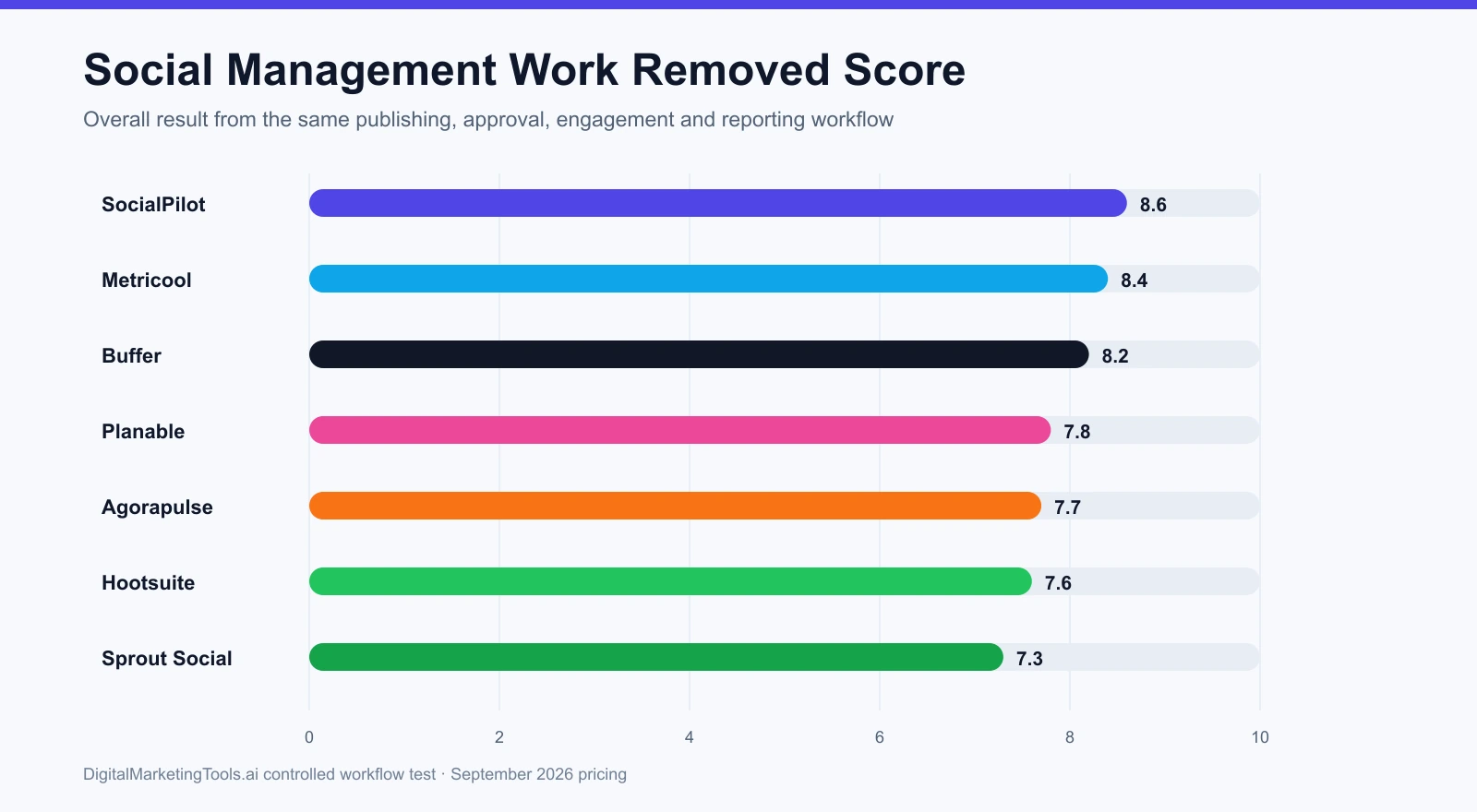
We ranked the platforms using a Social Management Work Removed Score rather than simply giving points to whichever product had the most features.
| Factor | Weight |
| Publishing workflow | 20% |
| Collaboration and approvals | 15% |
| Engagement / inbox | 15% |
| Analytics and reporting | 15% |
| Scaling cost | 15% |
| Platform coverage and reliability | 10% |
| Setup and usability | 5% |
| AI usefulness | 5% |
The directional idea is:
Work Removed ≈ recurring manual work eliminated − review burden − setup burden − external handoffs
A platform can advertise hundreds of features and still force its users into Slack for approvals, native apps for engagement and spreadsheets for reporting. In practice, a smaller product with a cleaner workflow may remove more work.
What Our Testing Found
| Tool | Setup | Publish + adapt campaign | Approval actions | Engagement coverage | Report | AI copy needing substantive edits | External handoffs | Score |
| SocialPilot | 18 min | 26 min | 4 | 75% | 8 min | 36% | 2 | 8.6 |
| Metricool | 20 min | 29 min | 5 | 70% | 6 min | 34% | 2 | 8.4 |
| Buffer | 12 min | 23 min | 5 | 55% | 13 min | 31% | 3 | 8.2 |
| Planable | 16 min | 27 min | 3 | 45% | 11 min | 42% | 3 | 7.8 |
| Agorapulse | 23 min | 30 min | 4 | 90% | 7 min | 40% | 1 | 7.7 |
| Hootsuite | 27 min | 28 min | 4 | 85% | 7 min | 28% | 1 | 7.6 |
| Sprout Social | 31 min | 27 min | 4 | 95% | 6 min | 30% | 1 | 7.3 |
Table 2: Results from our controlled social media management workflow.
No platform dominated every task. Buffer was fastest to set up and publish with, Planable required the fewest approval actions, Metricool and Sprout Social tied for the fastest reporting result, while Agorapulse, Hootsuite and Sprout kept substantially more engagement inside one workspace.
SocialPilot came first because it remained competitive across almost every stage while avoiding the much steeper scaling costs of the premium per-seat platforms.
1. SocialPilot: Best Overall for Growing Teams and Agencies

Best for: Growing teams, agencies and businesses managing several social accounts
Starting price: $17/month annually
Free access: 14-day trial
Work Removed Score: 8.6/10
External handoffs: 2
SocialPilot finished first because it gave us the strongest overall balance rather than winning one isolated benchmark. We completed the one-week publishing workflow in 26 minutes, generated the stakeholder report in eight minutes and handled around 75% of our representative engagement sample centrally.
Its current Essentials plan starts at $17 per month on annual billing and supports five social accounts and one user. Standard moves to ten accounts and three users while adding bulk scheduling, an inbox, analytics and collaboration. Premium expands to 20 accounts and six users with client approvals, advanced analytics and white-label reporting.
Where SocialPilot Saved Us Work
SocialPilot’s strongest quality was consistency. Publishing, calendar management, collaboration, engagement and reporting could remain relatively connected, resulting in only two external handoffs. It was not the fastest platform for setup, reporting or approvals individually, but it performed well enough across all of them that we did not have to sacrifice an entire part of the workflow to keep costs down.
The economics also held up much better as we added users and accounts. That became particularly important in our agency scenario, where premium per-seat alternatives became several times more expensive.
Where SocialPilot Fell Short
The $17 starting price is not the price an agency should automatically budget around. Client approvals, larger account allowances and white-label reporting sit on higher tiers, so the relevant cost is always the plan containing the workflow you actually need.
Its 75% engagement coverage also trailed Agorapulse, Hootsuite and Sprout Social. Teams spending most of the day handling inbound conversations may get more operational value from one of those platforms despite paying more.
Choose if: you manage several accounts, expect to add teammates or clients and want broad social management without moving immediately into premium per-seat pricing.
Skip if: you manage only a handful of profiles or require enterprise-level social customer care.
Bottom line: SocialPilot gave us the strongest overall balance of work removed and scaling cost.
2. Metricool: Best Value for Multi-Brand Reporting
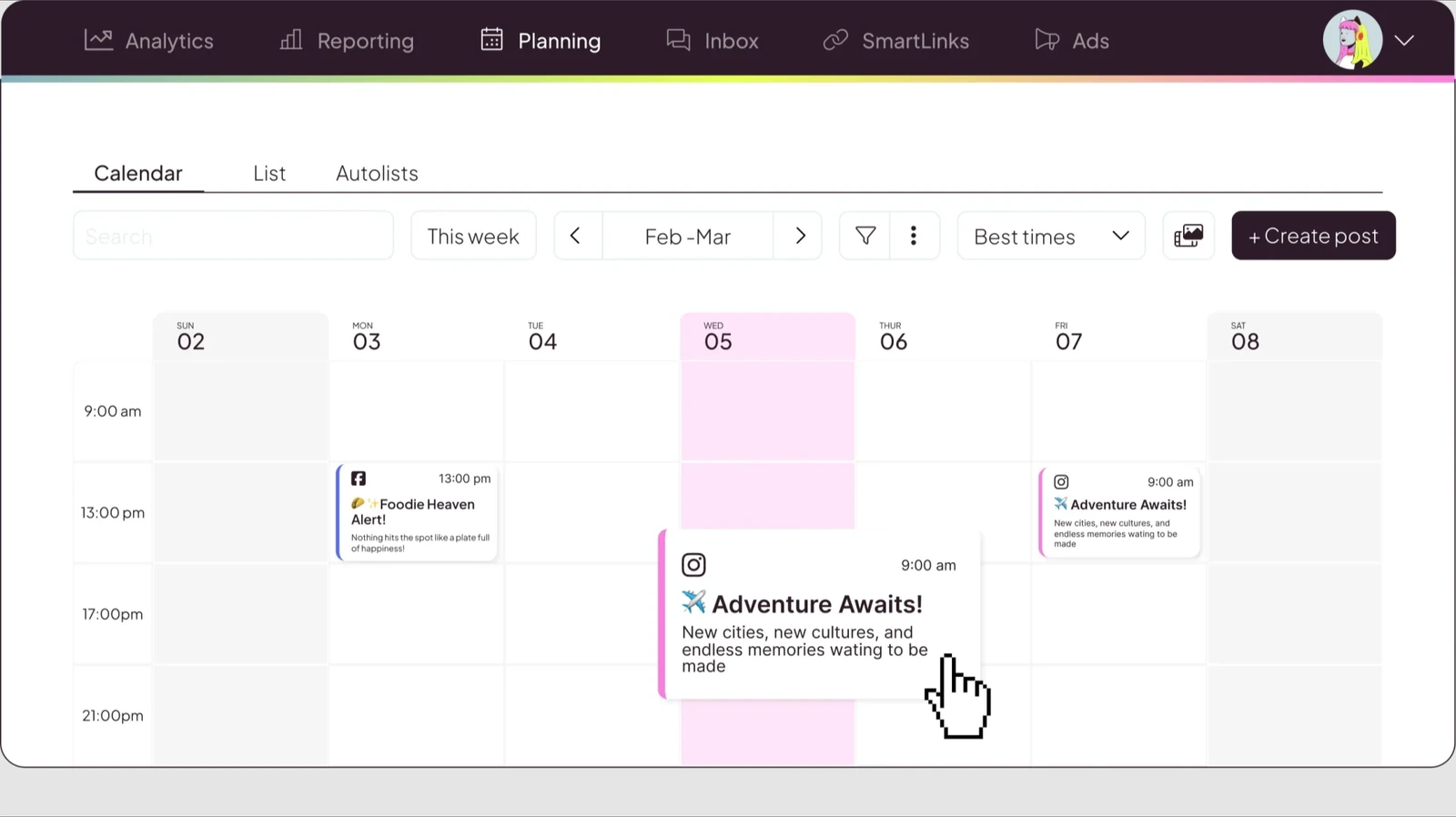
Best for: Marketers managing several brands with regular analytics and reporting requirements
Starting price: $20/month annually
Free plan: Yes
Work Removed Score: 8.4/10
External handoffs: 2
Metricool finished only 0.2 points behind SocialPilot and produced one of the clearest wins in our benchmark: reporting.
Our stakeholder report took six minutes, tying Sprout Social for the fastest result. Metricool also handled roughly 70% of our engagement sample centrally and required only two external handoffs.
Its current Free plan supports one brand and up to 20 scheduled posts per month. Starter begins at $20 per month in the current annual USD configuration and expands into more brands, unlimited publishing and reporting, while Advanced starts at $53 and adds team/client management, roles, approvals, custom reporting and a Looker Studio connector.
Where Metricool Saved Us Work
Reporting was Metricool’s clearest advantage. A scheduler that saves ten minutes during publishing but forces a marketer to rebuild client reports manually every month has only solved part of the operating problem.
That advantage becomes increasingly valuable when the same reporting process has to be repeated across several brands. Metricool’s multi-brand pricing also remained substantially more favourable in our scaling scenarios than the premium per-seat products.
Where Metricool Fell Short
Approval required five actions, compared with three for Planable and four for most of the wider suites. The collaboration functions needed for our full team scenario also require Advanced rather than the entry-level Starter plan.
Choose if: several brands, analytics and recurring reporting create a large share of your workload.
Skip if: advanced approval or customer-care workflows matter more than reporting efficiency.
Bottom line: Metricool was our strongest multi-brand value and reporting option.
3. Buffer: Best for Simple Social Media Publishing
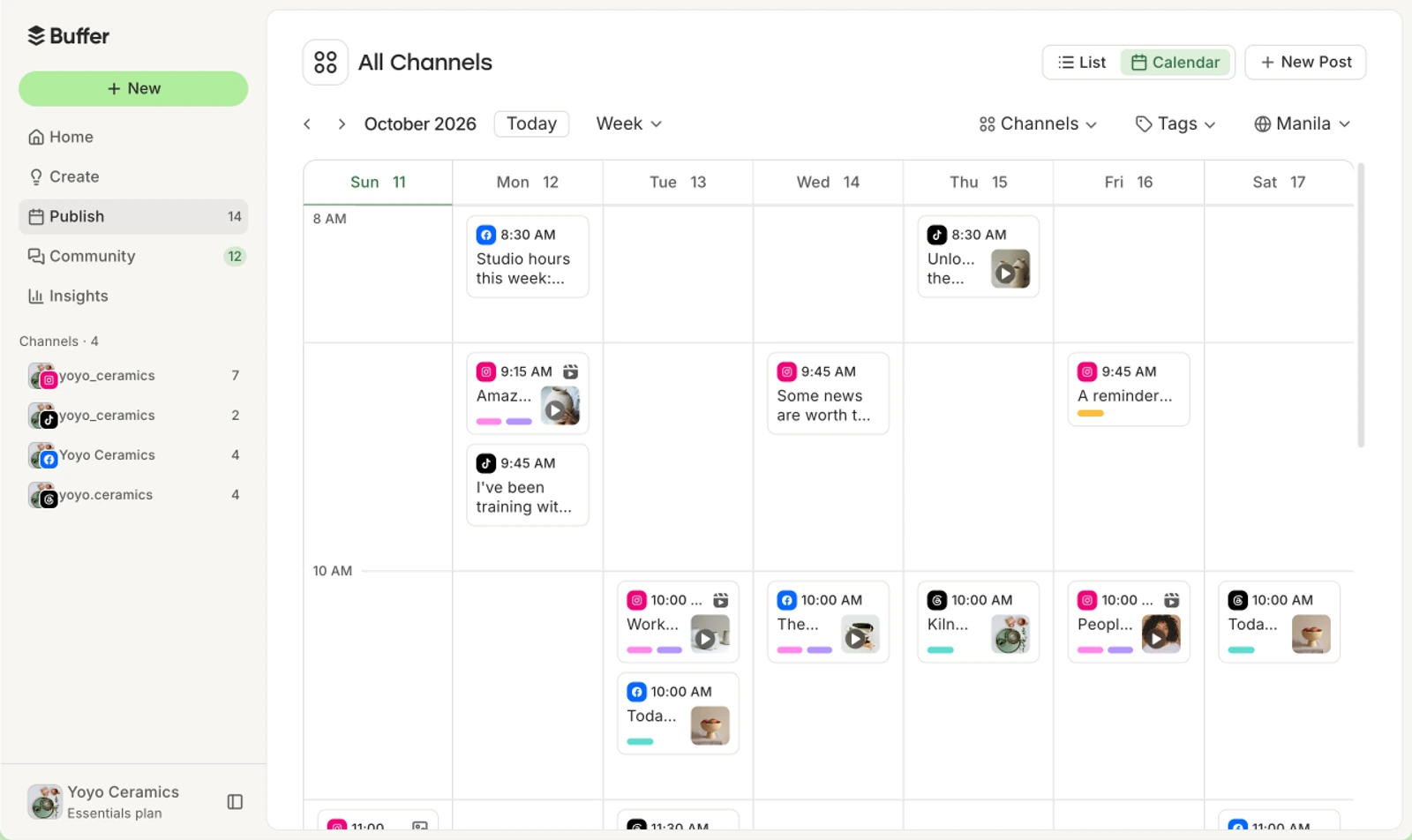
Best for: Solo marketers, creators and smaller businesses
Starting price: $5/channel/month annually
Free plan: Up to three channels
Work Removed Score: 8.2/10
External handoffs: 3
Buffer was the fastest product in two of the most visible parts of our benchmark. Setup took 12 minutes, while preparing and adapting the week’s campaign took 23 minutes.
Its pricing is also straightforward. Buffer’s Free plan currently supports up to three channels with ten scheduled posts per channel, while Essentials costs $5 per channel per month on annual billing. Team costs $10 per channel and adds unlimited team members, access levels and approval workflows.
Where Buffer Saved Us Work
Buffer’s advantage is simplicity. If the core problem is organising and publishing content across a manageable number of channels, a more complicated enterprise platform can introduce more software than the workflow actually needs.
Its AI-generated copy also performed relatively well, with 31% requiring substantive editing. Only Hootsuite and Sprout Social performed better on that measure.
Where Buffer Fell Short
The gaps became more obvious after publishing. Buffer handled about 55% of our engagement sample centrally and required three external handoffs. Reporting took 13 minutes, more than twice as long as Metricool and Sprout Social for the same task.
Per-channel pricing can also change the economics quickly. Four channels are inexpensive; 30 channels spread across several clients create a very different calculation.
Choose if: straightforward multi-platform publishing is the main problem you want software to solve.
Skip if: engagement, multi-brand reporting, listening or complex client workflows dominate your workload.
Bottom line: Buffer is one of the easiest products here to recommend when you do not need an enterprise social suite.
4. Planable: Best for Content Approval and Collaboration
Best for: Teams and agencies where approvals are the bottleneck
Starting price: $39/workspace/month monthly or $390/year
Free access: First 50 posts
Work Removed Score: 7.8/10
External handoffs: 3
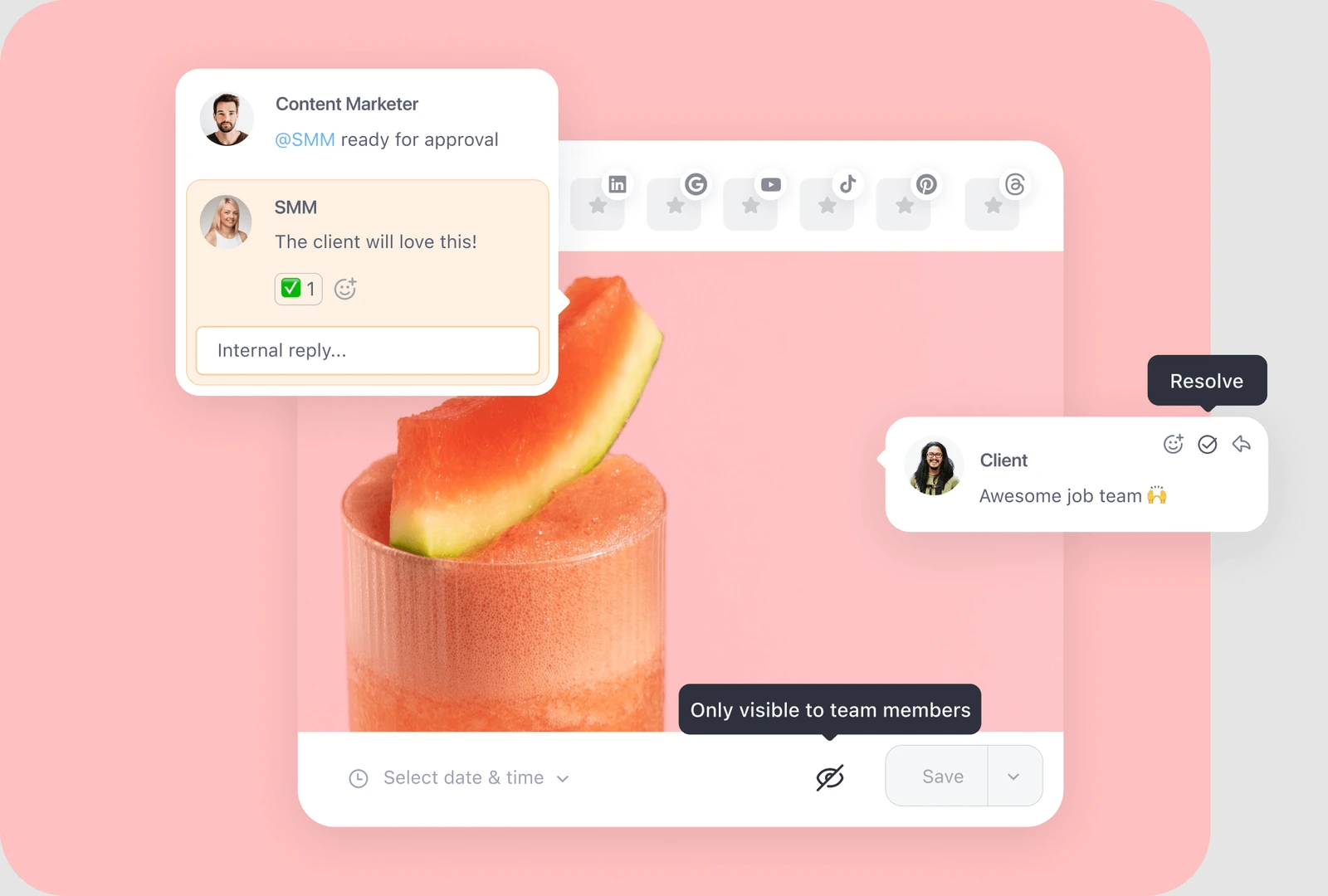
Planable produced the strongest approval result in our test. Moving a post from submission through feedback and revision to final approval required only three actions, the fewest of all seven products.
Its free access currently covers the first 50 posts with no time limit. Basic costs $39 per workspace monthly or $390 annually, while Pro costs $59 monthly or $590 annually. Analytics, Social Inbox and Social Listening can be added separately.
Where Planable Saved Us Work
Approval is easy to underestimate until a post starts moving between a writer, social manager, brand owner and client. Without a dedicated workflow, feedback often becomes scattered between email, Slack, documents and the scheduler.
Planable’s workspace model keeps much more of that discussion attached to the content, which is why its three-action approval result mattered more than shaving another minute from publishing.
Where Planable Fell Short
Central engagement coverage reached only 45%, the lowest result in our benchmark, and the full workflow produced three external handoffs. The modular pricing also means the effective cost increases once Analytics, Social Inbox or Listening are required.
Choose if: approval and stakeholder feedback are the recurring problems consuming your team’s time.
Skip if: deep inbox management, listening or broad engagement coverage matter more than content review.
Bottom line: Planable was the clear approval specialist, even though the wider workflow was less complete.
5. Agorapulse: Best for Social Inbox and Engagement

Best for: Teams handling substantial comments, messages and moderation
Starting price: $79/user/month annually
Free trial: 30 days
Work Removed Score: 7.7/10
External handoffs: 1
Agorapulse becomes much more compelling when social media management is treated as an engagement problem rather than merely a publishing problem.
Agorapulse kept approximately 90% of our interaction sample inside its central workflow, second only to Sprout Social, and required just one external handoff. Its Standard plan currently costs $79 per user monthly on annual billing and includes ten social profiles, unlimited scheduled posts, a unified inbox and reporting. Professional adds team workflow and assignments, while Advanced expands moderation and reporting.
A unified inbox helps teams manage existing conversations, but understanding what people are saying outside your owned channels requires a different capability. Our social listening tools comparison explores how to evaluate monitoring coverage rather than relying on advertised platform features.
Where Agorapulse Saved Us Work
The unified inbox was its strongest advantage. For a team receiving significant volumes of comments, DMs and questions, repeatedly jumping between native networks can consume much more time than publishing the original content.
Our stakeholder report also took just seven minutes, giving Agorapulse a strong combination of engagement and reporting capability.
Where Agorapulse Fell Short
Cost increases quickly because the platform uses per-user pricing. The included ten profiles are shared across those users, with additional social profiles sold separately.
Its 30-minute publishing result was also the slowest in our benchmark, reinforcing that its best use case is engagement-heavy social operations rather than publishing speed.
Choose if: community management, DMs and moderation consume a significant part of the working week.
Skip if: you mainly schedule low-volume content and rarely manage inbound conversations.
Bottom line: Agorapulse makes the most sense when social management means managing conversations, not just a calendar.
6. Hootsuite: Best Broad All-in-One Social Management Platform
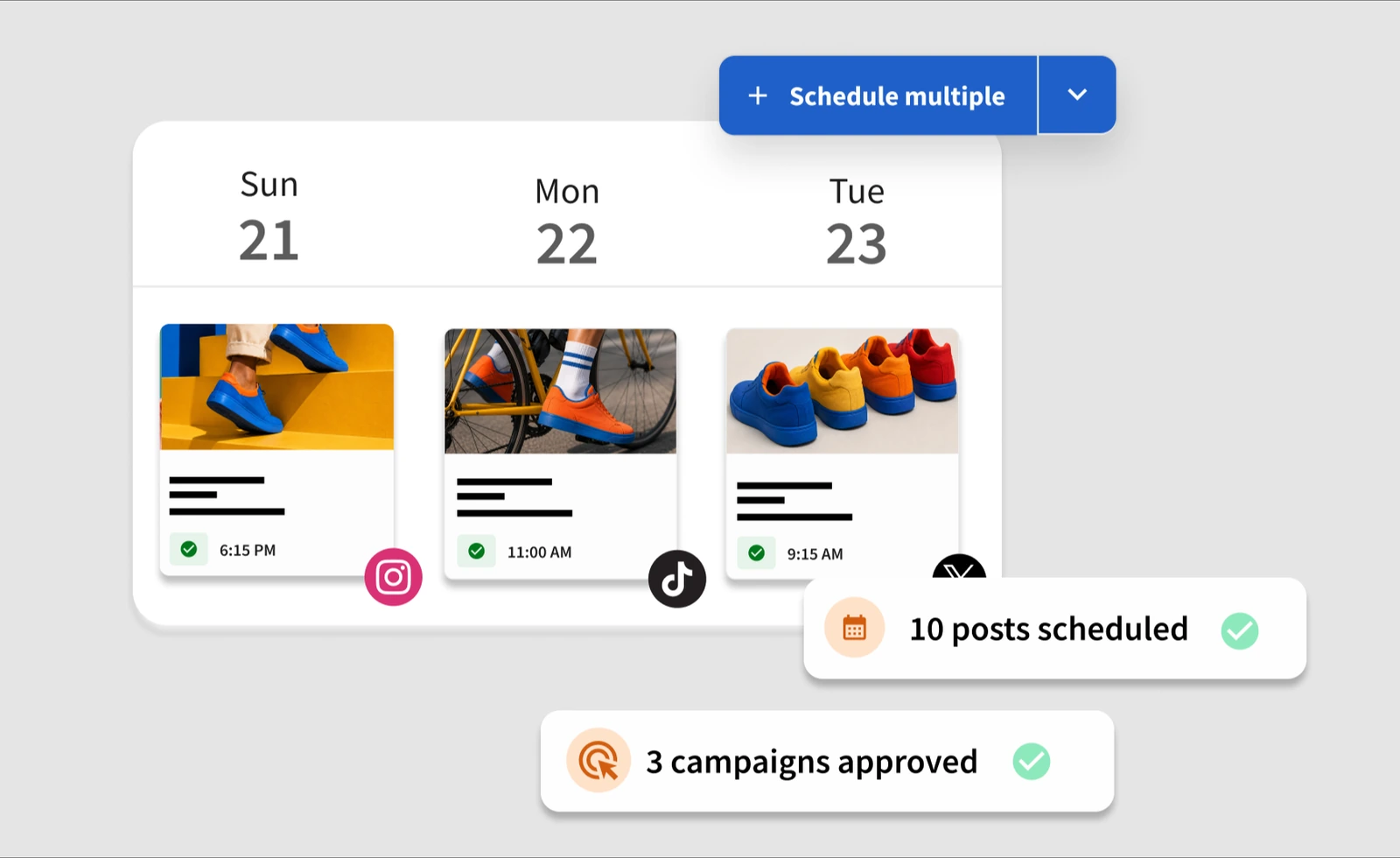
Best for: Teams wanting publishing, engagement, monitoring, reporting and AI in one platform
Starting price: From $99/user/month
Free trial: 14 days
Work Removed Score: 7.6/10
External handoffs: 1
Hootsuite remains one of the category benchmarks because it tries to cover substantially more of the social workflow than a lightweight scheduler.
In our benchmark, Hootsuite kept about 85% of engagement inside the platform, required one external handoff and generated the stakeholder report in seven minutes. Its AI-generated copy also required the least rewriting of any product we tested, with a substantive-edit rate of 28%.
Hootsuite’s Standard plan currently starts at $99 and manages up to ten social accounts, while Professional expands into unlimited accounts and deeper automation and reporting. Advanced adds structured approval and collaboration workflows.
Where Hootsuite Saved Us Work
Coverage was the strongest argument. Publishing, engagement, monitoring, reporting and AI-assisted work can live closer together than they can in many lower-cost schedulers.
The single external handoff in our test supports that positioning. Hootsuite was not simply offering more menu items; it genuinely reduced how often we needed to leave the environment.
Where Hootsuite Fell Short
The trade-off is price. A per-user model becomes increasingly expensive as several people require access, and the approval workflow needed for our team scenario sits on Advanced rather than Standard.
That makes Hootsuite much harder to justify when the real requirement is simply scheduling and basic reporting.
Choose if: centralisation, monitoring and a broader social workflow are valuable enough to justify premium pricing.
Skip if: your needs are mostly publishing with light analytics.
Bottom line: Hootsuite provides genuine workflow consolidation, but you need to use enough of that breadth to justify paying for it.
7. Sprout Social: Best Premium Platform for Large Social Teams
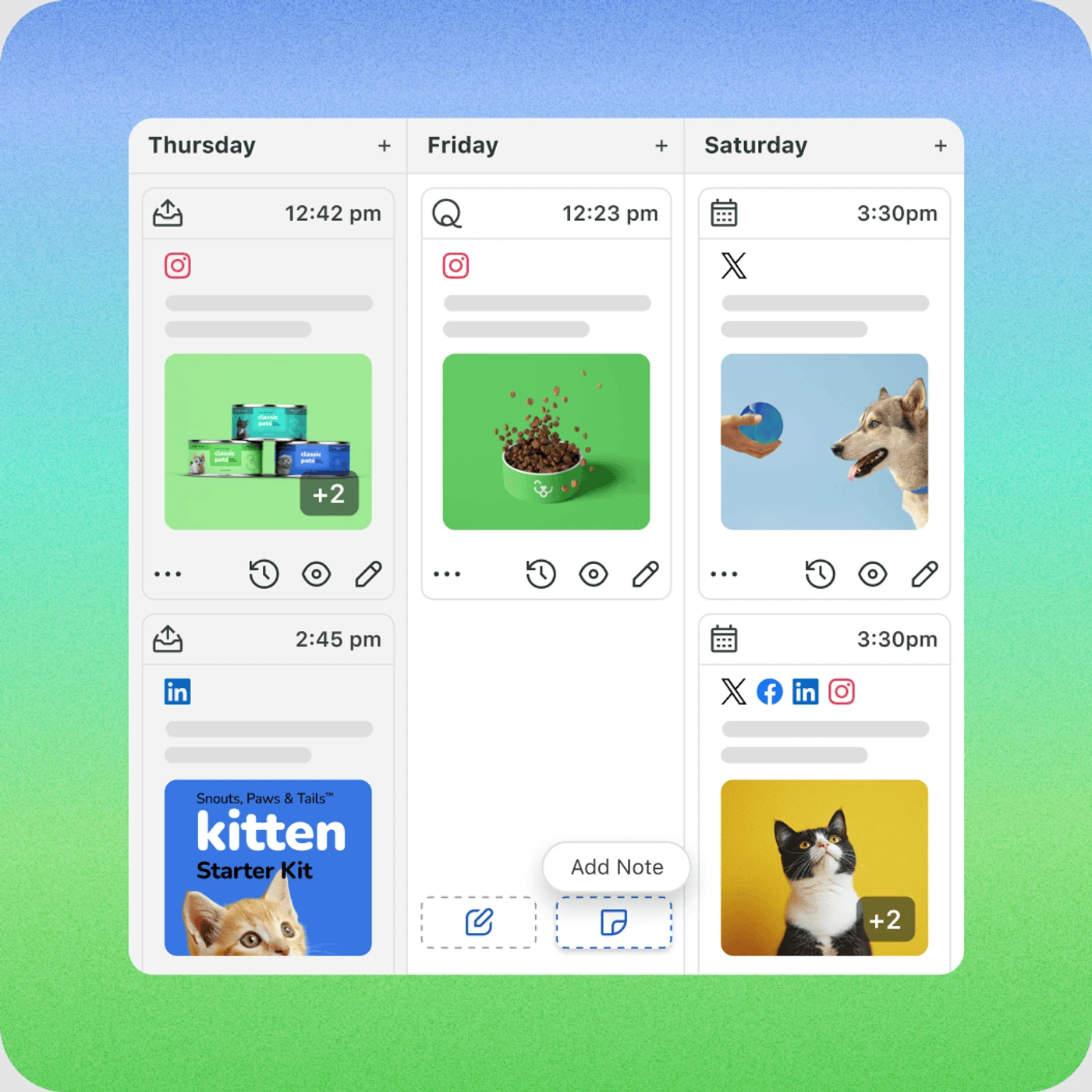
Best for: Larger marketing, social customer-care and intelligence teams
Starting price: $199/seat/month for Standard
Free trial: 30 days
Work Removed Score: 7.3/10
External handoffs: 1
Sprout Social produced some of the strongest individual operational results in our benchmark but finished seventh because its per-seat pricing materially affected the value side of the score.
Sprout kept 95% of our engagement sample centrally, the best result of all seven platforms, and tied Metricool for the fastest stakeholder report at six minutes. The workflow required only one external handoff.
Its current public Standard plan starts at $199 per seat per month and includes five social profiles, a consolidated inbox, collaboration tools, keyword/location monitoring and review management. Professional costs $299 per seat and adds unlimited profiles and deeper insights, while Advanced is $399 per seat with more sophisticated customer-care and workflow functionality.
Where Sprout Social Saved Us Work
Engagement was the standout result. Keeping 95% of our representative interactions inside the same workspace can eliminate substantial native-platform switching for organisations processing high volumes of social conversations.
Its six-minute reporting result also shows why judging Sprout only on publishing speed would miss much of its value.
Where Sprout Social Fell Short
The limitation is economics rather than basic capability. A Standard seat costs $199 per month, and a modest multi-person team can quickly move into four-figure monthly spend on higher tiers.
That does not make Sprout inherently overpriced. It means the organisation needs enough customer-care, analytics and social-intelligence work to justify what it is paying to consolidate.
Choose if: social is a substantial customer-care, intelligence and reporting operation.
Skip if: your workflow mainly consists of creating and scheduling posts for a few profiles.
Bottom line: Sprout delivered the best central engagement result, but smaller teams pay heavily for that depth.
The Pricing Trap: What Happens When Your Team Grows?
Starting prices turned out to be one of the least useful numbers in this category. To understand the actual economics, we modelled three operating scenarios and selected the lowest public plan that could reasonably support each workflow.
| Scenario | Users | Social profiles | Brands / clients | Additional requirement |
| Solo marketer | 1 | 4 | 1 | Publishing + inbox + reporting |
| Small team | 3 | 10 | 2 | Internal approval |
| Agency | 5 | 30 | 5 | Client approval + reusable reporting |
Different vendors charge for different units. Buffer scales primarily by channel, Planable by workspace, Metricool by brands and plan capacity, while Agorapulse, Hootsuite and Sprout rely much more heavily on users or seats. SocialPilot bundles accounts and users into its plan tiers.
What the Tools Cost at Solo, Team and Agency Scale
| Tool | Solo marketer | Small team | Agency |
| SocialPilot | $17/mo · $204/yr | $34/mo · $408/yr | $125/mo · $1,500/yr |
| Metricool | $20/mo · $240/yr | $53/mo · $636/yr | $53/mo · $636/yr |
| Buffer | $20/mo · $240/yr | $100/mo · $1,200/yr | ≈$163/mo · $1,950/yr |
| Planable | ≈$52/mo · $620/yr | ≈$137/mo · $1,640/yr | ≈$342/mo · $4,100/yr |
| Agorapulse | $79/mo · $948/yr | $357/mo · $4,284/yr | $795/mo · $9,540/yr |
| Hootsuite | $99/mo · $1,188/yr | $747/mo · $8,964/yr | $1,245/mo · $14,940/yr |
| Sprout Social | $199/mo · $2,388/yr | $897/mo · $10,764/yr | $1,495/mo · $17,940/yr |
Table 3: Estimated costs at three operating scales using public September 2026 pricing and the configurations required by our test.
These are configuration estimates, not invoices. Taxes, currencies, promotions, add-ons and negotiated enterprise contracts can change the checkout total.
The pricing differences become substantial at agency scale. Our model ranged from roughly $636 per year for Metricool and $1,500 for SocialPilot to almost $15,000 for Hootsuite and $17,940 for Sprout Social.
Those tools do not provide identical functionality, so the cheapest option does not automatically win. What the table does reveal is how much additional work the premium platforms need to remove before the price difference becomes economical.
Scheduling Is Usually the Easy Part
Publishing performance was relatively close across the seven platforms. Buffer completed our campaign in 23 minutes, while even the slowest result, Agorapulse, took 30 minutes.
The harder differences appeared around the post: approvals, comments and messages, client coordination, reporting and switching between applications. That is why publishing represents only 20% of the Work Removed Score.
Saving five minutes on scheduling has limited value if the team then spends hours every week switching between inboxes or rebuilding stakeholder reports.
Count Workflow Handoffs, Not Just Features
A supposed all-in-one workflow can still look like:
Draft → Canva → Slack approval → scheduler → native apps → spreadsheet report
We counted a handoff whenever one distinct stage had to leave the management platform and move into another application or native social network. Repeated switching within the same stage counted once.
| Tool | External handoffs | What forced us outside |
| SocialPilot | 2 | Advanced asset production; native format/engagement check |
| Metricool | 2 | Advanced asset production; unsupported native engagement action |
| Buffer | 3 | Asset production; deeper reporting; native engagement |
| Planable | 3 | Asset production; listening; selected inbox actions |
| Agorapulse | 1 | Complex visual asset production |
| Hootsuite | 1 | Native TikTok audio/format check |
| Sprout Social | 1 | Native TikTok audio/format check |
Fewer handoffs do not automatically mean a better product. Canva may still be a better place to produce an advanced visual than any built-in editor. What this metric exposes is whether an “all-in-one” claim translates into meaningfully less operational switching.
Do You Need AI in a Social Media Management Tool?
Simply having an AI caption generator did not earn many points in our ranking. We wanted to know whether the AI actually reduced editing compared with using a separate general-purpose assistant.
Every platform received the same brief:
Promote a B2B webinar about SEO reporting. Create suitable versions for LinkedIn, Facebook, Instagram and TikTok.
We then estimated the share of generated copy that required a substantive rewrite, rather than a minor spelling or punctuation correction.
| Tool | AI copy requiring substantive edits |
| Hootsuite | 28% |
| Sprout Social | 30% |
| Buffer | 31% |
| Metricool | 34% |
| SocialPilot | 36% |
| Agorapulse | 40% |
| Planable | 42% |
No tool gave us four completely publish-ready posts without human changes.
This is what we call AI Review Debt: the work created when AI output appears finished before it is actually ready to publish. Generating four captions in seconds is less impressive if the marketer then spends another 15 minutes fixing tone, context and platform fit.
When Native Social Platforms Are Still Better
Centralisation saves time, but third-party social management software does not completely replace Instagram, TikTok, LinkedIn, Facebook or other native platforms. New formats and platform-specific functionality can appear natively first, and certain editing, audio, community-management and analytics features still work better in the original network.
We saw this even among the most comprehensive products. Hootsuite and Sprout each required only one external handoff, but that handoff was still necessary for a native TikTok audio and format check.
The goal should therefore not be zero native-platform use at any cost. The useful question is whether centralising the recurring workflow saves more work than the occasional native action creates.
For a business posting twice a week to one or two channels, the answer may be that a paid social media management platform is unnecessary.
Third-party scheduling tools also depend on platform APIs, which can restrict certain publishing formats, engagement actions and integrations. Our guide to social media scheduling API restrictions covers the limitations worth checking before committing to a platform.
Do You Actually Need a Social Media Management Tool?
The right product depends on where the bottleneck sits.
| Situation | What we’d consider |
| One brand, 1–2 channels, low volume | Native scheduling may be enough |
| Solo marketer across several channels | Buffer |
| Small team needing approvals | Planable or SocialPilot |
| Several brands with regular reporting | Metricool |
| Agency managing multiple clients | SocialPilot or Planable |
| High comment and DM volume | Agorapulse |
| Broad listening + publishing + reporting | Hootsuite |
| Enterprise customer-care operation | Sprout Social |
If approval is already efficient, paying substantially more for sophisticated approval workflows adds little value. If the team loses hours every week jumping between social inboxes, saving another three minutes during scheduling is equally unlikely to solve the real problem.
Start with the recurring work, then choose the software.
Where Digimetrics Fits in the Social Workflow
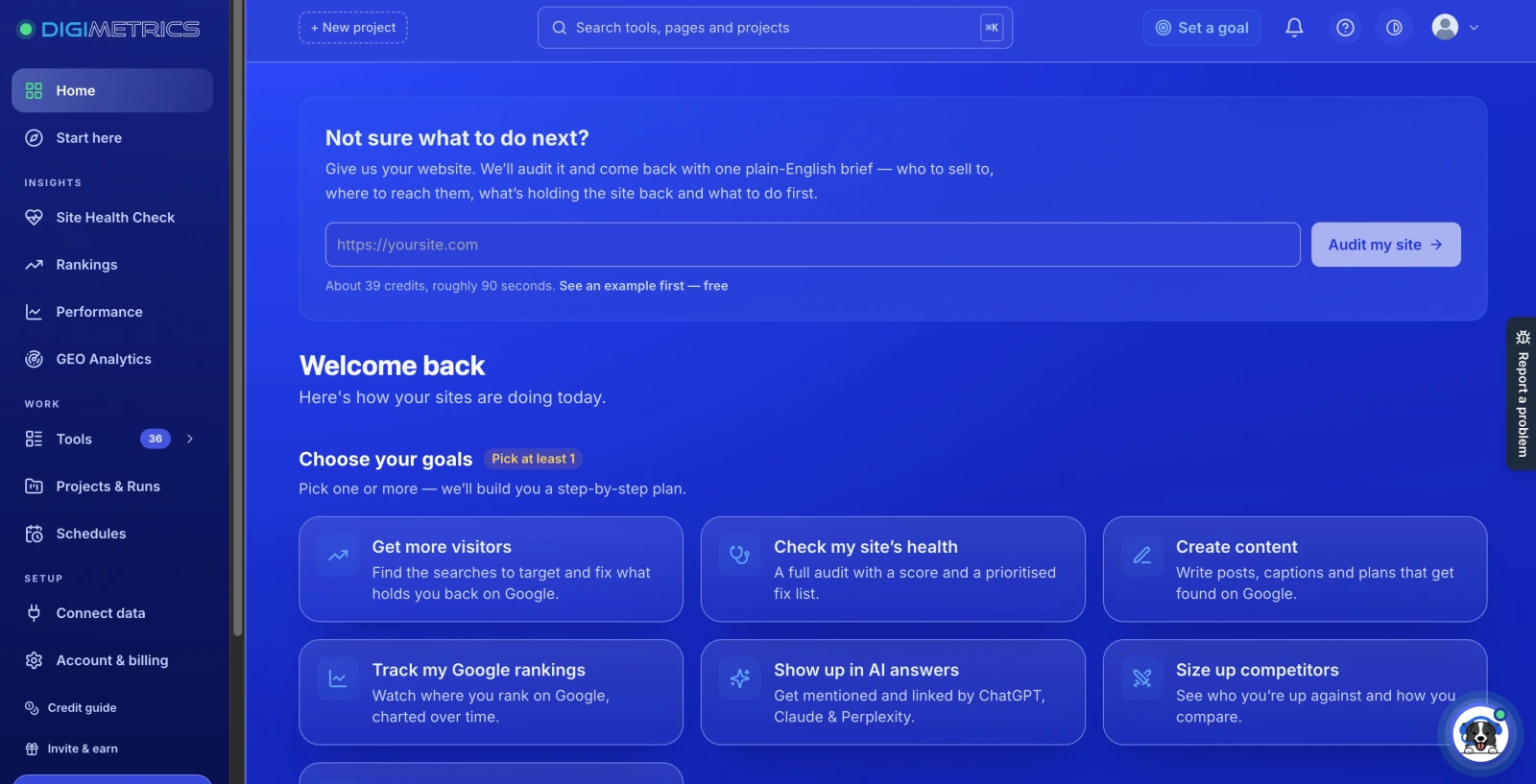
Disclosure: Digimetrics is built by our team.
We did not rank Digimetrics among these seven platforms because it currently serves a different part of the workflow. The product includes tools such as a Caption Generator for channel-specific social copy, while its wider marketing workspace is designed around research, content, SEO and strategy rather than replacing a dedicated publishing calendar and social inbox.
Its role is therefore better represented as:
Audit and strategy → content creation → social media management → reporting and optimisation
Digimetrics can contribute upstream to strategy and content production, while the seven products ranked above own the recurring publishing, approval and engagement layer.
Final Verdict: Buy the Workflow, Not the Feature List
After running the same workflow through all seven platforms, SocialPilot ranked first at 8.6/10, followed closely by Metricool at 8.4/10 and Buffer at 8.2/10.
SocialPilot delivered the strongest overall balance for growing teams and agencies. Metricool was particularly strong for reporting and multi-brand value, while Buffer was the fastest and simplest publishing option. Planable clearly won the approval test, Agorapulse excelled at engagement, and Hootsuite and Sprout demonstrated why larger organisations pay more for deeper inbox, reporting and customer-care coverage.
Pricing changed the picture considerably. The premium products kept more of the workflow inside one environment, but their costs increased rapidly when we added users. At agency scale, our model ranged from roughly $636 per year for Metricool to $17,940 for Sprout Social.
That is why we would not choose the best social media management tool by feature count alone. Look at which recurring work disappears, how often the team still has to leave the platform and what the bill looks like at the next stage of growth.
For our test scenario, SocialPilot offered the best overall balance of those three things.
Frequently Asked Questions
What Is the Best Social Media Management Tool in 2026?
SocialPilot ranked first in our test with a Work Removed Score of 8.6/10. It did not win every individual benchmark, but it offered the strongest combination of publishing, collaboration, engagement, reporting and scaling economics.
Metricool followed at 8.4/10, with Buffer at 8.2/10.
What Is the Best Free Social Media Management Tool?
Buffer and Metricool both currently offer permanent free plans. Buffer’s Free plan supports up to three channels, while Metricool’s Free plan supports one brand and up to 20 scheduled posts each month.
Buffer makes more sense when simple publishing is the priority. Metricool becomes more attractive when analytics and reporting matter alongside scheduling.
What Is the Best Social Media Management Tool for Agencies?
SocialPilot was our strongest overall agency recommendation. Its Premium plan currently supports 20 accounts and six users before paid account additions, alongside client approval and white-label reporting.
Planable deserves particular consideration when the agency’s main problem is client review and approval rather than broad social engagement.
Is Hootsuite Still Worth It in 2026?
For the right organisation, yes. Hootsuite handled approximately 85% of our engagement sample centrally, required one external handoff and completed our reporting task in seven minutes.
Its premium pricing becomes harder to justify for small teams that mainly need publishing, but broader social operations may get enough value from its inbox, monitoring, analytics and workflow consolidation.
Is Sprout Social Worth the Price?
Sprout delivered the highest central engagement coverage in our benchmark at 95% and tied for the fastest stakeholder report.
Its current Standard plan costs $199 per seat monthly, however, while Professional costs $299 and Advanced $399. That makes it much easier to justify when social media is a meaningful customer-care, analytics and intelligence operation rather than simply a publishing calendar.
Is Buffer Better Than Metricool?
It depends on the job. Buffer was faster to set up and publish with: 12 minutes for setup and 23 minutes for our campaign, compared with Metricool’s 20- and 29-minute results.
Metricool was substantially faster for reporting, finishing the same stakeholder report in six minutes compared with Buffer’s 13, and it handled a larger share of our engagement sample centrally.
Choose Buffer for publishing simplicity. Choose Metricool when multi-brand reporting and analytics matter more.
What Should I Look for in a Social Media Management Tool?
Identify where the team repeatedly loses time: publishing, approval, client coordination, engagement, reporting or application switching. Then calculate what the platform will cost at the number of users, profiles and brands you expect to manage 12 months from now, rather than comparing only the advertised starting price.
Disclosure: digitalmarketingtools.ai is sponsored by Digimetrics.ai. Sponsored Highlights are clearly labelled advertising. Our reviews, comparisons and guides are written to be useful and fair regardless of who sponsors the site. Read the full disclosure.