
Keeping AI-Generated Ads On-Brand and Compliant: A Practical Workflow for Brand Voice and Ad Compliance
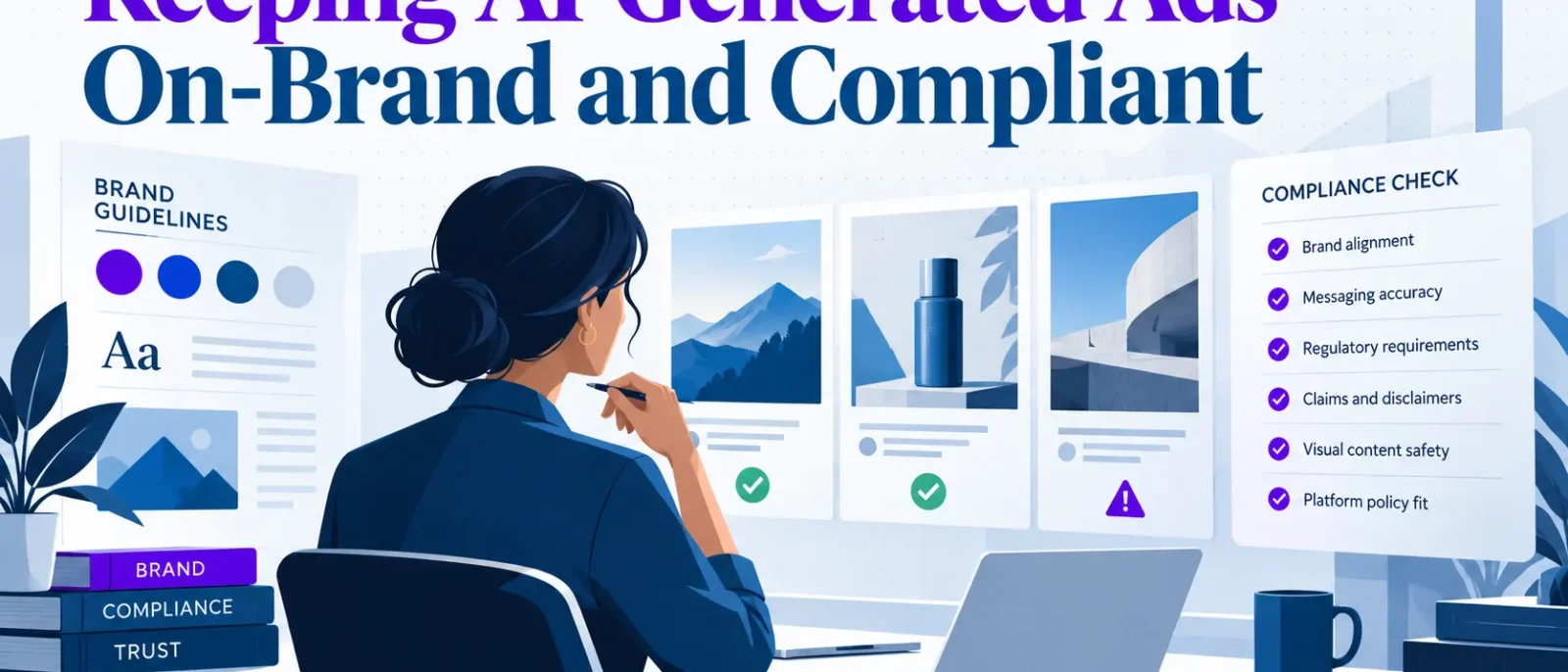
Keeping AI ad copy on-brand and compliant means encoding the brand voice in a versioned profile that every tool reads, then passing each ad through five checks before launch: voice, claims, rights, audience fit and named human sign-off. That is the short answer. The rest of this article explains how to build each layer and why process controls work where prompt changes do not.
AI can draft, resize and multiply ad copy in seconds. That speed is the problem. A study conducted at the end of 2025 found that 98% of marketers review and revise AI-generated content before publishing. The first draft is rarely ready to run.
Most teams assume a good prompt is enough. It is not. Prompt tweaks fix one output at a time, and the next brief drifts again. Ad copy stays on-brand and compliant only when the brand voice is a versioned profile that every tool reads, and when every ad passes a named checkpoint before launch. A PDF style guide or a generic prompt leaves the business exposed on copyright and impersonation risk. The same consistent brand voice can feed GTM AI workflows, so outreach, blog posts, social media and campaigns sound like one team and one company. Marketing sales operations teams can apply the same profile across lead processing deal and inbound lead processing steps, while content creation teams apply it to every blog and campaign draft.
Key Takeaways
- Encode brand voice, do not just request it. A versioned voice profile keeps AI ad copy on-brand. Generic prompts drift.
- Run every ad through the Brand-Safe Ad Gate. Five layers (voice, claims, rights, audience fit, named sign-off) each pass or fail.
- Confirm vendor indemnity covers ad output. Guarantees often cover less than they appear, so get the scope in writing.
- Treat imagery and voiceover as rights risks. Copy review will not catch scraped training data or cloned voices.
- Assign each failure type to one named owner.
- Log which layer caught each failure. The log shows where the workflow breaks.
Table of Contents
- Building a Brand, Audience, and Writing Brief the Model Can Use
- Designing a Multi-Stage Review and Quality Assurance Workflow
- Conclusion: Making On-Brand, Compliant AI Ads a Repeatable Practice
- Frequently Asked Questions
Building a Brand, Audience, and Writing Brief the Model Can Use
An AI tool only knows what you tell it. A generic prompt produces the average of the internet, not your company, and that gap is where voice drift starts. Human review is the norm for a reason: a 2025 study reported by Content Marketing AI found that 98% of marketers review and revise AI-generated content before publishing. One brief that every tool reads before writing is the single source of truth for a consistent brand voice across every team, whether the output is for marketing, sales operations or content creation. A shared brief also keeps unified data strategy and consistency rules aligned across marketing sales workflows.
Brand identity and voice: what to document
Write the voice as rules a model can apply, not adjectives a person can admire. Record:
- Positioning: one sentence on what the brand does and for whom.
- Tone rules: three to five traits, each with a “we are / we are not” pair (for example, “confident, not boastful”).
- Vocabulary: words to use, words to avoid, and any regulated or banned claims.
- Two approved and two rejected examples of real copy, each labelled with the reason.
Give each voice profile a version number and a last-updated date, so every tool can confirm it has the current version.
Example entry:
Voice profile v2.1 (updated 2026-03-02)
Positioning: A payroll software company for small firms with 5 to 50 staff.
Tone: Clear, not salesy. Practical, not technical. Calm, not urgent.
Use: “Run payroll in under an hour.” Avoid: “Revolutionary,” “guaranteed savings.”
Approved example: “Pay your team on time, every time.” (Reason: states the benefit plainly.)
Rejected example: “Our best-in-class platform will transform your finances!” (Reason: hype, no proof.)
Audience and offer briefs for ad copy
Each ad brief names the audience segment, the single offer, the channel (Meta or TikTok) and the one action wanted. Keep offer terms in the brief itself, not in the model’s memory, so a discount or eligibility rule cannot be invented in the output. Briefs for lead processing and inbound lead handling follow the same rule, with the offer and qualification criteria written out in full. Sales prospecting cockpit and inbound lead processing briefs should carry the same offer terms, so the team never works from different versions.
Turning a style guide into an AI style guide
A PDF style guide in a shared drive is not a working control. Convert it into a machine-readable profile and load it into the tools that write ads. Content Marketing AI describes AI style guides as rules built into the creation workflow, so every asset reads as if it came from one source. Where workflows copy agents and an intelligence layer draw on the same profile, the rules apply across every platform component powering the output, from the cockpit used for prospecting to the blocks of workflows that run the campaign. Tables introducing workflows and the intelligence layer tables and actions should reference the same profile version, so the GTM AI workflows stay consistent for the whole team.
The practical test: change a tone rule once, then check whether the blog drafts and the ad copy both change. If they do not, drift has already started.
Choosing the platform matters as much as the prompt. AdFactory reports that eight criteria separate brand-safe platforms from generic generators, and most general tools pass only one or two. For ad work, three matter most: whether the tool writes from a documented voice profile, whether that profile is shared across every asset type, and whether the vendor will stand behind the output legally.
Image and likeness risks in generative tools
Ad imagery carries rights exposure that copy does not. Some image generators are trained on scraped web content. According to AdFactory, their outputs can reproduce recognisable parts of copyrighted work or generate imagery that resembles real people. Before a campaign runs, ask the vendor what the training data was and whether it will indemnify you against copyright claims.
Adobe indemnifies enterprise customers against copyright claims arising from Firefly output, a commercial guarantee most tools do not offer. Read the indemnity terms directly and check the scope and date against your campaign. Where the terms are unclear, get written confirmation before launch.
Voiceovers and spokesperson clips add a second risk. The Federal Trade Commission published a consumer alert on AI voice cloning in March 2023, identifying cloned voices in impersonation fraud as an emerging threat. A short audio sample is enough to produce a convincing clone.
Comparison table: generic generator versus brand-safe platform
| Criterion | Generic generator | Brand-safe platform |
|---|---|---|
| Voice source | Generic prompt | Documented, versioned voice profile |
| Brief updates | Edited per tool | Updated once, applied everywhere |
| Image training data | Often undisclosed | Disclosed, licensed |
| Copyright indemnity | Usually absent | Stated and scoped in writing |
| Human checkpoints | Not built in | Named review stages |
Designing a Multi-Stage Review and Quality Assurance Workflow
Most teams treat AI ad review as one read-through before launch. That is not enough. 98% of marketers revise AI output, according to Content Marketing AI. Effective QA is a predictable system with named checkpoints, not a single final review, and a unified data strategy gives every checkpoint the same facts to check against. AI ad copy brand voice compliance must be enforced at every stage, which keeps messaging consistent across social media and paid channels. Teams running marketing sales operations and sales prospecting cockpit workflows across several channels need this most, because each handoff is a chance for the voice to drift. Inbound lead processing faces the same risk, so the review gate should cover those touchpoints as well. Building workflows copy agents that enforce a consistent brand voice across every touchpoint keeps the gate predictable for each new campaign.
Human-in-the-loop checkpoints for tone, facts, legal and SEO
Each checkpoint should own one failure type and have one accountable role. Work through the gate in order, and never let a later stage override an earlier one.
| Checkpoint | Failure it catches | Owning role |
|---|---|---|
| Tone | Copy that breaks the documented voice | Brand or content lead |
| Facts | Unsubstantiated claims, wrong prices or dates | Product or subject-matter owner |
| Legal | Deceptive claims, missing disclosures, rights issues | Legal or compliance reviewer |
| SEO | Keyword and landing page mismatches | SEO or performance marketer |
Splitting ownership this way stops a legal reviewer from judging voice and stops a brand lead from signing off a claim they cannot verify.
Worked example: one ad through the gate
Take an ad for a payroll tool that reads “Cut payroll time by half, guaranteed.” The voice layer passes, but the claims layer fails: “guaranteed” and “by half” need evidence on file. The facts owner has no source, so the ad returns to the marketer. Log the failure as “claims layer, unsubstantiated figure.” Rewrite it as “Run payroll in under an hour” only after the team confirms that claim. Where the workflow introducing tables and blocks of workflows is used to route such drafts, the right owner sees the failure before it reaches the next stage.
The 7-point pre-launch checklist for every AI ad
Run every AI-generated ad through this checklist before launch. Each point is a pass or fail test. The owning role can override a failed check only with a documented reason and a second sign-off from the legal or compliance reviewer. A claim clears the facts check only when a named source, dated within the current campaign period, is on file. A failure returns the ad to the owning role, and the layer that caught it is logged. Apply the same checklist to each platform’s version of the ad and to any blog post that repurposes the copy.
| # | Check | Pass criterion | Who may override |
|---|---|---|---|
| 1 | Voice matches the profile | Tone and vocabulary follow the current profile version | Brand or content lead, with a logged reason |
| 2 | Claims are substantiated | Every claim has a dated source on file | No override; the claim is rewritten or removed |
| 3 | Offer terms match the brief | Price, eligibility and dates match the brief exactly | Product owner, with the brief updated first |
| 4 | Disclosures are present | Required sponsorship or pricing disclosures appear | Legal or compliance reviewer only |
| 5 | Imagery is cleared | Training data and likeness checks are recorded | Legal or compliance reviewer only |
| 6 | Audience and channel fit | The message suits the segment and the platform’s ad rules | Performance marketer, with the platform policy cited |
| 7 | Named sign-off is recorded | A named owner has approved the final version | None; the ad does not launch without it |
Why most failures happen at handoffs
Errors rarely start in the model. They appear when work moves between tools and people. A better prompt does not stop a stale brief from reaching the ad tool, but a process control does. A brief updated in one platform but not in the ad tool produces voice drift that no single reviewer will notice. Assign one owner to each handoff and keep a single versioned brief that every stage reads from. Platform components powering GTM AI workflows should read that same brief, so consistency holds across content creation, marketing and resources the power teams rely on. Agents intelligence layer tools that read the same brief help the right cases sales prospecting and lead processing deal flows stay aligned, and the layer tables actions log every change for audit.
Conclusion: Making On-Brand, Compliant AI Ads a Repeatable Practice
Keeping AI ads on-brand and compliant is an ongoing system, not a one-off clean-up. It runs each time a brief is written, an asset is generated and a campaign goes live. The voice profile, rights checks and named human sign-off each close a gap that a generic prompt leaves open.
Most teams already review AI output. According to Content Marketing AI, 98% of marketers review and revise AI-generated content before publishing. The gap is structure. Start with a documented voice profile, version it, assign each gate to an owner and log every failure. These logs can feed sales prospecting cockpit and inbound lead processing deal flows.
Frequently Asked Questions
Do I need to review AI-generated ad copy before it runs?
Yes. A 2025 study found that 98% of marketers review and revise AI-generated content before publishing. For paid ads, treat that review as a pass or fail gate. Each ad should clear every layer (voice, claims, rights, audience fit and human sign-off) before launch.
The FTC holds advertisers responsible for the claims in their ads, even when a machine wrote the copy. Check the specific rule that governs your claim before you rely on it.
What is an AI style guide?
An AI style guide is a machine-readable version of your brand voice. It is a set of instructions the content tool reads every time it writes, not a PDF a writer has to remember. For example, it bans phrases like “best in class” and sets approved claim wording, so every draft starts from the same brief.
Content Marketing AI describes this as embedding brand rules directly into the creation workflow, which reduces drift between channels.
Can AI-generated ad images create copyright risk?
Yes. Some image generators are trained on scraped web content, and their outputs can reproduce recognizable elements from copyrighted work or resemble real people. Check where each image came from and whether the vendor indemnifies you.
Adobe indemnifies enterprise customers against copyright claims arising from Firefly output, a guarantee most tools do not offer. Read the indemnity terms closely, since many cover only narrow cases.
How do I stop AI tools from drifting off brand voice?
Stop generating from generic prompts. Drift happens when a tool writes from a loose instruction instead of a documented voice profile. Build a versioned profile with examples of approved and rejected copy, and attach it to every brief.
Confirm that every tool and team member uses the same version. A brief updated in one tool but left stale in another is a common cause of drift.
What should a pre-launch checklist for AI ads include?
Cover the five layers of the gate:
- Voice profile version: the ad uses the current, dated profile.
- Claims: every claim has a dated substantiation source on file.
- Rights: image provenance is known, indemnity coverage is confirmed, and any real person or voice shown has consent.
- Audience and channel fit: the ad meets the ad policy of the platform it runs on.
- Human sign-off: a named person approves the ad before launch.
Log each failure with the layer that caught it. That log shows which checkpoint works and where your process leaks.
How do I protect executives from voice cloning and impersonation?
Treat executive voice and likeness as protected assets. Voice cloning can work from a short audio sample, and the Federal Trade Commission published a consumer alert on AI voice cloning in March 2023.
Limit the public audio and video you publish of executives. Require verified channels for financial instructions, and confirm any request by a second route before acting. Never use a cloned executive voice in an ad without written consent and sign-off from legal.
Disclosure: digitalmarketingtools.ai is sponsored by Digimetrics.ai. Sponsored Highlights are clearly labelled advertising. Our reviews, comparisons and guides are written to be useful and fair regardless of who sponsors the site. Read the full disclosure.


