
How Are Marketing Tools Reviewed? An Inside Look at How Digital Marketing Tools Evaluate and Update Their Tool Listings
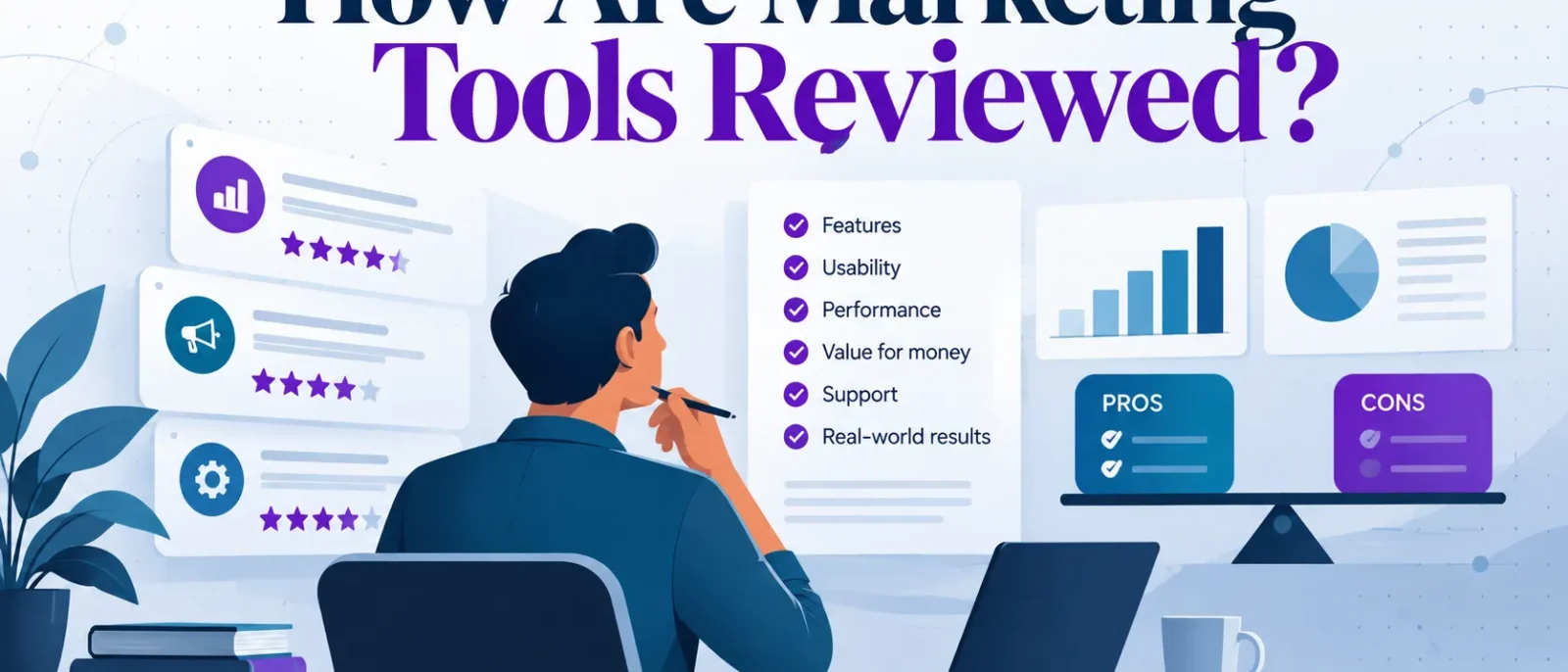
In short, a marketing tool review is only as trustworthy as the process behind it: a named testing method, stated criteria, a visible update date and clear disclosure of any paid relationship.
Marketing tool reviews are usually judged by their star ratings, but the number says little on its own. To judge a review, ask how the tool was tested, what criteria were used and when the listing was last checked. The method is what makes a review worth reading.
This article describes how tool reviews should work, what a reader should expect to see before trusting one, and how listings are kept current. A listing is only as reliable as the process behind it, so that process should be visible on the page.
Most listings look alike: stars, a price range and a “top pick” badge. Few explain how those were produced, and that gap is the problem this article addresses. The sections that follow set out one publication’s method for answering the question “how are marketing tools reviewed?” Other publications may work differently, and readers should compare methods rather than assume a shared standard.
Key Takeaways
- A rating is only as useful as its method. Check whether the listing describes hands-on testing with dates and account tiers.
- Look for named, weighted criteria. Stated weights are easier to audit than stars alone.
- Check the last-updated date. Pricing and plan tiers change often in this category.
- Disclose commercial ties. A trustworthy listing says whether affiliate or sponsored relationships affect order or only the links shown.
- Use the Listing Transparency Checklist. Score testing, criteria, freshness, monetization and corrections. Four or five passes make a listing usable for shortlisting.
- Verify before you buy. Confirm the listed US-dollar price on the vendor’s public pricing page, then run a trial and check references. A review is one input, not the decision.
Table of Contents
- What “Review” Means for a Marketing Tool Listing
- The Evaluation Pipeline: From Submission to Published Listing
- The Scoring Framework: Criteria, Weights and Thresholds
- Evidence Standards: What Counts as Proof in a Tool Review
- Editorial Independence, Conflicts of Interest and Disclosure
- Keeping Listings Current: Update Triggers and Review Cycles
- Conclusion and Summary
- Frequently Asked Questions
What “Review” Means for a Marketing Tool Listing
A review, a ranking and a listing are different things. A review is a written account of how a tool performed under test: what it does, where it falls short, and the conditions under which the findings hold. A ranking places several tools in order against a stated purpose, such as “best for small agencies.” A listing is the public record describing a tool, usually including its category, price, integrations and rating.
A listing can exist with no review behind it, and a ranking can be built from listings without anyone opening the product. When a page combines all three, the reader should ask which part was actually tested.
The difference between a review, a ranking and a listing
The practical test is whether a claim can be traced to something a person did. A review should name the account tier used, the testing dates and the workflows attempted. A ranking should state its weighting logic. A listing should carry a last-verified date. If a page shows a star rating with none of these, the number summarises something, but the reader cannot tell what.
Who the reviews are written for: buyers, practitioners and procurement teams
Three audiences read tool reviews, and each needs something different.
- Buyers, often founders or marketing leads at small firms, want to know whether a tool fits their budget and team size.
- Practitioners, such as SEO specialists or lifecycle marketers, want to know whether a feature works as the documentation says.
- Procurement teams at larger US companies need evidence they can attach to a purchase request: current US-dollar pricing, contract terms, support hours and data handling details.
A single review rarely serves all three well, which is why a transparent method matters more than a verdict.
Why review criteria matter more than star ratings
A star rating compresses many judgments into one number, and that compression hides trade-offs. A tool with five stars for reporting depth may score poorly on onboarding speed, and onboarding speed may decide the purchase for a team with no analyst. Named criteria let a reader see the trade-off and weigh it against their own priorities. The criteria are the substance; the stars are only the headline.
One position follows from this. For most buyers, the visible method matters more than the star rating. A rating tells you where a tool landed; the method tells you whether that landing point applies to your team. The obvious counterargument is that busy readers want a verdict and will not read methodology. That is true, but a verdict without method cannot be checked, and a listing that cannot be checked is harder to trust when the stakes are a annual contract.
The Scoring Framework: Criteria, Weights and Thresholds
A rating is only as useful as the criteria behind it. The method has three steps. First, the category’s key factors are chosen. Second, each factor gets a weight. Third, a minimum score is set that a tool must clear before it can be recommended. A tool with a high average can still fail. If it scores poorly on one factor a buyer cannot work around, such as a missing CRM integration, the listing says so.
Our position is that the visible method matters more than the star rating for most buyers. A score on its own tells a reader very little. The weights, thresholds and test notes tell them whether the score fits their situation. The counterargument is that most buyers do not read methodology pages and simply want a verdict. That is a fair point, which is why each listing places its headline score next to a short summary of the weights and the single criterion that most often decides the outcome.
Core functional criteria: integrations, data handling and reporting depth
Three functional areas carry the most weight in most listings.
- Integrations: Does the tool connect natively to the platforms a typical US team already uses, such as Salesforce, HubSpot, Shopify, Google Analytics or Google Ads? Native connectors score higher than connections built through a third-party bridge. Bridges add cost and another point of failure.
- Data handling: How does the tool import, store, export and delete data? Reviewers check whether data exports in a standard format, whether deletion is documented, and whether the vendor states where data is hosted.
- Reporting depth: Can the tool answer a real question without a spreadsheet export? A dashboard showing only vanity metrics scores lower than one that supports attribution, cohort views (grouping users by sign-up date) or custom date ranges.
Each area is checked during hands-on testing, not copied from the vendor’s feature page. A feature listed on a marketing site but locked behind a higher plan is recorded against the plan the reviewer actually tested.
Usability and time-to-value: measuring onboarding effort
Time-to-value is the time a competent user needs before the tool produces a result they can act on. The reviewer records it during a timed onboarding exercise on a clean account. Each step, blocker and help-document lookup is logged.
The thresholds below are an illustrative house standard, not an industry benchmark. They were chosen to separate quick setups from slow ones, and readers should adapt them to their own team’s tolerance for setup time:
- Under 2 hours to a first usable output: strong score.
- 2 to 8 hours, including data import: acceptable score.
- More than 8 hours, or any step that requires vendor support: weak score, with the blocker named in the listing.
The account tier used for the test is noted, because onboarding on a free plan can differ sharply from onboarding on an enterprise plan. Without that note, readers cannot compare the figure with their own situation.
Pricing transparency and total cost of ownership in US$
Price is scored on two questions: is the price public, and what does the buyer pay over a year? A tool that hides pricing behind a sales call is penalized less than one that publishes a price and then adds mandatory fees. Both lose points against tools with clear pricing.
Total cost of ownership (TCO) is calculated in US dollars over twelve months and includes:
- The base subscription at the tier a team of the stated size would need.
- Required add-ons, such as extra seats, contact-based pricing tiers or integration fees.
- Onboarding or implementation fees, where the vendor requires them.
- Staff time for setup, estimated from the timed onboarding exercise.
Each figure carries the date the price was checked and a link to the vendor’s pricing page. Prices change, so an undated figure is treated as unreliable.
A sample scoring table with weights and minimum passing scores
The table below shows a worked framework for an email marketing platform. The weights sum to 100 percent. A minimum passing score applies to each criterion separately, so a strong total cannot hide a weak area.
| Criterion | Weight | Minimum passing score (out of 10) | What a high score looks like |
|---|---|---|---|
| Native integrations | 25 | 6 | Direct connectors to the team’s CRM and e-commerce platform |
| Data handling | 20 | 7 | Standard-format export, documented deletion, stated hosting region |
| Reporting depth | 15 | 5 | Attribution and segmentation without spreadsheet work |
| Time-to-value | 20 | 6 | Usable first campaign in under 2 hours on a clean account |
| Pricing transparency | 10 | 5 | Public pricing with the TCO reproducible from the vendor page |
| Deliverability support | 10 | 6 | Published sending practices and responsive support hours |
A tool must reach the weighted total threshold (for example, 70 out of 100) and clear every minimum passing score. A tool scoring 9 on reporting but 4 on data handling fails. A weak data-handling score signals a risk the buyer cannot offset elsewhere.
Weights are set by the reviewer before scoring begins, based on the category and the buyer’s stated priorities. Two reviewers score independently, then compare results. Any criterion where their scores differ by more than two points is discussed, and the final score records the agreed value and the reason for it.
Where scores are adjusted for category context (CRM, email, SEO, analytics)
Weights are not fixed across categories. What matters in one category is secondary in another, so the framework is adjusted before scoring begins.
- CRM: Integration depth and data handling carry the most weight, because a CRM is the system of record and migration is costly.
- Email: Deliverability and time-to-value weigh more heavily, because campaign results depend on sending reputation and speed of use.
- SEO: Reporting depth and data freshness weigh more, because keyword and ranking data must be current to be useful.
- Analytics: Data handling and reporting depth dominate, because accuracy and export control determine whether the numbers can be trusted.
Each adjustment is stated in the listing. A reader comparing an email tool with a CRM should not compare raw scores, because the weights behind them differ. The adjusted weights are published so readers can apply their own priorities. A listing that does not show its weights fails the criteria check in the transparency checklist described earlier in this article.
Evidence Standards: What Counts as Proof in a Tool Review
A rating is only as credible as the evidence beneath it. When a listing says a tool scores 4.5 out of 5, the reader should be able to ask: based on what? This section sets out what counts as proof, how each type is weighed, and where its limits sit. Put simply, a review shows its working, and a score that cannot be traced back to that working should not be trusted.
Firsthand testing versus vendor-supplied claims
Firsthand testing means a reviewer used the tool, usually through a trial or a paid account, and recorded what happened. Vendor-supplied claims come from the company itself: feature pages, sales decks, benchmark figures and case studies. Both can be accurate, but they answer different questions. Vendor material shows what the company wants readers to believe. Testing shows what the product does when someone runs a real workflow in it.
A credible listing treats vendor material as a lead to verify, not a source of record. If a vendor says its email platform sends a message quickly after a trigger, the reviewer sets up a trigger, times it and logs the result. If the test cannot be run, the listing says the claim is unverified.
The most useful finding often sits in the gap between the two. In one publisher’s testing, onboarding time was consistently longer than the time stated on the vendor’s setup page, because the stated figure assumed a clean data import. Reviewers who record the gap, rather than choosing the more flattering number, give readers a far better basis for planning.
| Evidence type | What it proves | What it cannot prove |
|---|---|---|
| Firsthand test with logged steps | The feature works, or fails, under the conditions tested | Performance at scale or in a reader’s own stack |
| Vendor claim | What the vendor states | Whether the claim holds in practice |
| Public pricing page, dated | The list price on that date | Negotiated discounts or hidden fees |
Documenting screenshots, test logs and dated observations
Evidence only persuades if a reader can check it. A defensible test record has four parts: the account tier used, the date of testing, the steps taken and the observed result. Screenshots help, but they are weakest when cropped or unlabelled. A useful screenshot shows the account plan, the date and the specific screen the claim refers to.
An illustrative test log might look like this:
- Date and account tier: a dated entry, recorded on the plan the reviewer actually tested.
- Task: connect the tool to a CRM and import a small sample of about 10-20 contacts as a test.
- Result: note whether the import completed, how long it took, and whether duplicates or field mapping issues appeared.
- Evidence: a dated screenshot of the import summary.
Dated observations matter because marketing tools change. A feature observed in one season may be gone by the next. Every observation should carry its date, and the listing should explain how long an observation is expected to remain valid.
How user reviews and third-party data are weighed, and their limits
User reviews on public platforms are useful for spotting patterns, such as repeated complaints about support response times or a common onboarding snag. They are weaker as evidence of core performance, for three reasons. Reviews are self-selected, so very satisfied or very angry customers are overrepresented. Many reviews predate the current pricing or product. And some platforms allow vendors to solicit reviews, which skews the sample.
Third-party data, such as traffic estimates, market share figures or aggregated ratings, carries similar limits. Each source uses its own method, and figures from different providers rarely match. A reviewer should name the source, state its method if known and avoid combining figures that measure different things.
The fair way to weigh this material is as corroboration. A pattern appearing across many independent user reviews and matching the reviewer’s own test result is strong support. A single glowing review, or a rating with no visible sample size, is weak support and should not move a score. Reviews are one input among several in the scoring process, not a standalone score.
Rules for citing statistics, case studies and customer quotes
Statistics should name the publishing organization, the year of the data and a link to the original. A figure that cannot be traced to its source should not appear in the listing. The year belongs to the source’s own data, not to the date of the listing, so a 2023 survey stays labelled 2023 even when quoted in 2026.
Case studies published by vendors should be labelled as vendor-produced. They show what is possible, but they are selected to flatter the product. A reviewer should note who funded the case study and whether the results can be checked. Customer quotes follow the same rule: attribute them to the speaker and their organization where permitted, state whether the quote came from a vendor page or an independent interview, and never present a paraphrase as a direct quotation.
The Federal Trade Commission publishes guidance on endorsements and testimonials in its Endorsement Guides, which sets out how material connections and testimonials should be presented to consumers. Reviewers who cite testimonials should apply the same standard of disclosure.
Counterpoint: Some readers argue that vendor case studies and user reviews are the only data available for many tools, and that rejecting them leaves listings thin. That objection is fair. The answer is not to exclude this material but to label it accurately and let it count for less than firsthand testing.
Editorial Independence, Conflicts of Interest and Disclosure
A tool listing is only as trustworthy as the separation between the people who test a product and the people who earn money when readers click through. That separation is often thin. Affiliate programs, sponsored placements and vendor-funded research sit close to the ratings, and a reader rarely sees the connection. This section explains how a credible listing keeps those relationships apart from its scores, what a reviewer should accept or refuse when a vendor offers access, and how a dispute over a finding should be handled.
How affiliate and sponsored relationships are separated from ratings
Affiliate income is the most common conflict. A listing may earn a commission when a reader signs up through its link, and commission rates can differ from one vendor to another. The safeguard is structural: the scoring team works from the testing record and the criteria, and the commercial team has no input into the score or the order of the list.
A practical test for any listing is to ask whether the ranking would change if the commission changed. If the answer is yes, and nothing in the listing says so, the ranking is commercially influenced. Sponsored placements need the same treatment. A paid “featured” slot should be labelled as paid wherever it appears, and it should never sit inside the scored comparison.
The Federal Trade Commission sets the baseline for disclosure. Its Endorsement Guides require that material connections between a reviewer and a seller be disclosed clearly and close to the claim they relate to. A line buried in a footer does not meet that standard. A reader should see the relationship before reading the rating.
Reviewers should also state what they do not do. A useful disclosure says, for example, that commission income does not influence scores, that vendors cannot pay for a higher position, and that paid placements are marked as such. Vague reassurance without a stated rule is not evidence of independence.
Policies on free trials, gifted access and vendor-funded research
Most tools are tested on free trials or standard paid accounts, and that is the preferred route. A trial taken at list price puts the reviewer in the same position as a buyer, with the same onboarding friction, support queue and feature limits on each plan. Where a vendor provides an upgraded or gifted account, the listing should say so and name the tier. A feature-rich account can produce a more favorable review than the plan most buyers actually purchase.
Vendor-funded research needs stricter handling. If a vendor commissions a survey, benchmark or comparison, the funding should be disclosed on the page where the findings appear, and the methodology should be published so a reader can check the sample size, questions and dates. A finding that only the vendor can reproduce is not independent evidence and should be labelled as vendor-supplied.
A workable policy for a review team usually covers four points:
- Accept trials and gifted access only when the source and tier are recorded in the testing log.
- Decline any offer that ties access to a favorable outcome or to review approval.
- Label vendor-funded research on the same page as its findings.
- Keep the testing record, not the vendor’s materials, as the basis for each score.
What happens when a vendor disputes a finding
Disputes are normal and useful, because vendors often know about a feature or pricing change a reviewer missed. The process should be the same whether the vendor is a large platform or a small start-up, and whether or not it is a paying partner.
When a dispute arrives, the reviewer first asks for the specific claim being disputed and the evidence behind it, such as a dated pricing page or changelog entry. The reviewer then re-tests the disputed element on the stated plan and records the result. If the vendor is correct, the listing is corrected and the change is dated. If the finding stands, the reason is explained in writing, and the vendor’s response can be published alongside the listing where space allows.
Equally important is what should not happen. A dispute should not be settled by removing a negative finding in exchange for a commission, a sponsorship or a renewed partnership. In a typical pricing dispute, the reviewer checks the page date, records the new figure with its source and updated date, and corrects the entry. The score changes only if the price change affects a scored criterion.
Readers can apply the same logic. A listing that describes how it handles disputes and shows a dated correction history has passed a meaningful check on its independence. A listing that never mentions disputes has not shown that it has none.
Keeping Listings Current: Update Triggers and Review Cycles
A tool listing that was accurate in January can be wrong by June. Vendors change prices, retire features, get acquired and rename products, often without saying so where a reviewer would notice. The useful question is not whether a listing was correct once. It is whether someone still checks it, and whether those checks are visible to you.
Scheduled re-reviews and how often they run
Scheduled re-reviews are the baseline. The right cadence depends on how fast a category moves. Pricing and plan structures for email and CRM platforms can change several times a year, so those listings should be re-verified at least every quarter. Analytics and SEO tools that ship frequent releases need a similar cycle. Slower-moving categories can run on a six-month or annual schedule, as long as the listing states its interval.
A listing should show when it was last verified, not only when it was first published. An older date beside current pricing is a warning sign. Each re-review should check the vendor’s public pricing page, confirm the plan names and log the date. If a reviewer cannot confirm a detail, the listing should mark it as unverified instead of carrying it forward.
Event-driven updates: pricing changes, acquisitions, product sunsets and breaking security issues
Scheduled cycles miss sudden events, so listings also need triggers that force an out-of-cycle update. The four that matter most are:
- Pricing changes. A price increase or a removed free tier changes the total cost of ownership and can reorder a shortlist.
- Acquisitions. When one vendor buys another, integrations, support terms and data-handling policies can shift within months.
- Product sunsets. Flag a discontinued product as soon as the vendor announces an end-of-life date, not after it goes offline.
- Breaking security issues. A publicly disclosed vulnerability or a change in how data is stored should prompt a review, and the listing should say what was checked.
Each of these should be a priority item with a written turnaround target, such as a set number of working days after confirmation. The exact target matters less than the fact that it is written down. A reader can then judge whether a listing responds to change.
How deprecated features and discontinued plans are flagged and dated
Deprecated features are the quietest kind of staleness, because the listing still describes them as live. Mark each changed item with its status and a date. A short status line works well: “Deprecated as of the vendor’s announced date, replaced by the successor feature.” The reader then knows what changed, when, and what to use instead.
Discontinued plans need the same treatment. Keep the old plan visible but labelled as withdrawn, with the withdrawal date and a note on whether existing customers were migrated. Deleting the entry erases history a buyer may need when comparing a colleague’s quote or a legacy contract. Flagging is the more transparent choice.
Version history and change logs shown to readers
A visible change log is one of the clearest signs that a listing is maintained. It should record what changed, the date of the change and the source that prompted it. An entry might read: “Entry plan pricing changed. Checked against the vendor’s public pricing page on the stated date.” Frequent, specific entries suggest active checking. A single entry from years ago suggests the opposite.
You can use this as a quick diagnostic. If a listing has no last-verified date, no change log and no record of a past pricing or feature change in a fast-moving category, treat its claims as unverified until you confirm them directly with the vendor.
Conclusion and Summary
Where readers should go next to make a buying decision
A review answers one question: what does this tool claim to do, and how was that checked? It cannot tell you whether the tool fits your workflow, data setup or budget. Treat the review as the first filter, not the final decision.
After reading a listing, take three steps:
- Shortlist two or three tools that pass the transparency checks and match your category, such as CRM, email, SEO or analytics.
- Run a trial on your own data. Import a small sample of about 10-20 contacts, campaigns or pages as a test, and time how long your first useful output takes. Compare that with the time-to-value the listing described.
- Confirm the commercial terms directly. Check the current US-dollar price on the vendor’s site, ask about annual versus monthly billing, and ask which features sit behind higher tiers. Request two or three references from teams of similar size.
Reviews remain a fast, structured starting point. They earn their place when they show their method, and they should be read alongside a trial and reference checks, not in place of them.
Frequently Asked Questions
How long does a typical marketing tool review take?
A rigorous review’s duration depends on how much hands-on testing the category requires. Most of that time goes to testing, not writing. A reviewer needs enough time in a trial account to complete real workflows, such as building an email sequence, connecting a CRM integration or pulling a report. Shorter reviews tend to rely on vendor demos and documentation. If a listing does not state how long it was tested, treat that as a gap in the method.
Do marketing tool reviewers pay for the software they test?
Reviewers should pay for software wherever possible, because paid access is the cleanest way to avoid bias. Where a vendor provides a free trial or a gifted licence, the listing should say so. Trial access is normal, but it must be disclosed and must not be used to inflate a score. Check whether the review names its account tier and whether that tier matches what a typical buyer would purchase.
How often are tool listings updated?
Most listings should be re-checked on a fixed schedule, with the date visible to readers. The interval depends on how fast the category changes, and the listing should state it. Faster updates are triggered by events: a price change, a new integration, an acquisition, a product sunset or a security incident. A listing with no visible last-updated date should be treated with caution, because a stale price can mislead a buyer.
Can a vendor pay to improve its rating?
A vendor should not be able to buy a higher score. Sound review sites separate editorial ratings from commercial relationships and state whether affiliate commissions exist. Some publications accept advertising or sponsored content, so the test is whether that money is labelled and kept apart from scoring. If a listing’s order changes with commission rates, or the disclosure is hard to find, do not rely on its rating for shortlisting.
What should I do if I find an error in a listing?
Report it to the publisher with the specific claim, the date you checked it and a link to the vendor’s current page or documentation. A reputable site should acknowledge the report, verify the claim and record the correction with a date. If you are a vendor who believes a finding is wrong, the same route applies: submit evidence and expect the publisher to explain its decision. A factual report with a source is much easier to act on than a general complaint.
Are user reviews included in the scoring?
User reviews may inform a listing, but they should rarely decide the score alone. Aggregated user sentiment can show support quality, common frustrations and long-term satisfaction that a short trial misses. Those reviews can be incentivized, sparse for newer tools or dominated by a few loud voices. A well-run listing states how user feedback was weighed against hands-on testing and names the limits of that data.
Disclosure: digitalmarketingtools.ai is sponsored by Digimetrics.ai. Sponsored Highlights are clearly labelled advertising. Our reviews, comparisons and guides are written to be useful and fair regardless of who sponsors the site. Read the full disclosure.


