Using AI-Generated Images for Ad Creative Testing: A Practical Guide for US Advertisers in 2026
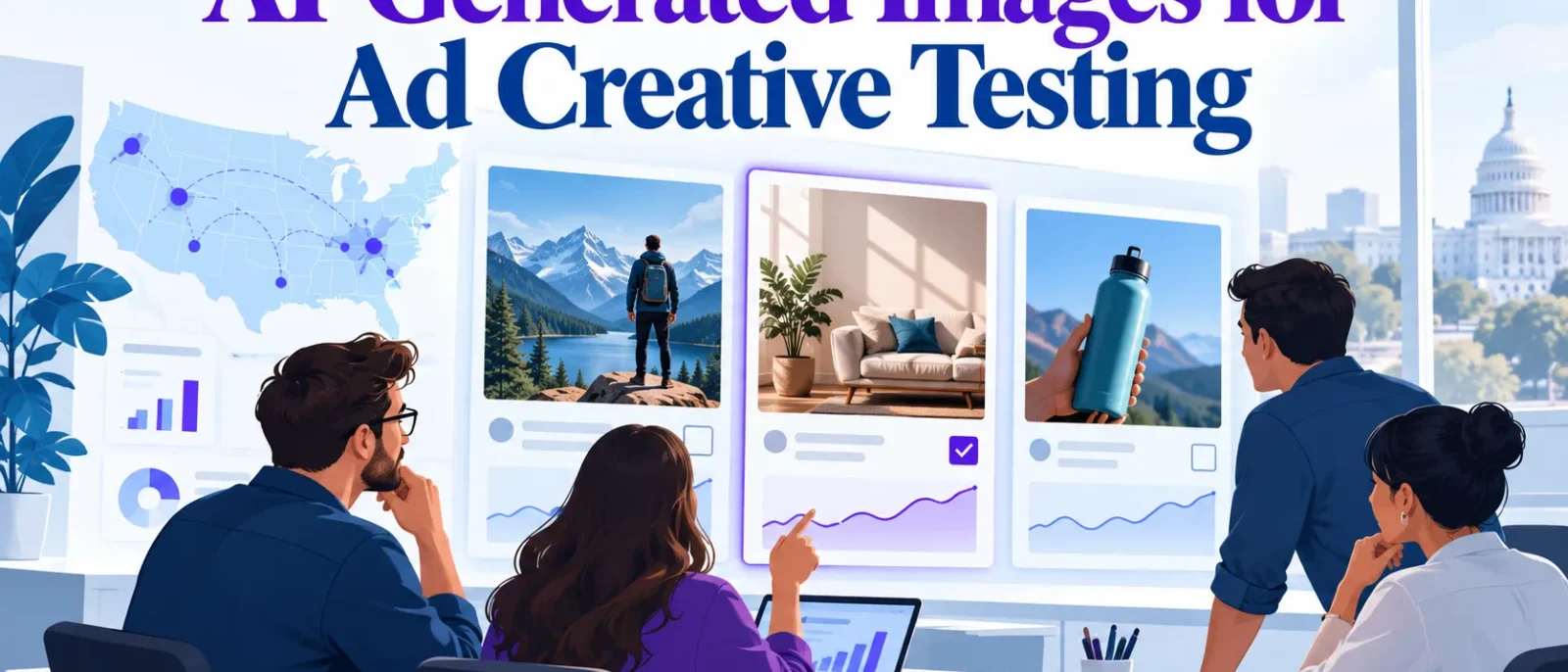
Most teams that want to use ai generated images for ads do it in five steps: write a one-line brief, fix the prompt, generate a base image, overlay the copy, and export to the sizes each platform needs. The rest of this guide explains each step and where it can go wrong.
Creative decides how well an ad performs. Vendor estimates put creative at 46 to 56% of performance on Meta and other platforms, while Google cites 70% of campaign success. Automated targeting and bidding have narrowed the levers advertisers still control. The real bottleneck is how many variants a team can test. Manual production limits most teams to a handful of concepts a week, which is too few to learn what works, and scale is what separates a useful test from a lucky one. Teams can use a free design tool to build quick comparison boards, but the volume of variants still drives the learning.
AI-generated images make testing cheaper. This guide argues that they work best as a testing layer that shows which hooks, visual angles and formats deserve full production budget. They are not a substitute for finished campaign assets. It is written for performance marketers, e-commerce operators and in-house creative teams running US paid social, including digital marketing teams and social media managers that need multiple creatives ready at once.
Key Takeaways
- Treat AI images as a testing layer, not a finished-asset shortcut. Use cheap variants to find the hook, angle and format that win. Then spend production budget only on proven concepts.
- Change one variable per test. Vary the hook, visual style or format alone. Otherwise you cannot tell what caused the result.
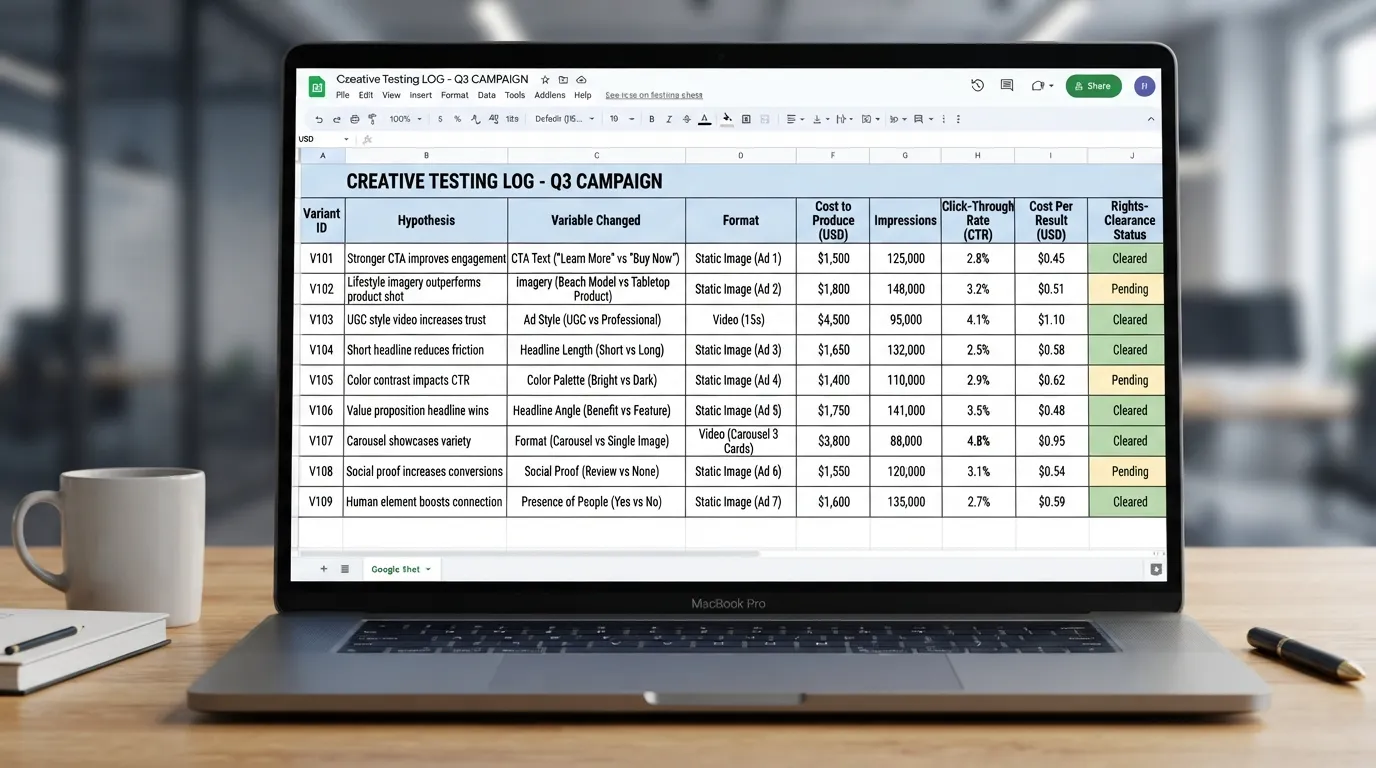
- Score every variant before it runs. The Creative Test Scorecard checks hypothesis clarity, variant spread, brand fit, rights clearance and cost-to-learning ratio.
- Cut low-clearance variants even when they win. AI-generated art may not be copyright-protected in the US, so unverified outputs carry legal and trust risk.
- Confirm CAC claims with your own controlled test. Vendor figures, such as Cometly’s reported 20 to 40% reduction in customer acquisition cost (CAC), are a starting hypothesis, not a result.
Many ad accounts stall because the creative stays the same for too long, not because they lack budget. Creative fatigue is the more common cause. Vendor estimates put creative at 70 to 80% of performance, according to AdAmigo, while platforms increasingly automate targeting and bidding. That leaves creative as the lever most teams can control. It is only as good as the number of variants a team can test.
The bottleneck is production. The average successful agency creative team can manually produce 8 to 12 high-quality ads per week. Each variant needs its own shoot, retouch and resize cycle, so testing volume stays low.
My view is that AI-generated images work best as a cheap testing layer. They are not a replacement for finished campaign assets. Their job is to show which concepts deserve full production, so budget for polished photography goes to ideas that have already earned it. This guide sets out that process, including a scorecard for rights clearance that should gate every variant before it runs.
Table of Contents
Why Creative Drives Ad Performance (and Why Testing Volume Matters)
Creative as the primary performance lever
On Meta and most other platforms, creative drives roughly 70 to 80 percent of campaign performance, according to AdAmigo’s free AI ad generator. That is a vendor estimate, so treat it as directional. Its direction still matches what many performance teams see. Once targeting and bidding move to the platform’s automated systems, the ad itself is the one lever a team fully controls, and strong marketing creatives with clear visuals and a sound design are where that control matters most. Product images and social media posts are part of that creative mix, so each one needs the same disciplined testing.
Creative therefore deserves the testing budget that audience targeting once received. Automated delivery finds people likely to buy. It does not write the hook, choose the visual angle or decide which benefit leads. Advertisers make those decisions, and brands that treat advertising as a content optimization problem tend to test more deliberately, including checking that each claim in a blog or ad matches the company policy.
The testing volume problem
Testing teaches you something only when you run enough distinct variants to separate a real winner from noise. A team producing three or four polished variants a week gets little signal. Each variant costs a shoot, an editor and a round of approvals, so the team tests fewer concepts and learns slowly.
The fix is to test concepts before committing to production. Create cheap, rough variants to find the hook, visual angle and format that earn attention and clicks. Then spend production money only on the winners. At this stage, watch click-through rate and early cost per result, not final return on ad spend. Cheap variants reveal winning angles because you can ask one question at a time. Does a lifestyle scene beat a product-only shot? Does a price-led headline beat a benefit-led one? Teams can also use search data to decide which questions to test first.
How AI Ad Generation and Image Creation Works
Most advertisers use AI image tools in a loop, not a single click. The workflow runs from brief to prompt, then to generated image, then to layout and copy overlay, and finally to variant export. Each stage can be audited, which matters when you later need to explain why a creative won or lost. Teams running multiple campaigns can reuse the same audit trail to compare what worked across each one.
AI image generation for advertising: the core workflow
Start with a brief that names one audience, one offer and one hypothesis. Turn that brief into a prompt that fixes the subject, setting, lighting and style. Generate the image. Then add the headline, price and call to action as a layout overlay, rather than asking the model to draw text, which models still handle poorly. Export each variant at the sizes the platform needs, so one design can serve every placement without rework.
Product photo transformation is where many teams start. You place a real product shot into an AI-generated scene, such as a kitchen counter or a beach. The product stays accurate while the background does the testing. Never let the model redraw the product itself, because mismatched details create trust and claims problems. Scenes must also not imply features, results or endorsements the real product does not deliver.
Checking output against the real product
Generators often fail on two points: text rendering and product fidelity. Models may misspell labels, garble packaging or invent logos. To check an output, place it beside the real product photo and compare the label text, shape, colour, count of components and any visible branding, line by line. Reject any variant where a detail differs. Keep text out of the generated layer entirely, so every word comes from the editable overlay you can proof.
AI ad generation and creation platforms
Three categories dominate. Ad-specific generators such as AdCreative.ai produce finished ad layouts. General image models give you raw visuals you assemble yourself. Product-feed tools such as Sivi build ads straight from a product catalog.
Judge a platform on three things. First, size support. Check it covers the US-standard placements, including Facebook 1200×628, Instagram 1080×1080 and 1080×1920, LinkedIn 1200×627 and the IAB display sizes. Second, batch generation, so one concept can fan out across formats. Third, brand controls such as fixed palettes, fonts and reusable style references.
Speed and ROI of AI-generated creatives
Speed is the easiest claim to check. Sivi says it can build a 1,000-product ad set in five languages across four sizes from a single CSV, shipped in under an hour. That is a vendor figure, but the direction is clear. Batch output can turn a week of production into an afternoon, and that speed also lets a team run more digital marketing tests per quarter.
Cost per acquisition is harder to prove. Cometly reports that most teams cut CAC by 20 to 40%. That is a vendor-reported figure, and it means something only if your own test compares AI variants against a control under the same audience and budget. Measure before you believe it.
AI Images vs. Traditional Stock Photography and Studio Shoots
Each option has a different cost, speed and authenticity profile. The table compares them on the points that matter most for testing.
| Factor | AI-generated images | Stock photography | Studio shoot |
|---|---|---|---|
| Cost to produce a variant | Low per variant | Licence fee per image | Highest, per concept |
| Speed to a new variant | Minutes to hours | Search and licensing time | Days to weeks |
| Customisation | High, through prompts and overlays | Limited to what the library holds | Full control |
| Authenticity | Lower if scenes look artificial | Generic, widely seen | Highest, when real |
| Rights clearance | Must be verified per output | Defined by the licence | Defined by the contracts you sign |
When each approach wins
AI images win in the testing phase, when you need many free, low-cost variants to learn which angle works, and when design tools make rapid creative iteration practical. Stock photography suits generic brand visuals where exact product fidelity is not needed. Studio shoots win once a concept has proven itself and the brand needs authentic, high-fidelity assets for long-running campaigns across social media and advertising channels.
Brand consistency and common image errors
Brand consistency is the main risk in AI testing. If every variant drifts in palette, lighting or style, the test measures noise, not the concept. Fix the palette, fonts and lighting in the prompt and the style reference, and reuse them across the whole batch so the brands’ creatives stay coherent.
Common image errors include misspelled text, extra fingers, warped packaging and a product that looks different from the real item. Each has a fix. Keep text in the editable overlay, use a real product composite, and run the side-by-side check described above before any variant goes live. Optimization of the batch should rely on the data each variant produces.
Copyright ownership
AI-generated art may not be copyright-protected in the US. The US Copyright Office has taken the position that works produced solely by AI lack the human authorship needed for protection. A federal court has since upheld that position in a case that concerned AI-generated art. Human contribution can still be protected. Arrangement, editing and substantial human-made elements can carry copyright, so document what your team added. Check the US Copyright Office’s AI guidance before you rely on ownership, and review the terms of service of any tool you use.
Ownership is not the only risk. Brown Bag Marketing reports that a client pulled a campaign after another company promoted its services with one of the campaign’s AI images, and that the image vendor offered no contract. Ask every vendor for written rights terms before you publish.
Conclusion and Summary
AI-generated images earn their place as a testing layer. They help you find the hook, angle and format worth funding, then hand the winners to production. The guardrails are simple. Change one variable per test, score every variant before it runs, verify rights, and confirm any cost claim with your own controlled test.
Frequently Asked Questions
Are AI-generated images safe to use in paid ads?
They can be, but only after checks. Confirm the rights terms with the vendor, verify that the image does not resemble a protected work, and check that the product shown matches the real item. Cut any variant that fails these checks, even if it wins.
Can I legally claim ownership of AI-generated ad images?
Not always. The US Copyright Office treats works produced solely by AI as lacking the human authorship needed for protection. Human contributions can still be protected, so record what your team wrote, edited and composed.
How many AI ad variants should I test at once?
Test enough distinct variants to separate a winner from noise, while changing only one variable per test. Keep each variant’s audience and budget the same so the result is readable.
Do ads need to disclose that an image is AI-generated?
Disclosure rules depend on the platform and on whether the image could mislead viewers about the product. Check each platform’s current ad policy before launch, and avoid any scene that implies a feature or result the product does not deliver.
How do AI-generated ad images compare on cost and speed?
They are usually cheaper and faster per variant than studio shoots, which makes them useful for testing. The gap narrows once you account for review time, rights checks and the production needed for winners.
Will AI images hurt my brand if the audience can tell?
They can, if the style drifts or the scene looks artificial. Keep the palette, lighting and fonts fixed across variants, and reserve high-fidelity studio work for the concepts you plan to run long term.
When each approach wins
AI wins at the start of the funnel. When you have ten hook ideas and no idea which will stop a scroll, cheap variants let you find the angle before you spend real money. A studio shoot is the wrong tool for testing whether a “save time” hook beats a “save money” hook. Use AI generation for concept testing, high-volume variants and format tests across Facebook 1200×628, Instagram 1080×1080 and 1080×1920, and LinkedIn 1200×627.
Studio or real-customer imagery wins when the claim depends on the product being real. Hero campaigns, testimonials, before-and-after results and anything showing product performance need photography that reflects what the customer will actually receive. An AI scene that shows a product doing something it cannot do creates a misleading-advertising problem, not a testing advantage. AI scenes must never imply product features, results or endorsements the real product does not deliver.
The working rule: AI finds the winner, and production makes it credible. Winners from the AI test graduate to human-shot or licensed production, and that is where your budget for finished assets should go.
Disclosure: digitalmarketingtools.ai is sponsored by Digimetrics.ai. Sponsored Highlights are clearly labelled advertising. Our reviews, comparisons and guides are written to be useful and fair regardless of who sponsors the site. Read the full disclosure.