
7 Best SEO Tools in 2026: What’s Actually Worth Paying For?
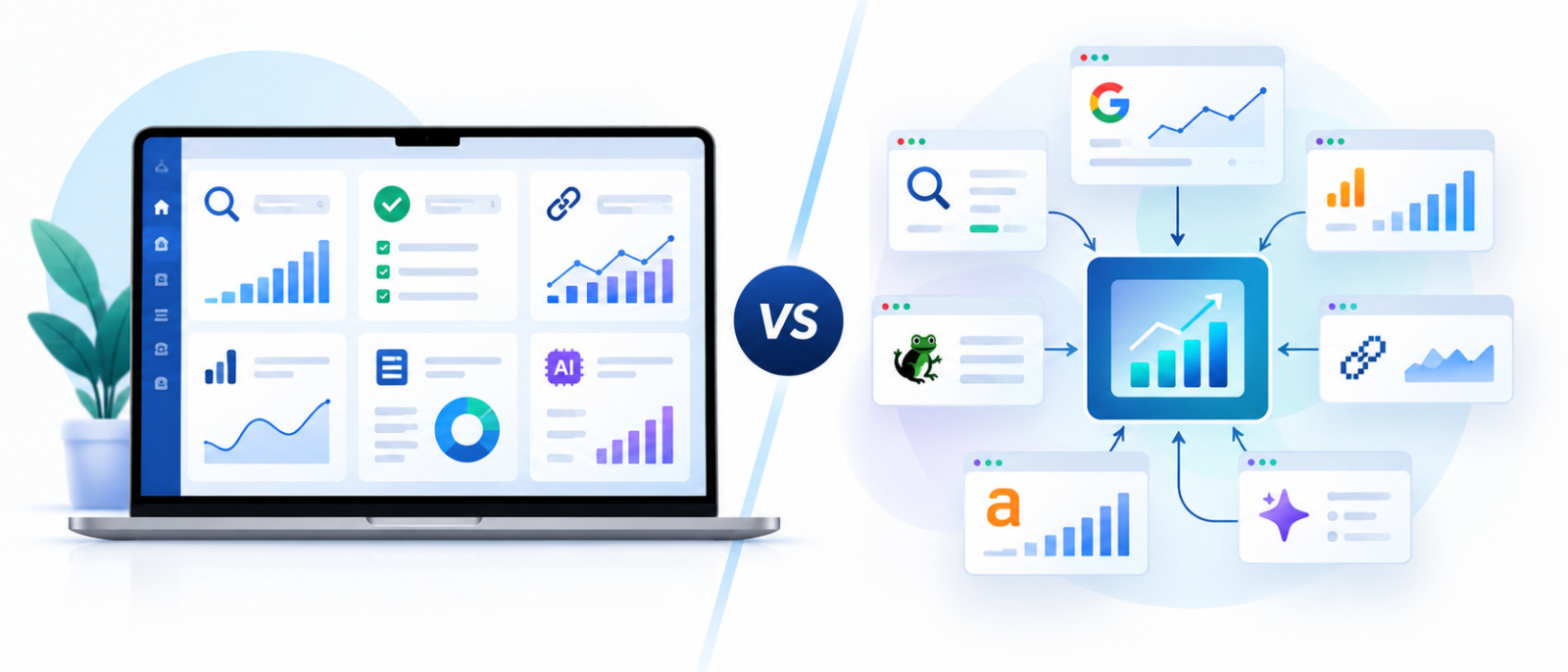
Tested picks for solo marketers, in-house teams and agencies, from $0 stacks to full SEO, content and GEO platforms.
Search for the best SEO tools in 2026 and the hard part is not finding software. It is deciding which products deserve a place in your workflow without paying several subscriptions to answer the same questions.
This comparison ranks tools by the SEO work they can actually cover and the decisions they help you make, rather than by feature count alone. We have used versions of these setups on live-site workflows and rechecked current access, pricing and product capabilities in September 2026.
That distinction matters because Google itself now advises site owners to understand the limitations of third-party SEO software. In its June 2026 guidance on using third-party SEO tools, services and advice, Google notes that external tools do not have access to its internal ranking systems and recommends Search Console when first-party Google Search data exists.
Quick Picks
| Need | Our pick |
| Best overall SEO suite | Semrush |
| Best for competitive SEO research | Ahrefs |
| Best integrated SEO, content and GEO workspace | Digimetrics |
| Best lean professional stack | GSC + GA4 + Screaming Frog |
| Best completely free stack | Google + Bing free stack |
| Best budget SEO suite | Mangools |
| Best for content optimisation | Surfer |
Semrush remains our strongest conventional all-in-one SEO choice, while Ahrefs is the better fit when competitor research, backlink analysis and search intelligence are the main priorities.
Digimetrics now deserves a different position in the comparison. Its current workspace spans SEO, content, AI visibility, strategy and connected marketing data, which makes it much broader than a simple action or prioritisation layer. That wider coverage is why we now include it as a ranked option rather than treating it as a separate add-on to a traditional SEO stack.
The 7 Best SEO Tools and Stacks Compared
| Rank | Tool or setup | Best for | Starting cost | Free trial / free access | G2/Capterra rating | Main trade-off | Pricing verified |
| 1 | Semrush | One primary all-in-one SEO suite | US$139.95/mo SEO Toolkit Pro | 7-day trial | 4.4/5 G2 | Expensive if most modules go unused | Sep 2026 |
| 2 | Ahrefs | Competitive SEO, keywords and backlinks | US$29/mo Starter; US$129/mo Lite | Free verified-site tools | 4.5/5 G2 | Starter limits exports, history and heavy research | Sep 2026 |
| 3 | Digimetrics | Integrated SEO, content, GEO and strategy workflows | US$39/mo Starter | 7 days / 200 credits | No established public score yet | Newer platform; specialist databases may still go deeper | Sep 2026 |
| 4 | GSC + GA4 + Screaming Frog | Lean professional SEO workflow | US$0 to start; £199/yr Screaming Frog | Free versions available | N/A | Competitor intelligence is the main gap | Sep 2026 |
| 5 | Free Google + Bing stack | New sites and small businesses | US$0 | Free | N/A | Limited competitor history and automation | Sep 2026 |
| 6 | Mangools | Lower-cost keyword, SERP and backlink research | From about US$29.90/mo | Free access available | 4.7/5 G2 | Less technical depth than larger suites | Sep 2026 |
| 7 | Surfer | Content optimisation and search-focused writing | US$49/mo (billed annually) | 7-day Pro trial | 4.8/5 G2 | Content specialist, not a full SEO suite | Sep 2026 |
Table 1: The 7 best SEO tools and stacks in 2026, compared.
Pricing note: Prices, access limits and public ratings were checked in September 2026. SEO software changes packaging frequently, so verify the vendor’s live pricing page before purchasing.
The ranking needs context. Semrush at #1 does not mean every site needs Semrush, and Digimetrics at #3 does not mean its backlink database automatically beats Ahrefs.
Each product wins for a different type of workflow. The goal is to identify which SEO jobs you repeatedly perform and how few tools you need to perform them well.
How We Tested
We evaluated the tools around actual SEO work instead of counting features. Platforms already used in ongoing workflows were judged using live-site experience alongside a September 2026 product review, while specialist entries were assessed around the jobs they claim to improve.
| Tool or setup | Testing basis | Workflows considered | Rechecked |
| Semrush | Ongoing agency use + current product review | Keywords, audits, tracking, competitors and reporting | Sep 2026 |
| Ahrefs | Ongoing SEO research use + current product review | Competitor, keyword and backlink research | Sep 2026 |
| Digimetrics | Ongoing internal product use + current workspace review | Keywords, ranking, technical SEO, content, GEO, strategy and connected performance data | Sep 2026 |
| GSC + GA4 + Screaming Frog | Ongoing live-site use | First-party performance, conversions and technical crawling | Sep 2026 |
| Free Google + Bing stack | Ongoing small-site workflow | Indexing, performance, technical checks and backlinks | Sep 2026 |
| Mangools | Focused workflow review | Keywords, SERPs, rankings and backlinks | Sep 2026 |
| Surfer | Focused content workflow review | Content briefs, optimisation and on-page recommendations | Sep 2026 |
The Decision Coverage Framework
A useful SEO stack should answer the questions that lead to action.
| Decision question | What it asks | Tool category that usually answers it |
| Where is the opportunity? | Which keywords, pages or search gaps deserve attention? | Keyword and competitor research |
| What is preventing performance? | Are technical, indexing, linking or content problems holding pages back? | Crawlers, audits and Search Console |
| What are competitors doing? | Which pages, keywords and backlinks work for competing sites? | Competitive databases |
| What is actually happening? | Are impressions, traffic, engagement and conversions moving? | Search Console, GA4 and business data |
| What should we do next? | Which finding deserves action first? | Diagnostics, strategy and workflow tools |
| Are we visible beyond conventional search? | Can AI systems access, cite or mention the site and brand? | GEO / AI visibility tools |
We call the gap between finding something and knowing what to do about it Decision Distance. Good tooling should shorten that distance without hiding the evidence used to make the recommendation.
The SEO Stack Redundancy Tax
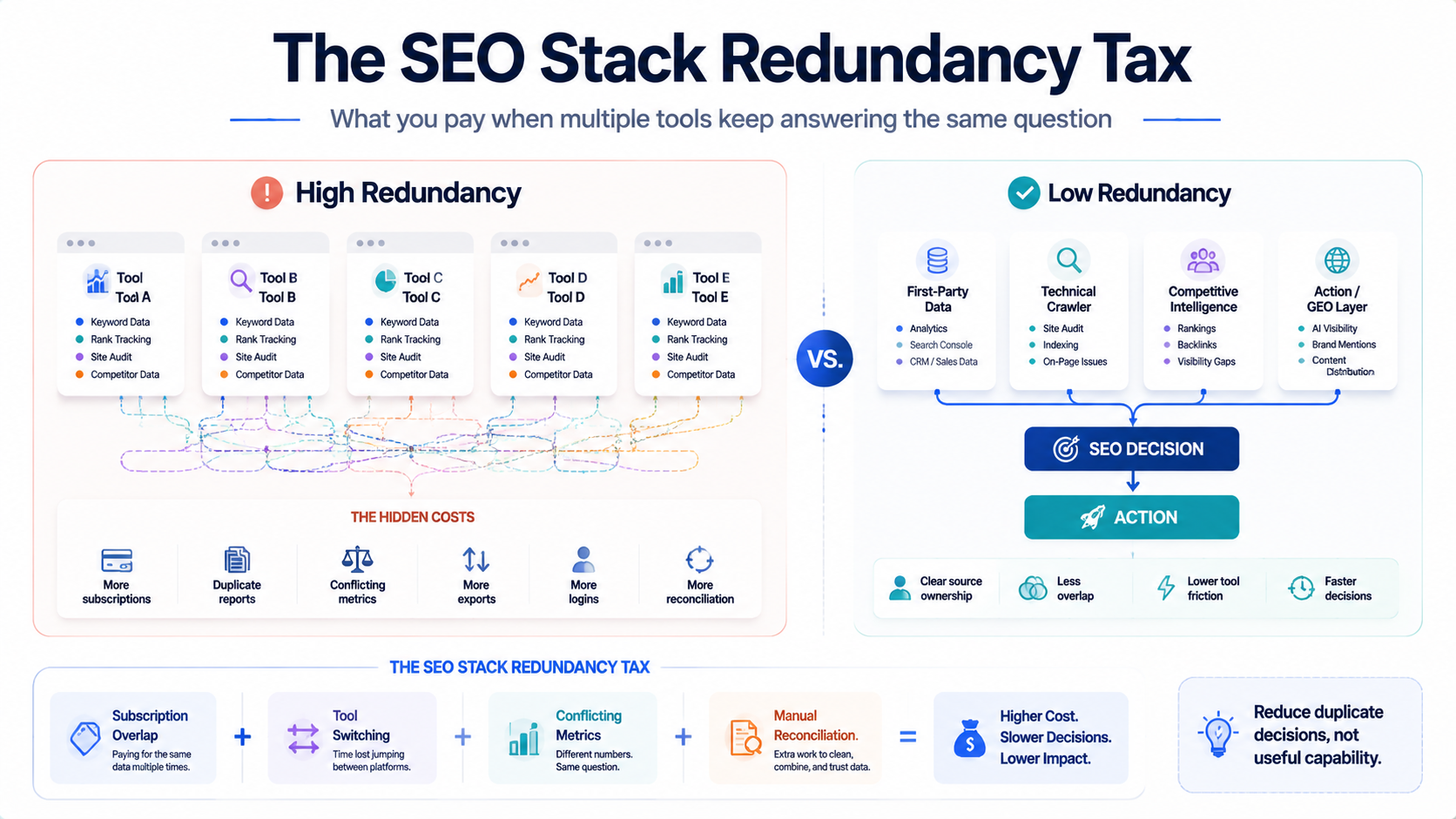
The SEO Stack Redundancy Tax is the money and time lost when several subscriptions repeatedly answer the same question.
A common stack might contain:
| Tool | Where overlap can appear |
| Semrush | Keyword research, rank tracking, audits and backlinks |
| Ahrefs | Keyword research, rankings and backlinks |
| Dedicated rank tracker | Tracking already covered elsewhere |
| Content platform | Another keyword dataset and optimisation score |
| GEO platform | Separate AI-visibility reporting |
| Search Console | First-party performance data for your own site |
Paying for overlap is not inherently wrong. Two tools can have different datasets or workflows that justify keeping both.
The problem begins when nobody can explain what different decision the second subscription enables.
Run a 30-Day Decision Log
For 30 days, record one thing whenever someone opens a paid SEO tool:
What decision changed because we used it?
Do not log “ran report.” Log the actual action.
| Day | Tool | Finding | Decision changed |
| Monday | Ahrefs | Competitor owns a comparison-intent cluster we do not cover | Add a comparison page |
| Tuesday | Search Console | Commercial page lost mobile impressions | Investigate indexing/template changes first |
| Wednesday | Screaming Frog | Navigation changes removed important internal links | Restore links and recrawl |
| Thursday | Semrush | Keyword opportunity duplicates the Ahrefs finding | Question whether both are needed on this project |
| Friday | GA4 | Organic traffic rose but qualified conversions did not | Review intent and conversion path |
At the end of the month, compare subscriptions. If several products repeatedly produce the same decisions, there may be redundancy to remove.
Platforms such as Digimetrics become especially interesting in this calculation because part of their value proposition is consolidating several adjacent SEO, content and GEO jobs. The correct question is not whether it contains 36 tools. It is how many existing workflows those tools can replace without losing specialist depth you actually use.
1. Semrush: Best Overall All-in-One SEO Suite
Editorial score: 9.2/10
Public rating: 4.4/5 on G2
Best for: Agencies, in-house teams and marketers wanting one primary platform for research, tracking, auditing and reporting.
Pros
- Broad keyword, competitor, backlink, audit and tracking coverage
- Can replace several overlapping SEO subscriptions
- Strong recurring-project and reporting workflows
- Useful multi-site capabilities for agencies
- Mature competitive and search database
Cons
- $139.95/month is expensive when only a few modules are used
- Additional AI/GEO products can increase the real stack cost
- Specialist crawlers or backlink tools can still go deeper
- Feature breadth can encourage unnecessary dashboard checking
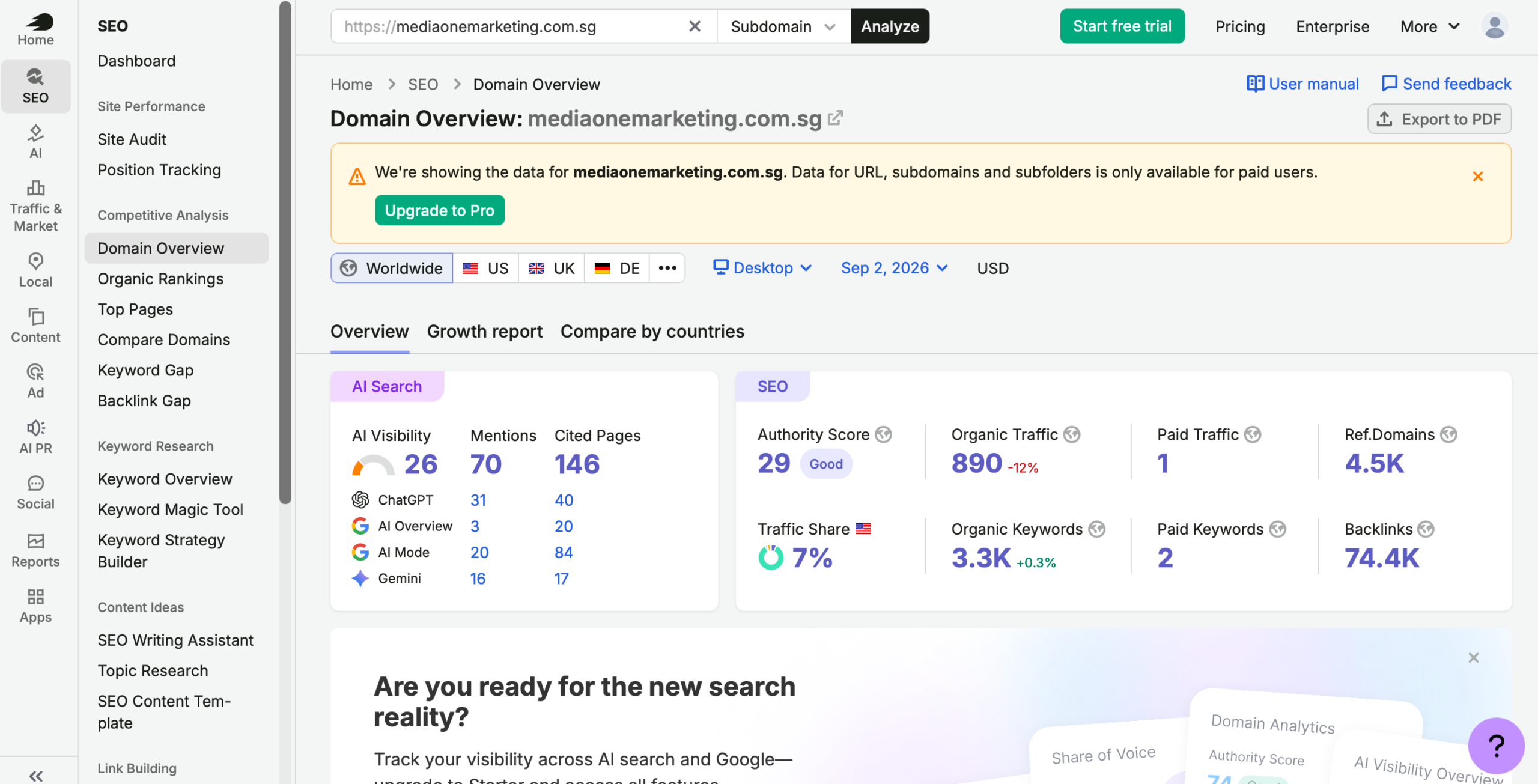
Semrush Pricing
| Plan | Monthly price | Selected limits |
| Pro | $139.95 | 5 sites, 500 tracked keywords, 100,000 Site Audit pages/month |
| Guru | $249.95 | 15 sites, 1,500 tracked keywords, historical data and Looker Studio |
| Business | $499.95 | 40 sites, 5,000 tracked keywords and API access |
Current plan details are available through Semrush’s SEO Toolkit pricing.
Where Semrush Earns the Money
Semrush makes the strongest case when a weekly workflow moves between several SEO jobs. You can identify a competitor, investigate its keywords, audit your own site, add important terms to tracking and report progress without rebuilding the research elsewhere.
The value is therefore not one proprietary metric. It is workflow breadth backed by a mature SEO dataset.
Where It Falls Short
The biggest problem is underuse. Paying $139.95 per month is easier to justify when Semrush replaces several recurring tools. It is harder to defend when someone opens it twice a month to check search volume.
At that point, you are not buying an SEO suite. You are renting an expensive keyword checker.
Choose Semrush if: keywords, competitors, audits, rankings and reporting are all recurring jobs.
Skip Semrush if: your site is small and a lean specialist stack already answers the questions you act on.
Bottom line: Semrush stays #1 because it combines mature SEO data with broad recurring workflows, but unused breadth quickly becomes expensive.
2. Ahrefs: Best for Competitive SEO Research
Editorial score: 9.0/10
Public rating: 4.5/5 on G2
Best for: SEO specialists and content teams that spend substantial time investigating competitors, keywords and backlinks.
Pros
- Strong Site Explorer and competitor-research workflow
- Excellent keyword and backlink analysis
- $29 Starter creates a relatively low-cost entry
- Useful free tools for verified properties
- Mature historical competitive data on higher plans
Cons
- Starter includes meaningful limitations
- You will still want Search Console and analytics alongside it
- Third-party estimates remain models rather than Google measurements
- Heavy research workflows can outgrow lower plans quickly
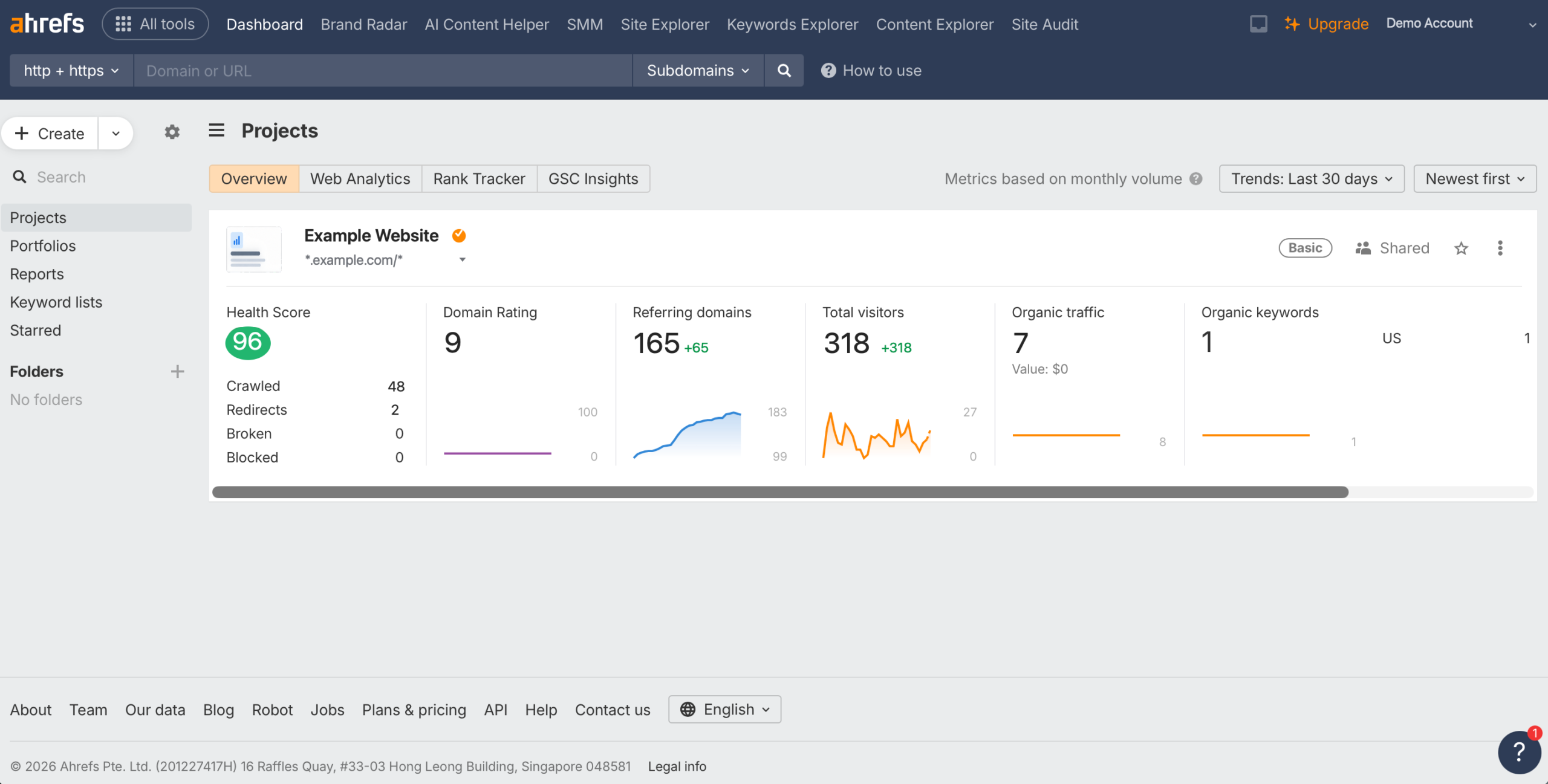
Ahrefs Pricing
| Plan | Monthly price | What matters |
| Starter | $29 | 200 credits/month, limited history and no exports |
| Lite | $129 | More projects, exports and historical data |
| Standard | $249 | Higher professional research limits |
You can check current access and limits on the Ahrefs pricing page.
A Concrete Research Workflow
A useful Ahrefs workflow starts with a competing site rather than your own.
We can use Site Explorer to identify pages driving the competitor’s organic footprint, narrow that list by intent and then investigate queries where our site lacks an equivalent asset. Search Console cannot answer that question because we do not have access to the competitor’s first-party property data.
Treat Ahrefs Numbers as Models
Google’s June 2026 guidance is the important boundary. Ahrefs can estimate search volume, traffic and ranking difficulty, but those values should not be treated as Google’s internal measurements.
For your own property, verify against first-party evidence where possible. For competitors, use the directional patterns and gaps that first-party data cannot expose.
Choose Ahrefs if: competitor pages, keywords and backlinks are central to the work.
Skip Ahrefs if: the bottleneck is execution rather than access to another research database.
Bottom line: Ahrefs remains our preferred research-led platform, particularly when understanding competitors is the job itself.
3. Digimetrics: Best Integrated SEO, Content and GEO Workspace
Editorial score: 8.9/10
Public rating: No established G2/Capterra score yet
Best for: Marketers whose SEO workflow also includes content optimisation, GEO, strategy and performance analysis.
Disclosure: Digimetrics is built by our team. We are ranking it because the current product directly overlaps with several categories buyers compare when building an SEO stack, but we apply the same limitations test as the other entries.
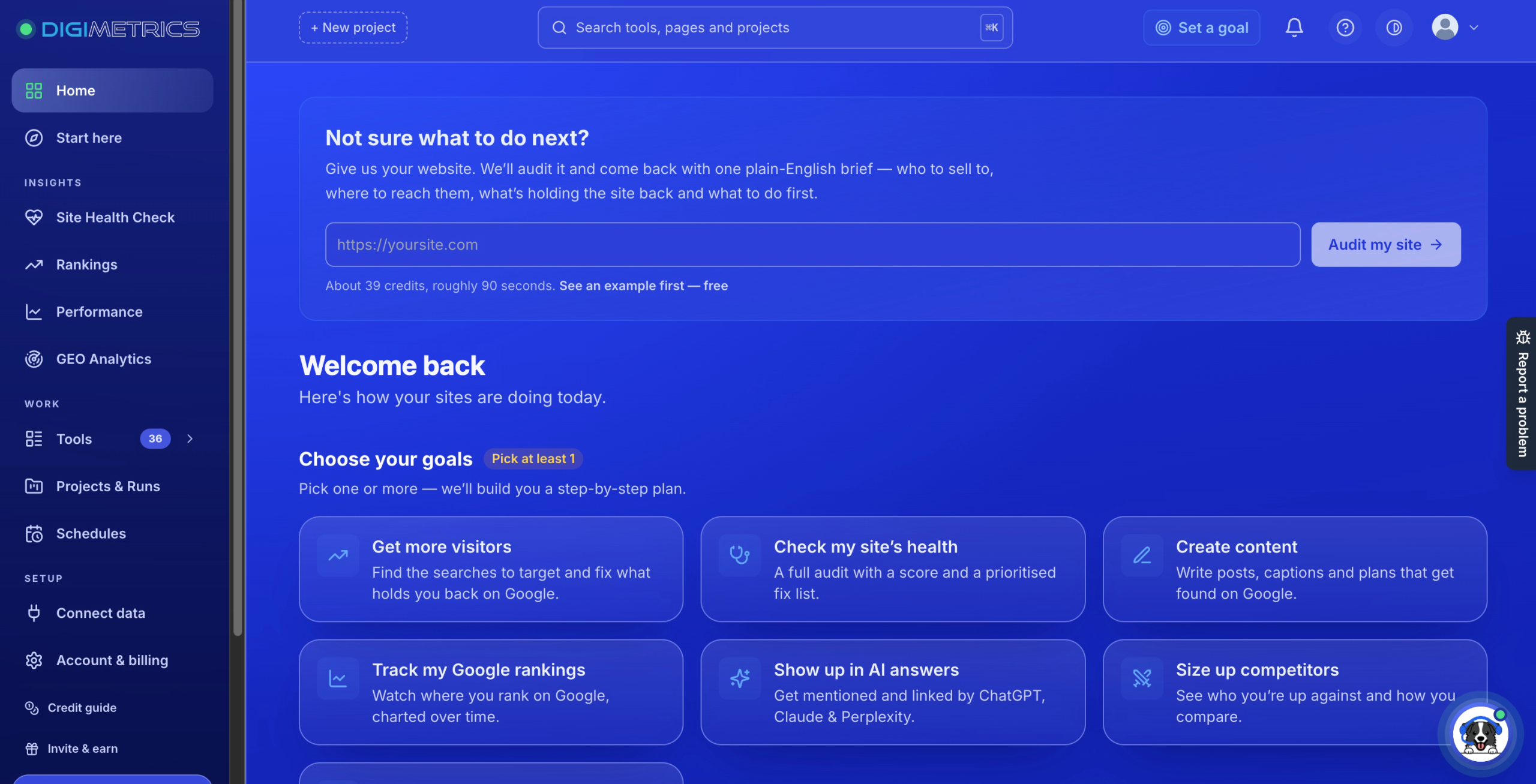
It is not simply an action layer sitting on top of other SEO products. The current platform contains 36 tools across five categories:
| Area | Tools | Examples |
| SEO | 14 | Keyword Analysis, Rank Checker, Technical SEO Crawler, Full Site Audit, Backlinks Explorer, SEO Diagnostics |
| Content | 7 | AI Content Optimiser, Article Comparison, Content Checker, Content Pillar Framework |
| AI Visibility | 4 | AI Mentions Tracker, AI Readiness Check, llms.txt Generator, AI Page Rewrite |
| Strategy | 6 | Persona Generator, Media Plan Generator, Landing Page Audit, Performance Marketing Audit |
| Integrations | 5 | Search Console, GA4, Google Ads, Meta Ads and LinkedIn Ads |
That makes Digimetrics closer to an integrated SEO and marketing workspace than a single-purpose diagnostic tool.
Pros
- Covers keyword research, ranking, technical SEO, backlinks and on-page work
- Adds dedicated content optimisation and comparison workflows
- Includes AI/GEO visibility tools rather than treating GEO as a separate product
- Connects first-party Search Console and GA4 data into the same workspace
- Also connects Google, Meta and LinkedIn Ads
- Monty AI concierge can work with connected performance information
- $39 Starter price is substantially below the major enterprise-style suites
Cons
- Newer platform with less public review history
- We would not assume its backlink index matches mature specialist databases without direct testing
- Specialist crawlers may still offer deeper technical configuration
- Some teams may not need the broader content, GEO or strategy capabilities
- Breadth creates value only if the workflows genuinely replace other tools
What the SEO Toolkit Actually Covers
The SEO section alone includes Keyword Analysis, Rank Checker, Time to Rank, Anchor Text Cleaner, Technical SEO Crawler, Full Site Audit (SEO + AI), On-Page Optimisation, Page Technical & Domain Analysis, Page Speed Check, Competitors Identifier, Backlinks Explorer, Schema Generator, SEO Strategy and SEO Diagnostics.
That matters because these are not merely recommendations derived from one audit score. They cover several jobs that are normally split across a keyword tool, crawler, rank tracker, backlink platform and optimisation layer.
The Full Site Audit combines crawl checks around SSL, speed, backlinks, structured data, llms.txt and AI-bot access with a prioritised fix list, while SEO Diagnostics combines keyword-to-fix auditing with Search Console/GA4 context and technical checks.
Content and GEO Are Part of the Same Workflow
Digimetrics becomes more differentiated when the workflow moves beyond conventional SEO.
Its AI Content Optimiser can research ranking pages, generate or improve content, run multiple QA checks and produce a quality grade. The platform also includes Article Comparison, Content Checker, caption generation and AI image/video generation.
The AI Visibility section includes an AI Mentions Tracker, AI Readiness Check, llms.txt Generator and AI Page Rewrite aimed at improving how pages can be accessed, understood, quoted and cited by AI assistants.
This means an SEO team does not necessarily need to buy one product for conventional optimisation and immediately add another product simply because GEO enters the workflow.
First-Party and Paid-Media Integrations Change the Value Proposition
The integration layer is another reason we no longer describe Digimetrics merely as an action tool.
Search Console can provide clicks, impressions, CTR and position, while GA4 supplies sessions, users, engagement and conversions. The workspace also supports Google Ads, Meta Ads and LinkedIn Ads performance data.
Monty, the built-in AI concierge, is visibly designed to answer questions about connected Search Console, GA4 and Ads numbers, which helps reduce one of the recurring problems with general AI: someone normally has to manually supply the business context before the model can reason about it.
Where Digimetrics Falls Short
We still would not claim one workspace automatically replaces every specialist product.
If the entire job is deep competitive backlink research, Ahrefs deserves the direct comparison. If the job requires advanced crawl configuration across very large technical sites, Screaming Frog remains a specialist benchmark. Semrush also has much longer public market history and mature datasets.
The reason Digimetrics ranks #3 is therefore workflow coverage, not a claim that every individual module beats every specialist.
Choose Digimetrics if: SEO, content optimisation, GEO and performance analysis regularly overlap and you want more of those jobs inside one system.
Skip Digimetrics if: you need only one specialist function and already have a mature platform dedicated to it.
Bottom line: Digimetrics earns #3 because it covers substantially more of the SEO workflow. Its strongest advantage is reducing the number of separate environments required to move from research to diagnosis, optimisation and GEO analysis.
4. Google Search Console + GA4 + Screaming Frog: Best Lean Professional Stack
Editorial score: 8.9/10
Starting cost: $0; Screaming Frog paid licence £199/year
Best for: Experienced practitioners who prefer first-party measurement plus specialist technical crawling.
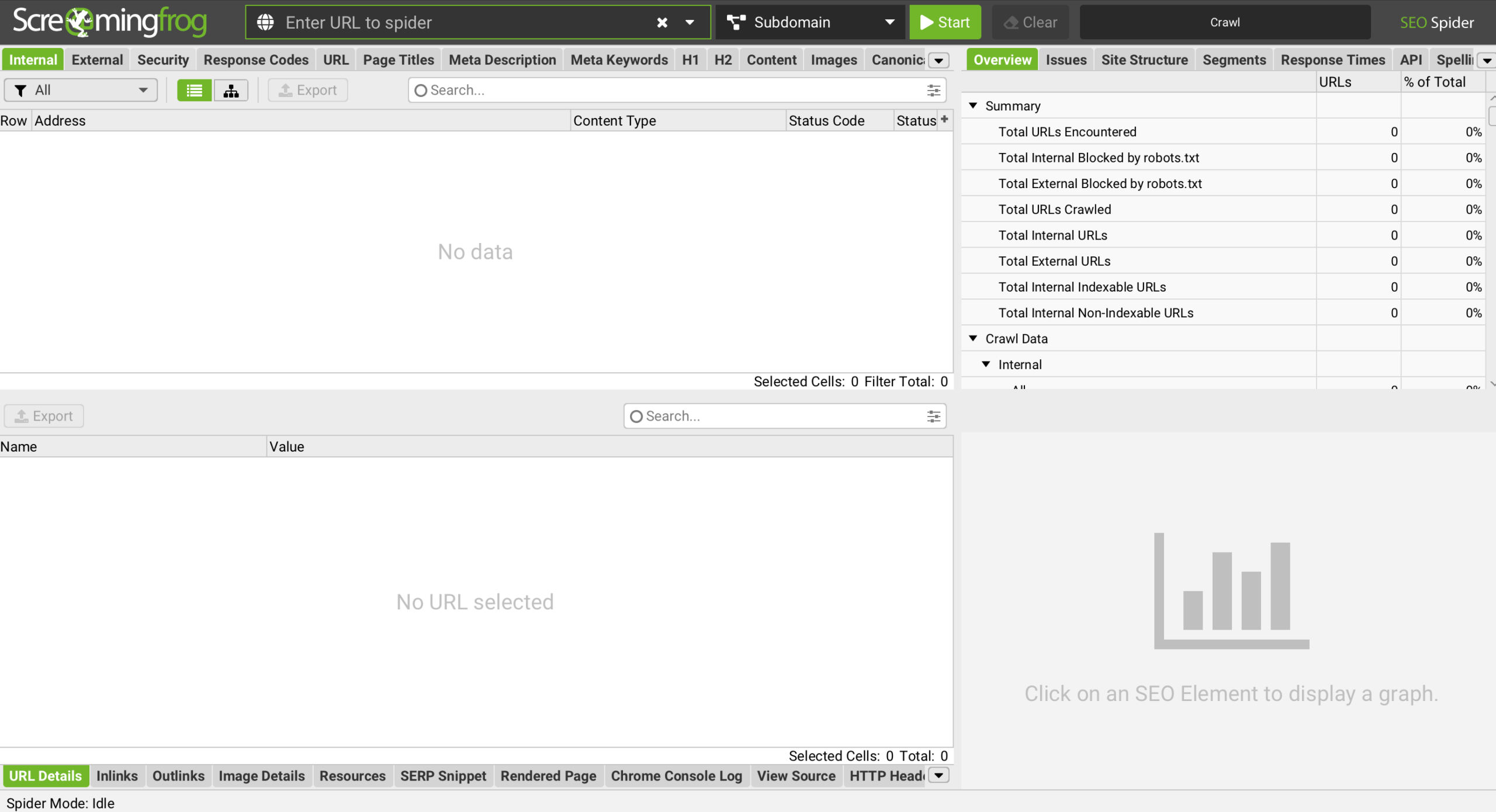
A smaller stack is not automatically a compromise. These three products have unusually clear ownership of different decisions.
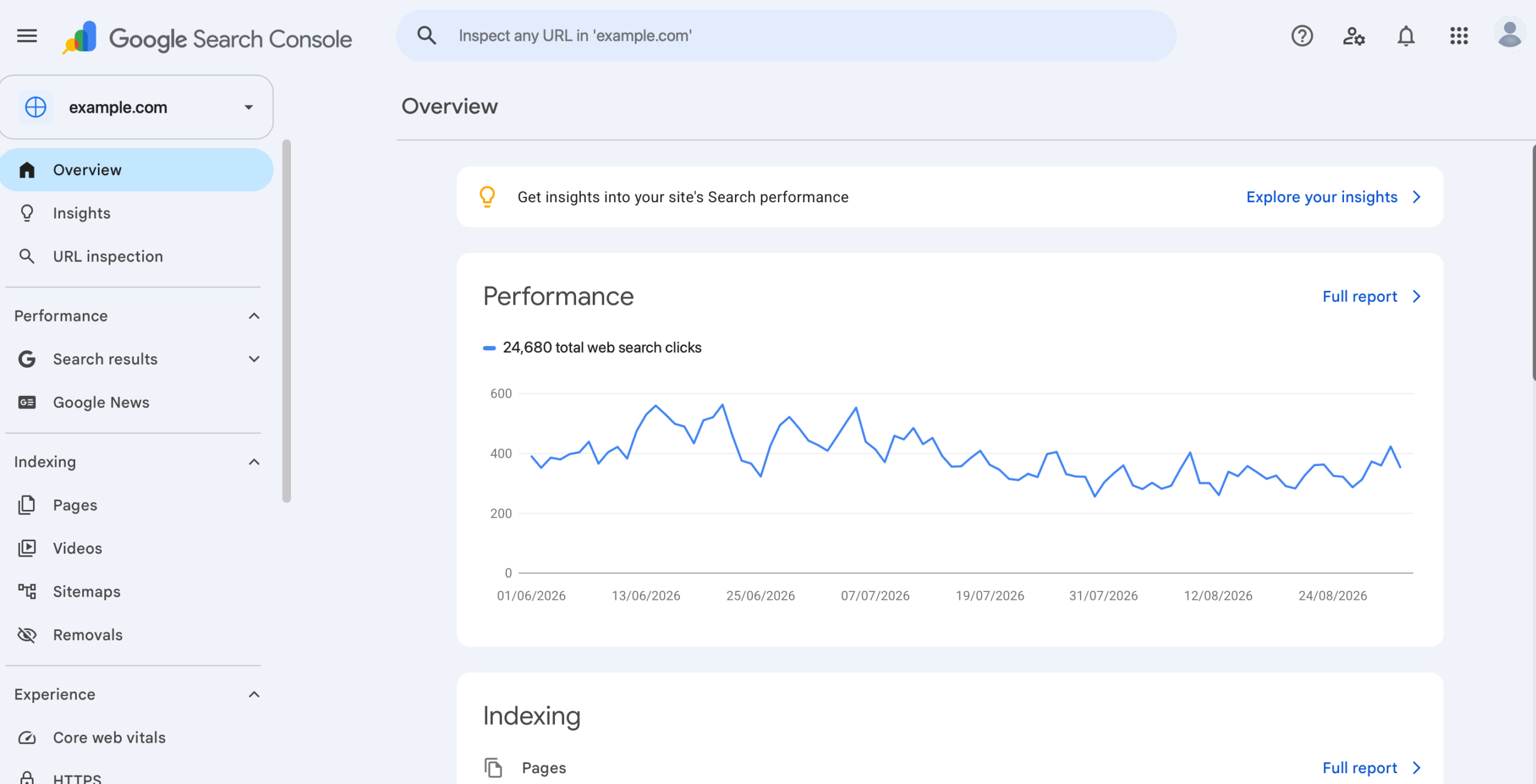
| Tool | What it answers | Cost | Main limitation |
| Google Search Console | How your property performs in Google Search | Free | Not a complete crawler or competitor database |
| Google Analytics 4 | What users do after acquisition | Free | Requires good measurement setup |
| Screaming Frog | What is technically happening across the crawlable site | Free to 500 URLs; £199/year paid | Competitive/search-demand research is not its job |
The free version of Screaming Frog SEO Spider crawls up to 500 URLs, while the paid licence removes that software limit and unlocks advanced configuration, JavaScript rendering, scheduling and integrations.
Pros
- First-party Google search and behavioural data
- Excellent specialist technical crawling
- Very little unnecessary functional overlap
- Strong foundation for experienced technical practitioners
Cons
- Competitor intelligence remains the main gap
- Reporting and reconciliation become more manual as projects grow
- Free crawler limit is restrictive for larger sites
- Requires more practitioner judgement than simplified dashboards
Choose this stack if: you understand what each source owns and want a lean professional foundation.
Skip it if: your team needs frequent competitor intelligence, GEO workflows or one shared environment.
Bottom line: This remains one of the strongest setups for skilled practitioners who value specialist evidence over platform consolidation.
5. Free Google + Bing Stack: Best Free SEO Stack
Editorial score: 8.4/10
Cost: $0
Best for: New websites, small businesses and teams that want to prove SEO value before buying software.
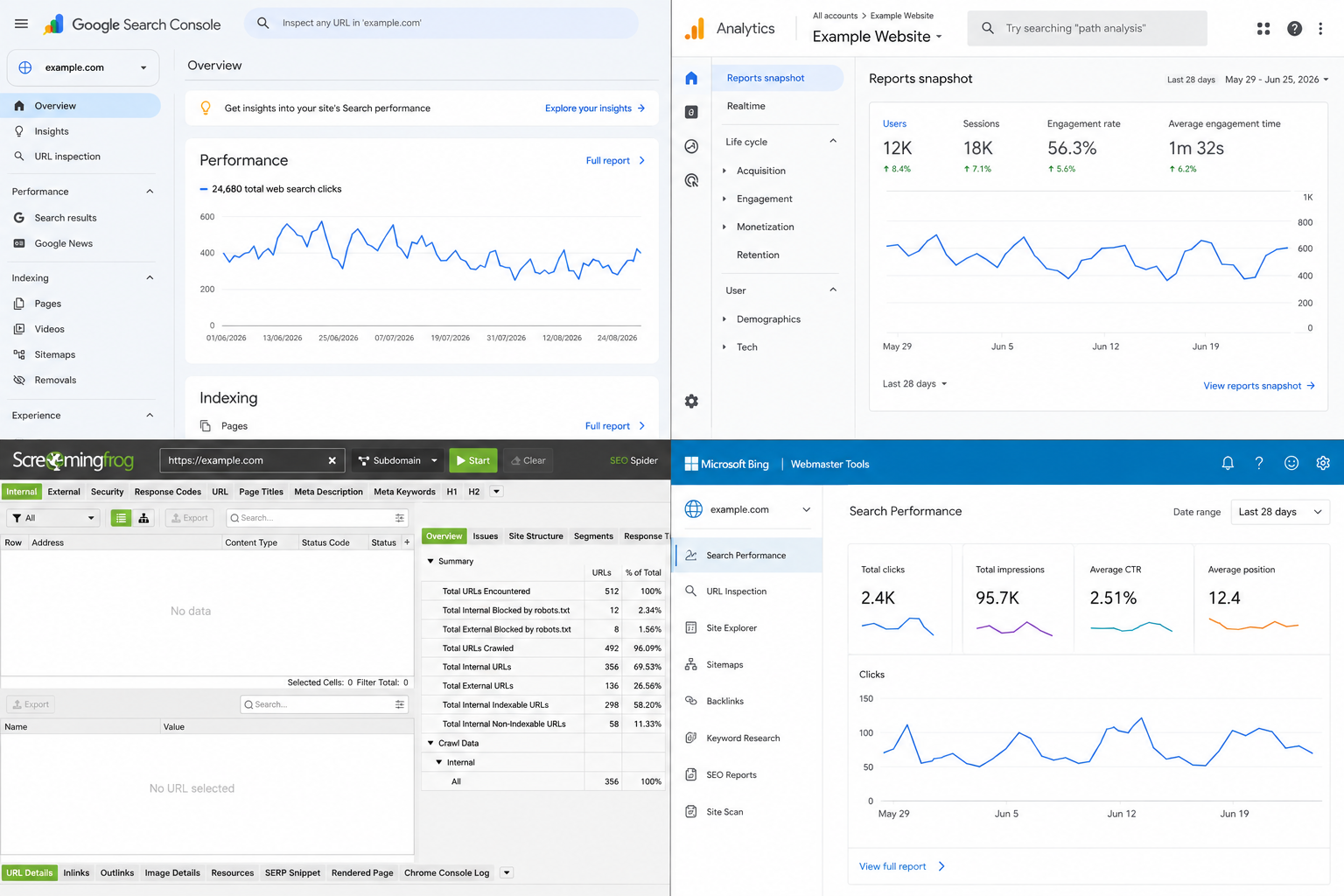
A capable free foundation can include Google Search Console, GA4, Screaming Frog Free and Bing Webmaster Tools.
Bing is particularly useful because it adds another search-engine perspective, site analysis and backlink information without introducing another paid subscription.
Pros
- Zero software cost
- First-party search and analytics evidence
- Technical crawling for smaller sites
- Bing adds additional search and backlink context
Cons
- Weak competitor-wide intelligence
- Limited history and automation
- Reporting requires more manual work
- Free technical limits become restrictive as sites grow
When Should You Finally Pay?
Pay when a free limitation becomes operationally expensive.
| Symptom | What it costs you | Paid category that solves it |
| Competitor research takes hours every week | Analyst time | Ahrefs, Semrush or competitor platform |
| Hundreds of rankings need monitoring | Manual checks | Rank tracking |
| Client reporting consumes staff time | Exports and presentation work | Suite/reporting platform |
| Several SEO/content/GEO tools are being stitched together manually | Context switching | Integrated workspace |
| Historical competitor analysis matters | Missing evidence | Paid database |
Choose the free stack if: you are still discovering which limitation deserves money.
Skip it if: the manual workaround already costs more than the software would.
Bottom line: Start at $0 until you can clearly name the problem you are paying to remove.
6. Mangools: Best Budget SEO Suite
Editorial score: 8.1/10
Public rating: 4.7/5 on G2
Best for: Freelancers, solopreneurs and small teams wanting straightforward SEO research without a $100-plus starting bill.
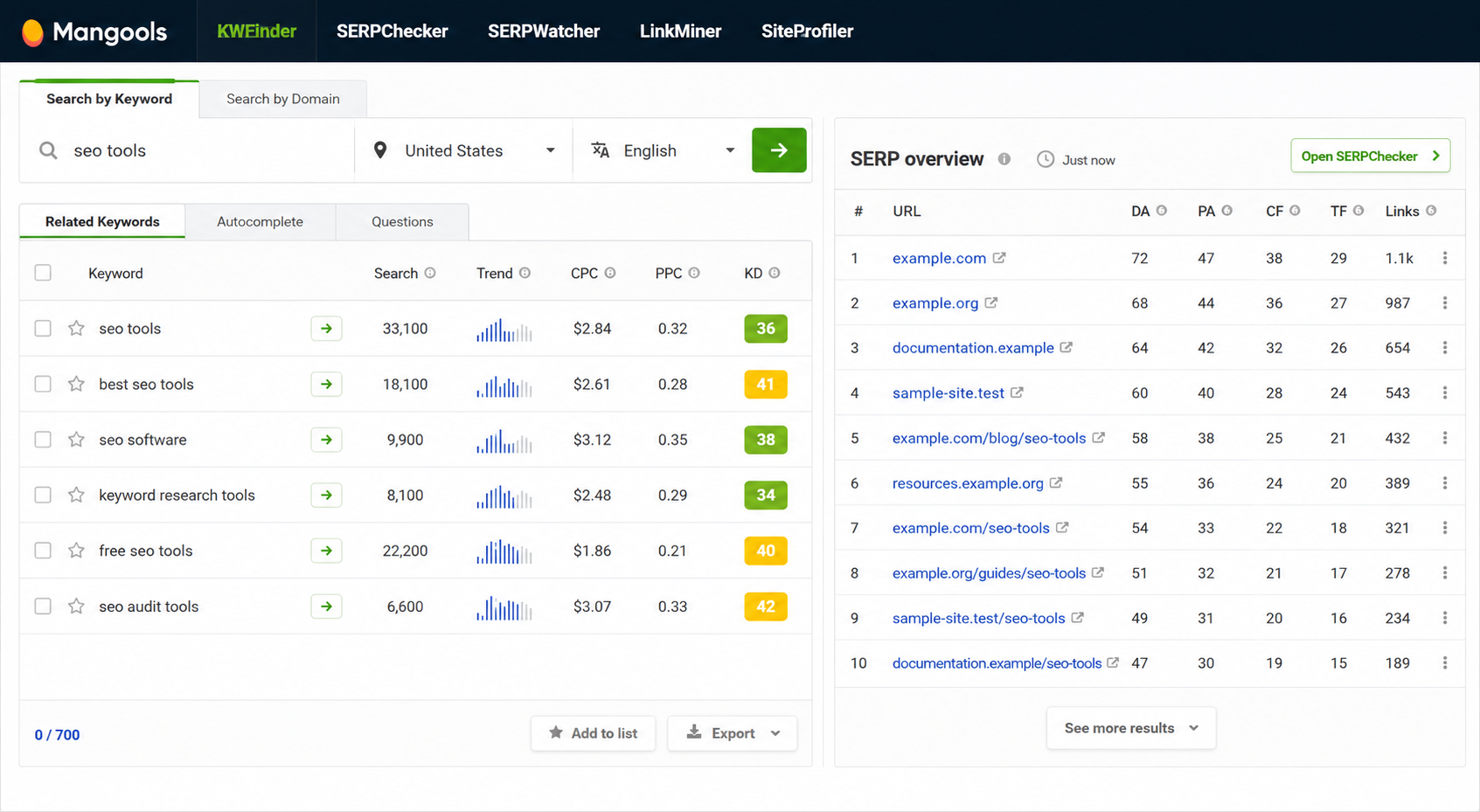
Mangools combines KWFinder, SERPChecker, SERPWatcher, LinkMiner and SiteProfiler into a relatively straightforward workflow.
It does not try to provide the technical depth or breadth of every larger platform, which can actually make it easier to justify when the work is primarily keyword, SERP, rank and backlink research.
Pros
- Lower cost than heavyweight suites
- Straightforward keyword and SERP interfaces
- Rank tracking and backlink research included
- Good fit for freelancers and smaller projects
- Strong public satisfaction scores
Cons
- Usage limits matter during heavy research
- Limited technical-audit depth
- Smaller data footprint than major competitors
- Agencies may outgrow the package
Current packages are available through Mangools plans and pricing.
Choose Mangools if: you need common research functions at a lower price.
Skip it if: you require deep crawling, extensive history or large agency workflows.
Bottom line: Mangools is our budget pick when focused SEO research matters more than having an all-purpose operating platform.
7. Surfer: Best for Content Optimisation
Editorial score: 8.0/10
Public rating: 4.8/5 on G2
Best for: Content teams needing dedicated on-page recommendations and optimisation workflows.
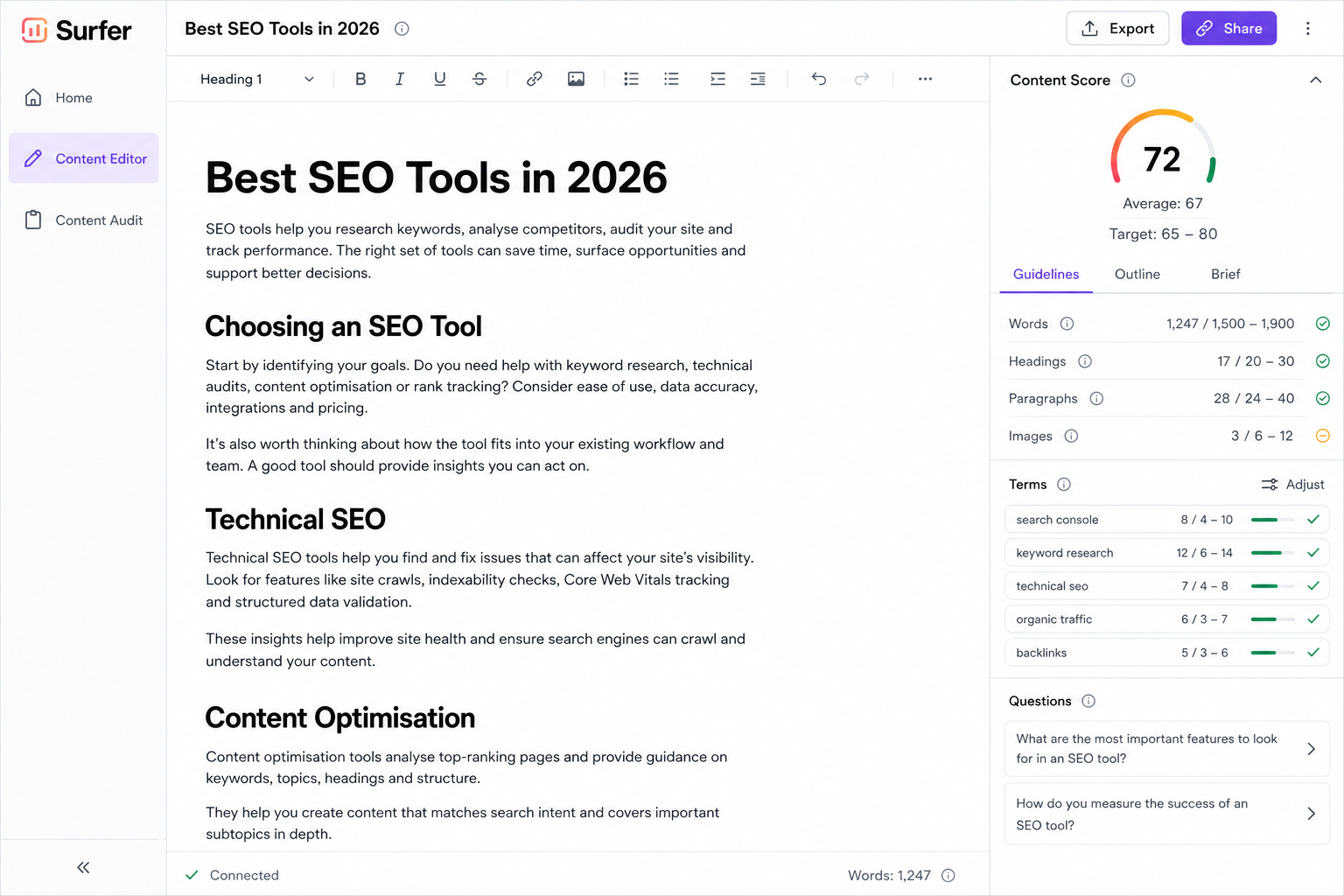
Surfer belongs in this list because content optimisation is an important SEO buying category in its own right.
Its job is narrower than Semrush, Ahrefs or Digimetrics: help writers and editors identify topical coverage opportunities and optimise pages around the characteristics of ranking competitors.
Pros
- Clear Content Editor workflow
- Strong fit for writers and editors
- Useful briefs and SERP-informed recommendations
- Good integration options
- Strong public review sentiment
Cons
- Not a complete SEO suite
- Content scores can become an unhealthy proxy for quality
- Higher plans become expensive for occasional use
- Editorial judgement remains essential
Do Not Optimise for the Score
Surfer can expose entities, subtopics and coverage gaps. The problem begins when the score becomes the objective.
If the reader’s problem can be solved properly in 1,400 words, adding another 1,000 words because competing pages are longer is not necessarily optimisation.
Use the tool to expose blind spots; let editorial judgement decide what belongs in the finished page.
Current plans are listed on the Surfer pricing page.
Choose Surfer if: content optimisation is a recurring production workflow.
Skip it if: your primary need is technical SEO, backlinks, rankings or broad competitor intelligence.
Bottom line: Surfer remains the strongest dedicated content-optimisation specialist in this comparison.
Why SEO Tools Disagree and What Each Source Owns
Semrush, Ahrefs, Digimetrics, rank trackers and Search Console can report different values without one necessarily being broken.
Search Console calculates its own metrics from Google Search activity. Third-party platforms operate independent databases, crawlers and models.
Do not average the numbers together and call the midpoint “truth.” Give each source a job.
| Source | What it owns | What not to expect from it |
| Search Console | Your Google Search clicks, impressions and queries | Universal fixed rankings |
| GA4 | Behaviour after acquisition | Competitor/ranking intelligence |
| Rank tracker | Consistent monitoring of selected searches | Perfect reproduction of personalised Google results |
| Ahrefs / Semrush | Competitor discovery and third-party modelling | Google’s internal measurements |
| Digimetrics | Integrated SEO/content/GEO workflows plus connected first-party context | Automatic superiority over every specialist dataset |
| Screaming Frog | Technical crawl evidence | Business prioritisation by itself |
| CRM/business data | Commercial outcomes | Technical SEO diagnosis |
The useful rule remains:
Use third-party tools to discover; use first-party data to verify wherever first-party evidence exists.
Suite vs Specialist Stack: Which Fits Your Workflow?
Consider an All-in-One or Integrated Workspace if 4+ Apply
- You manage multiple sites or clients
- Several people need the same working environment
- Competitor/search research happens frequently
- Rank monitoring is recurring
- Reporting or reconciliation takes meaningful staff time
- SEO increasingly overlaps with content or GEO
- Several specialist subscriptions cost roughly the same as a broader platform
- Tool switching itself is becoming operational work
Consider a Specialist Stack if 4+ Apply
- You work mainly on one or a few sites
- First-party data answers most performance questions
- Technical crawling depth matters more than convenience
- Competitor research is occasional
- You know exactly which source owns each decision
- Coordination between tools remains manageable
- You would pay for major modules you rarely use
- Specialist depth is more important than one interface
Which SEO Stack Should You Choose?
| Situation | Stack we would start with | Why |
| New site / learning SEO | GSC + GA4 + Bing + Screaming Frog Free | Learn from first-party evidence first |
| Solo freelancer | Free foundation + Ahrefs Starter or Mangools | Low-cost competitor intelligence |
| Small marketing team wanting one workspace | Digimetrics + first-party integrations | Covers SEO, content and GEO in one environment |
| Research-heavy SEO specialist | Ahrefs + GSC/GA4 | Competitive depth plus first-party verification |
| Technical SEO specialist | GSC + GA4 + Screaming Frog + Ahrefs | Deep technical and competitor evidence |
| Content-led SEO team | GSC/GA4 + Surfer or Digimetrics | Dedicated optimisation depending on desired workflow breadth |
| Agency managing many clients | Semrush or Ahrefs + first-party data + crawler | Mature scale and reporting |
| Team investing heavily in GEO | Existing SEO foundation + Digimetrics / GEO workflow | Adds AI visibility without abandoning SEO evidence |
Do You Need Both Semrush and Ahrefs?
Usually, no.
Some agencies and specialists can justify both because their datasets and recurring workflows support genuinely different decisions. That should be demonstrated rather than assumed.
Ask:
What recurring decision can Ahrefs support that Semrush cannot support efficiently?
Then reverse it.
If the answers are specific and valuable, keep both. If they are vague, you may be paying Redundancy Tax.
The same test now applies to Digimetrics. If its keyword, rank, content, technical and GEO workflows already cover enough of your day-to-day work, ask whether every overlapping standalone subscription still has a distinct specialist job.
Four Things We Would Not Pay Extra For in 2026
| Cost trap | What it means | Consequence |
| Duplicate rank tracking | Multiple products monitor the same terms | More cost without a new decision |
| Precision Theatre | Treating 1,900 vs 2,100 estimated searches as factual precision | False confidence |
| Audit volume | Generating more warnings without better priorities | Bigger reports, not better SEO |
| AI features that do not reduce work | Another score or chatbot with no meaningful workflow benefit | More monitoring and subscriptions |
The explosion of AI features makes the final row particularly important. An AI label is not enough reason to buy another platform.
The product should remove work, improve evidence or enable a decision your existing stack cannot support efficiently.
Final Verdict
If you want one established all-in-one SEO suite, Semrush remains the strongest general choice. If your workflow is driven more heavily by competitor research, backlink analysis and search intelligence, Ahrefs is the better fit.
Digimetrics takes a different position in the stack. With 14 SEO tools, seven content tools, four AI-visibility tools, six strategy tools and five marketing integrations, it now functions as a broader SEO, content and GEO workspace rather than simply a layer for turning findings into actions. That breadth is why it ranks #3 in our comparison.
We would still favour mature specialist platforms when their deeper datasets or highly specialised functionality are the main reason for buying them. Digimetrics becomes more compelling when the alternative is stitching together separate products for keyword research, rank tracking, technical SEO, content optimisation, GEO and performance analysis.
For experienced practitioners who prefer a leaner specialist stack, Google Search Console + GA4 + Screaming Frog remains an excellent combination. Start with the free Google and Bing stack when free limits are not yet slowing down the work, consider Mangools when budget is the main constraint, and add Surfer when dedicated content optimisation is the specific bottleneck you need to solve.
The best SEO stack is not the one with the longest feature list. It is the one where every tool has a clear job, overlapping subscriptions earn their place and the distance between finding a problem and knowing what to do next stays as short as possible.
If you’re comparing tools for other search workflows, you can also browse our full collection of SEO tools and guides.
Frequently Asked Questions
What Is the Best SEO Tool in 2026?
Semrush is our best overall conventional SEO suite because it combines mature research, tracking, audit and reporting capabilities.
Ahrefs is our preferred research-heavy option, while Digimetrics now ranks third for teams wanting SEO, content optimisation, GEO and connected performance workflows inside one workspace.
Is Digimetrics a Full SEO Tool?
Yes. The current Digimetrics platform includes 14 dedicated SEO tools covering jobs such as keyword analysis, rank checking, technical crawling, full-site auditing, on-page optimisation, backlinks, schema, competitor identification and SEO diagnostics.
It also extends into content optimisation, AI visibility, strategy and integrations, which is why we no longer classify it only as an action layer.
Does Digimetrics Replace Semrush or Ahrefs?
Not automatically.
Digimetrics has much broader functionality than the previous version of this article suggested, but Semrush and Ahrefs have mature specialist databases and long market histories.
The decision comes down to breadth versus specialist depth. Digimetrics is particularly compelling when SEO, content and GEO workflows overlap; Ahrefs remains stronger when intensive competitive research is the core job.
Do I Actually Need Paid SEO Tools?
No.
Search Console, GA4, Bing Webmaster Tools and Screaming Frog Free provide a capable foundation. Pay when a free limitation begins costing more in time, missing competitor intelligence, manual reconciliation or scale than the subscription would cost.
Can I Do Professional SEO Using Only Free Tools?
Yes, particularly for your own website.
The biggest gaps appear when you need competitive history, large-scale rankings, advanced crawling, automation, GEO monitoring or analysis across many projects.
Professional SEO remains a skill set rather than a software subscription.
Why Do Semrush and Ahrefs Show Different Numbers?
They maintain different databases, crawlers and modelling methodologies.
Google’s June 2026 guidance explicitly says third-party tools do not have access to its internal ranking systems, so these metrics should be treated as analytical models rather than perfect ground truth.
What Is the Cheapest SEO Setup We Would Recommend?
Start with Search Console, GA4, Bing Webmaster Tools and Screaming Frog Free.
If competitor research becomes necessary, Ahrefs Starter or Mangools can provide a relatively inexpensive next layer. If the problem expands into managing SEO, content and GEO from several disconnected systems, an integrated platform such as Digimetrics becomes a different type of upgrade.
Disclosure: digitalmarketingtools.ai is sponsored by Digimetrics.ai. Sponsored Highlights are clearly labelled advertising. Our reviews, comparisons and guides are written to be useful and fair regardless of who sponsors the site. Read the full disclosure.


