Keyword Clustering Tools: Methods, Pricing, and Common Mistakes
Keyword clustering tools turn your keyword research into content plans, but outputs vary sharply between tools. The clustering method often matters more than the tool itself. This guide explains how the main methods group keywords, how to score a tool against your list size and budget, and where teams go wrong. It includes a five-criterion scorecard and a step-by-step workflow. Written for US agencies and in-house SEO teams, it uses US dollar pricing.
Our contrarian thesis: threshold tuning matters more than tool choice. Two tools running the same method at the same threshold return similar clusters, while the same tool at two thresholds returns very different ones. The evidence is in the body of this guide.
Tool details, prices and limits were checked in February 2026 and change often, so confirm them on each vendor’s pricing page before you buy. Prices in this guide were checked in February 2026. Confirm them on each vendor’s pricing page before you buy.
Key Takeaways
- Judge tools by method first. SERP-overlap and semantic clustering produce different clusters from the same keyword list.
- Threshold beats tool choice. A 40% overlap rule and a 30% rule on the same list produce different page counts, so test the threshold before you compare vendors.
- Check capacity against your list. Limits differ by tool, from 2,000 keywords per list to 1 million keywords on enterprise plans.
- Model the real cost. Credit systems and re-import rules, such as a 90-day window, change what repeat runs cost.
- Validate before you plan. Spot-check clusters against search intent before building pages.
- Avoid common errors. Shared words are not shared intent. Mixed-intent clusters produce thin or cannibalizing content.
Table of Contents
- What Keyword Clustering Is and Why It Matters for SEO
- How Keyword Clustering Tools Work
- How to Evaluate a Keyword Clustering Tool
- Keyword Clustering Tool Comparison and Pricing
- Step-by-Step Workflow: From Raw Keywords to Clusters
- Conclusion and Summary
- Frequently Asked Questions
What Keyword Clustering Is and Why It Matters for SEO
Keyword clustering groups search terms that one page should target. Two keywords belong in one cluster when a single page can satisfy searchers for both. The goal is one page per distinct need, rather than many near-identical pages competing with each other. Good keyword research depends on this step, because raw keyword lists are hard to act on. A keyword grouping step, often run with a keyword grouper or grouping tool such as keyword cupid or keyword insights, turns that raw list into a manageable set of topics a content team can plan around.
Keyword clustering definition and core concepts
A cluster has three parts: the seed or head term, the variants (synonyms, questions and modifiers), and the shared intent behind those searches. User intent decides membership. Two phrases can share a word and still belong in separate clusters, while differently worded phrases can belong together.
How search engines interpret keyword clusters
Search engines read the pages that rank, not a list. When the same URLs rank for two queries, the engine treats those queries as having one answer. SERP-based keyword clustering tools copy this logic. A page built around one member of a cluster tends to rank for the others. Checking SERP overlap is often the best way to validate a cluster before you commit content to it. Results are personalised and shift by time and location, so treat any single snapshot as a sample.
Semantic keyword clustering versus lexical grouping
Lexical grouping sorts keywords by shared words or stems. It is fast and transparent, but it is blind to meaning, so “cheap running shoes” and “affordable trainers” never meet. Semantic clustering uses meaning, usually through language models or embeddings, to capture synonyms and intent. It needs checking, because it can merge terms a searcher would treat as different.
Benefits of keyword clustering for SEO
Clustering reduces internal competition, since one strong page replaces several weak ones. It also reveals topics where a site has no page at all. Clusters turn thousands of keyword rows into content briefs that writers can use directly, and each brief can become a single, well-targeted piece of content.
Three outcomes are worth tracking:
- Cannibalization reduction. When two pages target the same cluster, they compete for one ranking. Merging them into one page concentrates signals.
- Crawl focus. A tidy set of pages per topic gives search engines fewer near-duplicates to crawl.
- Topical gap discovery. A cluster with no existing URL on your site marks a page to create. For example, a home goods retailer may find a cluster of “how to clean cast iron” queries that no page answers.
How Keyword Clustering Tools Work
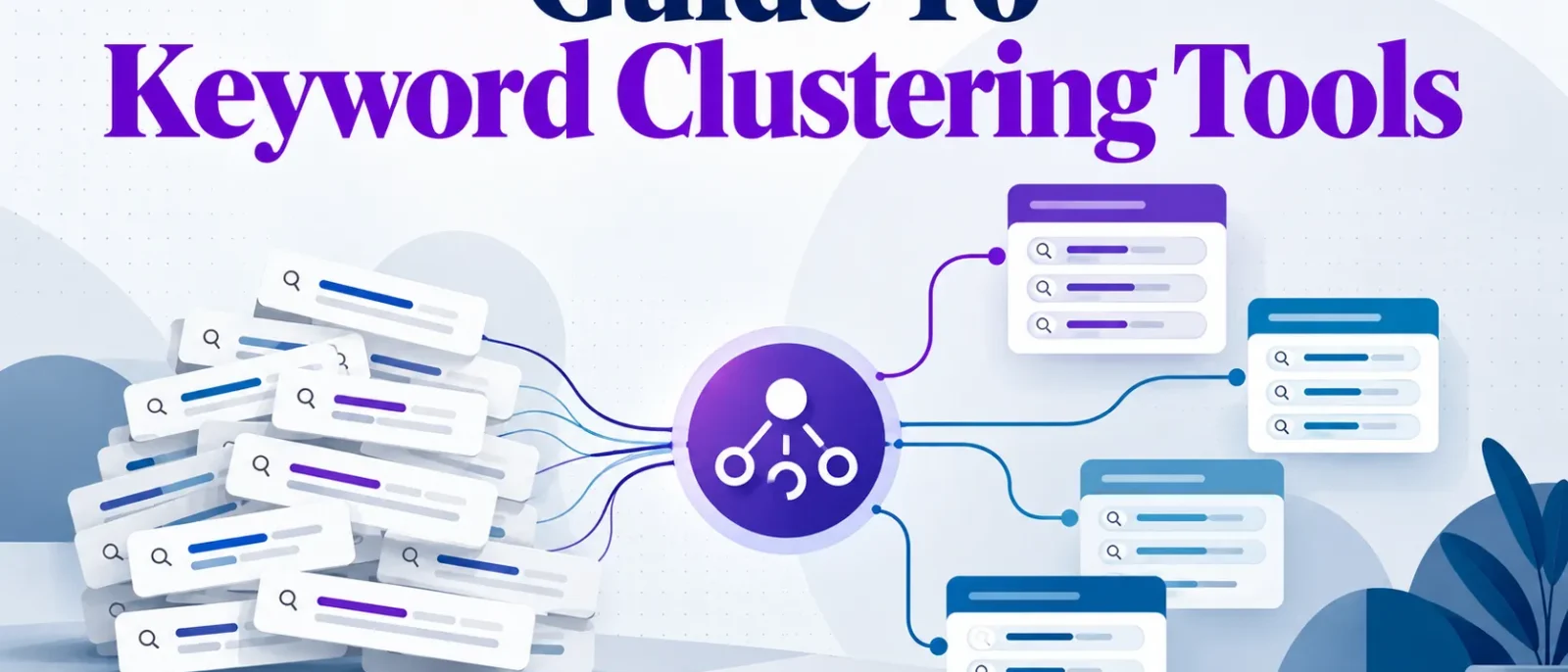
Most keyword clustering tools group keywords in one of two ways. They either compare the search results pages (SERPs) that keywords produce, or they compare what the keywords mean. The method decides which keywords end up together, so it matters more than any feature list. Teams building content around a topic need to know which approach their tool uses.
The two main clustering methods: SERP-based and semantic
SERP-based clustering treats two keywords as related when Google shows the same pages for both. The tool records the ranking URLs for each keyword and groups keywords whose results overlap. “Running shoes for flat feet” and “best running shoes for overpronation” may share most of their URLs, so they land together despite different wording. This is useful when you need to create pages that match how search engines already group a topic.
Semantic clustering ignores the results and compares meaning. The tool converts each keyword into a numerical representation, called an embedding, and groups keywords that sit close together, even when they share no words.
SERP-based grouping reflects what Google currently ranks for a topic. Semantic grouping reflects what the language means. Each can be wrong in a different way, so check the method before trusting the output.
SERP overlap thresholds explained (the 40% rule and customizable 30% thresholds)
SERP-based tools need a rule for how much overlap counts as the same topic. One tool’s default is the 40% rule: keywords are grouped when they share at least 40% of their ranking URLs, as described in eesel.ai’s keyword grouping guide. These percentages are individual vendor settings, not industry standards. Other tools let you set the threshold yourself, and one uses a customizable 30% URL overlap.
| Threshold | Effect on grouping | Typical risk |
|---|---|---|
| Higher (for example 50%+) | Fewer, tighter clusters | Close keywords split apart, creating near-duplicate pages |
| Around 40% | Balanced default | Suits most informational topics |
| Lower (for example 30%) | Broader, looser clusters | Unrelated intents merged into one page |
A lower threshold suits niches where Google ranks broad pages for many variations. A higher one suits sites where each product or service needs its own page. Treat the threshold as a setting to test, not a fixed rule.
Overlap-based grouping also varies by country, device and language. The same keyword can return different results in New York and London, or on mobile and desktop, and results change over time. The same threshold can therefore produce different clusters in each market and on each run. Run the test in the market you serve and record the date.
Here is a worked example. It is illustrative, not a measured result. A home goods retailer has 120 keywords about cookware. At a 50% threshold, the tool returns 14 clusters, and the team builds 14 pages, several of which overlap. At 40%, the same list returns 9 clusters, and the team merges two near-duplicates, leaving 7 pages to build. The 40% version wins on page count, but only after the team checked a sample of the merged clusters by hand.
Keyword clustering tool functionality: inputs, processing, and outputs
Most tools follow the same three-stage pipeline:
- Inputs. You upload a keyword list, usually as a CSV. One keyword grouper caps uploads at 2,000 keywords, while others accept far larger lists. Include search volume where the tool supports it, so you can prioritize clusters.
- Processing. The tool either pulls SERP results for each keyword or generates embeddings, then applies the grouping rule. SERP processing is slower and uses credits or API calls per keyword, so re-run costs matter.
- Outputs. You receive keyword clusters with a suggested name, a representative keyword and member keywords. These are usually exportable as CSV. A “keyword cupid export” is one such CSV file: a downloaded table of each cluster and its member keywords, which you can open in a spreadsheet.
The output is a proposal, not a finished content plan. Its value depends on whether the groups match real user intent, which you must verify.
Why results differ between tools (an 11.8% similarity example)
Two tools fed the same keywords can return different clusters, and the method often explains why. In one vendor comparison, two keywords showed only an 11.8% similarity in their results, according to Keyword Insights’ own comparison. That vendor’s figure comes from its own test, and its methodology is not independently verifiable here. Under a 40% rule, a pair with low URL overlap would not be grouped, while a semantic tool might group them immediately.
Neither tool is simply wrong. The SERP tool reports that Google treats these queries as different. The semantic tool reports that the wording is close. When results diverge, check the SERP for both keywords yourself before choosing a grouping.
Step-by-Step Workflow: From Raw Keywords to Clusters
Most keyword clustering failures happen before the tool is opened. A tool can only work with the list it receives and the rules applied to it. Teams that skip preparation often end up with clusters that look neat but do not map to real pages, which weakens any SEO strategy built on them. A keyword grouping tool, a keyword grouper, or a keyword insights report can look tidy, but a search engine only rewards clusters that match real pages. Keyword Cupid is one example of a keyword grouping tool: it exports a spreadsheet of groups, and each export is simply a list of keywords sorted into those groups.
Preparing and cleaning your keyword list
Export your keywords with search volume, difficulty and, where available, intent data. Remove duplicates, misspellings you do not want, brand terms you will handle separately, and irrelevant noise pulled in by broad seed terms. A clean list makes it easier to spot related keywords that belong in the same group. This is the first step in good keyword research and in creating keyword clusters that hold up under review.
A tidy 2,000-keyword list clusters more usefully than a messy 10,000-keyword one. Check the upload limit first. Some keyword grouping tools cap uploads at 2,000 keywords per list, so split larger research sets before you start.
Choosing a clustering method and threshold
SERP clustering groups keywords that return the same ranking URLs. One free tool’s documented rule places keywords together when they share at least 40% of their ranking URLs. Other tools let you adjust this, including a customizable 30% overlap threshold. These percentages are individual vendor settings, not industry standards. The right threshold depends on how broad or narrow your content plan needs to be.
A lower threshold produces broader clusters. A higher one produces tighter groups. Results also change with time, location and device, so the same list may cluster differently when you run it again or from another market.
Semantic clustering groups keywords by meaning and can catch synonyms that SERP data misses. Use the table below to choose between them.
| Situation | Better method | Why |
|---|---|---|
| You want to match keywords to pages that already rank | SERP clustering | It reflects which URLs search engines currently show |
| Your list has many synonyms or phrasing variants | Semantic clustering | It groups terms by meaning, not shared results |
| You are planning a new site section with no rankings yet | Semantic clustering | There may be little SERP data to compare |
| You need a defensible, auditable rule | SERP clustering with a documented threshold | You can test the overlap rule yourself |
Start with a SERP-overlap run at the 40% setting, then rerun a sample at 30% to compare. Where the two runs diverge, read those clusters by hand before deciding which threshold is right.
Reviewing and correcting clusters manually
Read the smallest and largest clusters first, since errors concentrate there. Look for unrelated terms bundled because they shared a generic ranking page, lone keywords that belong elsewhere, and large clusters that are really two topics.
Move keywords by hand, rename clusters so each label states its topic, and record each change. The log shows which patterns the tool gets wrong, so you can build a sharper rule set for the next run. Clusters reviewed and relabelled this way are easier to maintain across future content creation cycles.
Validating clusters against user intent
A cluster is usable only if its keywords want the same answer. Search two or three keywords from each cluster in an incognito window and check whether the top results match. Ask whether one page could satisfy every term. If a cluster mixes a buying query with a learning query, split it.
This check turns an automated grouping into a content plan. It is the step most teams skip, yet it is what makes the clusters ready for content creation.
Turning Clusters Into a Content Plan
Clusters become useful when each one maps to a page. Assign one primary page per cluster, and use the cluster’s representative keyword as the working title. Record the search intent beside each page so writers know whether to inform, compare or convert.
A brief for each page should include the primary keyword, the supporting keywords from the cluster, the target intent, and the internal pages it should link to. Link related pages to each other, and link from broad pages to narrower ones, so the site structure mirrors the clusters.
Conclusion and Summary
The core takeaways
Choose a keyword clustering tool by its method, not its capacity badge. A SERP-overlap tool groups keywords that share ranking URLs, so the threshold decides what lands together. Tools that document their rule let you check the output. Tools that hide it leave you guessing. Threshold tuning matters more than tool choice: two tools with the same rule can still produce different clusters if their settings differ. Treat related keywords as a single signal within your overall SEO strategy, and check that each cluster reflects the content you plan to create.
Score each candidate on the five Cluster Fit Scorecard criteria. Capacity is the criterion teams overweight.
Next steps for your keyword research
- Export your raw keyword list and count it against each tool’s limit.
- Score two or three candidate tools on the five Scorecard criteria.
- Run the shortlisted grouping tool on 100 to 200 keywords and spot-check the clusters against search intent.
- Map each approved cluster to one page, merging clusters that share a page-level intent.
- Re-run the full list within the tool’s re-import window so repeat runs add no cost.
Frequently Asked Questions
How many keywords can a keyword clustering tool handle?
Capacity varies. One free tool handles up to 10,000 keywords per run, some grouping tools cap uploads at 2,000 keywords per list, and enterprise options such as Keyword Insights advertise up to 1 million keywords. Compare a tool’s limit with your list size before committing, or you may end up clustering across inconsistent batches.
Is there a free keyword clustering tool?
Yes, several offer a free tier. One free tool handles up to 10,000 keywords, which is enough for a mid-sized site’s first pass. Free tiers usually limit daily runs or exports, so check those limits first.
What is the difference between SERP-based and semantic clustering?
SERP-based clustering groups keywords whose search results share ranking URLs. One tool’s rule places keywords together when they share at least 40% of their top-ranking URLs. Semantic clustering groups keywords by meaning, regardless of current rankings. SERP-based grouping reflects how search engines see intent today, while semantic grouping can surface relationships no single results page shows.
How much do keyword clustering tools cost per month?
Many advanced clustering features are bundled into SEO platforms, with monthly fees often between US$50 and US$200. Credit-based models change the real cost, since re-running a large keyword set can use credits quickly. Some tools allow re-importing previous keywords for up to 90 days without extra credits. Prices and caps are individual vendor settings and change, so confirm current figures on the vendor’s pricing page before you buy.
Can I trust automated keyword clusters without manual review?
Not fully. Automated clusters can reflect the quirks of a single results page rather than a genuine topic, and tools can disagree on the same list. Results also vary by market, device and date. Spot-check each cluster for one shared search intent before assigning it to a page.
Disclosure: digitalmarketingtools.ai is sponsored by Digimetrics.ai. Sponsored Highlights are clearly labelled advertising. Our reviews, comparisons and guides are written to be useful and fair regardless of who sponsors the site. Read the full disclosure.