
SEO Tools in 2026: What They Do, Which Ones You Need and How to Build Your Stack
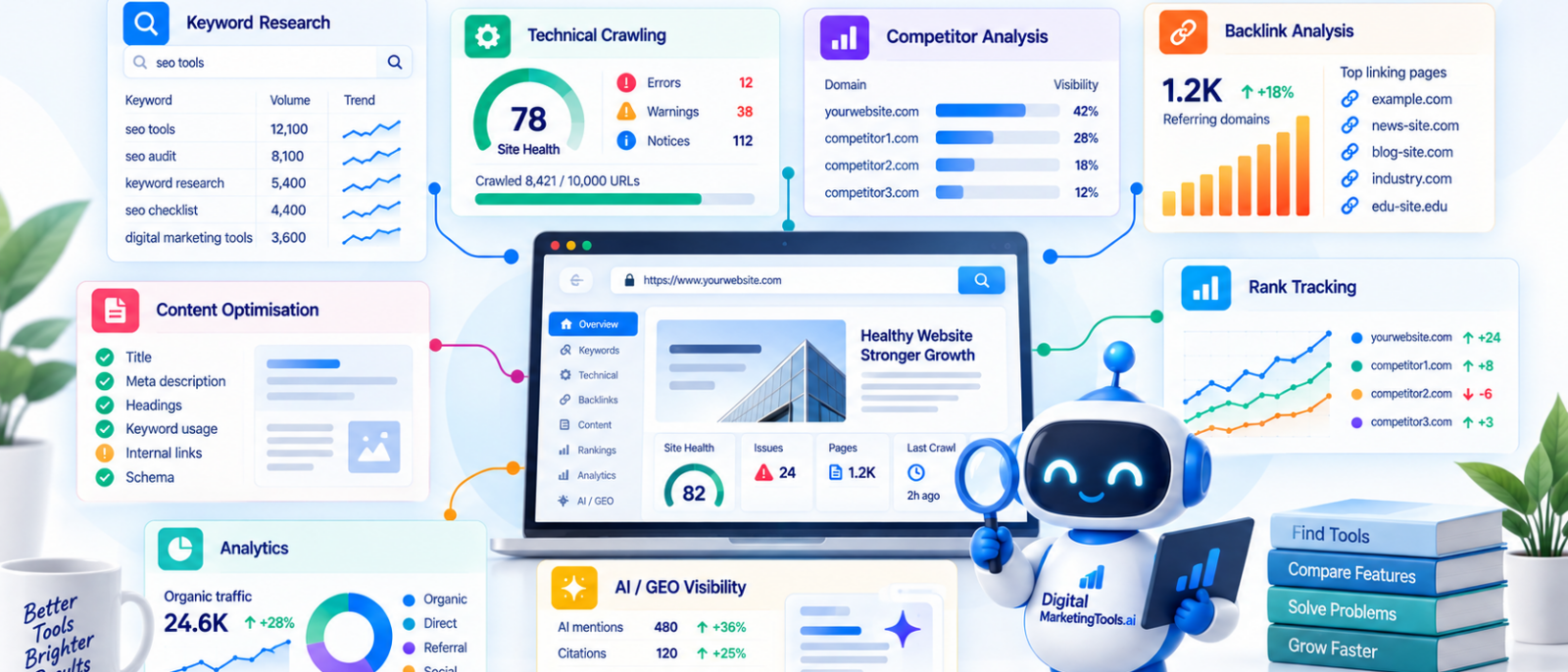
SEO tools can help you research keywords, audit websites, analyse competitors, track rankings and measure performance. The harder part is knowing which tool should answer which question.
There is no shortage of SEO tools in 2026. Platforms such as Semrush and Ahrefs cover large parts of the search workflow, Screaming Frog specialises in technical crawling, Google provides first-party search and analytics data, and newer platforms increasingly connect traditional SEO with content optimisation and AI-search visibility.
That creates a different problem: you can have plenty of SEO software and still not have a useful SEO workflow.
An SEO keyword tool might estimate that 2,000 people search for a phrase every month. A crawler might uncover 600 technical warnings. A rank tracker might show that a page moved from position 11 to position 8. Those numbers can all be useful, but none automatically tells you what the business should work on next.
The better way to understand SEO tools is by the decision each tool helps you make.
This guide maps the main types of SEO tools to the jobs they actually perform, explains where their data stops being enough and shows how to build a stack without paying several platforms to answer essentially the same question.
If you already understand the categories and are deciding what software to buy, our Best SEO Tools in 2026 comparison looks specifically at whether an all-in-one suite or a smaller specialist stack makes more sense.
What Are SEO Tools?
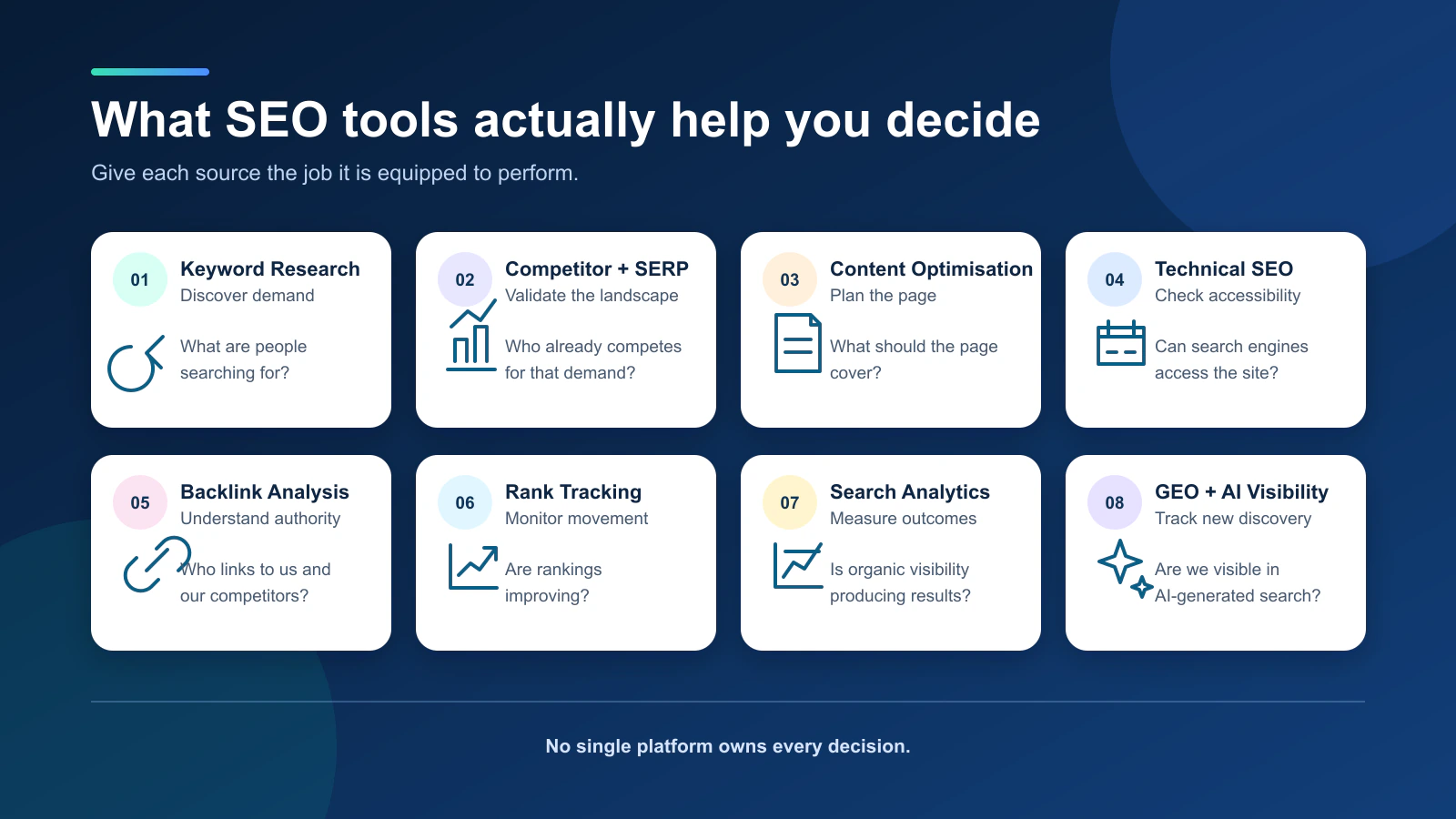
SEO tools are software platforms and data sources that help marketers research, execute, diagnose or measure search optimisation.
Some help answer what people search for. Others investigate why competitors rank, whether search engines can properly access your pages, who links to your website, how rankings change or whether organic traffic creates any meaningful business result.
That makes “SEO tools” a much broader category than any individual platform.
| Decision | Type of SEO tool |
| What are people searching for? | Keyword research |
| Who already competes for that demand? | Competitor and SERP research |
| What should the page cover? | Content and on-page optimisation |
| Can search engines access the site correctly? | Technical SEO and auditing |
| Who links to us and our competitors? | Backlink analysis |
| Are rankings improving? | Rank tracking |
| Is organic visibility producing results? | Search analytics |
| Are we visible in AI-generated search? | GEO and AI visibility |
No single source owns every decision.
Google Search Console, for example, provides first-party information about how your own property performs in Google Search. It can show actual queries, pages, clicks and impressions associated with your site, but it cannot function as a complete market-wide competitor database.
That idea of metric ownership is one of the easiest ways to avoid misusing SEO software. Give every source the job it is actually equipped to perform.
You can also browse the wider DigitalMarketingTools.ai SEO section as we expand individual topics beyond this overview.
1. SEO Keyword Research Tools
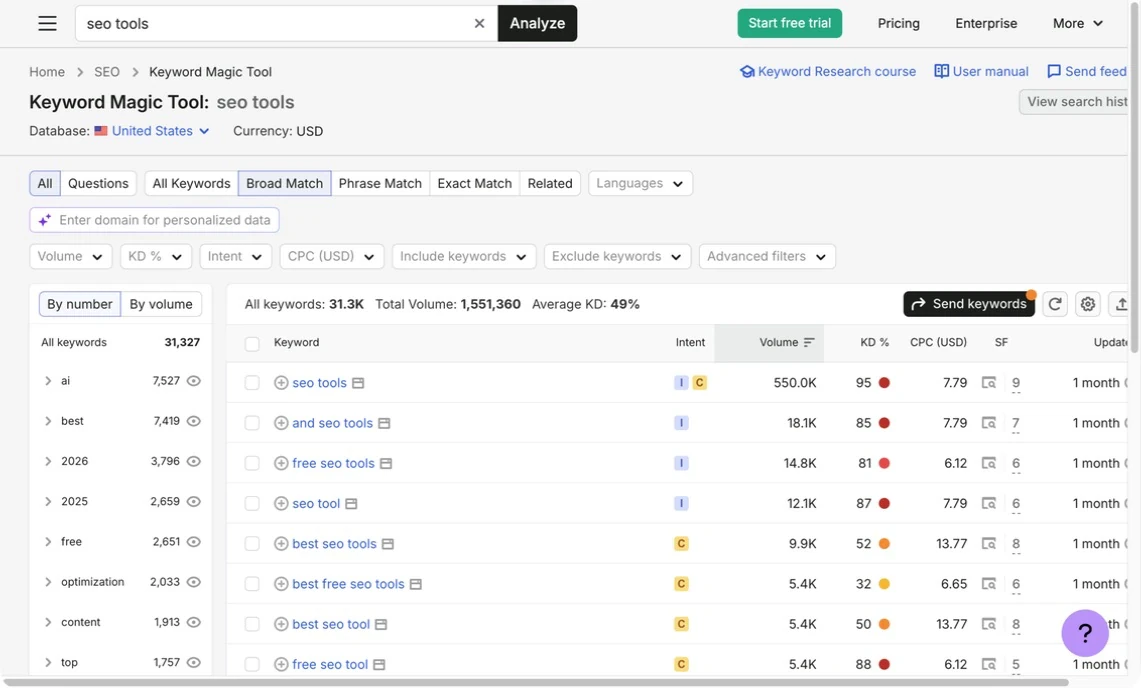
An SEO keyword research tool helps marketers discover how people search around a topic and decide which opportunities deserve deeper investigation.
A typical keyword platform may provide search-volume estimates, related keywords, CPC, search intent, Keyword Difficulty, questions, SERP features and competitor rankings. The mistake is assuming all of those metrics represent the same type of evidence.
Take Google Keyword Planner. Google’s Keyword Planner documentation explains how the tool can discover related keywords and provide historical search estimates. However, Keyword Planner exists within Google Ads, so its Competition metric describes advertiser competition rather than directly measuring how difficult a query will be to rank for organically.
That distinction matters. A keyword can show low advertising competition while the organic SERP is dominated by major publishers, marketplaces or highly authoritative specialist websites.
Semrush approaches keyword research differently. Its Keyword Magic Tool adds SEO-oriented information such as search intent, Keyword Difficulty, volume and related keyword groups.
Ahrefs Keywords Explorer introduces another methodology, combining keyword discovery with search-volume estimates, ranking difficulty, SERP information and wider organic opportunity data.
The result is predictable: different SEO keyword tools can show different values for the same query.
That does not necessarily mean one is broken. It means the numbers should be interpreted according to how they were produced and what decision you are trying to make.
For a closer look at Google’s data specifically, our Google Keyword Planner for SEO guide explains which numbers we would use for demand, advertising context and organic research.
If you are not ready to pay for another platform, our Free Keyword Research Tools comparison looks at how far Google, Semrush, Ahrefs and other free options can realistically take the research.
What Should an SEO Keyword Tool Actually Help You Decide?
The goal is not to produce the largest spreadsheet.
A useful keyword workflow should move you closer to deciding whether there is real demand, what search intent exists, what type of page currently satisfies that intent and whether your website has a realistic reason to compete.
The tool provides evidence. The final keyword decision comes from combining that evidence with the live SERP, your existing visibility and the value of the audience to the business.
2. Technical SEO and Audit Tools
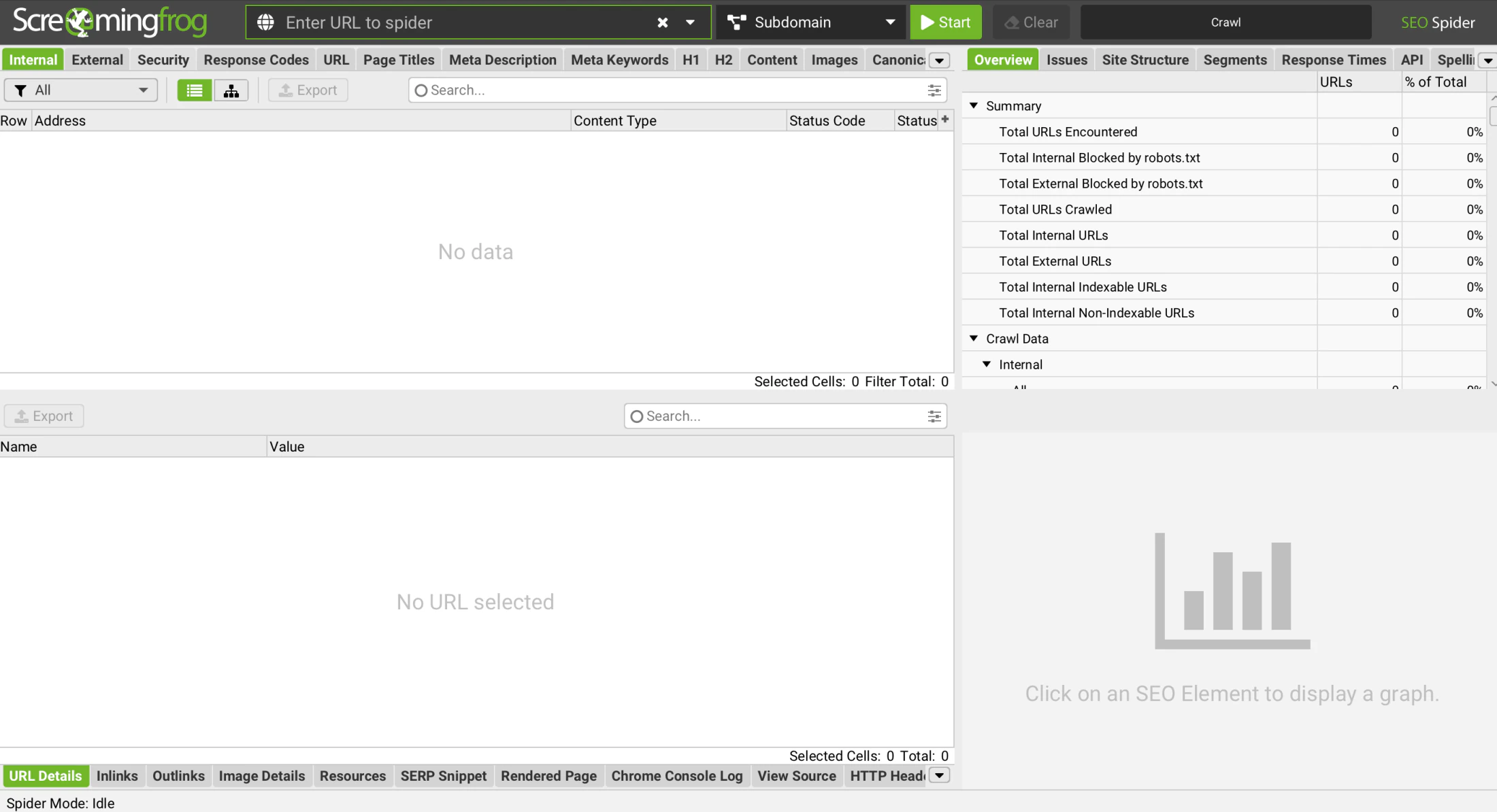
Technical SEO tools answer a different question: can search engines efficiently access, process and understand the website?
A crawler can inspect status codes, redirects, canonical tags, robots directives, internal links, metadata, hreflang, structured data, duplicate pages and other technical conditions across large numbers of URLs.
Screaming Frog SEO Spider is one of the clearest examples of a specialist technical SEO tool. Its free edition can crawl up to 500 URLs, while the paid licence expands the workflow with capabilities such as JavaScript rendering, crawl comparison, integrations, scheduling and more advanced configuration.
Broader SEO suites approach auditing differently.
Semrush Site Audit places technical findings inside a larger search-marketing ecosystem, while Ahrefs Site Audit connects website auditing with Ahrefs’ wider backlink and organic-search research environment.
Neither approach is automatically better.
The more important distinction is between detecting an issue and deciding its priority.
Suppose a crawler finds 400 missing image alt attributes, 70 duplicate titles and one accidentally noindexed revenue page. The single noindex problem can matter far more than hundreds of lower-impact warnings.
That is why an audit should not become a competition to generate the largest issue count.
If the goal is to complete as much technical diagnosis as possible without another subscription, our Free SEO Audit Tools comparison breaks down the actual crawl and usage limits of the major $0 options.
When auditing becomes a recurring operational requirement, our Best SEO Audit Tools comparison looks at the opposite question: which limitations are actually worth paying to remove?
3. Competitor and SERP Research Tools
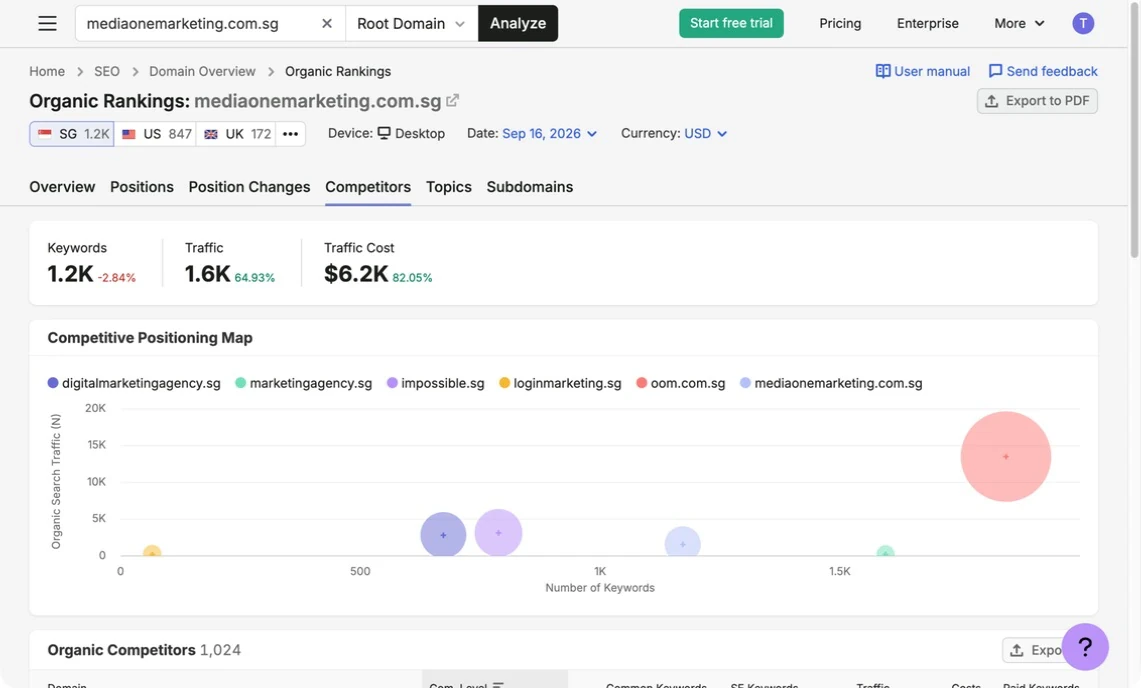
Keyword research can show that demand exists. Competitor research helps explain what you would actually need to compete for it.
Semrush and Ahrefs can surface competing domains, ranking keywords, top-performing pages, backlink profiles and content gaps. Similarweb adds another perspective around estimated traffic, audience behaviour and wider digital-market competition.
The live SERP still matters.
Imagine two keywords each have roughly 2,000 estimated monthly searches. One SERP is dominated by authoritative publishers with specialised resources and strong backlinks. The other contains inconsistent pages that only partially satisfy the query.
The volume may be similar. The opportunity is not.
This is why we would never let a proprietary Keyword Difficulty score make the final content decision by itself. Difficulty metrics are useful screening signals, but the ranking pages, search intent, backlink environment and your own ability to create something better still need to be examined.
A more useful sequence is:
keyword estimate → live SERP → competing pages → your capabilities → decision
The software helps narrow the investigation. It should not replace it.
4. Backlink and Authority Tools
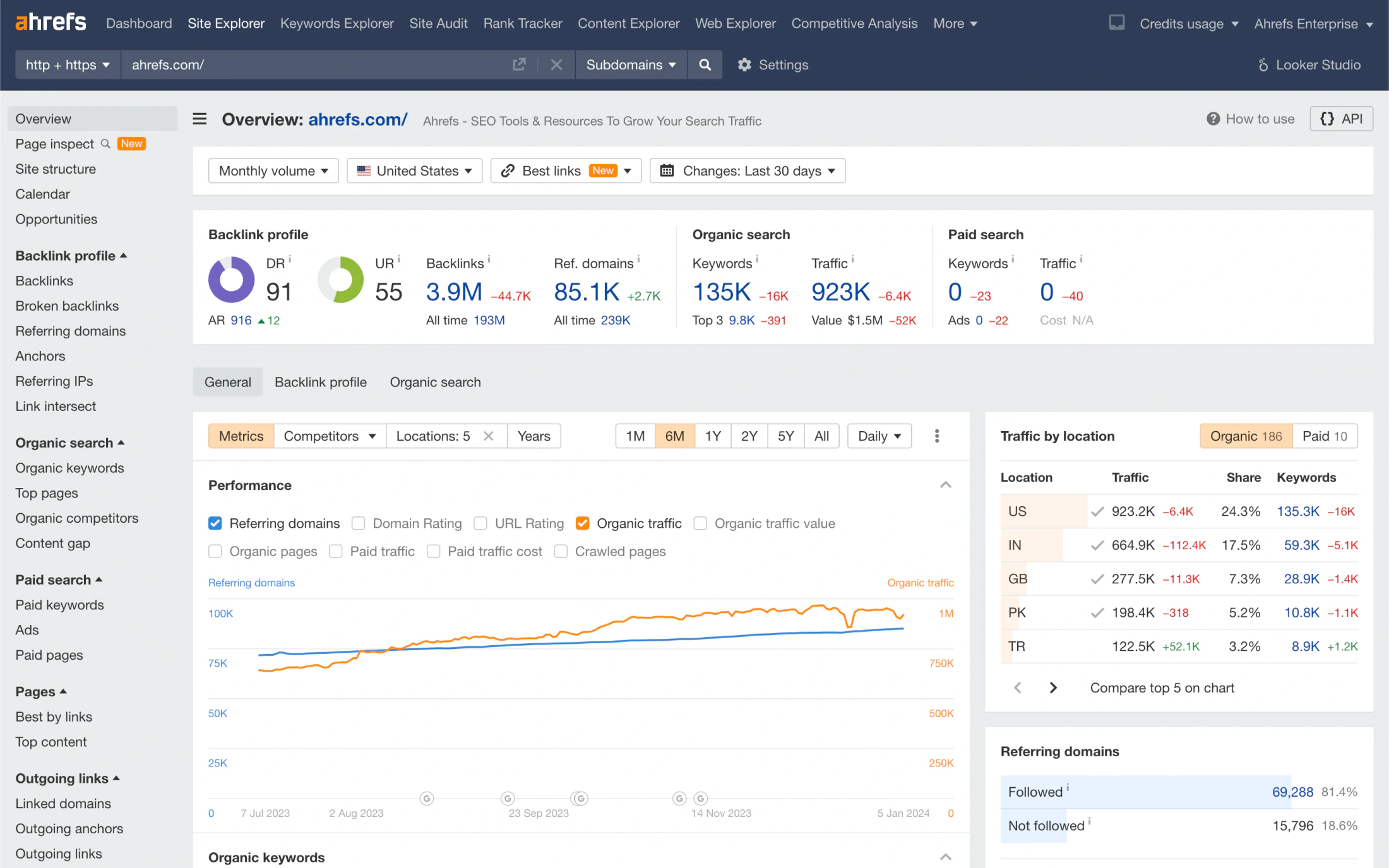
Backlink tools investigate which websites link to your domain, which pages attract those links and how your backlink profile compares with competitors.
They also introduce one of the most commonly misunderstood areas of SEO software: authority metrics.
Ahrefs has Domain Rating. Moz has Domain Authority. Semrush uses Authority Score. Majestic has metrics such as Trust Flow and Citation Flow.
These can be useful comparative signals, but they are not Google ranking scores. Each belongs to the company and methodology that created it.
That means a sensible backlink workflow does not stop at:
“This website has DA 70.”
You still need to understand where the link originates, whether the referring page is relevant, whether the website has meaningful search visibility, how the link fits into the page and whether pursuing it makes sense for the business.
The same principle applies when analysing competitors. Authority metrics can help filter a large dataset, but the actual pages, domains and links remain the evidence that deserves investigation.
5. Content and On-Page SEO Tools
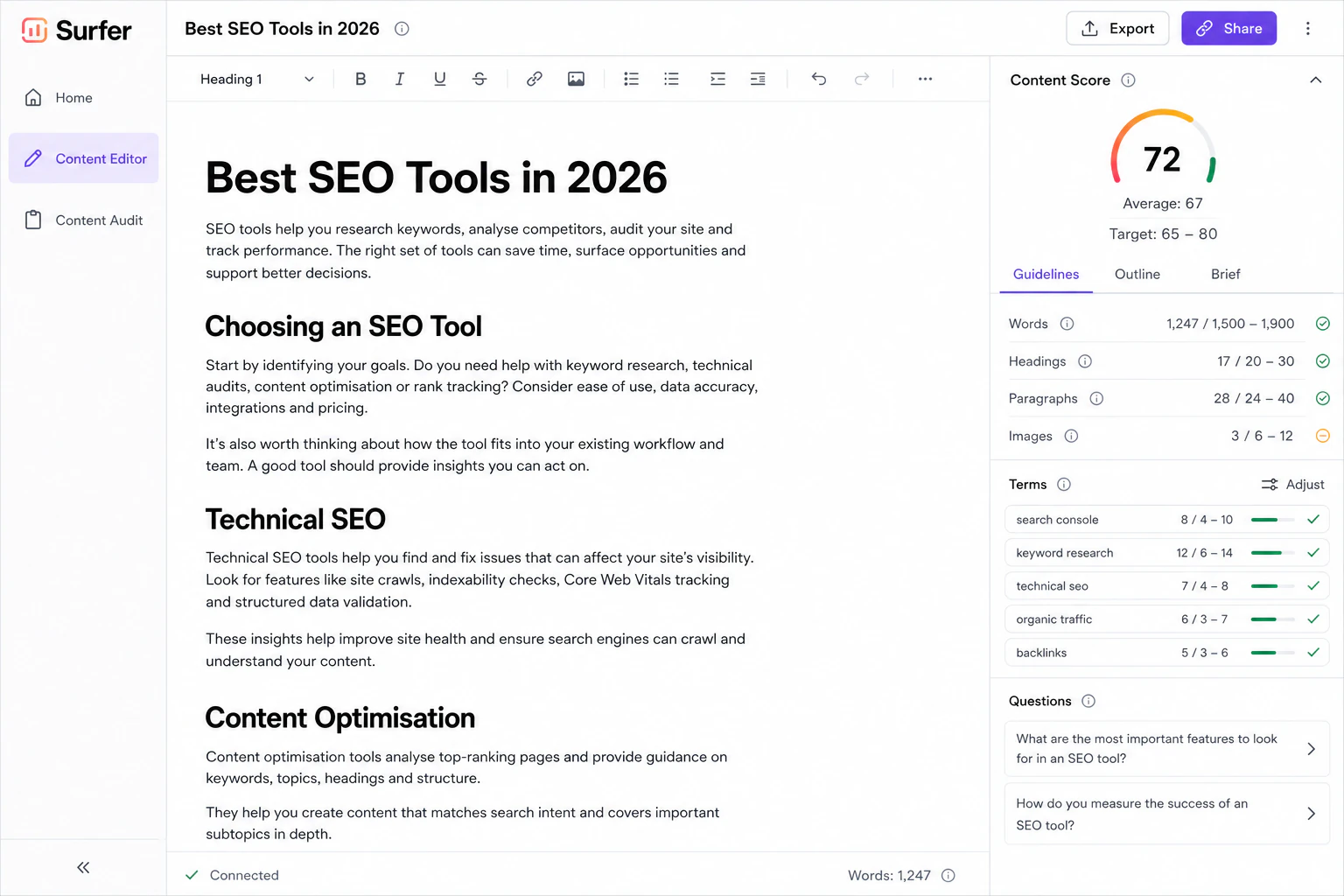
Content optimisation tools sit closer to the page itself.
Platforms such as Surfer and Clearscope can analyse pages ranking around a topic and surface patterns involving terminology, content coverage, headings and other on-page signals.
Broader SEO suites increasingly provide similar optimisation features inside larger keyword and research workflows.
These systems become useful when they expose something worth investigating.
They become less useful when the objective changes from improving the page to achieving a perfect proprietary score.
A page reaching 95/100 inside an optimisation platform has not earned a 95/100 score from Google. The number represents that platform’s model of what appears relevant or complete.
Search intent, originality, first-hand experience, usefulness, authority, links and the quality of competing pages still matter.
The useful question is therefore:
What does this analysis suggest the page may be missing?
Not:
How do we make every recommendation turn green?
6. Rank Tracking Tools

Rank tracking software monitors where a website appears for selected searches over time.
Unlike manually searching Google, dedicated trackers can repeatedly measure keywords across different locations, devices and search environments. They can also preserve historical movement and SERP-feature changes that would be difficult to monitor consistently by hand.
Platforms such as SE Ranking combine rank tracking with broader keyword, competitor and auditing functionality, while dedicated rank trackers place more emphasis on monitoring itself.
This becomes especially useful once the keyword set grows beyond what someone can realistically check manually.
But ranking movement still needs context.
Moving from position 15 to position 7 sounds positive. Whether it matters depends on what happened to impressions, clicks, qualified leads and revenue.
A keyword can improve while contributing almost nothing commercially. Another query may already sit at position four and consistently generate useful enquiries.
That is why rank tracking works best when eventually connected with Search Console, analytics and business evidence rather than functioning as an isolated scoreboard.
7. Search Analytics and First-Party SEO Data
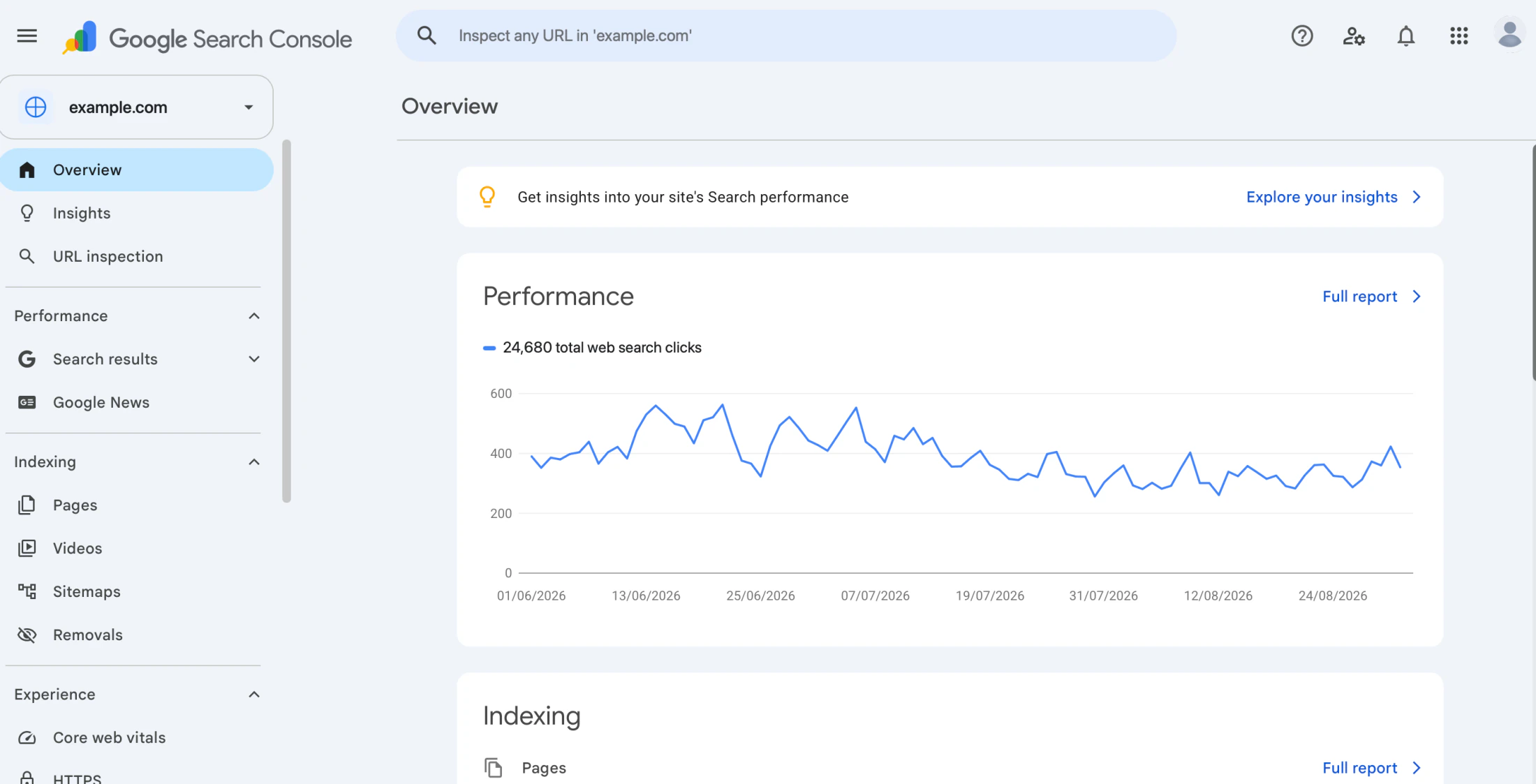
Some of the most important SEO tools are not traditional SEO suites.
Google Search Console and analytics platforms help answer what happened after research and optimisation became real search exposure.
Google’s Search Console Performance documentation explains how site owners can analyse queries, pages, clicks, impressions, CTR and average position.
Google Analytics adds the next layer by helping teams understand what visitors do after reaching the website.
That creates a useful evidence progression:
SEO estimate → live SERP → first-party search evidence → onsite behaviour → business outcome
Suppose an external keyword platform reports almost no volume for a long-tail topic, but Search Console shows your site receiving hundreds of impressions around closely related search language. At that point, your own first-party evidence becomes extremely difficult to ignore.
Likewise, a keyword showing enormous estimated demand does not automatically represent a valuable opportunity if the resulting visitors rarely engage, enquire or convert.
This is one reason we would rather connect SEO research with first-party performance data than continually add more keyword databases to the stack.
8. GEO and AI Search Tools
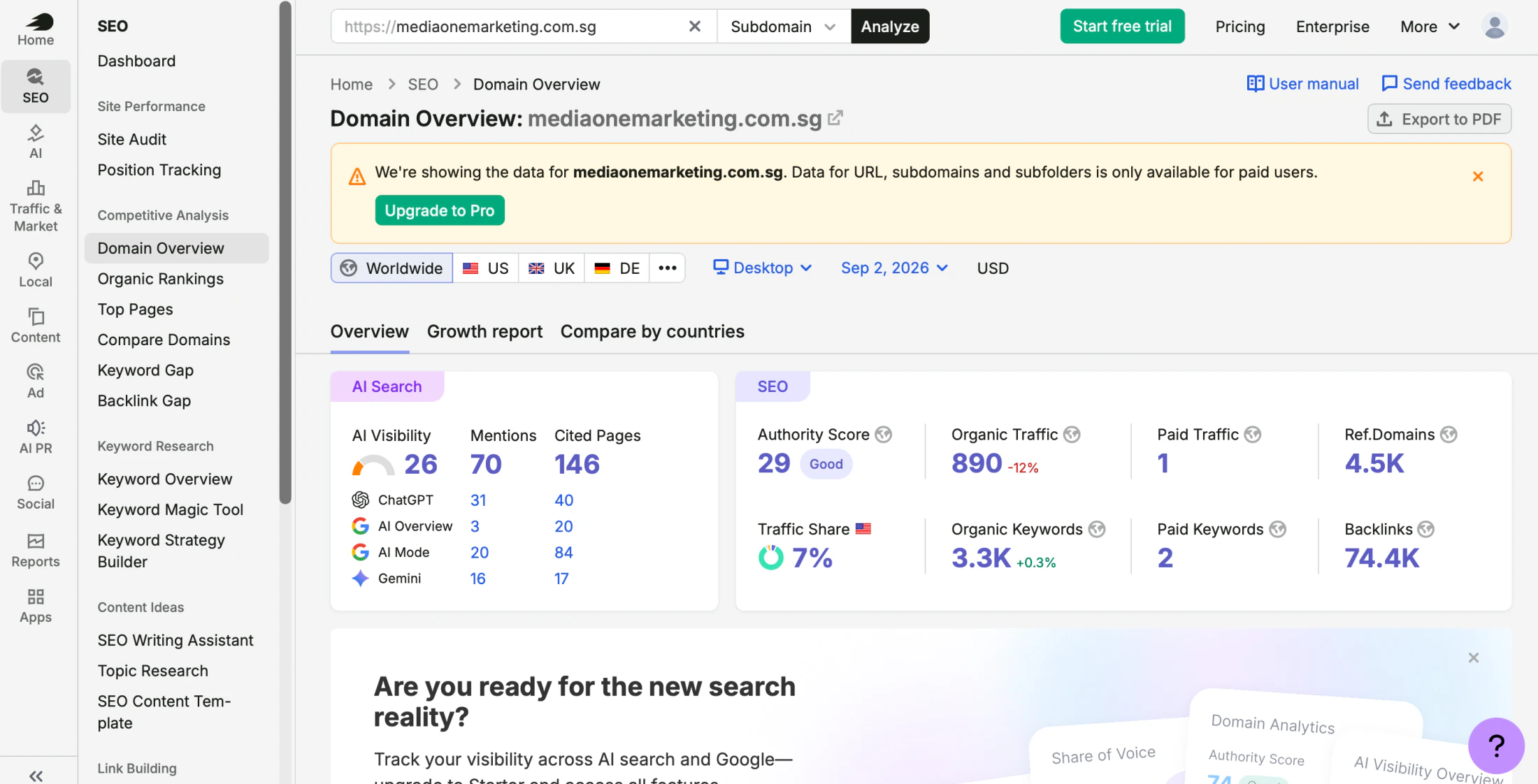
Search discovery increasingly extends beyond conventional Google rankings.
A marketing team may now also want to understand whether its brand appears in AI-generated answers, which pages or domains receive citations, what competitors are mentioned and whether important content is accessible and understandable to AI systems.
That has created a newer category around Generative Engine Optimisation, AI visibility and Answer Engine Optimisation.
The important point is that GEO does not erase the layers underneath it.
A page still needs to be accessible. The information still needs to be useful. Search and AI systems still need clear signals about the topic, entity and source behind that information.
We therefore see GEO as an additional visibility layer, not a replacement for keyword research, technical SEO, content, links or first-party measurement.
This distinction becomes particularly important when teams begin adding AI-visibility products to an already crowded SEO stack. The new platform should answer a genuinely new question instead of reproducing traditional SEO data in another dashboard.
How SEO Tools Fit Together
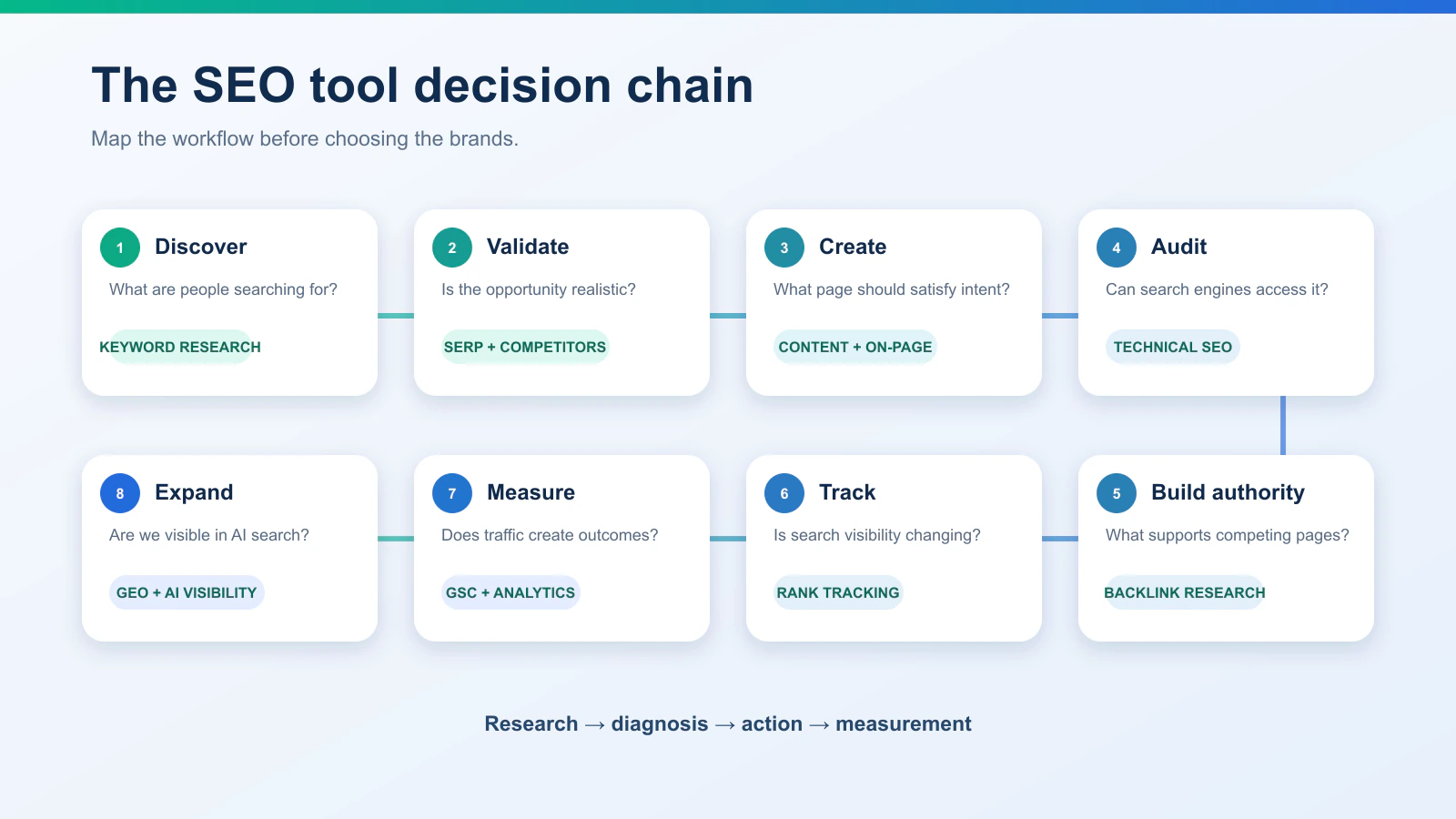
The easiest way to avoid building a messy tool stack is to stop thinking about brands temporarily and map the workflow instead.
The SEO Tool Decision Chain
| Stage | Question | Tool type |
| Discover | What are people searching for? | Keyword research |
| Validate | Is this opportunity realistic? | SERP + competitor research |
| Create | What page should satisfy the intent? | Content / on-page |
| Audit | Can search engines access it correctly? | Technical SEO |
| Build authority | What supports competing pages? | Backlink research |
| Track | Is search visibility changing? | Rank tracking |
| Measure | Is organic traffic producing useful outcomes? | GSC + analytics |
| Expand | Are we visible in AI search as well? | GEO / AI visibility |
This is where many oversized SEO stacks become inefficient.
A company might pay three platforms that all provide keyword-volume estimates, several products with their own site-health scores and two rank trackers showing nearly identical movements.
More dashboards do not automatically produce better decisions.
The more useful question is:
What new decision does this tool allow us to make that our existing stack cannot answer efficiently?
Free SEO Stack vs All-in-One Suite vs Specialist Tools
There are three practical ways to build an SEO stack.
A free stack combines first-party and specialist tools such as Google Search Console, Google Analytics, Google Keyword Planner, Google Trends, PageSpeed Insights, Screaming Frog and Bing Webmaster Tools.
This can take a smaller site surprisingly far. The trade-off is that evidence lives across several interfaces and often needs to be combined manually.
An all-in-one SEO suite reduces some of those handoffs. Semrush, Ahrefs and SE Ranking can combine several functions such as keyword research, competitor analysis, auditing, backlinks and rank tracking within one environment.
The downside appears when the subscription contains far more capability than the team actually uses.
A specialist stack goes in the opposite direction. A company might use one product for crawling, another for rankings, another for backlink intelligence and another for content optimisation.
That can create greater depth in individual areas, but it also increases subscriptions, integrations and context switching.
If you’re already deciding between those models rather than learning what each category does, our Best SEO Tools in 2026 comparison goes deeper into the all-in-one suite versus specialist stack decision.
An Integrated SEO, Content and GEO Workspace
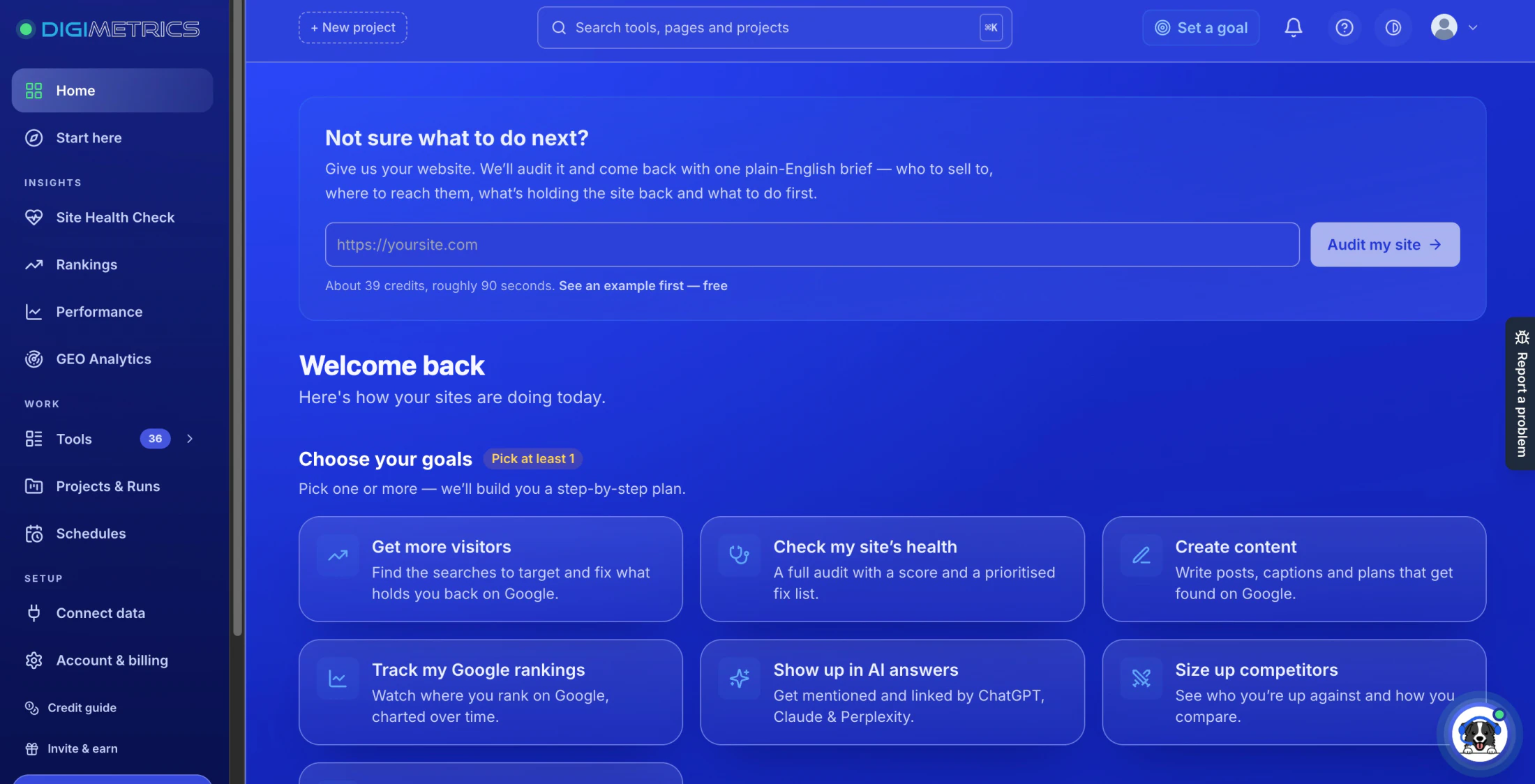
Disclosure: Digimetrics is built by our team.
Digimetrics follows the integrated-workflow model rather than specialising exclusively in one SEO job.
Its current toolkit connects keyword analysis, rank checking, technical crawling, full-site auditing, competitor research, backlink analysis, SEO diagnostics and on-page optimisation with adjacent content and GEO workflows.
The relevant question is not whether having more functions automatically makes it better than a specialist product.
A crawler such as Screaming Frog may still provide greater flexibility for a complicated technical investigation. A mature backlink platform may offer more specialist link intelligence.
The integrated model becomes useful when repeatedly moving findings from one platform into another has itself become a problem.
For example, a workflow may start with keyword evidence, move into competitor analysis, identify an existing page, uncover a technical or content problem and then require monitoring after the change.
If every stage requires rebuilding the context in another platform, the handoffs themselves become part of the cost.
In other words, workflow consolidation is a capability too.
When Should You Pay for SEO Tools?
Paid SEO software becomes easier to justify once you can name the constraint it removes.
A free crawler that covers the entire website may be completely sufficient today. Once the same property grows beyond its crawl allowance, the limitation becomes operationally important.
The same applies when manual rank checks become unmanageable, competitor research is unavailable, keyword exports are constantly restricted or several hours each week disappear into combining data from different platforms.
A useful rule is:
Pay when the limitation becomes more expensive than the tool.
That cost does not have to appear directly on an invoice. It may be staff time, missing evidence, delayed reporting, technical risk or repeated context switching.
Keyword research is a good example. Our Free Keyword Research Tools comparison shows how far a combination of free sources can take the workflow before limits around scale, exports or competitive data start getting in the way.
Technical auditing follows the same logic. Our Free SEO Audit Tools guide focuses on the $0 stack, while the Best SEO Audit Tools comparison focuses on what teams are actually paying to unlock.
Buying a larger SEO platform simply because it has more features is not necessarily an upgrade. If those features do not remove an existing problem, they may only create another dashboard to maintain.
How to Choose an SEO Tool Without Overbuying
Before adding another subscription, start with the decision you cannot currently make.
If the problem is identifying search demand, you probably need better keyword evidence. If the problem is understanding why a website is not being indexed correctly, another keyword database will not help. If the team already has enough data but spends hours moving it between spreadsheets, the constraint may be workflow rather than research depth.
Then ask whether you already own the information.
Search Console may already provide the first-party visibility data you need. Your existing SEO suite may already include adequate rank tracking. A free crawler may already cover the entire website.
Frequency matters too. A capability used every day across twenty clients can justify a very different subscription from software opened twice per year.
The strongest tools tend to remove something measurable: manual work, missing data, reporting overhead, technical risk or another subscription.
If you cannot clearly identify what the new tool removes, another subscription may not be the next thing the SEO workflow needs.
Common SEO Tool Mistakes
Some of the biggest problems with SEO software come from giving a metric the wrong job.
Google Ads Competition is not organic Keyword Difficulty. Keyword Planner’s advertiser competition data belongs to paid-search research rather than directly measuring the strength of organic results. We break that distinction down further in our Google Keyword Planner for SEO guide.
Keyword Difficulty is not a final SEO decision. It can be a useful filter, but the live SERP, intent, backlinks and your own competitive position still need to be considered.
Domain authority metrics are not Google metrics. They are proprietary models produced by SEO platforms and should be interpreted within the methodology that created them.
A perfect audit score is not the objective. One serious indexing problem can matter more than hundreds of low-impact warnings.
The same principle applies to keyword mapping. An SEO keyword research tool returning separate rows for “best SEO tool,” “best SEO tools” and a closely related variation does not automatically justify three separate pages.
If the search intent and ranking results substantially overlap, one stronger page may be the better decision.
What SEO Tools Still Cannot Do
SEO software reduces uncertainty. It does not eliminate the need for judgement.
A platform does not inherently understand which customer problem is most important to the business, how much a particular lead is worth or whether engineering should prioritise one technical issue over another.
It also cannot reliably determine that one observed change caused another simply because the two happened at roughly the same time.
That is why we treat SEO tools as evidence systems rather than decision makers.
A crawler provides technical evidence. A keyword platform provides demand and competitive estimates. Search Console provides first-party Google evidence. Analytics provides onsite behaviour. CRM and revenue data provide commercial context.
The strategy comes from connecting those layers.
This is also why buying another tool is not always the answer when SEO performance stalls. Sometimes the team already has enough data. The missing piece is interpretation.
What SEO Stack Do You Actually Need?
For a small or local website, we would usually start lean. Search Console, GA4, Keyword Planner, Screaming Frog and PageSpeed Insights can cover much of the initial workflow before another subscription becomes necessary.
A content-heavy website may add deeper keyword research and content optimisation. A growing SEO team may then justify an all-in-one suite alongside a technical crawler and first-party analytics.
Agencies usually require another layer because research, crawling, rank tracking and reporting need to operate consistently across many properties.
Enterprise and ecommerce websites introduce different constraints again. Large-scale crawling, server logs, automated monitoring and more sophisticated analytics become much more valuable when one technical mistake can affect hundreds of thousands of URLs.
Teams now responsible for AI discovery can add a GEO or AI-visibility layer to the traditional stack rather than rebuilding the entire workflow around AI.
The products change. The underlying jobs are much more stable.
Final Verdict: Start With the Decision, Then Choose the Tool
The easiest way to build an expensive SEO stack is to start with software instead of the problem.
If you need to understand demand, start with keyword research. If the question is competitive strength, investigate the SERP and competing pages. If search engines cannot properly access the website, use technical crawl and indexing evidence. If visibility needs monitoring, use rank tracking. Once traffic arrives, connect search performance with analytics and commercial outcomes.
GEO and AI-search tools add another useful layer in 2026, but they do not eliminate the foundations underneath them.
The best SEO stack is therefore not the one with the longest feature list. It is the smallest combination that gives your team enough reliable evidence to move from research → diagnosis → action → measurement without repeatedly paying for the same answer.
If you’ve reached the point where the question is no longer “What do SEO tools actually do?” but “Which SEO tools should we pay for?”, continue with our Best SEO Tools in 2026 comparison.
Frequently Asked Questions
What Are SEO Tools Used For?
SEO tools help marketers research search demand, understand competitors, audit websites, analyse backlinks, optimise pages, track rankings and measure organic-search performance.
Different platforms specialise in different parts of that workflow, which is why one tool should not automatically be treated as the source of truth for every SEO decision.
What Is an SEO Keyword Tool?
An SEO keyword tool helps discover and evaluate the searches people make around a topic.
Depending on the platform, it may provide keyword ideas, estimated search volume, CPC, search intent, Keyword Difficulty, SERP data and competitor rankings.
For a $0 workflow, our Free Keyword Research Tools comparison looks at the different jobs Google Keyword Planner, Search Console, Semrush, Ahrefs and other tools can perform without a full paid subscription.
What Is the Best SEO Keyword Research Tool?
There is no universal answer because different sources specialise in different forms of evidence.
Google Keyword Planner is useful for demand and paid-search context, while platforms such as Semrush and Ahrefs add broader organic and competitor information. Search Console becomes particularly valuable once your own website has first-party visibility evidence.
If Google Keyword Planner is part of your workflow, our Google Keyword Planner for SEO analysis explains which of its numbers we would use and which require more context.
Do I Need to Pay for SEO Tools?
Not necessarily.
Google Search Console, GA4, Keyword Planner, Google Trends, PageSpeed Insights and free or limited crawlers can cover a substantial part of SEO for smaller websites.
Paid software becomes easier to justify when the team needs greater scale, deeper competitor intelligence, historical data, automation or less manual work between tools.
What Are the Best Free SEO Audit Tools?
There is no single free tool that covers an entire audit.
Search Console is valuable for indexing and Google search evidence, Screaming Frog provides direct technical crawl data, PageSpeed Insights covers the performance layer and Ahrefs Webmaster Tools can add recurring auditing for verified properties.
Our Free SEO Audit Tools comparison explains how those tools fit together and where their free limits begin to matter.
Can One SEO Tool Do Everything?
No SEO platform is deepest in every discipline.
All-in-one platforms reduce workflow fragmentation, while specialist products concentrate more heavily on individual jobs such as crawling, rank tracking, backlink analysis or content optimisation.
The right approach depends on where your own workflow is currently breaking down.
Are SEO Tool Scores Accurate?
They can be useful, but proprietary metrics should be interpreted according to the methodology behind them.
Keyword Difficulty, authority metrics, content scores and audit health scores are models built by individual companies rather than universal Google measurements.
Use them alongside the live SERP, first-party search evidence and business outcomes.
What Is a Good Free SEO Tool Stack?
For a smaller website, a practical starting point is Search Console for Google search evidence, GA4 for onsite behaviour, Keyword Planner for demand research, Screaming Frog for technical crawling and PageSpeed Insights for performance.
Add another platform when one of those tools can no longer answer an important question efficiently.
When Should I Upgrade to Paid SEO Software?
Upgrade when you can clearly identify the recurring limitation you are paying to remove.
That could be crawl capacity, competitor intelligence, historical data, rank-tracking scale, automation, reporting or the amount of manual work required to reconcile several platforms.
If there is no clear answer to “What will this subscription allow us to do that we cannot do efficiently now?”, it may be too early to add another SEO tool.
Disclosure: digitalmarketingtools.ai is sponsored by Digimetrics.ai. Sponsored Highlights are clearly labelled advertising. Our reviews, comparisons and guides are written to be useful and fair regardless of who sponsors the site. Read the full disclosure.


