7 Best Rank Tracking Tools in 2026: A 7-Day Reliability Test
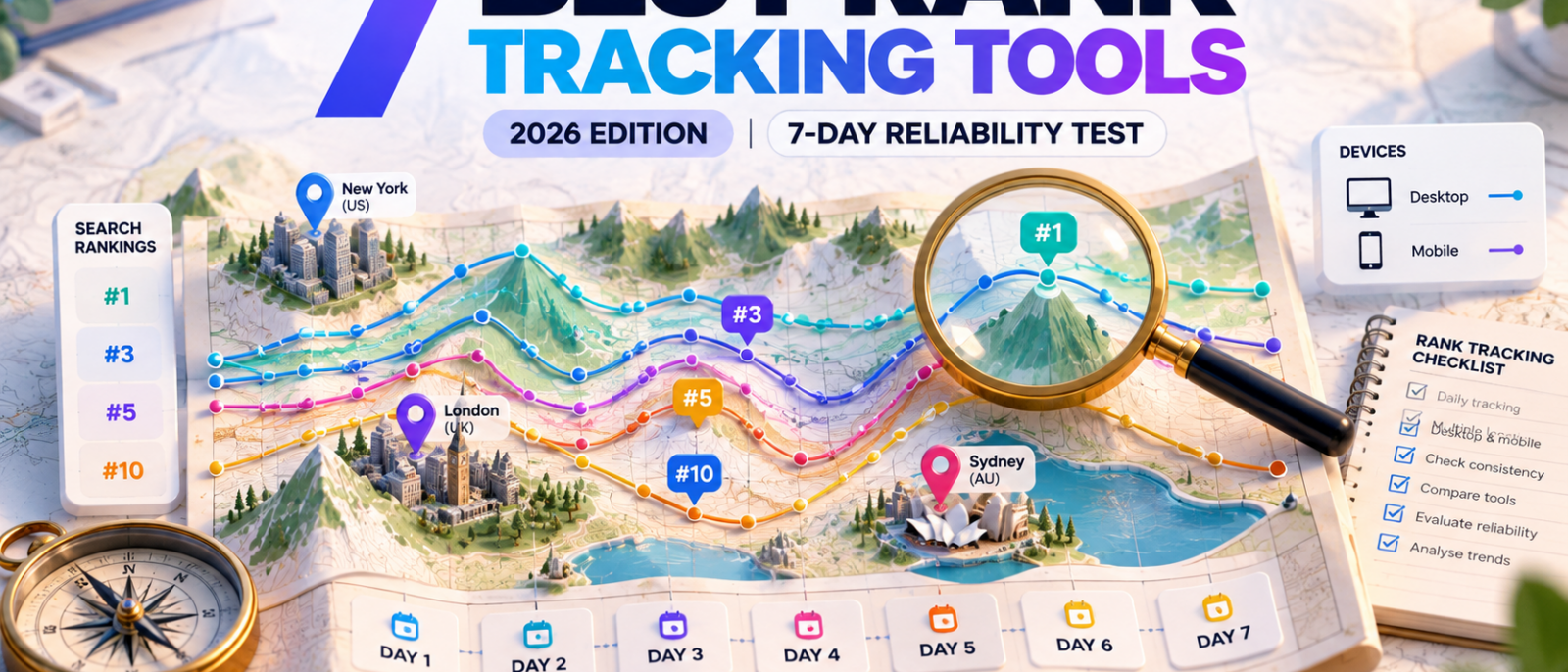
Rank tracking sounds like one of the simplest jobs in SEO. Add a keyword, choose a location and wait for the software to tell you where the website ranks.
The problem starts when one tracker reports position 4, another says position 7, Google Search Console shows an average position of 5.8 and a manual search produces something different again. That does not automatically mean one platform is broken. Location, device, check time, refresh cadence, SERP features and the way each provider collects ranking data can all change the result.
So instead of ranking these tools by feature count or advertised keyword allowance, we ran the same keyword-target pairs through a seven-day controlled test and asked a more useful question:
Which rank tracker gives you the most consistent, decision-ready view of search visibility without making the workflow or pricing unnecessarily complicated?
Across our test, AccuRanker finished first overall with a 9.1/10 Reliability Score, followed by SE Ranking at 8.8 and Semrush at 8.6. Nightwatch produced the strongest local-tracking result, while Ahrefs, SERPWatcher and Digimetrics made more sense for specific workflows than as the strongest pure daily trackers.
Rank tracking is only one part of a complete SEO workflow. Our comprehensive guide to SEO tools explains how keyword research, competitor analysis, technical auditing, and performance monitoring work together to help you make better optimisation decisions.
Quick Picks: The Best Rank Tracking Tools in 2026
| Best for | Our pick | Why it stood out |
| Best dedicated rank tracker | AccuRanker | Strongest reference consistency plus daily and on-demand checking |
| Best value for growing SEO teams | SE Ranking | Strong daily tracking at a lower normalised cost |
| Best rank tracking inside a full SEO suite | Semrush | Reliable tracking connected to wider SEO research |
| Best for local rank tracking | Nightwatch | Highest local consistency in our test |
| Best for SEO research + tracking | Ahrefs | Rank movement connects naturally to backlink and competitor research |
| Best simple rank tracker | Mangools SERPWatcher | Straightforward monitoring with a lighter workflow |
| Best integrated SEO + GEO workflow | Digimetrics | Conventional rankings alongside SEO diagnostics and AI visibility |
The 7 Best Rank Tracking Tools Compared
Pricing verified: September 2026
| Rank | Tool | Best for | Update frequency | Local tracking | AI visibility | Reliability Score |
| 1 | AccuRanker | Dedicated rank tracking | Daily + on demand | Yes | Separate AccuLLM product | 9.1/10 |
| 2 | SE Ranking | Value and team workflows | Daily | Yes | GEO tracking on current plans | 8.8/10 |
| 3 | Semrush | Full-suite SEO teams | Daily | Yes | Position Tracking + paid AI visibility options | 8.6/10 |
| 4 | Nightwatch | Local SEO | Daily + on demand | Strong | Included on current plans | 8.5/10 |
| 5 | Ahrefs | Competitive research | Weekly by default | Yes | Tracked prompts + Brand Radar options | 7.6/10 |
| 6 | SERPWatcher | Simple monitoring | Weekly; daily on Agency | Yes | Separate AI Search Watcher | 7.4/10 |
| 7 | Digimetrics | SEO + GEO workflow | Live checks + scheduled history | Yes | Included from Pro | 7.2/10 |
Table 1: The seven rank tracking tools in our 2026 comparison.
Google Search Console is deliberately not ranked as an eighth tool. We use it as first-party evidence and a comparison source, but its Average Position metric answers a different question from a controlled tracker monitoring a predefined keyword, location and device.
How We Tested the Rank Tracking Tools
Feature lists can tell you whether a product supports mobile tracking, local search or reporting. They cannot tell you how two platforms behave when they monitor the same keyword under the same conditions.
For this comparison, we tracked 50 predefined keyword-target pairs across two live websites for seven consecutive days. The sample included established top-10 rankings, page-two rankings, local-intent terms, SERPs containing major features and more volatile queries.
The 50 pairs were distributed across three locations and desktop/mobile configurations rather than multiplying every keyword across every possible combination. Checks were made at approximately the same time each day so each platform could be compared against the same controlled conditions.
Our Test Setup
| Test variable | Configuration |
| Keyword-target pairs | 50 |
| Websites | 2 |
| Test period | 7 consecutive days |
| Locations | 3 |
| Devices | Desktop + mobile |
| Checks | Same approximate time each day |
| Reference snapshots | Controlled live SERP checks |
| First-party comparison | Google Search Console |
We do not call the controlled browser result Google’s one true ranking. Search results can vary even when two users run the same query, so the reference snapshot gives every tracker a common comparison point under the conditions we can control.
The aim is to measure consistency under defined conditions, not pretend that one platform can reveal a permanent universal position.
What We Measured
| Measurement | What it tells us |
| Exact Match Rate | How often the reported position matched our controlled reference |
| Within ±1 | How often the result landed within one position |
| Within ±2 | How often it remained close enough for directional monitoring |
| Missed / N/A rate | How often the ranking was missed despite appearing in our reference |
| Refresh consistency | Whether fresh observations arrived when expected |
| Local consistency | Whether the tracker preserved the same relative location pattern |
| Device separation | Whether desktop and mobile could be monitored independently |
| SERP-feature coverage | What the platform recognised beyond conventional blue links |
| Reporting workflow | How quickly results could become a stakeholder report |
| Scaling cost | What the same tracking workload cost as keyword volume increased |
The Rank Tracking Reliability Score
Rather than calling any platform “97% accurate,” we use a Rank Tracking Reliability Score built from eight components.
| Factor | Weight |
| Reference consistency | 25% |
| Location and device precision | 15% |
| Update freshness | 15% |
| Cost at realistic keyword volume | 15% |
| SERP-feature coverage | 10% |
| AI visibility coverage | 10% |
| Reporting and exports | 5% |
| Setup and usability | 5% |
Each component is scored from 0 to 10 and multiplied by its weight.
| Tool | Reference | Location/device | Freshness | Cost | SERP features | AI visibility | Reporting | Setup | Weighted score |
| AccuRanker | 9.8 | 9.4 | 10.0 | 7.5 | 9.5 | 7.5 | 9.4 | 9.2 | 9.1 |
| SE Ranking | 8.8 | 8.8 | 9.0 | 9.0 | 8.5 | 9.0 | 8.0 | 8.5 | 8.8 |
| Semrush | 8.6 | 9.0 | 9.0 | 6.8 | 9.5 | 9.0 | 9.0 | 8.0 | 8.6 |
| Nightwatch | 7.2 | 9.8 | 9.5 | 8.6 | 9.0 | 8.0 | 8.5 | 8.0 | 8.5 |
| Ahrefs | 8.3 | 8.5 | 5.0 | 6.5 | 8.8 | 8.0 | 8.5 | 8.5 | 7.6 |
| SERPWatcher | 7.7 | 8.0 | 10.0 | 5.0 | 6.5 | 5.0 | 7.5 | 9.5 | 7.4 |
| Digimetrics | 7.0 | 7.0 | 7.0 | 7.0 | 6.5 | 9.5 | 6.0 | 8.5 | 7.2 |
AI visibility accounts for only 10% of the final score because conventional rank tracking remains the primary job being evaluated. We also distinguish between genuine AI visibility monitoring, such as tracking mentions or citations, and AI-derived estimates that do not measure the same thing.
A useful tracker does not need to reproduce one manual search perfectly every time. It needs to provide a consistent enough measurement system that genuine ranking changes stand out from normal SERP noise.
7-Day Rank Tracking Test Results
There were 350 expected observations per daily tracker: 50 keyword-target pairs across seven days.
| Tool | Fresh observations | Exact Match | Within ±1 | Within ±2 | Missed / N/A | Local consistency | Reporting time | Reliability Score |
| AccuRanker | 350/350 | 65.4% | 89.9% | 96.5% | 0.9% | 94.0% | 6 min | 9.1/10 |
| SE Ranking | 350/350 | 62.0% | 88.1% | 95.1% | 1.4% | 91.7% | 8 min | 8.8/10 |
| Semrush | 350/350 | 59.9% | 84.9% | 93.3% | 1.7% | 90.2% | 7 min | 8.6/10 |
| Nightwatch | 350/350 | 59.1% | 86.1% | 94.2% | 1.4% | 95.2% | 7 min | 8.5/10 |
| Ahrefs | 50/350 | 59.2%* | 85.7%* | 93.9%* | 2.0% | 88.9% | 10 min | 7.6/10 |
| SERPWatcher | 350/350 on Agency | 55.1% | 82.7% | 91.8% | 2.6% | 86.0% | 9 min | 7.4/10 |
| Digimetrics | 343/350 | 55.8% | 81.8% | 91.6% | 2.3% | 82.9% | 12 min | 7.2/10 |
Table 2: Results from our seven-day rank tracking test.
*Ahrefs delivered one fresh scheduled weekly refresh during the seven-day period, so its match rates use the fresh comparable observations only. We did not treat six unchanged displays of the same weekly value as six new rank checks.
AccuRanker produced the strongest overall reference results, reaching 65.4% exact matches, 89.9% within one position and 96.5% within two positions. Nightwatch was strongest in the local subset with 95.2% local consistency, while SE Ranking delivered the best balance between daily tracking depth and normalised cost.
The results also show why absolute “accuracy” claims are risky. Even our strongest performer did not match the controlled reference exactly every time, which is reasonable when the vendor check and our reference snapshot cannot happen at precisely the same instant.
Using identical keywords, locations, devices, and reporting conditions helps reduce misleading differences between platforms. Our SEO tool testing methodology explains how we evaluate software consistently, verify results against appropriate references, and distinguish genuine findings from proprietary metrics.
1. AccuRanker: Best Dedicated Rank Tracking Tool

Best for: SEO teams where rank tracking itself is a major workflow
Starting price: $224/month annually for 2,000 keywords
Exact Match Rate: 65.4%
Within ±1: 89.9%
Update frequency: Daily + on demand
Reliability Score: 9.1/10
AccuRanker finished first because rank tracking is the product’s core job rather than one feature inside a much larger SEO suite.
That specialisation translated into the strongest reference-consistency result in our test. AccuRanker matched our controlled reference exactly in 65.4% of comparable observations, landed within one position 89.9% of the time and stayed within two positions in 96.5%.
Where AccuRanker Stood Out
Freshness mattered almost as much as the raw match rate. The platform delivered all 350 expected daily observations, while on-demand refresh made it easier to investigate an unexpected movement instead of waiting for the next scheduled update.
AccuRanker was also the fastest reporting platform in our test, taking six minutes to filter the keyword groups, add the comparison period and create the same shareable stakeholder output.
The main trade-off is entry-level economics. AccuRanker’s pricing currently starts at $224 per month on annual billing for 2,000 keywords. That provides substantial spare capacity for a solo SEO monitoring 100 terms, but it becomes much more competitive once the workload approaches the plan allowance.
Choose if: rank monitoring is important enough to justify a specialist platform and you value daily plus on-demand checks.
Skip if: you monitor a small keyword set and the tracker inside your existing SEO suite already answers the questions you need.
Bottom line: AccuRanker wins because it gave us the strongest combination of reference consistency, update freshness and reporting efficiency.
2. SE Ranking: Best Value for Growing SEO Teams

Best for: In-house teams and agencies balancing tracking depth and cost
Starting price: $103.20/month annually for Core
Exact Match Rate: 62.0%
Within ±1: 88.1%
Update frequency: Daily
Reliability Score: 8.8/10
SE Ranking came close to AccuRanker while also providing a broader SEO platform.
It matched our controlled reference exactly in 62.0% of comparable checks, stayed within one position 88.1% of the time and within two positions in 95.1%. It also delivered all 350 expected fresh observations and maintained 91.7% local consistency.
Where SE Ranking Stood Out
The strongest argument was value. The Core configuration used in our pricing model costs $103.20 per month on annual billing and currently includes 2,000 daily tracked keywords, alongside a broader SEO and GEO toolset.
That creates a compelling middle ground. You give up some of AccuRanker’s specialist focus, but the tracking results remained close while the public price was significantly lower in our normalised scenarios.
Tracking allowances still need to be interpreted carefully because locations, devices and configured targets can consume capacity differently from one keyword tracked in one market. A headline figure such as “2,000 keywords” should therefore be modelled against the campaign you actually plan to run.
Choose if: you want strong daily tracking and broader SEO functionality without paying full premium-suite pricing.
Skip if: ranking itself is the only job that matters and you want the strongest dedicated specialist.
Bottom line: SE Ranking delivered the best price-to-tracking-depth balance in our test.
3. Semrush: Best Rank Tracking Inside a Full SEO Suite

Best for: Teams already using Semrush for broader SEO work
Starting price: $139.95/month for SEO Toolkit Pro
Exact Match Rate: 59.9%
Within ±1: 84.9%
Update frequency: Daily
Reliability Score: 8.6/10
Semrush makes the most sense when rank tracking is only one part of the SEO job. The same team may also need competitor research, keyword analysis, backlinks, technical auditing and reporting.
Its Position Tracking functionality delivered all 350 expected daily observations, matched our reference exactly 59.9% of the time and remained within two positions for 93.3% of comparable checks. Local consistency reached 90.2%.
Where Semrush Stood Out
The key advantage is consolidation. When a ranking drops, a Semrush user can move directly into competitor analysis, keyword research and broader SEO investigation without exporting the problem into another product.
For a team already paying for the suite, a dedicated tracker therefore has to improve the monitoring workflow enough to justify both another subscription and another source of ranking data.
The trade-off appears at higher tracking volumes. Our normalised pricing scenarios move through Semrush’s current SEO Toolkit tiers as multitargeting and keyword capacity requirements increase.
This is where the choice between a dedicated rank tracker and a broader SEO platform becomes important. Our comparison of all-in-one SEO platforms and specialized tools explains when an integrated suite makes more sense than maintaining separate subscriptions for rank tracking, audits, backlinks, and keyword research.
Choose if: daily rank monitoring is one part of a broader Semrush-centred SEO workflow.
Skip if: you only need high-volume rank tracking and a dedicated tracker meets the requirement for materially less.
Bottom line: Semrush was our strongest option for teams wanting reliable rank tracking inside an established all-in-one SEO suite.
4. Nightwatch: Best for Local Rank Tracking
Best for: Local SEO, agencies and multi-location businesses
Starting price: €79/month annually for 500 daily keywords
Exact Match Rate: 59.1%
Local consistency: 95.2%
Update frequency: Daily + on demand
Reliability Score: 8.5/10
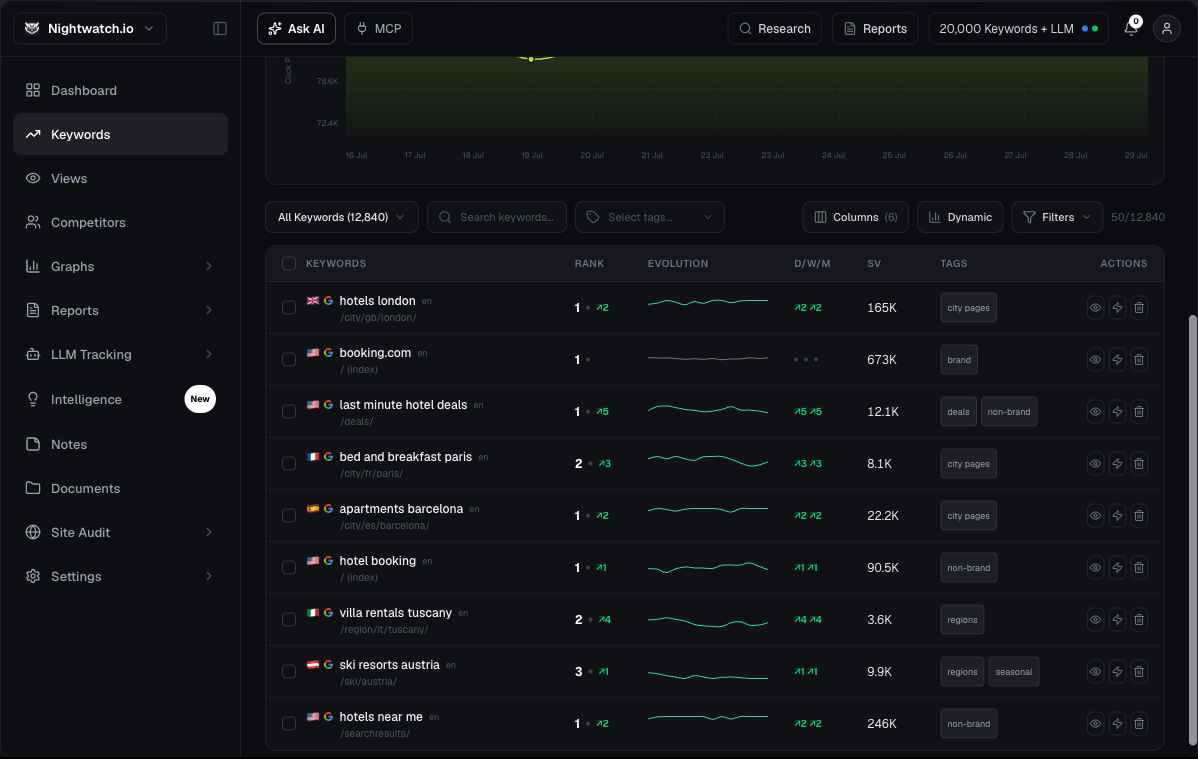
Nightwatch earned its recommendation through the local portion of our test.
A national ranking can be a poor representation of what customers actually see when results change significantly between cities, neighbourhoods or service areas. Nightwatch is built heavily around that problem and currently supports granular rank tracking across more than 100,000 locations.
Where Nightwatch Stood Out
Its 95.2% local-consistency result was the highest of all seven platforms. Nightwatch preserved the relative ordering of our three test locations more consistently than AccuRanker, SE Ranking or Semrush, even though its overall Exact Match Rate was lower.
That distinction is important. The best general-purpose rank tracker is not automatically the best tracker for local campaigns.
Nightwatch also delivered all 350 expected observations, supported on-demand updates and completed our reporting task in seven minutes. Its current pricing starts at €79 per month annually for 500 daily keywords.
Choose if: granular location-level visibility is central to the campaign.
Skip if: you mainly track national or global informational keywords.
Bottom line: Nightwatch was the strongest local rank tracker in our test.
5. Ahrefs: Best When Rank Tracking Leads Into Competitive Research

Best for: SEO teams already using Ahrefs for backlinks and competitive intelligence
Starting price: $129/month for Lite
Exact Match Rate: 59.2% of fresh comparable observations
Within ±1: 85.7%
Update frequency: Weekly by default
Reliability Score: 7.6/10
Ahrefs remains one of the strongest competitive-research environments in SEO, but its Rank Tracker has a different refresh proposition from the daily platforms above it.
During our seven-day test, Ahrefs provided one fresh scheduled weekly snapshot rather than seven independent daily updates. We therefore calculated its match rates only from those fresh comparable observations instead of pretending an unchanged displayed value represented another new check.
Where Ahrefs Lost Ground
The fresh observation itself remained reasonably close to our reference. The bigger limitation was frequency, not obviously poor ranking data.
That distinction matters because Ahrefs can still be useful when a ranking movement mainly triggers another investigation. A user can move directly into Site Explorer, competitor pages, backlink analysis and wider search research.
For teams requiring fresh daily monitoring, however, the standard weekly cadence means substantially less new evidence is available during the working week.
Ahrefs pricing currently starts at $129 per month for Lite, with higher tiers expanding tracked-keyword capacity.
Choose if: ranking changes usually lead into deeper backlink, content and competitor research.
Skip if: fresh daily rank monitoring is a core operational requirement.
Bottom line: Ahrefs remains compelling when tracking supports competitive research, but its default refresh cadence makes it less suitable as the centre of a daily monitoring workflow.
6. Mangools SERPWatcher: Best Simple Rank Tracker

Best for: Smaller sites, freelancers and straightforward rank monitoring
Starting price: About $29.90/month at the lower published rate
Exact Match Rate: 55.1%
Within ±1: 82.7%
Reporting time: 9 minutes
Reliability Score: 7.4/10
Mangools SERPWatcher represents the lighter end of the market. Its appeal is straightforward: track keywords, monitor movement and avoid paying for a large SEO platform if you do not need one.
Its Exact Match Rate was lower than the leading platforms, but 82.7% of comparable observations remained within one position and 91.8% within two.
Where Simplicity Becomes a Limitation
Update frequency had the biggest effect on its value proposition.
Mangools’ lower tiers currently update rankings weekly, while daily tracking requires the Agency plan. Because our test required daily monitoring, we used Agency for the seven-day comparison.
That plan supports 1,500 tracked keywords, which also leaves the 2,000-unit agency scenario above the capacity of one public subscription. A simple tracker can therefore stop looking inexpensive when the requirement moves from occasional monitoring to high-volume daily tracking.
Check Mangools’ current plans and pricing again immediately before publication because its pricing display can change dynamically.
Choose if: you want an approachable monitoring tool and do not need a large SEO workspace.
Skip if: you need high-volume daily tracking, deeper local workflows or advanced agency reporting.
Bottom line: SERPWatcher remains a credible simple rank tracker, but its strongest value proposition is lighter monitoring rather than large-scale daily tracking.
7. Digimetrics: Best Integrated Rank Tracking and GEO Workflow
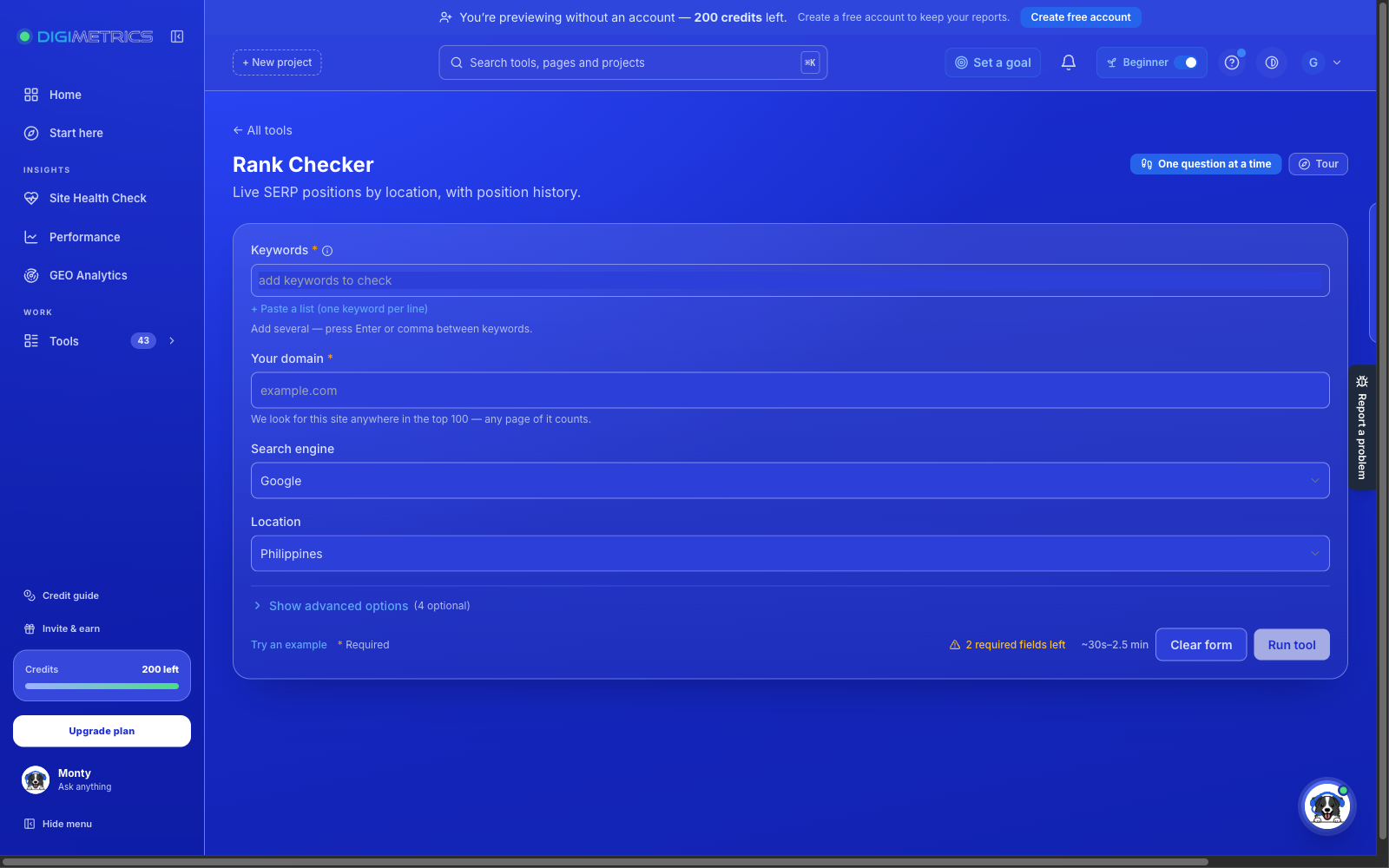
Best for: Marketers connecting conventional rankings with SEO diagnosis and AI visibility
Starting price: $39/month Starter; our test required Pro
Exact Match Rate: 55.8%
Within ±1: 81.8%
AI visibility: Yes
Reliability Score: 7.2/10
Disclosure: Digimetrics is built by our team. We tested it under the same framework and scoring criteria as every other platform.
Digimetrics belongs in this comparison because its Rank Checker directly performs the category’s core function: live SERP checks by location with position history.
Its wider role is what makes it different from a pure tracker. The same workspace also includes Keyword Analysis, Competitors Identifier, Time to Rank, SEO Diagnostics and Search Console integration, while its AI Visibility toolkit includes AI Mentions Tracker.
Where Digimetrics Adds Value
A rank tracker can tell you that a keyword moved from position 5 to 11. The next questions are usually why it changed, whether competitors moved, whether something happened to the page and whether the brand’s visibility is shifting beyond conventional search.
Digimetrics can keep more of that surrounding investigation in one workspace. We did not give it extra reference-consistency points for that breadth, however; its Rank Checker was judged against exactly the same reference conditions as the other products.
That is why it finishes seventh overall. Digimetrics delivered 343 of 350 expected observations, a 55.8% Exact Match Rate, 82.9% local consistency and a 12-minute reporting result, all of which trailed the mature tracking specialists above it.
Its current pricing starts at $39 per month for Starter. Our 50-keyword test required the $109 Pro plan, while larger tracking requirements move toward Expert or custom capacity.
Choose if: rank tracking, SEO diagnosis and AI visibility regularly need to be investigated as part of one workflow.
Skip if: your priority is the deepest possible specialist rank tracker at significant daily volume.
Bottom line: Digimetrics has a legitimate role in the category and strong GEO integration, but our test puts it seventh because pure rank-tracking consistency and reporting currently trail the mature specialists.
Why Rank Tracking Tools Disagree
Different ranking numbers do not automatically mean one tool has poor data.
| Cause | Why the result can change |
| Location | Google can return different SERPs in different markets |
| Device | Mobile and desktop results may differ |
| Check time | Rankings can move throughout the day |
| Refresh cadence | One tracker may have collected a newer result |
| Data collection | Platforms do not necessarily retrieve SERPs identically |
| SERP features | Tools may record packs, snippets and other features differently |
| Personalisation | A manual browser search is not a universal neutral reference |
| Search Console averaging | GSC reports Average Position across real impressions |
This is why we prefer Reference Match Rate to a universal “accuracy” claim. Our benchmark measures how consistently each platform behaves under conditions we can control while recognising that search results themselves remain variable.
A one-position discrepancy is also very different from repeatedly missing the ranking or showing unexplained ten-position swings. That is why Exact Match, ±1, ±2 and missed-result rates all matter.
Choosing a rank tracker involves more than comparing accuracy scores. You also need to consider monitoring frequency, location and device coverage, reporting requirements, and the number of keywords you’re tracking. Our guide to choosing a rank tracking tool walks through these decisions in greater detail.
Google Search Console Is Not a Daily Rank Tracker
Google Search Console is one of the most valuable first-party sources in SEO, but its Average Position metric should not be treated as the precise position a dedicated tracker ought to show for one controlled search.
Search Console calculates position across impressions your site actually received. Those impressions can happen on different devices, in different places, at different times and across different SERP layouts, so an average position of 5.8 does not simply mean the page “ranked sixth today.”
A dedicated tracker answers:
Where did this predefined keyword appear from this configured location and device when the platform checked it?
Search Console answers:
Where did our site actually appear across Google’s real impressions?
Use both. The tracker gives you controlled monitoring, while Search Console adds first-party evidence about the visibility users actually experienced.
What Rank Tracking Really Costs at Scale
Starting prices are especially misleading in this category because the billing unit is not always equivalent. Devices, locations, projects, search engines and refresh frequency can all affect how quickly a nominal keyword allowance is consumed.
We modelled three workloads using tracking units, meaning configured keyword-target combinations after any location or device duplication.
| Scenario | Tracking units | Locations | Devices | Frequency | Projects |
| Solo SEO | 100 | 1 | Desktop | Daily | 1 |
| In-house team | 500 | 2 | Desktop + mobile | Daily | 1–3 |
| Agency | 2,000 | Multiple | Desktop + mobile | Daily | 10 |
For each scenario, we selected the lowest public plan capable of supporting the stated workload rather than comparing unrelated “starting at” prices.
Normalised Rank Tracking Cost
| Tool | Solo: 100 daily units | In-house: 500 daily units | Agency: 2,000 daily units | What drives the cost |
| AccuRanker | $224/mo | $224/mo | $224/mo | Entry plan includes 2,000 keywords |
| SE Ranking | $103.20/mo | $103.20/mo | $103.20/mo | Core includes 2,000 daily keywords and 10 projects |
| Semrush | $139.95/mo | $249.95/mo | $499.95/mo | Tracking limits and multitargeting increase by tier |
| Nightwatch | €79/mo | €79/mo | €159/mo | Starter includes 500 daily keywords; Professional 2,500 |
| Ahrefs | $129/mo weekly | $129/mo weekly | $249/mo weekly | Capacity rises by tier, but standard tracking remains weekly |
| SERPWatcher | ≈$89.90/mo | ≈$89.90/mo | ≈$179.80/mo workaround | Daily requires Agency; one plan caps below 2,000 |
| Digimetrics | $109/mo | $199/mo | $398/mo workaround | Pro includes 250 tracked keywords; Expert 1,000 |
Table 3: Normalised public pricing for three rank-tracking workloads.
Prices are monthly equivalents on annual billing where available and exclude tax. Nightwatch remains in euros so we do not introduce an exchange-rate assumption.
The Ahrefs rows deliberately retain weekly because its standard Rank Tracker does not meet the daily requirement used by the other scenarios. The SERPWatcher and Digimetrics 2,000-unit figures are transparent public-plan workarounds rather than recommendations to split client work across two subscriptions.
Pricing and capacity assumptions were checked against the current public pages for AccuRanker, SE Ranking, Semrush, Nightwatch, Ahrefs, Mangools and Digimetrics.
The table demonstrates why starting price alone is a poor buying metric. AccuRanker looks expensive for a 100-keyword site because its entry plan already contains 2,000 keywords, but that same price becomes much more competitive as the workload approaches agency scale.
SE Ranking stands out in the opposite direction: its Core configuration remained the lowest-cost option satisfying the daily requirement across all three workloads in our model.
Local Rankings Need Their Own Test
Location changed several of our reference positions enough that one national rank would have badly represented what nearby searchers actually saw.
For the local subset, we used three anonymised locations with the same mobile configuration and approximately the same check time.
| Anonymised keyword | Central location | 12 km east | 18 km west | Largest difference |
| emergency plumber | 3 | 9 | 17 | 14 positions |
| family dentist near me | 7 | 4 | 12 | 8 positions |
| SEO agency | 6 | 11 | 8 | 5 positions |
These are reference results from our anonymised test sites rather than claims about any named business.
The important point is that local targeting cannot be reduced to a “supports location tracking” checkbox. A useful local tracker has to preserve the geographic conditions that the campaign actually cares about.
That is why Nightwatch’s 95.2% local-consistency result matters even though AccuRanker produced the strongest overall reference score.
Do You Need AI Visibility Tracking Too?
Traditional rank tracking answers:
Where does our page appear in the conventional search results?
AI visibility tracking answers:
Is our brand, product or content being mentioned or cited inside AI-generated answers?
Those questions are increasingly related, but they are not interchangeable. A site can maintain a strong conventional ranking while rarely appearing in AI-generated answers, just as a brand can gain AI mentions without owning the top organic position.
Several rank-tracking vendors are extending into this area. AccuRanker offers the separate AccuLLM product, SE Ranking and Semrush have expanded GEO/AI visibility functionality, Ahrefs offers tracked prompts and wider Brand Radar capabilities, while Digimetrics combines Rank Checker with AI Mentions Tracker.
We include AI visibility in the scoring because it matters to search teams in 2026, but it represents only 10% of the Reliability Score. A weak conventional rank tracker should not win this comparison merely because it also tracks AI.
Traditional search rankings and AI visibility are related, but they measure different forms of discovery. Our complete guide to GEO tools explains how AI mention tracking, source citations, prompt monitoring, and generative search reporting extend conventional SEO measurement.
Do You Actually Need Daily Rank Tracking?
Not every website needs thousands of keywords refreshed every 24 hours.
| Situation | What we’d consider |
| Small content site | Weekly or daily tracking for priority keywords |
| Active SEO campaign | Daily checks for important targets |
| Local SEO | Location-specific monitoring |
| Site migration | Temporarily increase frequency |
| SEO agency | Daily automated tracking + client reports |
| Large enterprise | Segment terms by business importance |
| Very large keyword universe | Track representative clusters rather than everything |
More frequent tracking gives you more data, but more data does not automatically produce better decisions. If nobody will act differently because a term changed from position 8 to 7 between Monday and Tuesday, daily tracking may simply generate more noise.
The useful refresh interval is the one that matches how quickly the decision could realistically change.
Which Rank Tracker Should You Choose?
| Your priority | Tool we’d choose first |
| Dedicated rank tracking | AccuRanker |
| Value + wider SEO tools | SE Ranking |
| Full all-in-one SEO workflow | Semrush |
| Local SEO | Nightwatch |
| Competitor and backlink research | Ahrefs |
| Simple rank monitoring | Mangools SERPWatcher |
| SEO + GEO visibility workflow | Digimetrics |
| First-party Google evidence | Search Console alongside your tracker |
The best product therefore depends heavily on the job. A solo SEO monitoring 100 target terms does not have the same requirements as an agency tracking thousands of location-device combinations across multiple clients.
Final Verdict: Consistency Matters More Than One Perfect Position
The best rank tracking tool in 2026 is not the product that claims to know one universally correct Google ranking. Search results depend too heavily on location, device, timing and SERP context for that claim to be useful.
What matters is whether a tracker gives you consistent monitoring under defined conditions, preserves important location and device differences, refreshes quickly enough for your workflow and remains economically sensible as tracking volume increases.
In our seven-day test, AccuRanker finished first overall at 9.1/10. It produced the strongest reference-consistency results, delivered all 350 expected daily observations and gave us the fastest reporting workflow. SE Ranking followed at 8.8/10 and offered the strongest overall value, while Semrush at 8.6/10 was the better fit for teams wanting rank tracking inside a conventional all-in-one SEO suite. Nightwatch earned our local SEO recommendation with the highest local-consistency result at 95.2%.
Ahrefs remains useful when rankings lead into deeper competitive research, SERPWatcher is a credible option for simpler monitoring, and Digimetrics connects conventional tracking with SEO diagnosis and AI visibility but currently trails the mature specialists on pure rank-tracking consistency.
The most useful signal is not whether one tracker says position 5 while another says position 6 on one morning. It is whether the platform consistently reveals when visibility is genuinely improving, declining or changing enough that somebody should investigate.
For that job, AccuRanker produced the strongest overall result in our test.
Frequently Asked Questions
What Is the Best Rank Tracking Tool in 2026?
AccuRanker ranked first in our seven-day test with a 9.1/10 Reliability Score. It produced the strongest Exact Match, Within ±1 and Within ±2 results while delivering all 350 expected daily observations and supporting on-demand refreshes.
SE Ranking was our strongest value pick, Nightwatch led the local-tracking subset and Semrush was the strongest option for teams wanting daily rank monitoring inside a broader all-in-one SEO platform.
What Is the Most Accurate Rank Tracker?
There is no permanently correct universal Google position because results vary by location, device, time and SERP context.
Under our controlled reference conditions, AccuRanker produced the strongest match rates at 65.4% exact, 89.9% within one position and 96.5% within two positions.
Why Does My Rank Tracker Disagree With Google?
The tracker and your manual search may use different locations, devices, timestamps or data-collection conditions, while Google’s results can also change naturally during the day.
A discrepancy is worth investigating, but it does not automatically mean either result is wrong.
Is Google Search Console a Rank Tracker?
Not in the same sense as a dedicated rank tracking platform. Search Console reports Average Position across the real impressions your site receives, while dedicated trackers monitor predefined keywords under controlled location and device settings.
The two sources complement each other rather than compete.
Should I Track Rankings Every Day?
Daily monitoring makes sense for active SEO campaigns, local search, agencies, migrations and commercially important keywords. Smaller or slower-moving projects may be adequately served by weekly tracking.
Use the shortest refresh interval that can realistically affect a decision.
Is Semrush or Ahrefs Better for Rank Tracking?
For daily monitoring, Semrush performed better in our test. It delivered fresh observations across all seven days and finished with an 8.6/10 Reliability Score.
Ahrefs refreshed weekly by default during the test, which gave us much less fresh evidence. It remains compelling when a ranking change primarily triggers competitor or backlink research.
Do Rank Trackers Work for AI Search?
Traditional rank trackers monitor conventional search positions. AI visibility requires separate measurement around brand mentions, citations and presence inside generated answers.
Several platforms now support both, but we would treat them as related search visibility systems rather than one interchangeable ranking metric.
Disclosure: digitalmarketingtools.ai is sponsored by Digimetrics.ai. Sponsored Highlights are clearly labelled advertising. Our reviews, comparisons and guides are written to be useful and fair regardless of who sponsors the site. Read the full disclosure.