
AI SEO Tools for B2B: A Practitioner’s Comparison of What Works for Lean and Enterprise Teams
Compare AI SEO tools for B2B teams by job, integration and pipeline fit. Test on your own pages before committing to an annual contract.

B2B teams should pick AI SEO tools by the job they need done, not by feature count. A tool that cannot connect keyword research and content work to the pipeline your sales team tracks will not earn its cost. This guide ranks AI SEO tools for B2B by job, from research and content scoring to technical audits and AI search visibility, and flags where output is unlikely to reach pipeline reporting.
Key Takeaways
- Match the tool to the job. Judge AI SEO tools for B2B by whether they handle research, content, technical audits and AI search visibility.
- Check integration first. A tool that cannot reach your CRM rarely appears in pipeline reporting.
- Five tool categories exist. Keyword intelligence, content optimization, AI writing, enterprise technical SEO and guided execution each solve different problems, according to diib.
- Enterprise crawl tooling is rarely needed. Google’s crawl budget guidance targets sites with 1 million or more unique pages.
- Test on your own pages. Run a 30-day trial on target accounts before signing an annual contract.
- Confirm current US pricing. Plans vary by seat count, so check each vendor’s pricing page.
Table of Contents
- What “AI SEO Tool” Means in 2026
- Types of AI SEO Tools in 2026
- Fit to Your Team Size and Site Scale
- Head-to-Head Comparison of Top AI SEO Tools
- Core Workflows: Where AI Tools Earn Their Keep
- Conclusion and Summary
- Frequently Asked Questions
What “AI SEO Tool” Means in 2026
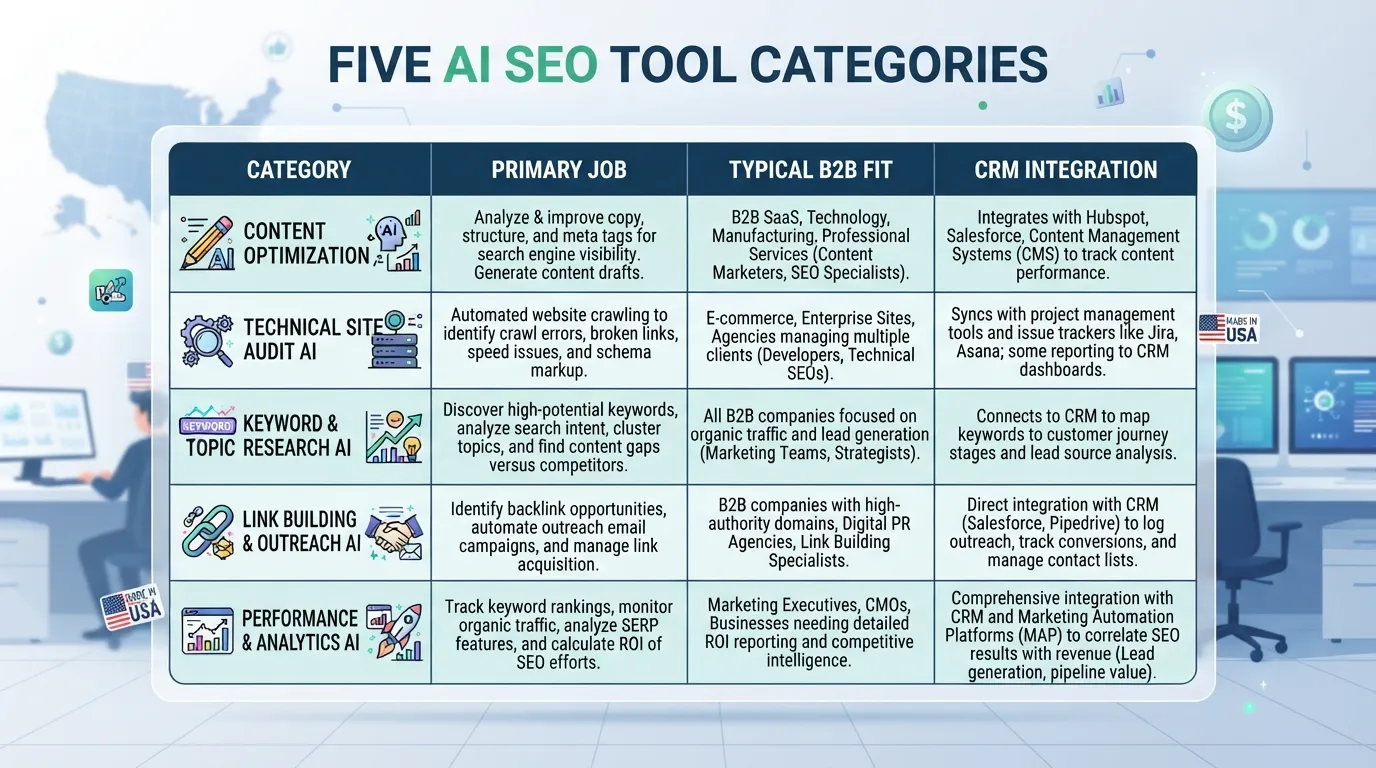
The label now covers very different products. Diib groups them into five types: keyword and competitor intelligence, content optimization, AI writing, enterprise technical SEO, and guided execution platforms (diib). Each type does different work. A keyword platform shows what to research. A content scorer compares a draft with ranking pages. A guided platform shows what to fix first.
The split matters because one label hides the job. A team that buys a writing assistant when it needs pipeline reporting gets fluent drafts that never link to an opportunity. Name the job before you compare products, and choose the tool that matches your actual workflow. B2B marketing leads should test each candidate against a real page from the current quarter.
Types of AI SEO Tools in 2026
Identify your category before you compare vendors. The five-type split below helps teams match a tool to a real need before weighing features or price, and the key features of each type matter less than the job the tool was built to do. This best AI SEO guide is organized by the job each category performs.
Keyword and Competitor Intelligence Platforms
Ahrefs, Semrush and Ubersuggest dominate keyword research. Their AI features sit on top of large keyword, backlink and competitor datasets, so the AI works on the research rather than replacing it. For b2b marketing teams, the value is in finding the long-tail questions buyers type, such as a finance director comparing vendors, instead of broad head terms that better-funded competitors will win.
Content Optimization Tools
Surfer, Clearscope and Rankability score a draft against pages already ranking for a target query, then suggest terms, structure and length changes. These tools measure similarity to search results, not usefulness to a buyer. A page can score well and still lack the technical depth a procurement reader wants, so set the depth target first. Use the score as a checklist, not a finish line.
AI Writing and Drafting Platforms
Jasper and Writesonic generate first drafts, briefs and variations quickly, which helps when a team produces many pages from a fixed template. Drafts become a problem when they go out with generic claims that only a practitioner would catch. Use drafts for outlines and first passes, then have a subject-matter expert add the specifics that make a page worth citing.
Enterprise Technical SEO Suites
BrightEdge and Botify handle large sites. Botify enables teams to analyze JavaScript rendering, monitor crawl behavior, and assess the impact of technical changes over time, with analytics that track each change across the crawl. Google’s crawl budget guidance targets sites with 1 million or more unique pages, or 10,000 or more pages that change daily. Most B2B sites sit far below that, so paying for crawl scale makes sense only with a large catalog or many regional subdomains.
Guided Execution Platforms
Diib scans a site and turns findings into a ranked list of actions, which makes it a practical choice for teams that want automation of the prioritization step. Many B2B teams lack capacity to decide what to fix first, not information. For a lean team, a short ranked list tied to revenue-bearing pages can produce more progress than a dashboard of hundreds of metrics. Diib reports more than 800k businesses using the platform, starting with a free website scan (diib). That figure comes from diib’s own site and has not been independently verified.
| Category | Primary job | Typical B2B fit |
|---|---|---|
| Keyword and competitor intelligence | Find and size demand | Teams with a research budget |
| Content optimization | Score drafts against ranking pages | Teams with a content program |
| AI writing and drafting | Produce first drafts | Teams with templated pages |
| Enterprise technical SEO | Crawl and monitor large sites | Very large page counts |
| Guided execution | Rank fixes by impact | Lean teams short on capacity |
A tool built for one job underperforms on another, so matching the job to the category is the first filter.
Fit to Your Team Size and Site Scale
Buying above your real needs is one of the most common ways B2B teams waste budget. Start by checking whether a tool fits your team and site, and compare the key features each option actually offers against your daily workflow.
Google’s crawl budget guidance targets sites with 1 million or more unique pages, or 10,000 or more pages that change daily. Most B2B sites are far smaller, often a few hundred to a few thousand pages. For that scale, enterprise crawl tools such as BrightEdge or Botify are rarely the bottleneck. A mid-market platform with an audit and a clear fix list does more useful work for most B2B marketing teams, especially one that supports automation of routine checks.
| Team profile | Likely fit | Decision threshold | Watch for |
|---|---|---|---|
| One marketer, under 200 pages | One platform for research, writing and audit | Under 200 pages and one seat | Paying for unused seats |
| Small content team with sales, 200 to 2,000 pages | Research platform plus content scoring, with CRM-ready reporting that can reach your email and blog workflows | 200 to 2,000 pages | Tools with no CRM route |
| Multi-region team, 10,000+ pages | Enterprise suite with crawl and governance | 10,000+ pages or daily-changing content | Cost and implementation time |
Score your team against these rows before opening a pricing page. Confirm only the features each row needs, and check whether a free trial lets you run a real analysis of your website first. At enterprise scale, a custom evaluation of your crawl needs is worth the effort. Choosing the best AI SEO tool each month depends on matching these rows to your actual page count and team size.
Head-to-Head Comparison of Top AI SEO Tools
Rankability, Surfer, and Clearscope Compared
Rankability, Surfer, and Clearscope are among the content optimization tools that Rankability’s comparison of the best AI SEO tools cites as of January 2026. All three score a draft against pages already ranking for a query, which matters for B2B teams that publish on a schedule and need consistent {custom} output. The decision comes down to workflow fit.
For a small B2B content operation with a sales function behind it, the table below summarizes fit as the sources describe it. Confirm current US pricing on each vendor’s site, since plans change. Some vendors offer a free trial worth testing before you commit.
| Tool | Category | Core strength | Best-fit team | Pricing model |
|---|---|---|---|---|
| Surfer | Content optimization | Scores drafts against ranking pages | Content teams publishing at volume | Subscription tiers |
| Clearscope | Content optimization | Term and topic guidance for editors | Editorial teams with a review step | Subscription tiers |
| Rankability | Content optimization | Scores and prioritizes content opportunities | Teams wanting a recommendation layer | Subscription tiers |
The gap for B2B is pipeline connection. A content score shows a page is well optimized, not whether the accounts reading it are worth winning. Use these tools as drafting partners, then check results against CRM data before renewing. A quarterly review of which optimized pages generated qualified leads shows whether the spend pays off for your {marketing} budget.
Semrush and Ahrefs for Research-Led Teams
Semrush and Ahrefs are keyword and competitor intelligence platforms, and their value sits in the research data beneath the AI features. The Semrush AI Toolkit centers on Copilot and the SEO Writing Assistant. The Writing Assistant checks readability, SEO, originality and tone, as Rankability describes it.
The fit is clearest for finding long-tail, problem-aware queries, which buying committees search before they name a vendor. The limit matches the content tools: the output is an SEO view and does not show which keyword wins an account. Pair it with sales-data review, and let {automation} handle repetitive keyword exports.
Enterprise Options: BrightEdge and Botify
BrightEdge and Botify are enterprise technical SEO suites for large sites where crawl behavior affects organic revenue. Google’s crawl budget guidance targets sites with 1 million or more unique pages, or 10,000 or more pages that change daily, as diib’s guide to AI SEO tools notes. Most B2B sites sit well below that.
The calculation changes for B2B companies with heavy technical debt, such as years of product pages, localized microsites, faceted navigation or acquired domains. There, a suite’s cost can be justified by the crawl issues it surfaces. Before committing, confirm your team can act on the findings. A tool that reports thousands of issues without a priority method creates work, not results.
Rank Tracking and AI Search Visibility Tools
Classic rank tracking shows where a page sits in results, not whether an AI answer engine cites your brand. Track both. Log target queries weekly, record your position, then run the same queries in AI assistants and note whether your domain or brand is named as a source.
Measure citations alongside rankings in one shared report. A page can hold a middle ranking and still be the source an AI answer quotes, so ranking alone understates visibility. Use the citation log to decide which pages to strengthen first.
Core Workflows: Where AI Tools Earn Their Keep
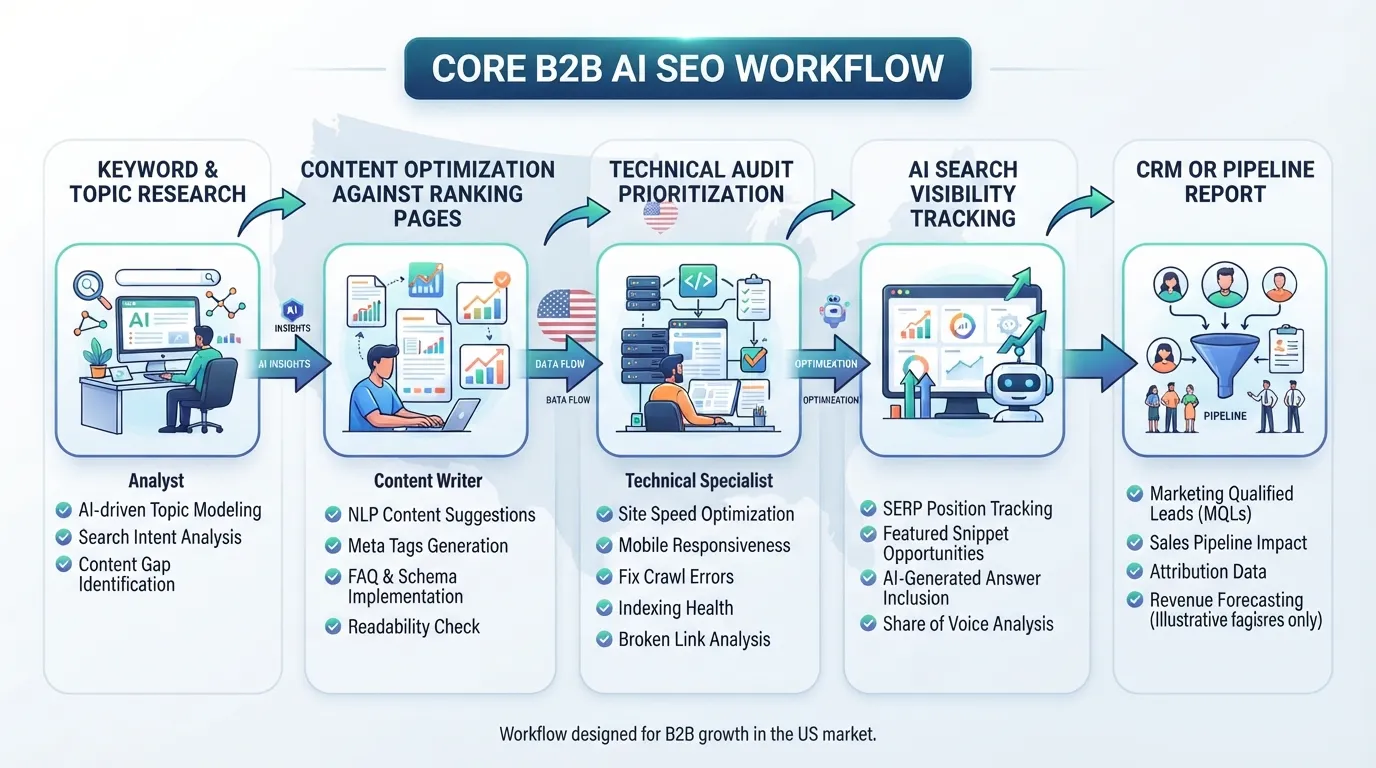
Most B2B teams buy AI SEO tools for the wrong reason. They pay for a platform, then use a fraction of its key features. Start from the jobs that move pipeline, check whether each tool does them well, and confirm its output reaches the sales data your team already uses. A tool that cannot feed a marketing report or sales dashboard is a cost centre, however impressive its demo.
Keyword and Topic Research for Long-Tail B2B Queries
B2B buying committees search in fragments. A finance director looks for “cost of manual invoice reconciliation,” an IT lead searches “SSO setup for mid-market SaaS,” and a champion asks an AI assistant how to justify a tool internally. These queries often have low volume but high commercial value, and many of them surface in an email thread or a meeting, long before anyone opens a search bar.
Use an intelligence platform such as Semrush or Ahrefs to surface these clusters. Filter for questions and comparison terms, and tag each topic with the buyer role it serves. One topic that reaches an economic buyer is worth more than ten generic informational queries, and a free trial of any platform is the cheapest way to test whether its clusters match your company’s actual buyers.
Automated Content Optimization and Scaling
Scoring tools such as Surfer and Clearscope compare a draft against pages already ranking for the target query. They reveal coverage gaps but do not decide your argument. Run each piece through this checklist:
- Brief: Name the target query, buyer role, pipeline stage, and two accounts or segments the piece should win.
- Draft: Generate a first pass with a writing assistant, then rewrite any section that makes unsupported claims.
- Score: Run the draft through an optimization tool and address missing entities, not every suggested term.
- Edit: Add first-hand examples, named sources and figures, and cut passages a competitor could have written.
- Publish: Check internal links and schema, and confirm the page answers its heading in the first two sentences.
Scaling works only when the brief and publish check are standardized. Without a custom brief template, AI drafting produces volume that dilutes site authority. Where automation handles routine steps like scheduling and tagging, keep a person accountable for the brief and final check.
Brand Voice Preservation with AI
Technical buyers spot generic copy quickly. Semrush’s Writing Assistant checks readability, SEO, originality and tone, but it cannot know your house style. Build a one-page voice guide covering the claims you will and will not make, preferred terms and banned phrases, sentence length, and two sample paragraphs marked as on-brand. Treat the guide as part of your content strategy, not a one-off document.
Set three review checkpoints: a voice check before editing, a fact check against sources before approval, and a final read by someone outside the content team. The fact check matters most in B2B, because a wrong figure in a technical article costs credibility with the buyers you want to reach, and that damage can outlast the time it takes to fix the page.
Technical SEO Audits
A crawl report can list thousands of errors, and most are irrelevant to revenue. Rank each issue by the value of the affected page. Does the URL receive organic traffic? Does it target a commercial query? Does it sit on a path leading to a demo or trial page? A broken link on a homepage path matters more than a hundred errors on an archive page nobody visits.
Crawl-scale tooling matters less than vendors suggest. Google’s crawl budget guidance is aimed at sites with 1 million or more unique pages, or 10,000 or more pages that change daily, and most B2B sites sit well below that. A monthly review of the top 50 commercial URLs will usually surface more revenue risk than a full-site crawl, and pairing it with web analytics on those pages shows which fixes actually move visits.
Conclusion and Summary
The right AI SEO tool for a B2B team does the job in front of it and connects to the pipeline data sales already uses. Feature counts are a poor guide. The best AI SEO tool for B2B is the one that fits your workflow, not the one with the longest list of key features.
Before you buy, run a 30-day trial. In week one, load five to ten high-value pages and two or three target accounts. In week two, test the content workflow end to end: brief, draft, score, edit, publish. In week three, check whether the output ties to accounts or opportunities. In week four, decide using the Job-to-Tool Fit Matrix and confirm US pricing on each vendor’s website, since plans vary by seat count. Many vendors offer a free tier or free trial, so you can run this test without a commitment.
Shortlist two or three tools only. Good candidates include Rankability, Surfer or Clearscope for content optimization, and Cognism if pipeline reporting is the gap. Read the contract terms and data handling clauses before signing, and ask how the vendor handles your email and social media data. Treat the trial as the start of your evaluation, not the end of it.
Frequently Asked Questions
Which AI SEO tool is best for a small B2B team?
There is no single best tool. The right choice depends on your team size, page count and the job you need done. For a small team, the best-fit option is usually one platform that covers keyword research and content optimization. Rankability, Surfer and Clearscope are named among the leading options as of January 2026, according to Rankability’s review of the best AI SEO tools. Before you buy, check whether the tool connects to your CRM. A tool that cannot show which content influenced a deal will struggle to justify its seat cost. Marketing teams that need to see which blog posts feed pipeline should rank CRM connection above feature count.
Do B2B companies need an enterprise technical SEO suite?
Usually not. Google’s crawl budget guidance targets sites with 1 million or more unique pages, or 10,000 or more pages that change daily, according to diib’s guide to AI SEO tools. Most B2B sites sit far below that. An enterprise suite such as BrightEdge or Botify earns its cost when you manage large catalogs, many subdomains or heavy technical debt. Otherwise, a crawler plus prioritized fixes on revenue pages delivers more.
How much should a B2B team budget for AI SEO tools?
Budget by seat and by job, not by feature count. Sales-data tools price very differently from SEO tools. Cognism lists a Business plan at $50 and an Advanced plan at $249 per month for 5 seats with 2k workflow credits, according to its pricing overview. Vendor pricing changes, so confirm current US pricing on each vendor’s page before committing. AI SEO and GEO agencies generally run from a few thousand to several tens of thousands of dollars a month, as Sell With Marketing’s agency review reports.
Can AI writing tools produce content that ranks for B2B queries?
They can produce drafts that rank, but rarely on their own. Long-tail B2B queries reward specific expertise, named evidence and buying-committee detail that generic drafts lack. Use writing tools for structure and first drafts, then have a subject expert add the specifics. Semrush’s Writing Assistant, which covers readability, SEO, originality and tone according to Rankability’s review, helps with the editing pass, not the substance.
How do I track whether my brand is cited in AI-generated answers?
Track citations alongside classic rank tracking, because AI answers draw on sources beyond the top organic results. Independent studies by Originality and Ahrefs found that roughly 37% of AI Overview citations come from outside the top 100 organic results, as reported here describes. Run a fixed set of buyer-problem prompts each month, log which sources are cited, and record whether your brand appears. Compare those logs against the pipeline your content influences.
Disclosure: digitalmarketingtools.ai is sponsored by Digimetrics.ai. Sponsored Highlights are clearly labelled advertising. Our reviews, comparisons and guides are written to be useful and fair regardless of who sponsors the site. Read the full disclosure.


