
GEO Tools AI Alternatives: Which Option Fits Your Team

Marketing leads need to know whether AI assistants already name their brand when buyers ask for recommendations, since many buyers act without visiting a website. “GEO tool alternatives” is therefore a serious purchasing question for US marketing leads and operations managers.
“GEO tool alternatives” covers three jobs: monitoring AI citations, optimizing content engines read, and running enterprise platforms with data access and security controls. Choose the tool that matches your job, and confirm it tracks the AI engines your buyers use, including Google AI Mode.
Fixing content and measurement basics often comes before buying a monitoring platform. The sections below show how to match a tool to team size, budget and engine coverage, and how to judge a platform such as Profound on brand visibility and tracking accuracy.
Key Takeaways
- Fix content and measurement first. Many US teams need content structure and reporting in place before a GEO tool pays off.
- Expect 40-60% monthly swings in AI citations. Judge progress over a quarter against a baseline, as Yotpo’s GEO tools guide notes.
- Match the tool to the team. Team size, buyers’ AI engines, and monitoring versus optimization needs matter more than rankings.
- Entry tools start near $29 a month. Enterprise platforms start around $800 a month, per StriveLabs.
- Pay for enterprise features only if you will use them.
- Pilot across a full measurement cycle. Score each geo tool alternatives option against the decision matrix before signing an annual contract.
Quick Comparison and Recommendations by Team Size
| Team profile | Recommended tool type | What to check first |
|---|---|---|
| Small team, first GEO project | Entry monitoring tool | Engine coverage for your top three buyer engines |
| Mid-sized team with an existing SEO stack | Mid-market monitoring and optimization tool | Refresh rate and dashboard reporting |
| Large program with data and security needs | Enterprise AI-visibility platform | API access, governance and total cost of ownership |
Use this table as a starting point, then work through the decision path to confirm fit. Each row describes a profile, so compare the profile that matches your team’s content and search needs before you commit.
Table of Contents
- GEO Fundamentals: Why Generative Engine Optimization Matters in 2026
- How GEO Tools Track Brand Citations
- Evaluating GEO Tool Alternatives: Criteria That Matter
- Comparing GEO Tool Categories and Pricing
- Choosing the Right GEO Tool for Your Team: A Decision Framework
- Conclusion and Next Steps
GEO Fundamentals: Why Generative Engine Optimization Matters in 2026
What generative engine optimization (GEO) means
Generative engine optimization (GEO) is the practice of making a brand appear, and be described accurately, inside answers from AI systems such as ChatGPT, Claude, Gemini, Perplexity, Google AI Overviews and google ai mode. Traditional SEO aims to rank a page in a list of links. GEO aims to get the brand cited or summarized inside the answer itself. A page can rank well and still be absent from the answer a buyer reads.
Modern GEO tools show which pages, facts and sources AI models rely on. The key question for teams is no longer only “where do we rank?” but also “are AI engines naming us, and in what context?” Tracking that answer requires analytics that cover AI citations as well as clicks, and best geo tools can help teams compare options before committing to a platform with its own pricing.
Zero-click search architecture and the referral gap
Yotpo’s GEO tools guide reports that over 60% of searches now end without a referral to an external website. A Seer Interactive analysis found that organic click-through rate fell 61% between June 2024 and September 2025 for informational queries where AI Overviews appeared.
A traffic dashboard alone can understate a brand’s presence. Citation visibility may reflect influence that the click no longer records, although that influence is hard to prove. Teams that publish well-structured content give AI systems more material to cite.
GEO vs AEO vs SEO: where each discipline applies
| Discipline | Primary goal | Where it applies most | Main measure |
|---|---|---|---|
| SEO (search engine optimization) | Rank pages in classic search results | Transactional and navigational queries | Rankings, organic clicks |
| AEO (answer engine optimization) | Win featured snippets and direct answers | Question-led queries with short answers | Snippet capture, answer presence |
| GEO (generative engine optimization) | Be cited or described inside AI-generated answers | Research-stage and comparison queries | Citation frequency, sentiment, share of answers |
The disciplines share foundations: clear page structure, accurate facts and authoritative sourcing. SEO still drives most commercial-intent traffic, while GEO matters most where buyers research a category through an assistant before searching for a vendor. Treat GEO as a layer that measures influence SEO reporting cannot see, not as a replacement for SEO.
How GEO Tools Track Brand Citations
Most GEO tools send a fixed list of prompts to AI assistants, record which brands and URLs each answer mentions, and repeat the exercise on a schedule. Products differ in prompt volume, engines queried, refresh frequency and how results are presented.
What a GEO tool actually measures
A GEO tool typically reports whether your brand appears in an answer, where it appears (first mention, supporting mention or cited link), and how it compares with named competitors for the same prompt. The unit that matters is the prompt-engine pair, since the same question can produce different answers on different engines and days. A tool’s reported brand visibility is only meaningful when you know which prompts and engines it covers.
Check whether a dashboard score counts mentions or citations. A brand named in passing is not the same as a brand linked as a source.
AI search citation tracking across LLMs
Coverage is where tools diverge most. LLM Pulse Enterprise expands coverage to up to nine LLMs, which helps if your buyers split research across several assistant platforms. Many tools cover only two or three.
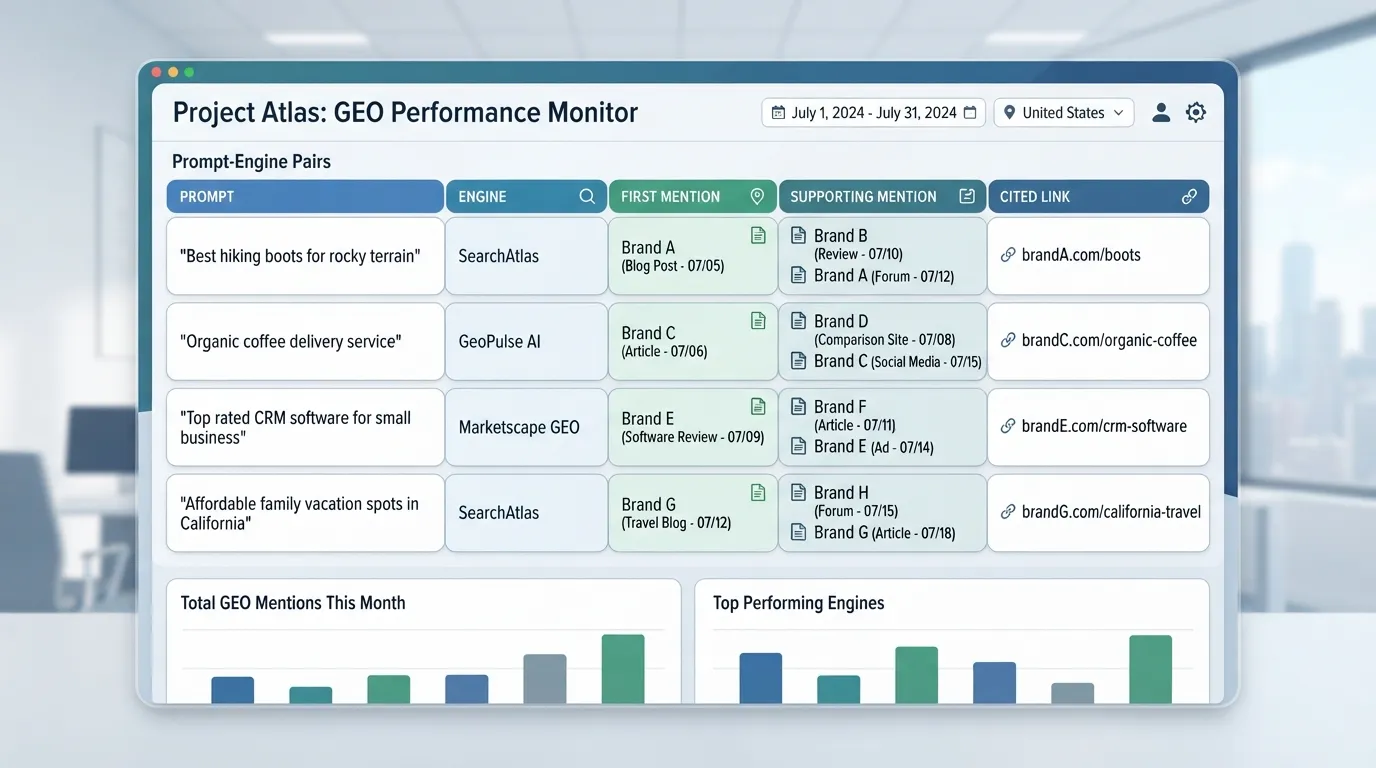
Claude and other AI model tracking coverage
Fewer tools track Claude than track ChatGPT or Google’s products, so check Claude coverage explicitly. Engine lists change often, so verify each vendor’s current list before you buy. Ask whether Claude is queried through the consumer interface or an API, how often it is refreshed, and whether Claude results are reported separately, since API answers can differ from consumer answers.
Why citation volatility requires a longer measurement window
The most common reason teams misjudge GEO progress is volatility. Yotpo reports that AI citations can fluctuate by 40-60% month-over-month, so a 20% gain in one month may sit inside normal variance and a 30% drop may not reflect lost ground. Teams that treat every swing as a profound signal of success or failure tend to overreact and change content that was working.
Consider 50 tracked prompts where citations rise from 18 to 26 in March, then fall to 19 in April. A team reacting to April would rush to change content, while a team reading the three-month average would see a flat pattern and recognize the March spike as noise.
Before judging any change:
- Record at least three months of baseline data before setting targets.
- Calculate a rolling three-month average for each prompt group.
- Treat movement as real only when it exceeds 40% and holds across two consecutive months.
- Log every content change with its date so citation shifts can be matched to edits.
- Review trends quarterly. Treat single-month dashboards as signals to investigate, not verdicts.
A sudden, large drop can signal a real problem, such as an engine changing how it sources answers or a competitor flooding trusted sources. The baseline tells you when investigation is warranted.
How AI agents read a site
Before a GEO tool can tell you whether your brand is cited, you need to know how an AI agent reads your pages. As Yotpo’s guide to GEO tools describes, modern tools analyze this process so brands can shape the source material answer engines draw on. An answer engine pulls out passages, checks whether they answer a specific question, and decides whether they are safe to attribute.
A page can rank well in classic search and still be ignored by an AI engine if its answers sit buried in long narrative or behind scripts. Check first whether each major claim sits in a short, self-contained sentence near a clear heading. If not, the citation problem is usually structural, not a tool problem.
Structuring pages so answer engines can cite them
Citable pages share three traits. Each heading states a question a buyer would ask. The first sentence beneath it answers directly, with the subject named. Every figure carries its source and date.
Use this checklist for each page:
- Open each section with a direct answer of one or two sentences.
- Name the subject in full rather than starting with “it” or “this”.
- Attach a source and date to every statistic, for example per Yotpo’s guide.
- Keep paragraphs short and each section focused on one idea.
- Add structured data so machines can identify page type, author and product details.
Structure raises your odds of citation but does not guarantee it. Treat these changes as a hypothesis to test over several measurement cycles.
Turning tool findings into page-level changes
A GEO tool is only useful if its findings change a page. Turn each finding into one of three actions: rewrite an answer, add a missing fact, or fix a structural problem. Work in that order, because a buried answer is usually cheaper to fix than a new page.
| Tool finding | Likely page-level fix |
|---|---|
| Brand not cited for a core buyer question | Add a direct answer under a heading matching the question |
| Competitor cited with a specific figure | Add a sourced figure of your own, with date and link |
| Cited page is outdated | Update dates, figures and product details, then re-check |
| Citations appear on one engine only | Review whether page structure suits that engine’s sources |
Log each change with the date it went live, so a later citation shift can be traced to your edit or to normal volatility. Improved brand visibility in AI answers usually follows this kind of disciplined, page-by-page work on a single platform at a time.
Evaluating GEO Tool Alternatives: Criteria That Matter
Choosing a GEO tool starts with four questions. None of them is a feature checklist.
Coverage: which models and prompts are tracked
Start with the AI engines your buyers actually use. A tool that tracks one assistant can show a clean dashboard while missing most of the conversation. LLM Pulse Enterprise expands to up to nine LLMs. Rankscale reaches more than a dozen AI engines, so check its current list against your buyer research. Tools also differ in how they handle Google AI Overviews and Google AI Mode, so confirm both are tracked if Google visibility matters to you.
Confirm that a plan covers your full prompt list. Otterly starts at 15 prompts and Peec AI at 50, often with overage charges beyond that.
Data depth, refresh rate and API access
For most working-professional teams, daily or weekly refresh is enough. Pay for API access only if you will use it, such as feeding citation data into a business intelligence dashboard. Check how each tool reports visibility and tracking over time, since refresh rate matters less than whether the trend data is usable for analytics.
Pricing transparency and total cost of ownership
Published prices are a starting point. Per StriveLabs’ review of GEO tools, Otterly starts at $29 a month, Peec AI at $95 a month for 50 prompts, Scrunch AI at $250, AthenaHQ at $295, Goodie at around $495 and Evertune at $800 a month.
Calculate annual cost including seats, prompt overages, API access and onboarding fees. A $29 plan that needs three upgrades in a year can cost more than a $250 plan bought once. Check whether the vendor charges for data export if you switch later.
Security, governance and reporting needs
For larger US teams, security often decides the purchase. Look for single sign-on, role-based access, audit logs and a documented data retention policy. LLM Pulse Enterprise lists enterprise security among its features.
Most smaller teams need only CSV export or a shared dashboard link. Match the tier to the audience, not to the vendor’s most impressive page. Reports on content performance should be easy to share with stakeholders.
Comparing GEO Tool Categories and Pricing
Most GEO tools fall into three groups: enterprise AI-visibility platforms, mid-market monitoring and optimization tools, and lighter monitoring-focused products. The right category depends on how many prompts you track, which AI engines matter to your buyers, and whether you need data access or security controls. Your content strategy should guide that choice, since the tool must track the prompts your buyers actually ask.
Enterprise AI-visibility platforms
Enterprise platforms suit large brands that need broad engine coverage and data they can feed into other systems. LLM Pulse Enterprise covers up to nine LLMs and adds a data API and enterprise security features. The cost is justified only if you will pipe citation data into an internal dashboard or warehouse.
Pricing starts high. According to StriveLabs, brand-focused platforms begin from around $800 a month, with Evertune at that level.
Mid-market monitoring and optimization tools
Most US marketing teams should start here. Per StriveLabs, Otterly starts at $29 a month for 15 prompts, and Peec AI starts at $95 a month for 50 prompts. Rankscale starts at $20 a month and reaches more than a dozen AI engines, with page-level recommendations.
The trade-off is prompt volume against model coverage. A $29 plan shows whether your brand appears at all in AI search, but not patterns across a full product range. Count the prompts your buyers actually ask before committing to any analytics plan.
Monitoring-focused GEO platforms and lighter alternatives
Lighter tools suit teams that want to test first. Olostep offers a free tier of 500 requests and batch processing. Treat a free tier as a pilot, not a permanent setup, especially if your team already reports on search performance elsewhere.
Quick comparison table of leading options and price points
| Tool | Category | Starting price | Coverage or capacity |
|---|---|---|---|
| Otterly | Mid-market monitoring | $29/mo | 15 prompts |
| Peec AI | Mid-market monitoring | $95/mo | 50 prompts |
| AthenaHQ | Mid-market | $295/mo | Free tier available |
| Scrunch AI | Mid-market | $250/mo | Not stated |
| Rankscale | Mid-market, page recommendations | From $20/mo | More than a dozen AI engines |
| Goodie | Mid-market | Around $495/mo | Not stated |
| Evertune | Brand-focused platform | $800/mo | Not stated |
| LLM Pulse Enterprise | Enterprise | Quoted | Up to nine LLMs, data API, enterprise security |
| Olostep | Lighter, batch processing | Free tier (500 requests) | Batch URL processing |
Prices come from StriveLabs and vendors’ published starting points. Confirm current rates on each vendor’s pricing page before budgeting, as plan terms change.
Choosing the Right GEO Tool for Your Team: A Decision Framework
Most US teams should fix the basics first: a list of buyer questions, pages that answer them directly, and a way to measure results. A monitoring platform bought too early produces citation counts nobody can act on. The right choice depends on team size and budget, which AI engines matter to your buyers, and whether you need monitoring, optimization or enterprise data access.
Matching team size and budget to tool category
Budget decides which category you can afford, and team size decides whether you can staff it. Entry monitoring starts at $29 a month for 15 prompts with Otterly, and $95 a month for 50 prompts with Peec AI, according to StriveLabs’ GEO tool roundup. Brand-focused platforms run from about $250 to $800 a month, and enterprise plans are quoted. For cost detail, see our geo tools pricing guide.
Diagnostic table: symptom, likely gap, tool type to consider
| Symptom | Likely gap | Tool type to consider |
|---|---|---|
| Citation counts swing and no one trusts them | No baseline or measurement window | Monitoring tool with history, reviewed quarterly |
| Brand appears in some engines but not others | Engine coverage too narrow | Tool tracking several engines, such as ChatGPT, Gemini, Perplexity and Claude |
| Visibility is measured but pages do not change | Monitoring without an action path | Optimization platform with page-level recommendations |
| Legal or IT asks about data handling | Missing security and governance | Enterprise tier with security features |
| Other teams want dashboards | No data export | Tool with a data API |
Step-by-step selection checklist
- Define the questions your buyers ask AI assistants. Write 20 to 30 real buyer questions from sales calls, support tickets and search data.
- Set a prompt list and model coverage requirement. Choose the prompts and engines that matter in your market. Check prompt limits, which differ sharply between tiers.
- Run a free trial on your own brand queries. Olostep offers a free tier of 500 requests.
- Score each option against the fit matrix. Rate each tool High, Medium or Low on team size and budget, engines tracked, monitoring versus optimization, and data access.
- Pilot for a full measurement cycle. AI citations can vary 40 to 60% month to month, according to Yotpo’s GEO tools guide. Run the pilot for a full quarter and read the trend, not one reading. Analytics from each pilot month should be logged so the trend is visible.
Counterpoint: A quarter is slow when leadership needs an answer now. A shorter pilot is defensible, but treat its readings as directional and set a review date.
Conclusion and Next Steps
For most US working-professional teams, a GEO tool pays off only after the basics are in place: clear content structure, a defined set of buyer questions, and a measurement habit. Buying a monitoring platform first often means collecting citation data that swings 40 to 60% month to month, according to Yotpo’s GEO tools guide, with no stable baseline to judge it against. Analytics only become useful once a clear baseline exists, and a profound shift in how you read that data follows once you have one.
Use the Fit-to-Team Decision Matrix to shortlist. Rate each candidate against team size and budget, the AI engines your buyers use, monitoring versus optimization need, and data access and security requirements. Keep the tools that score High on the most rows. If you lack several months of citation history, start with a low-cost option before committing to a larger contract, and compare the pricing tiers before you commit.
Your next step this quarter: pick 20 to 30 prompts your buyers type into AI assistants, run a 60-day pilot on one shortlisted tool, and record a baseline. Review trends quarterly rather than reacting to a single month’s dashboard.
What is the difference between GEO and SEO?
Traditional SEO aims to rank pages in a list of links, while generative engine optimization (GEO) aims to get your brand named or cited inside an AI-generated answer. SEO is measured in rankings and clicks, GEO in how often and how accurately AI engines mention your brand. The two overlap, since strong content and clear site structure help both, and both shape your brand’s search visibility.
Do I need a GEO tool if I already use SEO software?
Not necessarily. Most SEO platforms do not track what ChatGPT, Gemini, Perplexity or Claude say about your brand, so a GEO tool fills a real gap. Check your fundamentals first: clear product pages, accurate schema and a monthly review process.
How often should I check AI citations for my brand?
Check monthly, but judge trends over a quarter. Yotpo reports that AI citations can vary by 40 to 60% month to month, so a single weak month says little.
Which AI models should a GEO tool track?
Start with the engines your buyers use. For most US teams, that means ChatGPT, Google AI Overviews, Gemini, Perplexity and Claude. LLM Pulse reports tracking up to nine LLMs. Coverage changes frequently, so verify each tool’s current engine list before you buy.
Are free GEO tools good enough to start?
For a first test, yes. Olostep offers a free tier of 500 requests. Run the same prompt list across two or three free or trial tools, then compare outputs. Move to a paid plan only once you have a stable prompt list and a baseline you trust.
Disclosure: digitalmarketingtools.ai is sponsored by Digimetrics.ai. Sponsored Highlights are clearly labelled advertising. Our reviews, comparisons and guides are written to be useful and fair regardless of who sponsors the site. Read the full disclosure.


