GEO Tools: A Complete Guide to Generative Engine Optimization
Your website ranks well in Google, attracts organic traffic, and has a library of useful content. But when someone asks ChatGPT, Google’s AI Mode, or Perplexity to recommend a product in your category, your business is nowhere to be found.
A competitor appears instead, sometimes with a direct citation to its website.
This creates a new question for marketers: how do you measure visibility when an AI system generates the answer rather than simply presenting a list of search results?
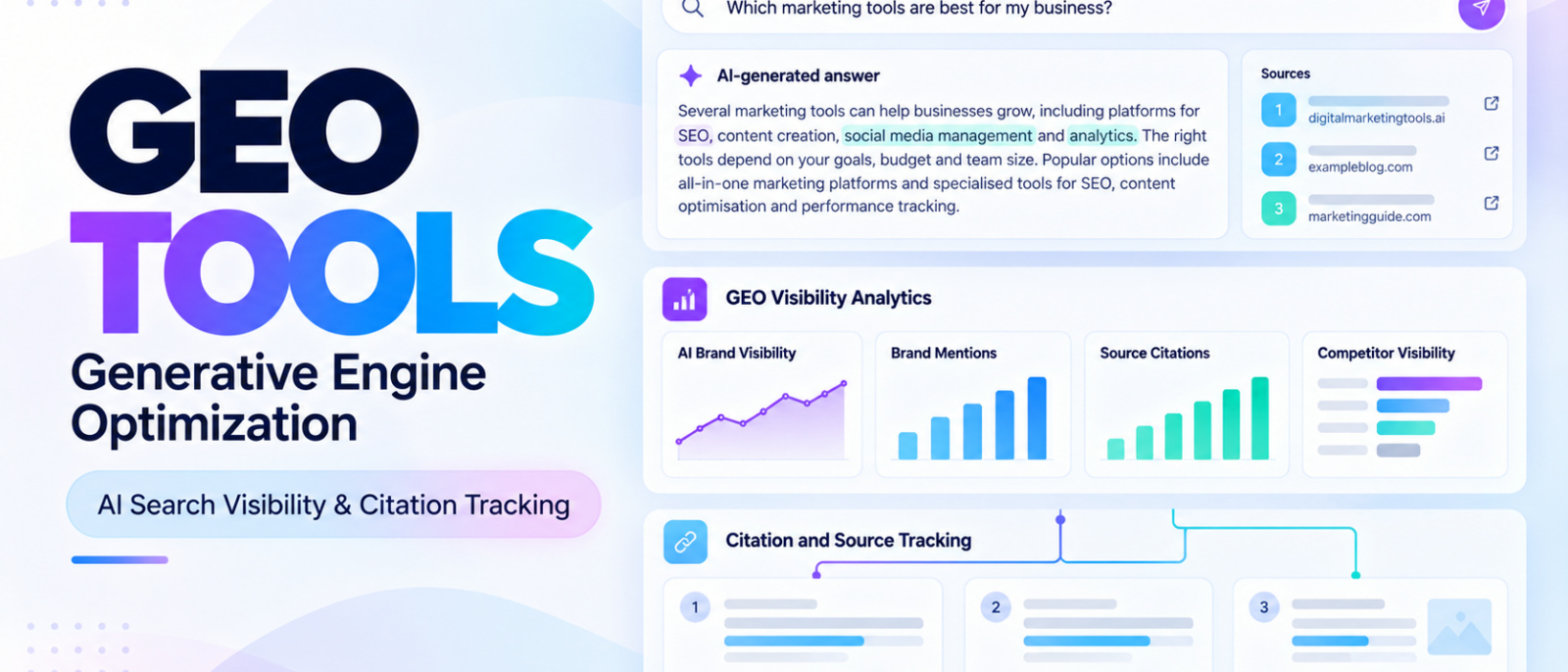
Generative Engine Optimization (GEO) tools help businesses understand how their brands, websites, and content appear in AI-generated answers. They can monitor brand mentions, source citations, competitor visibility, and the questions that trigger those responses.
However, not every GEO tool measures the same thing. Some analyse AI-generated answers directly, others use sampled prompts, and newer first-party reports provide information from search platforms themselves.
A citation in ChatGPT is not the same as an impression in Google AI Overviews. Neither automatically represents a website visit or a customer.
At MediaOne, our SEO workflows cover keyword research, competitor intelligence, technical auditing, content optimisation, and performance measurement. GEO adds another layer to these activities: understanding how existing content and brand information are represented in AI-assisted discovery.
This guide explains how GEO optimisation tools work, what they can measure, which platforms are worth understanding, and how to build a practical GEO workflow without relying on misleading visibility scores.
Key Takeaways
- GEO extends SEO rather than replacing it. Helpful content, technical accessibility, and reliable information remain important foundations.
- GEO tools measure different signals. Brand mentions, citations, AI impressions, and referral traffic answer separate questions.
- Free first-party reporting is now available. Google Search Console and Bing Webmaster Tools provide insights into generative-AI visibility, although their measurements differ.
- AI answers are variable. The same question can produce different sources or recommendations across platforms, locations, sessions, and collection dates.
- There is no guaranteed GEO optimisation formula. Claims about special AI markup, fixed citation rankings, or guaranteed inclusion should be treated cautiously.
- Start with the audience’s questions. Monitor relevant prompts, identify meaningful content gaps, improve the underlying information, and evaluate changes over time.
What Is Generative Engine Optimization (GEO)?
Generative Engine Optimization is the practice of improving how information about a website, brand, product, or organisation is discovered and represented in AI-generated responses.
Traditional search engine optimisation focuses on helping content become discoverable and useful in search results.
GEO considers what happens when an AI system retrieves information, synthesises an answer, and decides which sources or brands to mention.
For example, someone searching Google for “best accounting software for freelancers” may see a conventional list of websites.
Someone asking an AI assistant the same question may receive a comparison of several products, an explanation of their differences, and links to supporting sources.
A business could appear in that response as a recommended product, a cited reference, both, or neither.
GEO tools attempt to make those outcomes observable.
GEO, SEO, and AEO: Understanding the Difference
The terminology can be confusing because these approaches overlap.
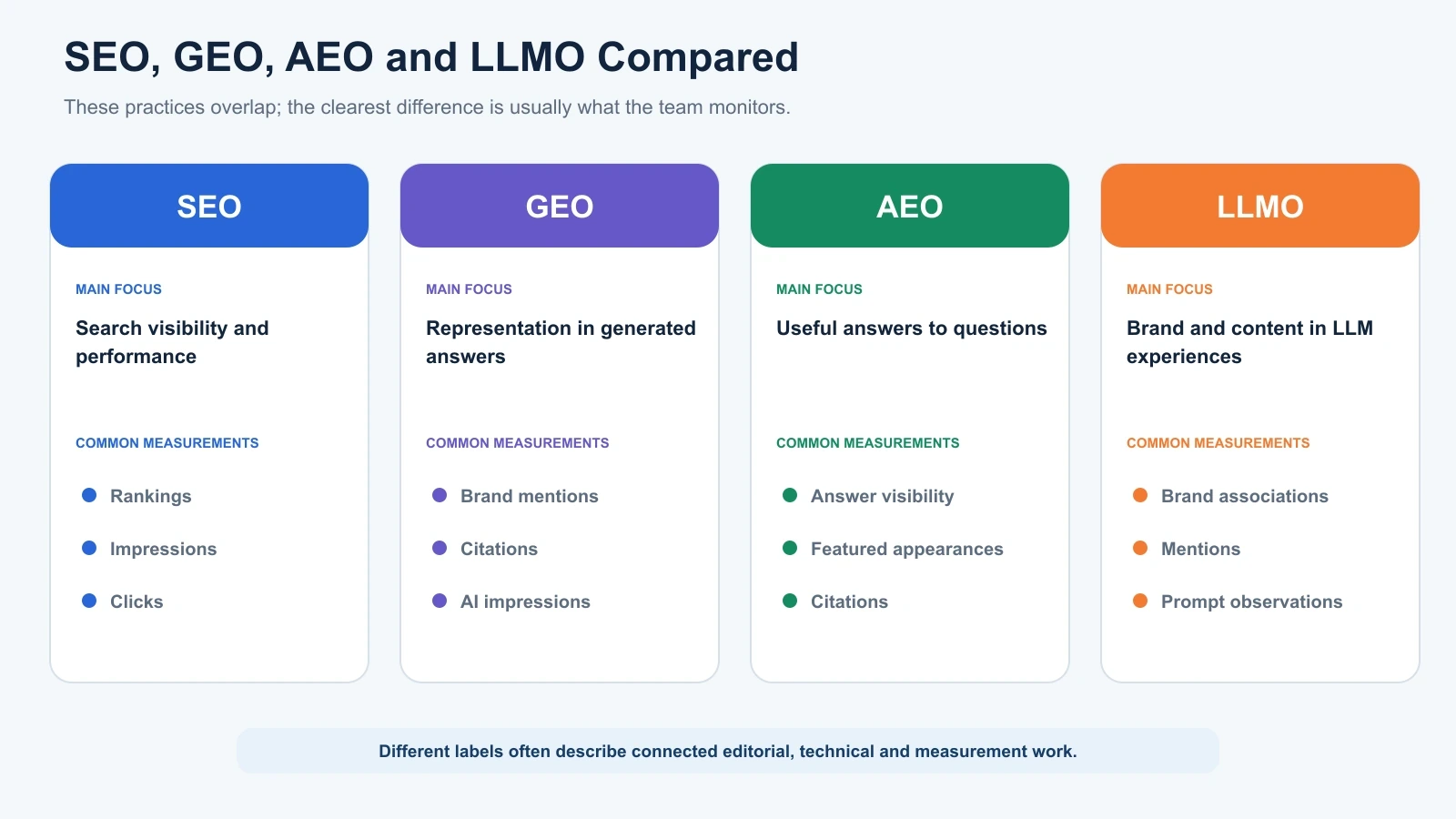
| Approach | Main Focus | Common Measurements |
|---|---|---|
| SEO (Search Engine Optimization) | Visibility and performance in search experiences | Rankings, impressions, clicks, organic traffic |
| GEO (Generative Engine Optimization) | Visibility and representation within generative AI answers | Mentions, citations, AI impressions, source coverage |
| AEO (Answer Engine Optimization) | Helping content provide useful, accurate answers to questions | Answer visibility, featured appearances, citations |
| LLMO (Large Language Model Optimization) | Brand and content representation in LLM-powered experiences | Brand associations, mentions, prompt-based observations |
These are overlapping marketing terms, not completely independent technical disciplines.
Google’s official guide to optimisation for generative AI features explicitly treats GEO and AEO as approaches built upon established search optimisation principles.
The practical difference is often in what marketers monitor.
A traditional SEO report might examine whether a product page moved from position eight to position four.
A GEO report might examine whether the brand appeared when AI assistants answered relevant product comparison questions, which sources supported those answers, and whether any resulting visits were measurable.
Both reports can be useful, but their numbers should not be treated as interchangeable.
For a deeper discussion, see our article on how GEO and SEO measure different visibility signals.
How Do Generative AI Search Engines Find and Cite Content?
Understanding how AI-assisted search uses web information makes it easier to evaluate GEO software.
Although individual platforms work differently, many search-enabled AI experiences use external information to help generate responses.
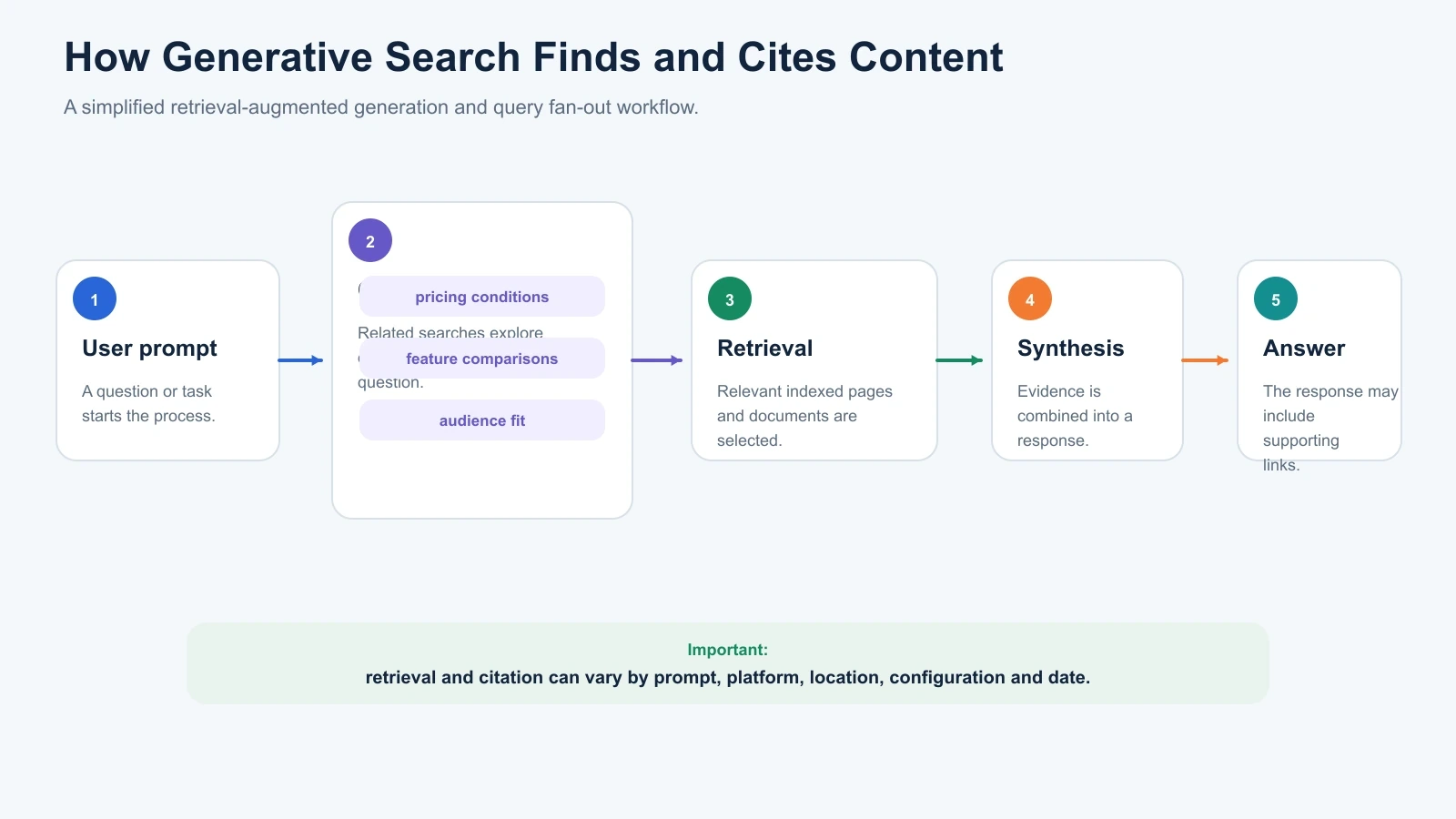
A common approach is retrieval-augmented generation (RAG).
Rather than relying entirely on information learned during model training, the system retrieves relevant material and uses it to support an answer.
Some systems also perform additional searches for related questions before producing their final response.
Google describes this process as query fan-out, where an AI system searches for several related aspects of the original question.
For example, a query about choosing CRM software for a small business might lead to research into pricing, integrations, ease of use, and industry-specific requirements.
The system may draw on different sources for each part.
Why a High Google Ranking Doesn’t Guarantee an AI Citation
A webpage’s position in traditional search doesn’t guarantee that it will be cited in an AI response.
AI systems may retrieve different material, answer a different interpretation of the question, or select sources that support particular details.
A business might rank prominently for “CRM software” without appearing in a response about software suitable for a particular industry.
Likewise, a detailed tutorial may receive a citation for a technical explanation even when its overall website doesn’t dominate every related keyword.
This doesn’t mean traditional rankings are irrelevant.
For Google AI Overviews and AI Mode, Google explains that its existing search ranking and quality systems remain central to how information is found and used.
The takeaway is that AI visibility needs additional measurement, not a replacement for conventional SEO.
Why AI Citations Can Change Between Checks
Unlike a fixed keyword ranking report, generative answers can vary when the same question is repeated.
Differences may arise from the prompt, system configuration, available information, geographic context, collection time, and other factors.
A GEO tool that checks a particular question today may record different cited sources when it checks again later.
That variability makes a single observation insufficient for broad claims.
A useful GEO report should explain what was tested, on which platform, and when.
It should also make clear whether its findings represent a small set of monitored prompts or a broader dataset.
What Does a GEO Tool Actually Do?
A GEO tool collects or analyses evidence about how brands and content appear in AI-assisted search experiences.
Different products focus on different stages of that process.
Some investigate whether a website is technically accessible to AI search crawlers.
Others monitor what AI systems say about a brand, identify cited URLs, analyse competing businesses, or help improve the underlying content.
AI Search Visibility Monitoring
AI search visibility tools examine whether a brand appears in generated responses.
For example, a software company may want to know whether ChatGPT mentions it when users ask for project management products suitable for small agencies.
The platform might record the response, identify named competitors, and track changes across repeated checks.
This is different from traditional rank tracking because generated answers don’t always have a stable ordering equivalent to Google’s organic positions.
The goal is to understand where and how the brand appears.
AI Citation Tracking
Citation tracking focuses on the sources linked or referenced in AI answers.
A citation might lead to the company’s website, a product documentation page, a review article, or another publication.
These distinctions matter.
A brand could be mentioned without its website being cited.
Its website could also be cited as an information source without the brand itself being explicitly recommended.
Those are different forms of visibility and should be reported separately.
Competitor and Topic Analysis
Some GEO optimisation tools compare how frequently competing brands appear across selected prompts or topic groups.
This can help marketers identify questions where competitors receive attention but their business does not.
However, a competitor mention isn’t automatically evidence that the competing product is better.
The AI response may reflect the sources retrieved, the prompt wording, or the information currently available.
Competitor analysis is most useful when it reveals a specific content or information gap worth investigating.
Technical AI Search Accessibility
Technical GEO auditing examines whether relevant crawlers can access important website content.
That includes checking robots.txt, HTTP responses, server restrictions, rendered content, and other accessibility issues.
Some products package these checks as AI crawler audits.
These capabilities can be useful, but they overlap substantially with technical SEO.
A crawler finding that OAI-SearchBot is blocked is reporting a technical condition. It isn’t proving that removing the block will automatically earn a ChatGPT citation.
Content and Entity Analysis
Other GEO tools offer suggestions about content structure, factual completeness, brand consistency, and topic coverage.
These recommendations can support editorial work when they identify genuine problems.
For example, a product comparison may omit pricing conditions that matter to customers, or an organisation’s contact details may be inconsistent across its own website.
However, proprietary optimisation scores should not be mistaken for official AI ranking factors.
A content score of 95 does not guarantee that an AI system will mention or cite the page.
What Should GEO Tools Measure?
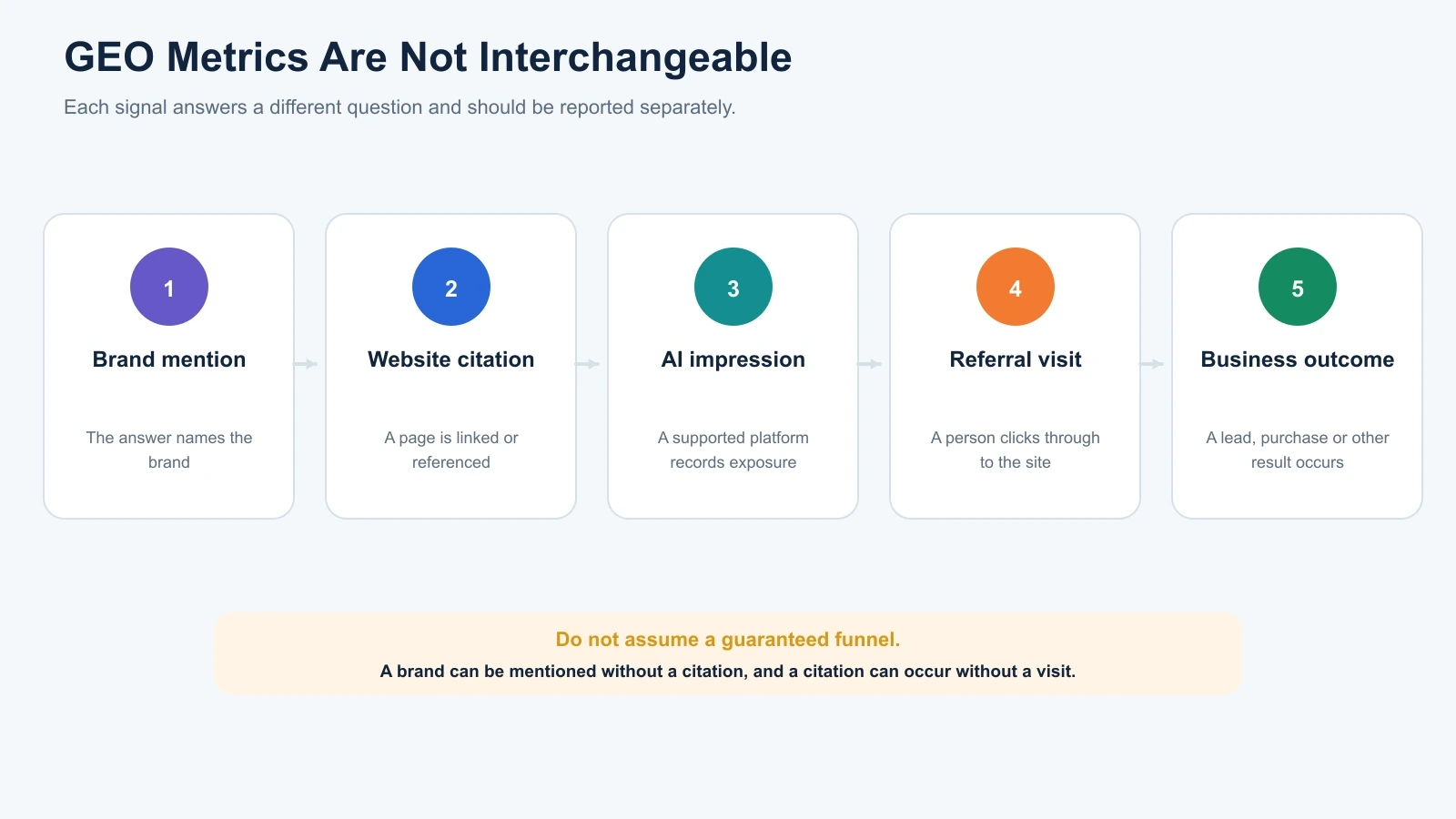
GEO measurement is still developing, and vendors often use similar terminology for different calculations.
Understanding the underlying metric is more useful than comparing dashboard scores.
| GEO Metric | What It Measures | Important Limitation |
|---|---|---|
| Brand mentions | Whether an AI answer names a brand | Doesn’t necessarily mean the brand was recommended |
| Domain citations | Whether a website is linked or referenced | A citation doesn’t guarantee a visit |
| Cited pages | Which individual URLs appear as sources | Coverage varies between platforms and datasets |
| Prompt coverage | How often a brand appears across monitored questions | Results depend on the selected prompt sample |
| AI share of voice | Relative visibility within a defined dataset | Usually a vendor-defined metric, not market-wide exposure |
| AI impressions | How often content is shown within a supported AI experience | Platform-specific reporting rules apply |
| AI referral traffic | Visits attributed to AI sources | Doesn’t capture users who never click |
| Sentiment or brand perception | How AI responses describe a brand | Automated interpretation can be subjective or inaccurate |
Brand Mentions vs Citations
Suppose an AI assistant answers a question about email marketing software.
It recommends Brand A and Brand B but links to an independent comparison article explaining both products.
In this example, Brand A and Brand B receive mentions.
The independent publication receives the citation.
If a GEO platform combines these outcomes into one visibility score, the report may hide an important distinction.
The brand marketer wants to know whether the company was recommended.
The publisher wants to know whether its original research was used as a source.
Both are valuable questions, but they require separate measurements.
Why Share of Voice Needs Context
AI share of voice usually describes a brand’s relative representation within a selected collection of prompts and responses.
However, there is no universal calculation adopted by every GEO platform.
Some products use mention frequency. Others incorporate placement, citations, topic coverage, or proprietary weighting.
A higher share-of-voice score doesn’t necessarily mean more people saw the brand.
Before relying on the metric, check which platforms, prompts, competitors, dates, and calculations are included.
GEO Tools Worth Understanding
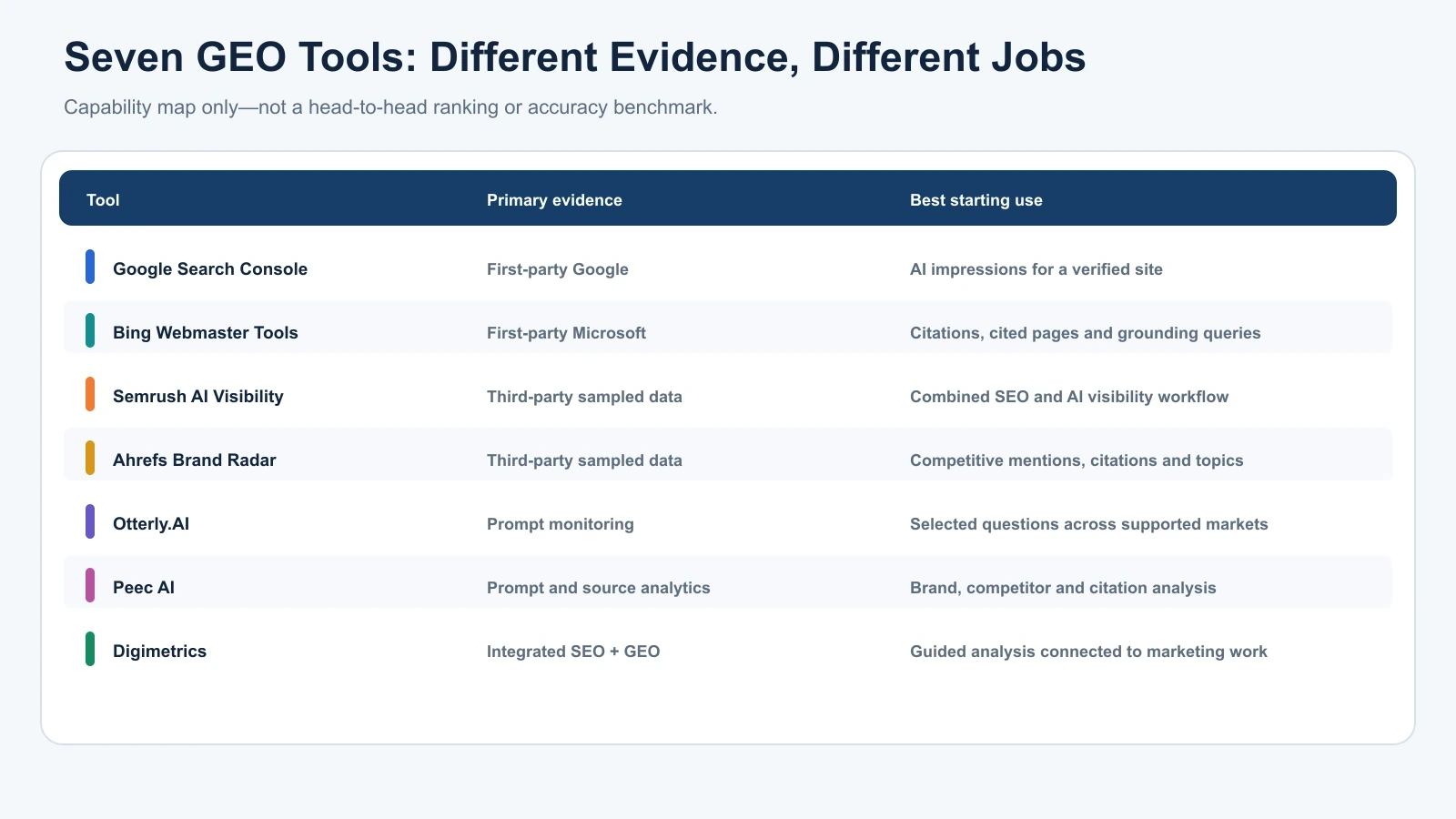
There are now several approaches to monitoring generative search visibility, from free first-party webmaster reports to paid third-party platforms.
The following products illustrate different capabilities. This is a feature-based overview, not a ranking derived from completed head-to-head testing.
| Tool | Main GEO Function | Best Starting Use |
|---|---|---|
| Google Search Console | Generative-AI impressions for your verified site | Google AI Overviews and AI Mode visibility |
| Bing Webmaster Tools | AI citations, grounding queries, topic insights | Microsoft-supported AI search visibility |
| Semrush AI Visibility | Brand mentions, prompts, citations, competitors | Combined SEO and AI visibility workflows |
| Ahrefs Brand Radar | AI brand mentions, cited pages, topic comparisons | Competitive brand and AI search research |
| Otterly.AI | Prompt-based AI search monitoring | Monitoring selected prompts across markets |
| Peec AI | AI brand tracking, competitor comparisons, citations | Brand-focused AI visibility reporting |
| Digimetrics | SEO and AI visibility within an integrated workspace | Connecting GEO analysis with broader marketing work |
Google Search Console
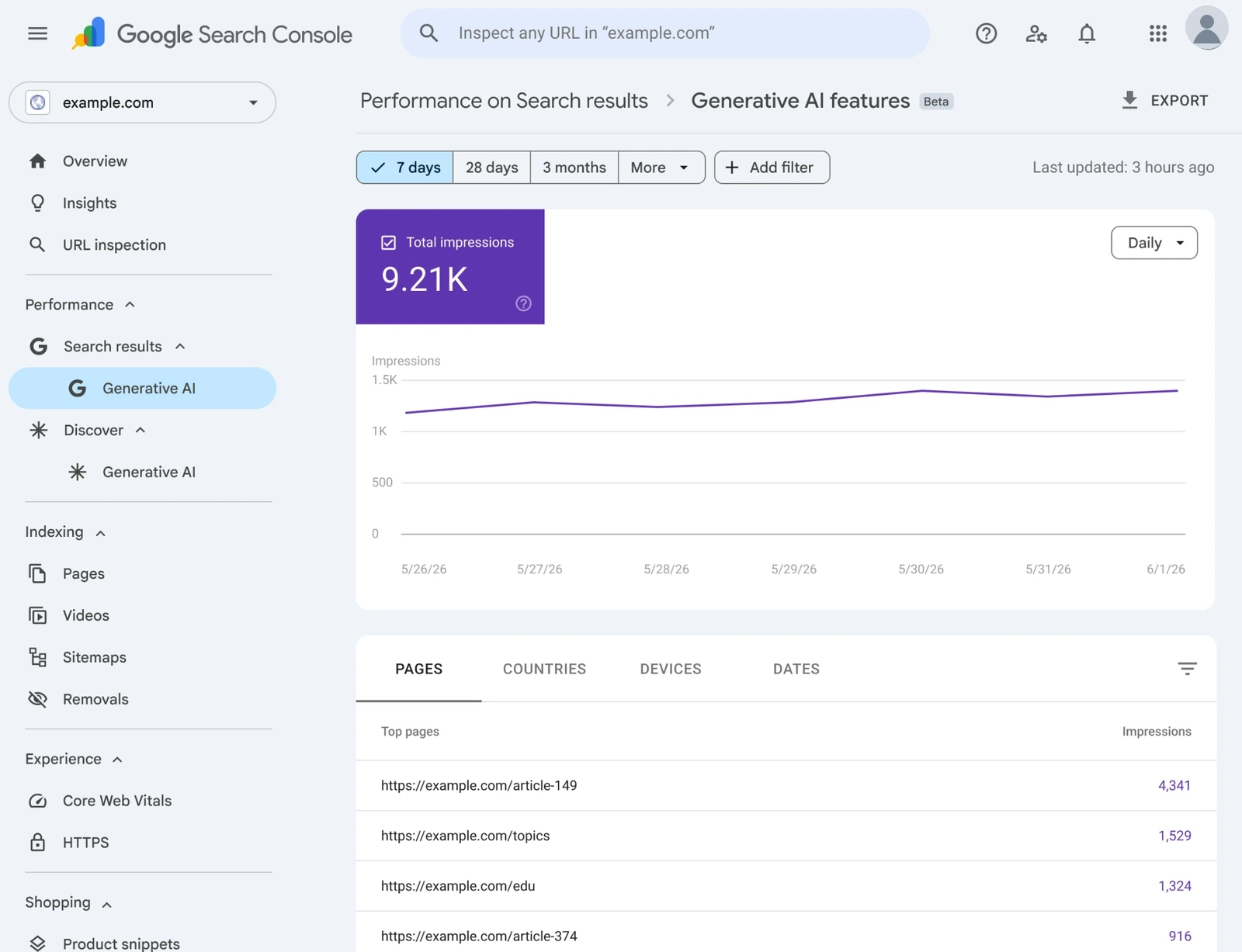
In June 2026, Google introduced dedicated generative-AI performance reports within Search Console. Google announced worldwide rollout by August 31, 2026.
The reports help verified site owners examine impressions associated with generative AI features, including AI Overviews and AI Mode.
They provide views by page, country, device, and date where applicable.
This is important because these are first-party measurements from Google rather than third-party estimates based on selected prompts.
However, the generative-AI report doesn’t provide a complete list of every question users asked or every competing brand shown alongside your content.
It also shouldn’t be treated as a complete GEO analytics system for other AI platforms.
See Google’s Generative AI performance report documentation for the scope of the measurements.
Bing Webmaster Tools
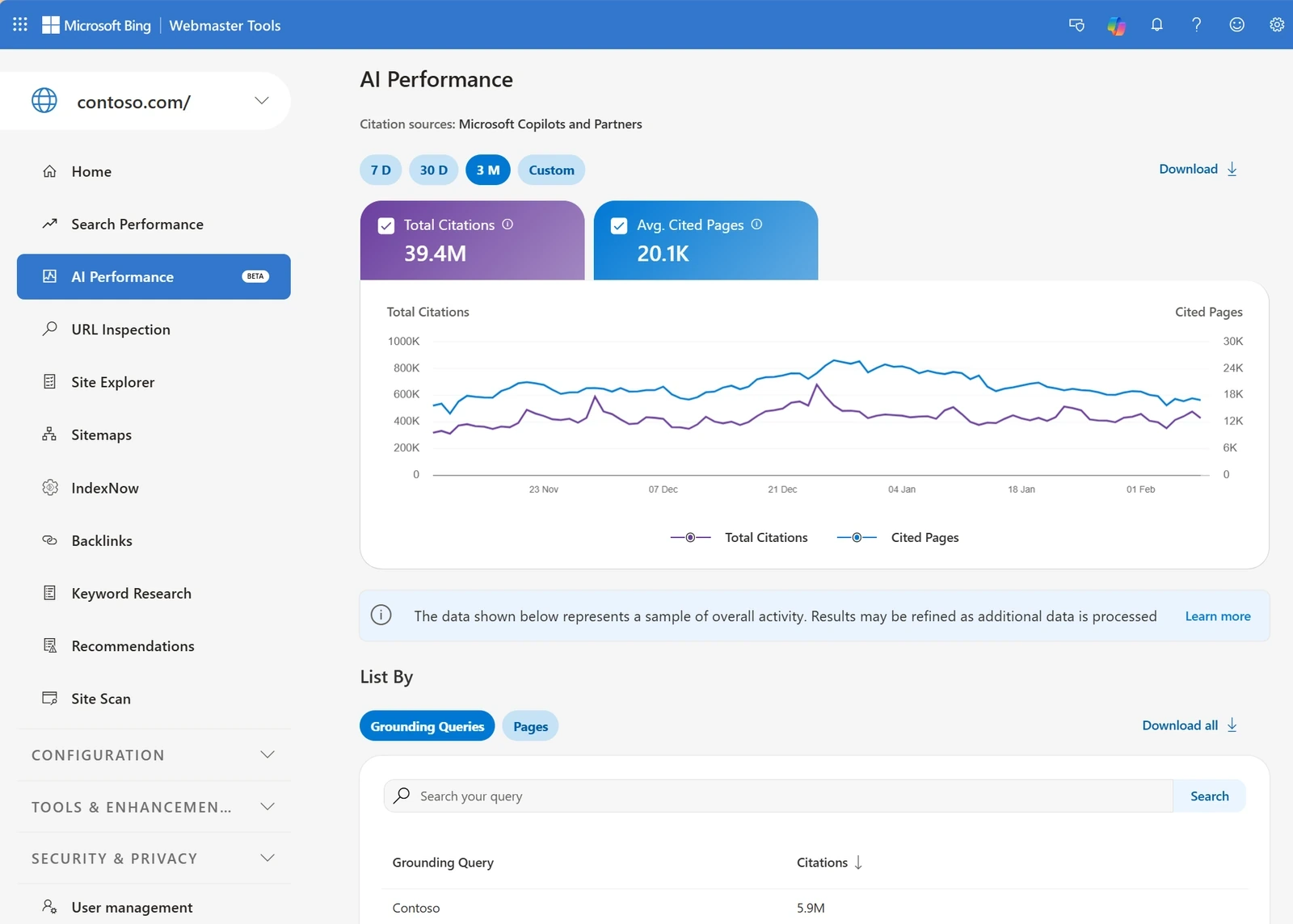
Microsoft introduced its AI Performance report in Bing Webmaster Tools in February 2026.
The report provides insight into when a website is cited across supported AI experiences, including Microsoft Copilot, AI-generated Bing summaries, and selected partner integrations.
Its measurements include citations, cited pages, and grounding queries.
A grounding query represents search terms used to retrieve information supporting an AI answer. It is not necessarily identical to the user’s original prompt.
In June 2026, Microsoft expanded its preview reporting with additional context around topics, intent, citation share, and comparisons.
On October 13, 2026, it also announced Topics Portfolio, a beta feature grouping grounding queries into thematic categories and showing potential opportunities.
These features make Bing Webmaster Tools a useful starting point for GEO research.
However, Microsoft’s beta metrics include estimates and classifications that should be interpreted directionally rather than as precise measures of audience reach.
See the official Bing AI Performance announcement and Topics Portfolio beta documentation.
Semrush AI Visibility Toolkit
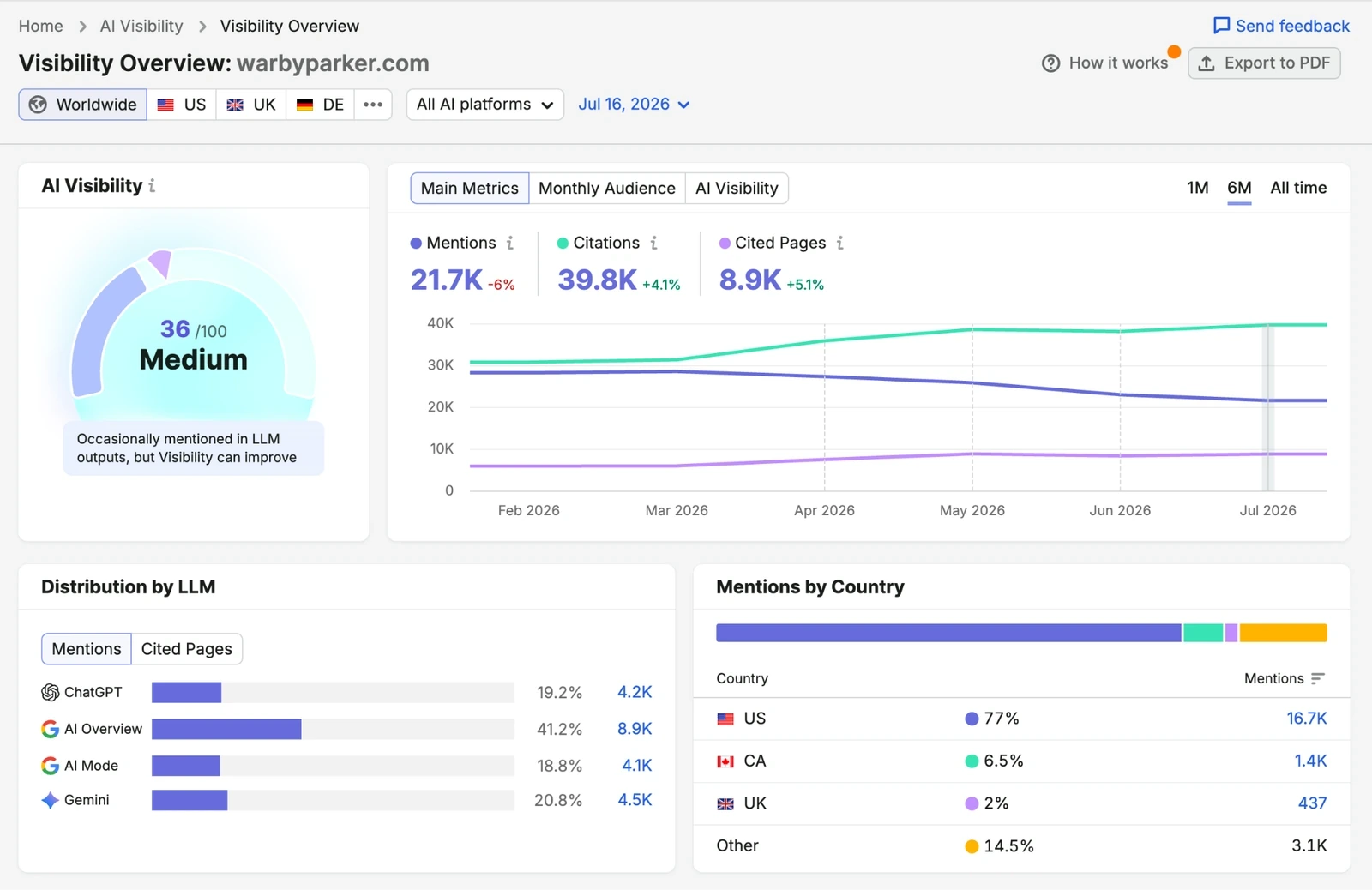
Semrush AI Visibility Toolkit monitors brand presence in AI-generated answers and provides competitor, prompt, and citation-related analysis.
Its documented capabilities include AI visibility benchmarking, brand-performance reports, prompt research, daily prompt tracking, and AI crawler accessibility checks.
This makes it relevant to businesses already using Semrush for traditional SEO research.
However, Semrush’s AI Visibility Score is a proprietary calculation.
It shouldn’t be compared directly with Google’s first-party AI impressions or Microsoft’s citation-share metrics.
Users should also confirm the AI products, locations, refresh schedules, and subscription allowances included in the specific reports they need.
Ahrefs Brand Radar
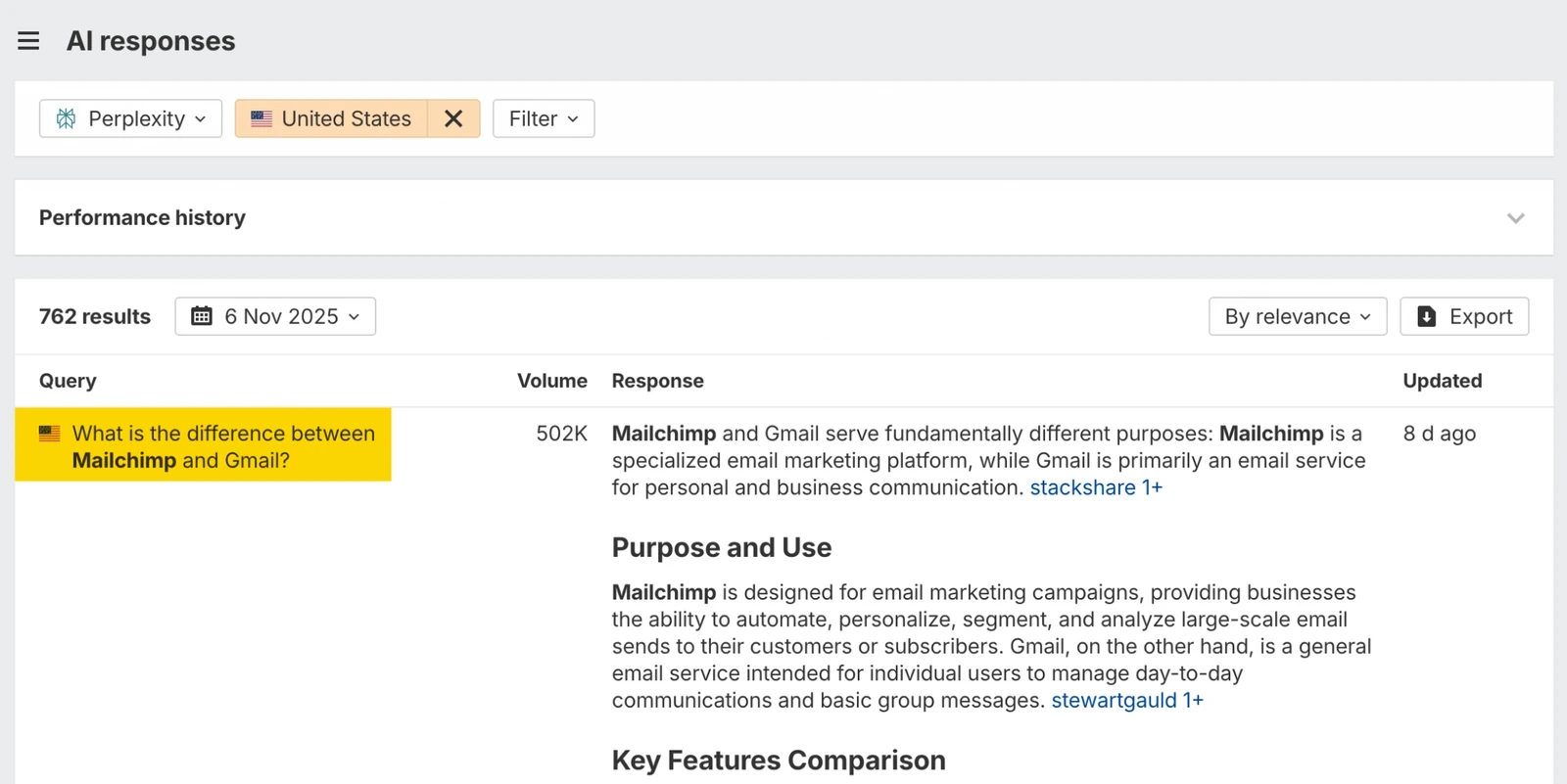
Ahrefs Brand Radar focuses on visibility across AI platforms and broader brand discovery.
Its reporting includes brand mentions, cited pages, competitor comparisons, and topic-related visibility.
Ahrefs has also introduced capabilities connecting AI citation information with bot activity and AI referral traffic within its wider product ecosystem.
This may be useful for research teams that want to investigate the relationship between traditional search visibility and AI-generated mentions.
As with any vendor dataset, coverage and proprietary scores need to be understood before treating them as measures of overall market visibility.
Otterly.AI
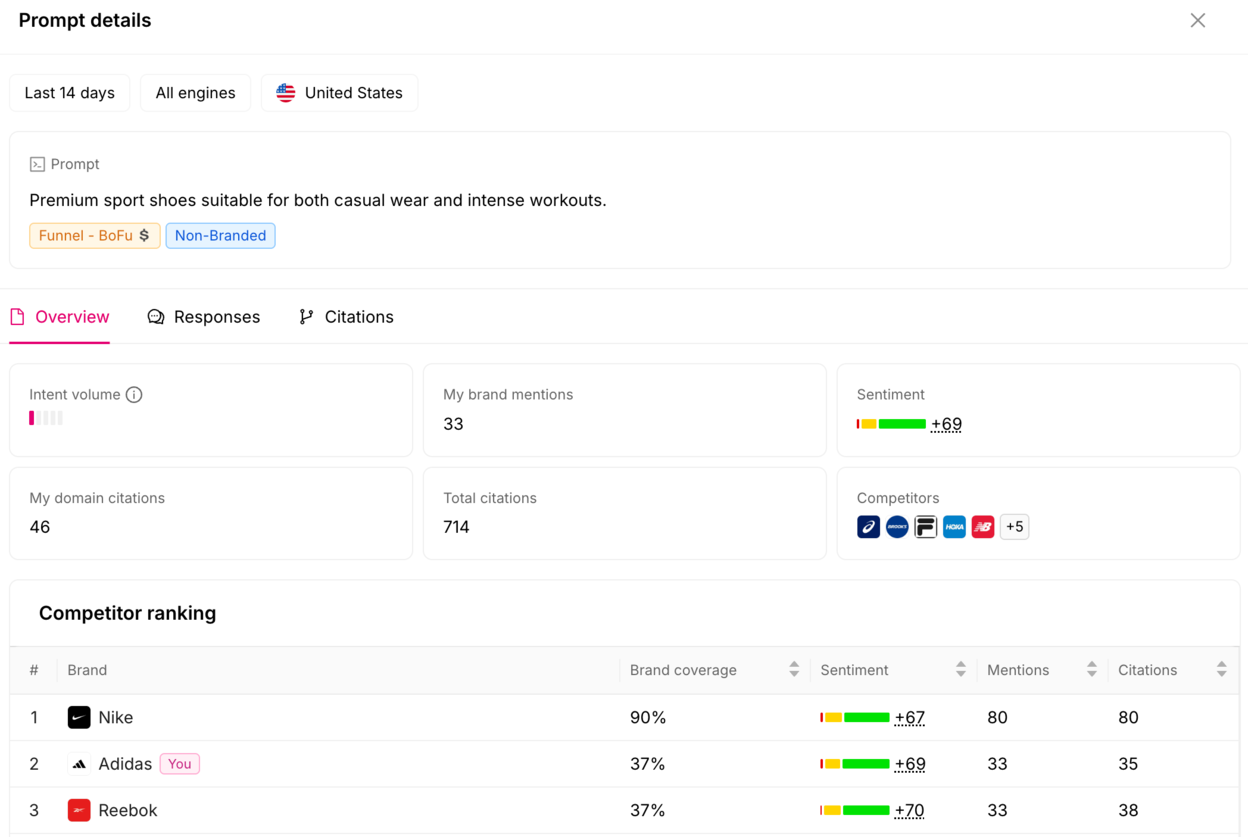
Otterly.AI specialises in monitoring selected questions and brand visibility across supported AI search experiences.
Its documented capabilities include country-level tracking across platforms such as ChatGPT, Perplexity, and Google AI Overviews.
This approach can be useful when a business has a clearly defined set of important customer questions.
However, monitoring selected prompts doesn’t reveal every possible AI interaction involving that brand.
Prompt selection remains a significant part of the methodology.
Peec AI
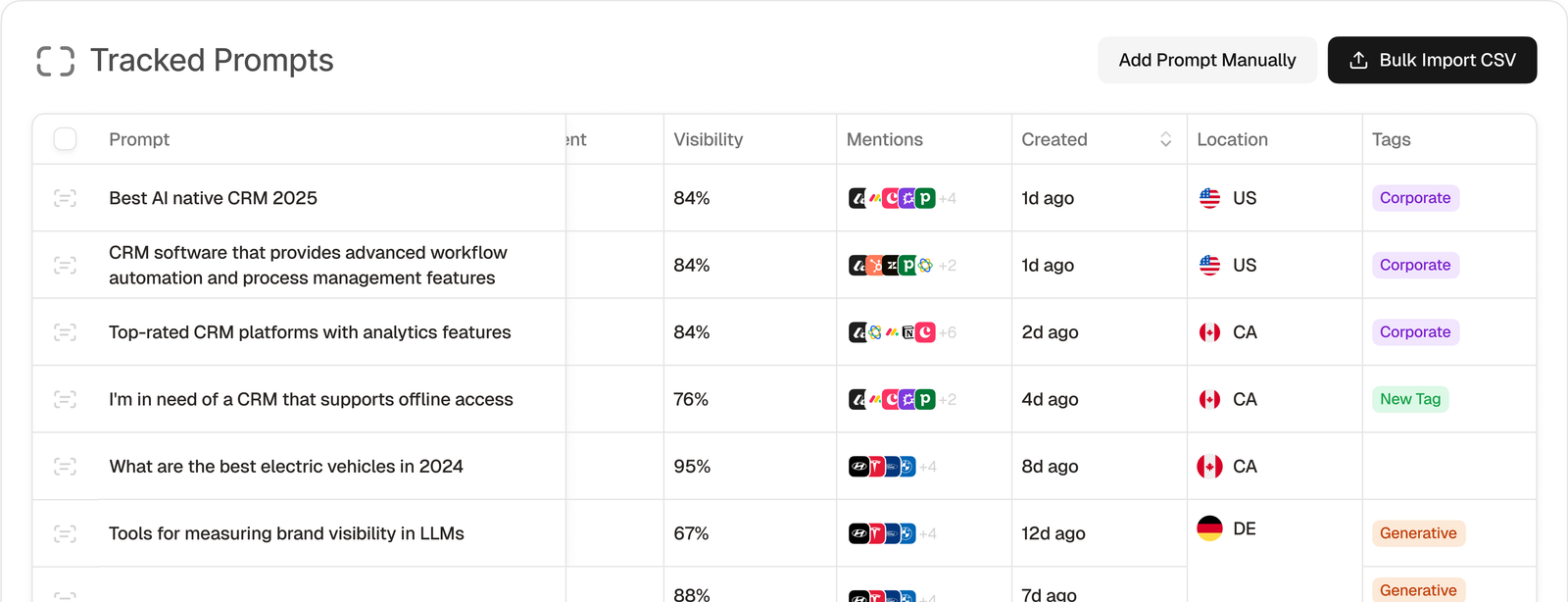
Peec AI provides brand-focused AI search analytics.
Its capabilities include tracking brand mentions across selected prompts, comparing competing brands, and identifying sources and citations in generated answers.
This makes it relevant for marketing teams that want to understand how their organisation is represented across supported AI products.
The value depends on the platforms monitored, how prompts are selected, and whether the resulting insights support real marketing decisions.
Digimetrics
Disclosure: DigitalMarketingTools.ai is sponsored by Digimetrics.ai, which is developed by MediaOne.
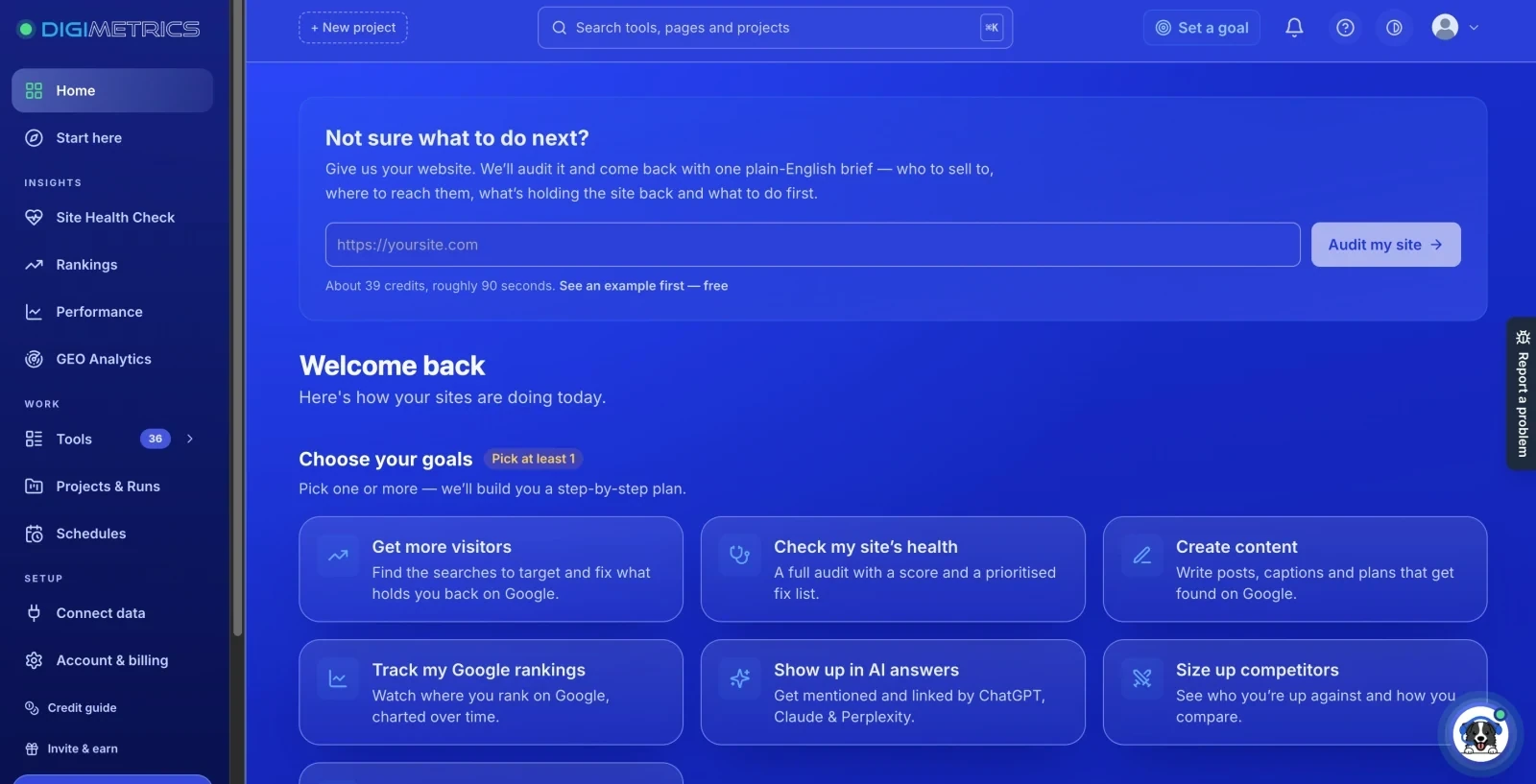
Digimetrics brings SEO, content, technical diagnostics, AI visibility, and other digital marketing tools together within an integrated workspace.
This approach may be useful for teams that want to connect AI search analysis with keyword research, content optimisation, and ongoing SEO work.
For example, a GEO-related visibility gap may lead to a content review or technical investigation.
Keeping those workflows connected can reduce unnecessary movement between separate applications.
However, an integrated platform isn’t automatically more accurate than a specialist GEO product.
Before choosing it, evaluate the supported AI platforms, prompt monitoring capabilities, citation data, reporting options, limits, and actual workflow requirements.
For more detail on this category, see our overview of tools that monitor whether AI assistants cite your brand.
How to Choose the Right GEO Tool
The most useful GEO tool is the one that answers an important business question with measurements you can understand.
A large dashboard and a high visibility score are not enough.
Check Platform Coverage
Start with where your audience is likely to discover information.
Some businesses may care primarily about Google AI Overviews and AI Mode.
Others may need to understand ChatGPT, Perplexity, Gemini, or Microsoft Copilot.
Confirm exactly which experiences the product monitors.
Coverage of ChatGPT Search doesn’t necessarily mean coverage of every ChatGPT conversation or model configuration.
Likewise, monitoring Google AI Overviews isn’t equivalent to monitoring Gemini.
These distinctions affect the meaning of the data.
Examine Prompt Selection
The questions a GEO tool monitors strongly influence its results.
A vendor-selected database may provide broad discovery opportunities, while a custom prompt list can focus on your customers’ actual needs.
Both approaches have value.
However, a report generated from ten branded questions may tell a very different story from one built around commercial, non-branded product comparisons.
Check whether the platform explains where its prompts come from and whether you can add your own.
Separate Observed Data From Estimates
A strong GEO product should explain whether a metric comes from first-party reporting, captured AI responses, sampled prompts, or a proprietary model.
These sources have different limitations.
Google’s own generative-AI impressions aren’t the same as a vendor’s estimated AI audience.
Likewise, observing that a brand appeared in a sampled response doesn’t establish how often real users saw that answer.
Look for reports that retain the underlying response, source links, collection date, and relevant settings.
Evaluate Citation-Level Evidence
A summary score may show that your brand’s visibility declined.
That becomes more useful when you can investigate which prompts changed, which competitors appeared, and which URLs were cited.
Without that evidence, it can be difficult to determine whether the change is meaningful.
A GEO tool should make it possible to move from the dashboard to the information supporting its conclusions.
Consider Reporting and Cost
Agencies may need client-level projects, competitor comparisons, scheduled exports, or integrations with existing dashboards.
Small businesses may only need periodic monitoring of a few important questions.
Choose the capabilities your team will use rather than paying for the broadest available package.
A free first-party reporting setup may provide enough information to establish whether more advanced GEO monitoring is worthwhile.
How to Build a Practical GEO Optimization Workflow
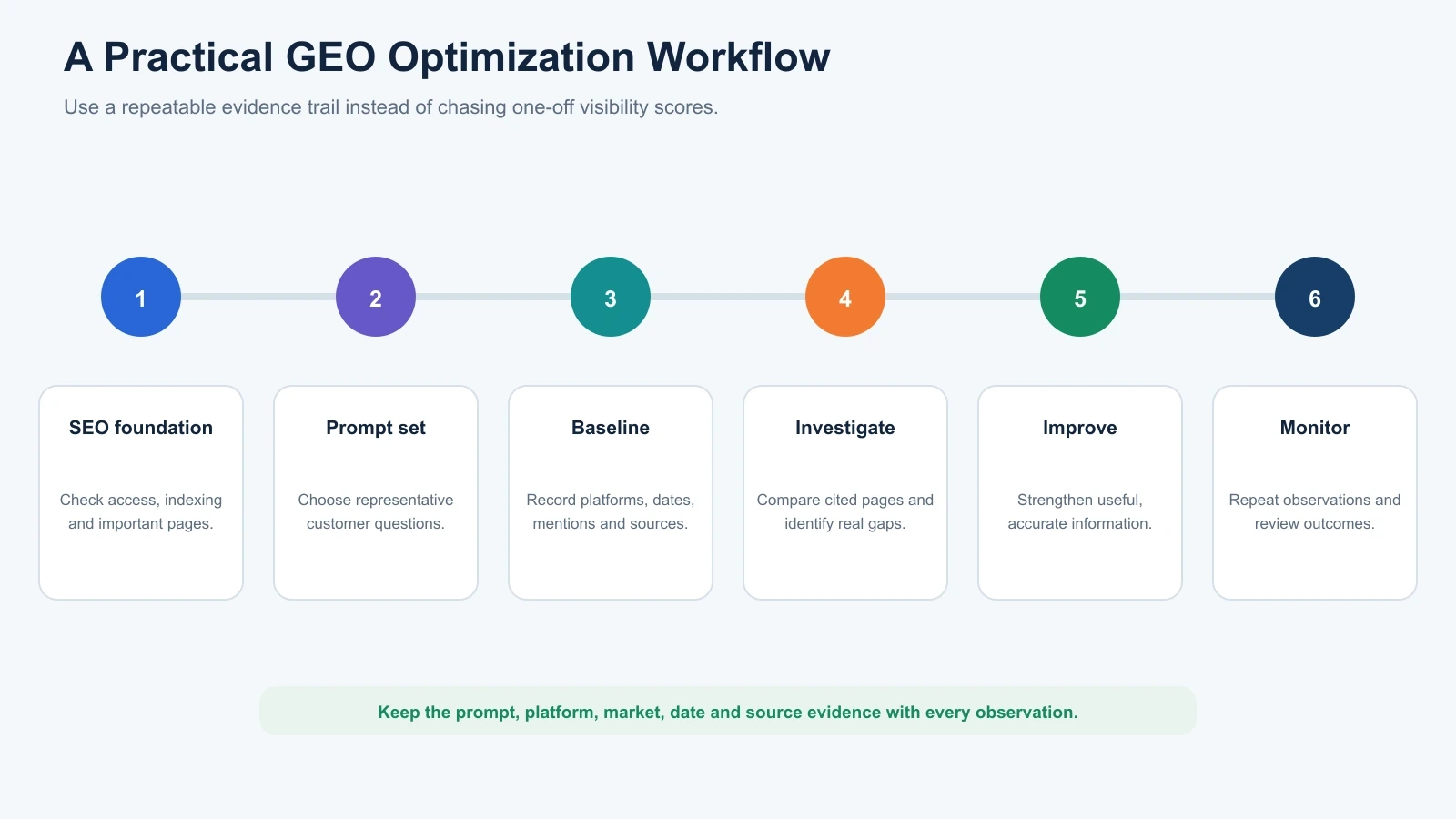
GEO research becomes useful when it leads to improvements in the information people and AI systems can discover.
The following workflow provides a repeatable starting point.
Start With Your Existing SEO Foundation
Before purchasing GEO software, check whether your important pages are accessible and indexed.
Google Search Console can help identify indexing problems and establish baseline search performance.
Bing Webmaster Tools provides additional search and AI visibility information.
A technical crawler can help investigate issues involving redirects, canonical tags, robots directives, internal links, and rendered content.
GEO doesn’t remove the need for these checks.
A technically inaccessible page may be difficult for search systems to discover regardless of how carefully its content is written.
Build a Representative Prompt Set
Choose questions that reflect how customers actually research your market.
Include informational, commercial, comparison, and problem-solving queries.
For example, a B2B marketing agency might monitor questions such as:
| Prompt Type | Example Question |
|---|---|
| Informational | How does GEO differ from SEO? |
| Commercial | What tools can monitor brand mentions in AI search? |
| Comparison | How does Semrush AI Visibility compare with Ahrefs Brand Radar? |
| Problem-solving | Why is my website not cited by ChatGPT Search? |
| Service-focused | What should a small business look for in a GEO consultant? |
These are illustrative research prompts, not evidence of live customer search volume.
A manageable initial set of relevant questions is more useful than a large collection assembled without a clear purpose.
Record the intended audience, market, and platform for each.
Establish a Visibility Baseline
Run the prompts through the relevant AI experiences or a monitoring product that supports them.
Record the complete responses and source information where available.
For each observation, capture:
- The question or prompt
- AI platform and relevant configuration
- Location or market, if applicable
- Date of collection
- Whether the brand appeared
- Whether the website was cited
- Which competing brands appeared
- Which URLs were cited
- Whether the mention was relevant and accurate
Avoid turning one response into a definitive brand ranking.
Repeated observations over time provide a more useful picture of variability.
Investigate Missing or Inaccurate Information
Suppose your brand doesn’t appear when an AI system compares products in your category.
Before assuming that the content needs rewriting, examine the sources that were cited.
Do they answer a different question?
Do they contain product details your website lacks?
Are they based on original research, updated documentation, or independent reviews?
The investigation may reveal an actual information gap.
It may also show that the answer depends on retrieval behaviour outside your direct control.
The purpose is to find improvements that benefit users rather than copying competitors simply to increase AI mentions.
Improve the Underlying Content
Prioritise improvements that make information clearer, more reliable, and more useful.
For example, a product comparison could benefit from verified feature descriptions, dated pricing information, transparent evaluation criteria, and clearly explained limitations.
A tutorial might need practical examples, screenshots, or instructions based on actual experience.
A service page may need more specific information about its audience, deliverables, and geographic coverage.
Good GEO work often looks like disciplined editorial and technical SEO.
It doesn’t require inventing a different writing style solely for AI systems.
Monitor Results and Business Outcomes
After publishing improvements, continue checking the same representative prompts and first-party reports.
Review whether relevant pages receive more visibility and whether the brand’s representation changes.
Also examine available referral data and business outcomes.
However, don’t assume that an increase in citations proves the content update caused it.
Generative systems, retrieval methods, competitors, and available web information can change during the measurement period.
Treat the results as evidence to investigate rather than guaranteed cause-and-effect.
How to Optimize Content for AI Search Without Chasing GEO Hacks
The most defensible GEO strategy is to publish information that is useful, accessible, and supported by evidence.
Google’s 2026 guidance specifically emphasises unique, non-commodity content rather than special formatting tricks.
Provide Original Information
A generic article repeating familiar advice gives readers little reason to choose it over other sources.
Original information creates clearer value.
That may include product testing, interviews, documented processes, firsthand examples, original comparisons, or carefully interpreted data.
However, claims about personal testing should only appear when testing actually occurred.
Publishing fictional experiments or unsupported benchmark results undermines the usefulness of the content.
Make Important Claims Easy to Understand
Clear explanations benefit human readers and make information easier to interpret.
A useful article defines important terms, provides enough context, and explains the evidence behind material claims.
That doesn’t mean every paragraph needs to be shortened to a particular word count.
Google explicitly states that artificial content chunking and special formatting are not requirements for inclusion in its generative AI experiences.
Write for the complexity of the subject and the needs of the audience.
Keep Information Accurate and Current
AI answers can be affected by outdated product information and inconsistent business details.
For software publishers, review plans, features, support policies, and integration information regularly.
For local businesses, keep business names, locations, operating details, and contact information consistent across relevant properties.
Dates matter when the information is time-sensitive.
However, adding the current year to every title doesn’t automatically make the content more trustworthy or visible.
Use Structured Data Appropriately
Structured data can help search engines interpret supported information about a page.
However, Google doesn’t require a special GEO schema to appear in AI Overviews or AI Mode.
Existing supported markup should accurately reflect information visible on the page.
Don’t invent ratings, reviewers, product claims, or FAQ markup simply to make an article seem more authoritative.
Schema is a supporting technical practice, not a guaranteed citation mechanism.
Build Clear Topic Relationships
Related content should be connected through useful internal links.
For example, a GEO pillar article can introduce AI visibility, citation tracking, content optimization, and technical accessibility.
More focused articles can then explain each subject in detail.
This helps users navigate a complex topic and supports ordinary search discovery.
Our article on structuring content for AI answer citations explores the editorial side of that process.
The key principle is relevance. Internal links should lead readers to genuinely related information rather than exist only to satisfy an SEO checklist.
Technical GEO: Can AI Search Crawlers Access Your Website?
Technical accessibility is one of the few GEO-related conditions a website owner can investigate directly.
However, different AI systems use different crawlers and content-access methods.
Google AI Overviews and AI Mode
Google states that established SEO technical requirements remain relevant.
For a webpage to be eligible as a supporting link in Google’s generative search experiences, it must meet the relevant indexing and snippet-eligibility requirements.
Google also introduced a Search generative AI control within Search Console in 2026.
The default setting includes eligible site content in supported generative-AI search features unless the site owner changes the control.
This can be reviewed under Search Console settings.
The important distinction is that eligibility doesn’t guarantee inclusion in AI-generated answers.
Read Google’s Search generative AI control documentation before making changes.
ChatGPT Search and OAI-SearchBot
OpenAI explains that publicly accessible websites may appear in ChatGPT search results.
To help ensure content can be discovered and included in summaries or snippets, publishers should check that OAI-SearchBot isn’t blocked.
Server configuration, content delivery networks, and bot protection may also affect access.
OpenAI distinguishes its search crawler from GPTBot, which is associated with potential model training.
These controls shouldn’t be treated as interchangeable.
Allowing search crawling does not guarantee a citation, and blocking training-related crawling isn’t the same as blocking search discovery.
See OpenAI’s publisher and developer guidance.
Do You Need an llms.txt File?
The llms.txt proposal is intended to make information easier for language-model-based systems to discover or interpret.
However, Google explicitly states that its Search systems do not use llms.txt as a special signal for generative AI search.
Creating such a file therefore isn’t a requirement for appearing in Google’s AI features.
Other systems may experiment with different conventions, but site owners should look for documented support before investing substantial effort.
Our discussion of whether llms.txt is worth implementing explores the distinction between proposed standards and demonstrated adoption.
The practical priority remains ensuring that important content is accessible, correctly indexed where necessary, and genuinely useful.
How to Measure the Business Value of GEO
GEO visibility is useful to monitor, but it doesn’t automatically translate into traffic, leads, or revenue.
A website can be cited in a generated answer without anyone clicking through.
A brand may also be mentioned in an AI response without receiving a direct link.
These are visibility outcomes, not confirmed conversions.
Combine First-Party and Third-Party Evidence
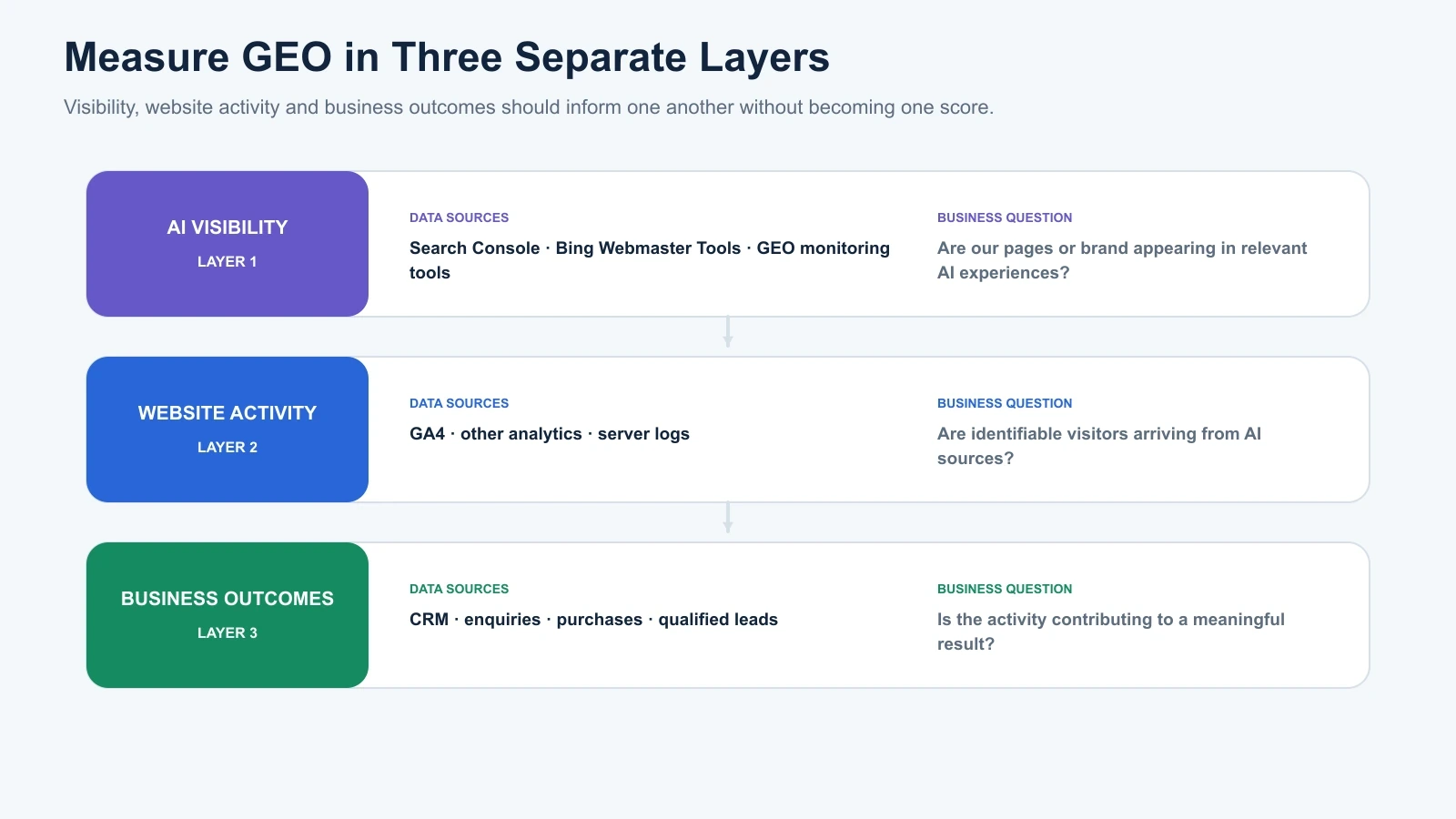
A practical reporting framework separates three layers.
| Measurement Layer | Data Source | Business Question |
|---|---|---|
| AI visibility | Search Console, Bing Webmaster Tools, GEO monitoring tools | Are our pages or brand appearing in relevant AI experiences? |
| Website activity | GA4, other analytics, server logs | Are visitors arriving from identifiable AI sources? |
| Business outcomes | CRM, enquiries, purchases, qualified leads | Is the activity contributing to meaningful results? |
These measurements should be examined together without forcing them into one proprietary score.
Google’s generative-AI impression reports and Bing’s citation reporting can provide useful first-party context.
Third-party tools can add sampled brand, competitor, and prompt observations.
Analytics and business systems help determine whether measurable visits or outcomes follow.
Tracking Referral Traffic From ChatGPT
OpenAI documents the use of utm_source=chatgpt.com in referral URLs associated with ChatGPT Search.
This can help site owners investigate identifiable visits through analytics platforms such as GA4.
However, referral tracking only captures activity that leads to a measurable visit.
It doesn’t reveal the full audience exposed to a brand mention inside AI-generated answers.
For this reason, AI referral traffic is only one part of GEO measurement.
Our discussion of measuring the value of zero-click visibility covers why brand exposure and website visits should be considered separately.
Avoid Treating Citations as Guaranteed Revenue
Suppose a business sees more citations after improving its product documentation.
That’s a useful observation.
However, the increase doesn’t automatically establish that those citations generated additional sales.
To make a stronger business case, examine relevant website visits, enquiries, assisted interactions where measurable, and changes in business performance.
Even then, distinguish observed relationships from proven causation.
GEO reporting becomes more credible when it acknowledges what the available evidence cannot measure.
Common GEO Mistakes to Avoid
Treating GEO as a Replacement for SEO
AI-assisted search still depends heavily on accessible information, useful content, and established discovery systems.
Ignoring technical SEO or content quality in favour of AI visibility scores is unlikely to produce a sustainable strategy.
Confusing Mentions With Citations
A brand named in an answer hasn’t necessarily earned a link.
A website used as a source hasn’t necessarily received a product recommendation.
Report these outcomes separately.
Trusting One Prompt as a Complete Benchmark
A single response doesn’t represent all possible user interactions.
A useful monitoring process records a consistent set of relevant questions across multiple observations.
Optimizing Only for Proprietary Scores
Vendor-defined visibility and content scores can help identify patterns.
However, they are not official measurements of AI ranking systems.
Investigate the underlying prompts, responses, and sources before changing your strategy.
Publishing Content Primarily for AI Extraction
Artificially breaking every article into tiny answer blocks or repeating similar questions across many pages doesn’t guarantee better results.
Content should remain useful to people.
Google’s generative-AI guidance specifically warns against creating low-value pages simply to capture many variations of a query.
Assuming a Citation Guarantees Traffic
AI systems may provide sufficient information within the answer itself.
A citation can create visibility without generating a website visit.
Evaluate exposure and business outcomes separately.
Do You Actually Need a Paid GEO Tool?
Not every business needs a dedicated GEO subscription immediately.
A basic workflow can begin with Google Search Console, Bing Webmaster Tools, and a manageable set of manually observed questions.
That can help establish whether AI-generated search is relevant to the business and where useful content opportunities exist.
A paid GEO platform becomes more attractive when the team needs repeated prompt monitoring across several AI systems, competitor comparisons, larger datasets, historical reports, or client-level automation.
However, the subscription should solve a specific problem.
A company that cannot explain which questions it needs to monitor may gain little value from a dashboard reporting hundreds of proprietary metrics.
The best starting point is a clear measurement question, not another subscription.
Final Verdict: What Makes a GEO Tool Worth Using?
GEO tools are useful because AI-generated answers introduce visibility outcomes that traditional keyword rankings and website traffic reports don’t fully describe.
A brand can be mentioned without receiving a click. A website can be cited without appearing prominently in a conventional keyword ranking report.
Understanding those differences requires new measurements.
However, GEO software is only as useful as the evidence behind its reports.
A credible platform should explain what it measures, which AI experiences it monitors, how its prompts are selected, and where its underlying observations come from.
It should also distinguish direct citations from brand mentions and sampled responses from first-party impressions.
For marketers, the practical approach is straightforward.
Start with accessible, accurate content. Establish a baseline using first-party reporting where available. Monitor relevant questions, investigate competitors’ cited sources, and improve information that genuinely needs improvement.
Then assess changes using consistent observations and measurable business outcomes.
At MediaOne, we view GEO as an extension of established SEO and content operations, not a replacement for them.
A good GEO tool doesn’t promise to make an AI assistant recommend your business. It helps you understand where your brand appears, where relevant information is missing, and which improvements are worth investigating.
That is what makes the software useful beyond the novelty of another AI visibility score.
Frequently Asked Questions
What Is a GEO Tool?
A GEO tool is software that helps businesses analyse their visibility in generative AI experiences. Depending on the platform, it may monitor brand mentions, citations, competitor appearances, relevant prompts, and content accessibility. Some GEO tools also provide content recommendations and reporting features.
What Does GEO Stand For in Digital Marketing?
GEO stands for Generative Engine Optimization. It describes practices intended to improve the discoverability and representation of brands, websites, and content in AI-generated answers. It overlaps substantially with traditional SEO, particularly content quality, technical accessibility, and reliable information.
What Is the Difference Between SEO and GEO Tools?
SEO tools traditionally focus on search rankings, keyword research, indexing, technical auditing, backlinks, and organic performance. GEO tools focus on how brands and content appear in AI-generated responses, including mentions and citations. Some modern platforms combine both categories.
Can GEO Tools Improve ChatGPT Visibility?
GEO tools can help identify whether a brand or website appears in observed ChatGPT Search responses and which topics deserve investigation. They cannot guarantee inclusion or citations. Website accessibility, relevant content, retrieval behaviour, and other factors influence what appears.
How Can I Track My Website in Google AI Overviews?
Google Search Console provides a dedicated generative-AI performance report covering supported AI features, including AI Overviews and AI Mode. The report includes impression-based visibility information and relevant dimensions such as pages and countries. Third-party tools may provide additional sampled prompt and competitor analysis.
Are There Free GEO Tools?
Yes. Google Search Console and Bing Webmaster Tools provide first-party information about supported generative AI search experiences. Businesses can also conduct limited manual monitoring of relevant AI prompts. Dedicated third-party platforms may offer free checks, trials, or paid subscriptions with broader capabilities.
Does Structured Data Help GEO?
Supported structured data can help search engines understand website information, but Google does not require special GEO schema to appear in AI Overviews or AI Mode. Markup should reflect visible content accurately. Structured data alone does not guarantee that a webpage will be cited by an AI system.
Is llms.txt Required for GEO?
No. Google explicitly states that llms.txt isn’t required or used as a special signal for inclusion in its generative AI search features. Other tools and services may adopt their own conventions, but implementation should be guided by documented support rather than assumptions about ranking benefits.
How Do You Measure GEO Performance?
GEO performance can be assessed using AI impressions, brand mentions, source citations, prompt coverage, and attributable referral traffic. These metrics measure different outcomes and should not automatically be combined. Reports are most useful when they explain the platform, sample, collection date, and limitations.
Which GEO Optimization Tool Is Best?
There is no universal winner. Google Search Console and Bing Webmaster Tools are useful first-party starting points. Semrush, Ahrefs Brand Radar, Otterly.AI, Peec AI, and Digimetrics offer different GEO-related capabilities. The right choice depends on platform coverage, prompt tracking, citation evidence, reporting, and cost.
How Long Does GEO Optimization Take to Work?
There is no guaranteed timeline. AI responses can change with new content, different retrieval behaviour, system updates, and competing sources. Some observations may change quickly, while others remain inconsistent. Evaluate progress across repeated measurements rather than expecting a fixed number of days before a citation appears.
Will GEO Replace Traditional SEO?
GEO is unlikely to make foundational SEO work unnecessary. Google’s official guidance continues to emphasise established search practices for its generative AI features. GEO introduces additional visibility and measurement considerations while relying on many of the same content, technical, and audience-focused principles.
Disclosure: digitalmarketingtools.ai is sponsored by Digimetrics.ai. Sponsored Highlights are clearly labelled advertising. Our reviews, comparisons and guides are written to be useful and fair regardless of who sponsors the site. Read the full disclosure.