How to Rank in Perplexity and ChatGPT: A Practical Guide to AI Search Visibility

Direct answer: To rank in Perplexity and ChatGPT, answer one narrow question clearly, make each claim easy to check, and structure the page so a retrieval system can lift a self-contained passage. An AI citation is not a Google rank, and no one can guarantee it.
Most marketers still judge search work by one question: where does this page rank on Google? That question no longer covers the full picture. When a buyer asks Perplexity or ChatGPT which tool to use, the answer may name three brands, show several sources, or mention nobody at all. None of those outcomes appears in a standard rank report.
This guide treats AI answer visibility as its own problem. Our working thesis is that pages earn citations for three reasons: they answer a narrow question clearly, their claims can be corroborated, and their structure lets a retrieval system lift a self-contained passage. Pages that rank well in traditional search are not always the ones that get quoted. Throughout, we set out what each engine does, a repeatable framework you can apply to your own pages, and a way to measure results in US dollars so you can explain the work to a finance team.
Key Takeaways
- A citation in an AI answer is a different outcome from a Google rank, and the two only partly correlate.
- Perplexity selects sources at query time. ChatGPT searches the web only some of the time and otherwise answers from training data.
- The Citation Readiness Checklist scores a page on five pass or fail criteria: a direct answer in the first 60 words, a self-contained definition, named sources, question-based headings, and a visible author with a date.
- Measure with a fixed prompt set, a simple log, and repeat runs. Single tests mislead.
- Judge progress as a trend over several months, not a single result.
Table of Contents
- What “Ranking” Means in Perplexity and ChatGPT
- How Perplexity Selects and Cites Sources
- How ChatGPT Surfaces Websites in Search and Answers
- Step 1: Audit Your Current AI Visibility With a Repeatable Prompt Set
- Conclusion and Next Steps
- Frequently Asked Questions
What “Ranking” Means in Perplexity and ChatGPT
Most marketers arrive with a Google mental model: publish, earn links, climb positions. That model does not transfer cleanly. In answer engines, the unit of competition is not a page’s position in a list. It is whether a specific passage gets selected, attributed and repeated. Getting that distinction right changes what you measure and what you change.
Why AI answer engines don’t rank pages the way Google does
Google returns an ordered list of links and lets the searcher choose. Perplexity and ChatGPT return a synthesized answer, and most of the time only a handful of sources are visible. There is no page one in the traditional sense. A page is either among the sources that feed the answer or it is not.
This is why organic rank and AI citation are only partly correlated. A page can sit near the top for a query and still be absent from the generated answer. The model drew its supporting passages from pages that stated the answer more cleanly. We have seen a modest-ranking page with a tight, self-contained definition get cited while a longer authority page did not. That is one observed pattern, not a measured rate, so run your own test queries before relying on it.
How citations are chosen: retrieval, grounding and source selection
Three stages matter, and they behave differently in each tool.
Retrieval is the search step: fetching candidate pages from the web. Perplexity retrieves live web results for almost every query and shows its sources by design. ChatGPT searches the web only when browsing is triggered, either by the user or by the model judging that the question needs current information. Otherwise it answers from training data, where your page may shape the model’s knowledge without ever being cited.
Grounding ties retrieved text to the answer, checking that a passage actually supports a claim. Passages that state a fact plainly, near the claim they support, are easier to ground. Passages where the fact is buried are harder.
Source selection is the final filter: which retrieved sources appear as citations. Clear attribution, a visible author or organization, and corroboration from other sites all make a source easier to justify citing.
You cannot optimize for “ranking” in one step. Your pages must be retrievable, groundable and citable.
The difference between being mentioned, cited and recommended
These three outcomes are often conflated in reporting. They carry different value.
| Outcome | What happens | What it signals |
|---|---|---|
| Mentioned | Your brand or site name appears in the answer text | Awareness: the model knows you exist |
| Cited | A link to your page appears as a source | Your content supported a specific claim |
| Recommended | The answer suggests your product for the user’s need | Commercial preference, the hardest to earn |
A mention without a citation is common and hard to act on, because nothing sends a reader to you. A citation is the most measurable outcome and the one this guide targets first. A recommendation depends on the user’s question and on how the model weighs the options it finds. You influence it indirectly, through the clarity of your product pages and how consistently third parties describe you.
Track all three separately. Counting them together hides which lever you pulled.
How Perplexity Selects and Cites Sources
Perplexity’s retrieval behavior and what it favors
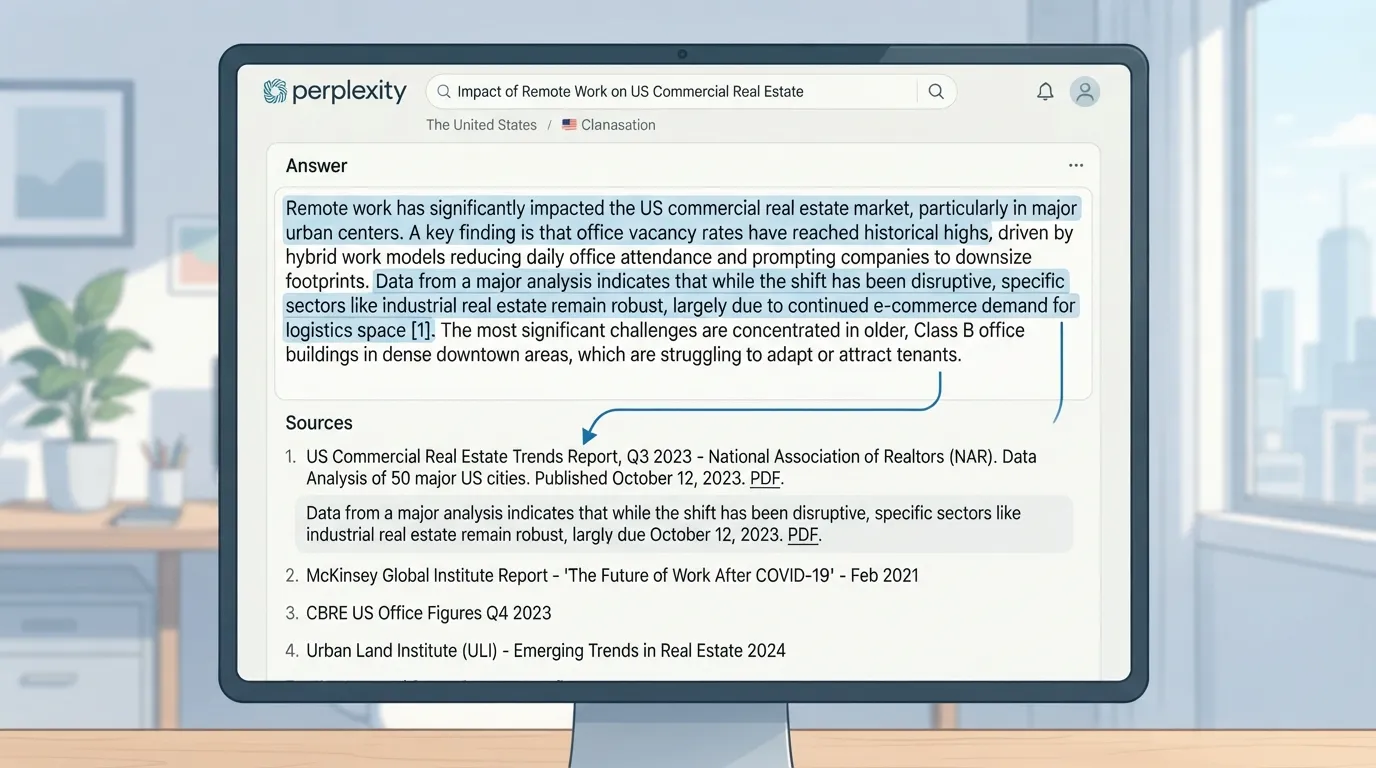
Perplexity selects sources at query time. When you ask a question, it searches the web, pulls a set of pages, reads passages from them, and writes an answer with numbered citations. The page that gets cited is usually the one whose passage most directly answers the question.
Perplexity favors three things. First, a passage that states a claim plainly, near the top of its section, so the model can lift it without rewriting. Second, sources that are independently corroborated, meaning the same fact appears on other reputable sites. Third, pages that are crawlable and render their text without heavy scripting. Client-side scripting runs in the visitor’s browser to build the page. A page the retriever cannot read cannot be cited.
Traditional rank and citation overlap, but they are not the same. A page can sit on page one of Google and never be cited if its key answer is buried in a long introduction. A narrow, well-structured page from a less prominent site can win citations because it answers one question cleanly. Treat Perplexity as a passage-selection system, not a ranking table.
Perplexity and ChatGPT differ in when they search. Perplexity searches on almost every query, so it is always looking for fresh passages. ChatGPT searches only when browsing is triggered, so the same page can be ignored for one question and used for the next. These behaviors reflect how each product worked when we tested them, and both change over time, so re-check them against the current version of each tool.
A step-by-step process to get your page cited
Work through these steps in order. Each one builds on the one before.
- Pick one narrow question your page will answer, and write it as a real customer would ask it.
- Put the direct answer first. State it in the first 60 words of the section, in plain language.
- Write a self-contained definition that still makes sense if a model quotes it alone.
- Attach a named, linkable source to every factual claim.
- Make the headings questions that mirror how people search.
- Show a visible author and a last-updated date.
- Run the Citation Readiness Checklist below and fix every failure.
- Test the page with your prompt set in Perplexity and ChatGPT, then log the result.
Structuring pages so Perplexity can lift an accurate answer
The Citation Readiness Checklist is the test to run before publishing any page you want Perplexity to cite. It has five pass or fail criteria.
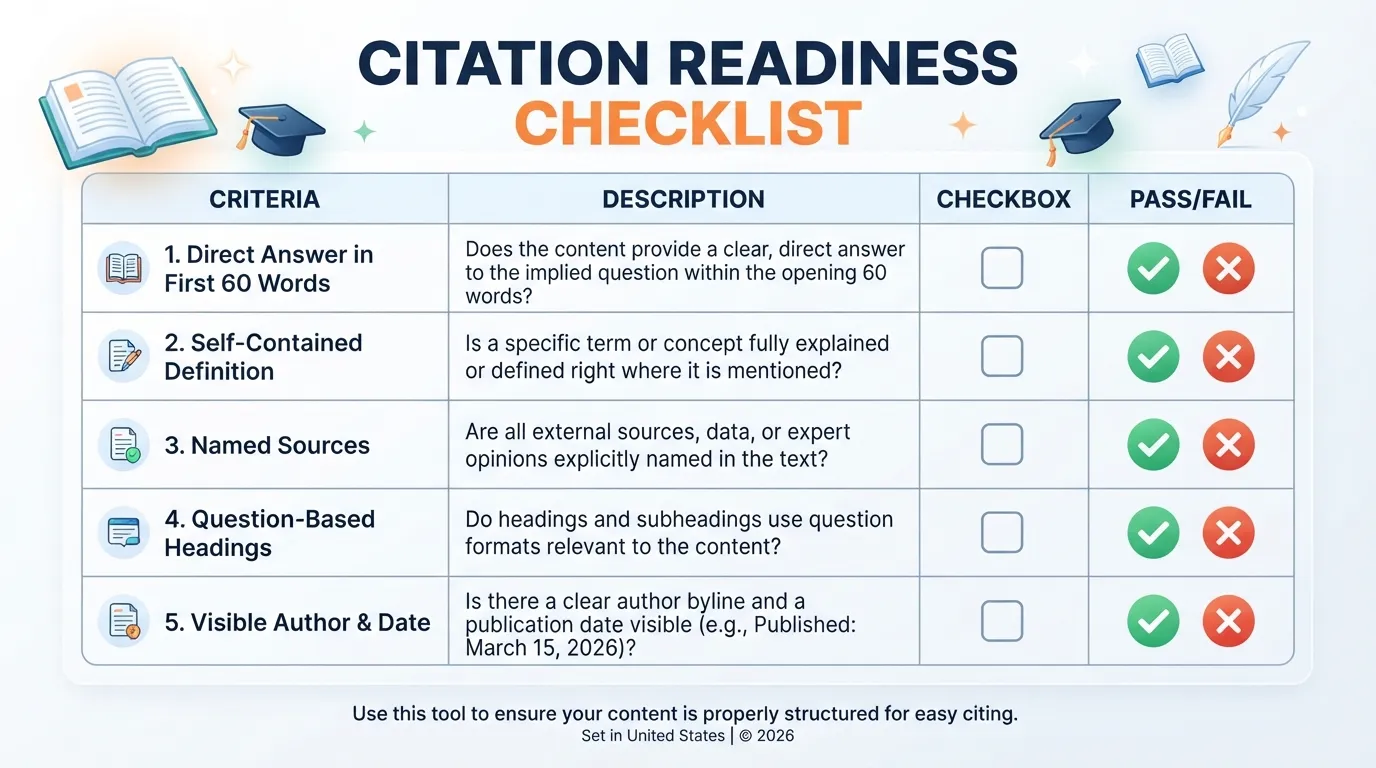
- A direct answer in the first 60 words of each section.
- A self-contained definition that still makes sense if quoted alone.
- Named, linkable sources for every factual claim. Perplexity’s own help center describes how it presents sources, and the Google Search Central guide to helpful content sets out the same plain-answer principles.
- Question-based H2 and H3 headings that mirror real queries.
- A visible author and last-updated date.
Revise the page until all five pass. Each one removes a reason the retriever might skip your passage.
Worked example. Take this opening: “It depends on several factors, and in this section we will explore how Perplexity picks sources.” It fails criterion one, because the answer is missing. Now take: “Perplexity picks sources at query time, then cites the passages that most directly answer the question.” It passes criterion one and states the claim plainly, so a retriever can lift it without rewriting. Score each section the same way and fix the failures first.
Keep each section focused on one idea. A heading such as “How long does a Perplexity citation last?” should be answered inside that section, not three sections later. When a passage depends on context from elsewhere, the model may quote the sentence without the qualifier, and that is how inaccurate citations happen. Write each answer so it stands alone.
Depth still matters. Put the direct answer first, then supply the reasoning, the caveats and the evidence beneath it. That gives the model a clean extract and gives a human reader enough to trust it.
Measuring Perplexity citations manually and with tools
Start with manual testing, because it is free and shows you exactly what the engine does. Build a set of 15 to 25 test queries that real customers would ask, including the narrow questions your pages claim to answer. Run each query in Perplexity and record the result using this template:
Query:. Engine tested: Perplexity. Date tested:. Source cited:. If cited, your page appears as:. Competitor pages cited:. Action taken:.
Run the same set monthly. Results vary between runs, so one test tells you little. Look for patterns across the set: which pages get cited, which competitor sources recur, and which queries return no citation of yours at all.
Tools can automate this, but they do not remove the need for judgment. Visibility platforms can rerun a prompt set on a schedule and log citations, which saves time once your set is large. Server log analysis is a separate check. It shows whether Perplexity’s crawlers reach your pages at all. If the logs show no visits, the problem is access, not content, and access should be checked first.
Treat the output as a trend. Judge progress across several months rather than from any single answer.
How ChatGPT Surfaces Websites in Search and Answers
ChatGPT answers a question in one of two ways. It either draws on what it learned during training, or it runs a live web search and builds the answer from pages it fetches. Which route it takes decides whether your page can be seen at all in that moment, so this is the first thing to understand.
When ChatGPT browses the web and what triggers it
ChatGPT does not search the web for every prompt. A search runs when a question needs information that is recent, specific or likely to change, such as current prices, news, product availability or local business details. Questions about stable concepts, such as how a canonical tag works, are usually answered from training data with no visible search.
Your visibility therefore depends on the query type. For a broad “what is” question, you compete against the model’s existing knowledge, which you cannot directly change. For a time-sensitive or comparison question, live retrieval becomes possible, and a well-structured page can be fetched and used.
When search runs, ChatGPT typically shows citations or source links. Whether a query triggers a search depends on the model and product version in use. OpenAI changes both over time, so test your own target queries rather than assuming a fixed rule. This section reflects platform behavior as observed and last verified in November 2026. Model dependence means the behavior may change with later versions. OpenAI’s documentation on ChatGPT search describes how the feature is presented.
Two access points matter. First, the crawler OpenAI uses for search must be allowed to reach your pages. OpenAI publishes its crawler details in its crawler documentation. Second, the page must show its main content in the initial HTML. Many pages load text with client-side scripting, which runs in the visitor’s browser after the page arrives. A fetcher that receives an empty shell has nothing to quote.
Signals that make a page easier for ChatGPT to use
Once a page is retrieved, ChatGPT must decide whether a passage answers the question. It favors passages that are direct, specific and easy to lift without losing meaning. The pages that get used tend to share a handful of traits.
- A direct answer near the top of the section. If a heading asks a question, the first two or three sentences should answer it. A passage that opens with background forces the model to dig for the point.
- Self-contained paragraphs. A paragraph that depends on three earlier paragraphs is hard to quote accurately. Name the subject in the sentence itself.
- Explicit, attributable claims. A specific figure linked to its named source is safer to use than an unsourced assertion. Link the organization itself rather than writing vague phrases such as “studies show”.
- Clean structure. Descriptive headings, short paragraphs and real tables give the model clear boundaries. A comparison in a table is easier to extract than the same comparison buried in prose.
- Schema markup. Structured data, such as Article or FAQ schema in JSON-LD, labels what each part of the page is. It helps machines identify the author, the date and the questions a page answers. It does not guarantee citation, but it removes ambiguity.
- Author bylines and dates. A visible author and an update date help a reader, and they help systems judge whether information is current. Show the real author and their role. Do not invent credentials to fill this gap.
None of these signals guarantees selection. They raise the odds that a page’s passage is the most usable one available for a given question. Pages that show all of them give the model the least reason to skip them.
Brand mentions versus linked citations in ChatGPT responses
ChatGPT can surface your business in two distinct ways, and each needs different measurement.
A brand mention means the answer names your company or product in the text, with or without a link. A linked citation means the answer attaches a source link to a claim, usually pointing to your page. A mention can happen from training data alone, with no retrieval. A linked citation generally requires live search and a retrieved page.
A mention shows that the model knows your brand. A citation shows that a specific page was fetched and used. You can have strong mentions and weak citations, which usually means your brand is recognized but your pages are not the ones answering the questions.
A practical test is to run the same prompt several times and record three things: whether your brand is named, whether a link to your domain appears, and which of your URLs, if any, is attached. Log the results in a simple sheet. Treat the output as a sample, not a fixed reading, because responses vary between runs.
For local listings and business entity information, the same principle applies. Consistent, accurate profiles across the sources a model draws on help it describe your business correctly. The best local seo tools listed on this site can help you audit that consistency for a US market.
Step 1: Audit Your Current AI Visibility With a Repeatable Prompt Set
Before changing anything, record where you stand. The procedure below is the same one you will rerun each month, so every result is comparable. Log each run in a simple spreadsheet with the query, engine, date, cited URLs, whether your brand was mentioned and whether it was recommended.
- Build a fixed prompt set. Choose 10 to 20 queries your buyers actually ask, mixing time-sensitive and comparison questions. Keep the wording identical between runs.
- Run each prompt in Perplexity and ChatGPT. Use the same account settings each time, and run each prompt at least three times to see how much answers vary.
- Record the outcome for each run. Mark whether your brand is mentioned, cited (with the URL) or recommended.
- Check crawler access. Confirm that the crawlers you care about can reach your key pages, using your server logs or the provider’s crawler documentation.
- Score the result. A run passes when your brand is cited with one of your own URLs. Set your pass threshold before you start, for example a citation on at least half of your runs for a query, and keep it the same every month.
- Log the next action. For each failed query, note the page that should have answered it and which checklist item it fails.
Comparing manual testing, log analysis and visibility platforms
Each method answers a different question. Manual testing shows what the answer says and which sources it names. Log analysis shows whether AI crawlers reach your pages. Visibility platforms track citations over time across a large prompt set. Start with manual testing, add log analysis when you need to confirm access, and move to a platform once your prompt set is too large to run by hand.
Decision table: which tracking approach fits your team size and budget
| Team situation | Recommended approach | Why |
|---|---|---|
| Solo marketer, small prompt set | Manual testing in a spreadsheet | Low cost; shows exact answer wording |
| Small team, focused topic | Manual testing plus periodic log checks | Confirms access without new software |
| Larger team, many topics | Visibility platform plus log analysis | Automated reruns and trend reporting |
Budget decides the tool, not the method. A platform is worth its cost only when manual reruns start to take too long to keep up. Before buying, price the time your team would spend on a manual run each month, in US dollars, so the comparison is concrete. Spending $0.00 is a real option if a spreadsheet covers your prompt set. Move up when the set outgrows it.
Conclusion and Next Steps
AI answer visibility is a separate outcome from Google rank. It depends on whether a passage is retrieved, grounded and selected. Start by auditing your current citations, then apply the procedure above to your highest-value pages. Measure over several months and judge the trend, not any single answer. No one can guarantee a citation, so treat progress as probabilistic.
Frequently Asked Questions
Can you pay to rank in Perplexity or ChatGPT?
Citations are selected by the engine based on the content and sources it retrieves, and no paid placement mechanism is described in this guide. Confirm any advertising options directly with each provider before assuming they exist.
How long does it take to appear in AI answers after changes?
It depends on when the engine next retrieves your page and on how often your test queries run. Results vary between runs, so track a set of queries over several months rather than expecting an immediate change.
Do traditional SEO rankings predict AI citations?
Only partly. A high Google rank can coexist with no citation, and a lower-ranked page with a clear, self-contained answer can be cited. Track both measures separately.
Should I block AI crawlers from my website?
That decision depends on your goals. Blocking a crawler stops it from reading your pages, which removes the possibility of citation from that engine. Check each provider’s crawler documentation before changing your robots settings.
How do I know if ChatGPT is recommending my brand?
Run your test queries in ChatGPT on a fixed schedule and log whether your brand is mentioned, cited or recommended. Keep the three outcomes separate in your records.
Step 1: Audit Your Current AI Visibility With a Repeatable Prompt Set
Before you change anything, find out where you stand. Most teams guess at their AI visibility, and guesses are hard to act on. A short, repeatable audit gives you a baseline to compare against next month.
Start by writing 15 to 25 prompts that a real buyer would type. Mix three types: category questions (“what are the best local SEO tools for a small clinic”), problem questions (“why isn’t my Google Business Profile showing in map results”), and comparison questions (“is a rank tracker worth paying for”). Keep the wording stable so that changes in results reflect your site, not your phrasing.
Run each prompt in Perplexity and ChatGPT on the same day, ideally in a clean browser session. Record the result in a simple log with these fields:
- Query, exact wording
- Engine tested and whether search was enabled (ChatGPT answers differ with and without web search)
- Date tested, in YYYY-MM-DD format
- Whether your domain was cited, linked or only mentioned by name
- Which competitor pages were cited
- Your position in the answer, if it is a list
Repeat the same run at least twice, a few days apart. Single runs mislead because these systems give variable answers. If your brand appears in one run in three, treat that as partial visibility, not a win.
This audit does two jobs. It shows which topics you already own, and it shows the pages that AI tools cite instead of yours. That second list is where the next steps start.
Comparing manual testing, log analysis and visibility platforms
Three methods can tell you whether AI answer engines are citing your pages. Each answers a different question, and none is complete on its own.
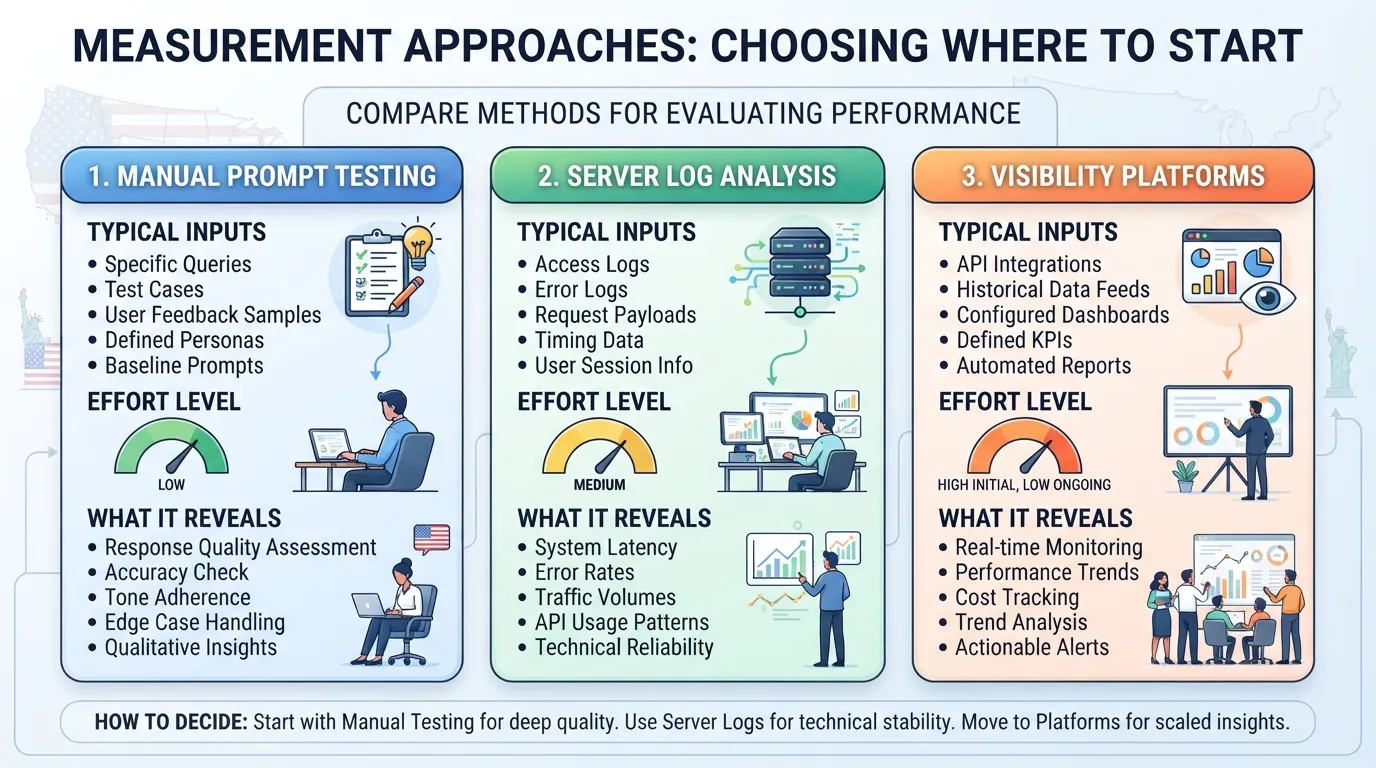
Manual testing means running a fixed set of queries in Perplexity and ChatGPT and recording what comes back. It is free and shows exactly what a user sees, including which sources are named and how your brand is described. Its weakness is scale and consistency, since answers vary between sessions, models and locations. One test tells you very little. Manual testing works best as a monthly check on the prompts you care about most.
Log analysis looks at your server logs for requests from AI crawlers and fetchers. It shows whether the bots that feed these tools can reach your pages, how often they visit, and which URLs they read. It does not show whether a page was used in an answer, only that it was fetched. Log analysis is the only method that reveals crawl access problems, such as a robots.txt rule that blocks a bot or a page that returns an error to it. It requires access to raw server or CDN logs and someone comfortable filtering them by user agent.
Visibility platforms are commercial tools that run prompt sets across several AI engines on a schedule and report citation share, mention frequency and the sources used. They trade precision for convenience. You get trend lines and competitor comparisons without building a testing process, but you pay a subscription, and results depend on the platform’s prompt library and sampling method. Ask any vendor how many runs sit behind each figure, and whether engine versions are logged.
The three methods answer different questions. Manual testing shows what users see. Log analysis shows what the bots can reach. Platforms show how your visibility moves over time against others.
Decision table: which tracking approach fits your team size and budget
| Team situation | Recommended approach | Why it fits |
|---|---|---|
| Solo owner or one marketer, minimal budget | Manual testing with a fixed prompt set and a simple log | Costs nothing but time, and a small prompt set is manageable by hand |
| Small team with a developer or hosting access | Manual testing plus periodic log analysis | Log checks catch crawl blocks that manual tests cannot reveal |
| Mid-size marketing team with reporting obligations | Visibility platform, backed by manual spot checks | Gives trend data for stakeholders, and spot checks validate what the platform reports |
| Agency or multi-brand team | Visibility platform plus log analysis across client sites | Scale and repeatability matter, and crawl data explains gaps |
Whatever you choose, keep a simple log with these fields: query, engine tested, date tested, whether your page was cited, which competitor pages were cited, and the action you took. Record the answer, not a score. Over several months, this log will show more than any dashboard about which changes made a difference.
Conclusion and Next Steps
Ranking in Perplexity and ChatGPT is not a separate discipline with secret levers. It depends on three things: whether a page answers a narrow question clearly, whether other sources corroborate what it says, and whether its structure lets a retrieval system lift a self-contained passage. Pages that win citations are often not the pages that rank highest in Google. That gap is the central point of this guide.
The work is editorial and technical, not a matter of keyword density or link volume. Results are also probabilistic. No one can guarantee that a specific page will be cited for a specific prompt, because the engines change how they retrieve information and answers vary between runs.
Your next three actions
- Pick five priority questions. Choose the questions your buyers actually ask about your category. For example, which tools suit a small business with a budget of $0.00 to $150.00 a month.
- Run the Citation Readiness Checklist on the pages that answer them. Score each page pass or fail on five criteria: a direct answer in the first 60 words, a self-contained definition, named and linkable sources, question-based headings, and a visible author and update date. Revise until all five pass, and use a before-and-after scorecard to track the change.
- Log your test queries. Record each prompt, the engine, the date, whether your page was cited and which competitor pages appeared. Repeat the same prompts monthly so changes are visible in your records rather than assumed.
What to expect
Treat the first month as a baseline. Changes to a page can take weeks to show up in Perplexity. ChatGPT’s behavior depends on whether search is enabled for a given answer. A page that gains citations on Perplexity may still be absent from ChatGPT, which is normal. Keep the log, compare like with like, and judge progress over several months.
For a broader view of how local visibility connects to these answer engines, see our guide to best local seo tools, which covers the listings and citation signals that often feed the same retrieval systems.
Frequently Asked Questions
Can you pay to rank in Perplexity or ChatGPT?
No. Neither Perplexity nor ChatGPT sells a placement that guarantees a citation, and paid ads do not buy a mention in an organic answer. Be wary of any agency that promises guaranteed AI rankings for a fee. The outcome depends on how each system retrieves and attributes sources, which no vendor controls.
How long does it take to appear in AI answers after changes?
There is no fixed timeline. A page must first be crawled, indexed and judged useful for a given question. Perplexity retrieves sources on each query, so it can reflect new content sooner than ChatGPT answers that rely on training data or occasional browsing. Re-test your key queries every few weeks rather than expecting a change on a set date.
Do traditional SEO rankings predict AI citations?
Only partly. A page that ranks well in Google often has the authority and crawlability that retrieval systems rely on, so the two correlate. But they often diverge. A lower-ranked page with a clear, self-contained answer can be cited while a top-ranked page with a long introduction is passed over. Organic rank is a useful signal, not a guarantee.
Should I block AI crawlers from my website?
Blocking is a business decision with trade-offs. Blocking AI crawlers in robots.txt may reduce the chance that your content is used in answers that cite you. Allowing them means your content can be quoted, which brings citation potential but may mean less direct traffic. Review each crawler’s published user agent and your server logs before deciding. Consider allowing access to your most answer-ready pages while restricting sections you consider proprietary.
How do I know if ChatGPT is recommending my brand?
Run a repeatable set of test prompts, record the answers, and note whether your brand is mentioned and whether a link appears. Use the same wording each time, test at the same interval, and save the output with the date. Mentions without links still matter for awareness, but only linked citations send readers to your site. A simple spreadsheet with query, date, mention (yes or no) and link (yes or no) gives you a baseline to compare after each change.
Disclosure: digitalmarketingtools.ai is sponsored by Digimetrics.ai. Sponsored Highlights are clearly labelled advertising. Our reviews, comparisons and guides are written to be useful and fair regardless of who sponsors the site. Read the full disclosure.