
Best SEO Tools for International SEO in 2026: We Tested the Same 5-Market Site
Choosing an SEO platform gets much harder once the same website needs to perform across different countries and languages.
A normal SEO audit might tell you that a page is crawlable, a canonical is present or a keyword has search volume. International SEO adds another layer. Hreflang relationships need to work across regional versions, canonicals have to agree with those signals, keywords can change meaning or intent from one country to another, and the companies competing with you in Germany may look nothing like the businesses ranking in the US.
That’s why we didn’t answer “what are the best SEO tools for international SEO?” by comparing feature pages.
We tested Semrush, Ahrefs, Sitebulb, Screaming Frog, AccuRanker and Digimetrics using the same anonymised international B2B SaaS site across the United States, United Kingdom, Germany, France and Japan. The test covered 2,460 crawlable URLs, 24 known international SEO problems, 10 commercial keyword clusters, 50 market-query combinations and three competitors per market.
The goal was to answer more practical questions: Which tool finds the most international SEO problems? Which understands local search demand instead of relying on literal translations? Which keeps rankings properly separated by market? And which one gives the team the clearest answer about what to fix first?
If you’re still deciding whether you need a broad platform or several specialist tools, our SEO tools guide explains where auditing, research, rank tracking and competitor analysis fit into the wider SEO stack.
Quick Answer: What Is the Best SEO Tool for International SEO?
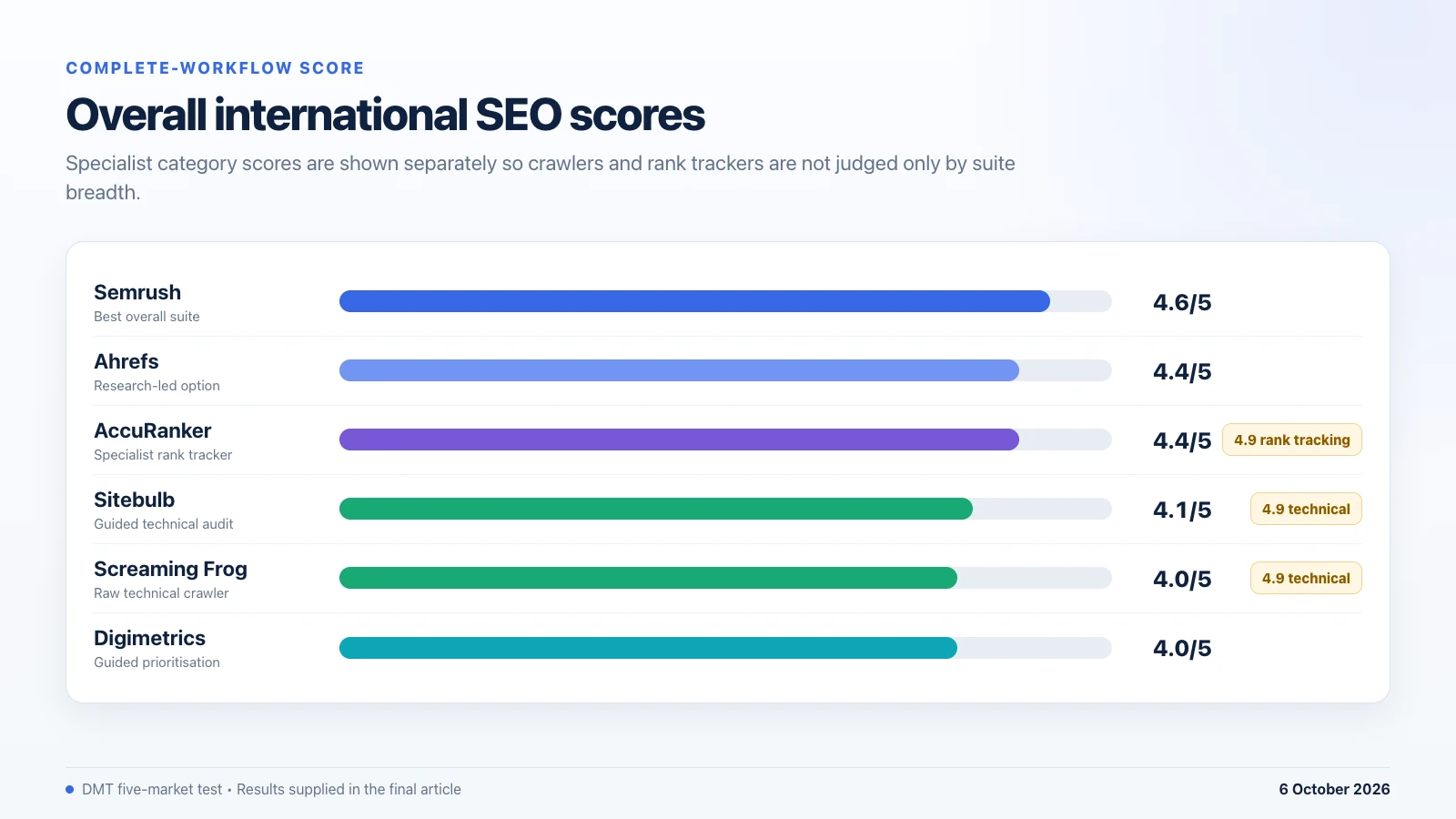
Semrush is the best international SEO tool overall in our five-market test, scoring 4.6/5. It provided the strongest balance of international technical auditing, multilingual keyword research, regional rank tracking, competitor analysis and reporting. Semrush found 21 of 24 known international SEO issues and selected the preferred local term and intent in 45 of 50 market-query combinations.
It didn’t win every specialist category. Screaming Frog found all 24 technical issues, while Sitebulb matched its hreflang coverage with fewer false positives and clearer cluster-level explanations. Ahrefs produced the strongest multilingual keyword and regional competitor research, AccuRanker was the best international rank tracker, and Digimetrics produced the clearest cross-market action plan.
That distinction matters. An enterprise SEO team troubleshooting a complicated 20-country hreflang implementation needs different software from a smaller business expanding from the US into the UK and Germany.
Best International SEO Tools at a Glance
| Tool | Best For | International Technical SEO | Multi-Market Keyword Research | Regional Rank Tracking | Action Clarity | Overall |
| Semrush | Best overall international SEO suite | 4.5/5 | 4.8/5 | 4.7/5 | 4.7/5 | 4.6/5 |
| Ahrefs | Multilingual keywords and regional competitors | 4.2/5 | 4.9/5 | 4.4/5 | 4.2/5 | 4.4/5 |
| Sitebulb | Hreflang validation and cluster explanations | 4.9/5 | N/A | N/A | 4.8/5 | 4.1/5* |
| Screaming Frog | Raw international technical crawling | 5.0/5 | N/A | N/A | 3.7/5 | 4.0/5* |
| AccuRanker | International rank tracking | Limited | Limited | 4.9/5 | 4.0/5 | 4.4/5* |
| Digimetrics | Guided SEO + GEO prioritisation | 3.4/5 | 4.3/5 | 4.0/5 | 4.9/5 | 4.0/5 |
*The overall scores for specialist products reflect their usefulness across the complete international SEO workflow, not weakness at their primary job. Screaming Frog’s raw technical performance, Sitebulb’s guided technical auditing and AccuRanker’s rank tracking are better judged by their specialist scores.
Why International SEO Needs a Different Tool Test
International SEO can involve different languages, regions or both at the same time. Google’s documentation for localized versions recommends explicitly identifying alternate language or regional pages and explains how hreflang can help Google associate those versions correctly.
The implementation is relational. A page shouldn’t simply point at its alternatives and call the job finished. Google’s guidance explains that localized versions should reference themselves and the relevant alternate versions, while reciprocal relationships are required so Google can verify that the site controls both pages.
That makes international auditing very different from checking whether one URL returns 200 OK.
A regional page can be perfectly crawlable while still having an invalid language-region code, incomplete hreflang cluster, alternate pointing at a non-canonical URL, accidental noindex, conflicting canonical or broken reciprocal relationship.
The keyword side creates another problem. A commercial query performing well in the US may use different terminology in the UK, while a literal German, French or Japanese translation may not reflect the query local users actually search.
Our comparison therefore measures technical implementation, local search demand, regional rankings and market-specific competitors together.
How We Tested the International SEO Tools
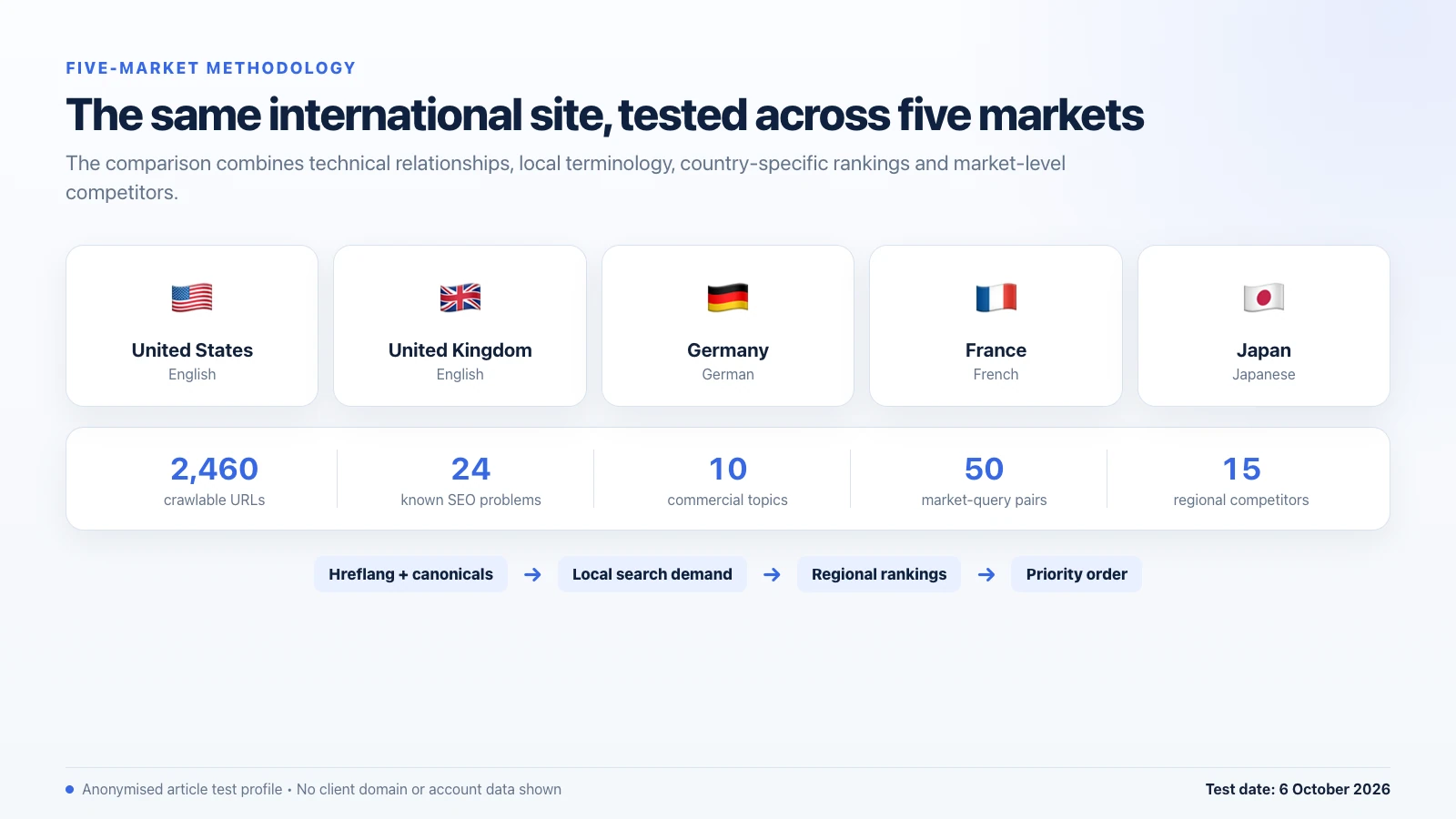
Every platform received the same site, markets and comparison conditions.
| Test Variable | Setup |
| Test date | 6 October 2026 |
| Business | Anonymised mid-market B2B SaaS company |
| Primary domain | .com |
| Regional structure | /us/, /uk/, /de/, /fr/, /jp/ |
| Markets | US, UK, Germany, France and Japan |
| Languages | English, German, French and Japanese |
| Crawlable URLs | 2,460 |
| Keyword clusters | 10 equivalent commercial topics |
| Market-query combinations | 50 |
| Competitors | 3 per market |
| Performance sources | Google Search Console + GA4 where applicable |
| Tester | MediaOne |
The mix gives us both multi-regional and multilingual challenges. US and UK pages test whether a platform can keep regional intent separate while the language remains English, while Germany, France and Japan reveal what happens when terminology, SERPs and competitor sets change more substantially.
The 24 Known International SEO Problems
Before running the tools, we established a known technical baseline.
| International SEO Problem | Known Issues |
| Missing reciprocal hreflang | 4 |
| Invalid language-region codes | 3 |
| Missing self-referencing hreflang | 3 |
| Hreflang pointing to non-canonical URLs | 3 |
| Hreflang pointing to redirects / broken URLs | 2 |
| Conflicting regional canonicals | 2 |
| Locale pages accidentally noindexed | 2 |
| Incomplete hreflang clusters | 2 |
| Incorrect x-default implementation | 1 |
| Regional internal-linking problem | 1 |
| Locale crawlability problem | 1 |
| Total | 24 |
These checks reflect real international SEO failure modes. Google documents requirements around reciprocal hreflang, self-references and valid language/region codes, while tools such as Ahrefs Site Audit also explicitly check problems such as missing return tags, invalid annotations and hreflang links pointing to non-canonical URLs.
We measured correct issues found, missed issues, false positives and detection rate rather than rewarding whichever crawler generated the longest warning list.
Detection Rate = Known Issues Correctly Found ÷ 24 × 100
The Multi-Market Keyword Test
We gave the research-capable platforms the same ten commercial topics across all five countries, producing 50 market-query combinations.
The goal wasn’t to see which product returned the largest keyword list. We evaluated whether it identified the preferred terminology and search intent for that particular market, surfaced useful local variants and found competitors actually visible in the regional SERP.
This becomes especially important in Germany, France and Japan, where translating the original English term doesn’t necessarily produce the keyword people actually use.
The International Rank-Tracking Test
The same market-query combinations were also used for rank tracking. We evaluated country and language targeting, device and locale controls, competitors, historical reporting and how easily market-level gains and losses could be separated.
A global visibility average can hide problems. Strong US gains can make a report look positive even while an important German or Japanese segment is losing visibility.
The DMT International SEO Score
| Dimension | Weight |
| International Technical Detection | 25% |
| Multi-Market Keyword Research | 20% |
| Country + Language Rank Tracking | 15% |
| Regional Competitor Intelligence | 10% |
| International Scale + Reporting | 10% |
| Action Clarity | 10% |
| AI / GEO Multi-Market Visibility | 5% |
| Value | 5% |
We intentionally keep AI/GEO secondary. International AI visibility matters, but it shouldn’t outweigh broken hreflang, conflicting canonicals or inaccurate local keyword targeting.
1. Semrush: Best Overall International SEO Suite
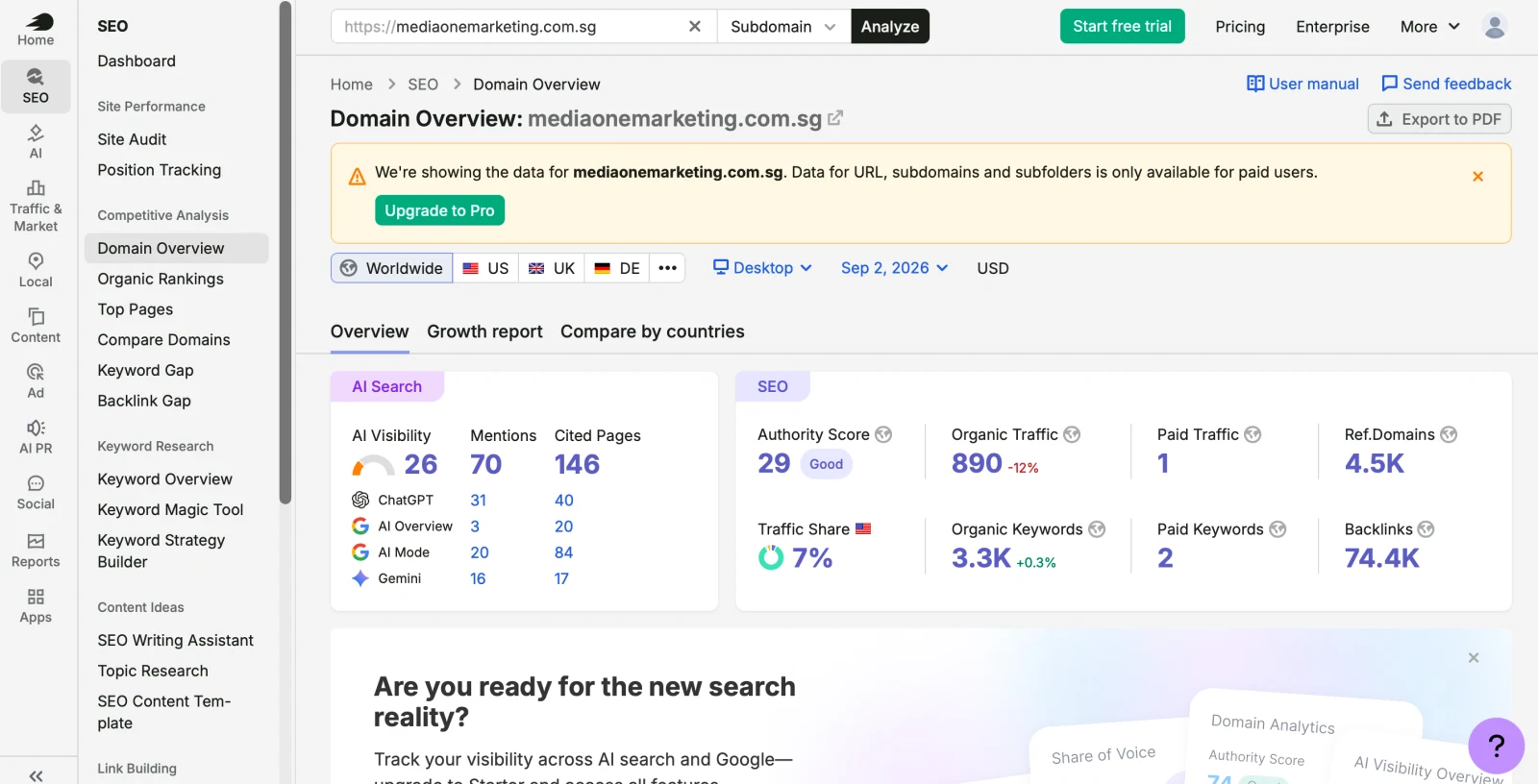
Semrush produced the strongest complete international SEO workflow in our test.
Its technical side includes an International SEO thematic report inside Site Audit that looks at hreflang-related implementation, while Semrush Position Tracking supports different geographic targets, devices and search settings. That combination made it easier to move from identifying an international technical problem to understanding whether the affected pages were commercially important in that market.
Semrush Test Results
| Dimension | Score | Tested Finding |
| International Technical Detection | 4.5/5 | Found 21/24 issues, including both conflicting canonicals and accidentally noindexed locale pages |
| Multi-Market Keyword Research | 4.8/5 | Selected the preferred local term and intent for 45/50 market-query combinations |
| Country + Language Rank Tracking | 4.7/5 | Kept all five targets separate across language and device settings |
| Regional Competitor Intelligence | 4.8/5 | Produced the broadest combined keyword-gap and regional competitor view |
| International Scale + Reporting | 4.7/5 | Strong multi-target reporting, with some setup overhead |
| Action Clarity | 4.7/5 | Correctly prioritised the revenue-critical UK canonical conflict |
| AI / GEO Multi-Market Visibility | 4.5/5 | Strong connection between traditional and AI-search monitoring |
| Value | 4.1/5 | Strong consolidation value at a relatively high entry cost |
| Overall | 4.6/5 | Best complete international workflow |
Known issues found: 21/24
False positives: 5
Detection rate: 88%
What Semrush Did Best
Semrush connected the different layers of international SEO more effectively than the other complete platforms. It didn’t simply surface the UK canonical conflict; it also helped establish that the affected cluster carried meaningful UK visibility and commercial demand.
Its rank-tracking workflow was another important advantage. All five markets could remain separated without forcing us to interpret one global visibility number, while technical, keyword and competitor information remained available inside the same broader platform.
Where Semrush Fell Short
Semrush missed one incomplete hreflang cluster, one lower-signal regional internal-linking issue and one x-defaultnuance. Five warnings were also downgraded after manual review, largely because optional or deliberately excluded locale relationships were treated as potential gaps.
That makes Semrush stronger as the complete operating platform than as the deepest international crawler.
Semrush Verdict
Semrush is our best international SEO tool overall. Specialist products beat it in raw technical detection, hreflang analysis and dedicated rank tracking, but none delivered a stronger combination of auditing, market research, rankings, competitors and reporting in one environment.
If consolidation is particularly important to your team, our Best All-In-One SEO Tools comparison looks at that question more broadly.
2. Ahrefs: Best for Multilingual Keywords and Regional Competitors

Ahrefs finished second among the complete platforms at 4.4/5, but it won two especially important international workflows: multilingual keyword research and regional competitor intelligence.
Its technical auditing also goes further than basic crawling. Ahrefs’ hreflang troubleshooting documentation covers invalid values, missing reciprocal annotations, self-reference problems, broken hreflang targets and non-canonical URLs.
Ahrefs Test Results
| Dimension | Score | Tested Finding |
| International Technical Detection | 4.2/5 | Found 20/24 issues |
| Multi-Market Keyword Research | 4.9/5 | Selected the preferred term and intent in 46/50 combinations |
| Country + Language Rank Tracking | 4.4/5 | Reliable separation with less convenient cross-market reporting |
| Regional Competitor Intelligence | 4.9/5 | Strongest local competitor, content-gap and backlink evidence |
| International Scale + Reporting | 4.4/5 | Strong segmentation but more movement between reports |
| Action Clarity | 4.2/5 | Strong evidence with additional manual prioritisation |
| AI / GEO Multi-Market Visibility | 3.8/5 | Useful visibility context but not the strongest international AI workflow |
| Value | 3.6/5 | Excellent research depth but weaker value for audit-only teams |
| Overall | 4.4/5 | Best research-led international option |
Known issues found: 20/24
False positives: 4
Detection rate: 83%
What Ahrefs Did Best
Ahrefs produced the strongest local keyword evidence in the comparison. It handled differences between US and UK terminology cleanly and became even more useful when German, French and Japanese queries couldn’t be derived reliably from literal translations.
It was also the strongest platform for understanding why the competitive landscape changed from market to market. Ranking pages, backlink evidence and content gaps made it easier to see why a competitor appearing prominently in Germany might barely matter in the US.
Where Ahrefs Fell Short
Ahrefs missed one x-default issue, one incomplete cluster, the lower-signal regional internal-linking problem and the locale crawlability issue.
The bigger limitation was workflow. Ahrefs gave us very strong evidence, but converting the technical, competitor and keyword findings into one ordered cross-market implementation plan required more analyst involvement than Semrush or Digimetrics.
Ahrefs Verdict
Ahrefs is our best SEO tool for multilingual keyword research and regional competitor analysis. Choose it when international expansion depends heavily on understanding what users in each market search for and who you’re really competing against there.
3. Sitebulb: Best Hreflang Validator
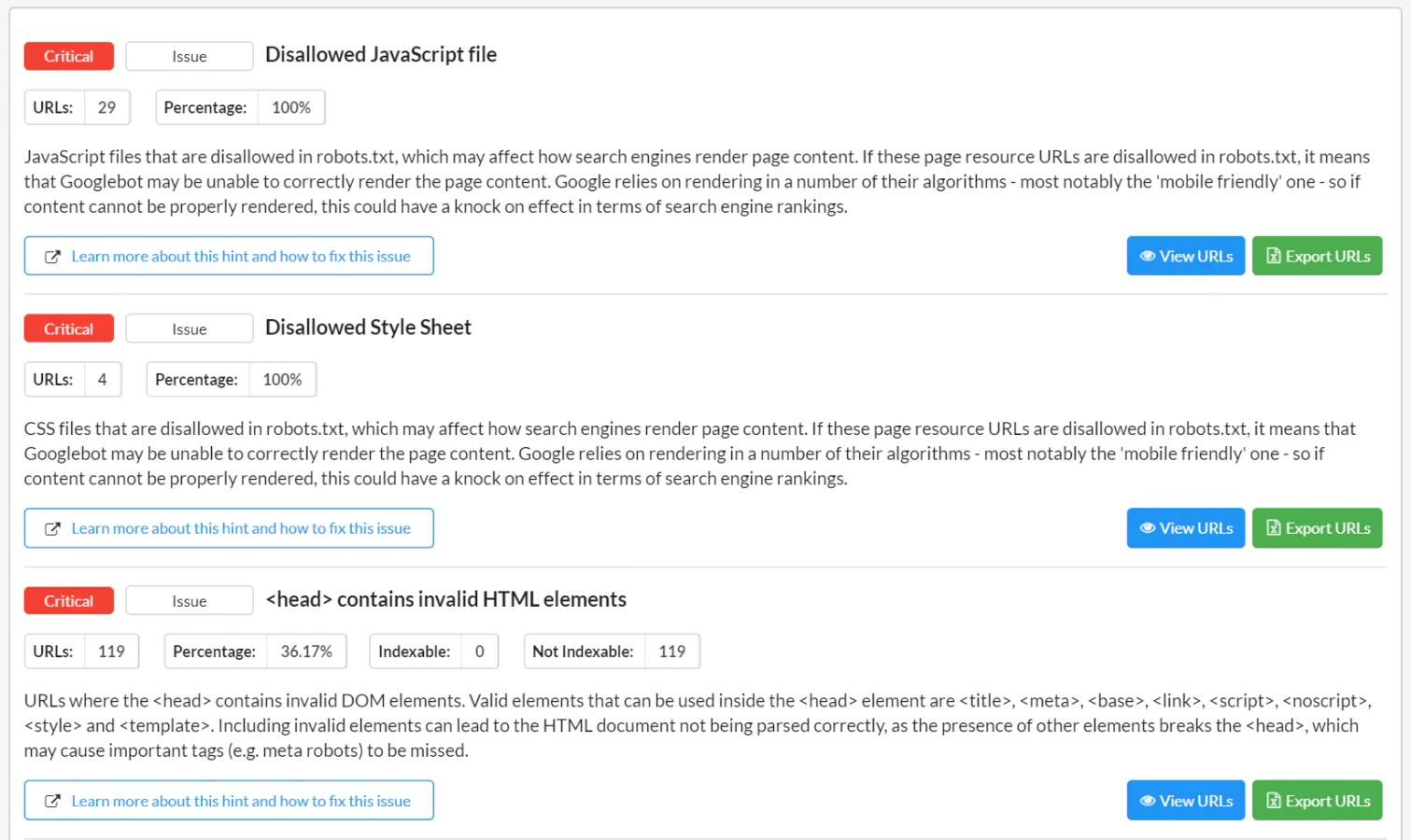
Sitebulb produced one of the strongest results in the comparison, finding 23 of 24 known international issues and all 18 hreflang-specific problems.
Its dedicated International Report is particularly relevant because it crawls hreflang relationships across URLs and presents international implementation through dedicated reports and visualisations rather than treating every alternate URL as an isolated warning.
Sitebulb Test Results
| Dimension | Score | Tested Finding |
| International Technical Detection | 4.9/5 | Found 23/24 known issues |
| Hreflang Validation | 5.0/5 | Found all 18 hreflang-specific issues |
| Canonical / Locale Analysis | 4.9/5 | Connected non-canonical and noindex targets to affected clusters |
| International Scale | 4.8/5 | Strong grouping, visualisation, exports and cloud crawling |
| Action Clarity | 4.8/5 | Best technical remediation sequence |
| Value | 4.3/5 | Strong when interpretation and stakeholder time matter |
| Technical Audit Score | 4.9/5 | Best guided international technical audit |
| Overall Suite Score | 4.1/5 | Research and rank tracking remain outside its main scope |
Known issues found: 23/24
False positives: 3
Detection rate: 96%
What Sitebulb Did Best
Sitebulb made the hreflang implementation easiest to understand. Its cluster view exposed the incomplete French and Japanese relationships without forcing us to reconstruct the problem manually from a flat spreadsheet of source and destination URLs.
That distinction matters. Screaming Frog ultimately found one additional technical issue, but Sitebulb generated fewer false positives and did a better job of explaining how the affected regional pages were connected.
Where Sitebulb Fell Short
Sitebulb missed one lower-signal regional internal-linking issue that became clearer only after crawl depth was compared with performance data.
It also doesn’t attempt to replace a full keyword database, international competitor platform or daily rank tracker, so larger teams will probably use it as one part of a broader stack.
Sitebulb Verdict
Sitebulb is our best hreflang validator and strongest guided international technical-audit tool.
If your biggest problem is untangling a complex hreflang implementation and explaining it to developers or regional stakeholders, we’d choose Sitebulb over the broader suites.
4. Screaming Frog: Best International Technical Crawler
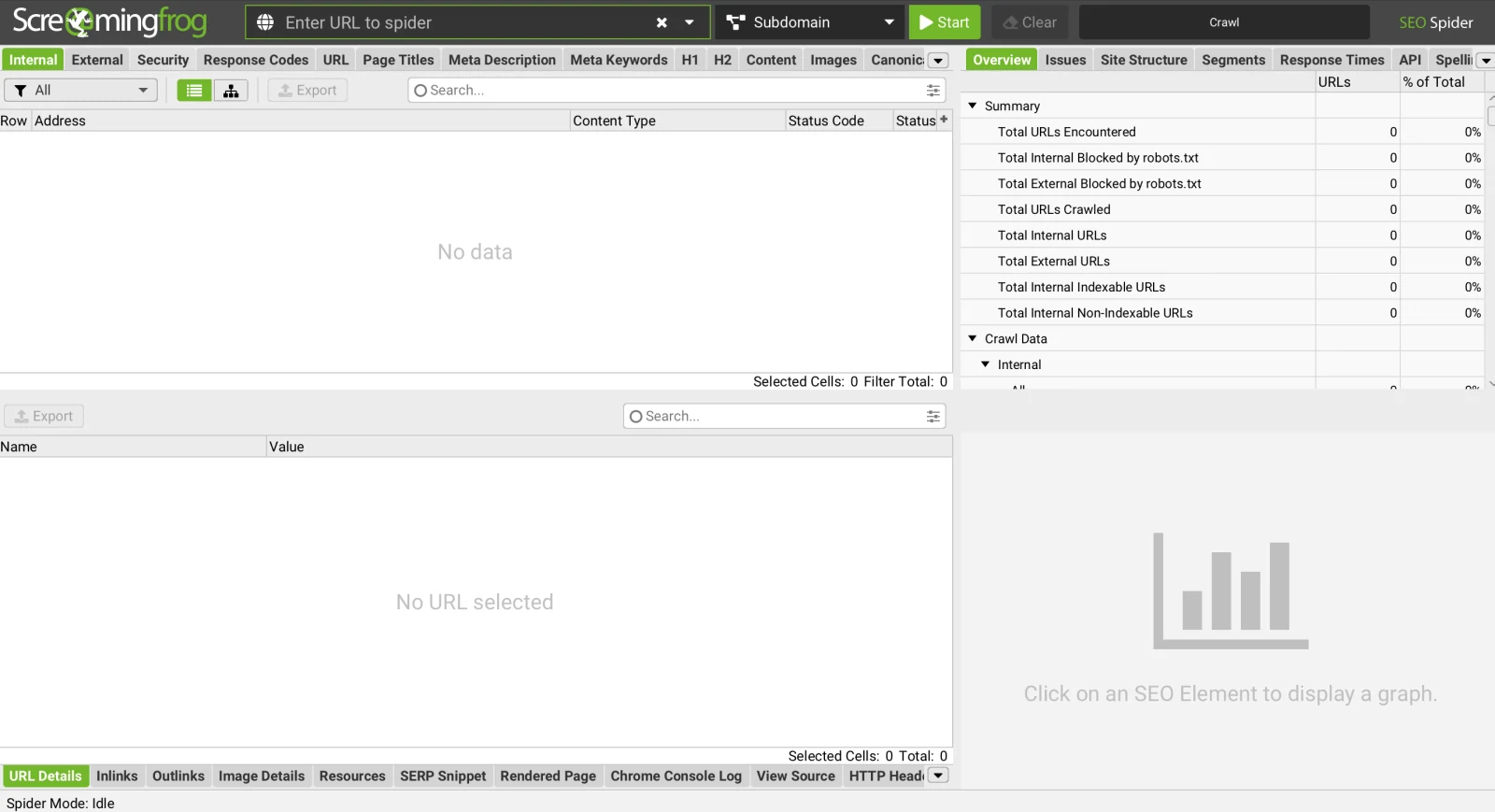
Screaming Frog SEO Spider produced the highest raw technical result in our comparison, finding all 24 known international SEO problems.
Its official hreflang auditing guide shows how the crawler can inspect hreflang implemented through HTML, HTTP headers and XML sitemaps, then isolate issues involving missing return links, invalid codes and problematic targets.
Screaming Frog Test Results
| Dimension | Score | Tested Finding |
| International Technical Detection | 5.0/5 | Found all 24 known problems |
| Hreflang Validation | 4.9/5 | Found all 18 hreflang-specific issues |
| Canonical / Locale Analysis | 5.0/5 | Strongest URL-level evidence for canonicals, redirects, status and indexability |
| International Scale | 5.0/5 | Best crawl control, list mode, extraction and bulk exports |
| Action Clarity | 3.7/5 | Excellent evidence but highest interpretation requirement |
| Value | 4.8/5 | Exceptional technical value |
| Technical Audit Score | 4.9/5 | Highest raw technical result |
| Overall Suite Score | 4.0/5 | Research and rank tracking sit outside its main scope |
Known issues found: 24/24
False positives: 7
Detection rate: 100%
What Screaming Frog Did Best
Screaming Frog produced the most complete technical evidence set. It found every known issue and made the exact source-target relationships for reciprocal hreflang, redirects, non-canonical targets, invalid codes and incomplete clusters available for filtering and export.
For experienced technical SEOs, that level of control is difficult to beat. It makes Screaming Frog particularly useful on large or unconventional international implementations where analysts want to inspect the underlying evidence rather than rely entirely on the software’s interpretation.
Where Screaming Frog Fell Short
Seven warnings didn’t require action after validation. Most involved intentional differences in locale availability, optional relationships or x-default decisions that needed business context rather than a purely technical rule.
The larger distinction was prioritisation. Screaming Frog showed almost everything required to diagnose the international setup, but it didn’t independently determine that the high-value UK canonical problem mattered more commercially than lower-priority cleanup elsewhere.
Screaming Frog Verdict
Screaming Frog is the best raw international technical crawler in our test.
Its lower overall suite score reflects the product’s specialist scope, not weaker technical performance. If maximum technical detection, crawl control and exportable evidence are your priorities, this is our strongest choice.
5. AccuRanker: Best International Rank Tracker

AccuRanker is included as a specialist rather than a complete SEO suite, and that focus paid off in the rank-tracking portion of the test.
Its keyword setup supports location-specific tracking and gives teams granular control over how individual keyword sets are monitored. That made it much harder to accidentally blend markets together.
AccuRanker Test Results
| Dimension | Score | Tested Finding |
| Country + Language Rank Tracking | 5.0/5 | Kept all 50 market-query combinations separated correctly |
| Location Granularity | 5.0/5 | Clean country, locale, device and location controls |
| Competitor Tracking | 4.9/5 | Strong regional Share of Voice and competitor comparison |
| Historical Reporting | 4.9/5 | Best trend comparison and visibility history |
| International Scale | 4.9/5 | Tags, filters and market-specific domains handled the setup cleanly |
| Action Clarity | 4.0/5 | Clear movement signals, but not a remediation platform |
| Value | 4.4/5 | Strong value when rank monitoring is the main requirement |
| Rank Tracking Score | 4.9/5 | Best international rank-tracking result |
What AccuRanker Did Best
AccuRanker made it hardest to accidentally blend markets. Each keyword retained its location, locale and device context, so a strong performance increase in the US couldn’t conceal deteriorating rankings in Germany or Japan.
Its competitor and Share of Voice reporting also made cross-market differences easy to spot. Instead of asking whether global rankings were improving, we could look at whether our actual competitive position was getting stronger in each target country.
Where AccuRanker Fell Short
AccuRanker tells you where visibility changed, but not necessarily why.
When a regional cluster lost rankings, another tool was still needed to determine whether the cause involved hreflang, canonicals, weak local keyword targeting, content gaps or another technical issue.
AccuRanker Verdict
AccuRanker is our best international rank tracker. It’s most useful for teams that already have technical auditing and keyword research covered and need accurate market-by-market visibility monitoring.
6. Digimetrics: Best for Guided SEO + GEO Prioritisation
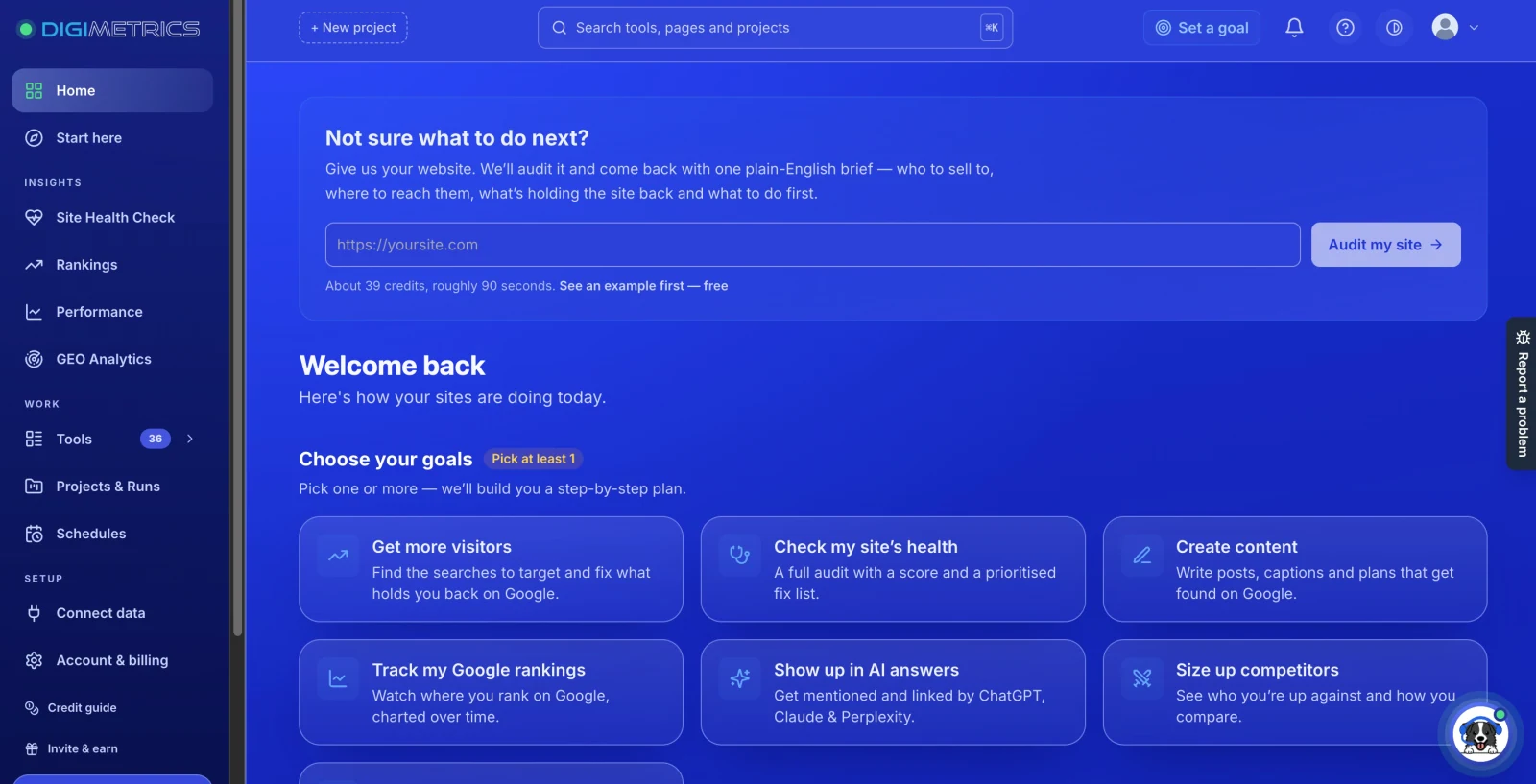
Digimetrics plays a different role from the international crawlers and dedicated rank tracker.
We didn’t include it because we expected it to outperform Sitebulb or Screaming Frog at hreflang validation. The more interesting question was whether its combination of SEO, keyword, competitor and GEO information could answer:
Which market should we work on first?
Disclosure: Digimetrics is developed by the MediaOne team, which also operates DigitalMarketingTools.ai. We included it because its guided SEO/GEO workflow is directly relevant to international search prioritisation. It was tested using the same markets, inputs and scoring criteria as the other products, without preferential weighting. Where established specialist platforms provided greater technical depth, functionality or market maturity, we ranked them higher.
Digimetrics Test Results
| Dimension | Score | Tested Finding |
| International Technical Detection | 3.4/5 | Found 15/24 known issues |
| Multi-Market Keyword Research | 4.3/5 | Selected the preferred term and intent in 40/50 combinations |
| Country + Language Rank Tracking | 4.0/5 | Useful market tracking with fewer specialist controls |
| Regional Competitor Intelligence | 4.1/5 | Useful context with less database depth |
| International Scale + Reporting | 3.7/5 | Clear workflow with fewer bulk international controls |
| Action Clarity | 4.9/5 | Highest cross-market prioritisation result |
| AI / GEO Multi-Market Visibility | 4.8/5 | Strongest guided SEO + AI visibility connection |
| Value | 4.1/5 | Strongest as an interpretation and prioritisation layer |
| Overall | 4.0/5 | Excellent guidance, narrower specialist depth |
Known issues found: 15/24
False positives: 4
Detection rate: 63%
What Digimetrics Did Best
Digimetrics produced the clearest answer to which market deserved attention first. It placed the high-impact UK canonical conflict ahead of German metadata cleanup, then prioritised the French reciprocal hreflang failures and Japanese terminology mismatch before the lower-impact technical work.
That distinction matters because technically valid issues aren’t commercially equal. A team shouldn’t spend its week cleaning up low-impact metadata while a high-converting regional cluster is canonicalising to the wrong country.
Its strong SEO + GEO result added another useful layer. International visibility increasingly involves understanding how brands and content appear across both conventional search and AI-driven discovery, but we deliberately kept this category to only 5% of the overall score so it couldn’t outweigh international SEO fundamentals.
Where Digimetrics Fell Short
Digimetrics missed nine known technical issues, including lower-level hreflang-cluster, language-code and internal-linking signals.
Its rank-tracking controls, technical evidence exports and crawl functionality were also less mature than those of the specialist products, so we wouldn’t use it as a replacement for Screaming Frog, Sitebulb or AccuRanker where their specialist depth is required.
Digimetrics Verdict
Digimetrics is our international action-prioritisation winner, not our hreflang or rank-tracking winner.
Its strongest role is turning technical, search, competitor and GEO evidence into a clearer decision about which country and which problem should receive attention next.
You can also see our Digimetrics tool profile for a broader look at the platform.
Which Tool Found the Most International SEO Problems?
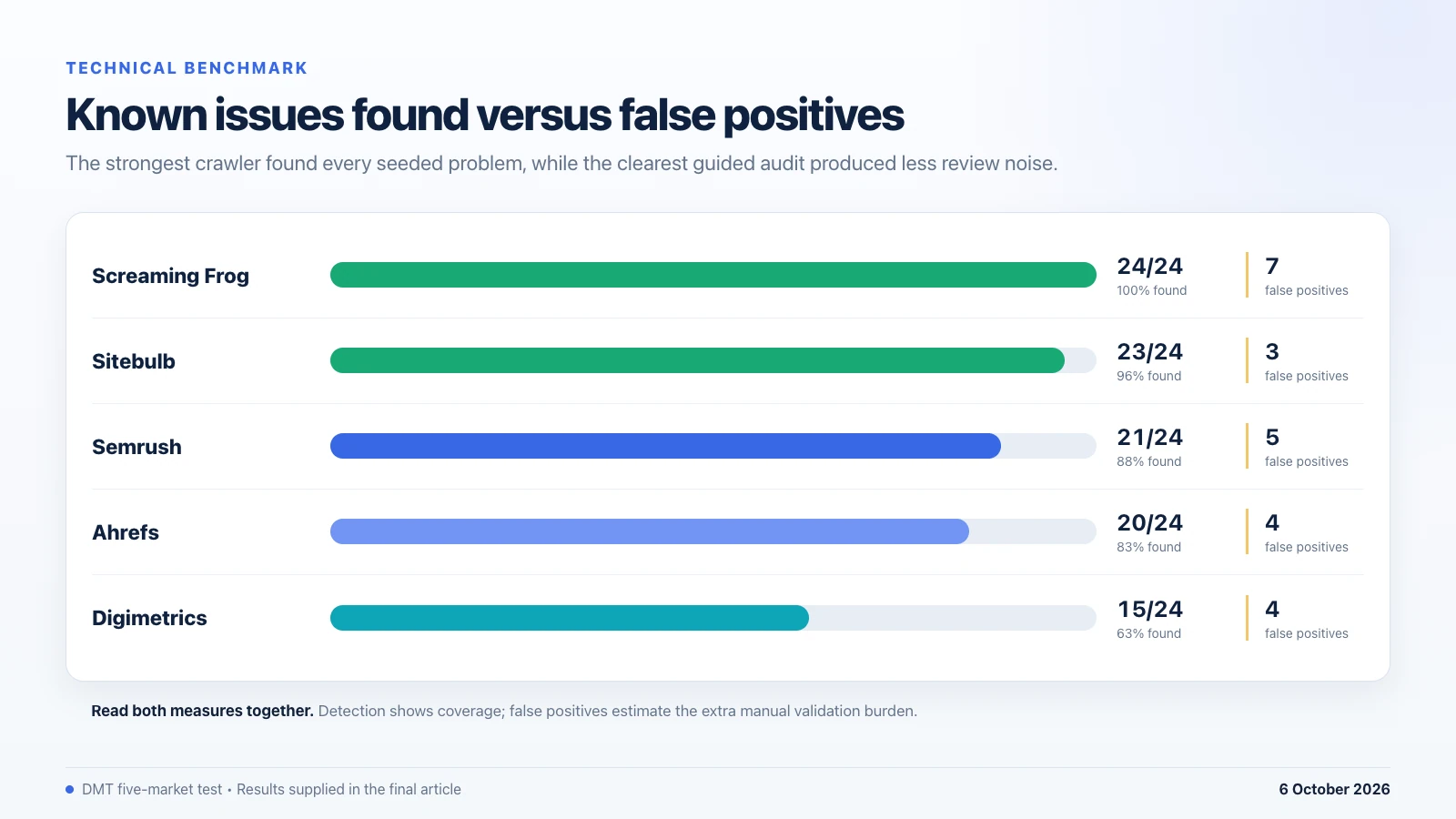
The raw technical results were clear.
| Tool | Known Issues Found | Missed | False Positives | Detection Rate |
| Screaming Frog | 24/24 | 0 | 7 | 100% |
| Sitebulb | 23/24 | 1 | 3 | 96% |
| Semrush | 21/24 | 3 | 5 | 88% |
| Ahrefs | 20/24 | 4 | 4 | 83% |
| Digimetrics | 15/24 | 9 | 4 | 63% |
| AccuRanker | N/A | N/A | N/A | N/A |
Screaming Frog wins raw detection, finding every known issue. Sitebulb is arguably the more approachable technical choice because it misses only one lower-signal problem while generating three false positives compared with Screaming Frog’s seven.
The broader platforms trade some crawl depth for additional context. Semrush finds three fewer technical problems than Screaming Frog, for example, but does a substantially better job of connecting those findings with regional rankings, demand and commercial importance.
Which Tool Is Best for Hreflang Validation?
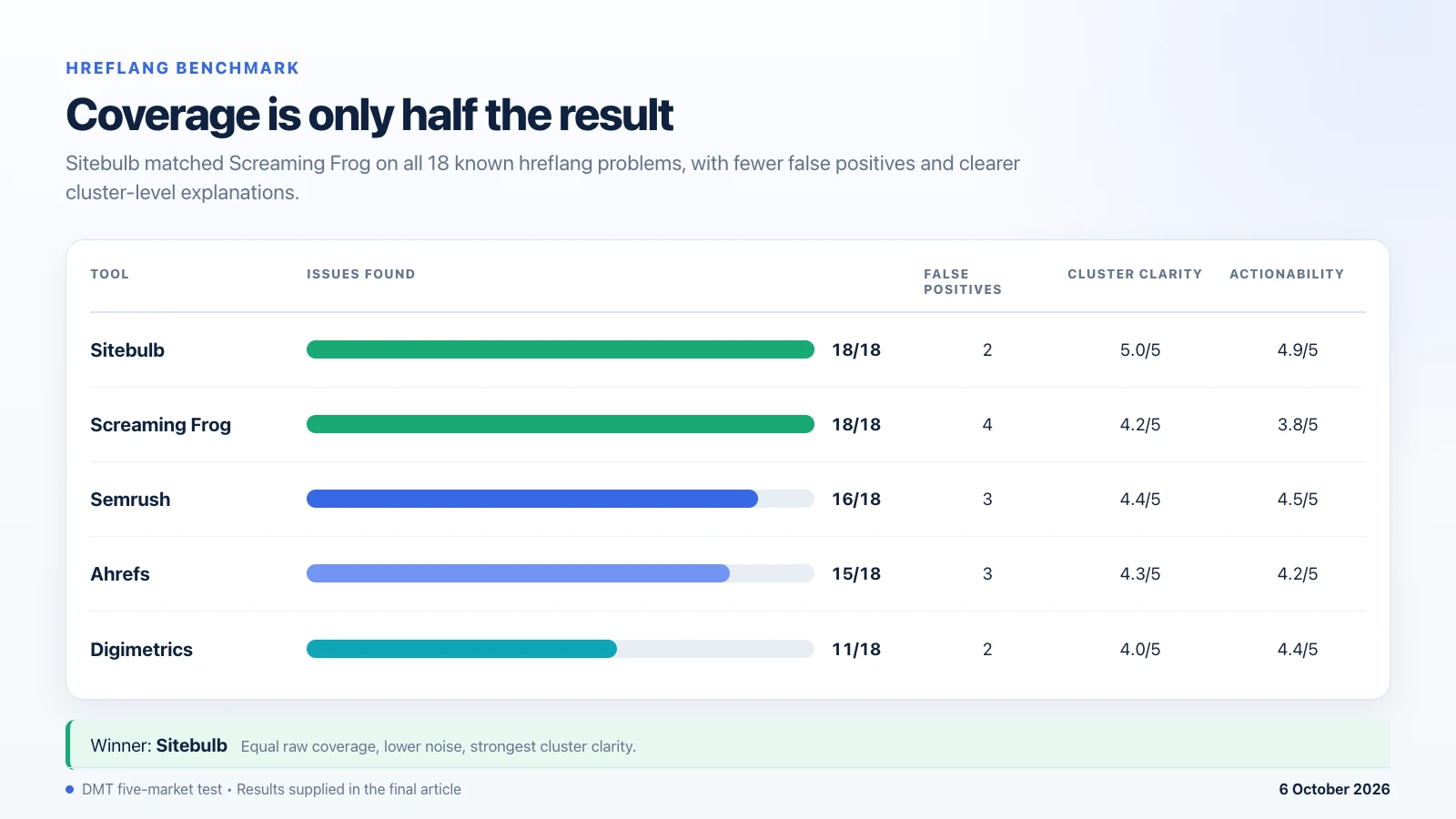
The hreflang benchmark contained 18 specific problems, including reciprocal failures, invalid language-region codes, missing self-references, non-canonical targets, broken or redirected alternates, incomplete clusters and an x-default issue.
According to Google’s hreflang guidelines, localized versions should identify themselves and relevant alternates, reciprocal relationships need to return correctly, and language plus optional region codes must use supported formats.
| Tool | Hreflang Issues Found | False Positives | Cluster Clarity | Actionability |
| Sitebulb | 18/18 | 2 | 5.0/5 | 4.9/5 |
| Screaming Frog | 18/18 | 4 | 4.2/5 | 3.8/5 |
| Semrush | 16/18 | 3 | 4.4/5 | 4.5/5 |
| Ahrefs | 15/18 | 3 | 4.3/5 | 4.2/5 |
| Digimetrics | 11/18 | 2 | 4.0/5 | 4.4/5 |
Winner: Sitebulb.
Screaming Frog matches Sitebulb’s 18/18 detection result, but Sitebulb wins because it creates fewer false positives and makes incomplete regional relationships easier to understand at cluster level.
Which Tool Is Best for Multilingual Keyword Research?
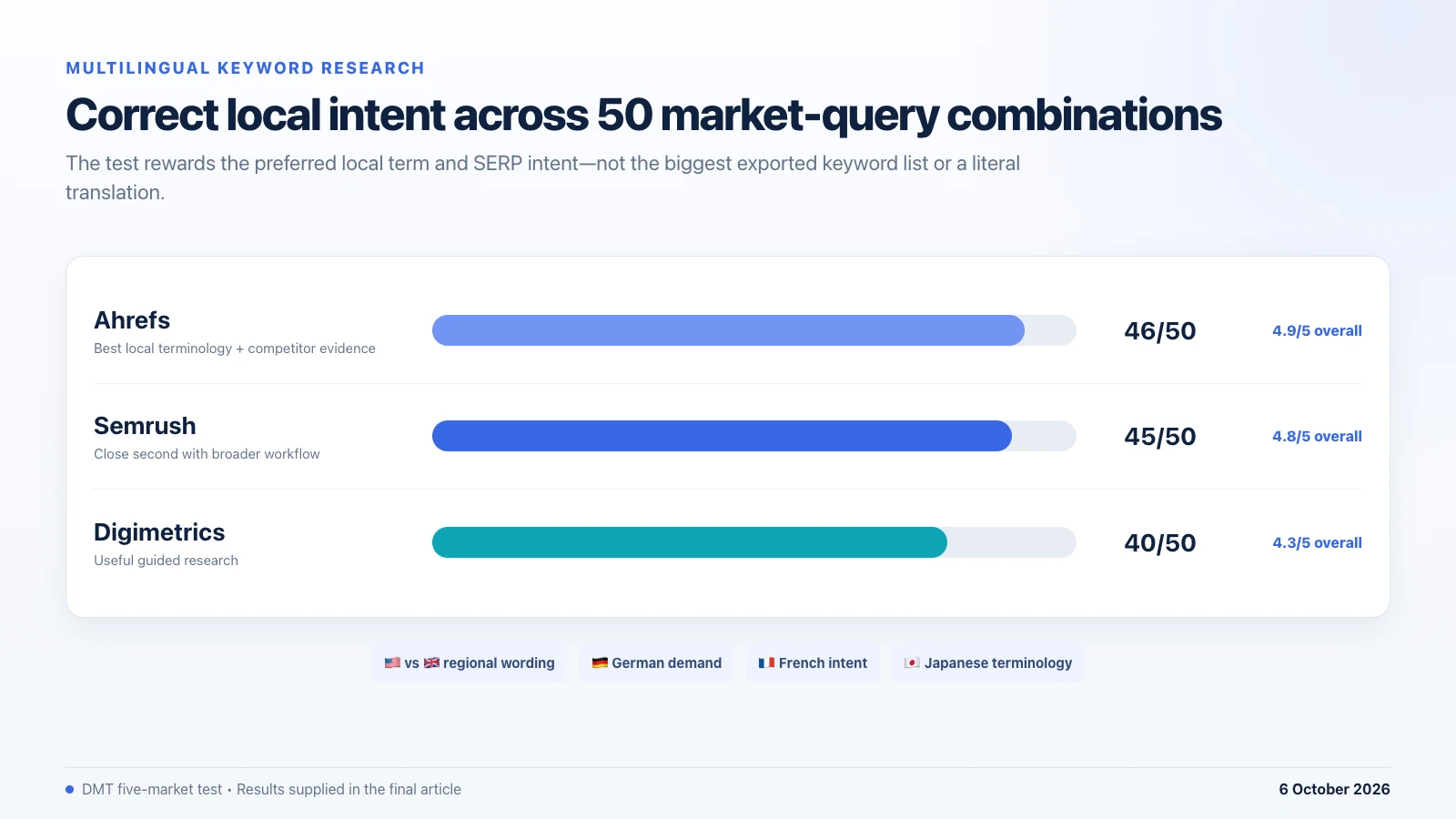
Literal translation is not international keyword research.
A phrase can be linguistically correct in German, French or Japanese and still be the wrong SEO target because local searchers use different terminology or expect another type of page.
Our test therefore measured whether each research-capable platform identified the preferred local terminology and intent rather than simply producing the largest list of keywords.
| Tool | Correct Market Intent | Useful Local Variants | Competitor Discovery | Overall |
| Ahrefs | 46/50 | 4.9/5 | 4.9/5 | 4.9/5 |
| Semrush | 45/50 | 4.8/5 | 4.8/5 | 4.8/5 |
| Digimetrics | 40/50 | 4.3/5 | 4.1/5 | 4.3/5 |
Winner: Ahrefs.
The margin over Semrush is small, but Ahrefs provided the strongest combination of local terminology, intent, competing pages and market-specific competitor evidence.
Which Tool Is Best for International Rank Tracking?

International rank tracking isn’t useful if all of the markets eventually collapse into one visibility score.
We wanted each keyword to retain its country, locale, device and competitor context, while still making cross-market comparisons practical.
| Tool | Country Targeting | Device / Locale Control | Competitors | Historical Reporting | Overall |
| AccuRanker | 5.0/5 | 5.0/5 | 4.9/5 | 4.9/5 | 4.9/5 |
| Semrush | 4.8/5 | 4.8/5 | 4.7/5 | 4.7/5 | 4.7/5 |
| Ahrefs | 4.5/5 | 4.4/5 | 4.6/5 | 4.3/5 | 4.4/5 |
| Digimetrics | 4.1/5 | 4.0/5 | 4.0/5 | 3.9/5 | 4.0/5 |
Winner: AccuRanker.
Its keyword-level location controls, competitor comparison and historical visibility made it the cleanest specialist workflow. Semrush finished closest among the wider SEO suites and remains more practical when rank tracking is only one part of the team’s job.
Which Tool Is Best for Regional Competitor Research?
Ahrefs wins regional competitor research, with Semrush close behind.
The strongest part of the Ahrefs workflow was its ability to connect local SERP competitors with ranking URLs, content gaps and backlink differences.
That’s important because international competitor analysis shouldn’t begin with a fixed list of companies your sales team considers competitors. The relevant organic competitors are the domains actually appearing for your commercial topics in that particular market.
A company can dominate German search results while barely appearing in the US, so its importance changes depending on which region you’re trying to grow.
Which Tool Is Best at Prioritising International SEO Fixes?
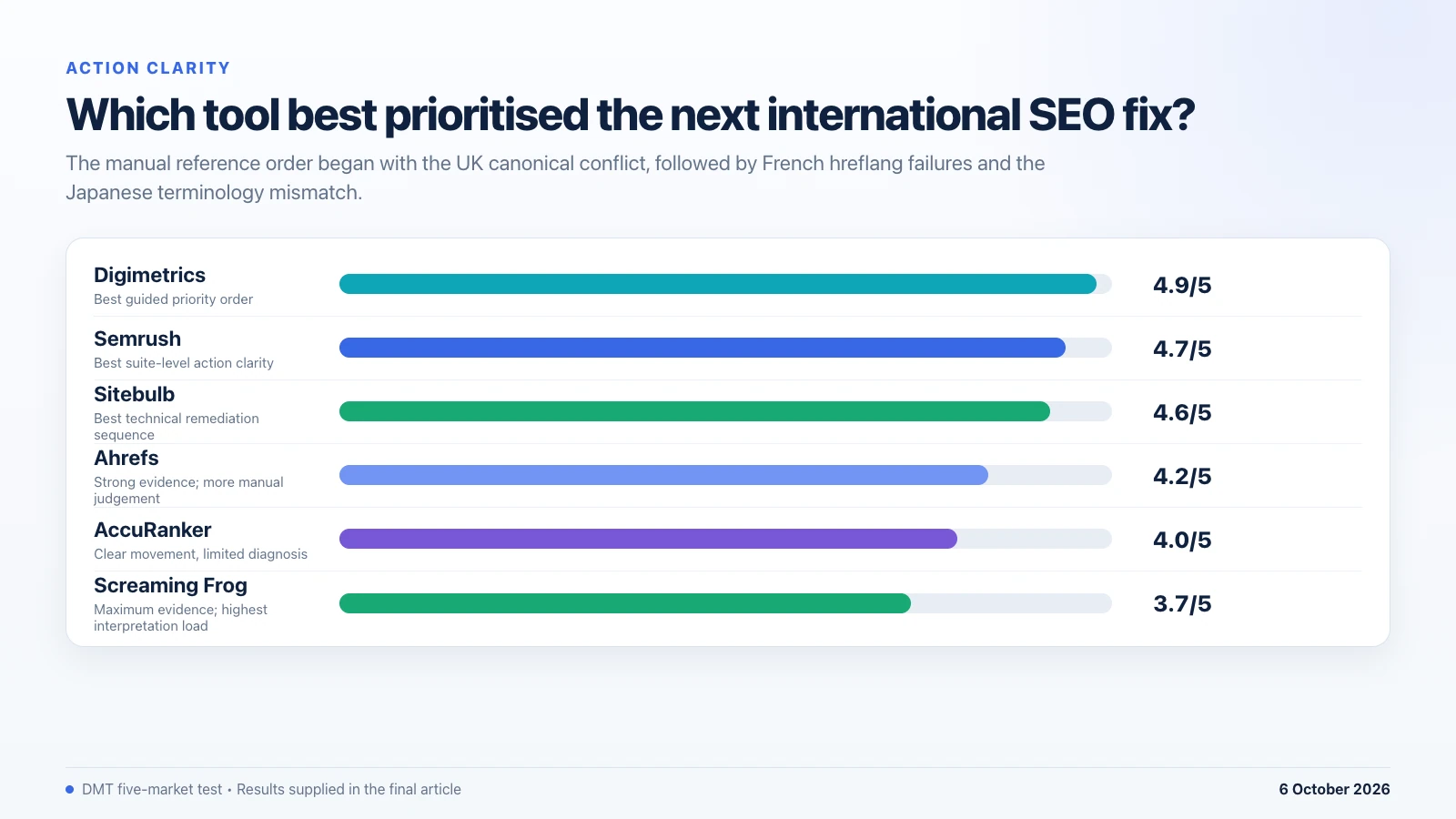
This was where we deliberately moved beyond warning counts.
Consider an international site with German pages missing metadata, French pages with broken reciprocal hreflang, a high-converting UK cluster canonicalising to the US version, Japanese content targeting literal translations with weak local demand and a German competitor gaining visibility across an important topic.
Every problem matters eventually, but fixing them in the wrong order can waste significant time.
| Tool | Priority Accuracy | Market Context | Explanation Quality | Action Clarity |
| Digimetrics | 4.9/5 | 4.8/5 | 4.9/5 | 4.9/5 |
| Semrush | 4.7/5 | 4.6/5 | 4.7/5 | 4.7/5 |
| Sitebulb | 4.8/5 | 4.2/5 | 4.8/5 | 4.6/5 |
| Ahrefs | 4.4/5 | 4.3/5 | 4.2/5 | 4.2/5 |
| AccuRanker | 4.1/5 | 4.0/5 | 3.9/5 | 4.0/5 |
| Screaming Frog | 4.3/5 | 3.5/5 | 3.8/5 | 3.7/5 |
Winner: Digimetrics.
Its recommended sequence most closely matched our manual order: UK canonical conflict first, French reciprocal hreflang failures second, Japanese terminology mismatch third, German competitive loss fourth and German metadata cleanup last.
This illustrates why the strongest international SEO stack may need both diagnosis and interpretation. Screaming Frog found significantly more technical problems, while Digimetrics was better at deciding which market-level problem deserved attention first.
Which Tool Is Best for International SEO and GEO?
Digimetrics wins the guided SEO + GEO category, scoring 4.8/5 for multi-market AI/GEO visibility, followed by Semrush at 4.5/5.
We wouldn’t use this category to override weak international SEO fundamentals. A site still needs clean crawlability, coherent canonicals, usable regional URLs and correct localized-page relationships before AI visibility becomes the primary concern.
Where the category becomes useful is after those foundations are in place. International teams increasingly need to understand whether the same brand, entities and content are represented consistently across different markets in both traditional search and AI-driven discovery.
Digimetrics’ strongest contribution was connecting those signals with the same cross-market prioritisation workflow rather than isolating AI visibility from the rest of SEO.
Best International SEO Tool by Use Case
| Situation | What Matters Most | Tested Pick |
| Two or three international markets | All-in-one simplicity | Semrush |
| Ten or more countries | Scale and reporting | Semrush, plus AccuRanker if rank tracking dominates |
| Complex hreflang implementation | Validation and cluster clarity | Sitebulb |
| Multilingual keyword research | Local search-demand accuracy | Ahrefs |
| Regional competitor research | SERP, content and backlink depth | Ahrefs |
| International rank tracking | Country and locale segmentation | AccuRanker |
| Large technical team | Crawl control and exports | Screaming Frog |
| Too much data, unclear priorities | Guided cross-market actions | Digimetrics |
| SEO + GEO across markets | Discovery and prioritisation | Digimetrics |
Do You Need One International SEO Tool or a Specialist Stack?
Our results suggest that Semrush gets closest to being a single international SEO operating platform, but specialist stacks still provide greater depth.
A smaller team managing several countries could realistically use Semrush + Google Search Console + GA4 and cover most recurring technical, keyword, competitor and rank-tracking workflows without excessive tool switching.
A technically complex international organisation might instead combine Sitebulb or Screaming Frog for international auditing, Ahrefs for regional research, AccuRanker for market-level rank tracking and first-party Google data for performance validation. Digimetrics can then sit above those sources as a prioritisation layer when the challenge becomes deciding which country or issue deserves resources next.
Neither approach is inherently better. All-in-one suites optimise for consolidation, while specialist stacks optimise for depth.
Our guide to choosing the right SEO tool covers that trade-off in more detail.
How to Choose an SEO Tool for International SEO
Start by identifying the part of international SEO that currently creates the most work or risk.
| Your Main Problem | Prioritise | Best Fit From Our Test |
| Hreflang clusters are difficult to debug | Relationship validation + visualisation | Sitebulb |
| Need maximum technical evidence | Crawl control + exports | Screaming Frog |
| Local keywords don’t match translations | Multi-market keyword research | Ahrefs |
| Competitors change by country | Regional SERP and backlink research | Ahrefs |
| Need one platform for most workflows | Consolidation | Semrush |
| Rankings are difficult to compare by country | Locale-specific tracking | AccuRanker |
| Know the problems but not what to fix first | Cross-market prioritisation | Digimetrics |
| SEO and AI visibility need one action plan | SEO + GEO analysis | Digimetrics |
The best SEO tool for international SEO therefore depends on what international SEO looks like inside your organisation. A company operating two English-language markets has a very different software problem from an enterprise managing dozens of regional sites in multiple languages.
Final Verdict: What Is the Best SEO Tool for International SEO?
Our final awards reflect the five-market test rather than the number of features advertised by each vendor.
| Award | Winner |
| Best international SEO tool overall | Semrush |
| Best all-in-one international SEO suite | Semrush |
| Best international technical SEO tool | Screaming Frog |
| Best hreflang validator | Sitebulb |
| Best multilingual keyword research | Ahrefs |
| Best international rank tracker | AccuRanker |
| Best regional competitor research | Ahrefs |
| Best for large international sites | Screaming Frog |
| Best technical value | Screaming Frog |
| Best action prioritisation | Digimetrics |
| Best guided SEO + GEO workflow | Digimetrics |
Semrush is our overall recommendation at 4.6/5 because it combines international auditing, multilingual research, rankings, competitors and reporting more effectively than any other single product in the test.
But there are good reasons to choose something else. Pick Screaming Frog when raw technical detection matters most, and Sitebulb when complex hreflang relationships need to be turned into a clearer remediation workflow. Choose Ahrefs when your biggest challenge is understanding how keywords and competitors change from market to market, while AccuRanker is the strongest option when country-by-country rank monitoring is the primary requirement.
Choose Digimetrics when the international SEO problem isn’t a lack of data but a lack of clarity about which market and which issue should be addressed next.
The strongest international SEO tool isn’t simply the one that finds the most errors. It’s the one that helps your team understand which regional pages should rank, whether you’re targeting the right local demand, who you’re really competing against in each country and where your next hour of SEO work can have the greatest impact.
Frequently Asked Questions
What Is the Best SEO Tool for International SEO?
Semrush is the best SEO tool for international SEO overall in our test, scoring 4.6/5. It produced the strongest balance of technical auditing, multilingual keyword research, regional rank tracking, competitor analysis and reporting across five markets.
Which Tool Is Best for Hreflang?
Sitebulb is our best hreflang validator. It found all 18 of 18 hreflang-specific issues, generated only two false positives and provided the clearest cluster-level explanation.
Screaming Frog also found all 18 hreflang problems but required more analyst interpretation.
What Is the Best Technical SEO Tool for International Websites?
Screaming Frog produced the strongest raw international technical result, finding 24 of 24 known issues for a 100% detection rate.
Sitebulb was close behind at 23/24 and generated fewer false positives.
Is Semrush Good for International SEO?
Yes. Semrush ranked first overall at 4.6/5, found 21 of 24 known international SEO issues and correctly mapped 45 of 50 market-query combinations.
Its combination of Site Audit, Position Tracking, keyword research and competitor analysis makes it particularly useful for teams that want to keep most international SEO work in one platform.
Is Ahrefs Good for International SEO?
Yes. Ahrefs is our winner for multilingual keyword research and regional competitor intelligence. It selected the preferred local terminology and intent for 46 of 50 market-query combinations, the highest result in our test.
Its Site Audit also provides dedicated hreflang checks, making it useful beyond research alone.
Is Screaming Frog Good for International SEO?
Yes, particularly for experienced technical SEO teams. Screaming Frog SEO Spider found every known international technical problem in our test and provides detailed controls for inspecting hreflang, canonicals, redirects, indexability and regional URL relationships.
Is Sitebulb Good for International SEO?
Yes. Sitebulb is our hreflang winner and strongest guided international technical-audit option. Its International Report makes complex relationships easier to investigate at cluster level instead of treating every alternate URL as a separate warning.
Is AccuRanker Good for International SEO?
Yes, particularly when rank tracking is the primary requirement. AccuRanker scored 4.9/5 for international rank tracking and kept all 50 market-query combinations separated correctly.
It makes the most sense as a specialist component alongside an auditing and research platform.
Can Digimetrics Be Used for International SEO?
Yes, although its strongest role is prioritisation rather than raw technical auditing.
Digimetrics found 15 of 24 technical issues, but it received the highest Action Clarity score at 4.9/5 and most closely matched our manual cross-market priority order.
Do International Websites Need More Than One SEO Tool?
Often, especially at larger scale.
Smaller international teams may be able to cover most recurring work with one broad suite plus first-party Google data. More technically complex organisations can benefit from combining a dedicated crawler, research platform and specialist rank tracker.
The right choice comes down to whether software consolidation or specialist depth removes more work from your international SEO process.
Disclosure: digitalmarketingtools.ai is sponsored by Digimetrics.ai. Sponsored Highlights are clearly labelled advertising. Our reviews, comparisons and guides are written to be useful and fair regardless of who sponsors the site. Read the full disclosure.


