
What Is a Backlink Analysis Tool? How SEO Link Analysis Actually Works in 2026
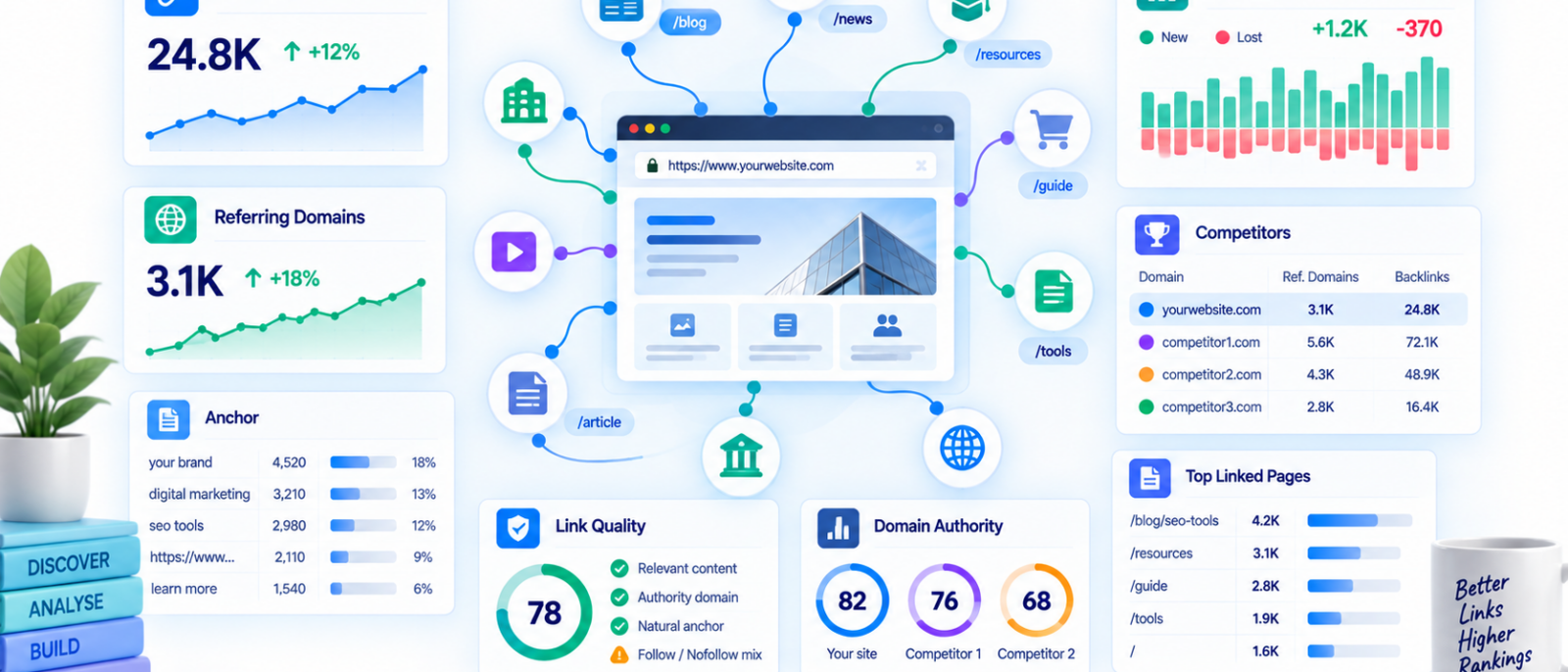
Backlink analysis tools can show who links to you and your competitors, but different platforms discover different links and calculate their own authority and risk scores. The useful part is knowing how to interpret that evidence.
A backlink analysis tool is software that discovers and organises links pointing from other websites to a domain or page. It can show where those links come from, which pages receive them, what anchor text is used and how the profile changes over time.
That sounds straightforward until you compare two platforms. One SEO backlink analysis tool might report 18,000 backlinks and 2,400 referring domains, while another finds 23,000 backlinks from 2,650 domains. Google Search Console may expose a different sample again.
Those differences do not automatically mean one platform is wrong. Backlink tools operate their own crawlers, indexes and processing systems, so each platform is effectively showing its own view of the web.
That leads to the main principle we use throughout backlink analysis:
Backlink discovery is evidence. Backlink quality is a judgement.
SEO backlink analysis tools are excellent for finding referring domains, investigating anchors, tracking new and lost links, studying competitors and uncovering possible link opportunities. What they cannot do is reveal Google’s internal calculation of exactly how much ranking value a particular backlink contributes.
This guide explains how backlink analysis tools work, why their numbers disagree, what the common metrics actually mean and how to turn a large backlink export into useful SEO decisions.
What Is a Backlink Analysis Tool?
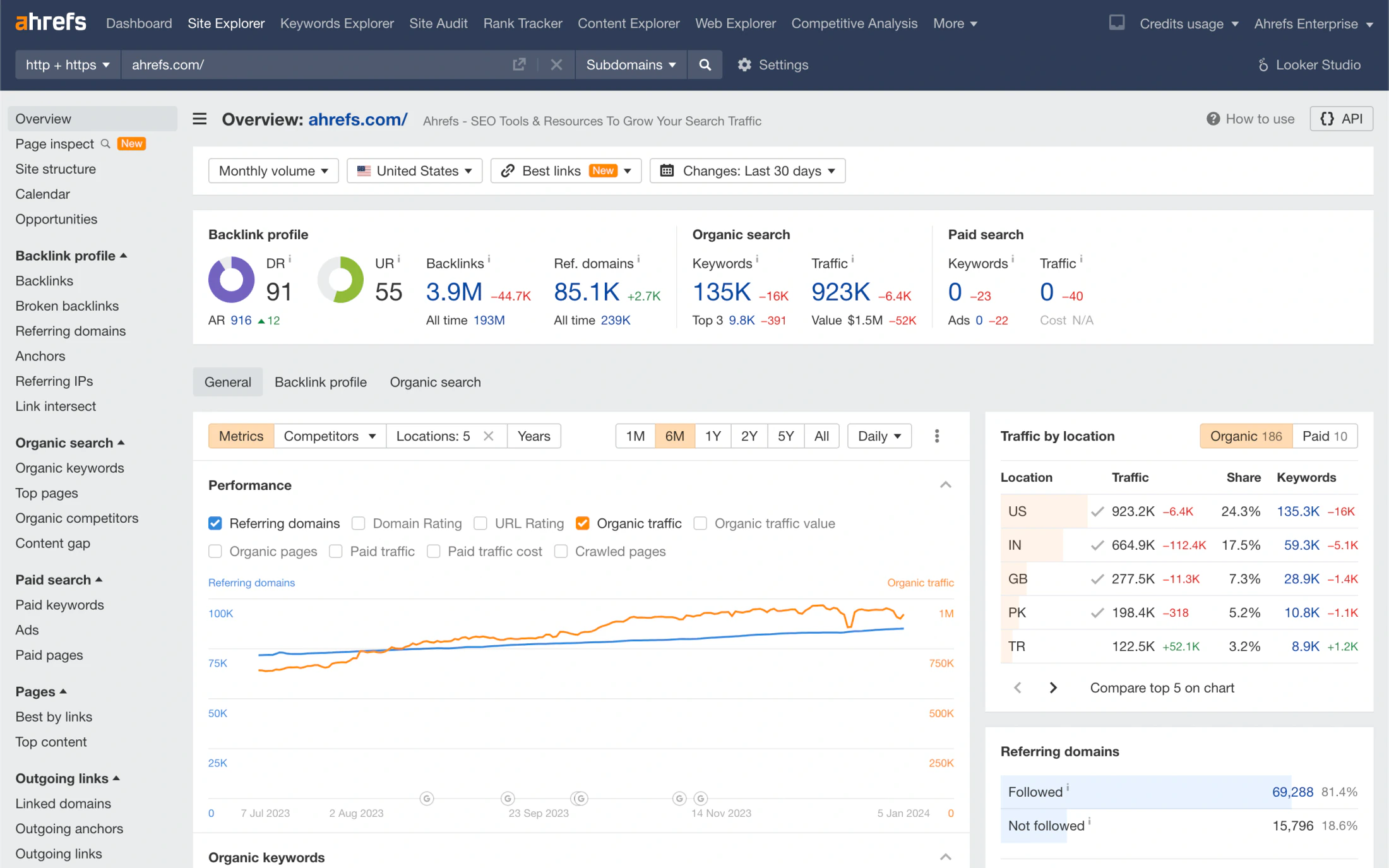
A backlink analysis tool is an SEO platform that identifies external pages linking to a website and helps analyse the structure of that backlink profile.
Depending on the platform, the report may include the referring page, referring domain, destination URL, anchor text, first-seen date, last-seen date, follow or nofollow attributes and proprietary authority metrics. More advanced tools may also provide historical link data, competitor comparisons and link-gap analysis.
The important distinction is that these platforms are not querying one universal database containing every backlink on the internet. Commercial tools such as Ahrefs, Semrush, Moz and Majestic build and maintain their own indexes.
That means an SEO backlink analysis tool is best understood as an evidence source, not a perfect representation of Google’s internal link graph.
Even Google Search Console’s Links report should not be treated as a complete export of every link Google knows about. Google describes the report as providing a sample of links rather than a comprehensive backlink database.
Backlink Checker vs Backlink Analysis Tool
The terms “backlink checker” and “backlink analysis tool” are often used interchangeably, but they can describe different levels of depth.
| Tool type | Main job |
|---|---|
| Backlink checker | Quickly shows links pointing to a domain or page |
| Backlink analysis tool | Investigates the structure, history and context of a backlink profile |
| Backlink monitor | Tracks new, lost or changed links over time |
| Link-building tool | Helps find prospects and manage outreach or acquisition |
A simple backlink checker might tell you that a competitor has 12,000 links and expose a limited sample. A more complete backlink analysis platform lets you segment those links by referring domain, destination page, anchor, link attributes, authority, estimated traffic and historical status.
The difference is important because the objective of backlink analysis is not simply to answer “How many links do we have?” It is to understand which external pages and domains appear to support the site, what patterns exist in the profile and how those patterns compare with competitors.
Where Backlink Analysis Fits Among SEO Analysis Tools
Backlink analysis is only one layer of a broader SEO diagnosis.
A website can have excellent technical SEO but compete against pages supported by substantially stronger external authority. At the same time, thousands of backlinks cannot automatically rescue a page that fails to satisfy search intent, targets the wrong topic or cannot be properly crawled.
| SEO analysis layer | Question |
|---|---|
| Keyword analysis | What are people searching for? |
| Competitor analysis | Who already controls that demand? |
| Technical analysis | Can search engines access the site correctly? |
| Content analysis | Does the page satisfy the search intent? |
| Backlink analysis | Which external pages and domains support the site? |
| Rank analysis | Is search visibility changing? |
| Analytics | Is that visibility producing useful outcomes? |
This is why broader SEO analysis tools often combine several of these datasets. Ahrefs and Semrush, for example, connect backlink information with keywords, rankings, competing pages and site-level analysis rather than treating links as an isolated report.
Specialist link-analysis platforms may provide greater depth in the backlink layer, while broader SEO suites reduce the amount of context switching required to move between different forms of evidence. Neither model is automatically better. The right choice depends on what question you are trying to answer.
If you are choosing between an all-in-one suite and a smaller specialist stack, our Best SEO Tools in 2026 comparison looks at that wider decision.
How Do SEO Backlink Analysis Tools Find Links?
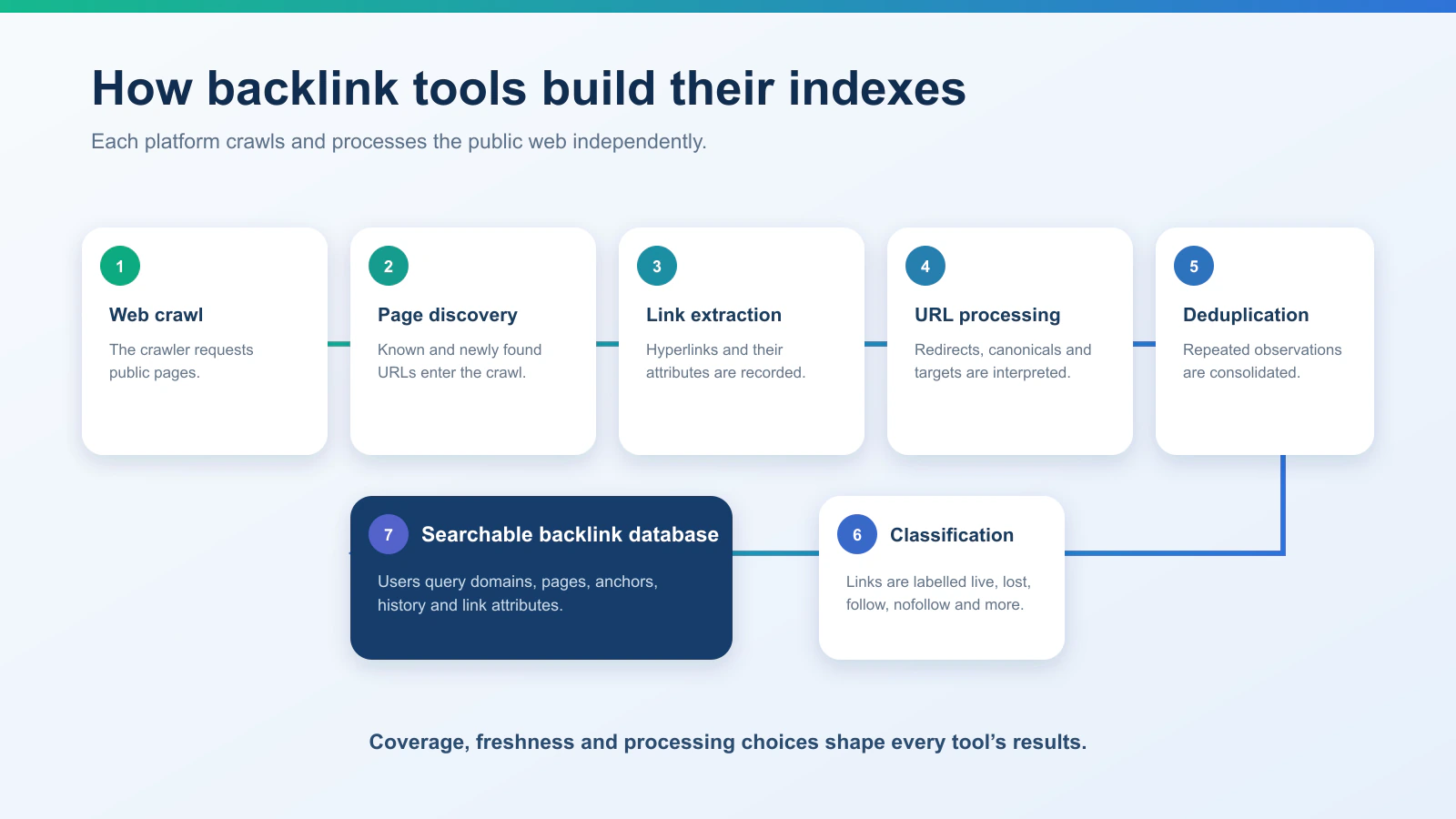
Backlink platforms generally discover links by crawling the public web.
Their crawlers find pages, extract hyperlinks, follow those links into other pages and revisit known URLs over time. The resulting information is processed into a backlink index that users can query by domain or page.
A simplified process looks like this:
Web crawl → page discovery → link extraction → URL processing → deduplication → link classification → backlink database
Every platform makes its own decisions throughout that process. Crawl coverage, crawl frequency, canonical handling, duplicate detection and the way a tool classifies live or lost links can all affect the final numbers.
That is why two platforms can analyse the same domain and return different backlink totals without either one necessarily being useless.
Why Backlink Counts Differ Between Tools
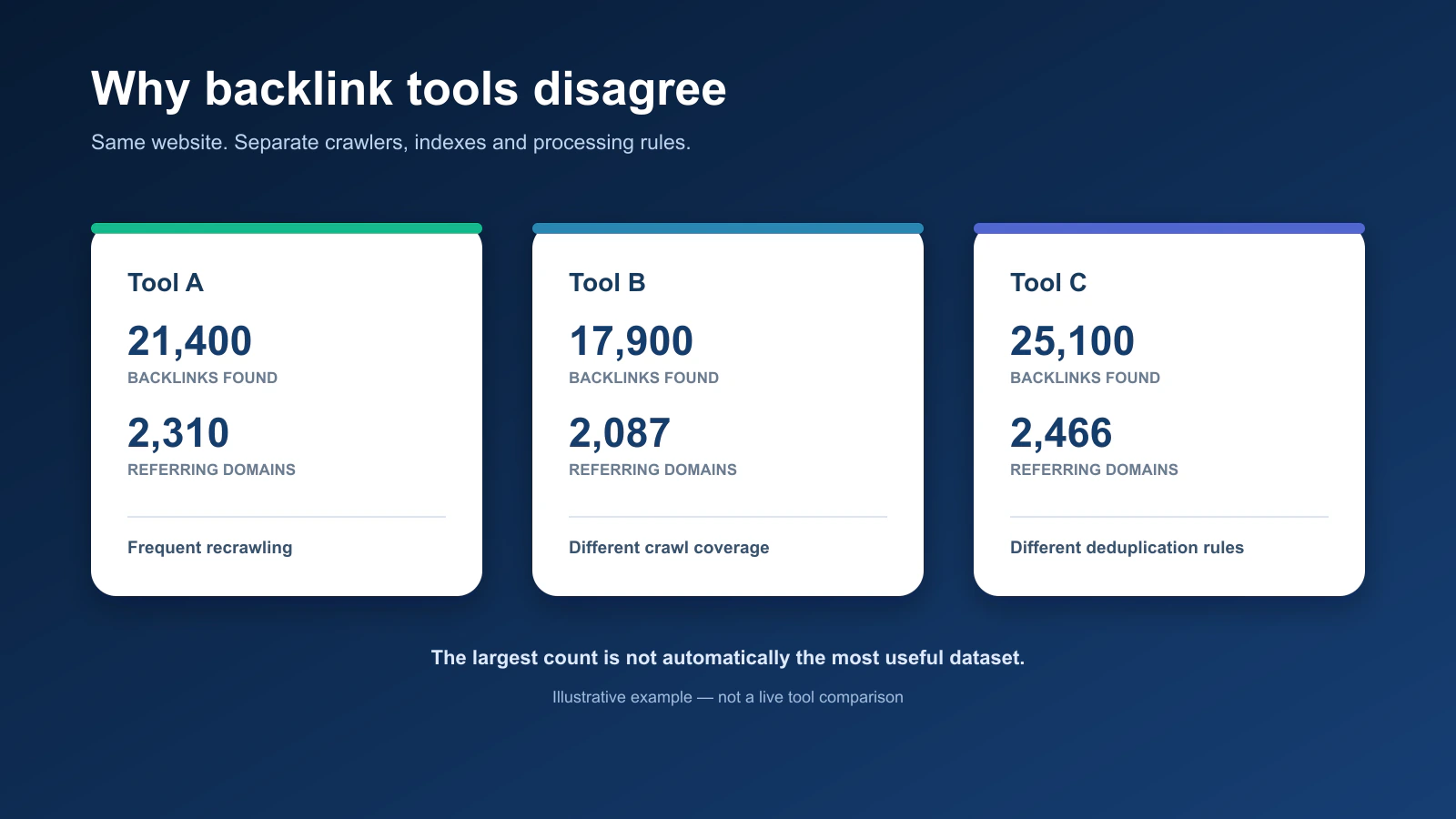
Suppose three platforms analyse the same site:
| Tool | Backlinks found | Referring domains |
|---|---|---|
| Tool A | 21,400 | 2,310 |
| Tool B | 17,900 | 2,087 |
| Tool C | 25,100 | 2,466 |
It is tempting to assume the tool reporting 25,100 backlinks has the most accurate database. In reality, the larger number could partly reflect repeated sitewide links, older URLs or links another platform has already classified differently.
The better question is:
Is the dataset sufficiently complete and fresh for the decision we are trying to make?
Consistency is also important when monitoring changes. If one platform reports 2,000 referring domains this month and 2,150 next month, that trend is more meaningful than switching to a different platform next month and interpreting the database difference as link growth.
For ongoing measurement, compare like with like.
Backlinks vs Referring Domains
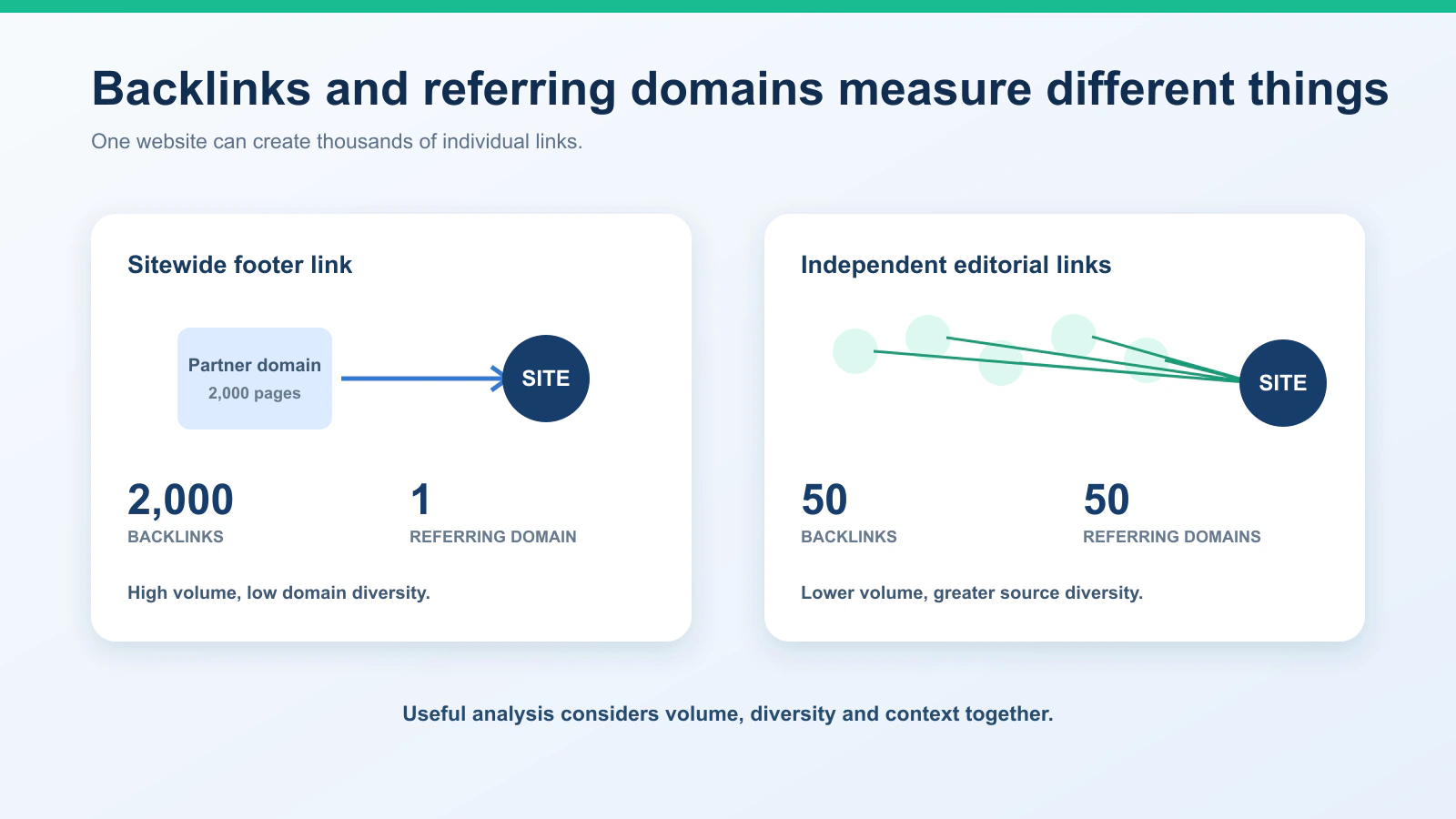
One of the first distinctions in link analysis is the difference between backlinks and referring domains.
A backlink is an individual link. A referring domain is a website containing one or more links to your site.
One domain can therefore create thousands of backlinks.
Imagine a partner links to your website from a sitewide footer across 2,000 pages. A backlink tool may report roughly 2,000 links, but they still originate from one referring domain.
Now compare that with 50 editorial links from 50 independent publications. The first example has the larger backlink count, while the second has much greater referring-domain diversity.
Neither number is enough to judge the profile by itself. The useful analysis considers volume, diversity and context together.
The Linking Page Matters More Than One Domain Score
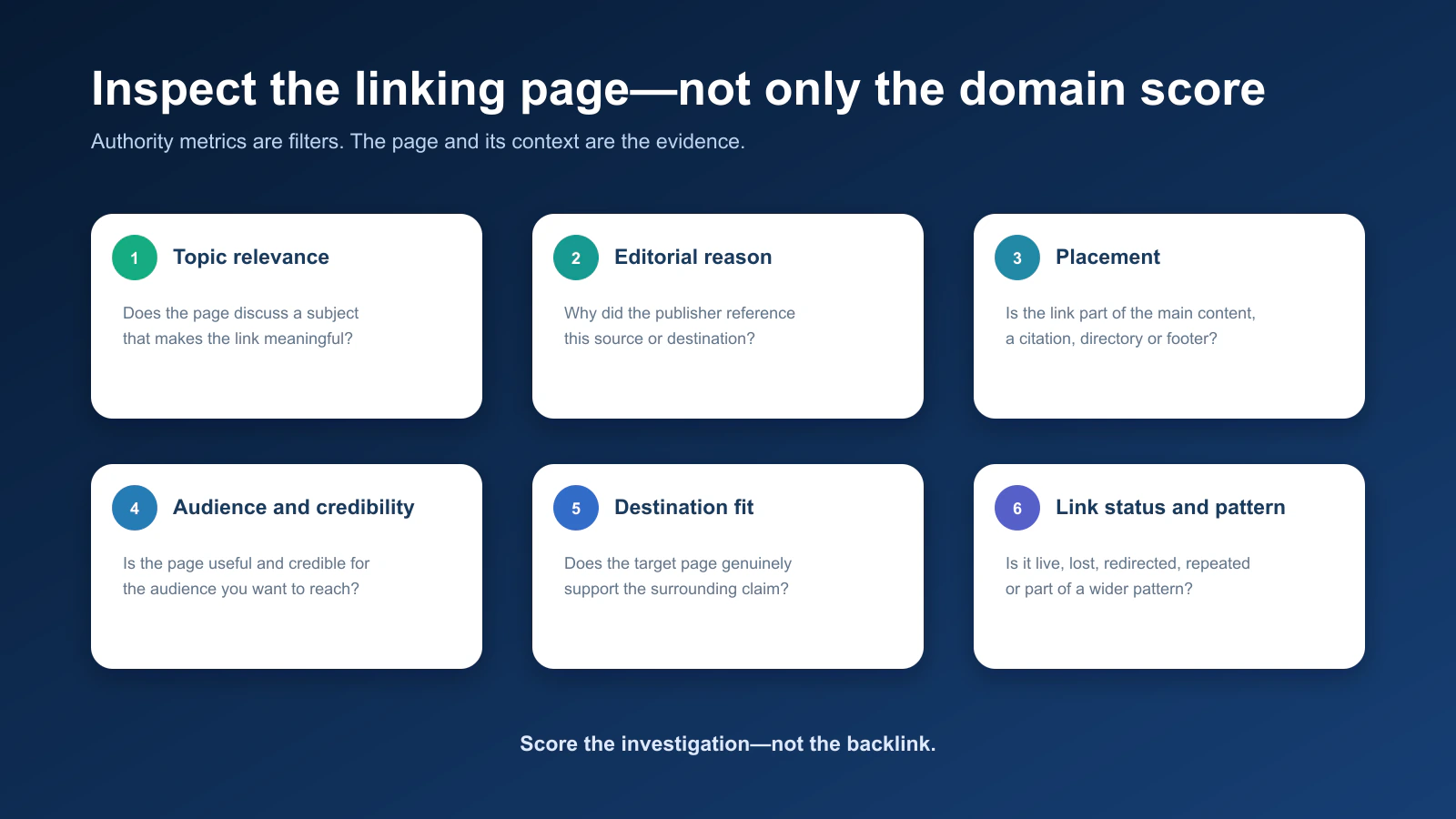
Backlink research often becomes overly focused on authority metrics.
An SEO enters a referring domain, looks at its DR or DA and immediately labels the link good or bad. That skips much of the evidence that actually makes the link meaningful.
The individual page containing the backlink deserves inspection. Consider what the page discusses, why it links to your site, where the link appears, whether the topic is relevant and whether the page itself seems useful and credible.
A link from a very authoritative domain could appear on an irrelevant page buried deep in the site. A smaller specialist publication might instead link from a highly relevant article read by exactly the audience your business wants to reach.
Domain-level authority can help filter a large dataset, but it should usually answer “What deserves inspection first?”, not “Is this backlink definitely valuable?”
What Do Backlink Authority Metrics Mean?
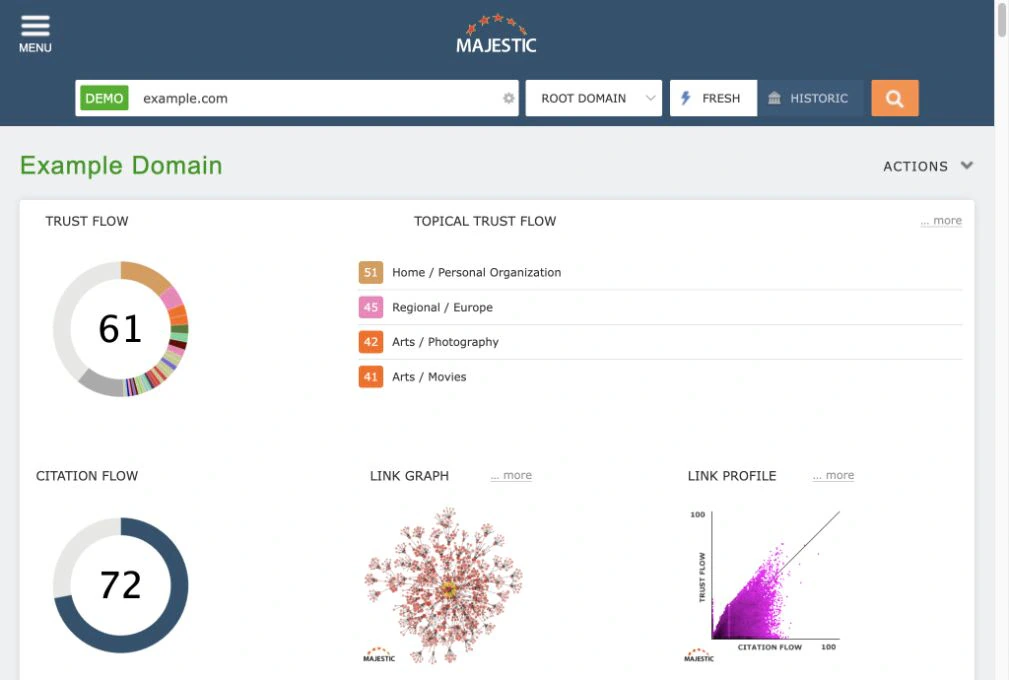
SEO platforms create proprietary metrics to summarise large backlink datasets.
| Platform | Common backlink-related metric |
|---|---|
| Ahrefs | Domain Rating / URL Rating |
| Moz | Domain Authority / Page Authority |
| Semrush | Authority Score |
| Majestic | Trust Flow / Citation Flow |
Ahrefs describes Domain Rating as a relative measure of backlink-profile strength. Moz uses Domain Authority as its own predictive metric, while Majestic uses Flow Metrics such as Trust Flow and Citation Flow.
These can all be useful. What matters is remembering that none of them is a Google metric.
Google does not publish a website’s Domain Authority, Domain Rating or Authority Score.
That means the metrics work best as comparative signals inside the methodology that created them. If you are analysing thousands of prospects inside Ahrefs, DR can help filter the dataset. If your workflow uses Moz, DA can serve a similar purpose.
What you should not do is assume that DA 60 and DR 60 represent the same thing or that either number directly expresses Google’s opinion of the domain.
What About Anchor Text?
Anchor text is the clickable text used inside a link.
Backlink analysis tools can aggregate anchor data across a profile to show how other websites describe your site or pages. You may find branded anchors such as a company name, URL anchors, generic phrases such as “read more” and descriptive anchors related to the topic of the destination page.
That information is useful because it reveals patterns in how links were acquired.
For example, if an unusually high percentage of newly discovered links suddenly uses the same commercial exact-match phrase, that may deserve investigation. On the other hand, a naturally earned profile may contain a mixture of branded, descriptive, generic and URL-based anchors.
The goal should not be to manufacture an “ideal” percentage for every anchor category. Use anchor text diagnostically to understand the profile rather than turning it into another score to optimise.
New and Lost Backlinks
Most SEO backlink analysis tools also monitor changes over time.
A new backlink appears when the platform discovers or confirms a new link. A lost backlink appears when a link that previously existed can no longer be found according to the tool’s latest crawl.
These reports can be valuable for link reclamation.
Suppose several strong editorial links disappear after a website migration. Further investigation might reveal that those links still point to URLs now returning 404 errors, giving you a clear opportunity to repair the destination or redirect the old URLs properly.
Not every lost link deserves action, though. Publishers update content, pages disappear and websites restructure their architecture constantly. A lost-link notification is therefore a reason to investigate rather than an automatic task.
How to Analyse Your Own Backlink Profile
When analysing your own site, start with the overall structure of the profile rather than scrolling through every individual backlink.
Referring domains provide a cleaner starting point because they reduce the noise created when one site links hundreds or thousands of times. From there, look at which pages on your site attract the most referring domains and how those patterns have changed over time.
One of the most useful questions is:
Which pages naturally earn links, and why?
You may find that original research, calculators, industry statistics, datasets, tools or particularly comprehensive resources attract substantially more external references than ordinary commercial pages.
That can tell you something useful about what publishers in your market consider worth citing.
Google Search Console adds another evidence source for sites you control. Its Links report includes information about top linked pages, linking sites and linking text, although Google makes clear that the report is a sample rather than a complete backlink index.
We would therefore use Search Console alongside a backlink database rather than treating either source as the single complete truth.
How to Analyse Competitor Backlinks
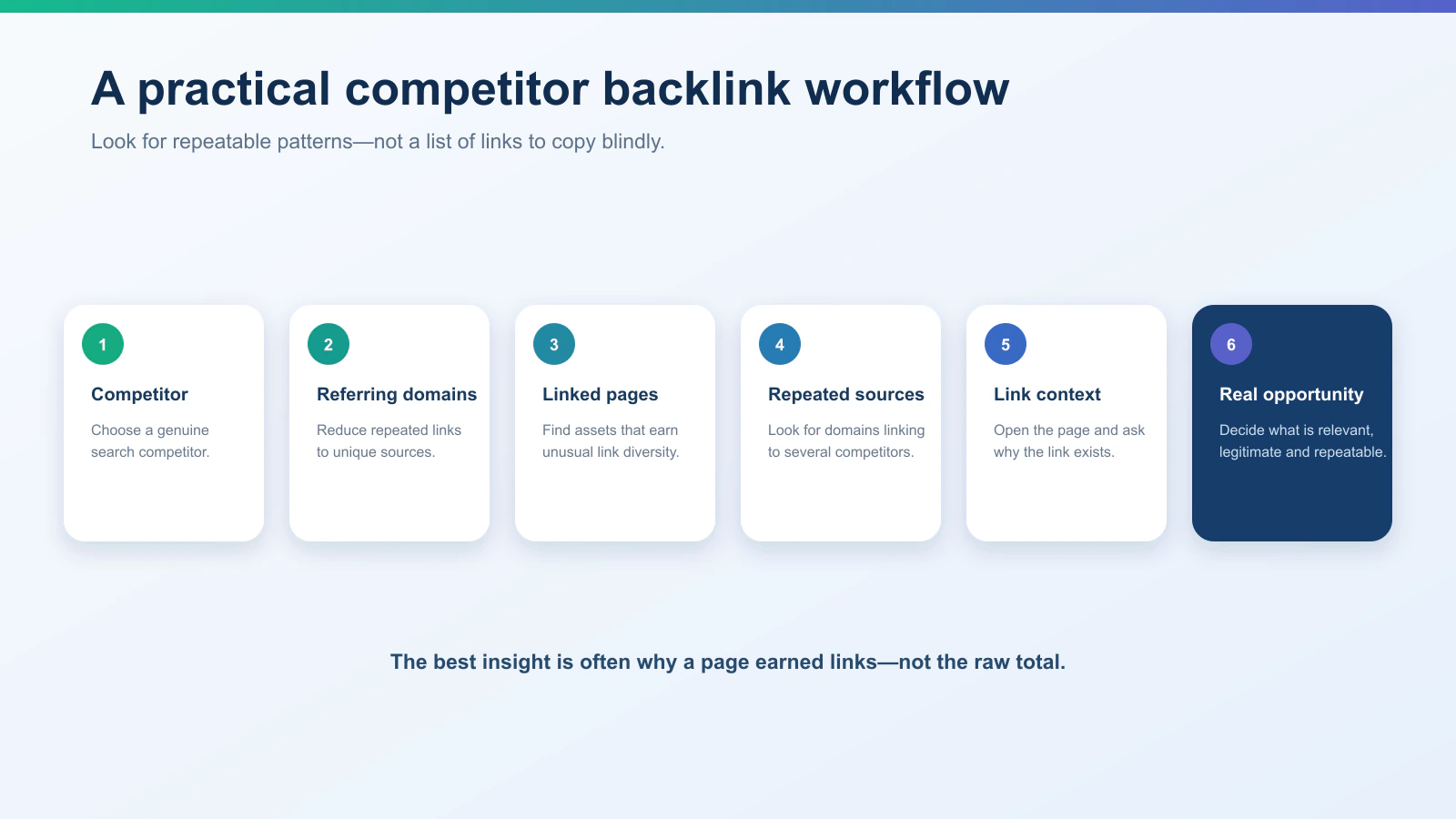
Competitor backlink analysis has a slightly different objective.
You are not trying to discover which competitor has the largest number. You are looking for patterns that help explain where their external authority comes from and whether any of those patterns are relevant to your own strategy.
A useful workflow is:
Competitor → referring domains → strongest linked pages → repeated sources → link context → realistic opportunities
Suppose several competing websites receive links from the same industry association, specialist publication and software directory while your site does not. That recurring pattern is much more interesting than one random high-authority domain linking to one competitor.
Backlink-gap and link-intersect tools are helpful because they surface exactly these overlaps. The resulting domains still require manual inspection, though, because the reason behind the link determines whether the opportunity can realistically be repeated.
A competitor may have earned it through original research, membership, sponsorship, a quote, a tool, a partnership or simply because it created the best resource available at the time.
Analyse the Pages That Earn Competitor Links
Some of the most useful backlink research starts with pages rather than domains.
Imagine a competitor’s normal articles attract five to ten referring domains, but one statistics page has links from 450 separate websites. That difference deserves attention because it suggests the page provides something people repeatedly find worth citing.
The useful question is not necessarily:
How do we copy those 450 backlinks?
It is:
What did this page provide that made other publishers want to reference it?
The answer might be proprietary research, regularly updated statistics, original graphics, a calculator, a free tool or a particularly clear reference resource.
Backlink analysis therefore doubles as content intelligence. It can help identify the types of assets that earn authority naturally rather than limiting the workflow to outreach lists.
Be Careful With “Toxic Backlink” Scores
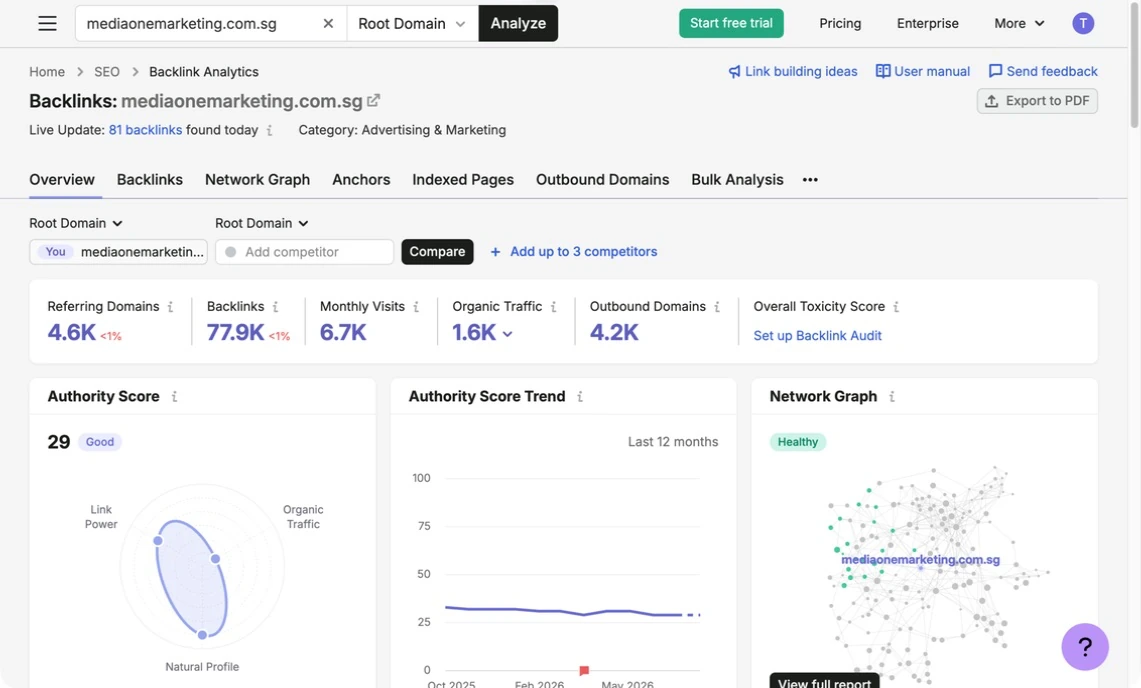
Many backlink platforms provide toxicity, spam or risk indicators.
These can be useful for filtering a large profile and identifying links that deserve closer inspection. They should not automatically decide which domains you add to a disavow file.
Google’s Disavow Links documentation describes the feature as advanced and warns that incorrect use can harm search performance. Google also says most sites do not need to use the tool because its systems generally determine which links can be trusted without additional guidance from the site owner.
The situations Google describes are much narrower, particularly where there is a considerable volume of spammy, artificial or low-quality links and those links have caused, or are likely to cause, a manual action.
That is very different from:
“Our SEO platform labelled 300 links toxic, so we should disavow all 300.”
We would treat a vendor risk score as “investigate this link”, not “Google considers this link harmful.”
Those are very different conclusions.
Link Spam Is Different From a Weak-Looking Backlink
The public web naturally produces noisy backlinks.
Sites scrape pages, directories copy business information, automated systems generate references and old websites can change ownership or quality over time. A strange-looking link therefore does not automatically mean a site has participated in manipulative link building.
Google’s spam policies focus on link practices intended to manipulate search rankings, including artificial linking arrangements and other link-spam techniques.
Backlink analysis tools can help identify patterns that deserve investigation, but the presence of an unattractive or low-authority referring domain is not enough by itself to establish manipulation.
Context still matters.
A Practical Backlink Analysis Workflow
Large link exports become much easier to work with when the analysis follows a consistent process.
Discover and Reduce the Noise
Begin by collecting backlink and referring-domain data for the site or page you are investigating. At this stage, the goal is coverage rather than deciding whether every link is good or bad.
Next, reduce repetition by looking at unique referring domains and important referring pages. Thousands of repeated links from one website can otherwise dominate the report without giving you proportionally more useful evidence.
Segment and Inspect the Profile
Separate the profile into meaningful patterns such as editorial mentions, directories, partner links, citations, resource pages and unusual low-quality clusters. These categories exist for different reasons and should not all be interpreted as one homogeneous dataset.
Then open the important referring pages manually. Check the topic, relevance, placement, destination and editorial context of each link rather than relying exclusively on a domain-wide score.
Compare Competitors and Decide What Deserves Action
Competitor analysis can then reveal which sources repeatedly link to other businesses in the market and which pages consistently attract authority.
The result may lead to link reclamation, content creation, digital PR, partnership opportunities or no action at all. The purpose of the analysis is not to produce the longest task list. It is to identify the findings that genuinely change what the SEO team should do next.
Monitor What Changes
Once you understand the profile, monitor meaningful new and lost referring domains over time.
This creates a much more useful process than repeatedly exporting tens of thousands of backlinks without a specific question in mind.
What Backlink Analysis Tools Cannot Tell You
Backlink analysis software can reveal a remarkable amount of information about relationships across the public web. It still cannot expose Google’s internal link weighting system.
A platform cannot definitively tell you exactly how much ranking benefit one backlink contributed. It also cannot prove that losing one specific link caused a ranking decline simply because the two events occurred around the same time.
Competitor data has similar limitations. A tool may show that another website earned a link, but it cannot guarantee you can reproduce that result. The competitor might have earned it through original research, a private partnership, a historical relationship or circumstances that no longer exist.
Likewise, a proprietary authority score does not tell you precisely how Google values the domain or page.
That is why we treat backlink platforms as evidence systems rather than ranking calculators. They help us understand the link graph and identify patterns worth investigating, while the final decision still comes from context.
Where Digimetrics Fits: Backlink Evidence Inside a Wider SEO Diagnosis
Disclosure: Digimetrics is built by our team.
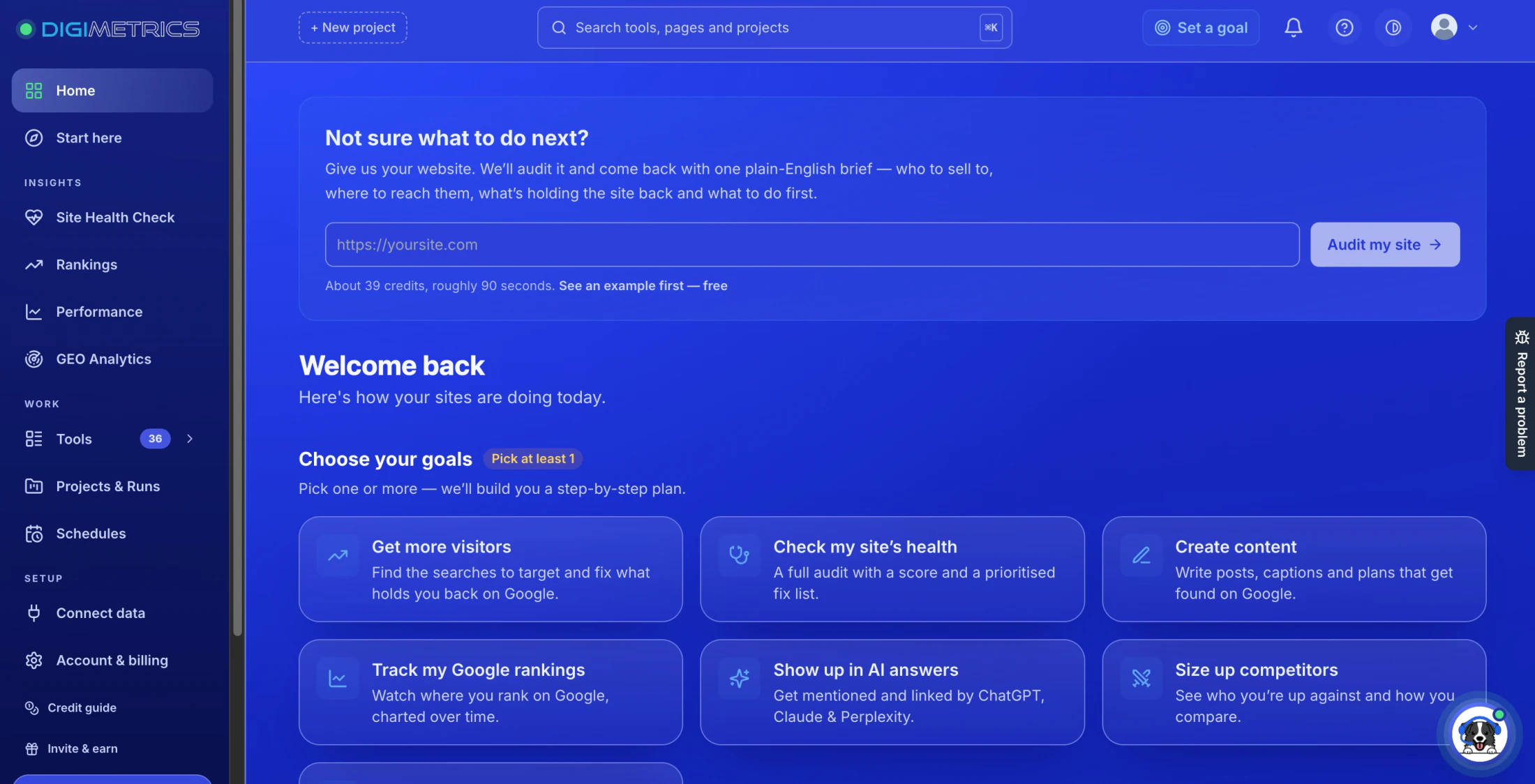
Digimetrics includes backlink analysis as part of a wider SEO workflow rather than treating links as a completely separate dataset.
Backlink Data Inside the Wider SEO Picture
The Backlinks Explorer can be used to investigate links and referring domains, while adjacent tools cover competitors, keywords, rankings, technical SEO and page-level diagnostics.
That broader context matters because a weak ranking page does not automatically have a backlink problem. A competitor may have more links, but your own page could also have technical issues, weaker content, poor internal support or several problems at once.
Backlink evidence becomes more useful when it can be considered alongside those other signals rather than becoming an automatic instruction to “build more links.”
From Link Pattern to SEO Decision
Suppose competitor analysis shows that several higher-ranking pages have substantially stronger referring-domain profiles. That may justify deeper backlink research, but it should not end the diagnosis.
If those same competitors also satisfy search intent more thoroughly while your own page has indexation problems, link acquisition may not be the first thing worth fixing.
The goal is to understand where backlink evidence fits into the wider diagnosis.
Where Specialist Backlink Platforms Still Go Deeper
Mature specialist backlink platforms can provide deeper historical research, larger dedicated indexes and more advanced link-specific workflows.
An integrated SEO platform does not need to replace every specialist database to be useful. Its value appears when backlink findings need to move quickly into competitor analysis, page diagnostics, content optimisation or broader strategy without repeatedly rebuilding the context across separate systems.
How to Choose an SEO Backlink Analysis Tool
The right backlink platform depends on what you actually need from the data.
| Need | What matters most |
|---|---|
| Analyse competitors | Backlink-gap and competitor comparison |
| Monitor your site | Fresh/new/lost link tracking |
| Deep link research | Index depth, filters and historical data |
| Evaluate prospects | Page-level context and usable comparative metrics |
| Agency workflows | Projects, exports and reporting |
| Find opportunities | Competitor intersections and linked-page analysis |
| Investigate risk | Link-level evidence rather than one toxicity score |
| Broader SEO diagnosis | Integration with pages, keywords and competitors |
A dedicated link builder may care most about database depth and advanced filtering. An in-house SEO may place more value on competitor research, monitoring and how quickly backlink evidence connects with the rest of the SEO workflow.
A smaller business may simply need enough visibility to understand its strongest referring domains and compare them with a few competitors.
Start with the job. Then evaluate the tool.
Common Backlink Analysis Mistakes
One common mistake is assuming the platform reporting the highest number of backlinks must have the best database. Coverage and freshness matter, but raw volume does not tell you whether the data is useful for the analysis you need to perform.
Another mistake is evaluating every backlink at the domain level. Domain-wide metrics are efficient filters, but the actual linking page, relevance and editorial context often tell you far more about why the link exists.
It is also easy to treat every suspicious-looking backlink as an SEO emergency. The web naturally contains noisy links, and Google’s own guidance does not recommend routine disavowing for most sites.
Finally, competitor backlink analysis should not become a race to replicate every link you see. A much better question is:
Why did this source link to the competitor, and is there a legitimate reason it could also reference us?
That shifts the workflow from copying backlinks to understanding why backlinks are earned.
Final Verdict: Use Backlink Tools to Understand the Link Graph, Not Replace Judgement
SEO backlink analysis tools solve an important problem. Without them, investigating thousands of referring pages, competitor links, anchor patterns and historical changes would be extremely difficult.
But the software is still providing its model of the backlink profile, not Google’s internal view of exactly how much every link matters. Different platforms discover different links, authority metrics use different methodologies and risk scores can identify areas worth investigating without proving that Google considers those links harmful.
That is why we would not judge a backlink using one DR, DA, Authority Score or toxicity number.
Start with the actual linking page and understand why the link exists. Compare patterns across referring domains and competitors, then decide whether the evidence changes what the SEO team should investigate or create next.
A backlink analysis tool becomes most useful when it moves the question from “How many links do we have?” to “Which external relationships appear to support these pages, how do they differ from competitors and what should we do with that information?”
That is where backlink data becomes useful SEO analysis rather than another export full of numbers.
Frequently Asked Questions
What Is a Backlink Analysis Tool?
A backlink analysis tool is SEO software used to discover and investigate external links pointing to a website or page.
Depending on the platform, it may show referring domains, linking pages, destination URLs, anchor text, authority metrics and new or lost backlinks.
What Do SEO Backlink Analysis Tools Do?
SEO backlink analysis tools crawl and index parts of the web to build databases of links. Users can then analyse their own profiles, compare competitors, investigate anchor text, find link gaps and monitor changes over time.
The tools provide the evidence. Interpreting whether those links matter still requires context.
Why Do Backlink Tools Show Different Numbers?
Different platforms operate separate crawlers and web indexes.
They may discover different pages, revisit URLs at different frequencies or process redirects, duplicate links and lost links differently. For trend monitoring, it is usually more useful to compare data consistently inside one platform than to compare raw totals across several databases.
What Is a Referring Domain?
A referring domain is a website containing at least one link to another site.
One referring domain can create many individual backlinks, which is why total backlink count and referring-domain count describe different aspects of a link profile.
Is Domain Authority a Google Metric?
No. Domain Authority is a proprietary Moz metric.
Ahrefs uses Domain Rating, Semrush uses Authority Score and Majestic uses metrics such as Trust Flow. These can help compare websites within their respective platforms, but they are not Google’s own authority scores.
Should I Disavow Toxic Backlinks?
Not automatically.
Google says the Disavow Links feature is advanced, should be used cautiously and is unnecessary for most websites. A third-party toxicity score should therefore be treated as a reason to investigate a link rather than automatic proof that Google considers it harmful.
Can Google Search Console Analyse Backlinks?
Yes. Search Console provides a Links report for verified properties containing information about external links, top linked pages, linking sites and linking text.
However, Google describes this data as a sample rather than a comprehensive export of every backlink it knows about.
How Do I Analyse Competitor Backlinks?
Start with competitor referring domains and their strongest linked pages rather than scrolling through every backlink.
Look for sources linking to several competitors, pages attracting unusually large numbers of referring domains and recurring patterns that explain why those links were earned. Then inspect those opportunities manually before deciding whether they are relevant or realistically repeatable.
Disclosure: digitalmarketingtools.ai is sponsored by Digimetrics.ai. Sponsored Highlights are clearly labelled advertising. Our reviews, comparisons and guides are written to be useful and fair regardless of who sponsors the site. Read the full disclosure.


