
Structured Data for AI Overviews: A Practical Checklist

Teams are told that schema markup gets pages into Google AI Overviews. The evidence does not support that. Structured data is a useful, low-cost signal, but no platform has documented that it guarantees inclusion, and several rich results it once unlocked have been retired.
Treat structured data as a clarity tool: markup that mirrors visible page content, uses a schema type with a current purpose, and is checked before release. Apply the triage steps below to any page, focusing effort where markup changes what a search engine understands.
Key Takeaways
- Structured data is a clear, low-cost signal, but no source shows it guarantees AI Overview inclusion.
- Search Console recorded zero rich-result appearances across one domain from July 17 to October 17, 2026, despite 9,191 impressions across 16 pages. This is a single-site observation, not a general finding.
- Google retired HowTo rich results in September 2023 and began reducing FAQ rich results in 2023.
- Use JSON-LD, mark up only visible content, and validate with Google’s Rich Results Test and the Schema Markup Validator.
- Put content clarity first. Markup supports that work rather than replacing it.
Markup Triage Matrix: Decide What to Mark Up
Check each page before adding markup, since structured data only helps when it describes content that search results can actually show.
- Is the content visible to visitors? If not, do not mark it up.
- Does the page answer one clear question for a real reader? If not, fix the content first.
- Does a schema type match the main content? If not, skip markup.
- Does Google list that type as eligible for a rich result? If yes, add and validate. If no, markup is an optional clarity signal.
- Is the type FAQPage or HowTo? If yes, skip it. HowTo rich results were retired in September 2023, and FAQPage markup causes no problems for Search.
- Does the markup match the visible text exactly? If not, correct it.
Table of Contents
- What Structured Data Does (and Doesn’t Do) for AI Overviews
- Schema Types Worth Prioritizing
- What the Evidence Suggests: A Measured View
- Conclusion: A Checklist, Not a Shortcut
What Structured Data Does (and Doesn’t Do) for AI Overviews
Structured data is a standardized way of labeling what a page’s content means. The vocabulary comes from Schema.org, and the markup applies it to a page. Google describes markup as explicit clues about a page’s meaning. A plain paragraph forces a machine to infer that “Jordan Lee” is an author, that “$49” is a price and that “Tuesday” is an event date. Markup states those facts directly. On a blog post, FAQ schema labels each question and answer as a discrete pair. Teams that add schema to a site get the same typed labels across every page, so the information a crawler reads matches what a visitor sees. Google’s AI Overviews draw on the same page signals that inform traditional results, so the labels a crawler reads need to match what a visitor sees.
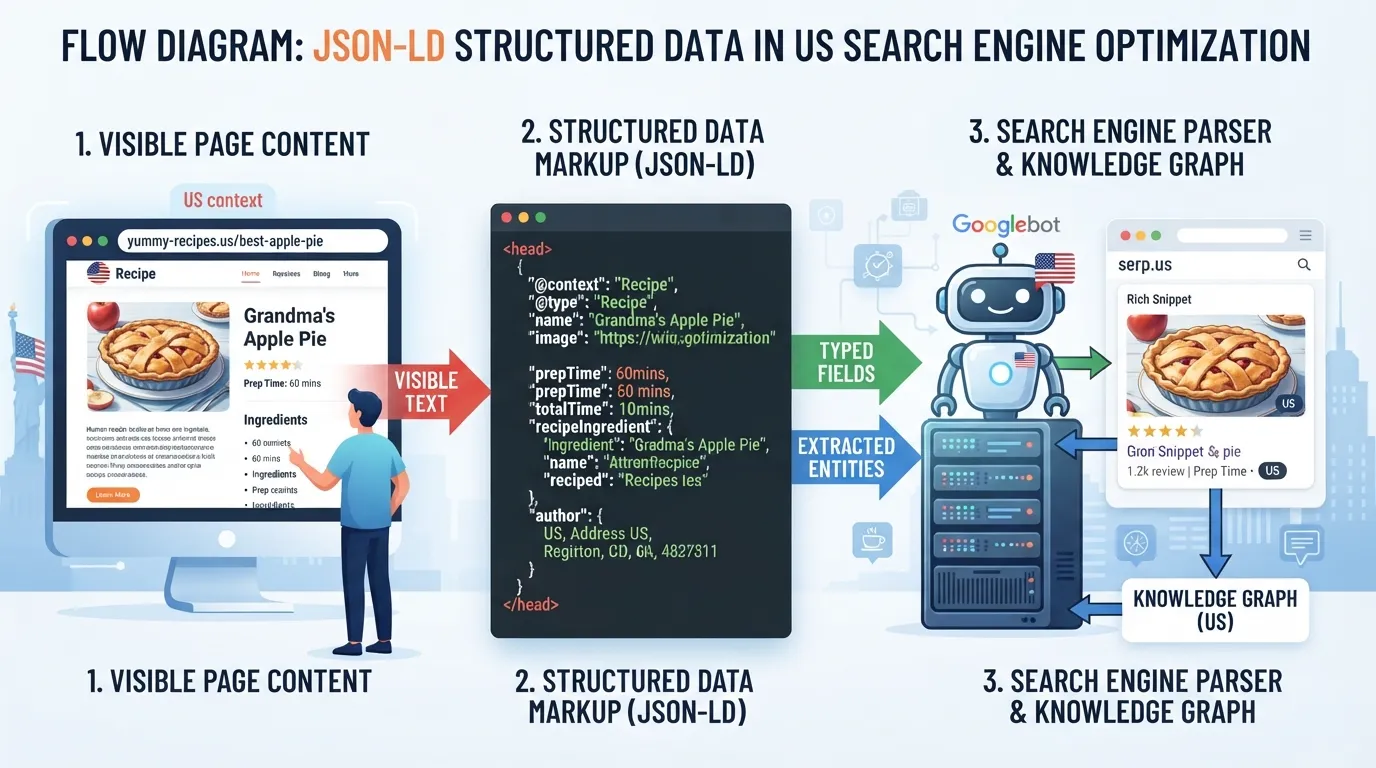
What the vocabulary and the markup each do
Schema.org is the vocabulary: agreed names for types and properties such as Article, author and datePublished. Structured data is what happens when you use that vocabulary on a real page. The Schema.org project describes its purpose on its About Schema.org page, accessed October 20, 2026. The vocabulary is free to use, but it only helps when the markup matches what a visitor can see.
Whether AI systems read the markup
AI systems typically crawl a page, parse its HTML, extract entities and then build an answer. Markup shortens the parsing step because entities are already labeled. Fabrice Canel said at SMX Munich that schema markup helps Microsoft’s large language models understand content, as Search Engine Land reported in March 2025. That describes Bing’s own models, not a general rule for every AI product.
OpenAI and Perplexity have published no documentation on whether markup affects which sources they select, as of October 20, 2026. Treat any claim that they reward schema as unproven.
Google Search Central guidance on AI Overviews
Google’s guidance on AI Overviews points back to its general search principles. Pages are eligible when they are helpful and reliable, and structured data helps Google understand the content. Nothing in that guidance says markup is required or promises a change to AI Overview outcomes. Treat markup as a clue, not a ranking guarantee or an eligibility switch. Traditional search and AI answers both depend on the same page quality, so markup supports the content rather than replacing it.
Google’s preference for structured data
Google favors explicit markup because it removes guesswork when extracting facts such as an author, a price or a date. In June 2025, Google dropped seven more rich result types, including Course Info, Claim Review and Estimated Salary, and said the change does not affect ranking. A type losing its display does not mean the markup lost value, but the visible payoff can disappear.
Why AI systems favor structured data
Explicit, typed fields reduce ambiguity. A value labeled as a price, date or author can be extracted and attributed without interpretation. Bing’s comment supports this reasoning, but it is not a documented ranking mechanism. We have not found evidence that markup causes AI Overview inclusion, so the argument stays at the level of clarity.
Structured data vs. unstructured data in AI
| Structured data | Unstructured text | |
|---|---|---|
| How it is read | Parsed directly from typed fields | Inferred from language and context |
| How ambiguity is resolved | Declared by the publisher | Guessed by the system |
| What a system can cite with confidence | Values that match visible content | Claims it has to interpret first |
The practical difference is confidence. Markup that mirrors visible text gives a system a value it can cite directly. Anything the page does not show users is a liability, so the next section starts from what is actually on the page. Good markup also gives the reader a clear experience, since the answers a visitor sees are the same ones a machine extracts.
Schema Types Worth Prioritizing
Not every schema type earns its place. Many once-promising rich results have been retired, so the useful question is which types match what is on the page and still do something for search results. Google’s AI Overviews draw on the same content signals as other results, so markup that clarifies what the page is about helps search systems understand it and helps Google understand the information on the page. Teams should also note that markup alone does not confer experience or authority.
Structured data types relevant to AI visibility
Five types cover most business sites:
- Organization: name, logo, URL, and sameAs links that tie the entity to its profiles.
- WebPage: name, description, and primary content, which confirms what the page is about.
- Article: headline, author, and dates, for editorial content.
- Product: name, price, and availability, but only where the values are current.
- Person: name and role for authors or executives, linked to the Organization.
Check eligibility first. Google’s search gallery lists the rich result types it currently supports. Google deprecated HowTo rich results in September 2023 and has pruned several other low-value types, saying the change does not affect ranking.
Priority schema types for AI optimizing
| Schema type | What it describes | What it does for search | Eligibility status |
|---|---|---|---|
| Organization | The business and its identity | Supports entity recognition | Valid markup, no rich result |
| WebPage | The page’s subject | Clarifies page meaning | Valid markup, no rich result |
| Article | Editorial content and authorship | Supports article features | Eligible for article features |
| Product | Items with price and stock | Enables product rich results | Eligible, values must be current |
| FAQPage | Question-and-answer content | Expandable result is narrowed | Limited to government and health sites |
| HowTo | Step-by-step instructions | None | Deprecated September 2023 |
FAQPage and HowTo are the two cases where the visible rich result is gone or narrowed, so marking them up now buys little.
Schema requirements for AI Overviews
Google has not published a dedicated schema requirement for AI Overviews. Eligibility rests on the same quality and helpful-content criteria that govern all of Google Search. Markup helps search engines understand content, but valid JSON-LD will not rescue weak content.
FAQ schema value and deprecation
In 2023 Google reduced FAQ rich results, limiting them mainly to authoritative government and health websites. For most businesses, FAQPage markup no longer produces a visible result. Google wrote in August 2023 that unused FAQPage markup causes no problems for Search. Existing markup can stay, but add new markup only where it mirrors questions the page genuinely answers.
Implementation checklist
- Choose the schema type that matches the page’s primary content. An article page gets Article, a product page gets Product, and an author profile gets Person.
- Use JSON-LD. Google accepts JSON-LD, Microdata and RDFa but recommends JSON-LD, which sits apart from the visible HTML and is easier to maintain.
- Mark up only content that is visible on the page. Markup describing hidden or invented content quickly erodes trust in the data.
- Fill required and recommended properties with accurate, specific values. Use exact dates, names and identifiers rather than generic text.
- Connect entities with stable IDs where relevant. An @id gives the author, organization and product a consistent identifier. Google’s Knowledge Graph uses entity IDs, so consistent IDs help match your entities to ones it already knows. See Google’s structured data documentation for more.
- Remove markup for types that are no longer useful. Dead code adds maintenance cost without benefit.
Validation workflow
- Run the page through Google’s Rich Results Test to confirm rich-result eligibility.
- Run it through the Schema Markup Validator at Schema.org to check any type, including types with no Google rich result.
- Compare the rendered page against the markup to catch mismatches between code and what the reader sees.
- Re-test after every template change. One change to a shared template can break markup across hundreds of pages.
Here is a complete, valid JSON-LD Article example for a blog post. Replace the placeholder values with the page’s real details before testing:
json
{
“@context”: “https://schema.org”,
“@type”: “Article”,
“@id”: “https://www.example.com/blog/structured-data-ai-overviews#article”,
“headline”: “Structured Data for AI Overviews: A Practical Checklist”,
“datePublished”: “2026-10-27”,
“dateModified”: “2026-10-27”,
“author”: {
“@type”: “Person”,
“@id”: “https://www.example.com/team/jane-doe#person”,
“name”: “Jane Doe”
},
“publisher”: {
“@type”: “Organization”,
“@id”: “https://www.example.com/#organization”,
“name”: “Example Company”,
“url”: “https://www.example.com/”
},
“mainEntityOfPage”: “https://www.example.com/blog/structured-data-ai-overviews”
}
Common mistakes checklist
- Markup describing content that users cannot see
- Duplicate or conflicting types on one page
- Stale dates, prices or availability values
- The same generic schema applied to every page
What the Evidence Suggests: A Measured View
Honest limits of the evidence
No platform has documented that markup guarantees inclusion in Google AI Overviews. OpenAI and Perplexity have published no documentation on whether markup affects which sources they select, as of October 20, 2026. Microsoft’s position is the strongest on-record statement: as Search Engine Land reported in March 2025, Fabrice Canel said at SMX Munich that schema markup helps Microsoft’s large language models understand content. That concerns Microsoft’s own models, not Google’s AI Overviews.
Our own results point the same way. From July 17 to October 17, 2026, the 16 pages with data earned 9,191 impressions, yet Search Console recorded zero rich-result appearances across the domain. This is one site observation, not proof. Markup can be correct and still produce no visible feature.
Markup remains a low-cost, defensible investment. It costs little to maintain, describes what a page is and protects against misreading. The case for it rests on clarity, not on a measured traffic gain.
Context matters too. Semrush’s data puts AI Overviews on 13.14% of queries in March 2025. A Pew Research Center analysis found users clicked a traditional result 8% of the time when an AI Overview was present, against 15% without one, and clicked a link inside the overview only 1% of the time. The click loss is the larger commercial fact.
Where effort should go first
Clear, accurate content and entity definition matter more than markup volume. A page that states who the organization is, what the product does and who wrote the piece gives search engines more to work with than a page buried in unneeded schema types. Good information structure helps Google and other engines understand your content, whether they reach it through traditional search or AI answers, so a blog post should lead with its answer. Strong visibility depends on this clarity, and teams should add schema only where it reflects the visible page.
Work in this order:
- Fix content clarity. State the answer in the first paragraph and name the entities plainly.
- Add accurate core schema. Mark up only what is visible on the page, using JSON-LD, and only where it matches the page’s content.
- Validate. Run the Rich Results Test and the Schema Markup Validator, and fix mismatches.
- Measure. Track impressions, clicks and rich-result reports in Search Console over several months before drawing conclusions. Judge each post by the answers and experience it gives readers, not by its markup count alone.
Conclusion: A Checklist, Not a Shortcut
Structured data helps machines read a page clearly and can support rich-result eligibility. It does not, on its own, secure a place in Google AI Overviews. The evidence for a direct lift is thin, so treat markup as a low-cost clarity signal, not a shortcut.
Before adding markup, check that it mirrors content a visitor can see and that a current Google rich result or documented search-engine use exists for that type. Then validate in Google’s Rich Results Test and the Schema Markup Validator, and compare the rendered page with the markup after every template change.
After each deployment, watch Search Console for enhancement errors and for changes in impressions and clicks on updated pages. Expect small effects.
Do AI Overviews require structured data?
No. Google has not published a requirement for schema markup to appear in an AI Overview. Eligibility rests on standard quality and helpful-content criteria.
Does Google use schema markup to choose AI Overview sources?
Google says structured data gives explicit clues about what a page means. It does not publish a rule that marks a page as an AI Overview source. Keep the visible content accurate and useful first, and judge each page by the experience it gives a reader.
Do OpenAI or Perplexity read schema markup?
We found no public documentation from either company on whether their systems use markup when choosing sources, as of October 20, 2026. Bing’s statement covers Microsoft’s own systems only.
Should I still add FAQ schema?
Only if the questions and answers are visible on the page and genuinely useful. Google has shown the expandable FAQ rich result only for well-known, authoritative government and health sites since August 2023, so most sites will not see it. Unused FAQPage markup causes no problems, but there is little reason to add it for visibility alone.
Which format should I use for structured data?
Use JSON-LD. Google accepts JSON-LD, Microdata and RDFa but recommends JSON-LD, because it sits apart from the visible HTML and is easier to maintain as a site grows.
Disclosure: digitalmarketingtools.ai is sponsored by Digimetrics.ai. Sponsored Highlights are clearly labelled advertising. Our reviews, comparisons and guides are written to be useful and fair regardless of who sponsors the site. Read the full disclosure.


