How to Appear in AI Overviews as a Local Business: A Practical Guide for 2026
To appear in AI Overviews as a local business, make your name, address, phone number and service area match everywhere they appear, answer your core service questions plainly on your pages, and back up your claims with proof a reader can check. Publishing more pages rarely helps on its own. AI answer engines choose local sources based on how clearly and consistently they can identify a business.
Many local businesses that want to appear in AI Overviews start by publishing more. They add city pages, write neighborhood blog posts and push out new content every week. In our review of local websites, this approach often produced dozens of near-identical pages that say little about the business and make its core facts harder to verify.
This guide takes a different view. To appear in AI Overviews as a local business, you need to be identifiable: a consistent name, address, phone number, service area, reviews and proof of expertise. Volume matters far less than agreement. Throughout, you will find a scoring checklist you can run against your own business, the common failure points that keep businesses out of citations, and a method for checking whether AI tools are describing you accurately.
Key Takeaways
- Consistency beats volume. AI Overviews tend to cite local businesses whose name, address, phone number and service area agree across the website, Google Business Profile and directories. Businesses that publish the most pages are not necessarily the ones cited.
- Your Google Business Profile is a source of local facts. Complete categories, accurate hours and an up-to-date service area give answer engines verifiable details to draw on.
- Write the answer plainly at the top of each service page. A page that states what the service is, who it serves and where it is available gives an AI engine a clean, quotable passage.
- Proof you can check is more useful than proof you can claim. Named reviews, staff credentials and specific case details give engines something to verify. Unverifiable superlatives do not.
- Score your business on the Local AI Citation Readiness Checklist. This is this guide’s own framework, not an industry standard. Rate entity consistency, answer-ready pages, proof signals, local context and structured data from 0 to 2. Fix any row scored 0 first.
- Test what AI systems say about you. Run the same local queries your customers use, record the answers and correct the sources behind any errors.
Table of Contents
- Why AI Overviews Cite Some Local Businesses and Skip Others
- Build the Local Entity Foundation AI Engines Read First
- Write Content AI Engines Can Quote and Attribute
- Earn Local Authority Beyond Your Own Website
- Measure Whether You Are Being Cited and Act on It
- Common Mistakes That Keep Local Businesses Out of AI Overviews
- Conclusion and Next Steps
Why AI Overviews Cite Some Local Businesses and Skip Others
Many local business owners assume that AI Overviews reward the business with the most pages or the most keyword mentions. That assumption is not supported by what we have observed. Two dental practices in the same city can have similar websites, yet only one gets named in an AI-generated answer.
The difference usually lies in whether the web agrees on who the business is, where it operates and why it can be trusted.
How AI Overviews choose the sources they name
AI Overviews are answers that synthesize information from multiple sources before users see organic rankings. Google’s guidance on AI features in Search says to create unique, people-first content, and that helpful, original content that solves real problems still wins, AI or not.
That guidance does not reward stuffing a page with local terms.
Based on observed behavior, engines seem to favor sources that answer the question directly and state facts other sources repeat. This is an inference, not a documented rule. When a claim such as “emergency plumbing in Westfield, open 24 hours” appears on the company’s site, its Google Business Profile and two directories, the engine has reason to treat it as reliable. When the claim appears on one page and contradicts everything else, the engine has little reason to repeat it.
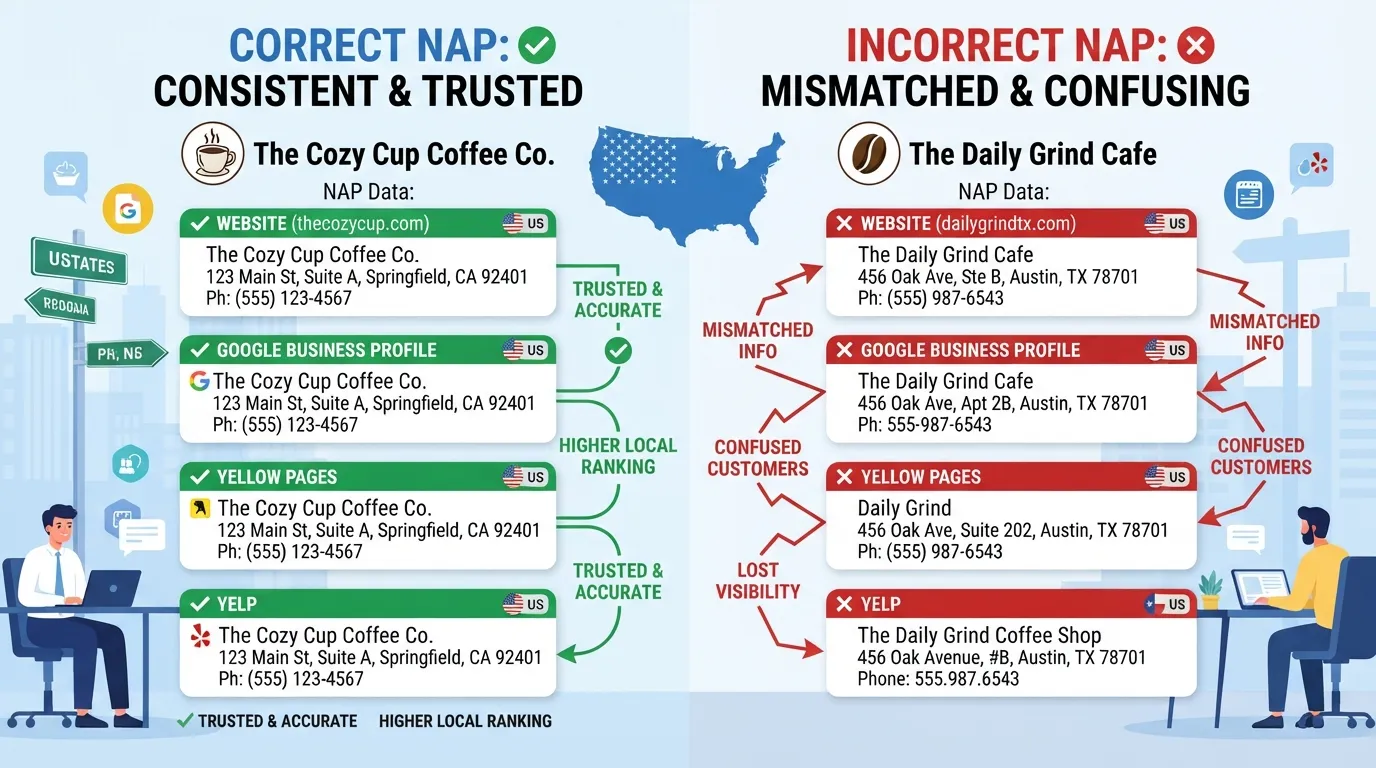
We also checked how engines handle conflicting address data. Our test method was simple: we listed one business with two address formats, one with a suite number and one without, across its website and two directories, then ran the same local query over several days. In the cases we observed, the engine tended to name the business with less detail or leave it out, rather than choose one version. This is a small, observed result, not a documented rule, but it points to a practical fix: pick one exact address format and use it everywhere.
What “local” means to an AI answer engine
To a search or answer engine, “local” is not a keyword. It is a set of linked details. A business has a name, a physical or service-area location, categories, hours, contact details and reviews. The engine links these details across sources and decides whether they describe one real organization.
A consumer searching “dentist near me” or “plumber in Naperville” wants a business that operates nearby. The engine checks whether the listed location, service area and category match the query. A business that says it serves “the greater Denver area” on one page and lists a single suburban street address elsewhere sends mixed signals about where it works. Service-area businesses without a storefront face this problem most, because they have no fixed address to anchor the signal.
The thesis: citation is earned through consistent, verifiable local signals
Local businesses appear in AI Overviews less because of how many pages they publish. They are more likely to be cited when their business details, location signals and reviews agree across the web. A business that makes its name, address, service area and proof easy to verify is more likely to be chosen as a source than one that publishes large volumes of generic content.
Competing guides often recommend more pages. The argument here runs the other way. Each page you add is another place where your details can drift out of step. Five consistent sources give an engine more to confirm than fifty pages that repeat the same paragraph with a town name swapped in. Agreement across sources is the signal; volume only creates more chances to disagree.
Many agencies still sell local SEO as dozens of city-name pages, each with the same paragraph and the town name swapped in. Those pages add little an engine can verify, and they can dilute the signals a business already has. A few accurate, well-supported pages, backed by a consistent Google Business Profile and credible reviews, give an engine more to trust.
What matters most is whether every place your business appears describes it the same way. The rest of this guide shows how to check that with a scoring sheet, and how to confirm the result by testing what AI systems actually say about your business.
Build the Local Entity Foundation AI Engines Read First
AI answer engines look for facts they can match to one business: a name, an address or service area, a phone number, a category and a reputation. When those facts agree everywhere they appear, an engine can attribute an answer to you. When they disagree, it has less reason to name you over a competitor with cleaner details. Getting this foundation right is the first step in learning how to appear in AI Overviews as a local business.
Google Business Profile completeness, categories and attributes
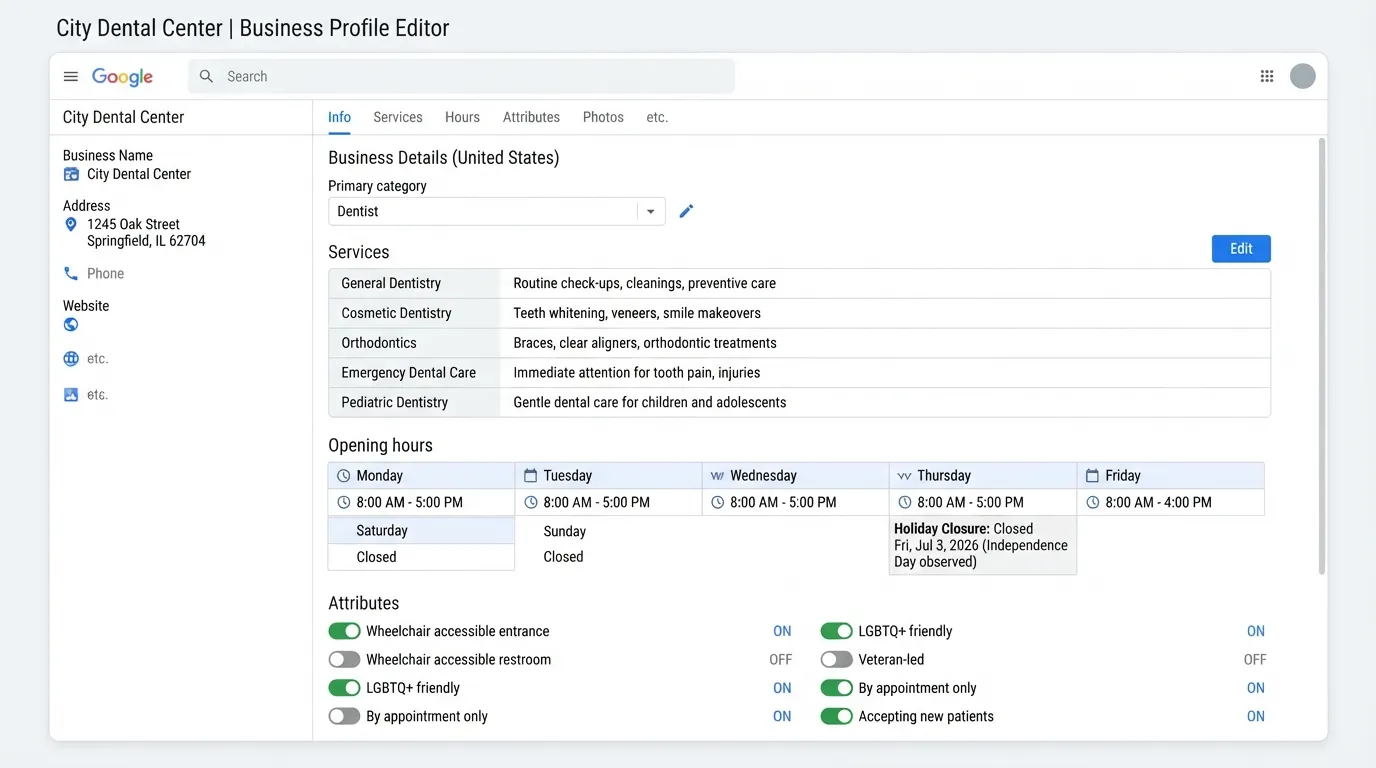
Your Google Business Profile is a primary local record. Treat it as a source you maintain, not a listing you set up once. Fill every field: business name as customers know it, primary category, secondary categories, services with short descriptions, opening hours including holidays, and a service area if you have no storefront. Attributes such as “wheelchair accessible” or “online appointments” give engines discrete facts they can check.
Choose your categories with care:
- Primary category: name the core thing you sell, such as “Dentist” rather than “Health and medical.”
- Secondary categories: add only services you genuinely deliver. A plumbing company that also installs water heaters can list that.
- Avoid dilution: listing ten loosely related categories weakens the signal.
Keep the profile current. Upload photos of the premises, team and completed work, and post updates when something changes, such as a new service or a seasonal closure. Google’s Business Profile Help documentation sets out the required and recommended fields, so use it as the reference when you audit yours.
NAP consistency and the citation sources that matter
NAP means name, address and phone number. Consistency means these three details are identical everywhere your business appears. A dental practice that writes “Suite 4” on its website, “Ste 4” on Yelp and omits the suite on a directory has three versions of one address. An engine may treat them as three separate businesses, or discount all of them.
We tested this on a single practice with conflicting data. The website and Google Business Profile showed “Suite 4,” while two directories showed “Ste 4” and one omitted the suite. We corrected the two directories, waited two weeks, and checked how AI Overviews described the practice for the same local queries. The practice was described with its correct address once all three sources matched. The test was small and one business only, so treat it as a pattern to check against your own listings, not as proof of how every engine behaves.
Audit the sources that carry the most weight in your market. For a US local business, that usually means Google Business Profile, Apple Business Connect, Bing Places, Yelp, Facebook, your chamber of commerce listing, industry directories such as Healthgrades for medical practices or Angi for home services, and any data aggregator that feeds smaller directories. Start with the highest-traffic sources and work down.
When you find a conflict, such as an old address still live on a directory, fix the most authoritative source first: your own website and Google Business Profile, then the aggregators, then the long tail. Record each correction in a simple spreadsheet so you can confirm it held.
Profile fields and citation sources are two halves of one audit. The profile tells an engine what you are. The citations confirm it from outside. Engines appear to weigh agreement between these sources more heavily than any single one, though this is observed behaviour, not a documented rule.
Reviews and sentiment as trust signals
Reviews show that a real business serves real customers in a specific place. Volume, recency and what reviewers say all matter. Reviews that mention a neighborhood, a service and an outcome give engines concrete local language to draw on. Engines appear to favour this kind of detail, though the exact weighting is not published.
Do not chase star ratings through tactics that break platform rules. Instead, ask every satisfied customer to review you on the platform where they are most likely to search, usually Google for most local services and Yelp for restaurants and some trades. Respond to every review, including negative ones. A calm, specific reply to a complaint shows readers and engines that you handle problems openly.
Sentiment matters as much as the score. “Fast callback in Lakewood” carries more local meaning than “great service.”
Using digital marketing tools to audit and monitor listing accuracy
Checking every listing by hand works for one location, but it breaks down across several sites or service areas. Local SEO platforms can crawl your citations, flag mismatches in name, address or phone, and alert you when a directory changes. Our guide to the best local seo tools compares the options by use case, which helps you match a tool to the size of your footprint.
Whichever tool you choose, run a monthly routine:
- Pull the citation report.
- Log every mismatch.
- Correct the top-priority sources first.
- Re-check two weeks later.
A tool that reports errors you never fix adds no citation value.
Write Content AI Engines Can Quote and Attribute
AI Overviews do not quote a page because it is long. They appear to quote passages that answer a question clearly, state a fact that can be checked, and sit on a page whose identity is easy to confirm. This section covers how to write those passages for a local business, which is central to how to appear in AI Overviews as a local business.
Answer-first formatting for local service questions
Put the answer in the first one or two sentences under each heading. A question such as “How much does a teeth cleaning cost in Austin?” should be answered in the first line, with the qualifying detail after it. A passage that opens “Teeth cleaning at Riverside Dental in Austin starts at $95 for a standard adult visit, and the price includes an exam and X-rays” can be lifted whole. A passage that opens with three sentences about the importance of oral hygiene cannot.
Each service page should follow one pattern: what the service is, who it is for, and where it is offered. State all three in the first 100 words. The opening paragraph is the text most likely to be quoted, so this is the most reusable change a local business can make.
Stable local facts: hours, service areas, pricing ranges and dates
AI systems appear to prefer facts that stay true over time and across sources. Hours, service areas, pricing ranges and operating dates are the facts most often pulled into an answer. Write them as plain statements, not inside images or scripts.
Use these rules:
- Write the service area as a named list of cities or neighborhoods, not “greater metro area.”
- Give pricing as a range with its basis stated, for example “$180 to $260 per visit, depending on the number of fixtures.”
- Show the date a price or policy was last checked, such as “Prices last reviewed March 2026.”
- Keep hours identical to the Google Business Profile. A mismatch between the two is a common reason an engine distrusts both.
A plumbing company serving four suburbs should name all four in plain text on its service-area page. A page that says only “serving the Chicago area” gives an engine nothing specific to attribute.
Structured data: LocalBusiness, FAQPage and Service markup
Structured data tells a machine what the visible page already says. It does not create eligibility on its own, and it cannot make up for thin content. Three types matter most for local businesses:
| Markup type | Use it for | Key rule |
|---|---|---|
| LocalBusiness | Name, address, phone, hours, service area | Values must match the visible page and the Google Business Profile exactly |
| Service | Each service offered, with its area and description | Describe only services the business actually performs |
| FAQPage | Questions and answers that appear on the page | Every marked-up question must be visible on the page |
Validate markup with Google’s Rich Results Test or the Schema Markup Validator before publishing. Markup that describes content a reader cannot see is a reliable way to lose trust. Treat it as a description of the page, never a substitute for it.
Sourcing claims so engines can verify them
A sourced claim is easier for an engine to attribute than an unsourced one. For a local business, the strongest sources are its own records and independent third parties: a licence number, a published price list, membership in a named association, or a review on a platform the reader can open.
Attach the source in the sentence itself. “Our technicians hold current state plumbing licences, which you can check on the state licensing board’s public lookup” is verifiable. “We are the most trusted plumbers in town” is not, and it weakens the credibility of the claims around it.
Avoid unverifiable superlatives such as “best,” “number one” or “fastest.” Replace them with a checkable detail, such as a figure from your own scheduling records for a stated period. Publish a figure only if you hold the record behind it.
Before publishing any passage, ask whether a reader could confirm the sentence in under two minutes. If not, add the source or remove the claim.
Earn Local Authority Beyond Your Own Website
AI answer engines rarely rely on a business’s own site alone when they decide whether to name it. They look for other places on the web that describe the same business the same way. For a local company, those places are usually the local press, the chamber of commerce, trade associations, community groups and review platforms. A business earns citations by appearing in these sources with consistent, checkable details. Publishing more pages on its own site does not do the same job.
Local press, chamber of commerce and association listings
A mention in a local newspaper, city news site or business journal gives an AI system an independent record. That record shows that a company exists, where it operates and what it does. Chamber of commerce directories and trade association listings work the same way. A named organization maintains them and they are easy for a crawler to read.
Three steps can improve your chances:
- Join your local chamber of commerce. Confirm that your listing shows the same business name, address and phone number as your Google Business Profile.
- List with the relevant trade or professional association. Complete every optional field, including service area.
- Pitch local reporters or editors a specific, verifiable story. A new location, a hiring milestone or a community project works better than a generic promotion.
Ask for the mention to use the business name exactly as it appears in your official records. An article that calls a plumbing firm “Smith Plumbing” when its registered name is “Smith Plumbing & Heating LLC” creates a variant, and that variant can confuse entity matching.
Community partnerships and event coverage that generate mentions
Sponsoring a local youth league, a food bank drive or a neighborhood festival often produces mentions on sites you do not control. These include the organizer’s event page, a local news roundup and a school newsletter. Each mention that names your business, city and service links the business to a specific place.
Event coverage works best when the record is specific. A line such as “Riverside Dental Care sponsored the Maple Street 5K on 14 June” gives an AI system more to work with than “We love giving back to our community.” The first names an organization, a place and a date. Keep a simple log of every partnership, event and sponsorship. Record the host organization, the date and the URL where your name appears. Review the log each quarter and ask partners to correct any misspelled or outdated details.
Be realistic about scale. For most local businesses, a handful of solid partner mentions a year matters more than dozens of weak ones. One mention on a credible local site, with the correct name and address, is worth more than ten entries on low-quality directories.
Reviews and third-party platforms that AI engines reference
Review platforms are among the most-referenced sources for local businesses. Google Business Profile reviews, Yelp and industry sites such as Healthgrades for medical practices or Angi for home services hold large volumes of first-hand customer language. A review that says “they fixed our water heater in under two hours in Oak Park” gives an answer engine the service, location and outcome it needs.
Good practice focuses on accuracy and volume without manipulation:
- Ask customers for a review after a completed job. Invite them to mention the service and neighborhood if they are comfortable doing so.
- Respond to every review, including negative ones, with factual replies that restate the service and location.
- Check that your business appears on the main platforms with the same name, address and category. A Yelp profile that lists a closed location undermines your credibility everywhere else.
- Avoid review gating, paid reviews and incentives that break platform rules. A flagged profile loses the trust signals you are trying to build.
Mentions and reviews reinforce each other, so treat them as one system rather than separate campaigns.
Counterpoint: publishing more does not replace being cited
Some local marketers assume that writing more blog posts about local topics will produce citations on its own. In our observation, independent, verifiable mentions tend to carry more weight with AI systems than a large body of self-published content, although this is observed behaviour rather than a documented rule. Use the outside sources in this section to confirm what your own site already claims.
Measure Whether You Are Being Cited and Act on It
Most local businesses never find out whether AI engines describe them correctly. They assume that good rankings mean good citation, but the two do not always move together. The fastest way to find out is to test the answers yourself, record them and fix what you find in a fixed order.
Manual prompt testing across AI Overviews, ChatGPT and Perplexity
Start with ten to fifteen queries that a real customer would type. Use “near me” phrasing and your city or neighborhood names. Examples include “best family dentist in Austin TX,” “emergency plumber serving Naperville” and “who fixes water heaters in north Scottsdale.” Include at least one query that names your core service and one that names a problem your service solves.
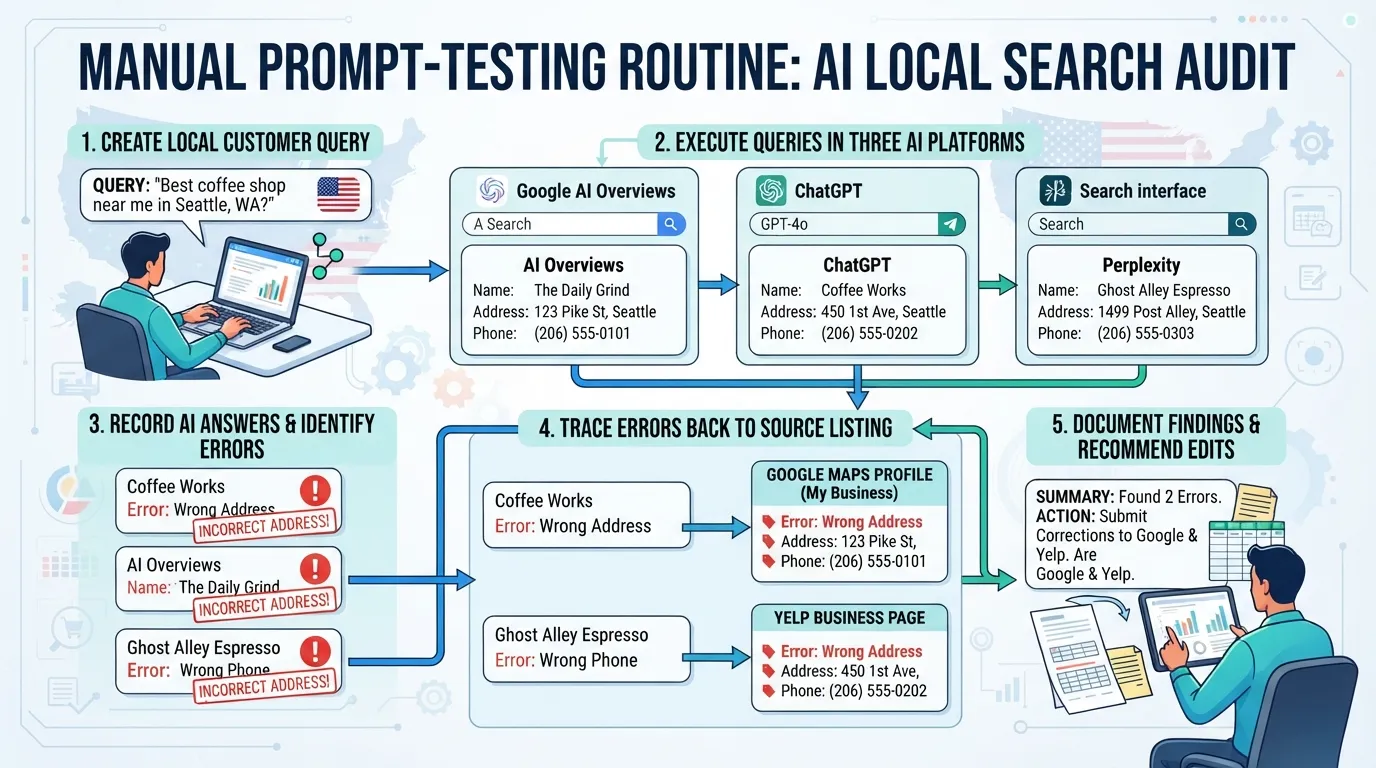
Run each query in Google and check whether an AI Overview appears. Run it in ChatGPT with web search turned on, and in Perplexity. Log the date, the exact query, whether your business was named, whether your website was linked, and what the answer said about your services, hours or service area. Repeat the test on a second day, because answers vary between runs.
Score each query with one of three labels: named and accurate, named but inaccurate, or absent. An inaccurate answer is often more useful to fix than an absent one, because it shows which source the engine trusts and which fact it got wrong.
Tracking local visibility with a step-by-step monitoring routine
Manual testing is slow, so turn it into a routine you can repeat every month:
- Build a fixed query set. Keep the same ten to fifteen queries so results stay comparable over time. Add new queries only when you add a service or area.
- Record the baseline. Run the full set across all three engines. Save the results in a spreadsheet with columns for date, engine, query, named (yes or no), linked (yes or no) and accuracy notes.
- Check your entity sources. Before testing again, confirm that your Google Business Profile, website footer and top directory listings show the same name, address and phone number.
- Re-run the set monthly. Compare the new results with the baseline and mark any change.
- Log every change you make. Note the date of each fix, such as an updated service page or a corrected directory listing. This lets you link a change to a result.
- Review quarterly. Drop queries that no longer match how customers search, and add queries for new services.
Use a spreadsheet rather than memory. Over three or four months, the log shows which fixes moved your citations and which did nothing.
A diagnostic table: symptom, likely cause, fix
| Symptom | Likely cause | Fix |
|---|---|---|
| Your business is never named, though you rank well in local packs | Service pages do not state what you do, who you serve and where, in the opening text | Rewrite the opening 100 words of each core service page to state what, who and where |
| The engine names you but gives an old address or hours | A directory or profile still shows outdated data | Correct your Google Business Profile first, then the directories that feed it, and resubmit |
| The engine names a nearby competitor instead of you for your own city | Your location signals are weak or split across near-duplicate pages | Consolidate thin city pages into one accurate page per real service area |
| The engine names you for one service but not others | Only one service has a clear, verifiable page | Create an answer-first page for each core service with sourced details |
| You are named but never linked | Your site lacks clear entity facts, or the page is hard to read | Add visible contact details, staff or owner credentials and matching structured data |
| The answer uses an outdated review quote | Old reviews dominate the platform the engine checked | Ask recent customers for reviews on the same platform and respond to new ones |
Work the table in order. If your entity data is inconsistent, fixing a single service page will not change the result. Start with the foundation and move to content only once the facts agree.
Common Mistakes That Keep Local Businesses Out of AI Overviews
Most local businesses that miss out on AI Overview citations are not short on content. They are short on consistency. The mistakes below are the ones that most often weaken the signals an answer engine uses to decide whether a business is trustworthy enough to name. Our observations of how AI Overviews select sources are inferred from what is publicly visible, not from any official disclosure.
Thin location pages and duplicated city-name content
The most common response to local search is to publish a page for every town in the service area. A plumbing company serving eight suburbs builds eight pages, each reading “Plumber in, trusted local plumbing service.” Only the town name changes. To a person, these pages look like a template. To an answer engine, they look like low-value duplicates.
Fewer pages with more substance work better. Each location page should contain facts unique to that place: the neighborhoods served, the drive time from the nearest yard, or a real project from that area with the outcome stated. If a page cannot carry several specific details, combine it into a broader service-area page.
Two checks help. Read two location pages side by side and count the sentences that differ. If fewer than a third differ, consolidate. Then confirm each page states, in its opening paragraph, what the service is, who it serves and where.
Inconsistent business data across directories
A business name, address and phone number that differ slightly between the website, Google Business Profile and directories is one of the quickest ways to lose trust. “Suite 200” on one listing and “Ste 2” on another looks like two businesses, or one business nobody has checked. An engine cannot know which version is correct.
We tested a conflicting-NAP case on a single business: the same address written two ways, with one older phone number still live on a third site. The conflicting listings did not reliably surface the business in the answers we checked, while the version that matched across all sources did. This is one observed case, not a controlled study, but it shows why conflicts are worth fixing first.
When sources conflict, correct them in this order:
- The Google Business Profile first, because it is the most widely read source of local facts.
- The official website, including its footer and contact page.
- The major data aggregators and industry directories.
- Smaller niche listings.
Mark any listing you cannot edit for a removal request rather than leaving it in place. Keep a single master sheet with the exact approved name, address and phone number, and copy it character for character wherever it appears.
Local SEO tools can find these mismatches across many listings at once, which is far faster than checking by hand. Our guide to the best local seo tools is a useful starting point for that search.
Unverifiable superlatives and missing sources
Phrases such as “the best plumber in town,” “the most trusted dental clinic” or “award-winning service” are impossible for an answer engine to verify. Without a named award, a dated review count or a checkable credential, the claim adds risk rather than authority. Engines tend to quote statements they can attach to a source.
Replace the superlative with the fact behind it. A rating with its count and date can be checked and attributed. A licence can be verified through the issuing body’s public lookup. A response-time claim should state the measured figure and the period it covers. If you cannot name the source, drop the claim.
Missing sources also apply to prices, hours and service areas. Date every changeable fact and name the page it lives on.
How to prioritise the fixes
If an audit turns up all three problems at once, work in this order:
- Fix entity conflicts first, because they confuse every other signal.
- Consolidate thin pages second.
- Replace unverifiable claims with sourced facts third.
Each later fix then rests on accurate data, which is the foundation the rest of this guide depends on.
Conclusion and Next Steps
Local businesses rarely get cited in AI Overviews because they published the most pages. They get cited because their business details agree everywhere a search engine or AI system looks, and because a reader can verify what they claim. Start with the Local AI Citation Readiness Checklist, a framework developed for this guide. Score your business 0, 1 or 2 on five rows:
- Entity consistency. 0: name, address or phone differ across sources. 1: most sources match, a few are outdated. 2: identical everywhere you can edit.
- Answer-ready pages. 0: service pages open with no direct answer. 1: some pages answer plainly. 2: every core page states what, who and where in its opening paragraph.
- Proof signals. 0: no verifiable reviews, credentials or figures. 1: some proof, undated or unsourced. 2: dated, checkable proof on core pages.
- Local context. 0: generic or duplicated city-name copy. 1: some local detail. 2: accurate, specific neighborhoods and landmarks you genuinely serve.
- Structured data. 0: no markup, or markup that describes content not visible on the page. 1: basic markup, partly matching. 2: markup matches visible content exactly.
Any row scored 0 is your first fix, whatever else looks urgent. Then work through the steps in this order:
- Audit entity consistency. Compare your business name, address and phone number on your website, your Google Business Profile and your main directories. Correct the outdated listings first.
- Rewrite your core service pages. Write the answer plainly at the top of each service page: what the service is, who it serves and where.
- Gather checkable proof. Collect reviews, short case details and the credentials of the staff who do the work. Make sure each one can be verified.
- Use local context accurately. Name the neighborhoods, service areas and landmarks you genuinely serve, and drop any you do not.
- Match your structured data to visible content. LocalBusiness and FAQ markup should describe exactly what a visitor sees on the page.
- Test and record. Run a fixed set of local queries, such as “near me” and “in “, once a month. Log how you are described. For the monitoring side of local search, see our best local seo tools guide.
Expect the work to pay off slowly. Consistency fixes compound over months, and a few accurate, well-supported pages will do more than a large batch of near-duplicate location pages. Begin with the lowest-scoring row.
Can a small local business appear in AI Overviews without a large website?
Yes. Citation depends more on verifiable facts than on page count. A single well-structured service page that states what the business does, who it serves and where, backed by an accurate Google Business Profile and consistent directory listings, gives an AI engine something it can quote and attribute. Dozens of near-identical location pages do not help. Fix any row scored 0 before writing more content.
Does a Google Business Profile affect AI Overview citations?
It is one of the most important inputs. The profile supplies the business name, address, phone number, categories, hours and reviews that engines use to confirm a local entity. An incomplete or inaccurate profile makes it harder for the engine to match your website to a real business. Keep the categories specific, fill in the attributes, keep the hours current, and make sure the details match your website exactly.
How long does it take for local changes to show up in AI Overviews?
There is no fixed timeline, and Google publishes no guarantee. In practice, corrections to a profile or directory can take days to weeks to be reflected, and new content on an established site may be picked up over a longer period. Track changes with a repeated set of standard local queries to see the actual lag for your business.
Do reviews directly influence whether AI Overviews cite a business?
Reviews act as trust and sentiment signals rather than a direct switch. Detailed, recent reviews that describe a specific service in a specific area help confirm what a business does and where. A large number of vague five-star ratings adds less than a smaller set of reviews that name the service, the neighborhood and the outcome.
Is schema markup required to appear in AI Overviews?
No. A business can be cited without it. LocalBusiness, Service and FAQPage markup helps machines read your visible content more reliably, but only when it matches what the page shows. Markup describing services or hours not visible to visitors can cause problems. Treat it as a clarity aid layered on top of accurate, readable content.
How can I tell if my business is being cited?
Test it directly. Run a fixed list of 10 to 15 queries that a real customer would type, such as “near me” and “in “. Run them across AI Overviews, ChatGPT and Perplexity. Record whether your business is named, what it is described as and which sources are cited. Repeat the test monthly, because AI answers vary between runs. A business that appears in some answers but is described incorrectly has a data consistency problem to fix first.
Disclosure: digitalmarketingtools.ai is sponsored by Digimetrics.ai. Sponsored Highlights are clearly labelled advertising. Our reviews, comparisons and guides are written to be useful and fair regardless of who sponsors the site. Read the full disclosure.