
9 Best SEO Audit Tools in 2026: Which Is Actually Worth Paying For?
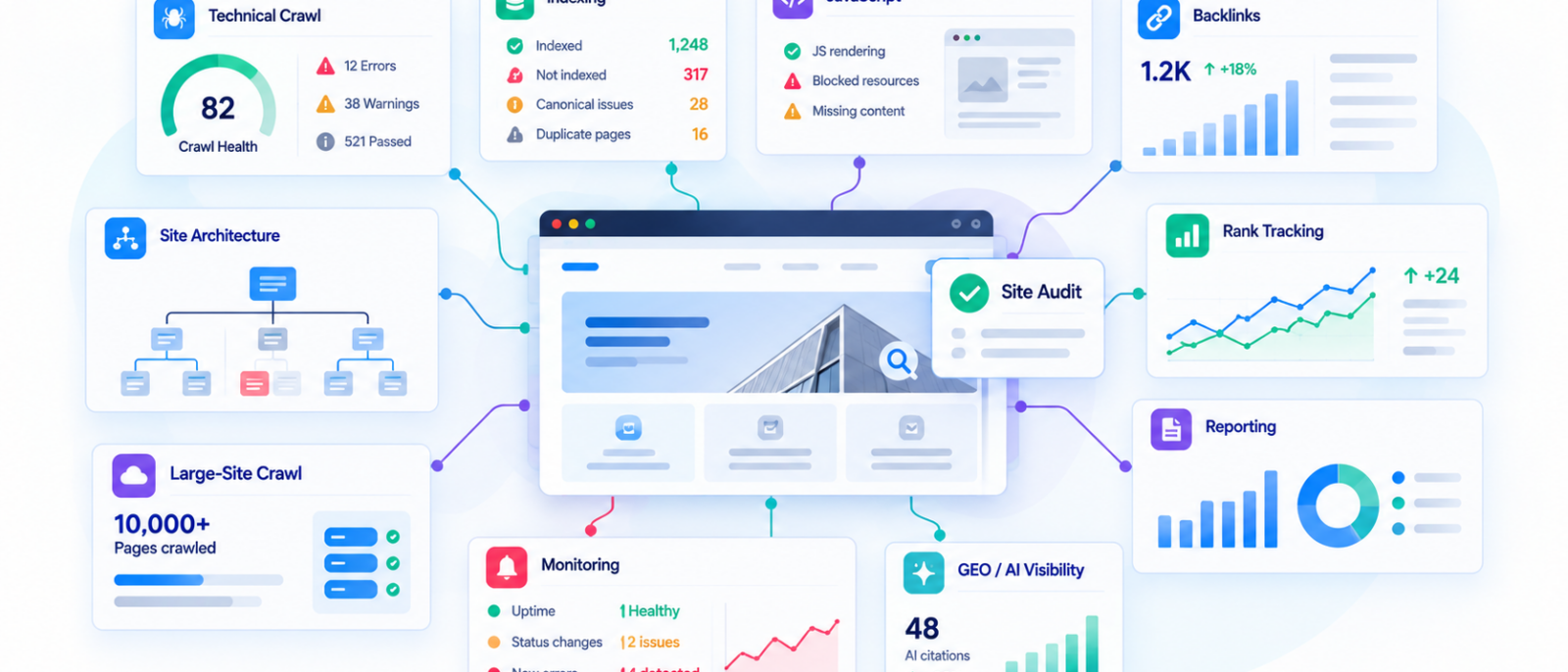
Almost every SEO audit tool can find something wrong with a website. Across agency SEO work, the difficult part is rarely generating a list of issues. It is separating problems that can affect organic visibility, conversions or crawl efficiency from warnings that create plenty of noise but little business impact.
We have seen why that distinction matters commercially. MediaOne’s Revenue Intelligence Framework draws on hundreds of client audits across Singapore, Malaysia, the wider APAC region and America. In one Singapore logistics audit, organic traffic had grown 67% year on year, 23 target keywords had reached page one and Domain Authority had increased from 32 to 41.
Those numbers looked encouraging. Proper attribution told a different story. Monthly SEO spending of S$7,182 was generating only S$3,160 in gross profit, producing a reported 56% negative ROI.
That experience shapes how we evaluate audit software. The tool needs to identify problems, but a health score or issue count cannot decide what actually matters to the business.
The best SEO audit tool therefore depends on the constraint you are trying to remove. A technical SEO specialist may need deeper crawl control. An agency may value competitor research and client reporting. A large ecommerce site may need server-log evidence or problems detected shortly after a deployment. A smaller team may care more about turning findings into an understandable list of actions.
This comparison focuses on which tools justify paying for and why. If your priority is completing as much of the audit as possible for $0, see our dedicated guide to the best free SEO audit tools in 2026.
The Best SEO Audit Tools at a Glance
| Rank | Tool | Best for | Editorial score | Entry point | Starting paid price |
| 1 | Semrush | Agencies and growing SEO teams | 92/100 | 100 Site Audit pages without SEO Toolkit | $139.95/mo |
| 2 | Ahrefs | Auditing plus backlink and competitor research | 90/100 | 5,000 crawl credits/month per verified project | $29/mo Starter |
| 3 | Screaming Frog | Dedicated technical crawl control | 89/100 | 500 URLs per crawl | £199/year |
| 4 | Sitebulb | Technical audits with prioritised insights and visual reporting | 88/100 | 14-day trial | From $18/mo |
| 5 | SE Ranking | SEO and GEO in one team platform | 86/100 | 14-day trial | $129/mo |
| 6 | Conductor Monitoring | Enterprise and continuous monitoring | 85/100 | 3-week trial | Custom |
| 7 | JetOctopus | Large-site cloud crawling and log analysis | 83/100 | 7-day trial | From $549/mo annually |
| 8 | SEOptimer | SMBs and client-facing reporting | 80/100 | 14-day trial | $29/mo |
| 9 | Digimetrics | SEO, content and GEO workflow consolidation | 77/100 | 7 days / 200 credits | $39/mo |
These are comparative editorial ratings, not laboratory measurements. A technical SEO specialist could reasonably put Screaming Frog or Sitebulb above an all-in-one platform. A retailer operating hundreds of thousands of URLs may get more value from JetOctopus or Conductor than from several tools ranked above them.
The ranking asks a broader question: which platform provides the strongest audit utility for the problem and audience it is designed to serve?
If you also need keyword research, rank tracking, backlinks and content optimisation, our best SEO tools comparison looks at the wider stack instead.
Disclosure: Digimetrics is developed by the MediaOne team. We have included it because it addresses an audit and optimisation workflow relevant to this comparison, but it has been judged against the same criteria as the other products. It ranks below established specialist platforms where they currently offer greater depth and market maturity.
Which SEO Audit Tool Should You Choose?
If you already know what is slowing down your workflow, choosing becomes much easier.
| If this sounds like you… | Start with | What you’re really paying for |
| I manage SEO across clients or several marketing channels | Semrush | Audit data connected to keyword, competitor and reporting workflows |
| I need auditing plus strong backlink and competitor research | Ahrefs | Wider search intelligence around technical findings |
| I care most about technical crawl control | Screaming Frog | Configurable crawling, rendering, extraction and integrations |
| I want deep technical auditing but easier prioritisation and reporting | Sitebulb | Crawl evidence translated into prioritised Hints and visual reports |
| I want SEO and GEO in one recurring platform | SE Ranking | Large audit allowances plus rankings, research and AI visibility |
| A technical mistake could damage a large site before our next scheduled crawl | Conductor | Continuous detection, prioritisation and alerting |
| I need to analyse crawling at very large scale alongside server logs | JetOctopus | Cloud crawling plus Googlebot and AI-bot behaviour |
| Clients need to understand the audit without being technical SEOs | SEOptimer | Simpler recommendations, reporting and white-label delivery |
| My SEO, content and AI-search findings are scattered across several workflows | Digimetrics | Consolidation and prioritisation across adjacent marketing tasks |
We have deliberately not filled the ranking with every product capable of checking a webpage. Products such as Surfer and Clearscope fit more naturally into a comparison of SEO content optimisation tools, while Google Search Console and PageSpeed Insights solve individual diagnostic jobs rather than competing as full commercial audit platforms.
How We Ranked the Best SEO Audit Tools
We use an Audit Utility Score based on what matters when auditing real websites: detecting problems, understanding their likely significance, communicating the findings and turning the diagnosis into useful work.
The methodology also reflects MediaOne’s documented agency workflow. Search Console and Analytics provide first-party performance evidence, Screaming Frog handles technical crawling, and platforms such as Semrush or Ahrefs add broader organic and competitor context. See MediaOne’s agency SEO audit workflow.
| Criterion | Weight | What we’re judging |
| Problem detection depth | 20% | Can it uncover indexing problems, crawl barriers and technical conditions capable of affecting visibility? |
| Prioritisation and actionability | 20% | Does it help distinguish meaningful problems from low-impact warnings? |
| Crawl and technical capability | 15% | How well does it handle scale, JavaScript, configuration and complicated site structures? |
| Usability and reporting | 10% | Can an SEO, marketer, developer or client understand the findings? |
| Wider SEO context | 10% | Can findings connect naturally with rankings, backlinks, competitors or search performance? |
| Value for money | 10% | Does the useful capability justify what the customer needs to spend? |
| Free entry point | 5% | Can someone meaningfully evaluate or begin using the product before committing? |
| AI/GEO capability | 5% | Does the platform help investigate AI-search accessibility or visibility where relevant? |
| Market trust and maturity | 5% | How established is the product and how much practitioner confidence has it earned? |
The scoring forces us to evaluate the same questions across every product. It does not suggest that one platform is universally superior.
A dedicated crawler can lose points for surrounding search intelligence while still being the best purchase for a technical SEO. An enterprise platform can score highly for monitoring while being completely uneconomical for a 100-page local-business website.
1. Semrush: Best Overall for Agencies and Growing SEO Teams
Score: 92/100
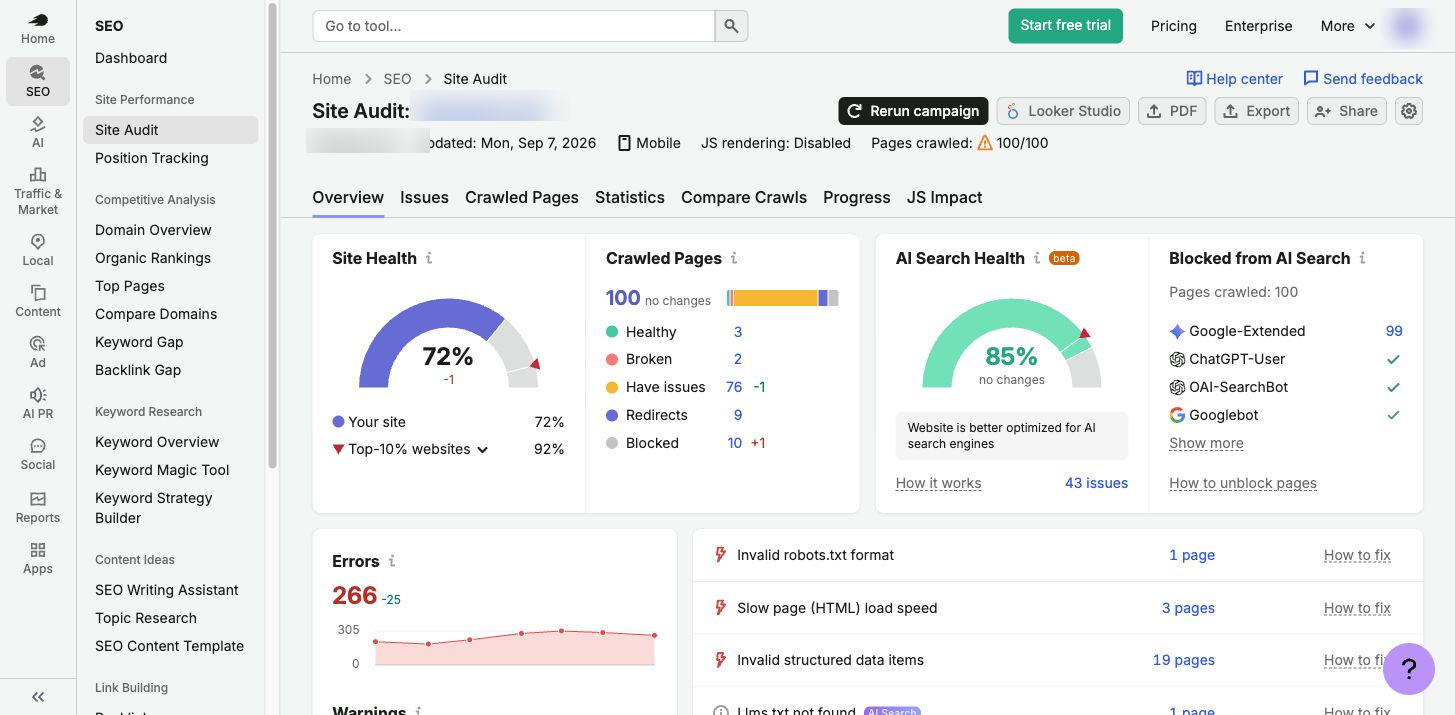
Semrush ranks first because Site Audit exists inside one of the broadest search-marketing ecosystems in this comparison.
Its current Site Audit supports recurring crawls, issue categorisation, crawl comparison and specialised reports across common technical SEO areas. Without an SEO Toolkit subscription, the current allowance is 100 pages per month. Pro SEO Toolkit increases that monthly crawl capacity to 100,000 pages.
The crawler itself is not the only reason to pay.
Suppose an audit confirms that an important category page is crawlable and indexable but organic visibility continues to fall. The investigation may need to move into keyword movements, competing URLs, backlinks, SERP features and content gaps.
That is where Semrush earns its higher monthly price. Much of the surrounding investigation can continue without rebuilding the project somewhere else.
Where Semrush Earns Its Price
Semrush makes the strongest case when technical auditing is one part of a recurring SEO operation.
An agency can move from a site issue to keyword research, competitor analysis, position tracking and reporting within the same environment. Growing in-house teams get a similar benefit when several people need consistent data rather than isolated crawler exports.
Its definition of search auditing now extends into AI visibility. Semrush’s AI Visibility functionality can examine brand mentions, sentiment, prompts, citations and technical conditions that may affect access by AI crawlers. The dedicated AI Visibility Toolkit is currently priced separately at $99 per month, while Semrush also offers bundled SEO and AI plans.
Where Semrush Becomes Expensive
The weakness is equally clear. You are paying for an ecosystem.
If your only requirement is crawling thousands of URLs and investigating canonicals, redirects, rendering and internal architecture, a dedicated technical crawler can be much cheaper.
Best suited for: agencies, growing in-house SEO teams and businesses regularly using audit, research, competitor and reporting functions.
Main limitation: a substantial part of the subscription value disappears if most of the surrounding suite goes unused.
Upgrade trigger: auditing, competitor research, rankings and reporting have become recurring parts of the same workflow.
Bottom line: Semrush is our strongest overall choice because the audit can continue naturally into the investigation that usually follows it.
2. Ahrefs: Best for Auditing Plus Wider SEO Research
Score: 90/100
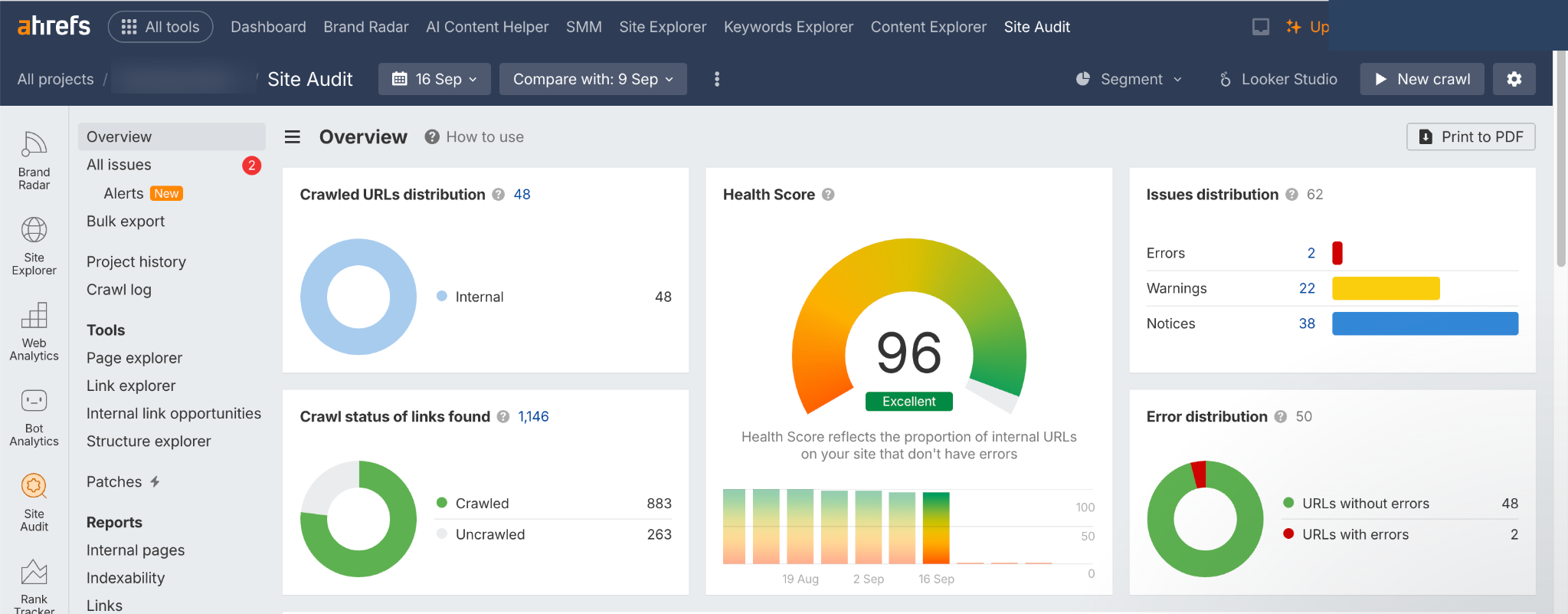
Ahrefs comes close because Site Audit sits beside a mature backlink and organic-search research environment.
That becomes useful when a technical crawl does not reveal one obvious failure. A page may be crawlable, indexable and technically clean while losing ground because competitors have stronger links, different content, better internal support or greater topical authority.
Ahrefs makes expanding that investigation relatively natural.
Its Ahrefs Webmaster Tools entry point is unusually useful. Verified projects currently receive 5,000 Site Audit crawl credits each month, with unlimited verified properties and visibility into up to 1,000 backlinks and keywords at once. Only internal HTML pages returning a 200 response consume those crawl credits.
Where Paying Changes the Workflow
The important boundary is ownership.
Free access is strongest for websites you can verify. Paid access becomes more relevant when an agency or SEO professional needs to research competitors, prospects or other properties they do not control.
The $29 Starter plan gives users 200 general credits per month and one unverified project, alongside access to Site Explorer, Keywords Explorer, Site Audit and Rank Tracker. Ahrefs’ larger Lite plan begins at $129 per month when substantially greater research capacity is needed.
This distinction matters because Ahrefs Webmaster Tools is not merely a demo. A business auditing its own site can get meaningful recurring value without paying. An agency comparing that site against an entire market encounters a different limitation.
Best suited for: SEO teams that want technical auditing to connect naturally with backlink, competitor and organic-search research.
Main limitation: the strongest free auditing benefits properties you can verify, while deeper external research pushes the workflow into paid access.
Upgrade trigger: competitor research, unverified properties and wider search datasets become necessary to explain what the crawl alone cannot.
Bottom line: choose Ahrefs when the audit frequently needs to expand into authority, links, competitors and wider organic-search performance.
3. Screaming Frog: Best Dedicated Technical SEO Crawler
Score: 89/100
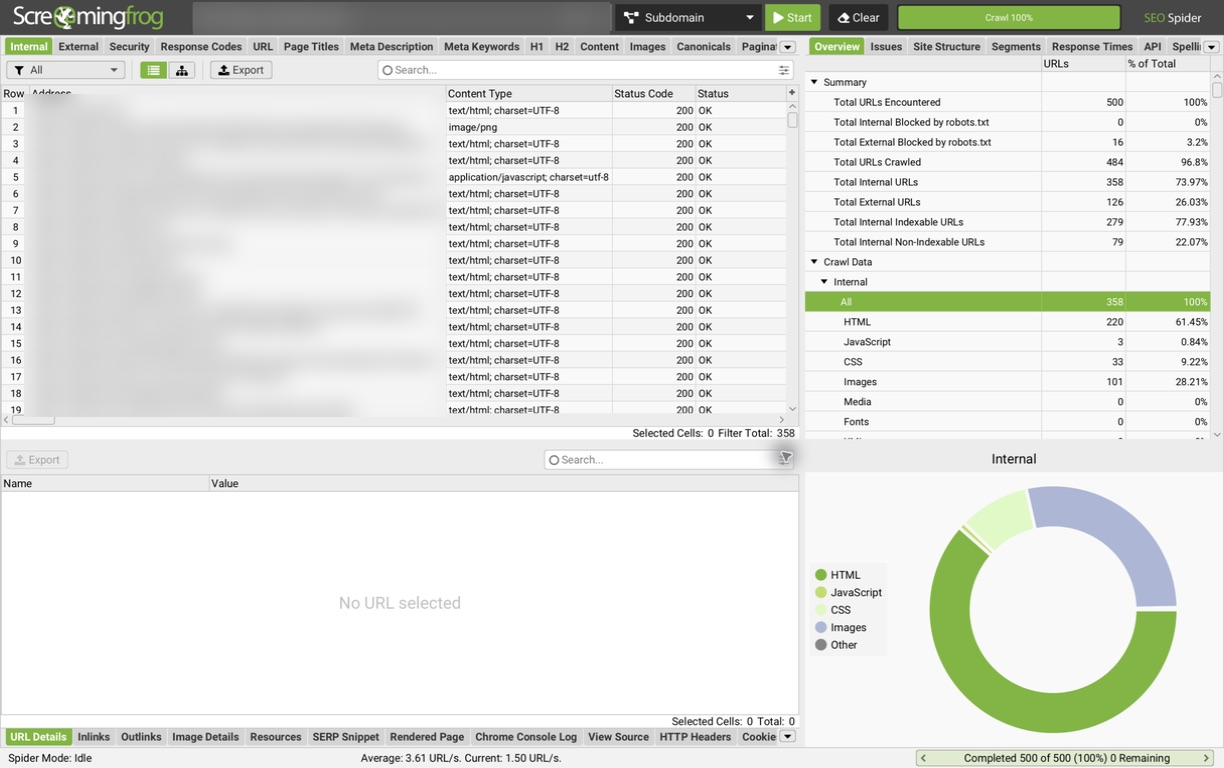
If we ranked these products on technical crawling alone, Screaming Frog could reasonably take first place.
The SEO Spider is built specifically around collecting and interrogating website data. That gives an experienced technical SEO more control over how a site is crawled than most broad marketing suites.
The free edition crawls up to 500 URLs at a time. The paid licence costs £199 per user per year and removes that software limit while unlocking scheduling, crawl configuration, JavaScript rendering, saved crawls, crawl comparison, custom extraction and integrations with Search Console, Analytics and PageSpeed Insights.
When the 500-URL Limit Stops Being the Real Problem
Five hundred URLs may cover an entire small corporate website. The same limit can become almost useless on an ecommerce property where parameters, pagination, faceted navigation and alternate crawl paths multiply the URLs discovered.
The paid licence therefore does more than purchase a larger crawl.
JavaScript rendering matters when important content and links depend on client-side rendering. Crawl comparison becomes valuable during migrations and major releases. Custom extraction can turn the crawler into a flexible auditing instrument for questions that do not fit a standard issue checklist.
Where Screaming Frog Still Needs Help
Its limitation is interpretation rather than collection.
The crawler can show that 700 URLs share a metadata problem. It cannot inherently know whether fixing those URLs deserves attention before a canonical issue on five landing pages responsible for a large proportion of qualified leads.
That judgement still belongs to the SEO team.
Best suited for: technical SEOs, migrations, complex architecture and detailed crawl investigations.
Main limitation: outstanding technical evidence still needs search-performance and commercial context.
Upgrade trigger: you exceed 500 crawlable URLs or need JavaScript rendering, crawl comparison, integrations, custom extraction or advanced configuration.
Bottom line: Screaming Frog remains difficult to beat when crawl control itself is the problem you are paying to solve.
4. Sitebulb: Best Technical Crawler for Prioritisation and Visual Reporting
Score: 88/100
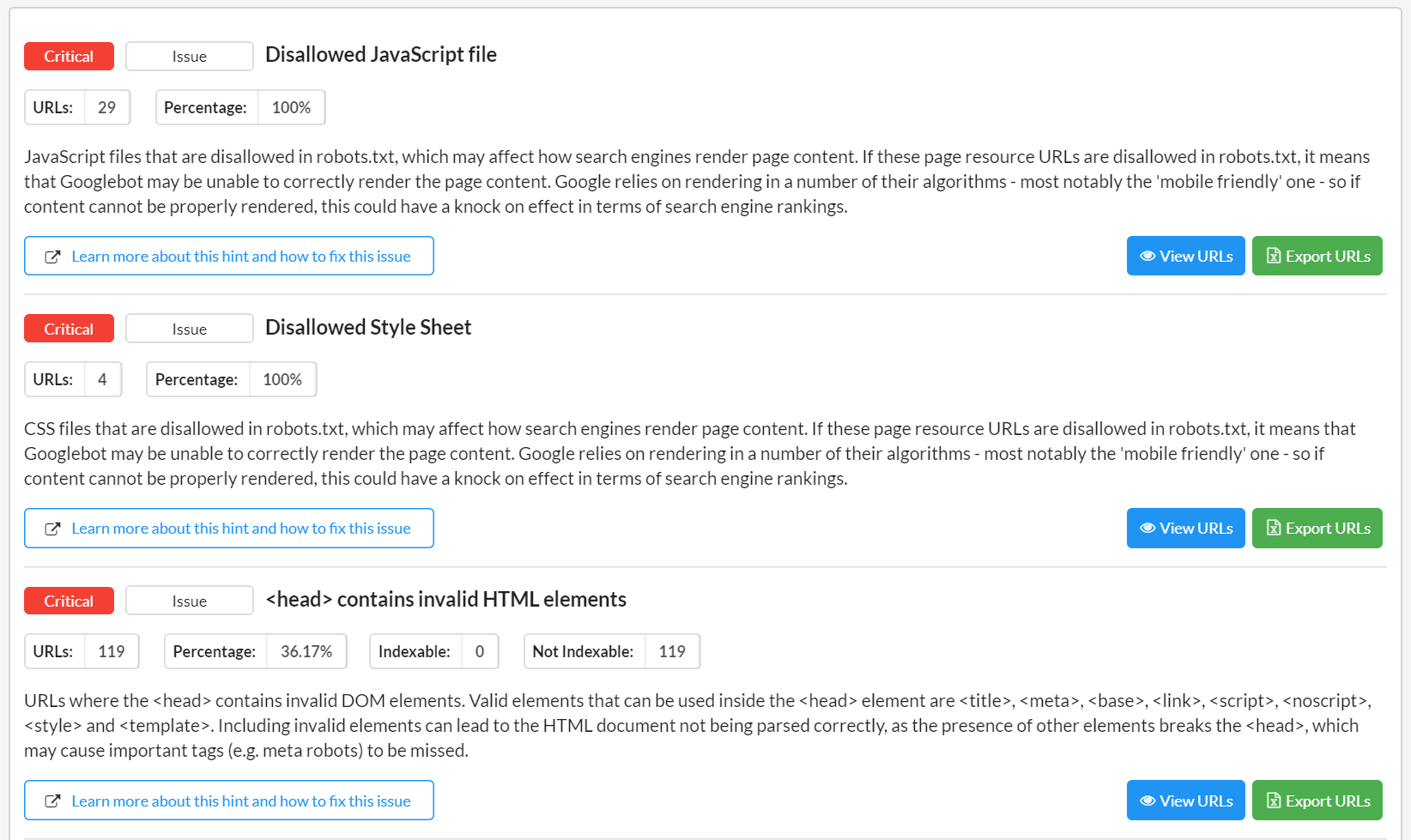
Sitebulb belongs this high because it solves a genuine gap between specialist crawling and easier interpretation.
Like Screaming Frog, it is designed around technical website auditing. The difference is in how aggressively Sitebulb tries to turn crawl evidence into prioritised recommendations, explanations and visualisations.
Sitebulb Lite currently supports 10,000 URLs per audit, more than 100 Hints, JavaScript crawling, duplicate-content analysis, crawl maps and integrations with Google Analytics, Search Console and Sheets. Pro raises the normal audit allowance to 500,000 URLs and adds more than 300 Hints, advanced configuration, audit comparison, scheduled audits and customised PDF reports. A 14-day trial is available.
Current public pricing lists Lite from around $18 per month and Pro at around $42 per month on monthly billing.
Why Sitebulb Is Not Just Another Screaming Frog
The two tools overlap heavily, but they do not produce the same experience.
Screaming Frog gives experienced practitioners enormous control over data collection and extraction. Sitebulb spends more effort explaining why a finding matters, grouping technical signals and presenting the audit visually.
That matters when the person running the crawl is not the only person who needs to understand it.
An agency SEO may need to show a developer which templates are affected, explain severity to an account manager and present the situation to a client. Crawl maps, prioritised Hints and custom reporting reduce some of the translation work between those audiences.
Screaming Frog vs Sitebulb
If we had to choose purely for technical flexibility, Screaming Frog would still be our first choice.
If we expected the audit to involve frequent reporting, prioritisation and communication with less technical stakeholders, Sitebulb becomes more attractive.
There is also no reason a technical SEO team cannot use both. The value of a second crawler is highest when it provides a different way to inspect or communicate the same site rather than merely producing another health score.
Best suited for: consultants, technical SEOs and agencies that need deep crawling without sacrificing understandable prioritisation and reporting.
Main limitation: the desktop product still depends on local hardware at larger crawl scales, although Sitebulb also offers cloud plans for teams that need to move beyond desktop crawling.
Upgrade trigger: you need larger audits, deeper technical Hints, scheduled crawling, audit comparison or client-ready reporting.
Bottom line: Sitebulb is the crawler we’d consider when Screaming Frog’s raw flexibility is appealing but the team also wants more help interpreting and communicating what the crawl found.
5. SE Ranking: Best Value for Teams Combining SEO and GEO
Score: 86/100
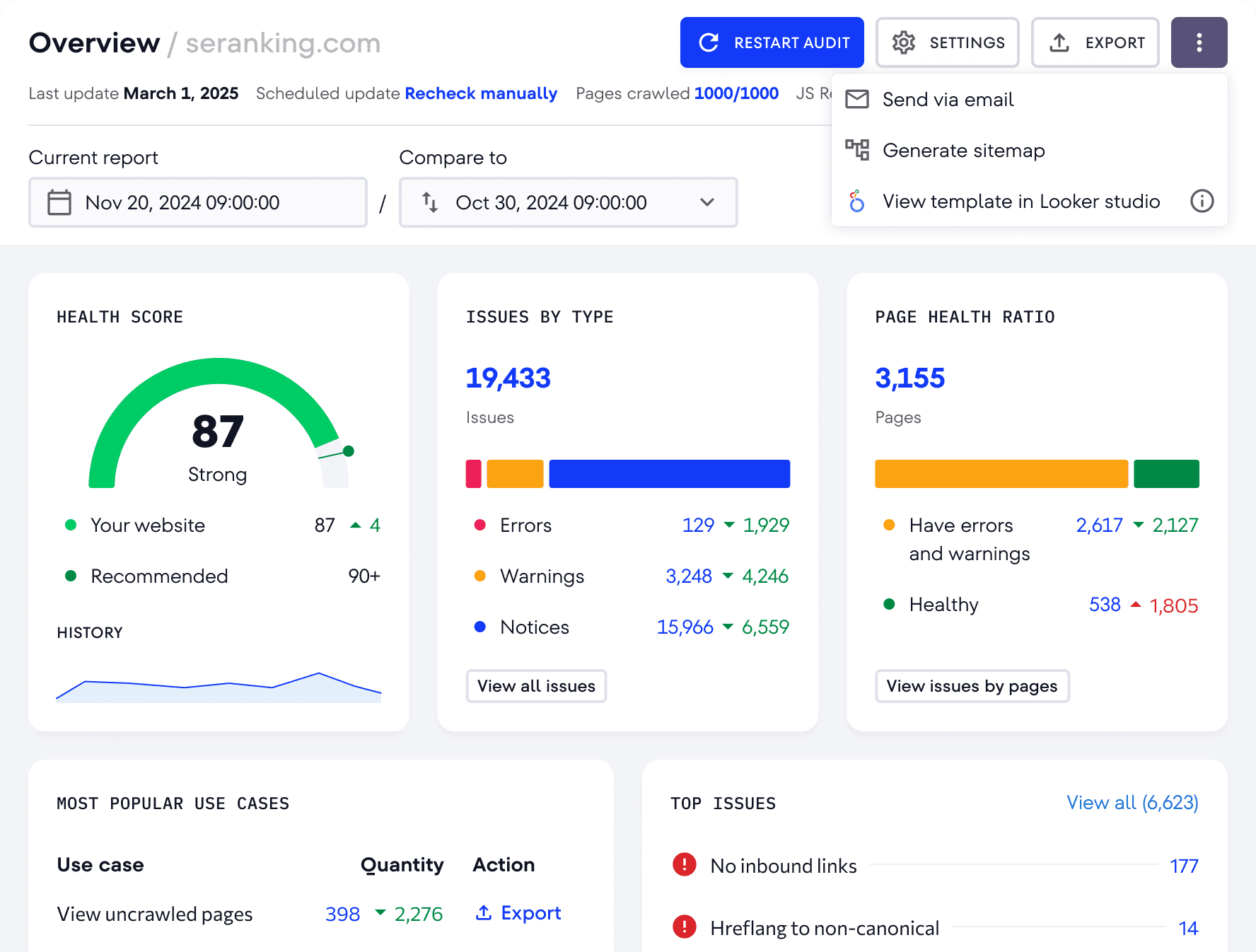
SE Ranking sits between a specialist crawler and the larger premium SEO suites.
Its platform combines website auditing with rank tracking, keyword research, competitor research, backlinks, reporting and GEO functionality. That combination is particularly relevant in 2026 because some teams now monitor conventional search visibility and AI discovery as parts of the same search strategy.
The current Core plan costs $129 per month and includes 10 projects, 2,000 tracked keywords, 100 AI prompts tracked daily, GEO research across five domains and 250,000 audit pages per month. Growth expands monthly audit capacity to two million pages and adds capabilities such as Page Changes Monitoring.
Why We Rank It Below Semrush and Ahrefs
SE Ranking offers substantial capacity for the price, particularly when auditing, rank tracking and GEO already belong in the same team’s recurring workload.
The question is not whether it has more raw features than every competitor. It is whether those features replace enough separate workflows to justify the subscription.
For many growing teams, the answer can be yes.
Semrush and Ahrefs still have advantages in their strongest specialist research datasets and longer-established ecosystems. Screaming Frog and Sitebulb remain stronger choices when technical crawling itself is the priority.
SE Ranking instead competes on breadth, audit capacity and recurring workflow value.
Best suited for: agencies and growing teams wanting recurring SEO and GEO capabilities inside one platform.
Main limitation: the $129 monthly entry price is difficult to justify if you only need an occasional technical crawl.
Upgrade trigger: auditing, keyword tracking, competitor research and AI-search monitoring have become ongoing responsibilities for the same team.
Bottom line: SE Ranking makes sense when you want substantial audit capacity plus wider SEO and GEO functionality without immediately moving into enterprise software.
6. Conductor Monitoring: Best for Enterprise and Continuous Monitoring
Score: 85/100
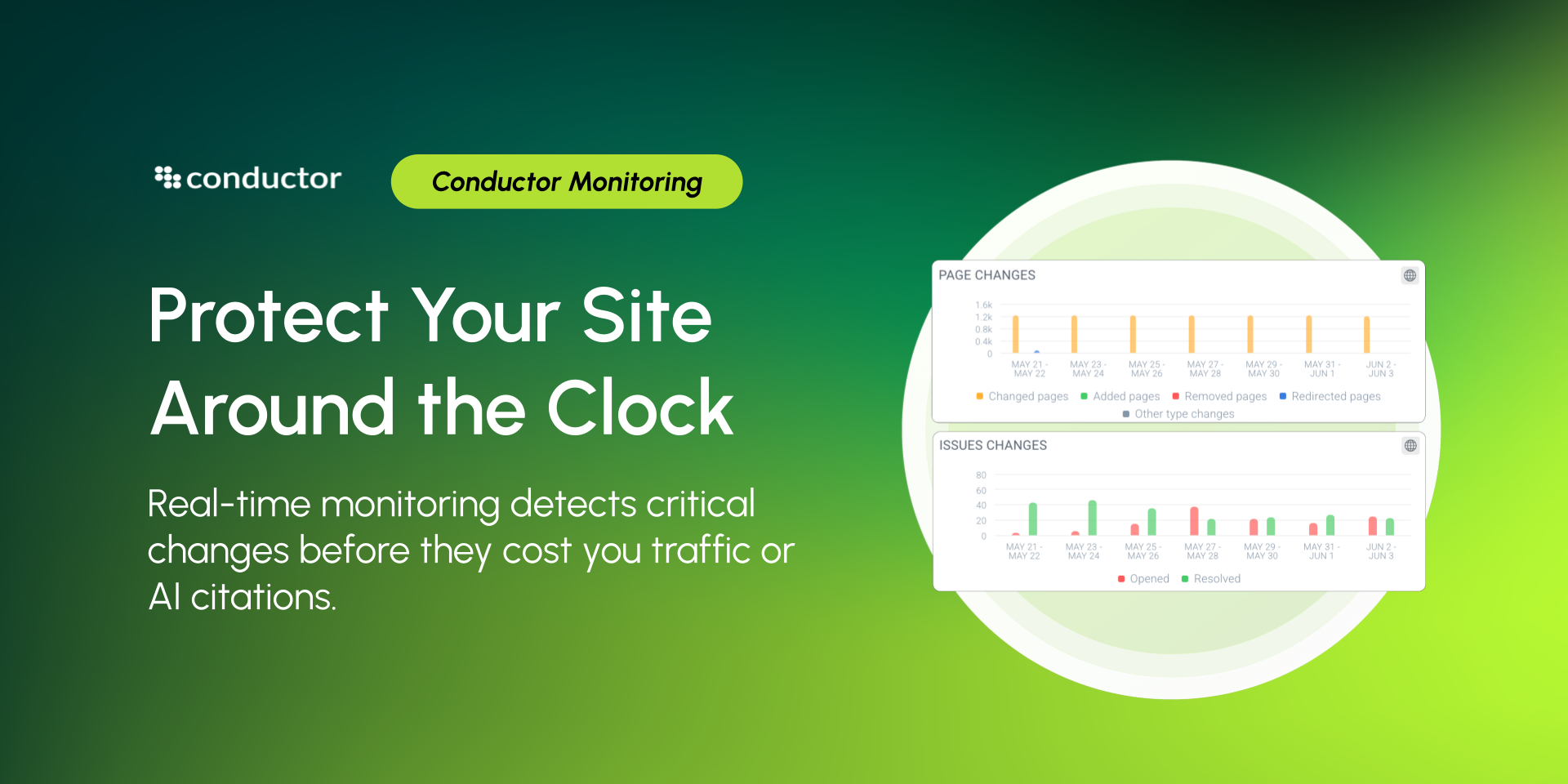
Most SEO audit tools tell you what was wrong when the crawler ran.
Conductor Monitoring addresses a different problem: what if discovering the issue during the next scheduled crawl is already too late?
Conductor provides 24/7 monitoring, real-time customised alerts, intelligent prioritisation, technical SEO insights and detailed change tracking. Its current trial provides three weeks of access without requiring a credit card.
When Continuous Monitoring Is Worth Paying For
Imagine a major ecommerce deployment accidentally introduces a noindex directive across thousands of product or category URLs.
For a relatively static 100-page company website, finding the problem during the next scheduled audit may be acceptable.
For a retailer generating substantial organic revenue every hour, it may not be.
Conductor’s current monitoring system can detect SEO and AEO technical changes continuously, route alerts according to custom rules and prioritise issues by business impact. The platform can operate across enterprise sites containing millions of pages.
Continuous monitoring becomes easier to justify when the expected cost of late detection exceeds the cost and operational overhead of the platform.
Best suited for: enterprise ecommerce, publishers and large websites where technical incidents create meaningful traffic, revenue or compliance risk.
Main limitation: custom enterprise pricing and platform scope are excessive for many smaller properties.
Upgrade trigger: discovering damaging changes during the next scheduled crawl has become operationally unacceptable.
Bottom line: buy Conductor when speed of detection matters almost as much as depth of diagnosis.
7. JetOctopus: Best for Large-Site Cloud Crawling and Log Analysis
Score: 83/100
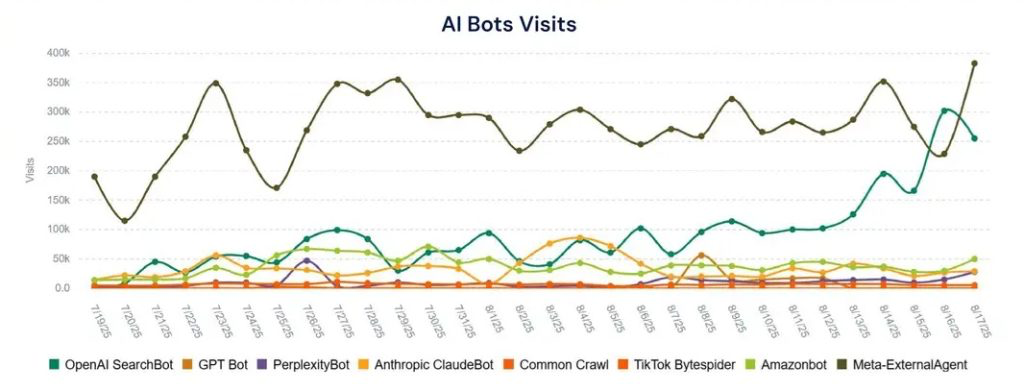
JetOctopus solves another problem that becomes more important as websites grow: the difference between what your crawler can access and what search-engine bots actually choose to crawl.
It combines cloud-based technical crawling with server-log analysis, Search Console and GA4 data. That allows technical SEOs to compare site architecture with Googlebot and AI-bot behaviour instead of treating crawler output as the entire picture.
The platform’s current seven-day trial includes access to the crawler, Log Analyzer, GSC Keywords and other modules, with up to 10,000 URLs crawled during the trial.
Its paid pricing makes the target audience clear. JetOctopus Pro currently starts at $689 per month on quarterly billing, or an equivalent $549 per month when billed annually. The in-house Pro tier includes up to one million crawled URLs and five million log lines per month, while higher plans increase those allowances further.
What Log Analysis Adds to an SEO Audit
A conventional crawler tells you what it found.
Server logs tell you what bots actually requested.
That difference becomes important on large sites. You may discover that valuable pages technically exist but receive little Googlebot activity, while low-value parameter URLs consume a disproportionate share of crawling. You can also compare search performance, crawl evidence and bot behaviour around the same URLs.
JetOctopus has also expanded this model to AI crawlers, making it possible to inspect how search bots and AI agents interact with large websites.
Why JetOctopus Ranks Below the Desktop Crawlers
The issue is not capability. It is fit.
A company with 500 pages does not need to spend hundreds of dollars each month to analyse millions of crawl and log events. Screaming Frog or Sitebulb can answer most of the relevant technical questions for a fraction of the cost.
The economics change when the site contains hundreds of thousands or millions of URLs and the SEO team needs cloud infrastructure, server logs and several datasets joined together.
Best suited for: large ecommerce sites, marketplaces, publishers and technical SEO teams working with substantial crawl and server-log datasets.
Main limitation: pricing and platform depth are difficult to justify for smaller sites that do not need log analysis or large-scale cloud crawling.
Upgrade trigger: sampling the site is no longer sufficient and crawler data needs to be reconciled with actual Googlebot or AI-bot behaviour.
Bottom line: JetOctopus becomes compelling when the question changes from “what can we crawl?” to “what are search and AI bots actually doing across this entire site?”
8. SEOptimer: Best for SMBs and Client-Facing Audit Reports
Score: 80/100
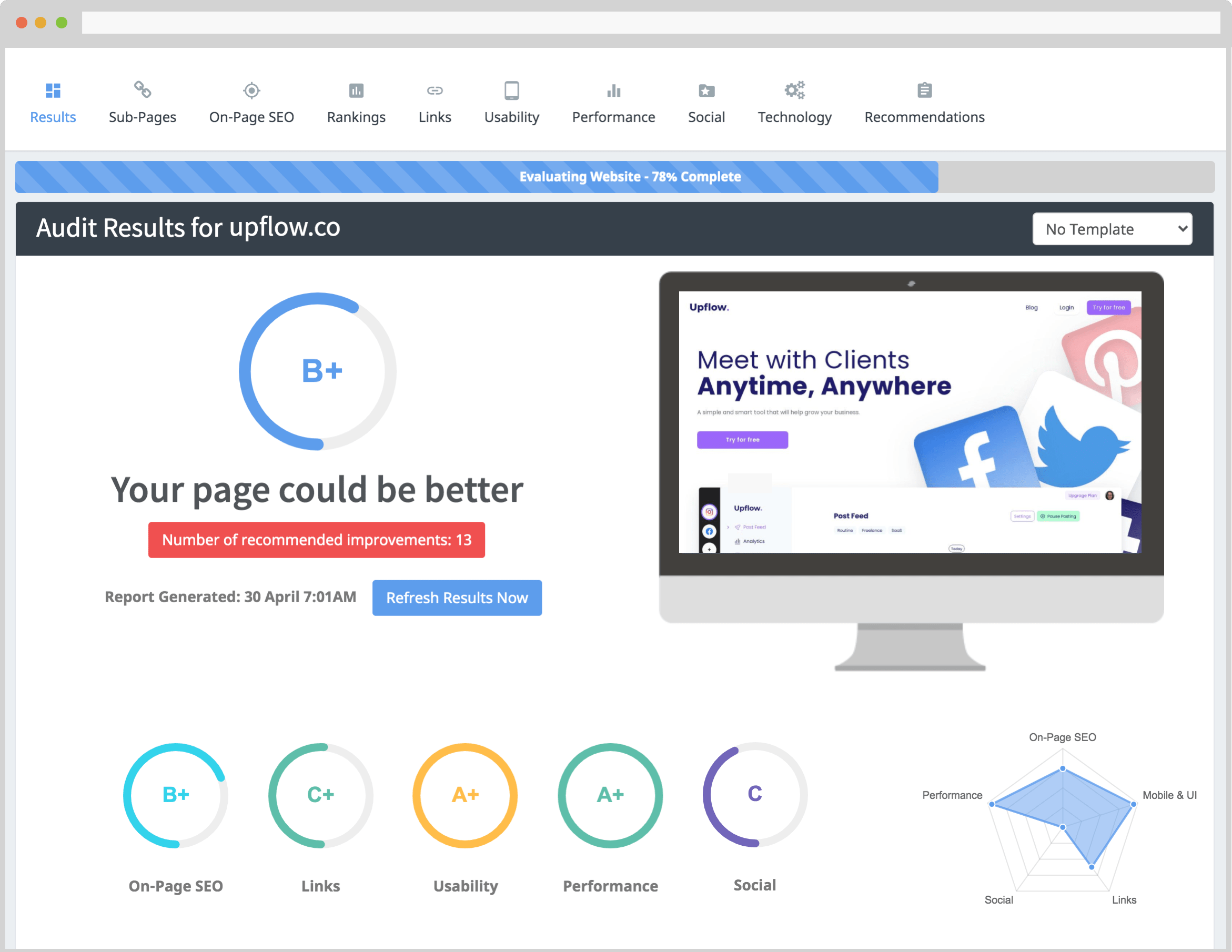
Not every SEO audit is read by an SEO specialist.
A technically excellent export can still be a poor deliverable if the business owner or client expected to act on it cannot understand what the findings mean.
SEOptimer competes strongly on that gap.
Its DIY SEO product crawls a website for issues, recommends tasks and tracks rankings. Higher plans add white-label reporting and embeddable audit functionality aimed at consultants, marketers and agencies.
Current monthly pricing remains $29 for DIY SEO, $39 for White Label and $59 for White Label & Embedding, with a 14-day trial.
When Simplicity Has More Value Than Crawl Depth
A technical SEO investigating complicated JavaScript rendering is likely to prefer Screaming Frog, Sitebulb or another specialist crawler.
A consultant trying to explain a website’s problems clearly to a small-business owner may prefer the platform that turns those problems into understandable tasks and a cleaner report.
Neither requirement is automatically more important.
SEOptimer therefore earns its place by solving a different job rather than trying to beat enterprise crawlers at technical depth.
Its higher plans also make sense when auditing forms part of client acquisition. Embeddable audit forms and branded reports can function as sales tools as well as diagnostic tools.
Best suited for: SMBs, freelancers, consultants and agencies producing client-facing SEO reports.
Main limitation: accessibility and simplicity come at the expense of some specialist crawl depth and configuration.
Upgrade trigger: recurring audits, branded reporting, multiple client properties or embedded lead-generation audits become part of the workflow.
Bottom line: SEOptimer is strongest when communicating the audit matters almost as much as performing it.
9. Digimetrics: Best for Consolidating SEO, Content and GEO Workflows
Score: 77/100
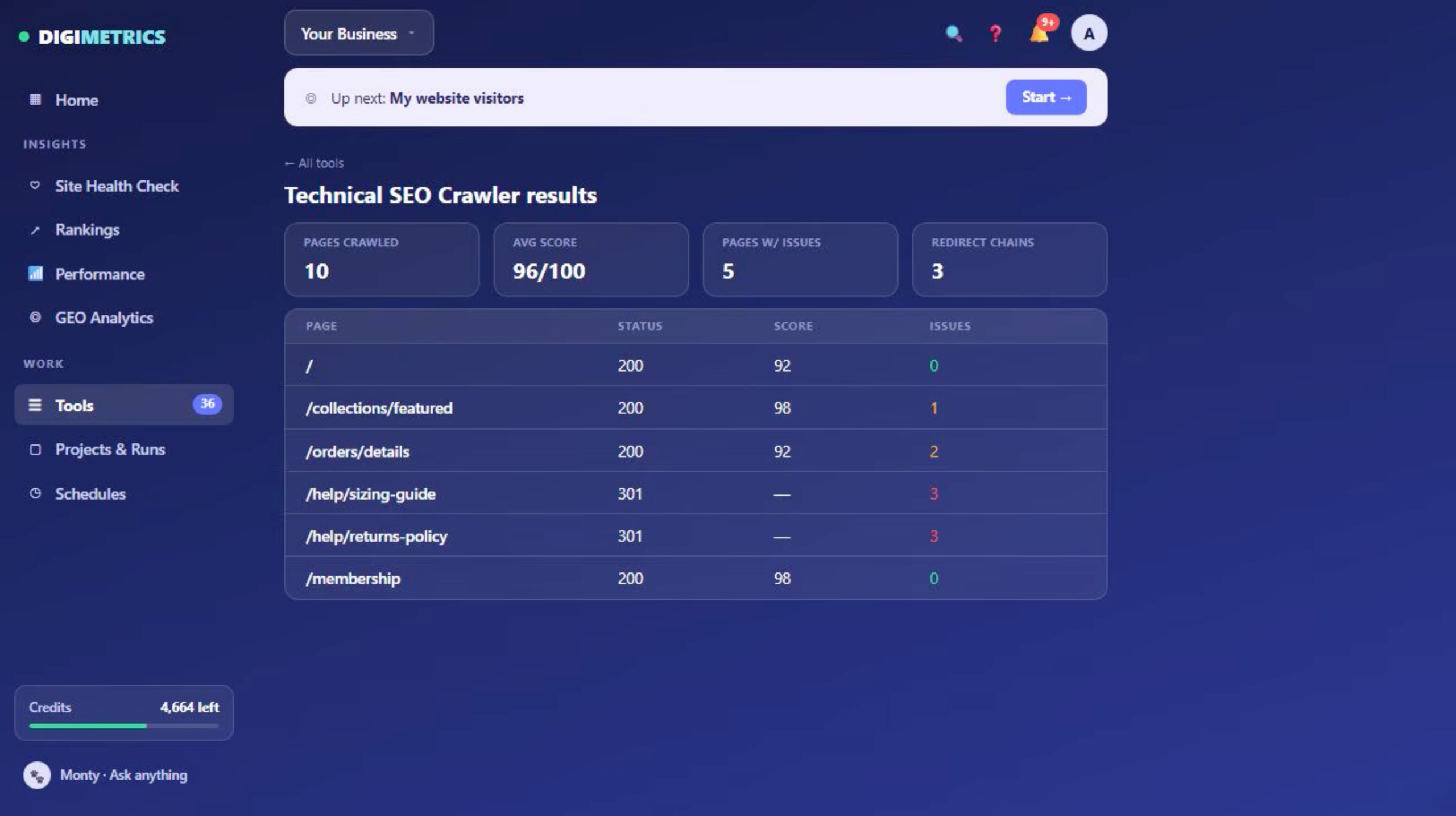
Because Digimetrics is built by the MediaOne team, it deserves more scrutiny rather than a more favourable position.
It ranks below Semrush, Ahrefs, Screaming Frog and other established products because those tools have longer market histories and deeper specialist capabilities in their strongest areas.
The more relevant use case for Digimetrics appears when the audit itself is no longer the main bottleneck.
The bottleneck is everything happening around it.
Search Console may show declining visibility. A crawler may expose an internal-linking or indexing problem. Content analysis may reveal a mismatch with search intent. An AI-search platform may show that competitors appear in generated answers more consistently.
The difficult part becomes reconciling those findings and deciding what deserves work.
What Digimetrics Is Trying to Consolidate
Digimetrics combines SEO, content, keyword and AI-visibility workflows instead of positioning itself as a replacement for every specialist crawler or research database.
Its current free access provides 200 one-time credits for seven days and one project.
Starter costs $39 per month with 500 monthly credits, three projects and access to the wider SEO and content toolkit. The $109 Pro plan increases capacity to 2,000 credits and includes the wider AI Visibility suite plus Google, Meta and GA4 integrations.
The value proposition therefore depends heavily on the team’s existing workflow.
If your team already moves efficiently between specialist tools, there may be little reason to consolidate them.
If technical findings, content recommendations, rankings and AI-search data regularly need to be rebuilt into one plan manually, reducing those handoffs can become useful.
Best suited for: teams combining traditional SEO, content optimisation and GEO analysis.
Main limitation: Digimetrics is newer and has a smaller independent market footprint than established specialist SEO platforms.
Upgrade trigger: reconciling SEO, content and AI-search evidence across several workflows takes more time than interpreting and acting on it.
Bottom line: Digimetrics makes the strongest case when workflow fragmentation has become the constraint.
Screaming Frog vs Sitebulb vs JetOctopus: Which Technical Crawler Fits Your Site?
Once three dedicated technical platforms appear in the ranking, it is worth separating them rather than pretending they solve the same problem.
| Requirement | Screaming Frog | Sitebulb | JetOctopus |
| Small technical audit | Excellent | Excellent | Overkill |
| Advanced crawl configuration | Excellent | Very good | Very good |
| Visual explanations and prioritisation | Good | Excellent | Very good |
| JavaScript crawling | Paid | Included | Included |
| Desktop crawling | Yes | Yes | No |
| Cloud crawling | No native cloud crawler | Available | Core model |
| Server-log analysis | Separate Log File Analyser product | Not core strength | Major strength |
| Client-friendly reporting | More practitioner-focused | Strong | Strong |
| Hundreds of thousands or millions of URLs | Hardware dependent | Desktop or Cloud | Core use case |
| Best fit | Technical practitioner | Technical audit + communication | Large-scale technical SEO |
For a technical SEO working primarily from a laptop, we would usually start with Screaming Frog or Sitebulb.
Screaming Frog gives us greater freedom to interrogate crawl data. Sitebulb becomes particularly useful when the audit has to be explained and prioritised for other people.
JetOctopus enters much later. Its value is not that it discovers a 404 that the desktop crawlers somehow cannot. Its advantage appears when scale, cloud infrastructure, logs and real bot behaviour become part of the diagnosis.
What Are You Actually Paying an SEO Audit Tool to Remove?
Software upgrades make more sense when you define the operational problem first.
| Constraint | What the upgrade should remove | Tools we’d consider |
| Crawl stops before enough of the site is analysed | URL and crawl-capacity limits | Screaming Frog, Sitebulb, Semrush, Ahrefs, SE Ranking |
| Important content depends on JavaScript | Rendering limitations | Screaming Frog, Sitebulb, JetOctopus |
| Audit findings need competitor context | Disconnected competitor and keyword research | Semrush, Ahrefs, SE Ranking |
| Client reporting consumes too much manual work | Exporting, formatting and explanation overhead | Sitebulb, Semrush, SEOptimer, SE Ranking |
| Problems are discovered too late | Gaps between scheduled crawls | Conductor Monitoring |
| Very large sites need cloud crawling | Local hardware and crawl-scale constraints | JetOctopus, Sitebulb Cloud |
| Actual bot behaviour needs investigation | Lack of server-log evidence | JetOctopus |
| SEO and AI visibility are becoming one workflow | Separate traditional and generative-search datasets | Semrush, SE Ranking, Conductor, Digimetrics |
| Audit findings are scattered across too many tools | Context switching and manual consolidation | Semrush, SE Ranking, Digimetrics |
| Several clients need recurring audits | Project, automation and reporting limitations | Semrush, Ahrefs, Sitebulb, SE Ranking, SEOptimer |
This is more useful than asking whether $29, $139 or $549 per month is “expensive.”
A £199 annual crawler can be expensive if it adds no useful capability to a 30-page website. A much larger enterprise contract can be economical if it catches a technical mistake quickly enough to protect substantial recurring revenue.
Pay to remove a constraint you can identify.
The Audit Priority Test
Finding an issue does not establish its priority.
This is where even the best SEO audit tools still require human interpretation. We evaluate findings using four factors.
| Factor | Question |
| Impact | Could this materially affect crawling, indexing, visibility, user experience or conversions? |
| Scope | How many important URLs, users or templates are affected? |
| Confidence | How strong is the evidence that this is genuinely contributing to the problem? |
| Effort | How much development, content or operational work will the fix require? |
A useful directional model is:
Priority ≈ (Impact × Scope × Confidence) ÷ Effort
The formula is not intended to create fake mathematical precision. It prevents issue count from becoming the prioritisation system.
For example, 400 images without alt attributes have greater numerical scope than a canonical configuration problem affecting ten commercial landing pages. That does not automatically make the image project more urgent.
If those ten commercial URLs generate a substantial share of qualified organic leads and the canonical problem threatens their indexation, the smaller issue count can carry much greater business impact.
MediaOne has seen the same principle on the measurement side. In one Singapore commercial-property consultancy case, the business had tracked organic leads for 18 months without connecting those leads to commercial value. MediaOne linked Analytics, enquiry forms, HubSpot CRM and revenue records.
The resulting attribution connected 72 organic leads to 11 clients and S$224,365 in attributable profit, producing a reported 681% quarterly SEO ROI.
The important lesson for auditing is not the percentage itself. A technically detailed report can still produce poor decisions when the commercial evidence required to prioritise those findings is missing.
If you only need a one-off site check, you may not need a subscription at all. Our free SEO audit test compares seven options and the limits of each.
When Does Paying for an SEO Audit Tool Make Sense?
A paid tool becomes worthwhile when the existing workflow stops answering an important question efficiently.
| Situation | Paid software likely justified? | Why |
| 50 to 150-page company site | Not necessarily | Basic diagnosis may already be covered without another subscription |
| Small local business | Not necessarily | Reporting convenience may matter more than crawl capacity |
| 500 to 2,000-page content site | Sometimes | Crawl limits and recurring monitoring start becoming relevant |
| 30,000-page ecommerce site | Usually | Scale, templates and rendering create substantially more complexity |
| 500,000+ URL marketplace or publisher | Yes | Cloud crawling, logs and automation become much more valuable |
| Major website migration | Usually | Crawl comparison and validation reduce migration risk |
| JavaScript-heavy platform | Often | Rendering and advanced crawl configuration become important |
| Agency managing many clients | Usually | Projects, research, automation and reporting can save significant staff time |
| Enterprise site with frequent releases | Usually | Continuous monitoring can protect traffic and revenue |
The site-size figures are not hard purchasing thresholds.
A 400-page JavaScript application may require more sophisticated crawling than a straightforward 10,000-page HTML site. A 500-URL limit is irrelevant if the complete site contains 150 URLs, while a one-million-URL monthly allowance can still be inadequate for a huge marketplace with numerous crawl paths.
The upgrade decision becomes easier when you can finish this sentence:
“We cannot answer or automate ______ efficiently with our current tools.”
If there is no meaningful answer, another subscription may simply create another dashboard.
What Even the Best SEO Audit Tools Still Miss
Automated auditing performs best when a problem can be expressed as a repeatable technical rule.
A URL returns 404. A canonical points somewhere unexpected. A page contains a noindex directive. An internal link is broken. Those conditions are relatively straightforward to detect.
The harder questions usually involve interpretation.
A technically clean page can still target the wrong search intent. If Google consistently rewards detailed comparisons and your URL is a thin commercial landing page, correcting another metadata warning may do little to improve visibility.
Technical auditing therefore needs to connect with live SERP analysis and content optimisation.
Crawlers also do not inherently understand commercial importance. Two pages can carry the same technical warning while deserving very different levels of attention if one produces meaningful revenue and the other produces none.
The same caution applies to traffic declines. Discovering an SEO problem at the same time rankings fall does not prove that the issue caused the decline.
The tools provide evidence. The SEO team still has to establish the diagnosis.
What Has GEO Changed About SEO Auditing?
Search visibility now extends beyond conventional ranking positions.
A business may also need to understand whether AI systems can access its content, whether the brand appears in generated answers, which pages earn citations and whether discovery patterns are shifting even while familiar SERP positions appear stable.
MediaOne has already encountered that distinction in client work.
In one anonymised B2B technology case, organic traffic declined even though conventional rankings appeared relatively stable. MediaOne’s GEO analysis mapped the brand’s presence across ChatGPT, Copilot and Gemini, then identified gaps involving content, metadata, FAQ schema and topical entities.
MediaOne reports that the content began reappearing in AI-generated answers and People Also Ask results within six weeks.
That does not mean every technical audit suddenly needs an AI-visibility subscription.
A canonical problem is still a canonical problem. A blocked page still needs to be crawlable. JavaScript still needs to render properly.
GEO adds another discovery layer rather than replacing the technical fundamentals.
The products in this comparison are responding differently. Semrush has added AI visibility and AI-search site auditing. SE Ranking combines conventional rankings with AI prompt and GEO tracking. Conductor now monitors AEO and SEO technical signals together. JetOctopus analyses both traditional search bots and AI crawlers alongside server logs. Digimetrics similarly combines traditional SEO work with an AI Visibility suite.
That is why GEO represents only 5% of our Audit Utility Score.
It matters increasingly in 2026, but it should not allow a weaker technical product to outrank a stronger crawler simply because its dashboard contains more AI features.
Need Help Interpreting Your SEO Audit?
SEO software can uncover hundreds or thousands of potential fixes.
Prioritising them still requires technical SEO knowledge, search-intent analysis, business objectives and an understanding of what users actually do after reaching the website.
If your main problem is no longer finding issues but deciding which ones deserve resources, MediaOne offers a free website audit and consultation that adds a prioritised diagnostic layer rather than another raw crawler export.
Final Verdict: Buy for the Constraint, Not the Score
There is no SEO audit tool that wins every scenario.
Semrush takes first place for agencies and growing SEO teams because its crawler sits inside a much broader research and reporting workflow. Ahrefs is particularly compelling when auditing needs to expand into links and competitor research. Screaming Frog remains difficult to beat when detailed technical crawl control is the requirement.
Sitebulb gives technical teams a compelling alternative when prioritisation, visualisation and client communication matter more. SE Ranking offers substantial capacity for teams combining SEO and GEO. Conductor Monitoring solves the enterprise problem of catching damaging changes before the next scheduled crawl, while JetOctopus becomes much more interesting when huge sites need cloud crawling and server-log evidence.
SEOptimer makes technical findings easier to communicate to clients and smaller businesses. Digimetrics targets a newer workflow problem where technical SEO, content and AI-search evidence increasingly need to be reconciled in one place.
MediaOne’s own audit experience points to the same conclusion.
More data does not automatically create a better decision. A campaign can have rising traffic and page-one rankings while losing money, just as an audit can show hundreds of warnings while the handful of issues affecting commercially important pages remain buried underneath them.
Choose the software according to the constraint you need to remove.
If you need deeper crawling, pay for crawl depth. If you need easier technical interpretation, pay for prioritisation and reporting. If you need competitor context, pay for research. If technical problems are discovered too late, pay for monitoring. If a huge website needs evidence of what search bots actually crawl, pay for cloud infrastructure and logs. If the team already has enough data but spends too much time reconciling it, pay for workflow consolidation.
The audit tool should support the decision. It should never become the decision itself.
For more technical SEO and search-tool comparisons, browse our SEO tools and guides.
Frequently Asked Questions
What Is the Best SEO Audit Tool Overall?
For agencies and growing SEO teams, Semrush is our strongest overall choice because technical auditing sits beside keyword research, competitor analysis, rankings and reporting.
That does not make it the best tool for every audit. Screaming Frog is stronger when technical crawl control is the main requirement, Sitebulb combines technical depth with more guided prioritisation, and Ahrefs is particularly useful when audit findings need to expand into backlink and competitor research.
Is Semrush or Ahrefs Better for SEO Audits?
Choose Semrush when you want auditing connected to a broad agency or marketing workflow involving rankings, competitors and reporting.
Choose Ahrefs when backlink analysis and organic competitor research regularly become part of the investigation.
For technical crawling as the primary job, we would consider Screaming Frog or Sitebulb before buying either suite purely for Site Audit.
Is Screaming Frog or Sitebulb Better?
Choose Screaming Frog when you want maximum flexibility over crawling, extraction and technical investigation.
Choose Sitebulb when you still need serious technical auditing but place greater value on prioritised recommendations, visualisations and reports that are easier to communicate to clients and other teams.
Both are strong enough that the decision is often about workflow rather than which crawler can produce the longer issue list.
Is Screaming Frog Worth Paying For?
Yes, when you have outgrown the 500-URL limit or need functionality such as JavaScript rendering, crawl comparison, saved crawls, advanced configuration, custom extraction or API integrations.
For a small static website comfortably below 500 URLs, the upgrade may be unnecessary.
What Is the Best SEO Audit Tool for Agencies?
Semrush is our overall agency pick because auditing connects with research, rank tracking and reporting.
SE Ranking is attractive for teams combining SEO and GEO. Sitebulb is particularly useful for agencies doing detailed technical audits that need to become understandable client deliverables, while SEOptimer is easier to justify when white-label reporting and lead-generation audits are central to the service.
What Is the Best SEO Audit Tool for Large Websites?
It depends on what “large” is causing.
Screaming Frog and Sitebulb can handle substantial technical audits when the hardware and configuration are appropriate. JetOctopus becomes more compelling when large-scale cloud crawling and server-log analysis are required.
Conductor Monitoring solves a separate enterprise problem when frequent website changes need to be detected continuously rather than waiting for another crawl.
Is JetOctopus Worth It?
JetOctopus is difficult to justify for a small website because its pricing and architecture target much larger technical SEO operations.
It becomes more attractive when the team needs to crawl hundreds of thousands or millions of URLs, analyse server logs and compare Googlebot or AI-bot behaviour with crawl, Search Console and analytics data.
Do SEO Audit Tools Need GEO Features in 2026?
Not every technical audit needs them.
AI-search auditing becomes useful when the organisation also needs to understand AI crawler accessibility, brand mentions, citations and visibility across generative-search platforms.
Those checks should extend technical SEO rather than replace crawlability, indexing, rendering, performance and content analysis.
How Much Should You Pay for an SEO Audit Tool?
There is no useful universal amount.
A solo technical SEO may solve the problem with an annual Screaming Frog licence or a lower-cost Sitebulb subscription. An agency may justify a $100-plus monthly suite because research and reporting save hours across several clients. A large ecommerce organisation may justify several hundred dollars per month when cloud crawling, server logs or continuous monitoring protect substantially more revenue.
The useful question is which measurable limitation the subscription removes.
When Should I Upgrade From Free SEO Audit Tools?
Upgrade when a free limitation prevents useful diagnosis or creates enough manual work that the limitation itself becomes a cost.
Typical triggers include crawl scale, JavaScript rendering, competitor research, multiple client projects, recurring reporting, server-log analysis and continuous monitoring.
If you are still deciding how far you can get without paying, our separate free SEO audit tools guide compares the $0 options and their actual usage limits in more detail.
Disclosure: digitalmarketingtools.ai is sponsored by Digimetrics.ai. Sponsored Highlights are clearly labelled advertising. Our reviews, comparisons and guides are written to be useful and fair regardless of who sponsors the site. Read the full disclosure.


