
Best SE Ranking Alternatives in 2026: What You Gain and Lose

SE Ranking is already a capable SEO platform, so why consider switching?
For most businesses and agencies, the decision comes down to a specific limitation. You may need more tracked keywords, deeper backlink research, better client reporting, or a subscription that makes more sense for the number of websites you manage.
The challenge is finding an alternative that solves those problems without introducing new ones.
At MediaOne, our SEO team brings over 10 years of experience helping businesses improve organic search performance. We’ve worked with platforms such as Semrush, Ahrefs, Google Search Console, Google Analytics, and Screaming Frog for competitor research, technical audits, keyword analysis, and reporting.
One thing we’ve learned is that the best SEO software isn’t necessarily the platform with the largest database or longest feature list. It’s the one that supports your actual workflow without making your team pay for capabilities it doesn’t need.
This guide compares eight of the best SE Ranking alternatives in 2026, including their features, pricing, limitations, and suitability for different businesses. We’ll also look at what you could lose by switching and when keeping SE Ranking is the better decision.
Key Takeaways
- Best for comprehensive SEO research: Semrush offers extensive keyword, competitor, backlink, and technical SEO capabilities, although its subscription structure can become expensive as requirements grow.
- Best for backlink-focused SEO: Ahrefs is particularly useful for competitor backlink research, historical link analysis, and identifying link-building opportunities.
- Best budget-friendly options: Serpstat, DinoRANK, and SEO PowerSuite offer alternatives at different price points, but their usage allowances and workflows differ considerably.
- Best for simpler keyword research: Mangools provides focused keyword, SERP, and rank-tracking tools without the complexity of a larger SEO suite.
- Best for AI-assisted workflows: Search Atlas combines traditional SEO functionality with automation and AI-assisted execution.
The most important consideration is whether an alternative offers enough value to justify the subscription cost, learning curve, and potential disruption to your existing SEO operations.
Best SE Ranking Alternatives at a Glance
Before examining individual platforms, here’s how the leading alternatives compare.
| SEO Tool | Best For | Starting Price | Main Trade-Off |
|---|---|---|---|
| Semrush | Competitive research and comprehensive SEO workflows | $139/month | Entry-level keyword and project limits |
| Ahrefs | Backlink analysis and competitor intelligence | $129/month | Weekly rank updates and usage restrictions |
| SEO PowerSuite | Budget-conscious freelancers and desktop workflows | Free; paid from $349/year | Desktop software and reporting limitations |
| Serpstat | Affordable all-in-one SEO research | Advertised from $50/month | Daily searches and position-check allowances |
| Mangools | Keyword research and straightforward rank tracking | $37.70/month, billed annually | Limited technical auditing and lower-tier tracking frequency |
| Moz Pro | SEO fundamentals and established authority metrics | $49/month | Lower-tier campaign and keyword limits |
| Search Atlas | AI-assisted SEO and agency automation | $99/month | Credit-based execution and project limits |
| DinoRANK | Lower-cost SEO research and rank tracking | €39/month | Tracked-keyword allowances |
Prices reflect publicly advertised plans reviewed in October 2026. Monthly and annual billing terms differ between vendors. Refer to the linked pricing pages for current offers and allowances.
Which Alternative Should You Consider First?
For a freelancer managing a few websites, SEO PowerSuite, Mangools, and Serpstat are worth investigating before committing to a more expensive subscription.
An agency requiring extensive competitor research may prefer Semrush or Ahrefs, particularly when those capabilities form a significant part of its client work.
If you’re mainly concerned about rising subscription costs, however, it may be worth comparing SE Ranking’s existing plans with a smaller stack of specialised tools.
Our complete guide to SEO tools explains how keyword research, rank tracking, audits, competitor analysis, and AI visibility fit together if you’re still deciding which functions you actually need.
Why Consider an Alternative to SE Ranking?
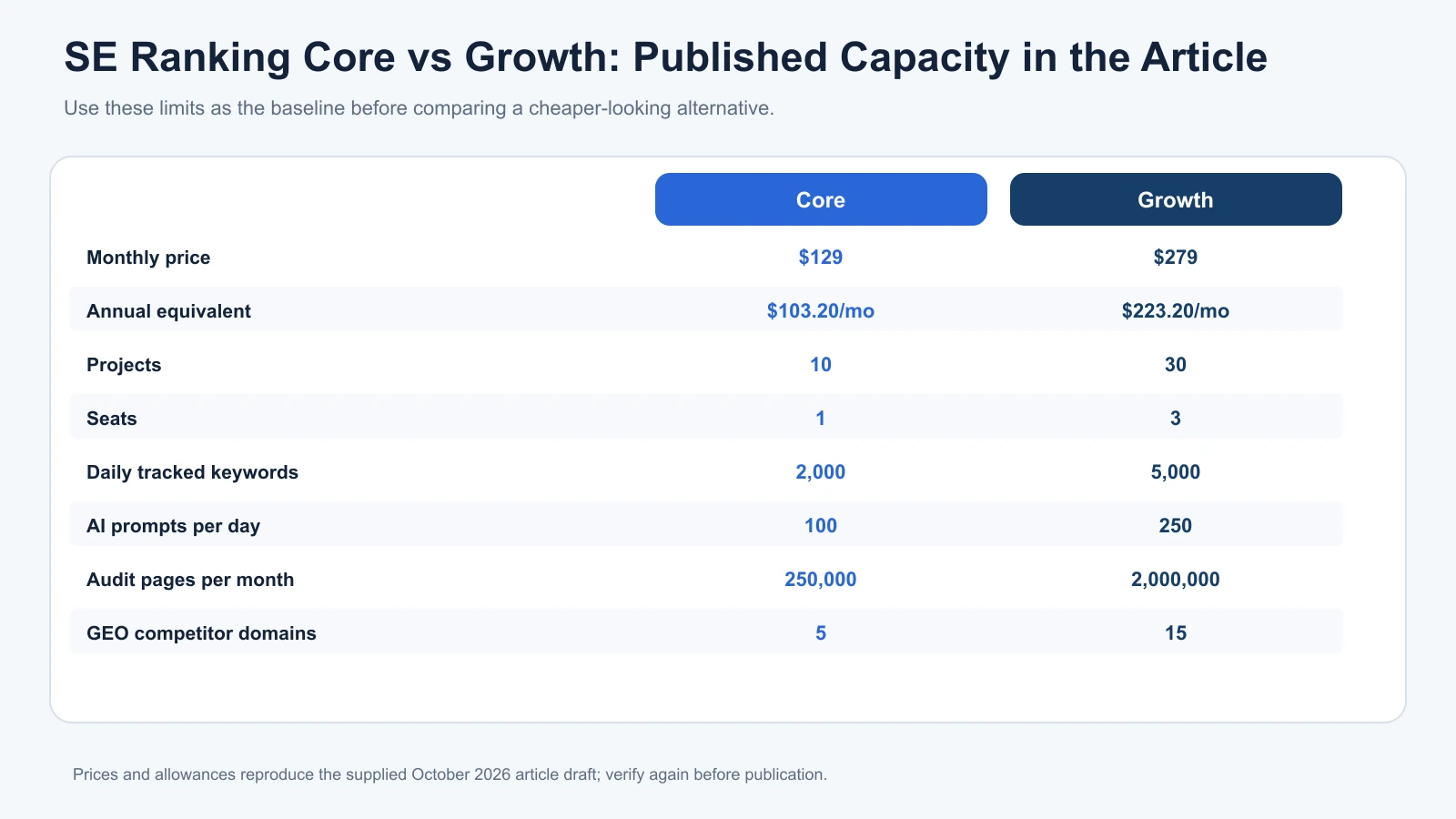
SE Ranking combines keyword research, daily rank tracking, backlink analysis, technical auditing, competitor intelligence, reporting, and AI-search visibility.
Its official subscription page currently lists two main self-service plans:
| Feature | SE Ranking Core | SE Ranking Growth |
|---|---|---|
| Monthly price | $129 | $279 |
| Annual billing equivalent | $103.20/month | $223.20/month |
| SEO projects | 10 | 30 |
| Manager seats | 1 | 3 |
| Daily tracked keywords | 2,000 | 5,000 |
| Daily tracked AI prompts | 100 | 250 |
| Monthly audit allowance | 250,000 pages | 2 million pages |
| GEO competitor research domains | 5 | 15 |
These are substantial allowances for many small businesses and agencies.
Importantly, the five-domain limit on Core applies to GEO competitive research, not regular SEO projects. Core supports ten SEO projects.
That distinction matters because choosing an alternative based on misunderstood restrictions can lead to unnecessary spending.
Nevertheless, there are legitimate reasons to consider switching.

Your Keyword or Project Requirements Have Grown
An agency may begin with a handful of clients and eventually manage several thousand tracked keywords across multiple websites.
Project capacity is only part of the equation. A platform might allow ten websites but include enough keyword tracking for only a fraction of the agency’s reporting needs.
SE Ranking allows additional tracked-keyword capacity and custom configurations, so upgrading doesn’t automatically require purchasing another account.
Before switching, compare the cost of expanding your existing subscription with the cost of replacing it.
You Need More Specialised SEO Research
All-in-one SEO software typically covers several disciplines, but some workflows benefit from a specialist platform.
For example, a link-building team may spend more time examining referring domains, lost backlinks, anchor text, and competing websites than generating general SEO reports.
Ahrefs or another specialist research tool may provide a better fit for that particular work.
Similarly, teams managing complex technical websites may continue using a dedicated crawler such as Screaming Frog even when their primary SEO subscription includes a site audit feature.
In these situations, adding one specialist tool can be more practical than replacing the entire platform.
Your Reporting Requirements Have Changed
Client reporting becomes more demanding as an agency grows.
A small business may only need occasional ranking exports. An agency managing multiple accounts may require automated reporting, branded dashboards, individual client permissions, and consistent historical comparisons.
SE Ranking offers reporting functionality, while additional white-label and agency features are available through its Agency Pack.
The relevant question is whether those capabilities are included in your existing plan or require additional spending.
You’re Paying for Features You Rarely Use
A comprehensive SEO suite can become difficult to justify if your team only uses keyword research, rank tracking, and occasional website audits.
However, cheaper software doesn’t always result in lower operating costs.
If switching requires separate subscriptions for backlink analysis, reporting, and technical crawling, the savings can disappear.
That’s why we recommend comparing tools based on the jobs they replace rather than their starting prices alone.
8 Best SE Ranking Alternatives Compared
The platforms below offer different approaches to replacing SE Ranking. Some provide comprehensive SEO functionality, while others are better suited to narrower workflows.
1. Semrush — Best for Comprehensive SEO and Competitor Research
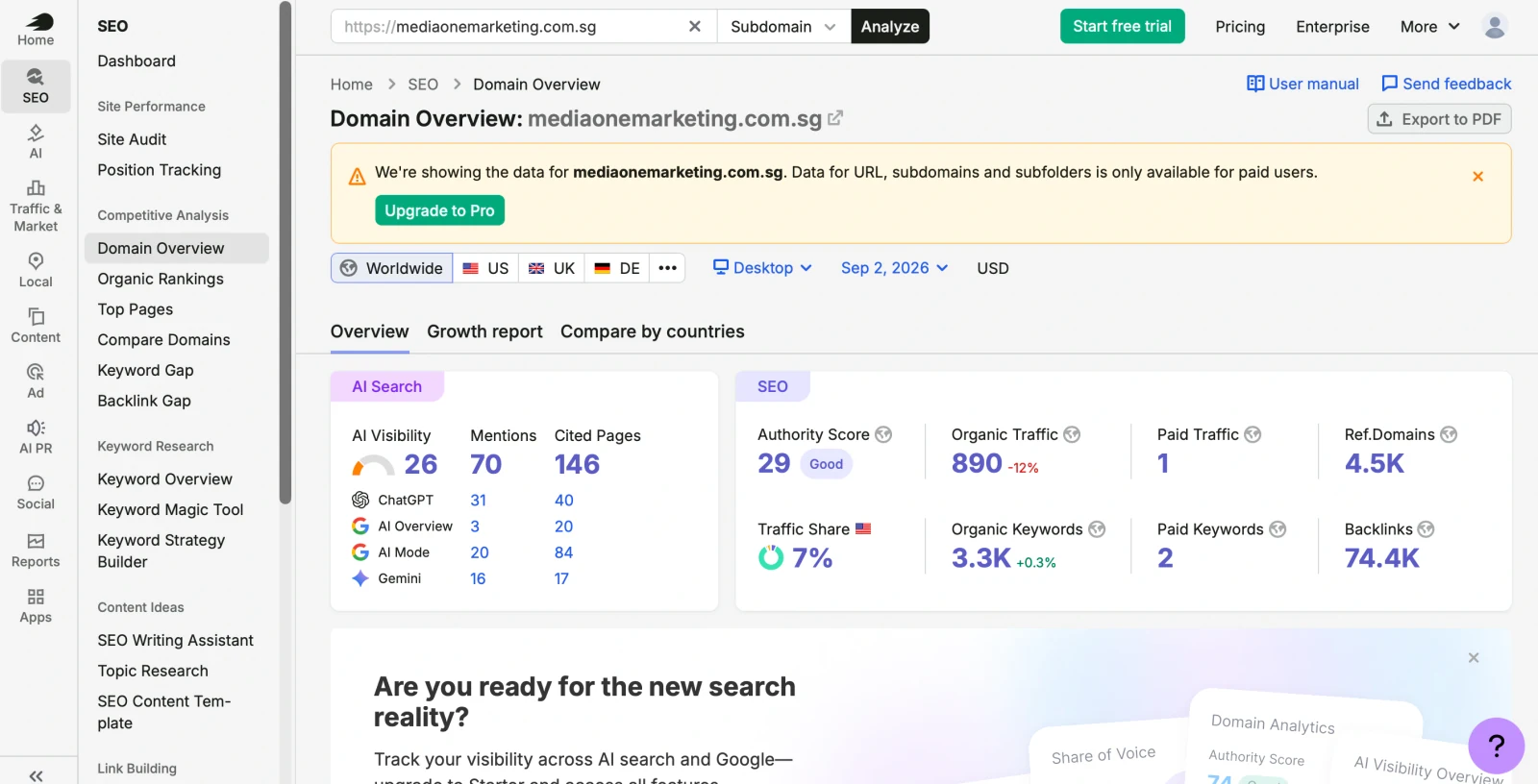
Semrush is one of the closest alternatives for businesses that want keyword research, competitor intelligence, backlink analysis, technical auditing, and position tracking in one environment.
Its SEO tools help marketers identify competing domains, discover organic keyword opportunities, investigate backlink profiles, and monitor performance.
For agencies working across different industries, the combination of these capabilities can reduce the need to move between multiple research platforms.
Where Semrush stands out
Semrush is particularly useful when competitive research drives your SEO strategy.
You can investigate which keywords competing websites rank for, identify gaps between domains, review their backlink profiles, and examine pages generating organic visibility.
This makes it relevant for agencies conducting market research, planning content strategies, or evaluating competitors across several client accounts.
Its broader product ecosystem also includes tools for AI-search visibility, traffic intelligence, advertising, and other marketing activities.
However, not every capability is included in the entry-level SEO subscription.
Where Semrush falls short
Pricing and tracked-keyword allowances are the biggest considerations.
Semrush’s current public pricing page advertises an SEO plan at approximately $139/month, with five monitored websites and 500 tracked keywords. It also offers Starter at $199/month, Pro+ at $299/month, and custom Advanced configurations for larger requirements.
These newer public-facing plans differ from some older SEO Toolkit documentation, so use the subscription being offered at checkout when comparing costs.
For context, SE Ranking Core offers 2,000 tracked keywords across ten projects for $129/month.
A business mainly purchasing software for rank tracking may therefore find SE Ranking more economical.
Our assessment
At MediaOne, we’ve used Semrush for competitor analysis, keyword research, and SEO planning. Its value becomes clearer when a team regularly moves between organic competitor research, backlinks, keyword opportunities, and reporting.
However, if your main requirement is tracking keyword movements across several relatively small websites, the additional research capabilities may not justify a higher subscription.
Best for: Agencies, established businesses, and marketers who regularly use advanced competitor research.
Pricing source: Semrush official pricing
For a closer look at competing platforms, see our best Semrush alternatives comparison.
2. Ahrefs — Best for Backlink Analysis and SEO Research
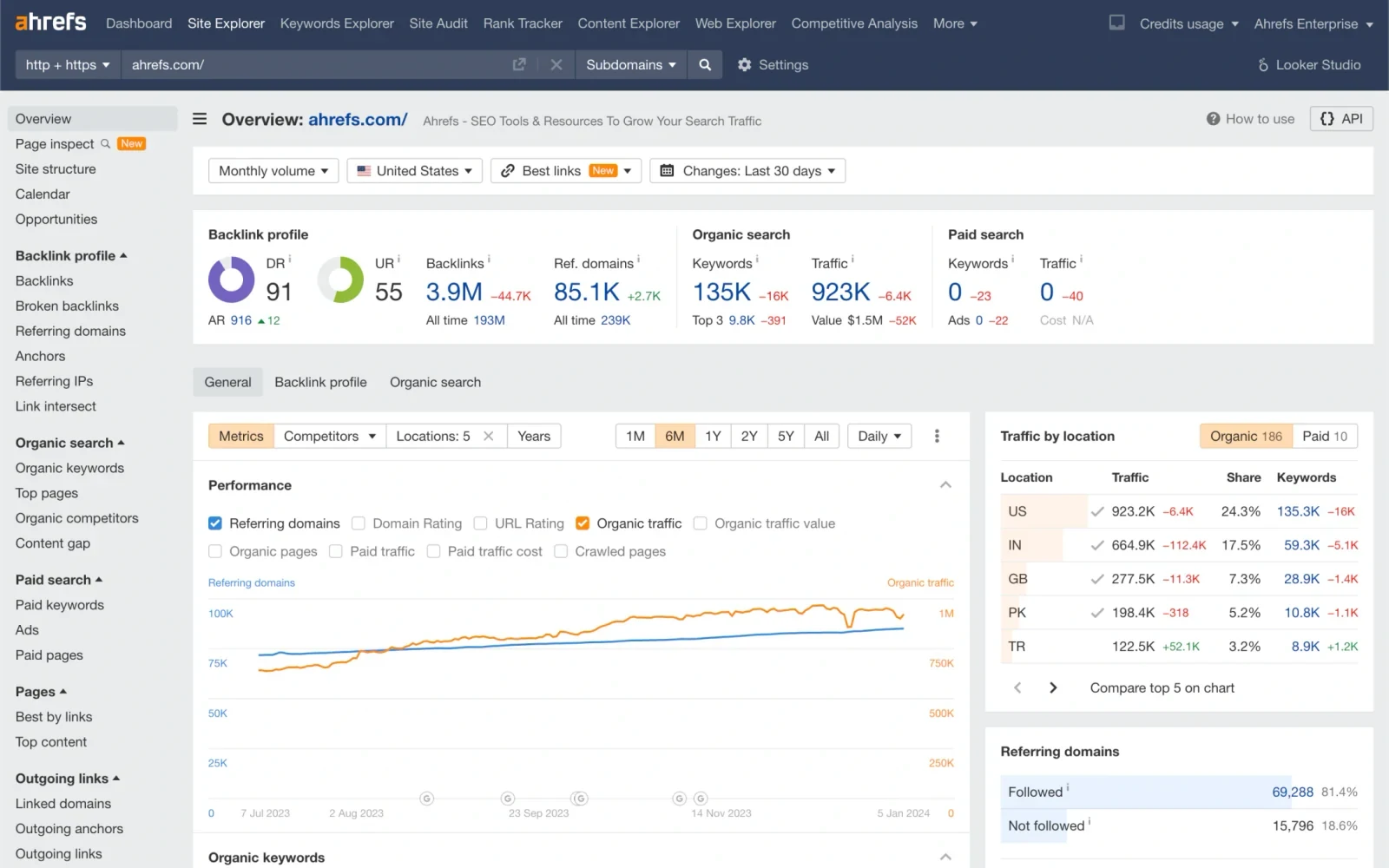
Ahrefs is a strong alternative for SEO professionals who prioritise backlink research, organic competitor analysis, and keyword intelligence.
Its core tools include Site Explorer, Keywords Explorer, Site Audit, Rank Tracker, and related reporting capabilities.
Although Ahrefs covers many of the same SEO functions as SE Ranking, its research environment is particularly relevant for teams spending significant time analysing competitor websites and link profiles.
Where Ahrefs stands out
Site Explorer provides a way to investigate backlinks, referring domains, linking pages, competing websites, and organic-search performance.
These capabilities are useful when identifying link-building opportunities or understanding why competing pages have stronger off-page signals.
For example, when reviewing a competitor’s link profile, we’d focus on the actual referring pages, their relevance, and the context of their links rather than relying entirely on a proprietary authority score.
A higher backlink count doesn’t automatically make one platform more accurate. Different crawlers discover and process links differently.
Our free backlink checker comparison explores why the usefulness of discovered backlinks matters more than the headline number.
Where Ahrefs falls short
Ahrefs’ standard rank-tracking schedule is weekly, whereas SE Ranking advertises daily keyword updates.
That difference matters for teams that want more frequent ranking reports.
Ahrefs also distinguishes between verified and unverified projects. Its Lite plan includes five unverified projects, but the platform offers different allowances for websites whose ownership has been verified.
Ahrefs pricing
| Plan | Monthly Price | Unverified Projects | Tracked Keywords |
|---|---|---|---|
| Lite | $129 | 5 | 750 |
| Standard | $249 | 20 | 2,000 |
| Advanced | $449 | 50 | 5,000 |
| Enterprise | From $1,499 | 100 | From 10,000 |
Additional users, historical data, exports, and other usage allowances vary by plan.
Our assessment
Ahrefs makes the most sense when backlink and competitor research are central to your SEO work.
If daily rank tracking is essential, though, switching entirely to Ahrefs could introduce another requirement for a dedicated tracking platform.
For some teams, retaining SE Ranking for monitoring and using Ahrefs for specialised research is a more practical combination.
Best for: Link builders, SEO agencies, and businesses prioritising backlink and competitor intelligence.
Pricing source: Ahrefs official pricing
You can also read our best Ahrefs alternatives comparison for a broader look at replacement options.
3. SEO PowerSuite — Best for Budget-Conscious Freelancers

SEO PowerSuite takes a different approach from most cloud-based SEO platforms.
Instead of providing all its functionality through a browser, it offers a desktop software suite containing Rank Tracker, WebSite Auditor, SEO SpyGlass, and LinkAssistant.
This makes it interesting for freelancers and smaller teams that prefer locally installed software.
Where SEO PowerSuite stands out
Its permanent free edition provides a way to explore several SEO functions without immediately committing to a subscription.
The free edition includes allowances for crawling 500 URLs, analysing 1,100 backlinks, and working with one project without saving it.
Paid plans significantly expand those capabilities.
The Professional edition supports unlimited saved projects, keyword tracking, broader backlink analysis, and larger technical audits.
That can make SEO PowerSuite appealing to professionals managing multiple websites who are comfortable using desktop applications.
Where SEO PowerSuite falls short
The biggest trade-off is its operating model.
Desktop software requires a different workflow from a cloud-based platform that colleagues can access through a browser.
This becomes especially important when several team members need shared projects, client access, or automated reporting.
Some functions also depend on the edition purchased.
SEO PowerSuite pricing
| Edition | Price | Main Limitation or Benefit |
|---|---|---|
| Free | $0 | Limited evaluation, no saved projects |
| Professional | $349/year | Unlimited projects and tracked keywords |
| Enterprise | $599/year | White-label reporting, scheduled reports, expanded exports |
Enterprise is the more relevant comparison for agencies that regularly deliver branded reports.
Our assessment
SEO PowerSuite deserves consideration when subscription cost is a priority and the team doesn’t require extensive cloud collaboration.
Its annual price can be significantly lower than a year of SE Ranking or another premium subscription.
However, the lower software cost should be weighed against the workflow differences, particularly for agencies.
Best for: Freelancers, consultants, and small businesses comfortable with desktop SEO software.
Pricing source: SEO PowerSuite official pricing
4. Serpstat — Best Affordable All-in-One SEO Alternative

Serpstat offers keyword research, competitor analysis, backlink research, rank tracking, and site auditing in one platform.
Its lower advertised entry price makes it attractive to businesses that need more than a specialist keyword tool but want to avoid the cost of larger SEO suites.
Where Serpstat stands out
Serpstat combines several SEO functions with usage-based allowances.
Its Individual plan includes five projects, 100 searches for sites, keywords, or links per day, 10,000 keyword position checks, and 30,000 pages for auditing.
These limits can work for smaller portfolios where research and monitoring requirements are predictable.
Higher tiers increase available projects, position checks, reporting, and collaboration features.
Where Serpstat falls short
The main limitation is how its allowances affect actual work.
For example, a plan offering 10,000 position checks per month does not necessarily mean you can monitor 10,000 keywords every day.
Tracking 450 keywords daily for 30 days would require approximately 13,500 position checks if each keyword and configuration consumes one check.
Additional locations, devices, or tracking requirements may increase usage further.
This is why Serpstat’s position-check allowance needs to be evaluated differently from the tracked-keyword limits advertised by some competitors.
Serpstat pricing
| Plan | Advertised Monthly Rate | Position-Check Allowance |
|---|---|---|
| Individual | $50 | 10,000 |
| Team | $100 | 50,000 |
| Team x2 | $169 | 100,000 |
| Agency | $410 | 500,000 |
These are advertised rates; confirm the billing term selected on Serpstat’s pricing page. Annual and multi-year commitments may affect the total payable.
Our assessment
Serpstat can provide good value when your team knows how many searches, position checks, exports, and audit pages it regularly uses.
Its lower entry price is less useful if a busy workload requires upgrading almost immediately.
For agencies, the Team and Agency plans deserve more attention than the cheapest subscription because reporting and collaboration requirements can be just as important as research limits.
Best for: Freelancers and growing SEO teams looking for an affordable integrated platform.
Pricing source: Serpstat official pricing
5. Mangools — Best for Simpler Keyword Research and Rank Tracking
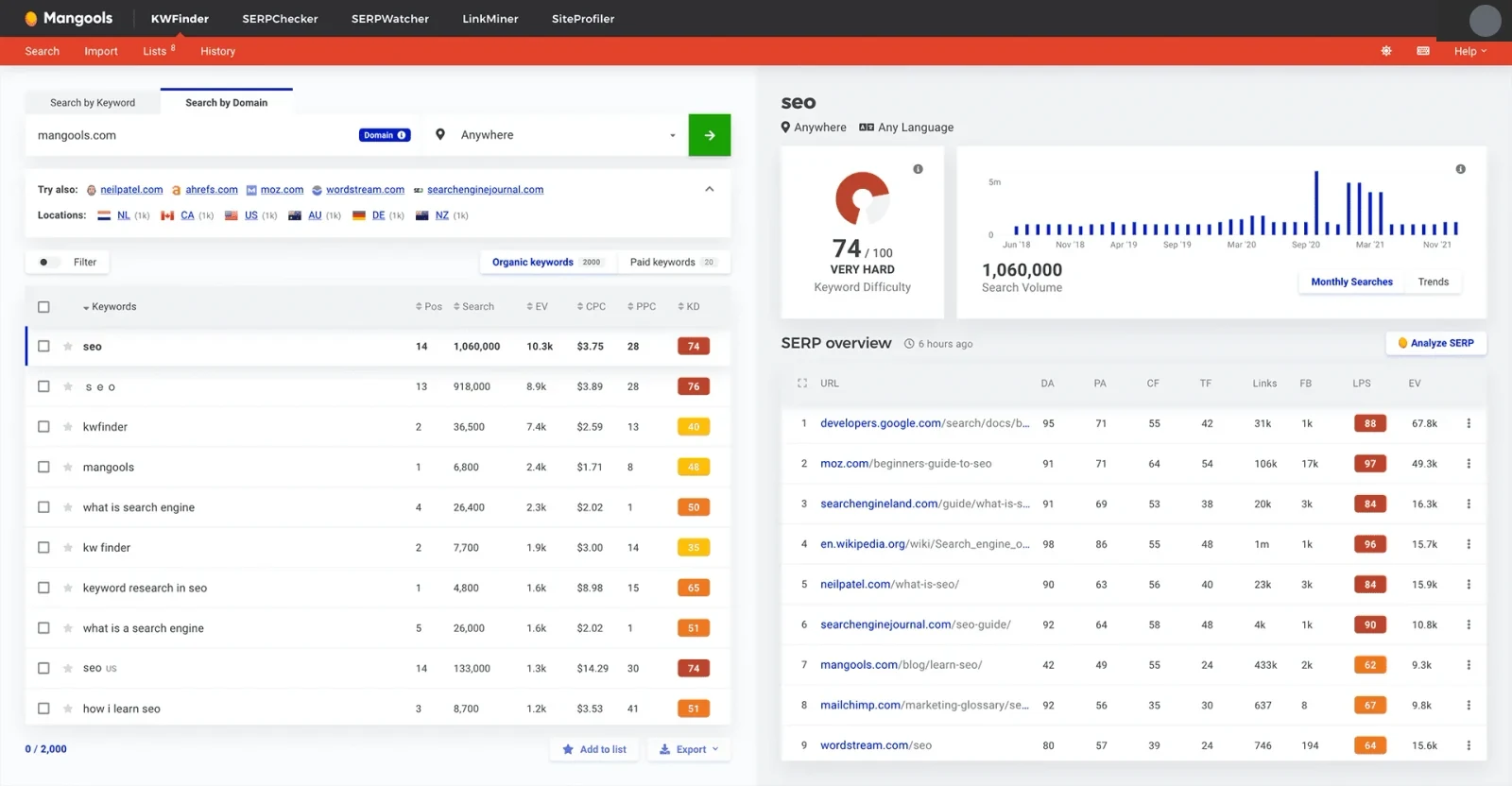
Mangools provides a collection of tools built around focused SEO research tasks.
Its products include KWFinder for keyword research, SERPChecker for search results analysis, SERPWatcher for rank tracking, LinkMiner for backlink research, and SiteProfiler for domain metrics.
Rather than positioning itself around extensive technical auditing and complex agency operations, Mangools offers a more straightforward research workflow.
Where Mangools stands out
The platform is particularly approachable for people who spend most of their time researching keywords, inspecting SERPs, and monitoring rankings.
KWFinder helps identify keyword opportunities, while SERPChecker provides context around competing results.
SERPWatcher handles rank monitoring without requiring users to learn an extensive enterprise-style reporting environment.
This separation can make the platform easier to navigate for smaller teams.
Where Mangools falls short
Mangools doesn’t provide the same breadth of technical site auditing as a more comprehensive SEO suite.
You may need another crawler to investigate redirects, canonical issues, indexing directives, JavaScript rendering, or complex internal-linking problems.
Rank-tracking frequency also depends on the subscription.
Its Basic and Premium tiers advertise weekly updates, while Agency provides daily updates.
Mangools pricing
| Plan | Annual-Billing Monthly Equivalent | Tracked Keywords | Frequency |
|---|---|---|---|
| Basic | $37.70 | 200 | Weekly |
| Premium | $52.70 | 700 | Weekly |
| Agency | $97.70 | 1,500 | Daily |
Our assessment
Mangools is worth considering if your main responsibilities are keyword research, SERP analysis, and rank tracking.
A freelancer managing a few relatively small websites may not need an expensive SEO platform when these tools cover most recurring tasks.
However, businesses requiring advanced audits, large-scale competitor research, and integrated client reporting should consider the additional software they would need.
Best for: Solo SEO professionals, bloggers, and smaller businesses prioritising simplicity.
Pricing source: Mangools official pricing
6. Moz Pro — Best for Established SEO Metrics and Core SEO Workflows
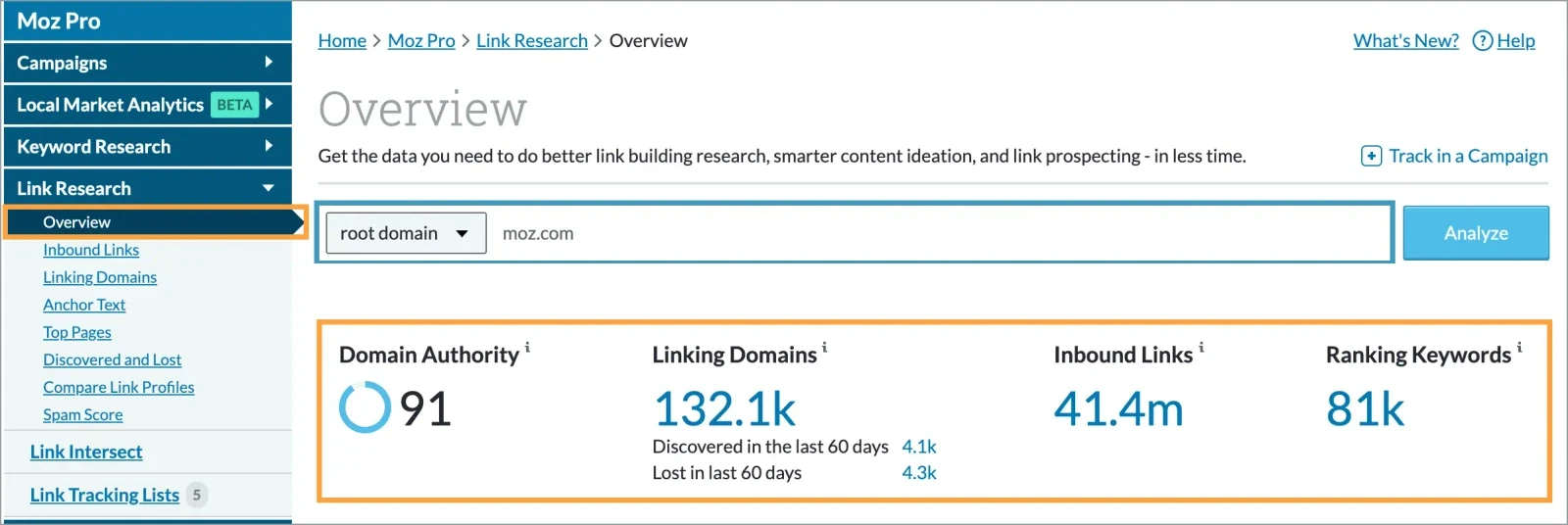
Moz Pro is another established alternative offering keyword research, rank tracking, link analysis, website crawling, and SEO reporting.
It is particularly recognisable for proprietary metrics such as Domain Authority and Page Authority.
These can help SEO professionals compare websites within Moz’s measurement system, although they should never be confused with Google’s own ranking signals.
Where Moz Pro stands out
Moz provides a relatively straightforward collection of tools for researching keywords, monitoring search visibility, analysing links, and identifying technical issues.
Its authority metrics can be useful when consistently applied to competitor comparisons or prospect evaluation.
However, the value comes from understanding what those metrics represent.
A website with higher Domain Authority is not guaranteed to outrank a lower-scoring competitor, particularly when search intent, relevance, content quality, and other factors differ.
Where Moz Pro falls short
Its lower-priced plans have relatively modest campaign and tracked-keyword allowances.
For example, the Standard plan includes three tracked sites and 300 keywords, which may not suit an agency managing multiple client accounts.
Moz Pro pricing
| Plan | Monthly Price | Tracked Sites | Keywords |
|---|---|---|---|
| Starter | $49 | 1 | 50 |
| Standard | $99 | 3 | 300 |
| Medium | $179 | 10 | 1,500 |
| Large | $299 | 25 | 3,000 |
Annual billing offers lower equivalent monthly rates.
Our assessment
Moz Pro is a reasonable choice for businesses wanting established SEO research functions and a familiar reporting environment.
However, teams working with large keyword sets should review the tracked-keyword allowances carefully.
It’s also important to treat Domain Authority as a proprietary Moz metric rather than a substitute for backlink review or actual search performance.
Best for: Small businesses, in-house SEO teams, and professionals comfortable with Moz’s metrics.
Pricing source: Moz Pro pricing
7. Search Atlas — Best for AI-Assisted SEO and Automation
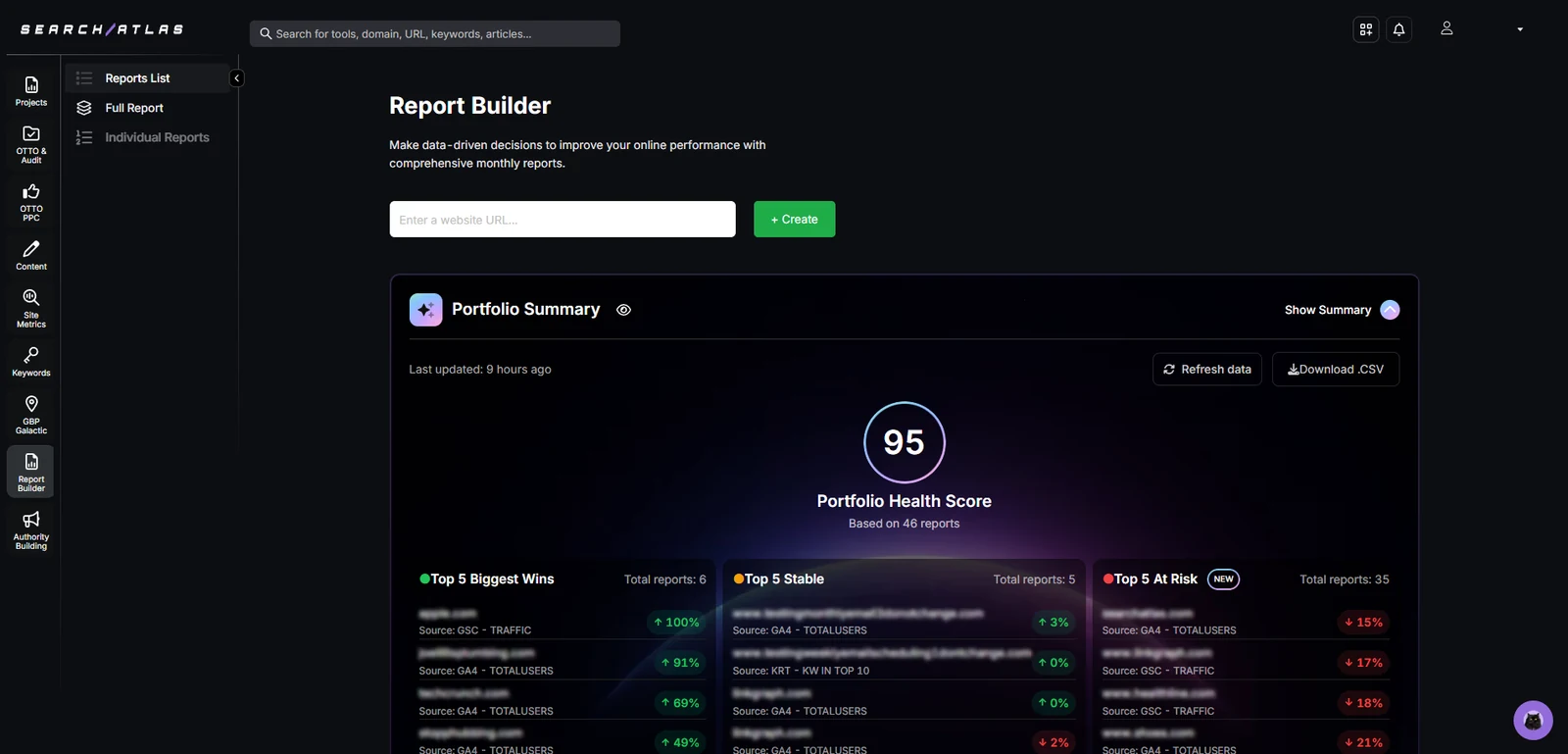
Search Atlas combines traditional SEO capabilities with AI-assisted workflows and automation.
Its platform includes products such as OTTO SEO, Atlas Agent, site auditing, keyword tracking, and content optimisation.
This makes it relevant to agencies interested in bringing research and SEO execution into a more integrated workflow.
Where Search Atlas stands out
Search Atlas places considerable emphasis on automation and AI-assisted execution.
Rather than limiting the workflow to identifying issues, its tools are designed to help users move into optimisation and content-related tasks.
For agencies handling recurring SEO work across multiple clients, reducing manual steps may provide operational benefits.
However, automation should not be confused with guaranteed ranking improvements. Suggested changes still require review, particularly when they affect important website pages.
Where Search Atlas falls short
Its credit-based model introduces another consideration.
Users need to understand how routine tasks consume their monthly Universal Credits, including rank checks, content generation, audits, and AI-related workflows.
Project allowances can also be restrictive on lower plans.
Search Atlas pricing
| Plan | Monthly Price | Projects | Tracked Keywords |
|---|---|---|---|
| Starter | $99 | 1 | 2,000 |
| Growth | $199 | 2 | 3,500 |
| Pro | $399 | 4 | 6,000 |
| Agency | From $999 | 10 | Unlimited keyword tracking advertised |
The Agency tier also offers expanded collaboration and client-facing capabilities. Other usage allowances and Universal Credits still apply.
Our assessment
Search Atlas is worth investigating when automation and AI-assisted execution are major priorities.
Its value depends on whether those capabilities meaningfully reduce your team’s workload.
If you’re primarily purchasing software for keyword tracking and occasional SEO research, the additional automation may not justify the subscription.
Best for: Agencies and marketing teams interested in integrating SEO research with assisted execution.
Pricing source: Search Atlas official pricing
8. DinoRANK — Best for Lower-Cost SEO Research
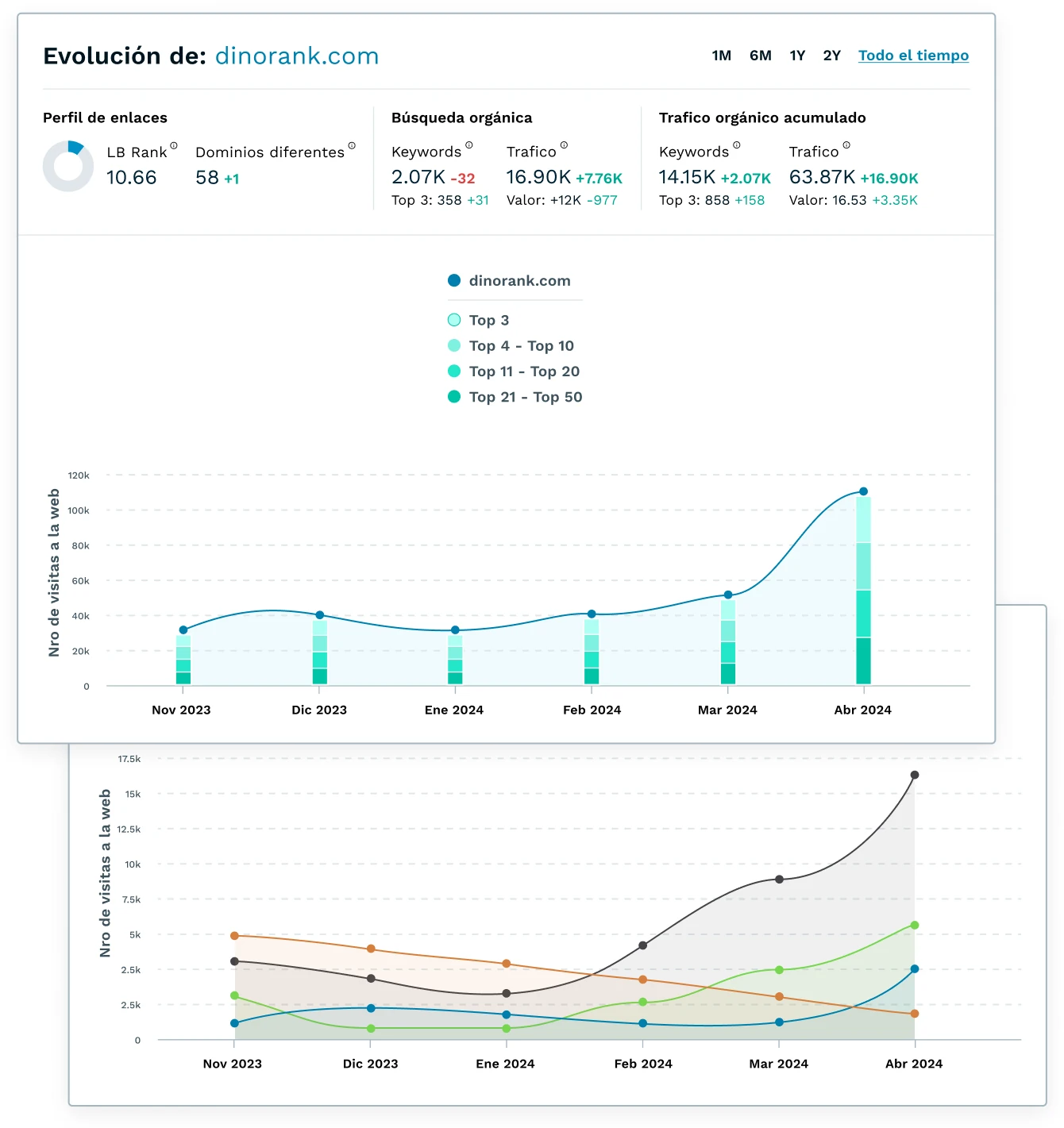
DinoRANK provides SEO functionality covering keyword research, rank tracking, competitor visibility, technical analysis, internal linking, and AI-assisted content workflows.
Its pricing makes it an interesting alternative for smaller teams looking for a broader range of SEO features without committing to a premium subscription.
Where DinoRANK stands out
DinoRANK advertises unlimited domains across its paid plans.
This can be attractive for consultants managing several relatively small websites.
However, unlimited domains shouldn’t be confused with unlimited keyword tracking.
Its plans have specific tracked-keyword allowances that determine how much ranking data you can monitor.
DinoRANK pricing
| Plan | Monthly Price | Tracked Keywords |
|---|---|---|
| Starter | €39 | 400 |
| Pro | €65 | 800 |
| Business | €139 | 2,000 |
Annual billing reduces the advertised equivalent monthly rates to approximately €33, €54, and €116 respectively.
Where DinoRANK falls short
The keyword caps may become restrictive for agencies.
For example, ten client websites with 1,000 keywords each would require 10,000 tracked keywords in total.
The platform’s Business tier includes 2,000, so its advertised unlimited-domain allowance wouldn’t solve that requirement by itself.
Its research, reporting, and automation capabilities should also be considered alongside the workload you expect the platform to handle.
Our assessment
DinoRANK offers an appealing alternative for smaller portfolios where keyword volume is manageable.
Its value becomes less straightforward when agencies require substantially more tracking capacity.
Best for: Freelancers, consultants, and smaller businesses with relatively modest keyword-tracking requirements.
Pricing source: DinoRANK official pricing
SE Ranking vs Alternatives: Feature Comparison
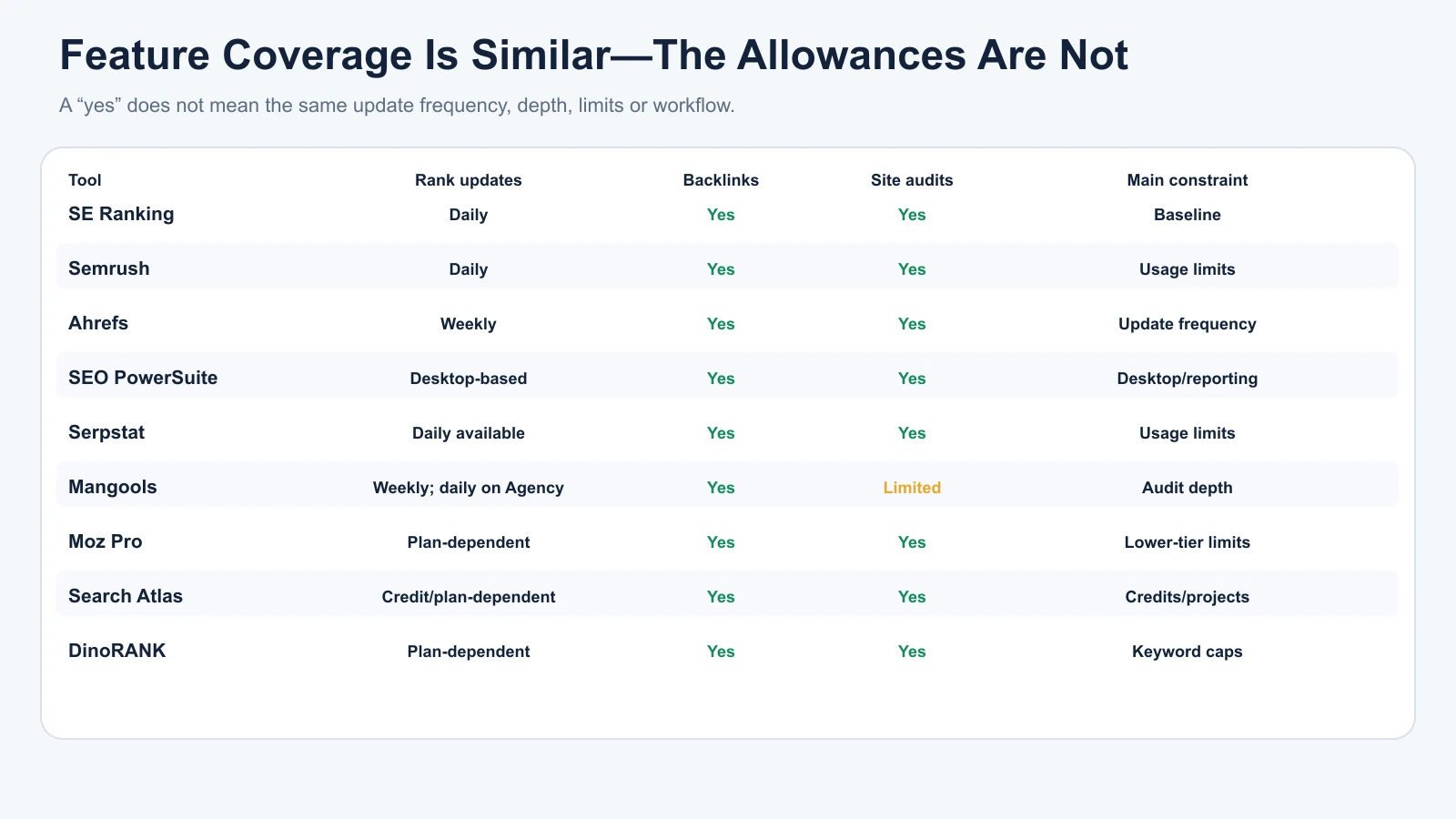
Comparing individual tools is useful, but it doesn’t fully explain whether a platform can replace your existing SEO workflow.
This table shows how the alternatives differ across several important requirements.
| Tool | Rank Tracking | Backlinks | Technical Audits | Main Consideration |
|---|---|---|---|---|
| SE Ranking | Daily | Yes | Yes | Project and keyword capacity |
| Semrush | Daily | Yes | Yes | Subscription tiers and research requirements |
| Ahrefs | Weekly | Yes | Yes | Rank-tracking frequency |
| SEO PowerSuite | Desktop-based | Yes | Yes | Installed software and reporting edition |
| Serpstat | Daily available | Yes | Yes | Position-check and research limits |
| Mangools | Weekly; daily on Agency | Yes | Limited | Specialist tools rather than a complete audit suite |
| Moz Pro | Plan-dependent | Yes | Yes | Campaign and keyword allowances |
| Search Atlas | Credit-based and plan-dependent | Yes | Yes | Execution credits and project capacity |
| DinoRANK | Plan-dependent | Yes | Yes | Tracked-keyword caps |
All-in-one functionality doesn’t necessarily mean every platform provides equivalent depth.
For example, a tool may include backlink analysis but offer different filters, historical coverage, exports, or research allowances than a specialist platform.
Similarly, having a site audit feature doesn’t guarantee the same level of technical investigation as a dedicated crawler.
Our technical SEO crawlers comparison explores why the ability to investigate and prioritise actual problems matters more than simply producing a large number of audit warnings.
How Much Does Switching from SE Ranking Actually Cost?
Subscription comparisons become misleading when they focus only on the cheapest advertised plan.
The real expense depends on how many websites you manage, how many keywords you track, which reports you need, and whether the replacement requires other paid tools.
At MediaOne, we look beyond the headline subscription and consider how a platform fits into ongoing SEO operations.
Two practical scenarios illustrate why this matters.
Scenario 1: A Freelancer Managing Three Websites
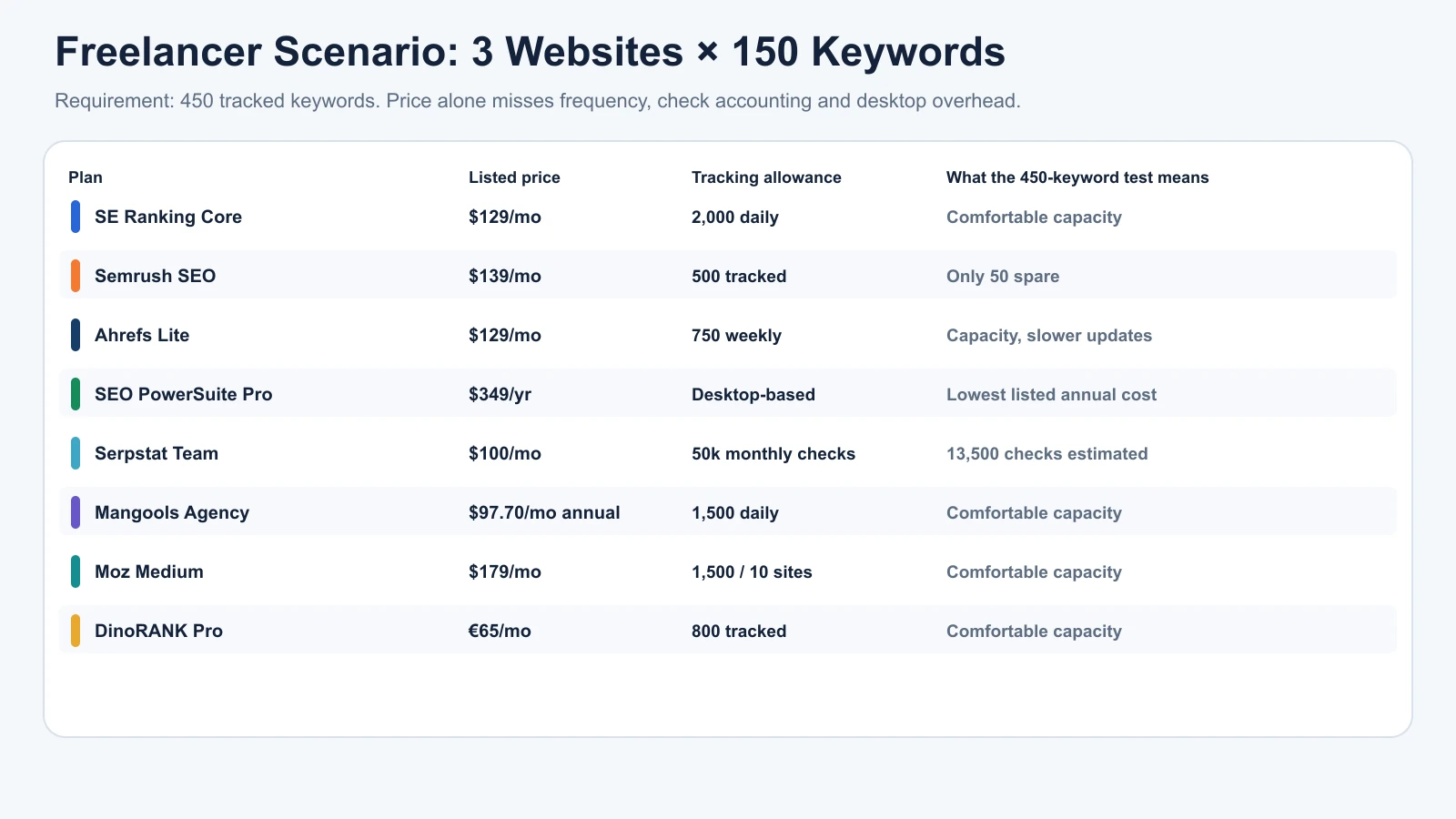
Consider a freelancer responsible for three client websites, with 150 keywords tracked per website.
That’s 450 keywords in total.
The freelancer also needs basic audits, keyword research, and periodic performance reporting.
Several platforms could handle this requirement, but their costs and limitations differ.
| Tool | Suitable Plan | Advertised Cost | Key Consideration |
|---|---|---|---|
| SE Ranking | Core | $129/month | 2,000 daily tracked keywords |
| Semrush | SEO | $139/month | 500 tracked keywords across five websites |
| Ahrefs | Lite | $129/month | 750 keywords, updated weekly |
| SEO PowerSuite | Professional | $349/year | Desktop workflow |
| Serpstat | Team | $100/month advertised | 50,000 monthly position checks |
| Mangools | Agency | $97.70/month equivalent annually | 1,500 keywords, daily updates |
| Moz Pro | Medium | $179/month | 1,500 keywords across ten sites |
| DinoRANK | Pro | €65/month | 800 tracked keywords |
For Serpstat, 450 daily keyword checks over 30 days would amount to approximately 13,500 position checks, assuming one check is consumed per keyword and tracking configuration.
That exceeds the Individual plan’s 10,000-position allowance, making Team a more relevant option for this scenario.
For Mangools, Basic and Premium have weekly tracking. The Agency tier is the closer comparison when daily updates are required.
SEO PowerSuite offers the lowest annual software cost among several of these options, but its desktop workflow and reporting differences matter.
SE Ranking Core remains competitive because it covers all three websites and leaves considerable keyword capacity for growth.
The important point is that the cheapest listed subscription isn’t always the cheapest way to complete the same work.
Scenario 2: An Agency Managing Ten Client Websites
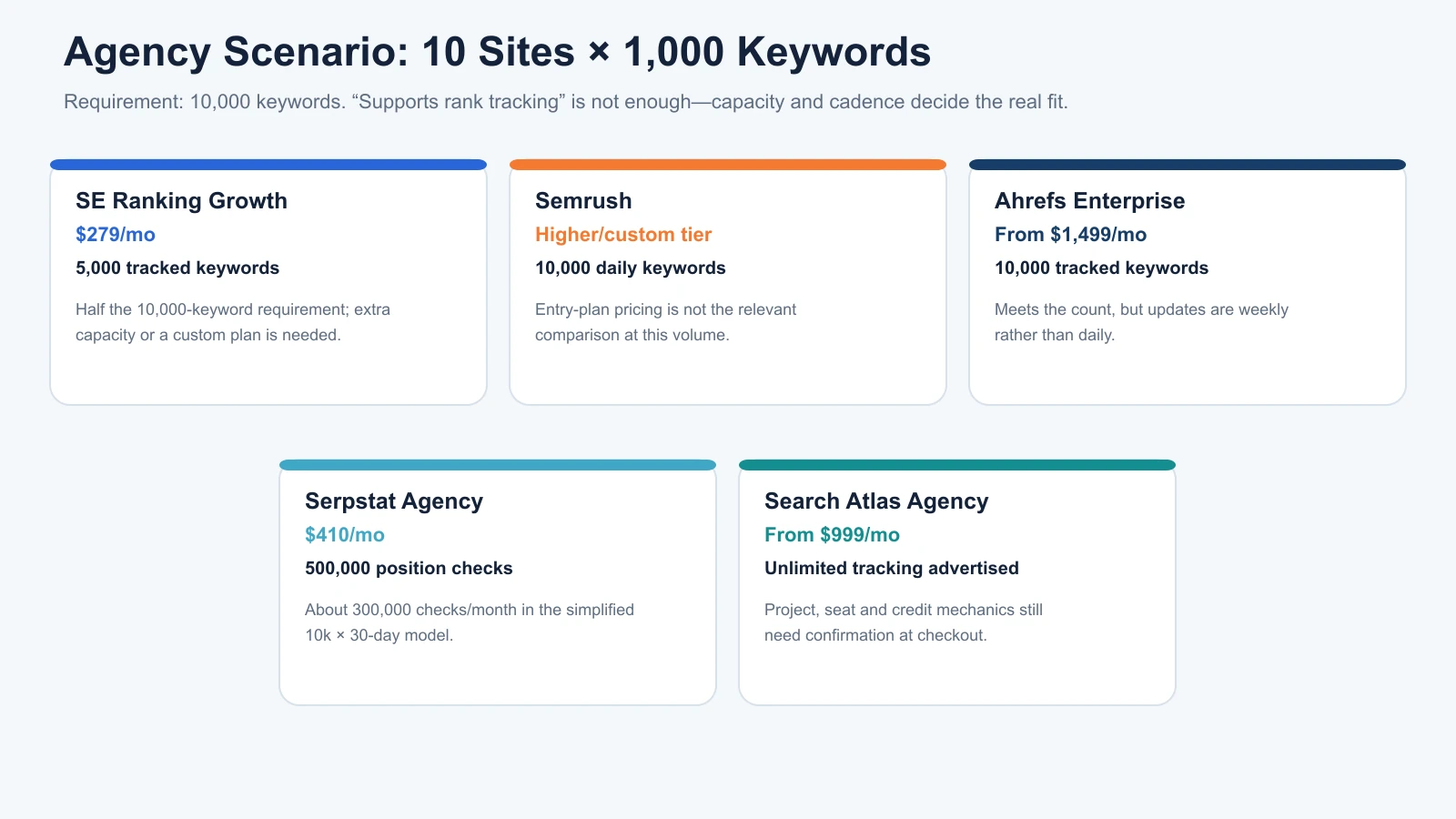
Now consider an agency managing ten client websites, each with approximately 1,000 tracked keywords.
That’s 10,000 keywords across ten projects.
The agency also needs multiple users, scheduled reports, and dependable historical tracking.
This requirement is very different from that of a freelancer.
SE Ranking
Growth includes 30 projects and 5,000 tracked keywords at $279/month on monthly billing.
The project allowance is sufficient, but the keyword allowance would need expanding.
SE Ranking offers additional keyword capacity and custom plans, so the agency should request pricing for another 5,000 tracked keywords before considering a second subscription.
The exact cost depends on the selected capacity and billing arrangement.
Semrush
Semrush’s current public plan structure offers larger website and keyword allowances through higher tiers and custom Advanced configurations.
The agency would need to confirm pricing for 10,000 tracked keywords, appropriate project limits, and additional team members.
A base subscription advertising 5,000 keywords is not sufficient for the entire portfolio.
Ahrefs
Ahrefs Enterprise advertises tracked-keyword capacity starting at 10,000, with pricing from $1,499/month.
This could support a larger SEO research operation, but it represents a substantially different software budget.
Weekly rank updates also remain an important consideration.
Serpstat
Serpstat Agency advertises 500,000 monthly position checks and unlimited projects.
Tracking 10,000 keywords daily for 30 days would require approximately 300,000 position checks if each keyword and configuration uses one check.
That falls within the advertised allowance under this simplified scenario, although additional devices, locations, and other tracking settings could increase consumption.
Search Atlas
Search Atlas Agency advertises ten projects, ten seats, and unlimited keyword tracking from $999/month.
However, agencies should also account for its shared credit-based execution model and confirm the limits that apply to their typical workload.
What These Cost Scenarios Tell Us
There is no universally cheapest alternative.
SEO PowerSuite may offer lower software costs but require a different working environment.
Serpstat’s value depends partly on the number of checks and searches performed.
Search Atlas emphasises execution and automation, while Semrush and Ahrefs place considerable value on their research capabilities.
SE Ranking can also remain competitive once additional keyword capacity is priced correctly.
For agencies, a useful comparison is:
Total SEO Tool Cost = Subscription + Extra Capacity + User Seats + Reporting Add-ons + Additional Tools + Migration Effort
A platform only represents better value when it can handle the required work at an acceptable total cost.
What Do You Lose When Switching from SE Ranking?
Changing SEO platforms affects more than your subscription.
You may be able to recreate keyword tracking and technical audits relatively quickly, but several parts of your existing workflow require additional attention.
Historical Ranking Data
Rank-tracking history is one of the most valuable things to preserve before changing platforms.
It allows you to compare performance over time, investigate changes in keyword positions, and report on the results of previous SEO activities.
A new platform may begin collecting rankings from the date you configure its tracking.
Although exports and migration tools can help preserve information, historical data doesn’t necessarily transfer into another platform’s reporting system in the same format.
Before cancelling, export your ranking history and confirm which information the replacement can import.
Client Reports and Dashboards
Reporting templates often contain more work than they appear to.
An agency may have configured branded reports, automated delivery schedules, specific metrics, and individual client views.
Rebuilding those reports takes time, particularly when competing tools define visibility and authority metrics differently.
Check whether the new platform supports equivalent reporting before migrating all your clients.
Existing Project Configuration
SEO projects contain settings that affect how the platform measures performance.
These can include tracked locations, devices, competing websites, keyword groups, and scheduled reports.
If those settings aren’t reproduced correctly, comparisons between the old and new platforms may become misleading.
A change from desktop rankings to mobile rankings, for example, can produce different results even when the underlying website hasn’t changed.
Integrations and Automated Workflows
SEO teams increasingly rely on integrations connecting their research tools with analytics, dashboards, spreadsheets, and reporting systems.
If your workflow uses SE Ranking’s API or scheduled exports, those connections may need rebuilding when switching.
This is particularly relevant for agencies using Looker Studio or internal reporting systems.
Learning Curve and Productivity
The final consideration is the time your team spends learning a replacement.
A different interface may seem straightforward during a product demo, but everyday tasks can require new procedures.
Even a small increase in reporting or research time can become expensive when repeated across several clients.
For this reason, we’d avoid switching platforms solely because a competitor advertises more features.
How to Choose the Right SE Ranking Alternative
The easiest way to narrow your options is to identify the main problem you want the alternative to solve.
| Your Main Requirement | Alternatives Worth Considering |
|---|---|
| More extensive competitor research | Semrush, Ahrefs |
| Specialist backlink analysis | Ahrefs |
| Lower overall software expenditure | SEO PowerSuite, Serpstat, DinoRANK |
| Straightforward keyword research | Mangools, Moz Pro |
| Integrated AI-assisted execution | Search Atlas |
| Agency reporting and collaboration | Semrush, SE Ranking, Serpstat Agency |
| Daily rank tracking with moderate project requirements | SE Ranking, suitable Serpstat or Mangools plans |
These are starting points rather than universal winners.
A platform can perform well in one area while being less suitable for another.
Evaluate the Features You Actually Use
Before selecting a replacement, consider five questions:
- How many websites and tracked keywords do we currently manage?
- Which SEO tasks consume most of our team’s time?
- How frequently do we need ranking updates and reports?
- Which features would require additional subscriptions?
- Would switching remove a meaningful limitation or simply introduce a different one?
Our guide to choosing the right SEO tool for your business covers this decision in more detail.
How to Switch SEO Platforms Without Losing Important Data
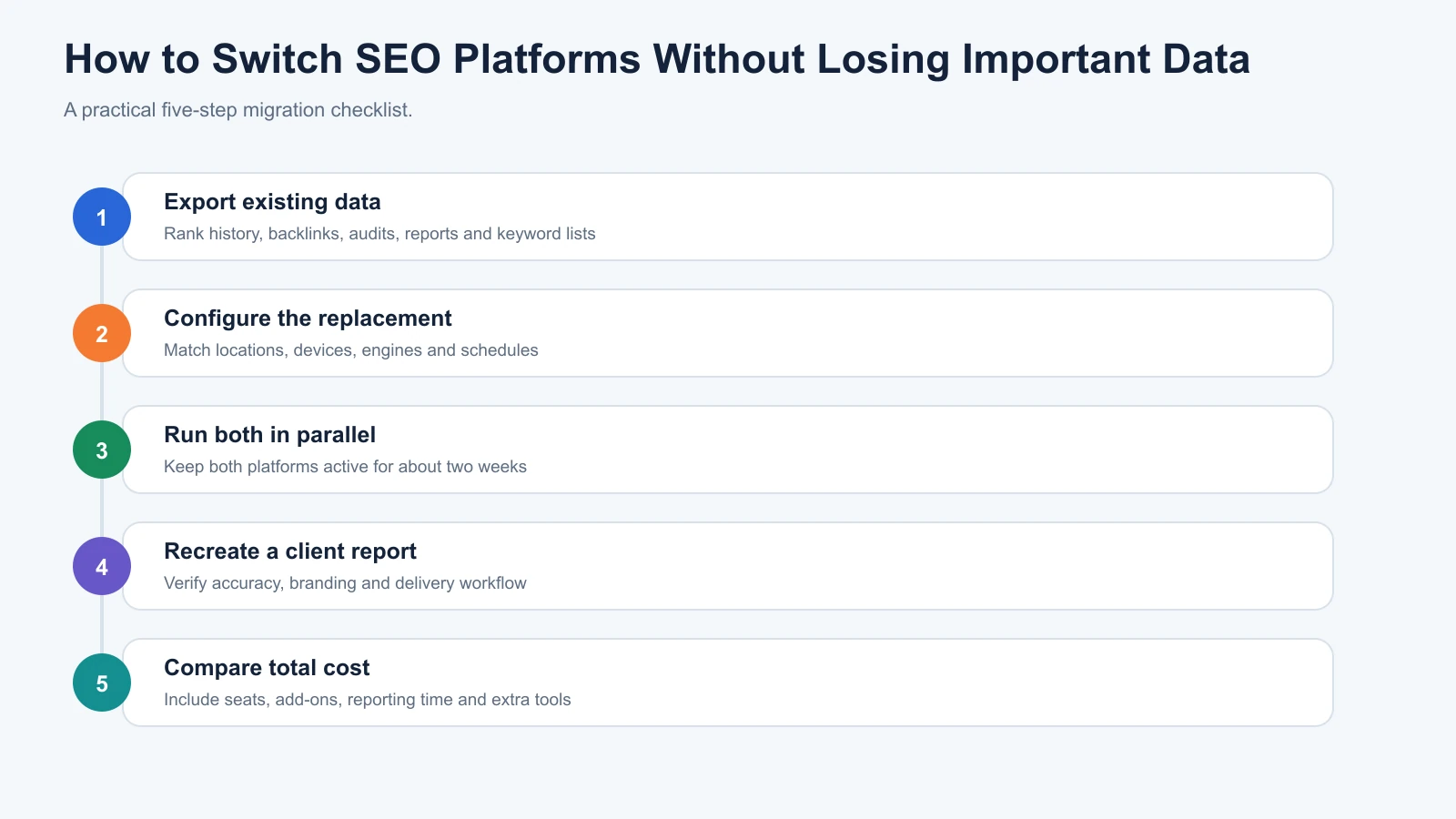
Once you’ve identified a suitable replacement, avoid cancelling your existing subscription immediately.
A short transition period allows you to compare outputs, preserve historical information, and confirm that the new platform supports your workflow.
Step 1: Export Your Existing SEO Data
Download keyword lists, ranking history, competitor information, technical audit reports, and any client reports you need to preserve.
Save the original exports in a location your team can access independently of either SEO subscription.
Step 2: Configure the Replacement Correctly
Set up the same websites, tracking locations, devices, search engines, and keyword groups.
This helps ensure that changes in tracking configuration aren’t mistaken for changes in actual search performance.
Step 3: Run Both Platforms in Parallel
Use the replacement alongside SE Ranking for approximately two weeks where practical.
Pay attention to the tasks your team completes regularly, including competitor research, keyword monitoring, audits, and client reporting.
Two weeks may be enough to expose workflow problems, although it isn’t sufficient to establish every long-term difference between platforms.
Step 4: Recreate a Client Report
Before switching all projects, reproduce at least one complete client report.
Check the available metrics, historical comparisons, branding, and automated delivery options.
This step is especially important when reporting is one of the reasons you wanted to change software.
Step 5: Compare Total Cost Before Cancelling
Calculate the new subscription cost, extra seats, add-ons, and any additional software your team still needs.
Then compare that amount with the cost of keeping SE Ranking and expanding its existing capacity.
The switch makes sense when the benefits outweigh both the financial and operational costs.
When Should You Stay with SE Ranking?
Despite the number of alternatives available, switching isn’t always the best decision.
SE Ranking remains a practical option when your existing subscription covers the majority of your requirements.
Its combination of daily rank tracking, keyword research, competitor analysis, technical auditing, reporting, and AI-search visibility can reduce the need for several separate tools.
Keeping SE Ranking may be preferable when:
- Your current project and keyword allowances are sufficient.
- Additional tracked-keyword capacity is cheaper than migrating.
- Your reporting setup already meets client requirements.
- Daily ranking updates are important.
- A competing platform would require several supplementary subscriptions.
- The cost of migration outweighs the expected benefits.
For a business that only needs deeper backlink research, adding a specialist platform may be more effective than rebuilding its entire SEO workflow.
The same principle applies to technical auditing.
A dedicated crawler can complement an existing SEO suite without replacing it.
Final Verdict: Which SE Ranking Alternative Is Worth Choosing?
The best SE Ranking alternative depends on which limitation you’re trying to overcome.
Semrush is a strong choice for businesses requiring comprehensive competitor research and a broader marketing toolkit. Its higher-level capabilities can justify the cost when they are regularly used.
Ahrefs is especially relevant for backlink-focused SEO and competitive intelligence. However, businesses requiring daily rank updates should account for its weekly tracking schedule.
SEO PowerSuite provides an affordable desktop-based alternative, while Serpstat offers an accessible all-in-one option for teams comfortable working within defined usage allowances.
Mangools suits freelancers and smaller businesses that prioritise keyword research and straightforward rank tracking. Moz Pro remains relevant for established SEO workflows, while DinoRANK provides a lower-cost option for portfolios with modest tracked-keyword requirements.
Search Atlas offers a different proposition by combining SEO research with AI-assisted execution and automation, although its credit model requires careful consideration.
At MediaOne, our approach is to evaluate SEO software based on how it supports real work. A longer feature list doesn’t automatically translate into better SEO decisions, and a cheaper subscription isn’t necessarily a better investment.
Before replacing SE Ranking, identify the specific limitation affecting your workflow, compare the cost of solving it within your existing plan, and evaluate the alternatives against the same requirements.
Sometimes switching is the right decision. Other times, keeping a capable platform and adding one specialist tool delivers better value.
Frequently Asked Questions
What Is the Best Alternative to SE Ranking?
Semrush and Ahrefs are strong alternatives for comprehensive SEO research, although the better choice depends on your priorities. Semrush is useful for broad competitor analysis and integrated marketing workflows, while Ahrefs is particularly relevant for backlink research. Budget-conscious users can also consider Serpstat, SEO PowerSuite, Mangools, or DinoRANK.
Is There a Free Alternative to SE Ranking?
SEO PowerSuite provides a permanent free edition with limited functionality. It allows users to evaluate rank tracking, website auditing, and backlink analysis, although project saving and reporting capabilities require paid licences. Google Search Console and other free tools can also replace individual SEO tasks, but not the entire suite.
Is Semrush Better Than SE Ranking?
Semrush may be more suitable for teams requiring extensive competitor intelligence and a broader marketing toolkit. However, SE Ranking offers generous keyword-tracking allowances for its price and daily ranking updates. For businesses primarily interested in tracking, auditing, and routine SEO research, SE Ranking may provide better value.
Is Ahrefs Worth Switching to from SE Ranking?
Ahrefs is worth considering when backlink analysis and competitor research are your main priorities. However, its standard weekly rank-tracking updates may not suit teams requiring daily monitoring. Compare your actual SEO workflow before deciding whether to replace SE Ranking or use Ahrefs alongside it.
Which SE Ranking Alternative Is Best for Agencies?
Agencies should compare project allowances, tracked keywords, team access, white-label reporting, and total subscription costs. Semrush, Ahrefs, Serpstat, and Search Atlas offer configurations for larger teams, but their pricing and usage models differ. SE Ranking itself may remain competitive when additional capacity can be purchased without replacing the platform.
Can I Migrate My SE Ranking Data to Another SEO Tool?
You can export keyword lists, ranking reports, and other available data from SE Ranking. However, whether historical information can be imported into another platform depends on the replacement’s migration capabilities. Export and archive important data before cancelling your existing subscription.
Can I Track Unlimited Websites with SE Ranking Alternatives?
Some platforms advertise unlimited projects or domains, including certain SEO PowerSuite, Serpstat, and DinoRANK plans. However, unlimited website allowances don’t necessarily include unlimited tracked keywords, rank checks, exports, or other resources. Always review the full plan limits before purchasing.
Is SE Ranking Still Worth Paying for in 2026?
Yes, for businesses that benefit from its integrated SEO research, daily rank tracking, auditing, reporting, and AI visibility capabilities. Switching is more appropriate when a competitor solves a specific problem at a better total cost or provides specialist capabilities that your team regularly needs.
Disclosure: digitalmarketingtools.ai is sponsored by Digimetrics.ai. Sponsored Highlights are clearly labelled advertising. Our reviews, comparisons and guides are written to be useful and fair regardless of who sponsors the site. Read the full disclosure.


