
How We Review SEO Tools: Our Testing and Evaluation Framework
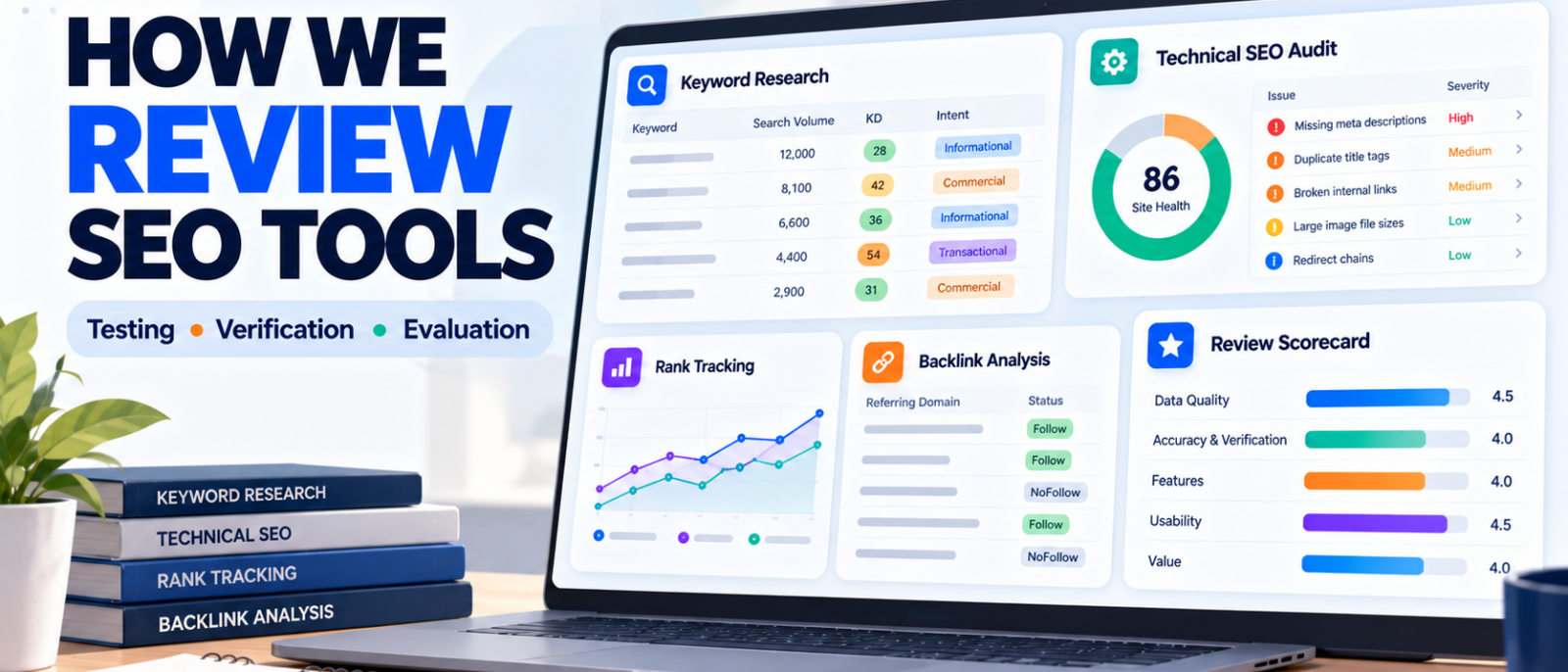
Three SEO platforms analyse the same website. One reports more backlinks, another estimates higher organic traffic, and a third identifies hundreds of technical issues the others missed.
Which one should you trust?
The answer isn’t necessarily the platform with the biggest database, highest score, or longest report. Different SEO tools collect information differently, and their results aren’t always measuring the same thing.
A useful way to review SEO tools should explain what a platform does, how its findings were evaluated, which limitations affect those findings, and whether the information helps users make better decisions.
At MediaOne, our SEO team brings more than 10 years of experience working with SEO research, technical audits, competitor analysis, and performance reporting. We’ve used platforms such as Semrush, Ahrefs, Google Search Console, Google Analytics, and Screaming Frog across different SEO workflows.
This article explains the evaluation framework we propose for reviewing SEO software, including how to compare tools fairly, investigate conflicting metrics, assess their practical value, and document findings transparently.
Methodology note: The procedures and scoring model described here are a proposed evaluation framework. Illustrative examples are not completed benchmarks, and we do not assign product scores without supporting test records.
Key Takeaways
- Useful results matter more than larger datasets. A tool should help users identify opportunities, diagnose problems, or make better SEO decisions.
- Comparable tests need consistent inputs. Keywords, websites, locations, devices, dates, and relevant configurations should be matched wherever possible.
- Different metrics require different validation methods. Search volume, rank tracking, backlinks, and technical audit results cannot all be checked using one reference source.
- Proprietary scores need context. Keyword Difficulty, authority metrics, content grades, and site-health scores are vendor-specific measurements.
- Important findings should be verified. Reviewers should examine a documented sample and investigate discrepancies before drawing conclusions.
- Transparency matters. A credible review identifies its testing scope, software plan, evidence, limitations, and relevant commercial relationships.
What Makes an SEO Tools Review Trustworthy?
Most SEO software provides more information than users can realistically act on.
A keyword research platform may generate thousands of suggestions. A backlink checker can report millions of links, while a technical crawler may flag hundreds of potential issues.
Those capabilities are useful, but the totals alone don’t establish which platform provides the best information.
Consider a hypothetical website audit.
Tool A identifies 400 missing image alt attributes. Tool B discovers 150 broken links. Tool C identifies one important product category page that has accidentally been marked noindex.
Which tool performed best?
There isn’t enough information to decide.
The missing alt attributes may deserve attention, and some broken links could affect important user journeys. However, the incorrectly noindexed category page could prevent an important commercial page from appearing in search results.
The review needs to establish whether each finding is correct, how important it is, and whether the platform helps users take the appropriate action.
That’s the difference between describing software features and evaluating software performance.
Feature Comparisons vs Practical SEO Reviews
| A Basic SEO Tool Review Asks | A More Useful SEO Tool Review Asks |
|---|---|
| How many keywords does the tool find? | How many suggestions are relevant to the intended audience? |
| How large is its backlink database? | Are the reported links current, relevant, and correctly classified? |
| How many technical problems appear? | Which findings are valid and worth fixing first? |
| How high is its content score? | Do its recommendations improve clarity, relevance, and usefulness? |
| How many features are available? | Can users complete their recurring tasks efficiently? |
| What’s the starting monthly price? | What does the required workflow cost at the appropriate subscription level? |
A strong review considers capabilities, limitations, and practical outcomes together.
It also distinguishes information verified through official documentation from features that have actually been tested.
If you’re unfamiliar with the different categories of SEO software, our complete guide to SEO tools explains what keyword platforms, crawlers, rank trackers, and backlink tools are designed to do.
The Seven Criteria in Our SEO Tool Evaluation Framework
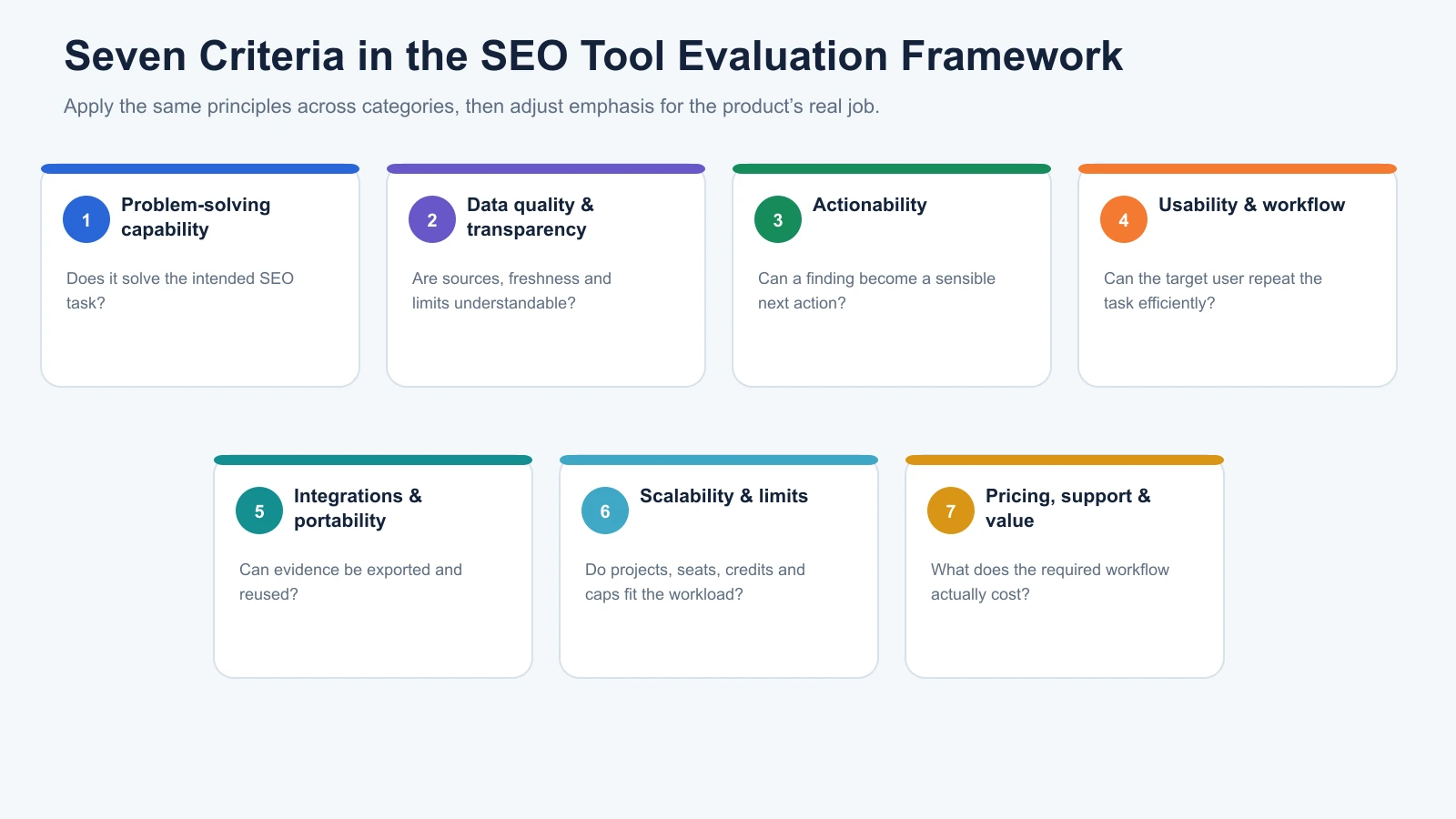
An effective review needs consistent criteria.
However, applying identical expectations to every product category would create misleading comparisons.
A dedicated technical crawler should be judged primarily on its crawling, detection, and diagnostic capabilities. A keyword research platform needs greater emphasis on research quality, relevant suggestions, and search-result analysis.
Our proposed framework uses seven criteria that can be adapted to different SEO tool categories.
1. Problem-Solving Capability
The first consideration is whether the software solves the problem it claims to address.
For example, a rank tracker may support thousands of keywords but lack the local tracking configuration required by a multi-location business.
A crawler might detect common HTML issues but offer limited options for investigating JavaScript-heavy websites.
Reviewers should therefore define the intended use case before evaluating features.
For a keyword research tool, the question might be whether it identifies realistic content opportunities.
For an audit tool, it might be whether it detects an important indexing problem.
The product’s suitability depends on the work it needs to complete.
2. Data Quality, Freshness, and Transparency
Not all SEO data comes from the same type of source.
A useful review should distinguish four categories:
| Data Type | Example | What Reviewers Should Understand |
|---|---|---|
| First-party search data | Search Console clicks and impressions | Actual reported search performance, with aggregation and reporting limitations |
| Third-party estimates | Estimated competitor organic traffic | Modelled figures rather than access to private analytics |
| Proprietary scores | Keyword Difficulty or Domain Rating | Vendor-specific calculations with defined limitations |
| Direct observations | A URL returning HTTP 404 | A result observed under particular testing conditions |
A platform may be highly useful even when its figures differ from other products.
The relevant questions are whether its measurements are explained, sufficiently current, and appropriate for the intended task.
Data quality also depends on geographic coverage, reporting history, and update frequency.
3. Actionability of Findings
Finding a problem and explaining what to do about it are different capabilities.
A technical crawler may correctly identify hundreds of duplicate titles but provide limited help identifying which affected pages matter.
Another tool might highlight a smaller group of problems with clearer explanations and prioritisation.
Reviewers should consider whether users can move from a finding to a sensible next action.
That includes identifying the affected URL, understanding the underlying issue, assessing its potential impact, and determining how to investigate it further.
A tool that generates extensive reports but requires significant manual interpretation may still be valuable to experienced specialists.
However, that limitation should be reflected in the review.
4. Usability and Workflow Efficiency
SEO professionals often perform the same tasks repeatedly.
Researching competitors, exporting keywords, checking rankings, and preparing reports can consume considerable time when software workflows are difficult to navigate.
A review should evaluate how easily users can complete these tasks.
Relevant factors include project setup, filtering, saved views, exports, reporting, documentation, and the learning curve.
When conducting a documented hands-on test, reviewers can record the time required to complete a defined task.
These measurements are most useful when the task and test conditions are consistent.
An advanced product should not automatically receive a poor usability rating because it requires technical knowledge. The review should consider the expertise of its intended users.
5. Integrations and Data Portability
SEO software rarely operates independently.
Teams frequently combine information from Google Search Console, Google Analytics 4, spreadsheets, reporting dashboards, and content management systems.
Reviewers should investigate whether a product connects to the relevant services and supports practical exports.
For example, can users download raw keyword data, preserve historical rankings, or access findings through an API?
A platform may produce excellent insights but create operational difficulties if its data cannot be reused elsewhere.
The importance of those limitations depends on the user’s workflow.
6. Scalability and Operational Limits
Subscription allowances become increasingly important as websites and teams grow.
A platform might include enough keyword research capacity for one small business but insufficient rank tracking for an agency managing several clients.
Reviewers should identify relevant limits, including projects, tracked keywords, crawl credits, user seats, research requests, exports, and API access.
Importantly, these allowances measure different things.
A subscription with 5,000 tracked keywords does not necessarily include 5,000 keyword research requests, and unlimited website projects don’t always mean unlimited ranking checks.
The review should explain which restrictions affect the intended use case.
7. Pricing, Support, and Overall Value
The advertised subscription price rarely tells the full story.
Additional users, larger projects, expanded tracking capacity, and reporting features can change the actual cost.
Reviewers should compare the subscription required to complete a defined workload, not simply the cheapest available plans.
Support and documentation also matter, particularly for teams depending on the platform for regular reporting or complex technical work.
A more expensive product can represent better value when it meaningfully reduces manual work.
Equally, a simpler product may be sufficient when the additional capabilities of a premium platform aren’t needed.
How We Establish Comparable Testing Conditions
One of the most important principles in SEO software evaluation is keeping the test conditions consistent.
Different inputs can produce different results even when both platforms operate correctly.
For example, a rank tracker checking mobile results in Singapore shouldn’t be directly compared with another monitoring desktop results across the entire country.
Similarly, a website crawler configured to execute JavaScript may discover different links and page information from one examining only the initial HTML.
Without documenting these differences, a review risks attributing normal variations to product performance.
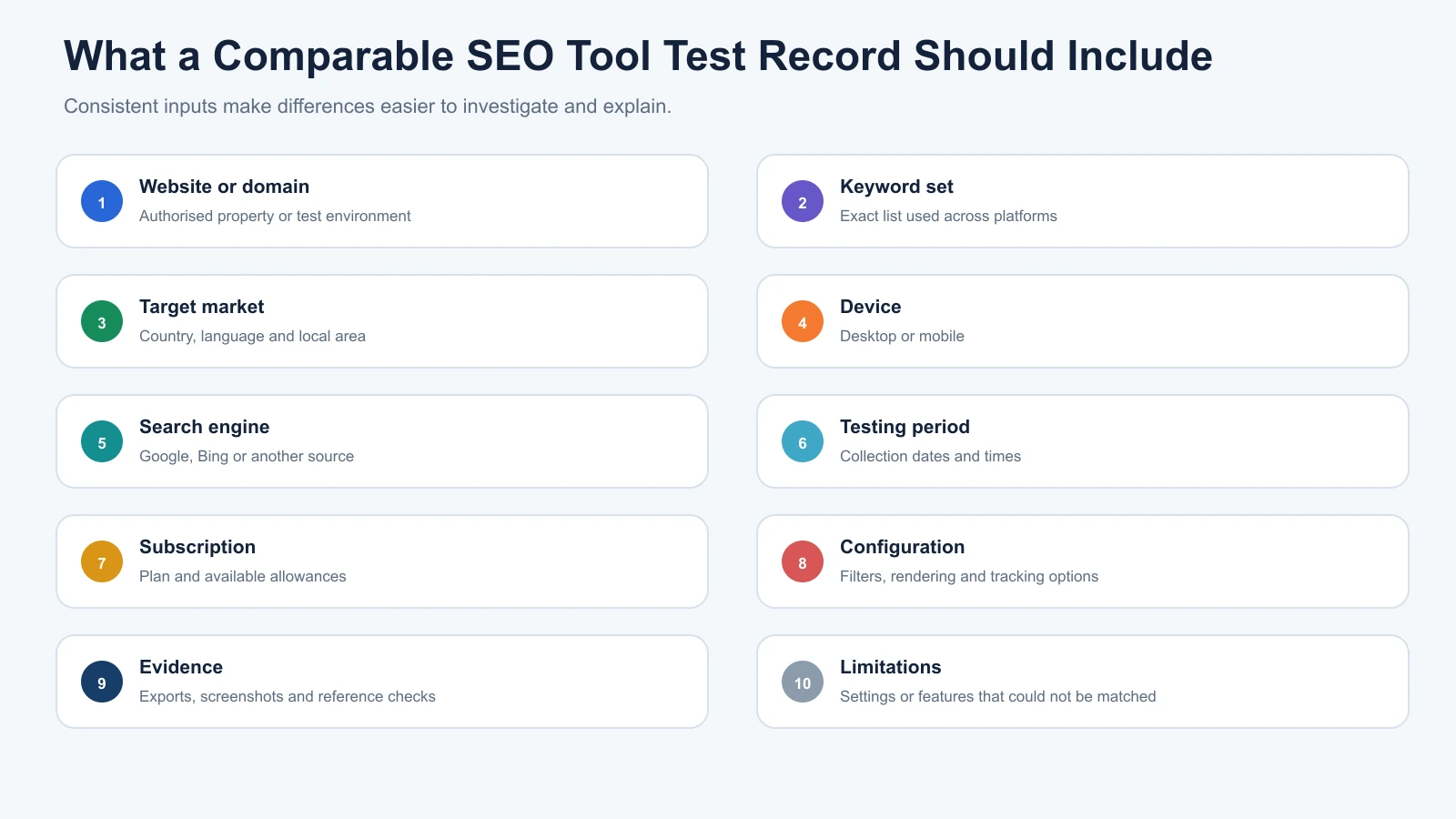
What a Proper Test Record Should Include
| Testing Variable | Information to Record |
|---|---|
| Website or domain | The tested property or authorised test environment |
| Keyword set | Exact list used across platforms |
| Target market | Country, language, and local area |
| Device | Desktop or mobile |
| Search engine | Google, Bing, or another supported source |
| Testing period | Collection dates and times |
| Subscription | Product plan and available allowances |
| Configuration | Filters, crawl settings, rendering, and tracking options |
| Evidence | Raw exports, screenshots, and reference checks |
| Limitations | Settings or features that couldn’t be matched |
These details help readers understand whether different results can be compared fairly.
Example: Why Two Crawlers May Report Different URL Counts
Imagine two technical SEO crawlers auditing the same website.
The first discovers 4,800 URLs, while the second reports 3,900.
It would be tempting to conclude that the first crawler is more comprehensive.
However, suppose the first tool follows parameterised URLs and the second excludes them.
The difference could come from configuration rather than a failure to detect existing pages.
The same problem can arise when crawlers use different user agents, robots.txt handling, rendering modes, or crawl limits.
Screaming Frog’s official documentation explains that configuration, website changes, server responses, and rendering can all affect results between crawls.
A fair review investigates these differences before drawing conclusions.
When equivalent settings are unavailable, the limitation should be disclosed rather than presenting the comparison as identical.
How We Evaluate Keyword Research Tools
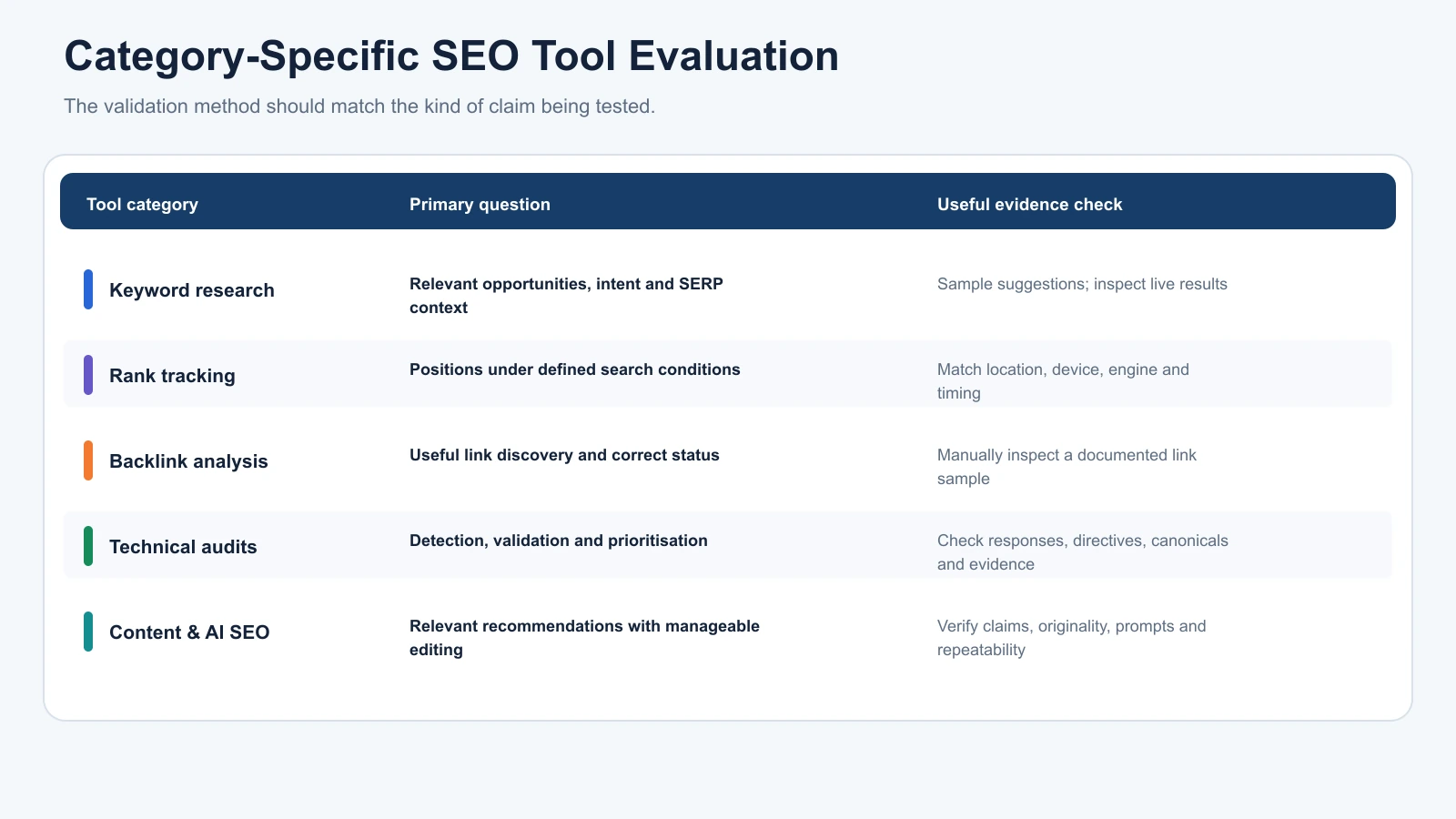
Keyword research platforms are particularly difficult to compare because their databases, estimates, and proprietary metrics are built differently.
Our proposed evaluation approach focuses on the relevance and usefulness of the information rather than database size alone.
Keyword Suggestion Relevance
Start with a representative list of seed keywords.
The list should include different search intents and topics relevant to the intended audience.
For example, a business researching SEO software might investigate informational terms, comparison searches, and product-specific queries.
Use the same list and geographic settings in each platform.
Then evaluate a sample of suggestions to determine whether they are relevant, genuinely distinct, and appropriate for the website.
A tool returning 5,000 suggestions isn’t necessarily more useful than one returning 500.
If most suggestions are unrelated or duplicates, the larger database may create additional filtering work.
Reviewers should disclose the sample size and explain how relevance was judged rather than assigning unsupported accuracy percentages.
Search Volume Estimates
Search volume is one of the most frequently misunderstood keyword metrics.
Third-party platforms estimate demand using their own sources and models.
Google Keyword Planner provides useful estimates from Google’s advertising ecosystem, but it isn’t a definitive measurement of the organic traffic available to a new webpage.
Its Competition metric also refers to advertising competition rather than organic ranking difficulty.
When two tools report different search volumes, the review should check the selected country, search settings, collection date, and available methodology.
Consider a hypothetical keyword with 2,000 estimated monthly searches in one tool and 2,800 in another.
The difference deserves investigation, but it doesn’t automatically establish that either product is inaccurate.
What matters is whether the figures provide sufficient context for the intended decision.
Search Intent and SERP Analysis
Keyword research software increasingly classifies queries by likely search intent.
Common categories include informational, commercial, transactional, and navigational.
These classifications are useful, but they still require interpretation.
Suppose a platform describes a keyword as informational while the current results are dominated by product comparisons and pricing pages.
That would warrant a closer look at the classification.
A practical evaluation examines the actual search results, competing page types, and available search features.
The goal is to determine whether the tool helps users understand the type of content appropriate for a query.
Our free keyword research tools comparison explores how different products support keyword discovery and where their limitations begin.
Keyword Difficulty
Keyword Difficulty is a proprietary estimate of organic ranking competition.
It isn’t an official Google measurement.
For example, Ahrefs explains that its Keyword Difficulty score considers the referring domains linking to the top ten organic ranking pages, without including on-page SEO factors.
Other platforms use different methods.
Consequently, a score of 30 in one product shouldn’t automatically be treated as equivalent to a score of 30 elsewhere.
A useful review examines whether each score helps identify relative competition and prioritise realistic opportunities.
It should also explain what the metric leaves out.
How We Evaluate Rank Tracking Tools
Rank tracking software monitors where webpages appear for specified search queries.
Although the function seems straightforward, results can differ considerably depending on the configuration.
Controlling Search Conditions
A comparable evaluation should record the same keyword list, location, language, search engine, device, and observation window wherever supported.
These settings matter because search results aren’t identical for every user.
A business ranking prominently on desktop in one location may appear differently on mobile or in another city.
Update frequency also affects comparisons.
A platform checking rankings daily can capture movements that another tool updating weekly may not report in the same way.
The review should identify which differences reflect settings, update schedules, or actual product limitations.
Comparing Rank Trackers With Search Console
Google Search Console’s Performance report includes average position.
However, average position is aggregated across impressions under the report’s selected dimensions and filters.
A dedicated rank tracker generally monitors specified keywords under selected tracking conditions.
These measurements serve different purposes.
For example, a tracker might report position five for one keyword in a particular city.
Search Console might show a different average position because the page appeared across different searches, devices, and locations.
That disagreement doesn’t automatically mean either tool is defective.
The reviewer should explain the difference rather than presenting the figures as interchangeable.
Tracking History, Reports, and Alerts
Beyond ranking positions, the review should assess how well the software communicates changes.
Useful capabilities may include historical trends, keyword groups, location filters, competitor comparisons, and configurable alerts.
The platform should make meaningful changes easier to investigate.
A tool generating excessive alerts about minor fluctuations may create more work than value.
Similarly, a reporting system may be accurate but poorly suited to agencies if it requires substantial manual preparation.
Reviewers should evaluate these operational considerations alongside the underlying ranking data.
How We Evaluate Backlink Analysis Tools
Backlink research is another area where platforms frequently report different numbers.
One tool may identify more referring domains, while another shows additional historical links or linking pages.
Those totals can’t be compared fairly until the review establishes what each platform counts.
Backlink Discovery and Coverage
The first consideration is whether the tool identifies relevant links pointing to the target website.
Different backlink platforms maintain their own indexes and crawling systems, so coverage varies.
A larger index can be useful, particularly for extensive competitor research.
However, a larger reported count doesn’t automatically demonstrate greater accuracy.
Reviewers should distinguish referring domains from individual backlinks, and live links from lost or historical records.
Link Status and Manual Verification
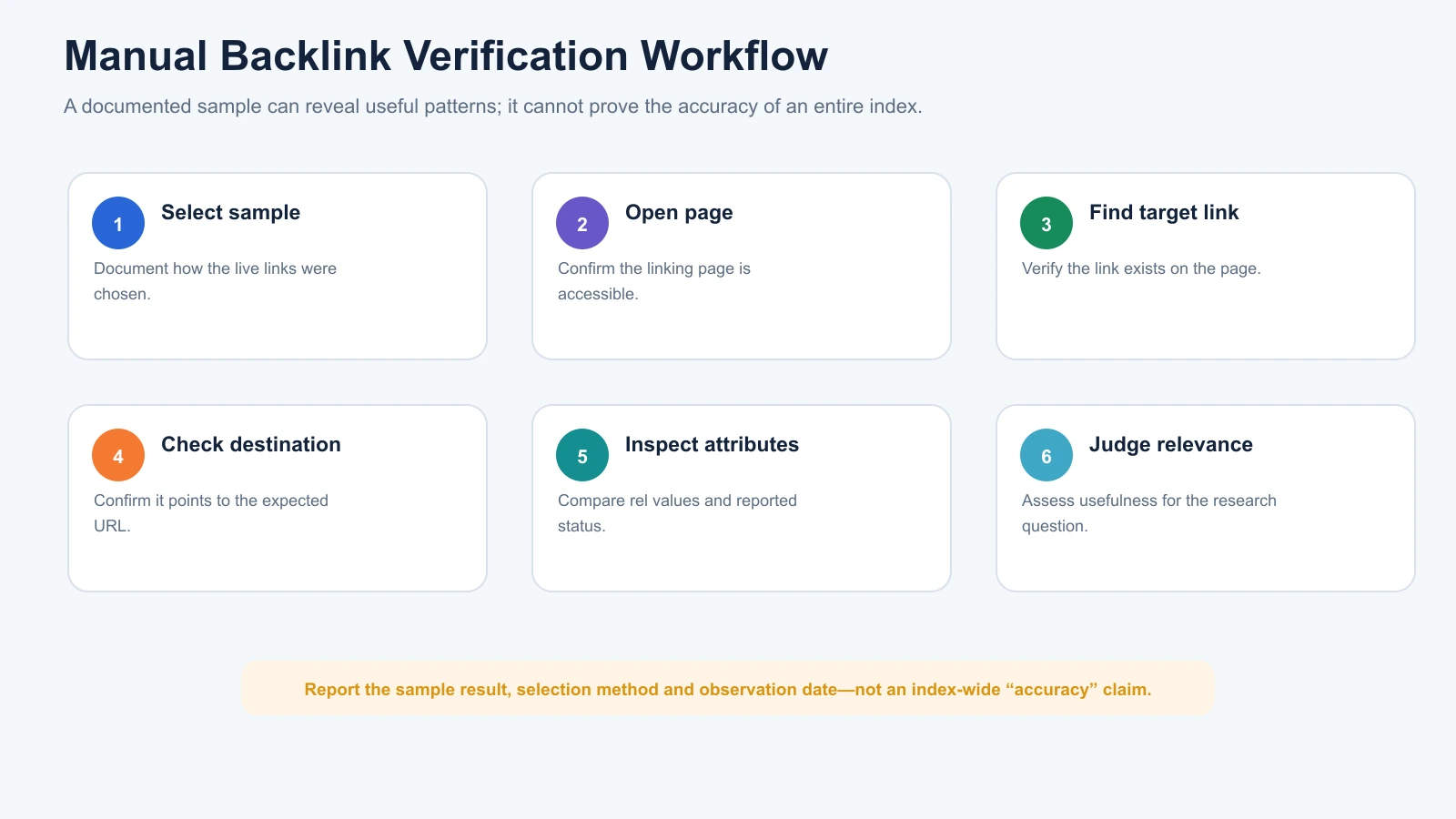
A repeatable evaluation can inspect a documented sample of reported backlinks.
For example, reviewers might select 20 linking pages from a particular tool’s live-link report.
The sample would be checked for whether:
- The linking page is accessible.
- The stated target link exists.
- The link points to the expected URL.
- The reported
relattributes match the page. - The linking page is relevant to the intended research question.
The review should record the date because linking pages can change.
Importantly, a sample of 20 links can reveal errors or useful patterns, but it cannot establish the accuracy of an entire backlink database.
Results should be described within their actual scope.
For example, stating that 17 of 20 sampled links were confirmed is more defensible than claiming the platform is 85% accurate overall.
That figure would only describe the specific sample.
Why Search Console Isn’t a Complete Backlink Benchmark
Google Search Console’s Links report can provide useful information about links associated with a verified property.
However, Google explains that the report shows a sample of links rather than a comprehensive list.
It also doesn’t function as a backlink intelligence platform for unrelated competitor websites.
Therefore, a backlink reported by Ahrefs or another provider but absent from Search Console isn’t necessarily nonexistent.
A reviewer should examine the linking page itself when investigating such discrepancies.
The focus should remain on the quality and usefulness of reported backlinks rather than simply counting which tool has the most.
How We Evaluate Technical SEO Audit Tools
Technical auditing software helps identify potential problems involving crawling, indexing signals, links, metadata, and website structure.
However, detecting an issue doesn’t automatically establish its importance.
A useful review should evaluate detection, validation, and prioritisation separately.
Technical Detection Coverage
The proposed evaluation checks whether the software can investigate relevant technical conditions.
| Technical Area | What Reviewers Examine |
|---|---|
| HTTP status codes | Broken pages, server responses, and accessibility |
| Redirects | Chains, loops, and unexpected destinations |
| Canonical tags | Missing, conflicting, or unsuitable canonical signals |
| Indexing directives | Meta robots and X-Robots-Tag directives |
| Internal linking | Broken links, crawl paths, and linking structure |
| XML sitemaps | Missing, redirected, or problematic URLs |
| Structured data | Detected markup and identifiable implementation issues |
| JavaScript rendering | Differences between initial and rendered content |
The exact testing scope should depend on the product and the intended website.
For example, advanced JavaScript rendering may be essential for a modern web application but less important for a simple static website.
Reviewers should document which settings were enabled before comparing crawl results.
Validating Findings Against Independent Evidence
A crawler may report that a page is not indexable.
To investigate, the reviewer can inspect the page’s HTTP response, robots directives, canonical tags, and relevant information in Search Console.
These sources describe different parts of the process.
A third-party crawler reports what it observed under its own settings.
Search Console provides information about Google’s crawling and indexing of the verified website.
Differences between them can reflect timing, configuration, or distinct measurement methods.
For example, a page may currently contain noindex while Google’s last recorded indexing state has not yet reflected the change.
Google’s documentation on blocking indexing also explains why robots.txt and noindex cannot be treated as identical mechanisms.
A review should investigate these distinctions rather than automatically classifying disagreements as product errors.
Prioritising Technical Issues
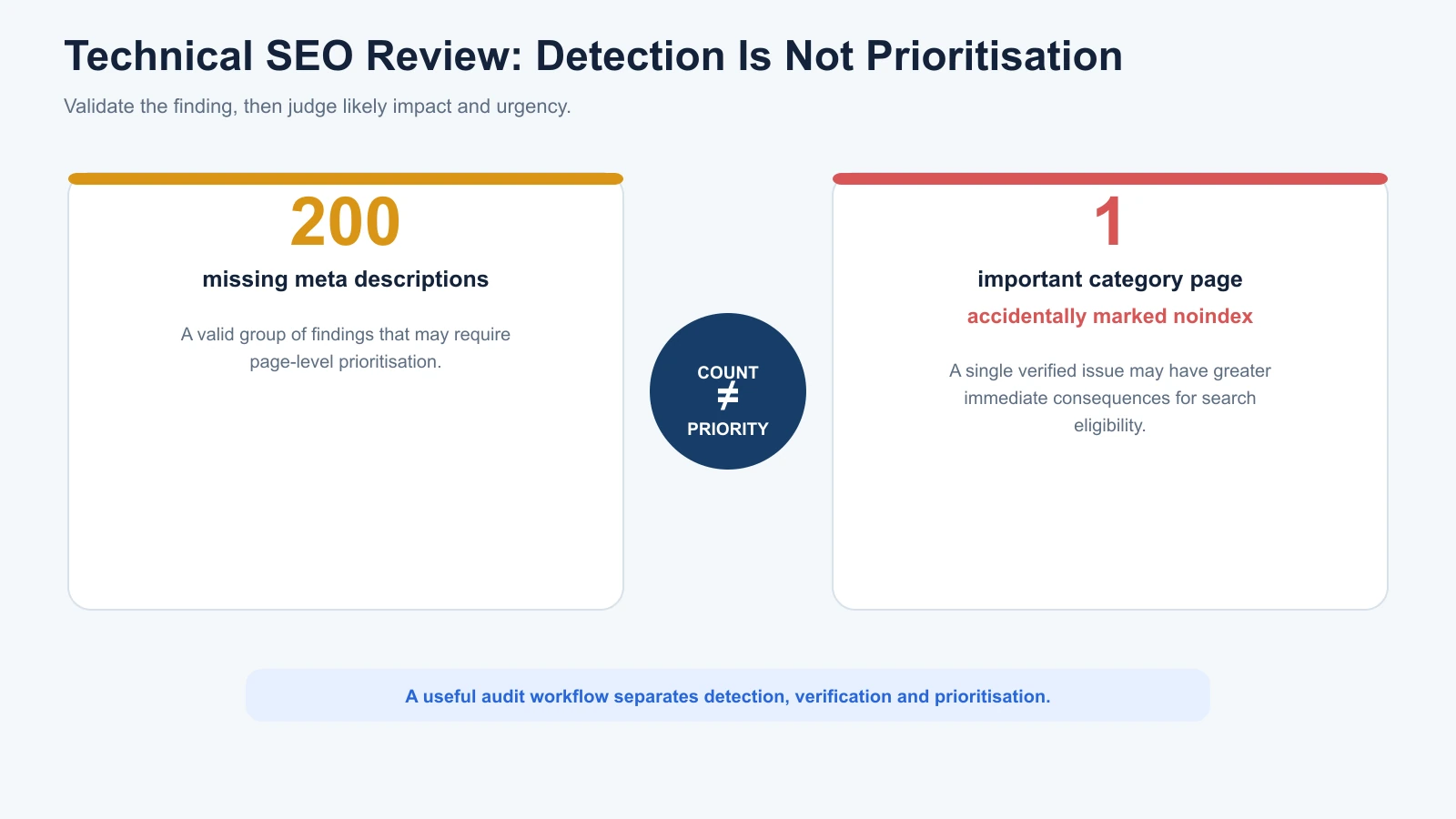
One of the most valuable audit features is the ability to identify which findings deserve attention first.
Consider a hypothetical ecommerce website.
A crawler discovers 200 missing meta descriptions and one important category page accidentally marked noindex.
Both categories of findings may be valid.
However, the incorrectly noindexed page could have a much more immediate effect on that page’s eligibility to appear in search results.
A useful audit workflow should help users identify that distinction.
Reviewers should therefore examine whether the software provides meaningful severity classifications, issue explanations, filtering, and useful next steps.
The number of problems detected is only one part of the assessment.
Our technical SEO crawler comparison also illustrates how detection and prioritisation can be discussed, although its published sample article is labelled illustrative rather than completed research.
How We Evaluate Content Optimisation and AI SEO Tools
Content optimisation platforms commonly provide keyword recommendations, suggested topics, competitor comparisons, content scores, and AI-generated writing assistance.
These features require a different evaluation approach from rank trackers or website crawlers.
The main question is whether their recommendations improve the quality and usefulness of the editorial work.
Relevance of Content Recommendations
Reviewers should examine whether suggested topics and headings reflect the actual search intent.
A tool may recommend adding terms that appear frequently in competing pages.
However, including those words doesn’t necessarily make an article more useful.
A proper evaluation should determine whether the recommendations help answer important reader questions, fill genuine information gaps, or improve clarity.
Factual Accuracy and Originality
AI-assisted platforms can produce useful starting points, but they may also introduce outdated information, unsupported claims, or repetitive explanations.
For this reason, reviewers should inspect a sample of recommendations and verify material factual claims using appropriate sources.
The review should also consider whether the tool encourages original analysis or merely reproduces the structure and wording of existing content.
A higher proprietary content score does not automatically establish better editorial quality or stronger search performance.
Editing Effort and Practical Value
A useful content tool should support the editorial process rather than create substantial additional work.
Reviewers can evaluate how much editing is required to produce accurate, relevant, publishable content.
This includes checking structure, clarity, search intent, sources, internal links, and duplication.
For AI-search visibility products, additional considerations include the prompts used, supported platforms, observation dates, and whether the findings remain consistent across repeated observations.
A single AI-generated response shouldn’t be presented as a stable measure of brand visibility.
Our Proposed SEO Tool Scoring Framework
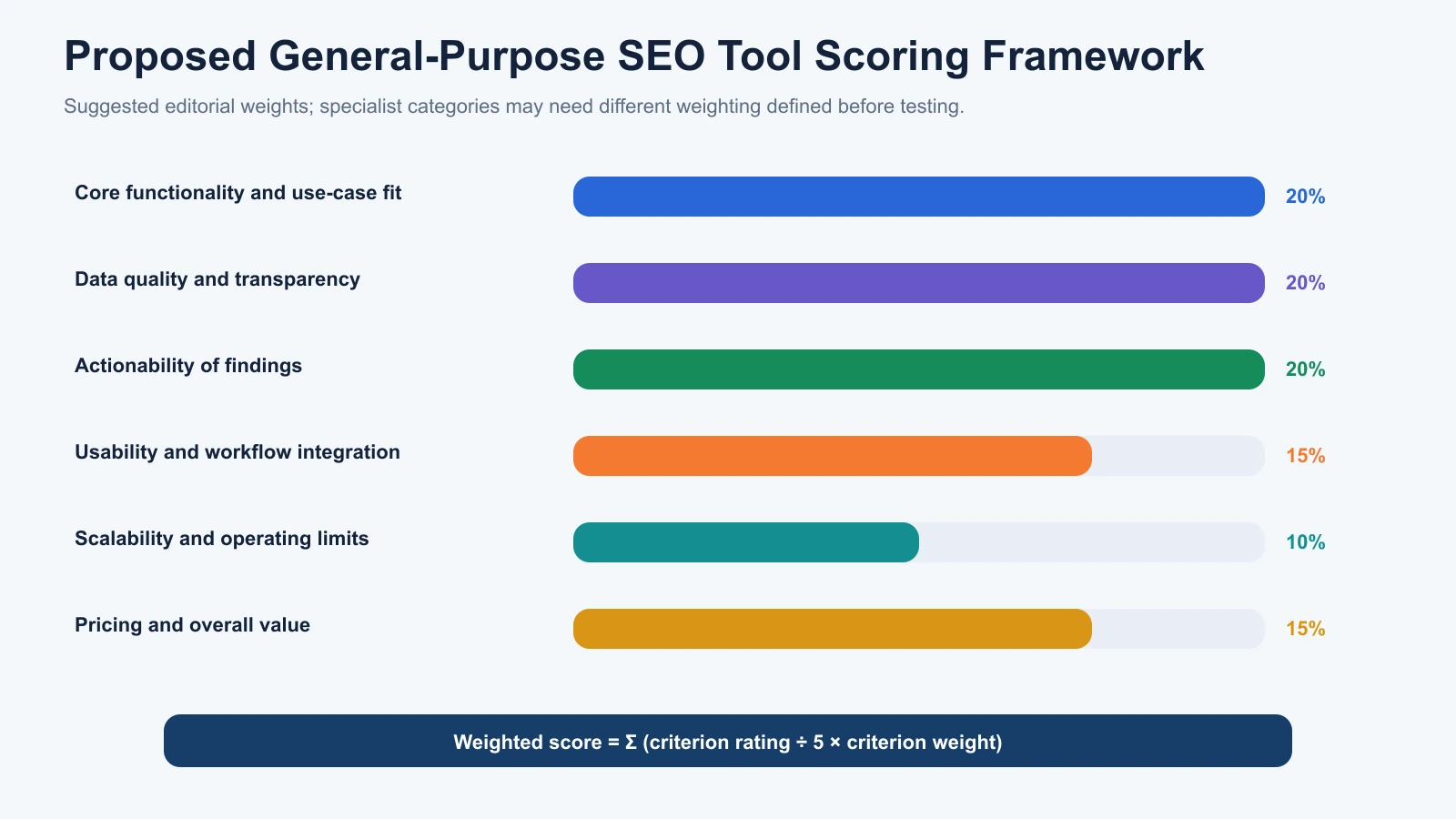
A review score is only useful when readers understand how it was calculated.
Rather than treating every feature as equally important, we recommend using weighted criteria based on the tool’s intended purpose.
The following is a proposed general-purpose framework.
| Evaluation Criterion | Suggested Weight |
|---|---|
| Core functionality and use-case fit | 20% |
| Data quality and transparency | 20% |
| Actionability of findings | 20% |
| Usability and workflow integration | 15% |
| Scalability and operating limits | 10% |
| Pricing and overall value | 15% |
| Total | 100% |
Each criterion receives a rating from one to five.
The weighted result can then be calculated using:
Weighted Score = Sum of (Criterion Rating ÷ 5 × Criterion Weight)
For example, a hypothetical tool receiving four out of five for a criterion weighted at 20% earns 16 percentage points toward the total score.
The complete result combines the applicable weighted criteria.
These percentages are proposed editorial weights, not a validated industry benchmark.
A specialist category may require different weighting.
For instance, a dedicated backlink platform may place greater emphasis on data quality, while a technical auditing product may require greater weight for detection and actionable diagnostics.
Any such adjustments should be defined before the evaluation begins.
Why We Don’t Assign Scores Without Evidence
An impressive-looking rating means little when the underlying tests aren’t documented.
A review should distinguish between features that have been tested, claims verified through documentation, and capabilities that couldn’t be evaluated.
If a product’s API or enterprise reporting wasn’t available under the tested plan, that limitation should be disclosed.
It shouldn’t receive an invented score simply to complete the comparison table.
A rating should reflect evidence within a clearly described scope.
How Review Evidence and Limitations Should Be Documented
Readers should be able to understand how a review reached its conclusions.
That requires more than publishing an overall score.
A useful review record should include:
| Review Detail | Information to Document |
|---|---|
| Product | Name and version, where applicable |
| Plan | Subscription or trial used |
| Reviewer | Identified author or evaluator |
| Test date | Dates the software was evaluated |
| Test environment | Website, market, device, and settings |
| Completed tasks | Research, auditing, tracking, or other workflows |
| Evidence | Exports, screenshots, observations |
| Verification | Official sources and manual checks |
| Limitations | Missing access or unmatched conditions |
| Last updated | Most recent verification date |
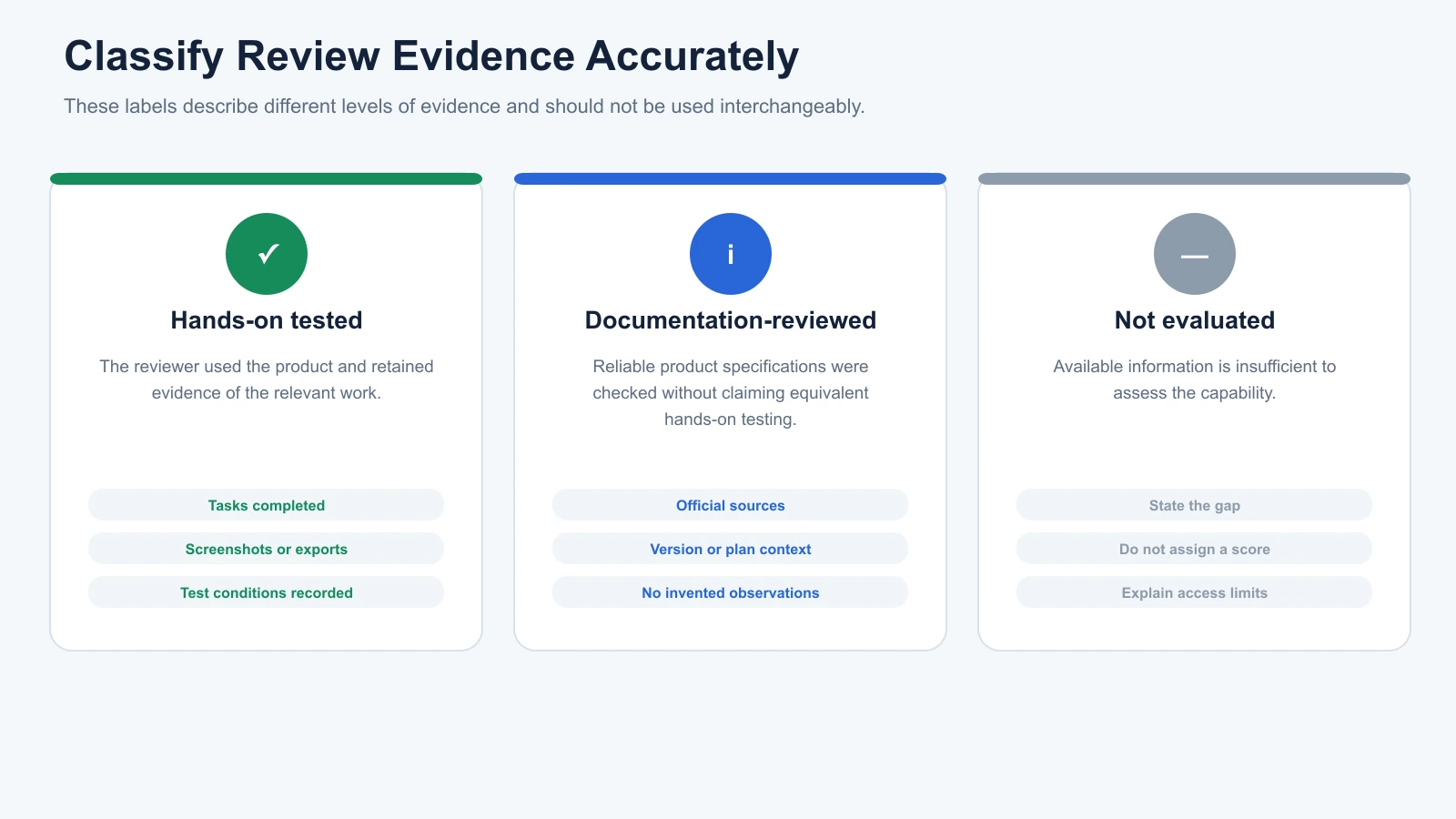
The evidence itself should also be classified accurately.
Hands-on tested means the reviewer used the product and retained evidence of the relevant work.
Documentation-reviewed means its features or specifications were checked using reliable sources, without claiming equivalent hands-on testing.
Not evaluated means there isn’t enough information to assess the capability.
These descriptions are not interchangeable.
Documentation-based research can still help readers understand a product, but it shouldn’t be described as a controlled benchmark.
Editorial Transparency and Sponsorship
Disclosure: DigitalMarketingTools.ai is sponsored by Digimetrics.ai, which is developed by MediaOne.
A software review should make relevant commercial relationships clear so readers understand the context in which recommendations appear.
A transparent evaluation should also explain the evidence supporting its conclusions and acknowledge limitations that could affect them.
For example, a product supplied through vendor-provided access should be identified as such when relevant.
Likewise, a review based only on public documentation should not imply that the reviewer personally tested every feature.
DigitalMarketingTools.ai maintains an Editorial Methodology page describing proposed standards for testing, disclosure, corrections, and ratings.
At the time of this article, that page is labelled as a draft awaiting approval. It should not be interpreted as evidence that every proposed testing procedure has already been completed or formally adopted.
The purpose of transparent methodology is to make editorial judgements easier to understand and evaluate.
How SEO Tool Reviews Should Be Kept Up to Date
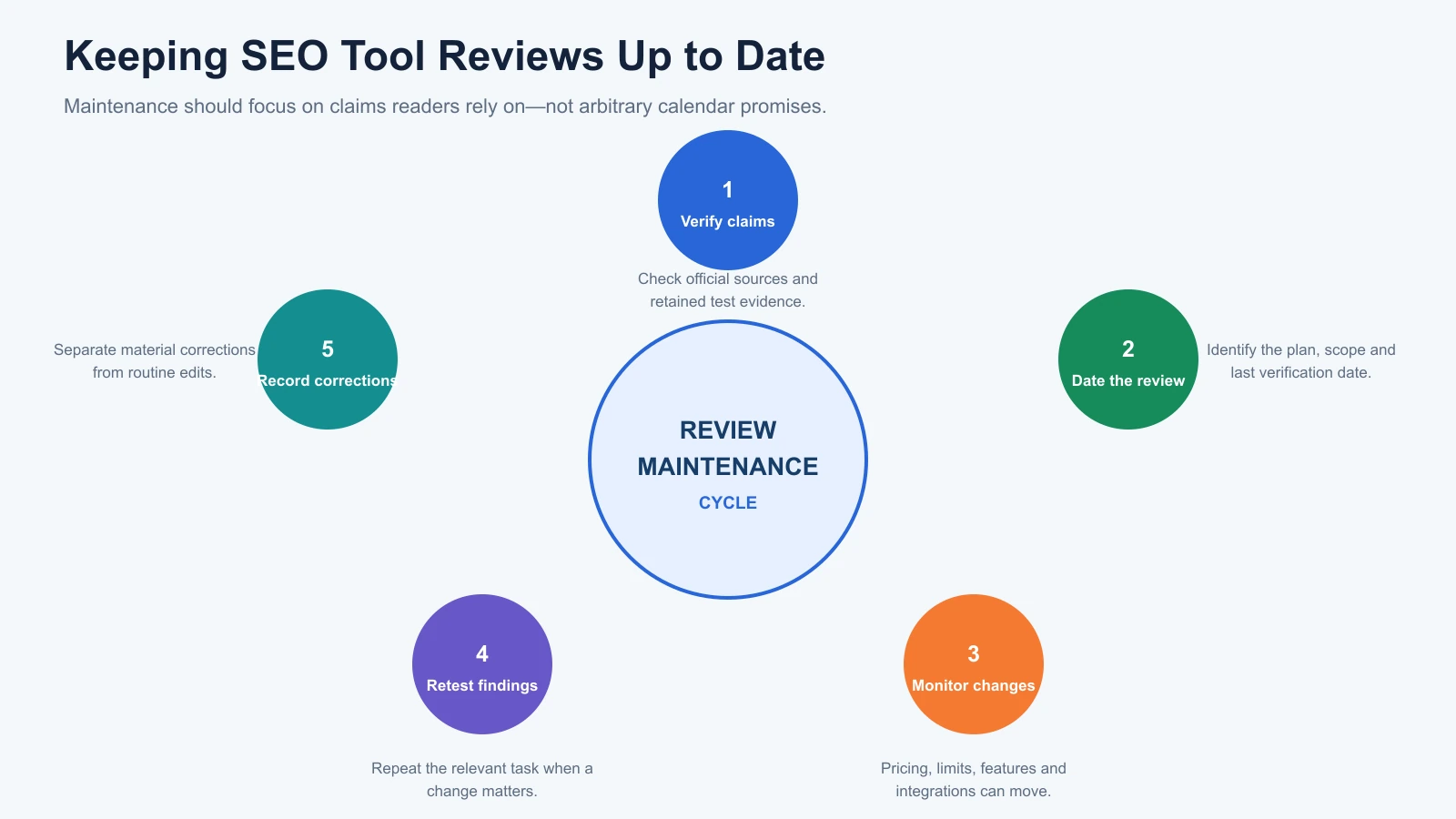
SEO software changes regularly.
Subscription prices, features, research allowances, supported integrations, and AI capabilities can change after an article is published.
A review that was accurate at publication may eventually describe a product that no longer exists in the same form.
For this reason, review maintenance should include periodic checks of official documentation and the specific claims readers are likely to rely on.
When significant product changes affect an earlier judgement, the relevant parts of the evaluation should be reconsidered.
A useful update record identifies what was changed and when the information was last verified.
Material corrections should also be distinguished from routine wording updates.
The goal isn’t to promise that every tool will be retested on an arbitrary schedule.
It’s to ensure the article makes clear which information remains verified and which findings may need additional evaluation.
Final Verdict: What Makes an SEO Tools Review Worth Trusting?
Reviewing SEO software properly requires more than collecting feature lists, comparing database sizes, or assigning scores.
The evaluation needs to begin with a real SEO task.
Keyword research platforms should be judged by whether they identify relevant opportunities and provide useful context.
Rank trackers should be evaluated under clearly defined search conditions.
Backlink tools should be assessed for discovery, status, relevance, and the limits of their datasets.
Technical crawlers should be evaluated on what they detect, whether important findings can be verified, and how effectively they help users prioritise work.
Content optimisation tools should be judged by the relevance, accuracy, and usefulness of their recommendations.
At MediaOne, our experience with SEO research and auditing tools reinforces one practical principle: a platform’s value depends on the decisions its information supports.
That is the principle behind the evaluation framework described here.
A credible SEO tools review makes its criteria clear, documents its evidence, acknowledges uncertainty, and distinguishes actual testing from product documentation.
It doesn’t need to prove that one platform is perfect.
It needs to give readers enough reliable information to understand where a tool is useful, where it has limitations, and whether it deserves a place in their workflow.
For help turning those findings into a purchasing decision, see our guide on how to choose the right SEO tool for your business.
Frequently Asked Questions
How Do Professionals Review SEO Tools?
SEO professionals can evaluate software by defining a relevant task, establishing comparable testing conditions, examining the results, and validating important findings. A credible review also considers usability, integrations, subscription limits, and overall cost. The testing scope and supporting evidence should be documented.
Why Do Different SEO Tools Show Different Results?
SEO platforms use different data sources, crawling systems, update schedules, and calculation methods. They may also use different locations or configurations. Conflicting numbers don’t automatically mean one product is incorrect. Reviewers should investigate the methodology and settings before deciding what the differences mean.
Does a Bigger Keyword Database Mean a Better SEO Tool?
Not necessarily. A large database may provide broader coverage, but its usefulness depends on relevant keywords, suitable geographic data, meaningful filters, and reliable context. Reviewers should consider the quality of the opportunities discovered rather than the total number of suggestions alone.
Is Keyword Difficulty the Same Across SEO Tools?
No. Keyword Difficulty is calculated using proprietary methods that vary between providers. Ahrefs, for example, bases its score on referring-domain data for leading organic results. Scores from different platforms shouldn’t automatically be compared as equivalent measurements.
Is Google Search Console More Accurate Than SEO Tools?
Search Console provides first-party information about a verified website’s performance in Google Search. However, it doesn’t replace competitor research platforms or dedicated rank trackers. Different tools measure different things, so accuracy depends on the specific metric and question being investigated.
How Many Backlinks Should Be Manually Checked in a Review?
A review might inspect a documented sample of 20 links or use a different sample size appropriate to the task. The important factors are how links were selected, which properties were verified, and what limitations apply. A small sample cannot establish the accuracy of an entire backlink database.
What Is the Most Important Test for a Technical SEO Audit Tool?
A useful technical audit evaluation checks whether the software detects important issues, whether those findings can be verified, and whether it helps users prioritise them. Identifying a serious indexing problem on a valuable page may be more useful than reporting hundreds of low-priority warnings.
Are SEO Tool Review Scores Reliable?
Review scores can be useful when the criteria, weights, and supporting evidence are transparent. However, a numerical rating should not replace an explanation of the product’s strengths and limitations. Scores based on incomplete testing or undisclosed assumptions can give readers a misleading impression of precision.
How Often Should SEO Tool Reviews Be Updated?
Reviews should be revisited when significant product changes affect earlier findings, particularly changes to pricing, usage limits, functionality, or integrations. The review should identify when important details were last verified and disclose material corrections where relevant.
Have All the Tests in This Framework Been Completed?
No. This article describes a proposed evaluation framework and explains how its tests can be conducted. Any future published benchmark or product rating should identify the actual testing conditions, review dates, evidence, and limitations rather than treating illustrative examples as completed results.
Disclosure: digitalmarketingtools.ai is sponsored by Digimetrics.ai. Sponsored Highlights are clearly labelled advertising. Our reviews, comparisons and guides are written to be useful and fair regardless of who sponsors the site. Read the full disclosure.


