What Is an AI Search Visibility Tool? Features, Metrics, and How to Choose
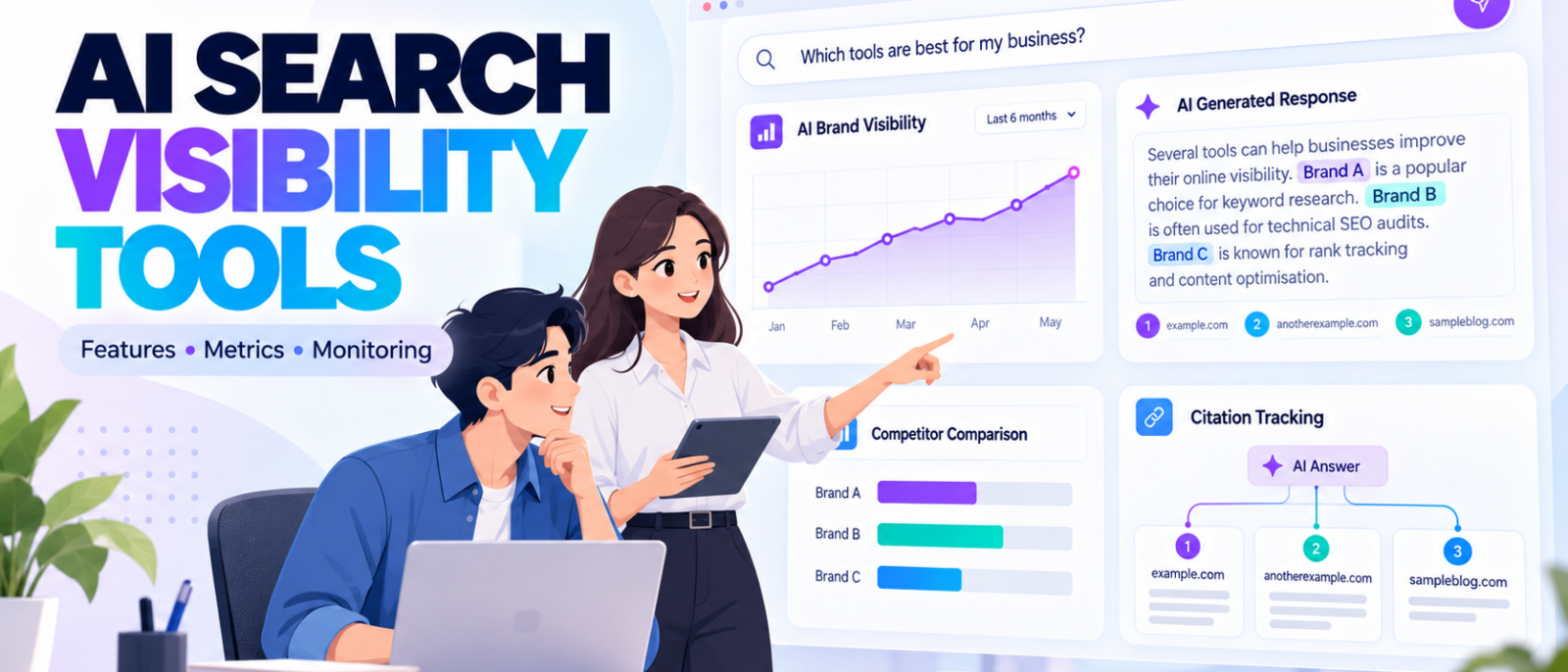
A business can rank well on Google, publish useful content, and maintain a technically healthy website without appearing in AI-generated recommendations. Someone might ask ChatGPT to compare products in your industry or use Google AI Mode to research a service, only to receive an answer featuring competitors instead of your brand.
Traditional SEO reports don’t always explain these situations. Google Search Console can help you understand your search performance, while rank trackers monitor keyword positions. However, neither provides a complete picture of how your brand is represented across AI-generated answers.
An AI search visibility tool is software that monitors how brands, products, and websites appear in responses generated by AI-powered search systems. Depending on the platform, it can measure brand mentions, source citations, competitor visibility, relevant prompts, and changes in those observations over time.
These measurements introduce new opportunities for SEO research, but they also create challenges. AI-generated answers can vary between requests, platforms use different approaches to selecting information, and vendors calculate visibility scores using different methods. A brand mention doesn’t necessarily mean a recommendation, just as a citation doesn’t guarantee website traffic.
This guide explains the AI search visibility tool features SEO teams should prioritise, the metrics worth understanding, and how to evaluate platforms before investing in another subscription.
Key Takeaways
- AI search visibility tools measure brand presence in generated answers, including mentions, citations, competitor appearances, and monitored prompts.
- Platform coverage and prompt selection determine what the data represents. Monitoring a few questions in ChatGPT doesn’t establish visibility across every AI search experience.
- First-party reports and third-party monitoring serve different purposes. Google Search Console and Bing Webmaster Tools provide platform-specific evidence, while specialist tools can investigate brands and competitors across sampled AI responses.
- Visibility scores aren’t universal standards. Compare underlying responses, collection methods, and measurement definitions rather than treating proprietary scores as interchangeable.
- The best tool is the one that supports useful decisions. Reliable evidence, relevant monitoring, practical reporting, and reasonable costs matter more than the number of dashboard features.
How Does an AI Search Visibility Tool Work?
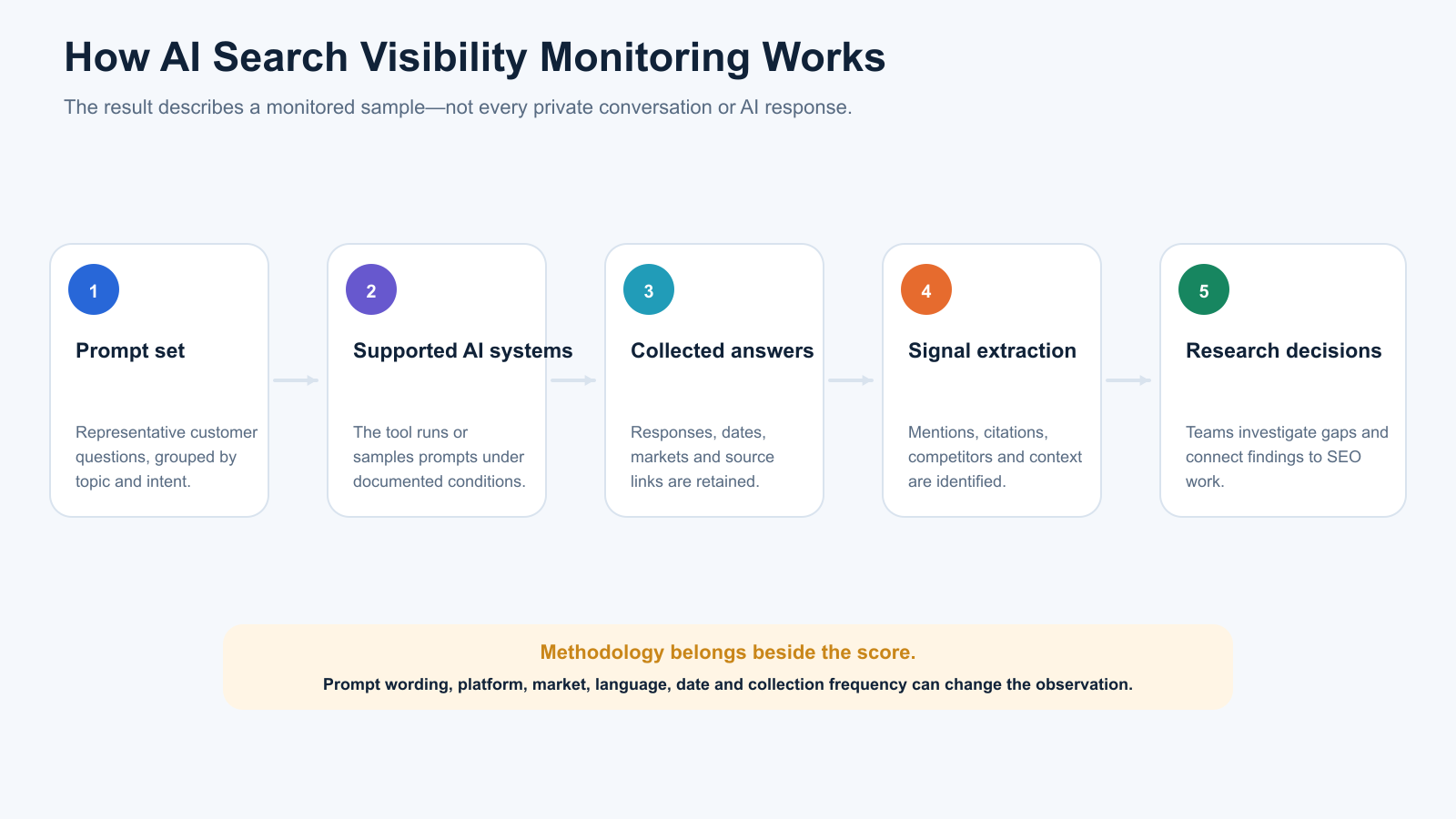
An AI search visibility tool examines generated answers to understand whether a particular brand, product, or website appears. Most third-party platforms do this by monitoring selected questions, collecting responses from supported AI systems, and analysing the information within those responses.
Consider a project management software company that wants to understand its visibility among small creative agencies. Its team might monitor a question such as “Which project management tools are best for creative agencies managing multiple clients?” The tool records which products appear in the answer, whether competitors receive recommendations, and which websites are cited as supporting sources.
Repeated observations can reveal patterns across monitored questions and collection periods. However, these findings describe the responses the tool collected, not every interaction that real users had with the AI platform.
How AI Visibility Differs From Traditional Rank Tracking

A conventional rank tracker typically monitors a selected keyword under defined search conditions, such as country, location, device, and search engine. It records where a website appears in the results and how that position changes over time.
AI visibility monitoring is different because generated answers don’t always present a conventional ranked list. An assistant may compare several products, describe their strengths and weaknesses, and cite independent publications without assigning a fixed ranking position to each brand.
| Traditional SEO Rank Tracking | AI Search Visibility Monitoring |
|---|---|
| Tracks keyword positions | Tracks appearances in AI-generated answers |
| Monitors selected websites and URLs | Monitors brands, products, and cited sources |
| Measures ranking movement | Measures mentions, citations, and prompt coverage |
| Compares competitors in search results | Compares competitors mentioned in AI responses |
| Uses ranking history | Uses collected AI responses and visibility history |
| Supports conventional SEO reporting | Supports GEO and AI-search analysis |
These approaches complement each other. A brand can maintain strong traditional rankings without appearing consistently in AI-generated comparisons, while a publication can receive an AI citation without holding the top organic position for a related keyword.
Our complete GEO tools guide explains how these measurements fit into Generative Engine Optimization and why GEO should extend existing SEO practices rather than replace them.
What Features Should an AI Search Visibility Tool Have?
The most useful AI search visibility tools go beyond showing a single visibility percentage. They provide enough information to understand where a brand appears, which competitors receive attention, and whether a change represents something worth investigating.
Not every business needs every available feature. However, several capabilities deserve careful evaluation because they determine how reliable and actionable the reports will be.
AI Platform Coverage
Platform coverage determines which AI experiences a tool monitors. Common examples include ChatGPT Search, Google AI Overviews, Google AI Mode, Perplexity, Gemini, and Microsoft Copilot, although coverage varies by vendor and subscription.
These systems shouldn’t be treated as interchangeable. Google AI Overviews appears within Google’s search experience, while AI Mode supports a different conversational search workflow. Similarly, monitoring ChatGPT Search doesn’t mean a vendor can observe every private ChatGPT conversation or every model configuration.
Before choosing software, establish which experiences matter to your audience and confirm exactly what the vendor collects. A business focused on Google Search may have different monitoring requirements from a software company researching how ChatGPT and Perplexity describe competing products.
Brand Mention and Entity Tracking
Brand mention tracking identifies whether an AI-generated response names a particular company, product, or organisation. It can reveal which questions trigger brand appearances and whether those appearances increase or decrease across monitored responses.
However, accurate recognition isn’t always straightforward. A company may be known by an abbreviated name, a product name, or several variations. Other companies might share similar names, creating the risk of incorrectly classified mentions.
A useful platform should explain how it recognises brands and whether it supports aliases or entity matching. For instance, Ahrefs Brand Radar provides entity-based brand monitoring alongside its wider AI visibility analysis.
This matters because a report that misidentifies brands can produce misleading comparisons, regardless of how polished its dashboard looks.
Prompt Research and Monitoring
Prompts are the questions or instructions submitted to an AI system. AI visibility platforms use them to investigate whether a brand appears when the system answers questions related to a market, product category, or customer problem.
Some products provide their own prompt research databases, while others allow businesses to enter custom questions. Both approaches have value, but they answer different research needs. A database may help discover related topics, while custom prompts provide control over questions that are particularly important to the business.
Prompt selection strongly influences the results. A company that monitors only branded questions could appear highly visible, even if it rarely appears in broader product comparisons.
For more balanced research, include informational questions, commercial comparisons, problem-solving prompts, and relevant branded searches. Grouping these by topic or stage of the customer journey makes the resulting analysis easier to interpret.
Competitor Monitoring and Benchmarking
Competitor monitoring reveals which other brands appear across the same collection of AI-generated responses. This can help identify questions where competitors receive recommendations or attention while your business is absent.
For example, a marketing agency might discover that competing firms appear frequently in responses about ecommerce SEO services. Rather than immediately publishing another generic article, the team could examine the questions being asked and the information supporting those recommendations.
A useful competitor report should allow marketers to investigate the actual responses behind the comparisons. The number of appearances alone doesn’t explain whether a competitor was recommended, criticised, or merely mentioned as an example.
Citation and Source Tracking
AI citation tracking identifies websites and pages referenced as supporting sources in generated answers. This information can reveal which publications, documentation pages, or third-party resources appear alongside important questions.
However, citations and brand mentions represent different outcomes. An AI assistant might recommend a software company while citing an independent comparison article. The software company receives a brand mention, while the publisher receives a citation.
A reliable platform should report these separately and provide access to the underlying URLs. Citation tracking also involves more detailed methodological questions about counting links, identifying repeated citations, and handling different AI interfaces, which deserve separate treatment from general brand visibility monitoring.
For related context, DMT’s guide to GEO and SEO measurement differences explains why distinct visibility signals shouldn’t automatically be combined into one performance score.
Historical Tracking and Reporting
Historical data helps distinguish occasional appearances from more persistent patterns. A brand may appear in a response during one collection period but disappear when the question is repeated later, even without an obvious change to the underlying content.
For this reason, a useful platform should retain previous observations and clearly identify collection dates, monitored prompts, relevant markets, and AI systems. Comparing results becomes harder when the underlying prompt set or collection method changes without being documented.
Reporting and exports also matter, particularly for agencies managing several clients. Teams should be able to inspect historical responses, investigate changes, and transfer useful findings into existing SEO reports without losing important context.
Brand Sentiment and Context
Some visibility products analyse the language AI systems use when describing a brand. They may classify mentions as positive, neutral, or negative, while more advanced reports attempt to identify recurring descriptions or product attributes.
This can help uncover inaccurate or outdated information. For example, an AI response might describe a software product as lacking an integration that has since been introduced, giving the company a reason to check its documentation and other publicly available product information.
However, sentiment analysis remains an interpretation. A response describing a product as affordable but limited in advanced features contains both positive and negative information, so a single sentiment score may oversimplify the meaning. Always examine the original passage before making editorial or brand decisions.
Which AI Search Visibility Metrics Actually Matter?
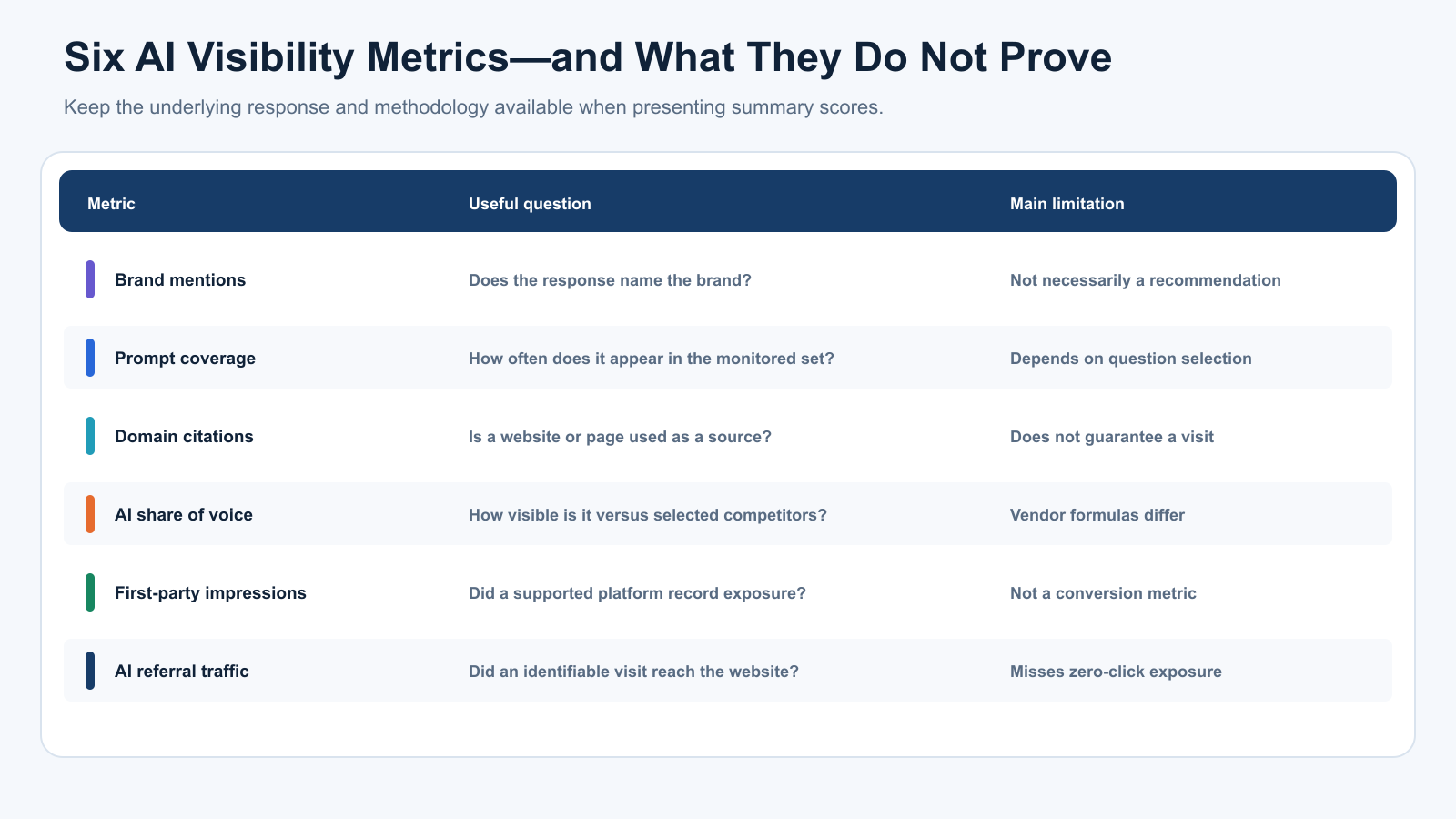
AI visibility platforms frequently display percentages, scores, and trend charts, but these metrics don’t necessarily have standard definitions.
A vendor may calculate share of voice using brand mentions, another may incorporate response placement, and another may use proprietary weighting. Understanding how the metric was produced is therefore more important than the number itself.
| Metric | What It Measures | Main Limitation |
|---|---|---|
| Brand mentions | Responses containing a brand reference | Doesn’t necessarily indicate a recommendation |
| Prompt coverage | Percentage of monitored responses containing a brand | Depends on the selected questions |
| Domain citations | Responses citing a website | Doesn’t guarantee a visit |
| AI share of voice | Relative brand visibility within a defined dataset | Vendor formulas differ |
| Estimated impressions | Modelled potential visibility | Not necessarily actual audience exposure |
| First-party AI impressions | Platform-reported appearances in supported AI features | Doesn’t directly measure conversions |
| Sentiment | Automated interpretation of brand descriptions | May miss nuance or context |
| AI referral traffic | Measurable visits attributed to AI sources | Excludes exposure without clicks |
Understanding Prompt Coverage
Prompt coverage measures how frequently a brand appears across a selected set of monitored responses. For example, suppose a fictional company monitors twenty relevant questions and appears in five collected answers during a reporting period.
Its observed coverage would be 25%. That means the company appeared in one-quarter of those collected responses, not that one-quarter of all AI users encountered the brand.
Changing the questions, AI platform, collection date, or target market could substantially change the result. A responsible report should therefore identify the sample and methodology alongside the percentage.
AI Share of Voice Is Not Universal Market Share
AI share of voice typically compares a brand’s representation with selected competitors within a particular dataset. The calculation may incorporate mention frequency, prompt coverage, appearance order, or other vendor-defined factors.
Semrush’s AI Visibility Toolkit calculates its AI Visibility Score using brand mentions relative to a competitor benchmark, while Ahrefs’ AI visibility documentation defines separate metrics for mentions, citations, estimated impressions, and share of voice.
These measurements can be useful within their respective reporting systems. However, a score from one platform shouldn’t be compared directly with another provider’s score without understanding the differences in coverage and calculation.
First-Party Impressions and Referral Traffic
First-party reporting provides another layer of evidence. Google’s dedicated generative-AI reports measure how a verified site’s pages appear within supported generative features, while Microsoft’s AI Performance reporting focuses on citations across supported AI experiences.
Website analytics can also help identify visits referred by AI platforms. These visits are measurable business activity, but they don’t represent the complete audience that may have encountered a brand in generated responses without clicking a link.
A practical GEO report should therefore separate observed brand visibility, platform-reported appearances, website traffic, and resulting business outcomes. Combining them without explanation risks overstating what the data can prove.
Free AI Search Visibility Tools: What Can You Measure?
Businesses don’t necessarily need a dedicated GEO subscription to begin monitoring AI search performance. Google Search Console and Bing Webmaster Tools now provide first-party reporting that can establish useful baselines, although their coverage and measurement methods differ.
Google Search Console
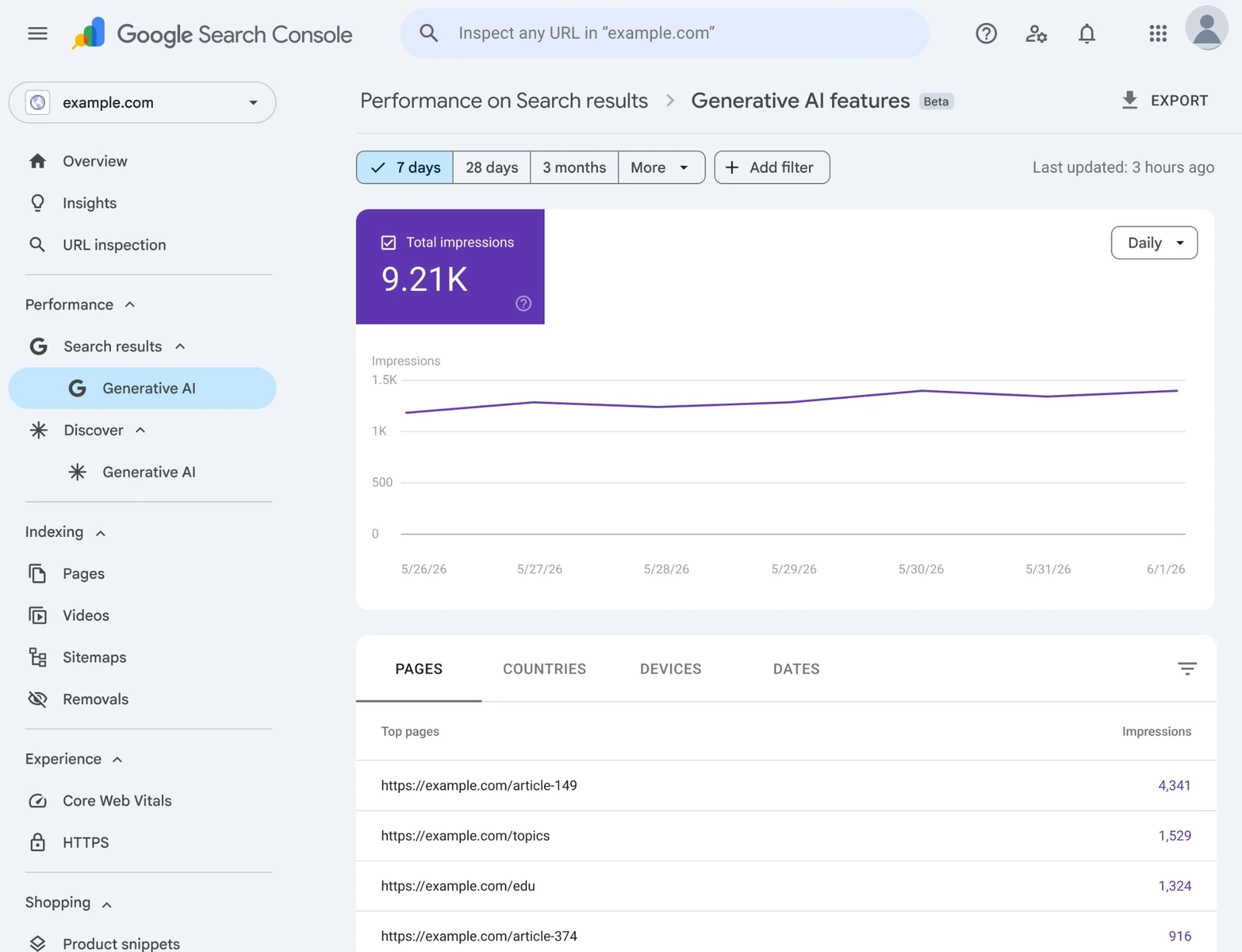
In June 2026, Google introduced dedicated Generative AI performance reports for Search Console, completing a worldwide rollout by August 31. These reports provide website owners with impression data for supported generative features, including AI Overviews and AI Mode.
The reporting allows site owners to examine visible pages, countries, devices, and trends over time. Because the information comes directly from Google, it provides a different form of evidence from third-party platforms sampling selected prompts.
However, the report doesn’t offer a complete database of competitors appearing in AI answers, and it doesn’t reveal every question users submitted. Websites without enough relevant impressions may also be unable to see the report.
Google explains the reporting scope in its Generative AI performance documentation.
Bing Webmaster Tools
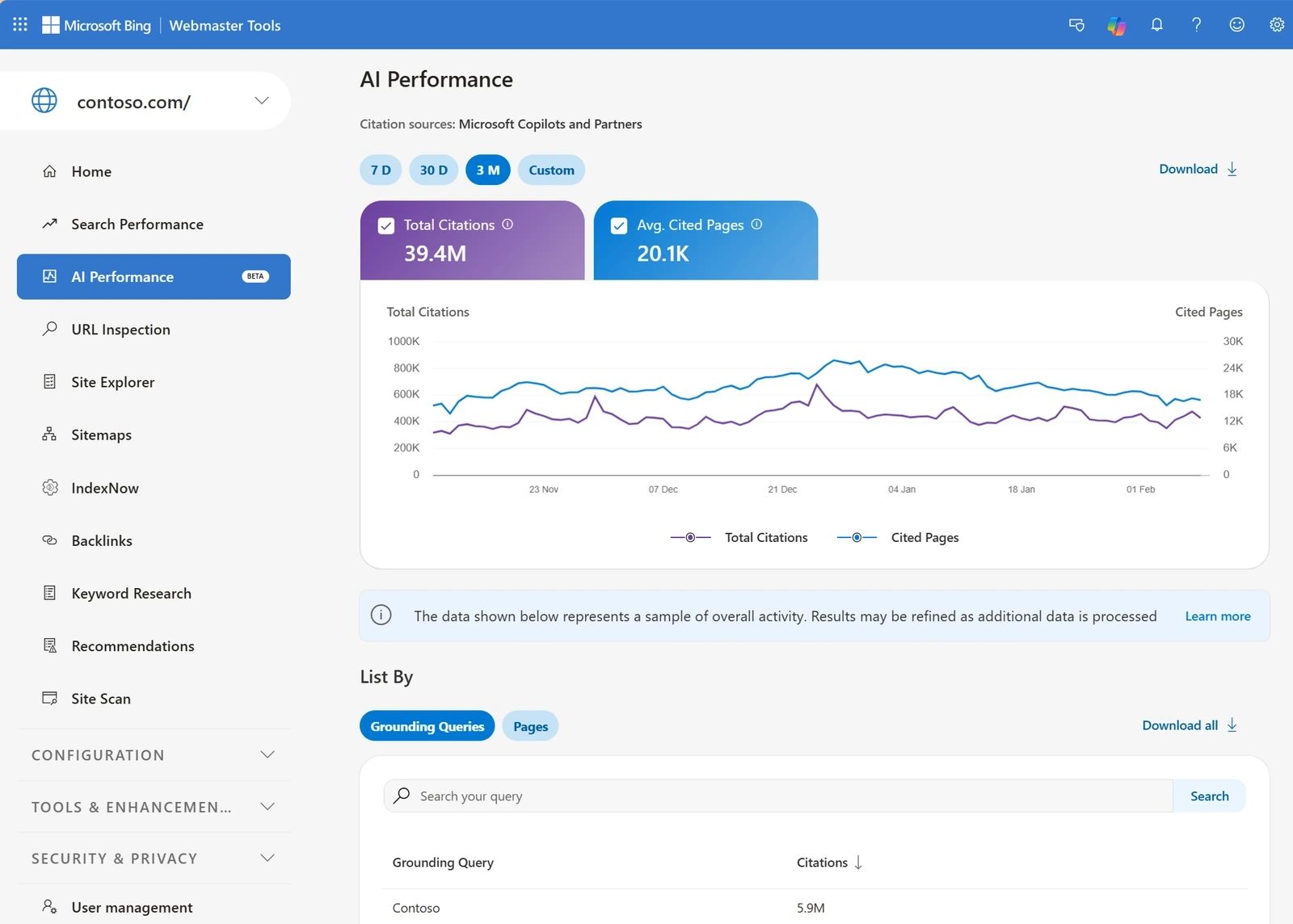
Microsoft launched its AI Performance report in Bing Webmaster Tools in February 2026. The report provides information about citation activity across supported AI experiences, including cited pages, grounding queries, and historical trends.
Grounding queries are particularly useful to understand correctly. They represent search phrases used when retrieving information for AI-generated answers, not necessarily the exact words originally submitted by the user.
Microsoft expanded these capabilities through 2026. Its Topics Portfolio beta, announced on October 13, groups grounding queries into thematic areas and provides information about related opportunities.
This gives publishers more context about where their sites contribute to AI-generated answers. However, Microsoft notes that parts of the beta rely on approximate measures and AI-generated classifications, so the results should be treated as directional research rather than precise audience statistics.
When Paid Monitoring Becomes Worthwhile
First-party reporting is a sensible starting point, but it doesn’t necessarily provide the cross-platform or competitor information a business may need. For example, Search Console can report Google-specific visibility without explaining how ChatGPT or Perplexity describes the same brand.
A paid AI search visibility tool becomes more relevant when the team needs recurring custom prompts, competitor comparisons, several AI platforms, historical response collection, or automated client reporting. The value should come from a particular research or operational requirement, not simply from having another dashboard.
Comparing AI Search Visibility Tools
Several established SEO platforms and newer GEO products offer AI visibility monitoring. Their features overlap, but they differ in the information they collect, the workflows they emphasise, and how they calculate performance metrics.
The following is a comparison of documented capabilities, not a head-to-head accuracy benchmark.
| Tool | Main Focus | Notable Capabilities |
|---|---|---|
| Google Search Console | First-party Google visibility | Generative-AI impressions, page and country reports |
| Bing Webmaster Tools | Microsoft AI search reporting | Citations, grounding queries, topic insights |
| Semrush AI Visibility | Combined SEO and GEO research | Prompt tracking, competitors, sentiment, AI visibility benchmarks |
| Ahrefs Brand Radar | Brand and AI search intelligence | Entity recognition, mentions, citations, estimated impressions |
| Otterly.AI | Prompt-based visibility monitoring | Daily response collection, brand coverage, sources, competitors |
| Peec AI | Brand visibility and positioning | Prompts, share of voice, sentiment, competitor comparison |
| Digimetrics | Integrated SEO and GEO workflows | AI mentions, discovery analysis, content and technical tools |
Semrush AI Visibility Toolkit
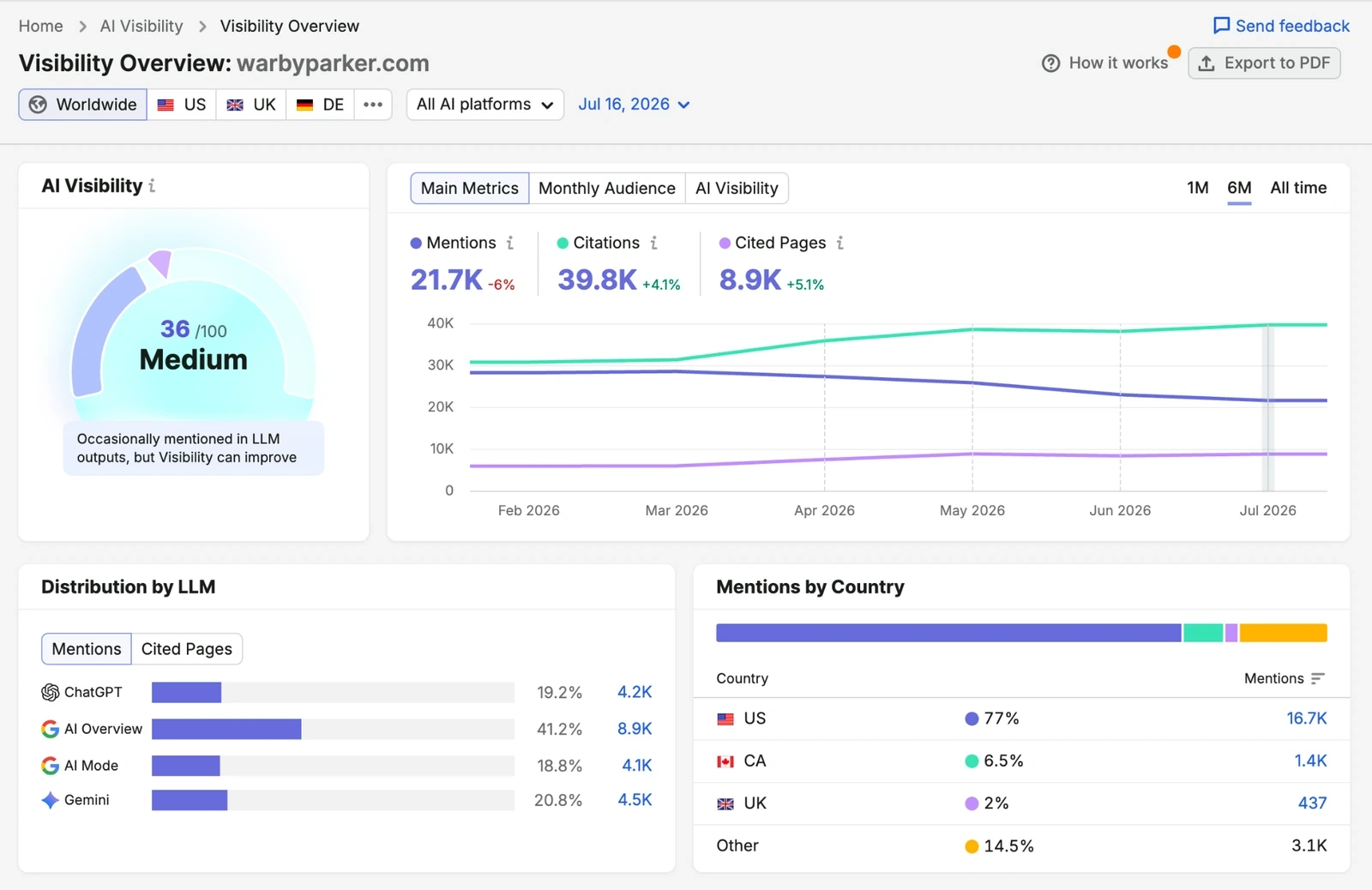
Semrush AI Visibility Toolkit combines brand monitoring with prompt research, competitor analysis, sentiment reporting, and technical checks related to AI search accessibility. Its monitoring capabilities include daily prompt tracking and broader visibility reports covering supported regions and AI systems.
This can be useful for organisations already using Semrush for keyword research, technical auditing, and competitor intelligence. However, availability, monitored prompts, locations, and user allowances depend on the subscription, while the reported AI Visibility Score remains a vendor-defined measurement.
Ahrefs Brand Radar
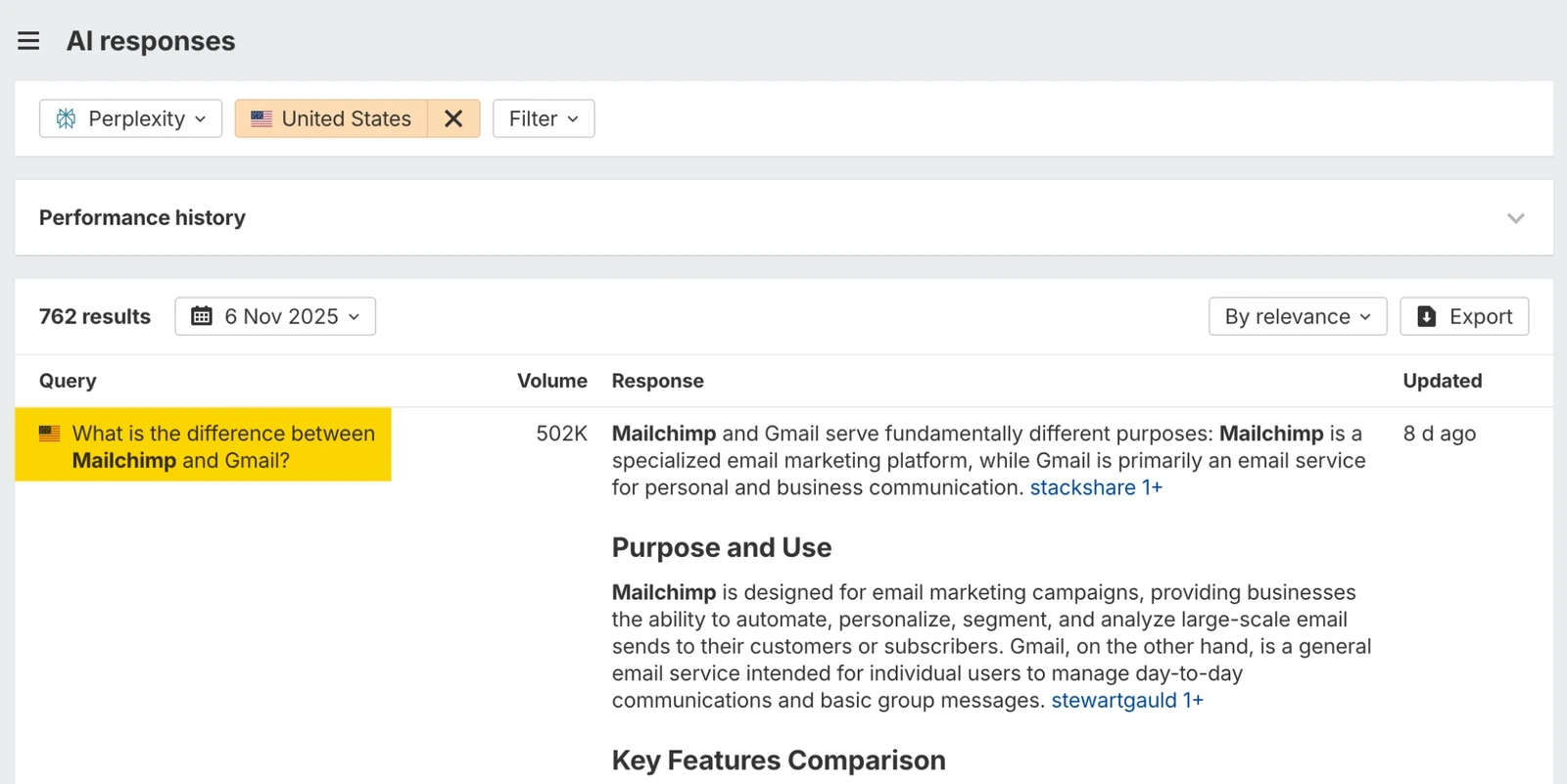
Ahrefs Brand Radar focuses on brand representation within AI answers, with reporting for mentions, citations, competitors, and broader AI visibility trends. Its documentation distinguishes between a brand appearing in a response and a website receiving a citation.
Ahrefs also provides entity-recognition capabilities intended to improve monitoring for brands with several names or related products. This makes it relevant to research teams investigating brand visibility alongside conventional SEO and backlink data, provided they understand how its estimated impressions and other proprietary metrics are calculated.
Otterly.AI
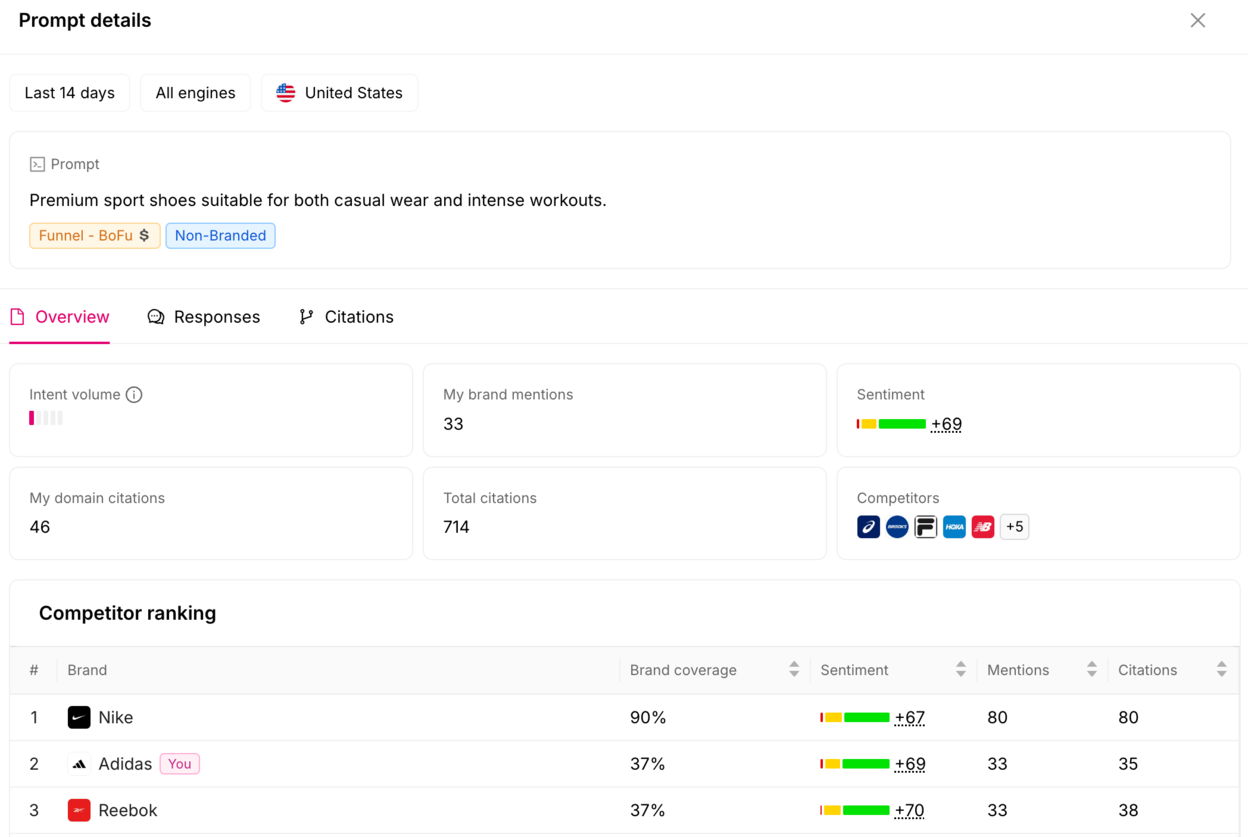
Otterly.AI offers prompt-based monitoring across supported AI search systems, storing generated responses and analysing brand mentions, source citations, competitors, and sentiment. Its documented functionality includes daily monitoring and reporting integrations, with specific AI engines and additional features varying by plan.
This approach can suit teams that have defined a consistent set of important customer questions. However, the usefulness of the findings depends heavily on prompt selection, platform coverage, and whether the monitored responses represent the markets the business is researching.
Peec AI
Peec AI focuses on how brands are described and compared across monitored AI-generated answers. Its documented features include visibility percentages, sentiment, competitor benchmarking, prompt tracking, and a form of average brand appearance position.
These measurements can be helpful for identifying patterns in how AI systems discuss competing brands. However, a brand’s placement within an AI response is not equivalent to a conventional organic Google ranking, and sentiment measurements should be reviewed alongside the actual language used.
Digimetrics
Disclosure: DigitalMarketingTools.ai is sponsored by Digimetrics.ai, which is developed by MediaOne.
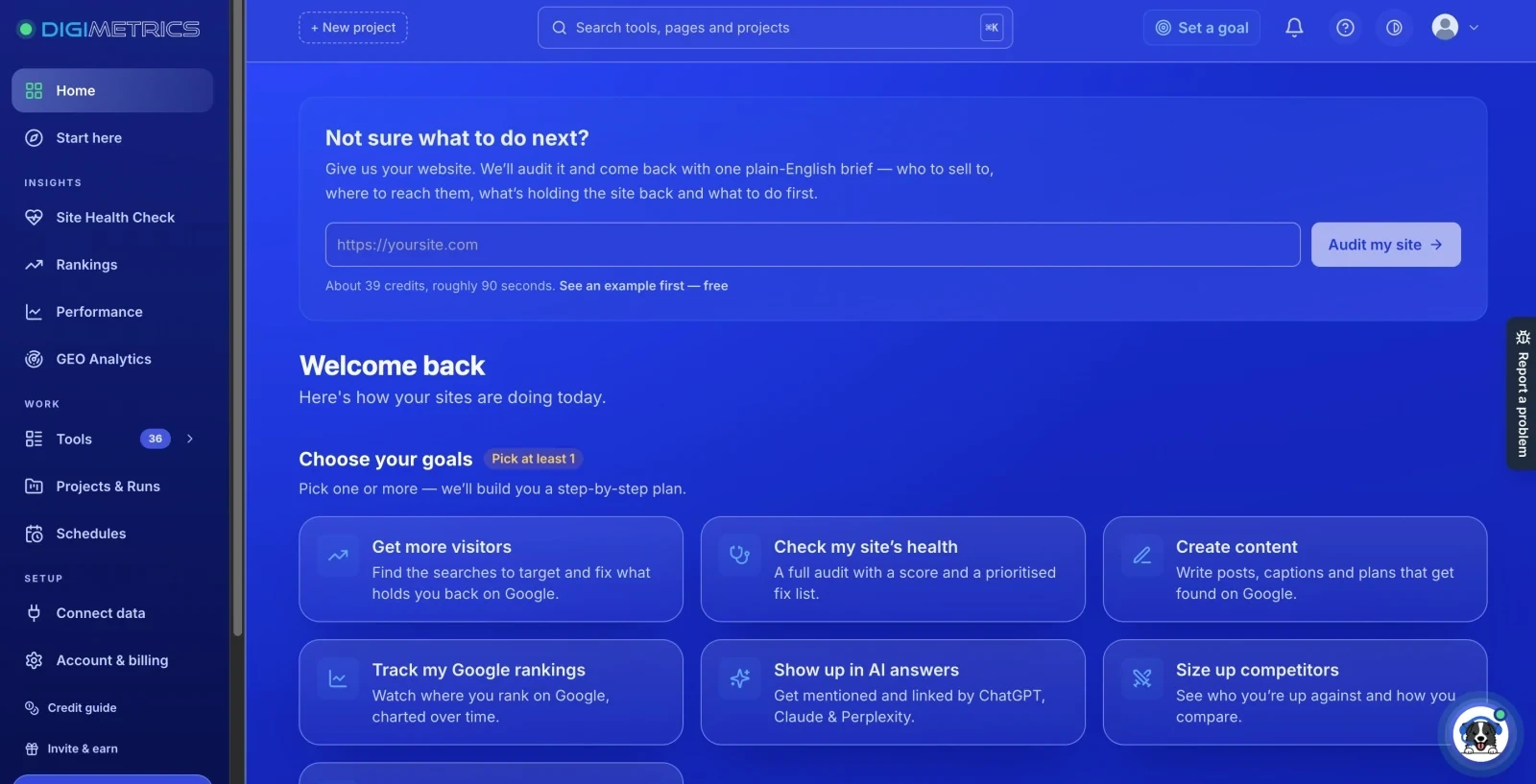
Digimetrics combines SEO, technical diagnostics, content optimisation, and AI visibility functionality within a connected digital marketing workspace. Its broader approach may appeal to teams that want to investigate AI search visibility and then continue into related SEO or content work without relying on several disconnected applications.
However, integration alone doesn’t make one product more accurate or valuable than a specialist GEO platform. Businesses should compare its supported AI systems, reporting capabilities, available credits, and the evidence behind its recommendations against the same requirements used to assess other vendors.
How to Choose the Best SEO Tool for AI Search Visibility
The best SEO tool for AI search visibility depends on what the organisation needs to monitor and how it intends to use the findings.
A small business focused on Google AI Overviews may find Search Console a useful starting point. An agency monitoring several competing brands across ChatGPT and Perplexity may need dedicated prompt research, historical monitoring, and client reporting.
Instead of starting with the largest feature list, define the questions your team needs answered. Then evaluate whether the software can provide evidence relevant to those questions.
Features to Evaluate Before Purchasing
| Evaluation Area | What to Verify |
|---|---|
| AI platform coverage | Which specific AI experiences are monitored? |
| Prompt management | Can you create, group, and update relevant questions? |
| Brand recognition | Are aliases and product names identified correctly? |
| Competitor analysis | Are brands compared across equivalent conditions? |
| Historical evidence | Can you review collected responses and dates? |
| Citation reporting | Are individual cited URLs available? |
| Geographic coverage | Does the platform support your markets and languages? |
| Metric transparency | Are visibility and share-of-voice calculations explained? |
| Reporting | Can the team export findings and inspect original evidence? |
| Subscription limits | How are prompts, collection runs, users, and projects counted? |
Different businesses will place different weight on these criteria. For example, an international brand may prioritise geographic coverage, while a publisher might focus on citation evidence and which articles appear as sources.
A useful tool evaluation should reflect those priorities rather than assigning the same importance to every available feature.
How to Test an AI Search Visibility Tool Before Buying
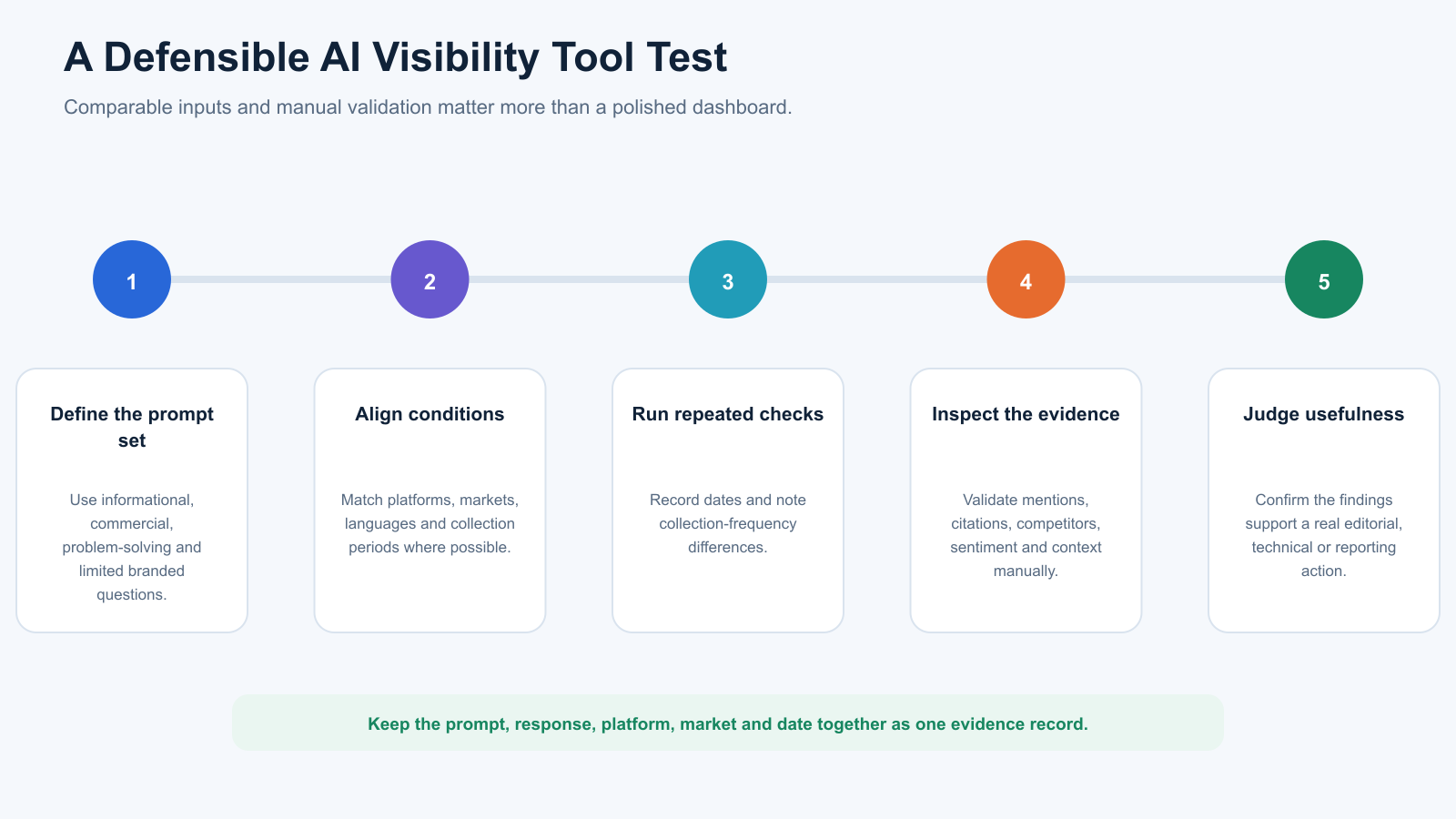
A meaningful evaluation should use realistic prompts, comparable settings, and clear criteria for deciding whether the tool supports your workflow. A polished dashboard is not sufficient evidence that a platform is suitable.
Define Your Questions and Prompts
Begin with a representative collection of questions related to your products, services, and customer needs. Include commercial comparisons, problem-solving questions, informational topics, and a limited number of branded searches to understand different forms of visibility.
For example, a fictional project management software company might monitor questions about client approvals, task dependencies, agency workflows, and differences between competing products. These questions should reflect genuine research objectives rather than being selected solely because they are likely to mention the brand.
Compare Equivalent Monitoring Conditions
Where supported, use the same prompts, AI platforms, markets, languages, and collection periods across the tools being evaluated. Record any differences that cannot be controlled, since they can affect the results.
Don’t treat a response from Gemini as interchangeable with one collected from Google AI Mode. Similarly, a platform checking questions once a week should not be compared directly with another collecting responses several times per day without accounting for those differences.
Inspect the Underlying Responses
Open a sample of collected answers to verify whether the platform correctly identified brand mentions, competitors, and cited sources. Check whether the response context supports the tool’s interpretation, particularly when sentiment or recommendation classifications are involved.
For example, a tool might count a brand mention that appears in a warning rather than a recommendation. That observation isn’t necessarily wrong, but it matters when evaluating how the brand is being represented.
Evaluate Reporting and Business Usefulness
Finally, test whether the results support a useful next action. Can the team identify relevant questions where its brand is missing, investigate cited sources, and connect those observations to content research or technical checks?
Also determine how easily the findings can be shared and whether the subscription limits cover the required monitoring workload. A specialist platform becomes worth paying for when its additional information or automation provides meaningful value beyond your existing tools.
How to Turn AI Visibility Data Into Useful SEO Improvements
Monitoring is only the first stage of an effective GEO workflow. The findings become more valuable when they lead to better information, clearer content, or useful technical investigations.
Identify the Questions Behind Visibility Gaps
Suppose an AI visibility report shows competitors appearing frequently in responses about email marketing automation, while your brand is rarely included. The first step should be to examine what those questions actually ask and which information the responses use.
Perhaps users are asking about integration support, migration difficulty, or pricing limitations that your existing content barely explains. Addressing those gaps could make your website more useful to prospective customers, regardless of whether an AI system subsequently cites it.
Review Cited Sources and Content Quality
The cited pages in monitored responses can help explain which kinds of information an AI system is drawing upon. A detailed product comparison, technical tutorial, or original research report may provide information absent from your own content.
However, copying a competitor’s structure or repeating the same claims doesn’t guarantee similar visibility. The better approach is to investigate whether your website can provide more accurate, specific, and useful information based on evidence you can verify.
Check Technical Accessibility
Some visibility gaps warrant technical investigation, particularly when important pages cannot be crawled or indexed. Google’s guidance for generative search features continues to emphasise established SEO practices, including making useful content accessible to its search systems.
OpenAI also documents the role of OAI-SearchBot in discovering publicly available website content for ChatGPT Search. These accessibility checks matter, but permitting a crawler doesn’t guarantee that a page will appear in an AI-generated answer.
Measure the Results Without Overclaiming
After making improvements, continue monitoring a consistent prompt set and examine relevant first-party reports. Record changes to the website alongside observation dates, while keeping track of other factors that might influence the results.
An increase in brand mentions can be useful evidence, but it doesn’t prove that one content update caused the change. AI systems, competing sources, and retrieval behaviour can evolve over the same period, so changes should be interpreted cautiously.
What Are the Limitations of AI Search Visibility Tools?
AI visibility software has introduced useful measurements, but the category still has important limitations.
The first is that sampled prompts don’t represent every real user interaction. Even a large dataset may reflect a particular market, language, question type, or collection method. A tool can therefore provide valuable directional information without measuring the full audience exposed to a brand.
Another limitation is the variability of generated answers. Repeating a question can produce different sources or recommendations, making short-term fluctuations difficult to interpret. This is particularly important when vendors use precise-looking scores that may suggest more certainty than the underlying observations support.
Proprietary metrics create additional challenges because vendors may define mentions, prominence, sentiment, and share of voice differently. Comparing those figures without examining their methods can produce misleading conclusions.
Finally, brand visibility is not the same as measurable business performance. A company might be mentioned without receiving a visit, while a publisher may receive a citation without generating an enquiry or sale. Our article on measuring zero-click visibility introduces this attribution problem, although that existing DMT page is currently marked as illustrative sample content rather than published research.
For these reasons, GEO reports should distinguish observed visibility from referral traffic and actual business outcomes. No third-party platform can guarantee recommendations or privileged access to AI ranking systems simply because a website achieves a high visibility score.
Final Verdict: What Makes an AI Search Visibility Tool Worth Using?
An AI search visibility tool is worthwhile when it helps a business understand something that its existing SEO and analytics reports cannot fully explain. This might be whether its brand appears in non-branded AI comparisons, how competing products are described, or which information sources repeatedly appear alongside important questions.
However, the most useful platforms do more than present a visibility percentage. They explain what was measured, preserve the underlying responses, distinguish mentions from citations, and provide enough context to make the results meaningful.
For businesses beginning GEO research, Google Search Console and Bing Webmaster Tools offer valuable first-party starting points. Platforms such as Semrush AI Visibility, Ahrefs Brand Radar, Otterly.AI, and Peec AI can add broader monitoring and competitor analysis, while integrated workspaces like Digimetrics may help connect these findings with established SEO workflows.
The right choice depends on which AI experiences matter to your audience, what questions your team needs answered, and whether the resulting data leads to useful work.
A good AI search visibility tool doesn’t promise to make your brand appear in every AI-generated answer. It helps you understand where your brand appears, what the evidence means, and which opportunities deserve further investigation.
Frequently Asked Questions
What Is an AI Search Visibility Tool?
An AI search visibility tool monitors how brands, products, and websites appear in AI-generated responses. Depending on the platform, it can analyse brand mentions, competitor appearances, citations, sentiment, and trends across selected questions. These measurements help marketers investigate visibility beyond traditional organic search rankings.
What Are the Most Important AI Search Visibility Tool Features for SEO?
Important features include relevant AI platform coverage, prompt monitoring, accurate brand recognition, competitor comparisons, historical responses, citation evidence, and transparent metrics. The most useful combination depends on the business’s audience and research requirements. Detailed reporting is particularly valuable when visibility monitoring needs to support recurring SEO or client work.
What Is the Best SEO Tool for AI Search Visibility?
There is no universal best option because platforms offer different data and monitoring methods. Google Search Console and Bing Webmaster Tools provide first-party information for supported AI search experiences, while Semrush, Ahrefs Brand Radar, Otterly.AI, and Peec AI offer different forms of cross-platform monitoring. Compare their capabilities against your actual requirements rather than choosing solely by overall visibility scores.
Can Google Search Console Track AI Search Visibility?
Yes. Google’s dedicated Generative AI performance reports provide impression-based information for supported features, including AI Overviews and AI Mode. The reports help verified site owners examine visibility by page and other available dimensions, but they don’t provide a complete record of every AI-generated answer or competing brand.
Can I Check Whether ChatGPT Mentions My Brand?
You can investigate relevant questions through ChatGPT Search or use a third-party platform that monitors supported ChatGPT responses. Consistent prompts and repeated observations provide more useful evidence than a single isolated response. Keep records of the question, date, market, brand mentions, and cited sources where available.
Is AI Visibility the Same as AI Citation Tracking?
No. AI visibility commonly focuses on whether a brand appears in generated responses, while citation tracking investigates which websites and pages are linked as supporting sources. A company may be mentioned without its website receiving a citation, and an independent publisher may receive a citation without being recommended as a product or service.
Are AI Search Visibility Tools Accurate?
They can provide useful observations, but accuracy depends on platform coverage, prompt selection, collection methods, brand recognition, and metric definitions. Generated answers also vary across conditions and collection periods. Review the underlying responses and understand how the vendor calculates its metrics before treating a visibility score as definitive.
Are There Free AI Search Visibility Tools?
Yes. Google Search Console and Bing Webmaster Tools provide first-party reporting for supported generative search experiences. Manual monitoring can also help businesses investigate a limited set of important questions, while some commercial products offer introductory access or trials. Paid software becomes more valuable when broader competitor analysis, cross-platform coverage, or ongoing automation is required.
How Often Should AI Search Visibility Be Monitored?
The appropriate schedule depends on the questions being researched and how often the team acts on the findings. Weekly or monthly reviews may suit smaller businesses, while daily monitoring can support active campaigns or competitive markets. Maintaining consistent measurement conditions is generally more useful than collecting frequent observations without a clear reason.
Can an AI Search Visibility Tool Improve SEO Rankings?
The software primarily measures and analyses how brands appear in AI-generated answers. It may reveal content gaps, inaccurate information, or technical issues worth addressing, but using the platform doesn’t directly improve Google rankings or guarantee AI citations. Improvements depend on the quality, accessibility, relevance, and usefulness of the underlying content.
Disclosure: digitalmarketingtools.ai is sponsored by Digimetrics.ai. Sponsored Highlights are clearly labelled advertising. Our reviews, comparisons and guides are written to be useful and fair regardless of who sponsors the site. Read the full disclosure.