What Is an AI Brand Mention Tracking Tool? How It Works and What to Measure
A business can rank well in Google, publish detailed product information, and receive steady organic traffic without knowing whether ChatGPT recommends it when potential customers ask for alternatives.
Imagine someone asks an AI assistant, “Which project management tools are best for a small marketing agency?” The response recommends three competing products but never mentions yours. Traditional SEO reporting can tell you where your website ranks, but it won’t show how your brand was represented in that particular AI-generated answer.
The opposite can happen, too. An assistant might mention your company in a product comparison without linking to your website. That exposure won’t necessarily appear in referral traffic, yet the mention could still influence which products the user decides to investigate.
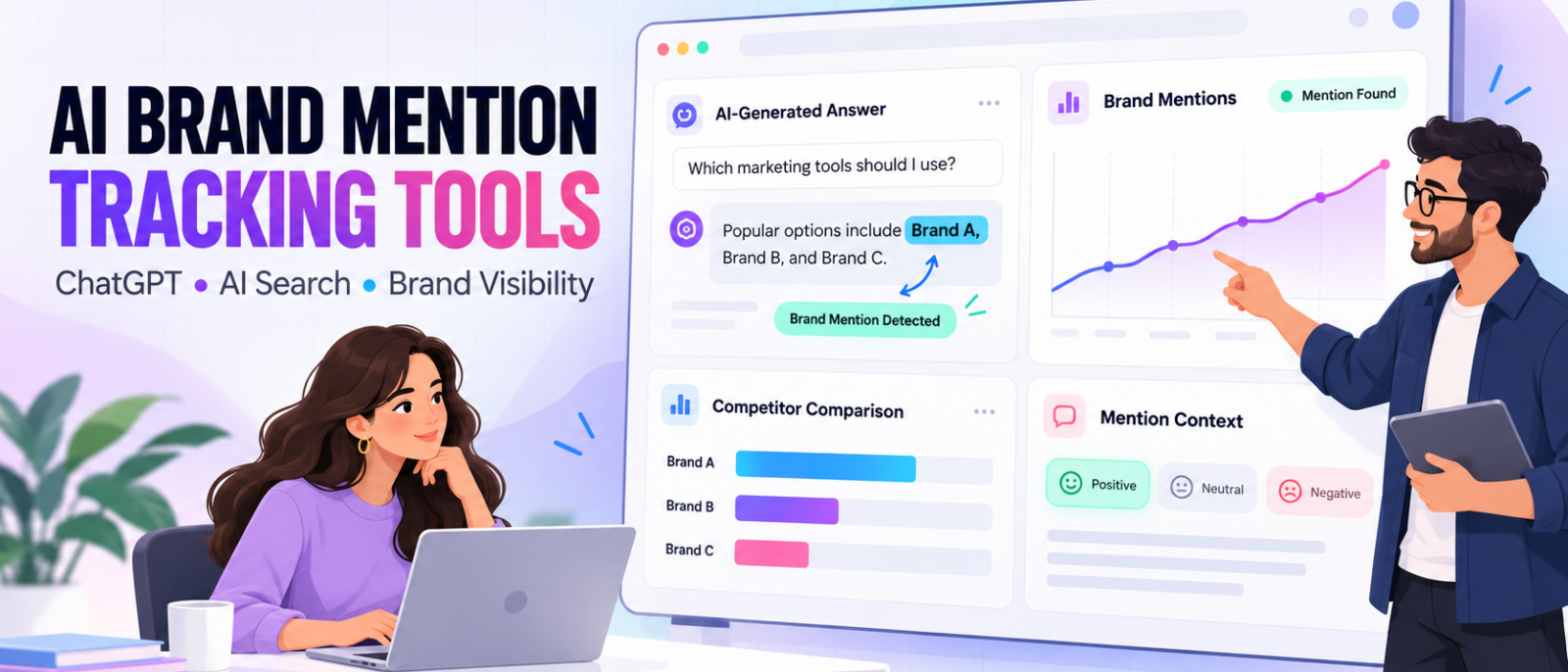
An AI brand mention tracking tool is software that monitors when and how a brand appears in responses generated by AI platforms such as ChatGPT, Gemini, Perplexity, and Google AI search experiences. It can record brand appearances, associated questions, competing businesses, response context, and changes across repeated observations.
However, these tools don’t have unrestricted access to every conversation occurring on AI platforms. Most monitor selected questions or analyse datasets of collected responses, which means their measurements describe observed visibility rather than complete audience exposure.
This guide explains how AI brand mention tracking works, which metrics deserve attention, how to monitor brand mentions in ChatGPT, and what to look for when evaluating the available tools.
Editorial disclosure: DigitalMarketingTools.ai is sponsored by Digimetrics.ai, which is developed by MediaOne. Digimetrics is included alongside other products based on documented functionality, not a completed independent benchmark.
Key Takeaways
- AI brand mention tracking measures whether a company or product is named in generated answers. It differs from monitoring traditional search rankings or website traffic.
- A mention isn’t automatically a recommendation. AI assistants can discuss a brand positively, neutrally, negatively, or as an unsuitable alternative.
- ChatGPT brand tracking relies on observed responses. Third-party tools generally cannot inspect every private conversation or calculate exact platform-wide mention totals.
- Brand mentions and citations are separate signals. A company can be named without receiving a source link, while its website can be cited without the brand being recommended.
- Prompt selection strongly influences visibility scores. Branded questions, product comparisons, and general informational questions can produce very different results.
- The best tracking tools preserve response-level evidence. Look for the original prompt, generated answer, platform, collection date, competitor mentions, and brand-matching rules.
What Is an AI Brand Mention Tracking Tool?
An AI brand mention tracking tool identifies references to a business, product, or organisation within responses produced by supported AI platforms.
Unlike conventional social listening software, which searches public social media posts, news articles, and online discussions, AI brand monitoring focuses on what an AI assistant says when answering a question.
For example, a customer might ask ChatGPT:
“What are some affordable CRM tools for small businesses?”
The generated response could name HubSpot, Zoho CRM, and several other platforms, explaining their features and possible limitations.
A brand mention tracker would attempt to identify those companies, record the response, and associate the mentions with the original question.
Over time, the business could investigate which types of questions lead to mentions, how often competing brands appear, and whether the descriptions are accurate.
These tools are part of the broader Generative Engine Optimization (GEO) category, which examines how businesses and their content are represented in AI-generated answers.
For a broader introduction, see our complete guide to GEO tools, which covers AI search monitoring, citations, technical accessibility, and competitor research.
AI Brand Mentions vs Citations vs Traditional Brand Monitoring
Several measurements can describe brand visibility, but they don’t represent the same event.
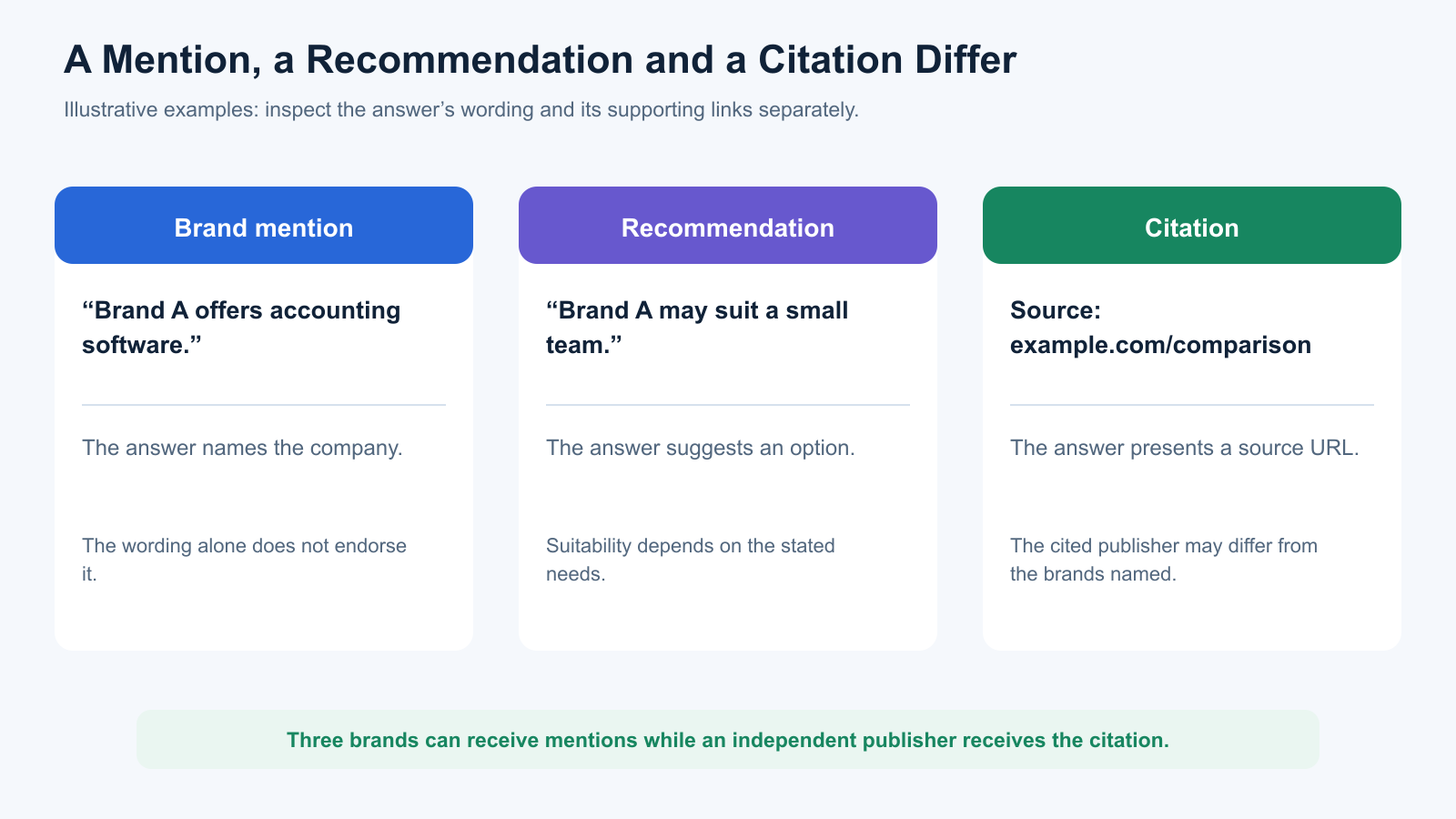
An AI brand mention occurs when the response names a company, product, or recognisable brand entity. A citation occurs when the answer presents a website or webpage as a supporting source.
A traditional brand monitoring tool, meanwhile, usually examines publicly available content such as online news, blogs, forums, reviews, or social media discussions.
| Signal | What It Measures | Example |
|---|---|---|
| AI brand mention | A company or product named in an AI-generated response | ChatGPT includes a software brand in a comparison |
| AI citation | A webpage or domain presented as a source | Perplexity links to an independent software review |
| AI recommendation | A brand suggested as an option for the user’s needs | An assistant recommends a CRM for a small team |
| Traditional brand mention | A reference in public online content | A Reddit user discusses a CRM product |
| AI referral traffic | A measurable website visit from an AI experience | A visitor clicks a source link from ChatGPT Search |
| Search impression | Content displayed within a supported search experience | A page appears in Google’s AI search results |
Why Brand Mentions and Citations Are Different
Suppose an AI assistant recommends three accounting software products but uses an independent comparison article as its supporting source.
The three software companies receive brand mentions, while the independent publisher receives a citation.
A company can therefore gain mention visibility without its own website receiving a link.
Likewise, a technical article may be cited to support an explanation without the AI assistant recommending the publisher’s products or services.
This distinction matters when interpreting GEO reports. A business trying to improve product consideration may prioritise brand mentions, while a publisher investigating content reuse may focus on citations.
Our guide to AI search visibility tools explains how these signals fit within broader GEO analytics.
How Does AI Brand Mention Tracking Work?

Most third-party tracking platforms use a process based on monitoring relevant questions and analysing the responses generated by supported AI systems.
The exact collection method differs by vendor. Some products let users submit their own questions, while others provide larger databases of previously collected AI responses.
A typical workflow includes selecting questions, collecting answers, detecting brand names, analysing the context, and comparing results over time.
1. Select the Questions You Want to Monitor
The monitoring process begins with prompts.
A software company might track questions such as “best email marketing platforms for small businesses” or “alternatives to Mailchimp for ecommerce.”
These questions are important because they represent different stages of customer research. A person asking for a definition may receive an educational explanation, while someone comparing products is more likely to encounter specific brand names.
A useful tool should support relevant question selection rather than relying entirely on generic industry prompts.
2. Collect Responses From Supported AI Platforms
The software then submits or retrieves responses associated with the selected questions.
Depending on the product, this may include ChatGPT Search, Google AI Overviews, Google AI Mode, Gemini, Perplexity, or Microsoft Copilot.
These are distinct experiences. Monitoring ChatGPT Search doesn’t automatically mean that the tool measures all ChatGPT models, private conversations, or other products offered by OpenAI.
Likewise, Google AI Overviews and Gemini should not be treated as one interchangeable data source.
A credible report should identify which experience was checked and when the response was collected.
3. Identify Brands and Competing Products
After collecting the answer, the tracking system searches for the relevant brand names, products, and competitors.
This sounds straightforward, but brand detection can become complicated.
A company may operate under multiple names, use abbreviations, or sell products that have names shared with unrelated businesses. A system that matches text without understanding the entity may count irrelevant references.
For example, the word “Apple” could refer to a technology company or a fruit. A product with a common dictionary-word name may create similar ambiguity.
Reliable tracking requires accurate brand identification rather than simply counting every occurrence of a matching word.
4. Analyse the Mention Context
The next step is understanding what the AI assistant actually said.
A brand may appear as a recommended solution, a neutral example, a competitor, or an unsuitable alternative.
Compare these hypothetical statements:
- “Brand A is a useful option for small teams.”
- “Brand A offers project management software.”
- “Brand A may not suit teams needing advanced reporting.”
All three contain a brand mention, but they communicate different information.
A mention tracker may attempt to classify these contexts through sentiment analysis, product positioning, or other labels. However, automated classifications should be checked against the original response before they inform important decisions.
5. Store Results and Monitor Changes
Finally, the platform stores its observations and compares them across reporting periods.
Historical tracking may show whether a brand appears consistently for important questions or only occasionally.
However, generated responses can vary with platform updates, retrieval conditions, prompt wording, geography, and collection time.
A sudden increase or decrease in mentions may be worth investigating, but it shouldn’t automatically be attributed to a recent SEO or content change.
Can You Track Brand Mentions in ChatGPT?
Yes. Several third-party platforms offer ChatGPT brand mention tracking by monitoring responses to selected prompts or analysing collected ChatGPT Search results.
However, it’s important to understand the scope of that access.
A ChatGPT brand mention tracking tool doesn’t normally provide a complete record of every time someone mentions or encounters your business in a private ChatGPT conversation.
Instead, it measures the responses available through its monitoring process.
For example, an agency might select twenty customer questions and monitor how ChatGPT responds to them each day. The platform could then record which answers mention the agency, competing businesses, or relevant products.
These observations can provide useful directional evidence, but they are not a census of actual ChatGPT users.
What Can a ChatGPT Brand Tracker Show?
Depending on the provider, the report may include the monitored prompt, collected answer, brand mentions, competing products, mention context, cited webpages, and historical observations.
These details help answer questions such as whether your company appears in commercial product comparisons, whether competitors are recommended more frequently, and how AI answers describe your offering.
For example, a software business might discover that ChatGPT mentions it when users ask about integrations but not when they ask about beginner-friendly alternatives.
That observation could lead to a review of the company’s positioning or product information.
However, it wouldn’t prove that the company is absent from every other ChatGPT response.
What Can’t It Reliably Show?
A third-party ChatGPT mention tracker generally cannot establish the exact number of real users who saw a particular recommendation, the private questions submitted by every user, or the commercial impact of each appearance.
It also cannot guarantee that the same answer will appear for every user.
OpenAI’s ChatGPT Search documentation explains that search-enabled responses can include supporting sources and links, while also noting that results and citations may be incomplete or incorrect.
That makes response verification particularly important.
The most defensible way to describe a finding is to specify the observation: for example, a brand was mentioned in twelve of forty monitored ChatGPT responses during a defined reporting period.
Avoid describing that result as a measured share of all ChatGPT searches.
Which AI Brand Mention Metrics Actually Matter?
GEO dashboards often include several metrics that appear similar but are calculated differently.
A useful brand monitoring report should explain what each measurement counts and what its limitations are.
| Metric | What It Measures | Important Limitation |
|---|---|---|
| Brand mentions | Responses containing a recognised brand reference | Doesn’t establish positive endorsement |
| Mention coverage | Percentage of monitored responses mentioning the brand | Depends on the prompt sample |
| Competitor co-mentions | Responses naming the brand alongside competitors | Doesn’t prove the products were equally recommended |
| Share of voice | Relative visibility under a vendor’s calculation | Not a universal AI market-share metric |
| Mention position | Where the brand appears in a generated answer | Not equivalent to an organic search ranking |
| Sentiment | The tone or context associated with a mention | Automated classifications may be inaccurate |
| Cited sources | URLs presented as supporting references | A citation isn’t necessarily a brand mention |
| Historical trend | Change in observed mentions across collection periods | Other factors may explain the change |
Brand Mention Count
A mention count records observed brand appearances within a defined dataset.
However, vendors may count repeated words differently.
Ahrefs Brand Radar, for example, counts one mention when a brand appears at least once in an AI-generated response. Repeating the same brand name several times within that response doesn’t create several mentions under this definition.
This is useful for response-level reporting, but it differs from counting every literal occurrence of the name.
Before comparing tools, check exactly what counts as one mention.
Mention Coverage
Mention coverage describes how often a brand appears within a defined collection of responses.
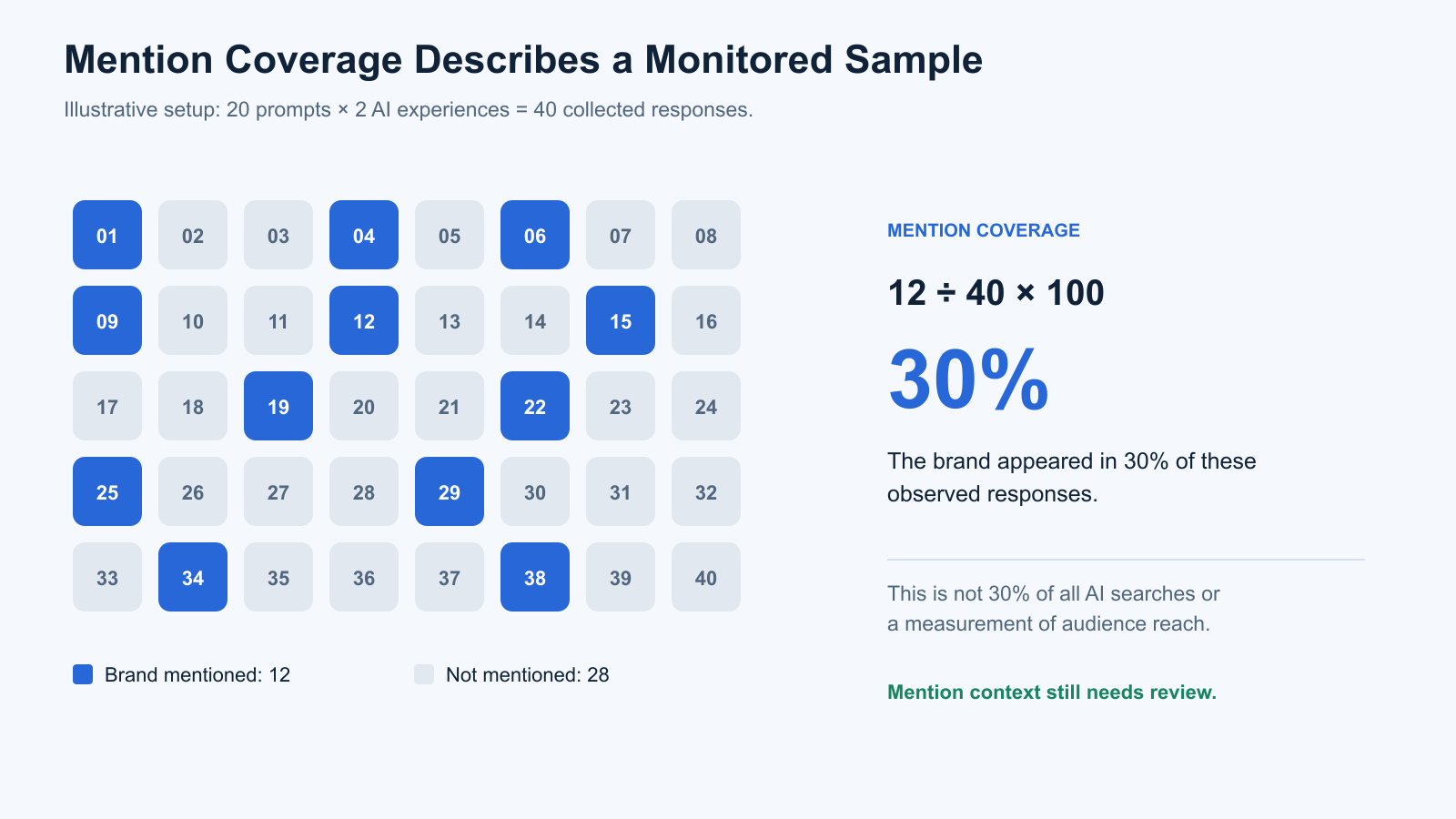
Consider a hypothetical example where a business monitors twenty questions across two AI experiences, producing forty responses.
Its brand appears in twelve responses.
Mention coverage = (12 ÷ 40) × 100 = 30%
This means the brand was mentioned in 30% of those forty observed responses.
It doesn’t mean the company appeared in 30% of all AI searches, and it doesn’t reveal whether the mentions were positive or commercially relevant.
The result is only meaningful when the underlying questions, platforms, and reporting conditions are identified.
AI Share of Voice
AI share of voice attempts to describe how visible a brand is relative to selected competitors.
However, different vendors define the measurement differently.
One product may compare mention frequency across tracked questions. Another may include estimated impressions, placement, topic weighting, or additional proprietary factors.
For example, Ahrefs describes its AI Share of Voice as a comparative measure based on estimated impressions, while Peec AI explains share of voice using a brand’s mention percentage relative to competitors.
These numbers shouldn’t be compared directly without understanding their calculations.
Brand Sentiment and Recommendation Context
Sentiment analysis attempts to classify the way an AI assistant describes a business.
However, a statement can contain both praise and criticism.
For example, an assistant might describe a software product as affordable while explaining that it lacks advanced reporting functions.
A simple positive or negative label may fail to represent that nuance.
Human review is particularly important when a report identifies a reputational problem, an inaccurate product claim, or a sudden shift in brand perception.
Competitor Co-Mentions
Co-mention tracking records when competing products appear together in the same response.
This can help reveal which businesses AI assistants associate with a category.
For example, a company selling customer support software might discover that three competing platforms repeatedly appear in the same product comparison questions.
That observation may be useful for competitive research, but it doesn’t automatically establish a formal ranking or customer preference.
The reasons for each recommendation need to be evaluated within the original answer.
What Features Should an AI Brand Mention Tracking Tool Have?
The strongest tools provide enough underlying evidence to explain their metrics.
A dashboard showing “AI Visibility: 75” may look impressive, but the score has limited value if users cannot investigate which questions produced it.
Accurate Brand and Entity Matching
Brand identification is one of the most important capabilities.
The platform should distinguish a business from unrelated entities with similar names and ideally support alternative names, product brands, common abbreviations, and known aliases.
A company that operates several products under different brands may need to monitor those entities separately.
Check whether the tool allows users to inspect false positives and correct the brand configuration.
Custom Prompts and Topic Groups
A tracking platform should let users monitor questions related to their actual customers.
Useful groups might include product recommendations, competitor comparisons, pricing questions, troubleshooting topics, and location-specific services.
Organising prompts by subject and search intent helps teams understand where their brand appears and where it doesn’t.
It also makes reporting more meaningful than monitoring an arbitrary collection of loosely related questions.
Platform and Location Coverage
AI-generated answers may differ across products and geographic contexts.
A business operating internationally may need country-specific monitoring, while a local service provider may need location-sensitive questions.
Before purchasing, verify the supported AI platforms, countries, languages, and available location settings.
Don’t assume that a platform’s worldwide coverage claim means every individual AI engine supports identical regional configurations.
Full Response History
A useful tool should preserve the actual generated answer, collection date, AI platform, and relevant prompt.
Without this information, it becomes difficult to verify whether the brand appeared, what the assistant said, and whether the mention was interpreted correctly.
Historical evidence also helps distinguish a persistent trend from a single unusual response.
Competitor and Source Analysis
Brand mentions become more useful when they can be compared with the products appearing alongside them.
Source analysis adds another layer by identifying the webpages used to support an AI answer.
For example, competitors may appear because the AI assistant references a relevant independent comparison article.
However, the source isn’t necessarily the only reason the model generated a particular recommendation.
Treat citations as evidence to investigate, not a complete explanation of how the model made its decision.
Exportable Reporting
For agencies and marketing teams, reports should ideally preserve the data needed for analysis outside the tool.
That includes prompt wording, platform, brand mentions, competitors, collection date, and supporting evidence.
CSV exports, reporting integrations, and accessible response histories can be more valuable than additional proprietary scores.
A report that cannot be independently checked is difficult to use for serious performance evaluation.
AI Brand Mention Tracking Tools Worth Comparing
Several SEO and GEO platforms now offer brand monitoring for AI-generated answers.
The following comparison focuses on documented product capabilities rather than declaring an overall winner. No controlled, same-prompt accuracy benchmark has been performed for this article.
| Tool | Documented AI Brand Monitoring Approach | Useful Starting Point |
|---|---|---|
| Otterly.AI | Prompt-based monitoring of mentions, sentiment, competitors, and citations | Teams monitoring specific customer questions |
| Peec AI | Brand visibility, share of voice, sentiment, and competitor comparisons | Brand-focused AI reporting |
| Ahrefs Brand Radar | Large AI response datasets and custom prompt tracking | Competitive visibility research |
| Semrush AI Visibility Toolkit | Brand Performance, Prompt Tracking, and competitor research | SEO teams researching AI brand perception |
| SE Visible | Brand mention rates, positioning, source analysis, and sentiment | Dedicated AI visibility reporting |
| Digimetrics | AI Mentions Tracker within an integrated SEO and GEO workspace | Teams connecting brand monitoring with other marketing tasks |
Otterly.AI
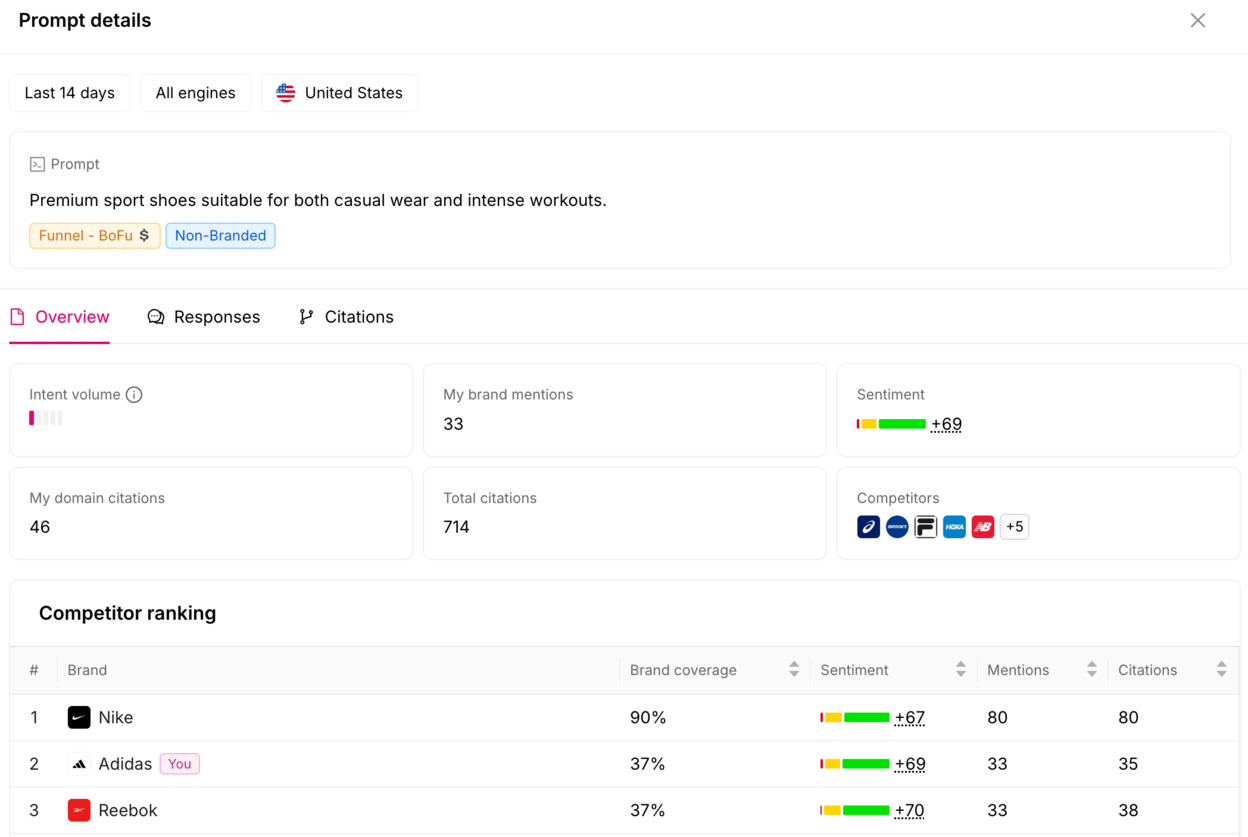
Otterly.AI tracks selected prompts and analyses how supported AI engines mention brands and competitors.
Its documented reporting includes mention frequency, sentiment, share of voice, and source citations. It also records generated responses so users can investigate the information behind reported metrics.
The platform’s standard paid engine coverage includes ChatGPT, Google AI Overviews, Perplexity, and Microsoft Copilot, with additional AI engines offered through optional packages.
Otterly is particularly relevant when a business already knows which customer questions it wants to monitor.
However, a small prompt set won’t necessarily reveal wider category-level visibility, and the entry-level subscription has a relatively limited monitoring allowance.
Peec AI
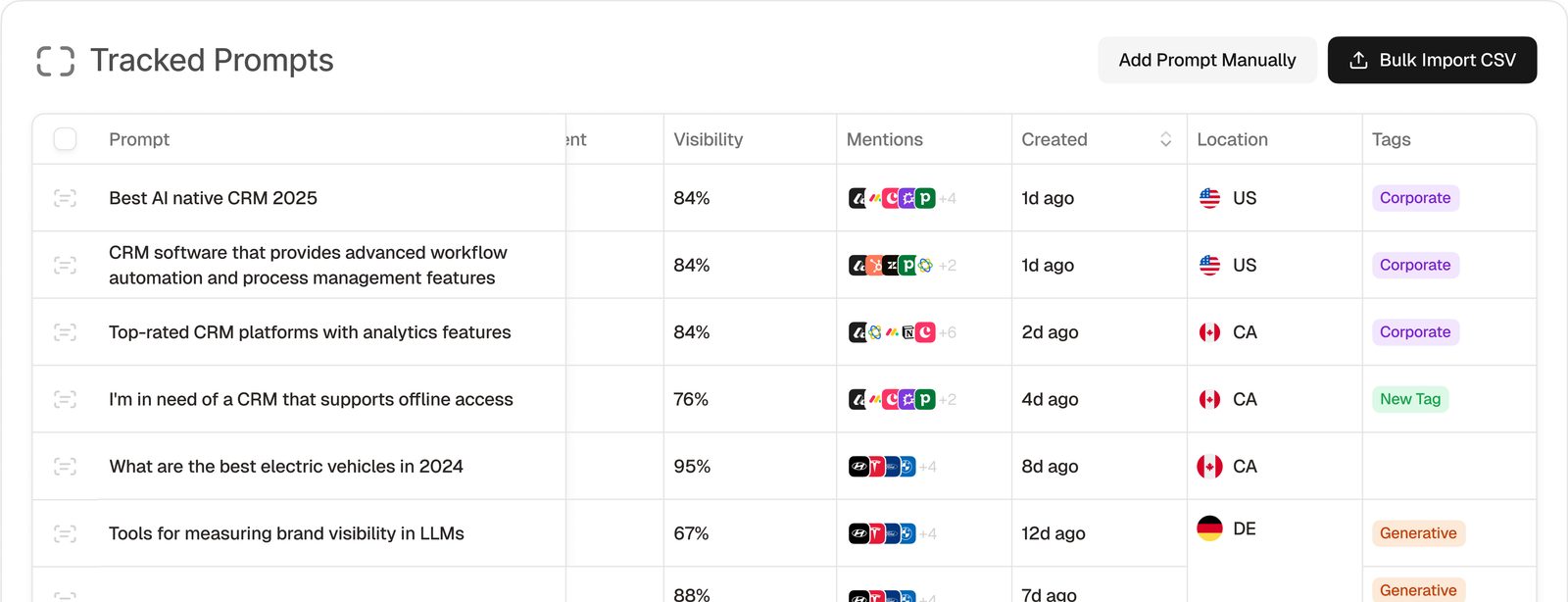
Peec AI focuses on visibility and brand perception within AI-generated answers.
Its documentation describes metrics covering visibility, average position, sentiment, and share of voice across supported AI experiences.
The platform can help marketers investigate which questions trigger brand appearances and how competing products are represented in the same response set.
Peec also provides source information, giving users additional context about the webpages cited in relevant answers.
Its suitability depends on the AI models, locations, and monitoring capacity required by the business.
Ahrefs Brand Radar
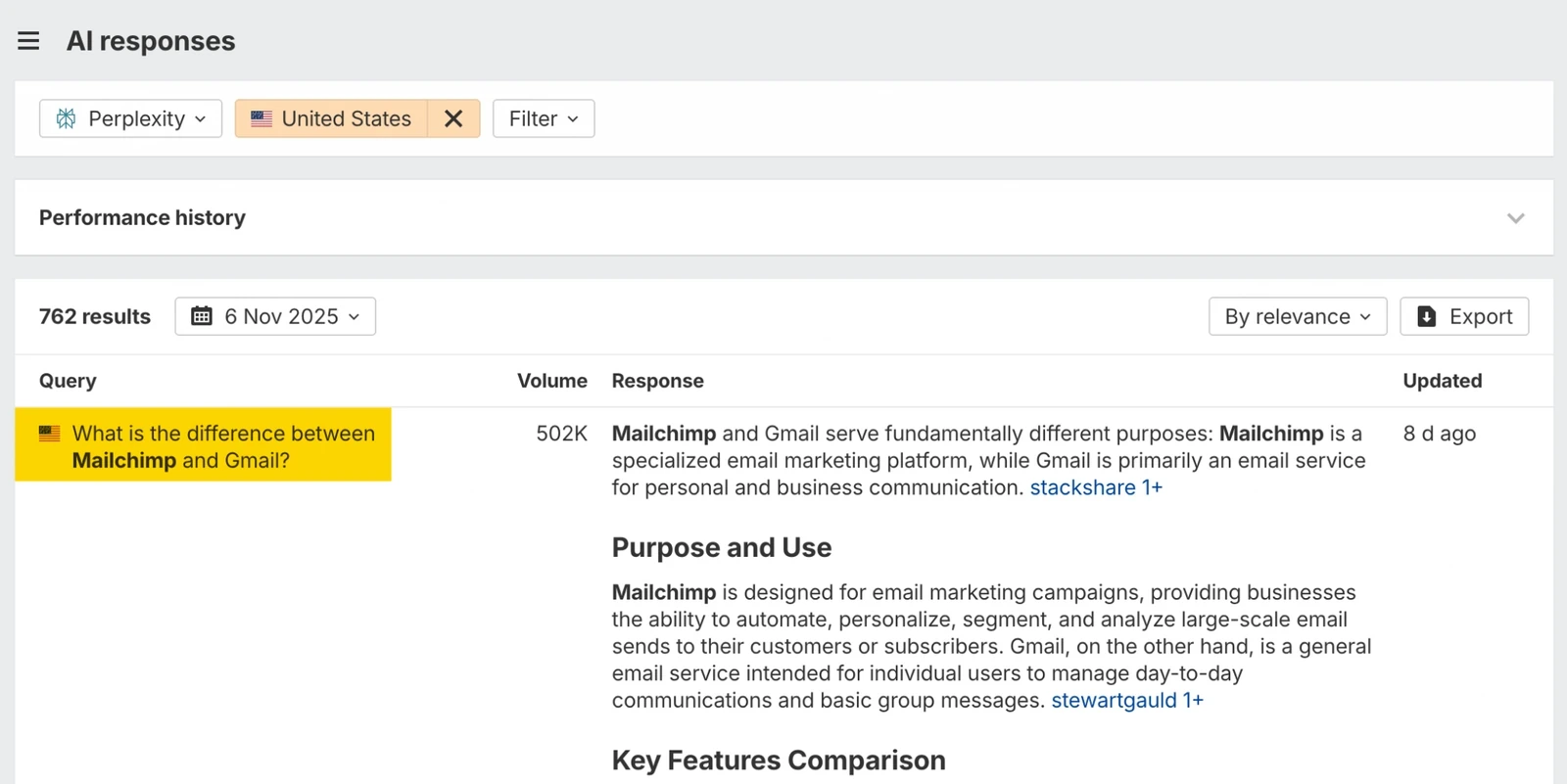
Ahrefs Brand Radar supports research into brand mentions, source citations, and competitors across AI search platforms.
The product offers a large AI Visibility Index based on collected prompts and a separate custom-prompt monitoring approach.
This distinction is useful because marketers may need both broad category research and consistent observation of their own customer questions.
Ahrefs also documents how individual brand mentions are counted, helping users understand the measurements behind its reporting.
However, its estimated impressions and share-of-voice metrics remain modelled measurements rather than direct records of every AI user interaction.
Semrush AI Visibility Toolkit
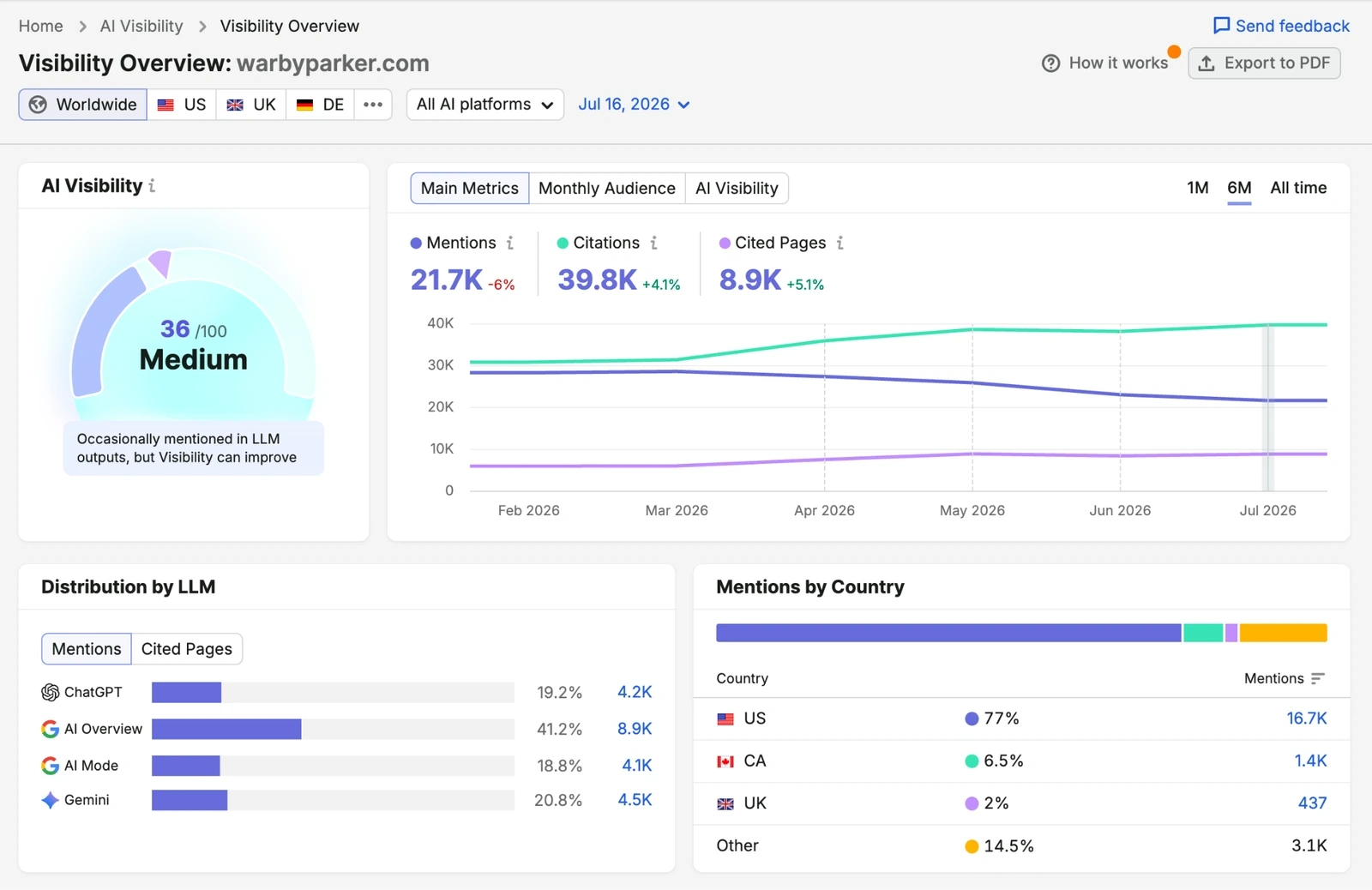
Semrush AI Visibility Toolkit includes reports covering brand performance, sentiment, competitor research, prompt discovery, and tracked AI search questions.
Its Brand Performance reporting analyses how AI platforms describe a company, while Prompt Tracking monitors visibility for selected questions over time.
These features may suit teams that already use Semrush for keyword research, competitor intelligence, and conventional SEO reporting.
However, Semrush’s AI Visibility Score is proprietary, and the Brand Performance and Prompt Tracking reports have different collection and update methods.
Users should also distinguish the standalone toolkit from the broader Semrush One subscription when evaluating access and pricing.
SE Visible
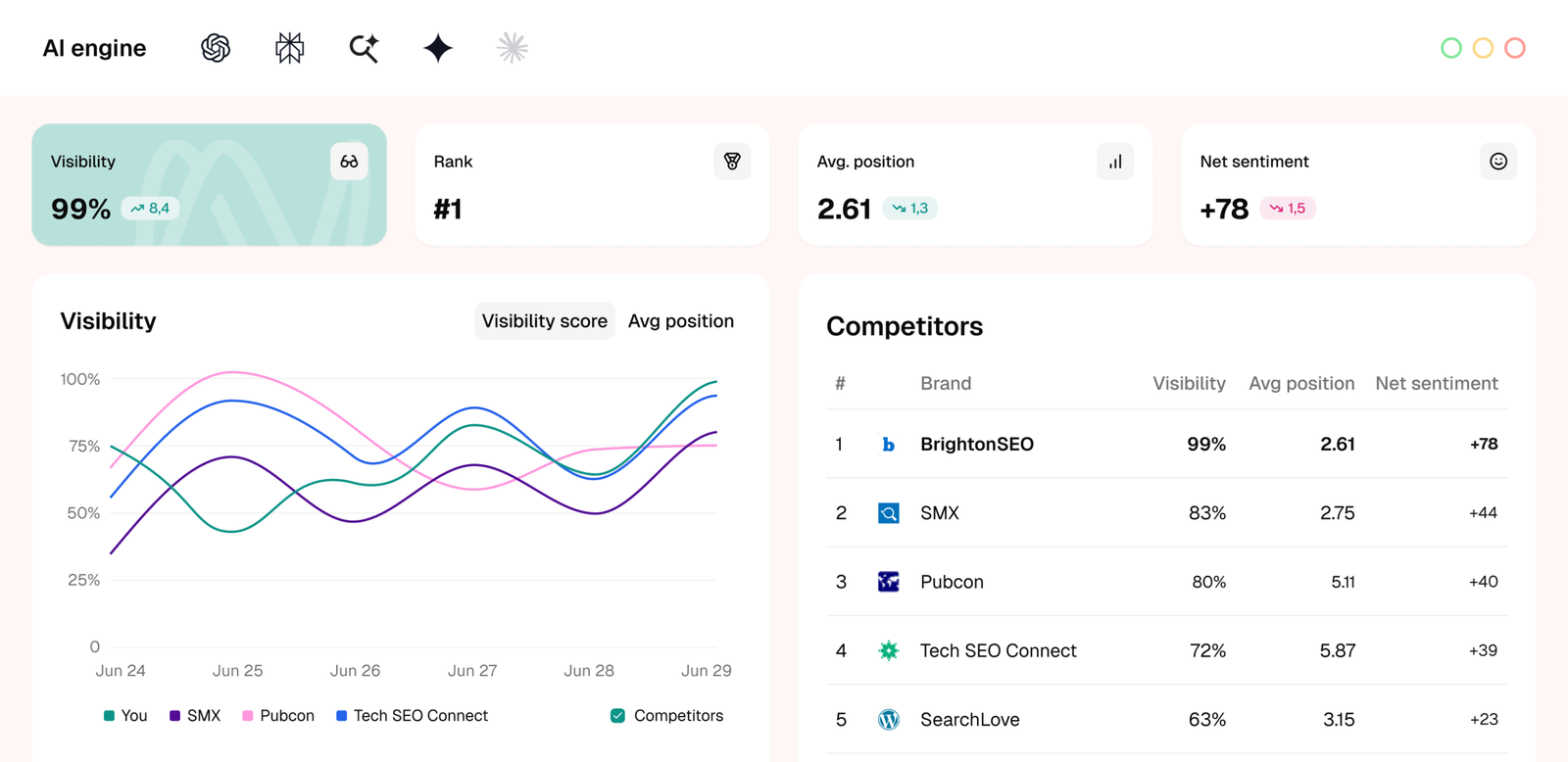
SE Visible is a dedicated AI search visibility product from the SE Ranking team.
It monitors brand appearances, competitor mentions, cited sources, and sentiment across ChatGPT, Gemini, Google AI Mode, Google AI Overviews, and Perplexity.
The platform separates its data into dashboard, prompts, competitors, and sources views, allowing marketers to examine both summary metrics and individual responses.
It may be particularly useful when a business wants dedicated AI brand reporting without making the broader SEO toolset its primary workflow.
However, users should verify regional coverage and confirm how its visibility, average position, and sentiment metrics are calculated.
Digimetrics
Disclosure: DigitalMarketingTools.ai is sponsored by Digimetrics.ai, which is developed by MediaOne.
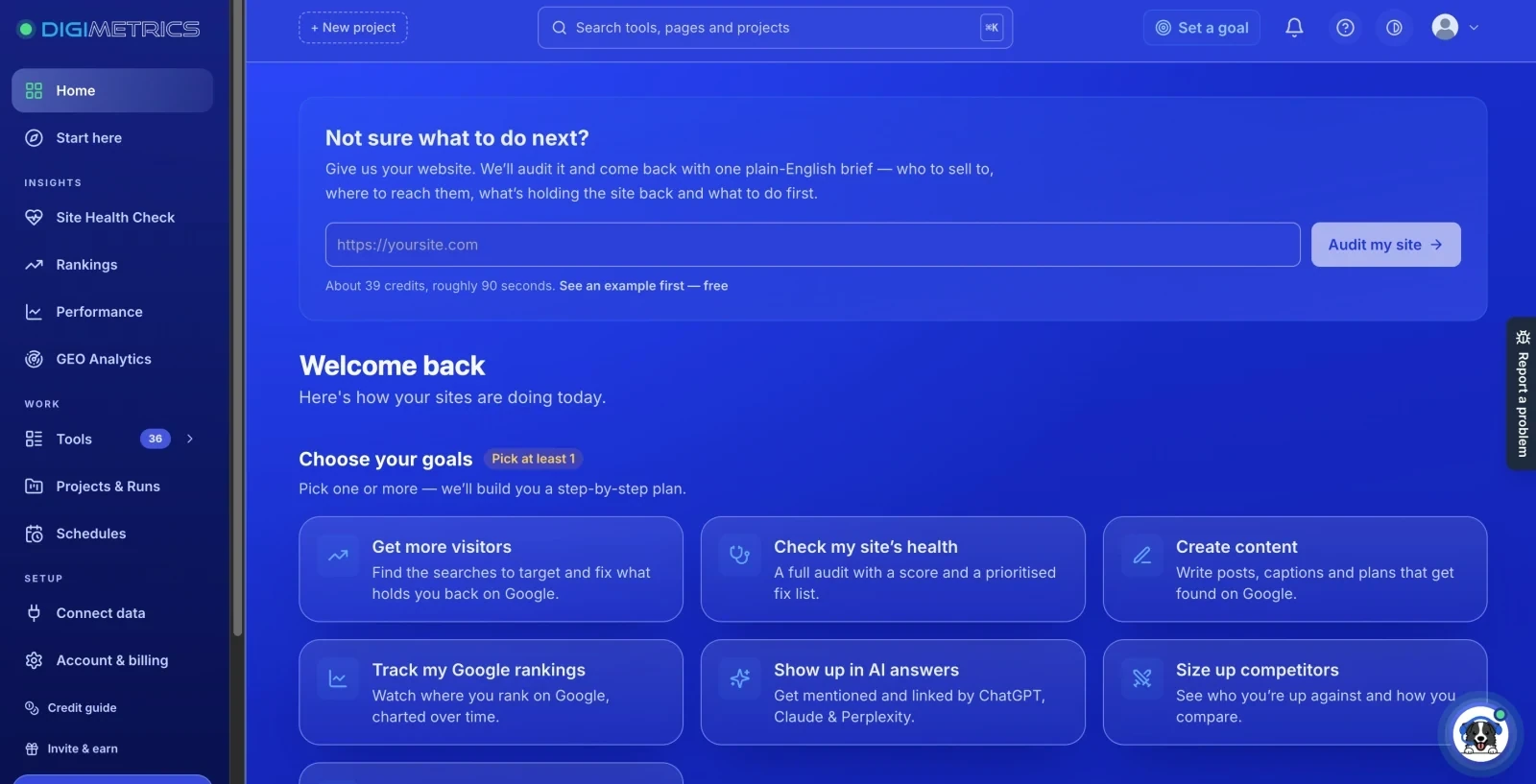
Digimetrics combines AI visibility, SEO research, technical diagnostics, content optimisation, and other marketing tools in one workspace.
Its publicly documented AI Mentions Tracker is designed to monitor brand mentions within AI-generated answers and observe changes in visibility over time.
Related tools, including AI Discovery Audit and GEO On-Page Optimisation, can support further investigation when a business identifies questions or topics where its brand is absent.
For example, a marketing team may want to connect an AI mention observation with an SEO or content review rather than treating brand visibility as a separate reporting activity.
However, the presence of an AI Mentions Tracker doesn’t automatically establish that the platform offers the same prompt database, historical coverage, source detail, or geographic monitoring as specialist products.
Users should check the actual output, credit requirements, supported AI experiences, and reporting options before choosing it for ongoing brand mention analysis.
How to Track Your Brand Mentions in ChatGPT and Other AI Tools
You can begin AI brand monitoring with a relatively small set of questions.
The most useful approach is to establish a consistent baseline and record enough information to explain the results later.
Step 1: Define the Brand Names You Need to Monitor
List the official company name, major product names, commonly used abbreviations, and recognised variants.
Also identify names that could be confused with unrelated businesses.
For example, a company with a common dictionary-word brand name may require stricter entity matching than a business with a distinctive name.
This preparation helps reduce false positives before collecting data.
Step 2: Build a Representative Prompt Set
Choose questions reflecting the decisions your customers make.
A project management software company might monitor questions such as:
- “What project management tools are suitable for a five-person agency?”
- “Which tools support client approval workflows?”
- “What are alternatives to Trello for managing complex projects?”
- “Which project management tools are easiest for beginners?”
These prompts cover different needs rather than repeating the same branded question.
For an initial test, fifteen to thirty prompts may provide a manageable starting point. This is an illustrative workflow recommendation, not a statistically representative sample of all customer searches.
Step 3: Select the Relevant AI Platforms
Start with the systems most relevant to your business rather than assuming every platform deserves equal attention.
For example, a business may want to compare ChatGPT Search and Google AI Mode, while another focuses on Perplexity and Gemini.
Document the monitored experience, language, geographic context, and date.
If you use a third-party tracker, confirm whether its collection process actually corresponds to the platform experience being described.
Step 4: Record Mentions and Their Context
For every collected response, record whether your company appears, which competing brands are named, and what the assistant says about each product.
Don’t stop at the mention count.
A recommendation based on accurate product information has a different meaning from a mention that describes your software as unsuitable for the user’s needs.
Also note any factual errors, outdated features, or incorrect pricing claims that require investigation.
Step 5: Repeat the Monitoring Under Consistent Conditions
AI-generated answers can vary between collections, even when the same question is used.
Repeat the observations over time, maintaining consistent prompts and relevant settings wherever possible.
Avoid interpreting a single week’s movement as proof that a recent content change worked.
Look for recurring patterns, verify the underlying responses, and document other changes that might affect the results.
How to Use Brand Mention Data to Improve GEO
Tracking is most valuable when it supports a useful business decision.
However, a missing brand mention doesn’t necessarily indicate a technical problem, and adding more brand keywords to a webpage won’t guarantee inclusion in AI-generated answers.
The better approach is to investigate why the monitored question matters and whether the available information about the business is accurate, accessible, and relevant.
Investigate Missing Information
Suppose competing products appear frequently in questions about software integrations, while your company is rarely mentioned.
Review the competitor responses and the information available on your own website.
You may discover that your integration documentation is incomplete or difficult to navigate, or that customers need clearer explanations of compatibility requirements.
Improving these resources may help customers directly while also making the information easier for search and AI systems to understand.
Correct Outdated Brand Information
An AI assistant may mention a business but describe it using outdated pricing, discontinued features, or an incorrect service area.
Brand mention monitoring can help identify these problems.
The appropriate response is to verify the information, update official resources where necessary, and review whether relevant third-party sources still contain outdated details.
However, no website update guarantees that every AI platform will immediately adopt the corrected information.
Improve Product Comparisons
If customers regularly compare your business with competitors, consider whether your website explains those distinctions clearly.
Useful comparisons should acknowledge real differences in functionality, pricing conditions, integrations, and limitations.
Avoid publishing unsupported superiority claims simply to influence AI-generated recommendations.
Transparent information helps customers evaluate products, regardless of whether an AI assistant subsequently mentions the brand.
Check Technical Accessibility
For search-enabled AI experiences, website accessibility remains relevant.
Google’s guidance on AI features in Search explains that established SEO fundamentals continue to matter for appearing within its AI search experiences.
OpenAI also documents the role of OAI-SearchBot in making webpages eligible for ChatGPT Search discovery.
However, allowing the relevant crawlers or improving technical SEO doesn’t guarantee a brand recommendation.
Technical accessibility establishes whether content can be considered; it doesn’t control the final answer.
Can You Track AI Brand Mentions for Free?
You can conduct a limited manual investigation by asking consistent questions across supported AI experiences and recording the answers.
This can help establish an initial baseline without paying for dedicated software.
However, manual checks have limitations. They are time-consuming, difficult to repeat at scale, and may produce different results depending on account settings, session context, location, or collection timing.
Free webmaster tools provide related evidence, but not an interchangeable brand mention dataset.
Google Search Console
Google introduced dedicated generative-AI performance reports in June 2026, with worldwide rollout completed on August 31.
These reports show how verified website URLs appear in supported generative-AI Search experiences, including Google AI Overviews and AI Mode.
However, this is primarily impression-based first-party reporting. It doesn’t provide a comprehensive list of all competitor brands mentioned in generated answers.
Bing Webmaster Tools
Microsoft introduced AI Performance reporting in February 2026.
The report provides citation-related information for verified websites, including cited URLs, grounding queries, and historical trends within supported Microsoft AI experiences.
This can help businesses understand when their content appears as a supporting source.
However, citation reporting is not the same as tracking every textual mention of a company or product.
For a broader discussion of these measurement differences, read our article on why GEO and SEO measure different signals.
How to Choose the Right AI Brand Mention Tracking Tool
The most useful tracking software is the product that monitors relevant customer questions, correctly identifies your brand, and provides enough evidence for meaningful analysis.
Before subscribing, evaluate the following areas.
| Evaluation Area | What to Ask |
|---|---|
| Brand identification | Does it recognise aliases, products, and ambiguous names? |
| ChatGPT coverage | Which specific ChatGPT experience does it monitor? |
| Other AI platforms | Are Google AI Mode, Gemini, Perplexity, and Copilot supported? |
| Prompt selection | Can you configure realistic customer questions? |
| Monitoring frequency | How often are responses collected? |
| Context analysis | Can you distinguish recommendations from negative mentions? |
| Competitor reporting | Does it show co-mentions and relevant comparison prompts? |
| Historical evidence | Can you review previous answers and collection dates? |
| Source analysis | Does it distinguish brand mentions from cited webpages? |
| Pricing | How are prompts, engines, locations, and credits counted? |
| Exports | Can you retain the results for independent review? |
Don’t Choose Based on the Highest Visibility Score
A platform reporting 70% visibility isn’t necessarily more accurate than another reporting 40%.
The tools may be monitoring different questions, platforms, locations, or response datasets.
They may also apply different definitions when calculating their scores.
Before interpreting the difference, examine the measurement methodology and compare the underlying observations.
Test Brand Matching Before Committing
Use your actual company and product names during the trial.
Check whether the tool mistakenly counts unrelated businesses or misses legitimate references because an AI assistant uses an abbreviated product name.
False positives and missed mentions can distort reports, particularly for businesses with ambiguous brand names.
A reliable product should make these errors visible and, ideally, allow users to refine their configuration.
Evaluate the Reporting Workflow
A tracking tool should help you answer a useful business question without requiring extensive manual interpretation.
For example, can the marketing team identify where competitors appear but the business doesn’t? Can it determine whether those responses refer to relevant products? Can it inspect the sources and decide whether the content or product information deserves improvement?
If a dashboard cannot connect its metrics with the original evidence, it may provide limited practical value.
Common Mistakes in AI Brand Mention Tracking
Treating Every Mention as a Positive Recommendation
AI assistants can mention a company critically or describe it as unsuitable for a particular purpose.
Always examine the surrounding language before classifying a mention as a desirable outcome.
Monitoring Only Branded Questions
If every tracked question includes your company’s name, visibility may look unusually strong.
Include relevant non-branded questions to understand whether your business appears during category discovery and product comparisons.
Comparing Different AI Platforms as Identical Experiences
ChatGPT Search, Google AI Overviews, Gemini, and Perplexity use different systems and interfaces.
Their response patterns should be analysed separately before drawing broader conclusions.
Confusing Mention Coverage With Audience Reach
Appearing in 30% of monitored responses doesn’t mean 30% of real AI users encountered the brand.
Prompt samples and vendor estimates should not be presented as complete user-exposure data.
Assuming More Mentions Will Create More Sales
A rise in brand mentions may indicate changing visibility in the monitored dataset, but it doesn’t automatically translate into visits or conversions.
Where measurable, evaluate AI referral traffic, customer enquiries, and business outcomes separately.
Final Verdict: What Makes an AI Brand Mention Tracker Worth Using?
An AI brand mention tracking tool helps businesses understand whether and how AI-generated answers discuss their products, services, and competitors.
Its value comes from making those observations repeatable and understandable.
For teams with a narrowly defined set of customer questions, prompt-based products such as Otterly.AI and Peec AI may be worth evaluating. Ahrefs Brand Radar and Semrush offer broader competitive research approaches, while SE Visible provides dedicated AI visibility reporting.
Digimetrics offers AI mention monitoring within a wider SEO and marketing workspace, making it relevant for teams that want to connect GEO observations with content and technical analysis.
However, no platform should be considered universally superior without comparing the same prompts, AI experiences, reporting conditions, and brand-matching accuracy.
The strongest AI brand mention tracker is not necessarily the one that reports the most mentions. It’s the one that shows what was said, where it was observed, whether it matters to your audience, and what your business can reasonably do with that information.
Frequently Asked Questions
What Is an AI Brand Mention Tracking Tool?
An AI brand mention tracking tool monitors when companies and products are named in generated answers from supported AI platforms. It may also analyse competing brands, sentiment, citations, prompts, and historical changes. The measurements typically come from observed responses or vendor datasets rather than every private AI conversation.
Can I Track My Brand Mentions in ChatGPT?
Yes. Third-party tools such as Otterly.AI, Peec AI, Ahrefs Brand Radar, and Semrush provide ChatGPT-related brand monitoring. However, they generally track selected prompts or collected AI responses rather than every interaction occurring within ChatGPT.
Can an AI Brand Mention Tracker See Private ChatGPT Conversations?
Third-party GEO monitoring products should not be assumed to have access to users’ private ChatGPT conversations. Their reporting generally relies on prompts they collect themselves or datasets assembled through their monitoring processes. Verify a vendor’s documented collection method before interpreting its results.
What Is the Difference Between AI Brand Mentions and AI Citations?
A brand mention occurs when an AI-generated answer names a company or product. A citation occurs when the answer references a source webpage. A brand may be mentioned without its website being cited, and a website may receive a citation without the company being recommended.
What Is AI Brand Share of Voice?
AI brand share of voice is a comparative visibility metric describing a brand’s presence relative to competing brands within a specified dataset. The calculation varies by vendor and may incorporate mentions, estimated impressions, or other factors. It should not be treated as a universal measure of total AI audience exposure.
What Is the Best AI Brand Mention Tracking Tool?
The best option depends on the monitoring requirements. Otterly.AI and Peec AI offer brand-focused tracking, while Ahrefs Brand Radar and Semrush support broader competitor research. SE Visible specialises in AI visibility reporting, and Digimetrics combines mention tracking with wider SEO and content workflows. A reliable comparison requires testing the products under equivalent conditions.
Can I Monitor AI Brand Mentions for Free?
You can manually collect a limited number of AI responses and record whether they mention your company. Google Search Console and Bing Webmaster Tools also provide related AI visibility and citation information, although they don’t replace cross-platform textual brand mention tracking.
How Often Should I Monitor AI Brand Mentions?
The appropriate frequency depends on how quickly the business needs to act and whether repeated monitoring supports useful decisions. Weekly or monthly reviews may be sufficient for smaller organisations, while competitive product categories may justify more frequent observation. Consistent questions and settings are more important than collecting large amounts of unstructured data.
How Do I Improve My Brand Mentions in ChatGPT?
Begin by reviewing relevant customer questions, identifying where the business is absent or misrepresented, and investigating the information available about its products or services. Improve accurate product details, useful comparisons, technical accessibility, and legitimate third-party information where appropriate. No specific change guarantees future mentions or recommendations.
Are AI Brand Mentions a Google Ranking Factor?
A brand mention inside an AI-generated answer should not be treated as a confirmed direct Google ranking factor. AI mentions, organic rankings, search impressions, citations, and website visits are different signals. They may be useful to analyse together, but a mention count alone doesn’t establish improved search ranking performance.
Disclosure: digitalmarketingtools.ai is sponsored by Digimetrics.ai. Sponsored Highlights are clearly labelled advertising. Our reviews, comparisons and guides are written to be useful and fair regardless of who sponsors the site. Read the full disclosure.