7 Best Competitor Analysis Tools in 2026: Same Competitors, Different Answers

Competitor analysis sounds straightforward until you compare the answers. One platform may identify your biggest competitor through overlapping Google keywords. Another may focus on traffic similarity. A third may surface a company you barely encounter in organic search but repeatedly compete against in paid ads or sales conversations.
The tools can disagree on traffic, top pages, keyword opportunities and even who your competitors actually are.
That is why we do not think the best competitor analysis tool is necessarily the one with the longest feature list. It should give you credible information you can turn into a decision without spending another hour verifying, exporting and interpreting it.
For this comparison, we tested seven platforms against the same three anonymised competitors and the same 10-question research brief. We measured useful findings, unique findings, evidence quality, research time, verification work, monitoring capability and cost.
The workflow was:
Identify → Research → Verify → Interpret → Decide → Monitor
Across the full benchmark, Semrush ranked first with an 8.9/10 Decision-Ready Insight Score, followed by Ahrefs at 8.6 and Similarweb at 8.3. But the specialist tools frequently beat the overall winner at narrower jobs such as backlinks, PPC history, exact webpage monitoring and ongoing competitive intelligence.
Competitor research becomes more useful when its findings connect to the rest of your marketing workflow. Our complete guide to SEO tools explains how keyword research, backlink analysis, rank tracking, and technical audits contribute different evidence to SEO decisions.
Quick Picks: The Best Competitor Analysis Tools in 2026
| Best for | Tool | Tested score | Why it ranks here |
| Best broad competitor research suite | Semrush | 8.9/10 | Strongest cross-channel combination of SEO, paid search, traffic and AI visibility |
| Best for SEO and backlink competitors | Ahrefs | 8.6/10 | Most decision-ready organic search and backlink findings |
| Best for traffic and market intelligence | Similarweb | 8.3/10 | Clearest channel, audience and market-level perspective |
| Best for PPC competitor research | SpyFu | 8.1/10 | Fast, affordable access to paid keywords, ad history and search competitors |
| Best for ongoing competitive intelligence | Crayon | 7.9/10 | Strong monitoring, synthesis, battlecards and enablement workflows |
| Best for website and pricing changes | Visualping | 7.6/10 | Fastest and most complete detection of changes on selected webpages |
| Best integrated SEO + GEO workflow | Digimetrics | 7.5/10 | Connects competitor findings to SEO diagnosis, content and AI visibility |
These products do different jobs. Comparing seven SEO keyword tools would be easier, but it would not represent the broader intent behind competitor analysis tools.
The 7 Competitor Analysis Tools We Compared
Pricing checked: September 8, 2026. Prices are public list prices before tax and may vary by currency, billing term and region.
| Tool | Strongest use case | SEO | Traffic | PPC | Change monitoring | AI/GEO | Starting paid access | Score |
| Semrush | Broad digital competitor analysis | Strong | Strong with Traffic & Market | Strong | Yes | Yes | SEO Toolkit Pro: $139.95/mo | 8.9 |
| Ahrefs | SEO + backlinks | Strong | Organic estimates | Some paid research | Limited | Yes | Lite: $129/mo | 8.6 |
| Similarweb | Traffic + market intelligence | Relevant plans | Strong | Relevant plans | Competitor alerts | Relevant plans | Competitive Intelligence: $125/mo annually | 8.3 |
| SpyFu | PPC + search history | Strong | Search-focused estimates | Strong | Historical search changes | Limited | Basic: $29/mo annually | 8.1 |
| Crayon | Ongoing competitive intelligence | Not SEO-first | Not traffic-first | Not PPC-first | Strong | AI synthesis | Custom quote | 7.9 |
| Visualping | Website change monitoring | No | No | No | Strong | AI change summaries | Free; Business from $100/mo annually | 7.6 |
| Digimetrics | SEO + GEO competitor workflow | Strong | Connected first-party context | Some broader analysis | Limited | Strong on Pro | Starter: $39/mo | 7.5 |
Semrush SEO Toolkit Pro currently costs $139.95 per month. Its separate Traffic & Market Toolkit costs $289 per month and expands competitor analysis into traffic sources, market landscapes, audience behaviour and competitor monitoring.
Ahrefs Lite starts at $129 per month in US pricing. Similarweb now publishes self-service Web Intelligence pricing, with Competitive Intelligence starting at $125 per month on annual billing. SEO, AEO and ads require higher packages.
SpyFu Basic starts at $29 per month annually. Crayon uses custom programme pricing, while Visualping has a permanent free tier and Business 20K at $100 per month annually. Digimetrics starts at $39 per month, with Pro at $109 and Expert at $199.
How We Tested the Competitor Analysis Tools
Feature lists are particularly weak for competitor analysis because the platforms do not necessarily observe the same evidence.
Semrush and Ahrefs see competitors heavily through search visibility. Similarweb models digital traffic and channel behaviour. SpyFu specialises in search advertising. Crayon is designed around ongoing competitive intelligence and enablement, while Visualping answers the narrower question of what changed on a specific webpage.
We therefore gave each platform the same assignment instead of awarding points for every report it happened to include.
Different research platforms can produce conflicting findings because they use different datasets, collection methods, and estimates. Our SEO tool testing framework explains why comparing identical tasks, inspecting supporting evidence, and recording verification work are more useful than judging platforms by feature count alone.
Test Setup
| Test variable | Configuration |
| Competitors | 3 anonymised companies: category leader, challenger and niche competitor |
| Market | Same B2B software category |
| Geography | US for search/PPC; worldwide, all devices for total-traffic estimates |
| Research brief | Same 10 questions |
| Researcher | Same experienced marketer |
| Time recording | Active research and initial setup; monitoring elapsed time excluded |
| Verification | Live webpages, SERPs and manually inspected backlink/ad evidence |
| Monitoring period | 14 days |
| Monitored pages | 15 public pages: homepage, pricing, product, comparison and careers page for each competitor |
| Known changes | 11 meaningful changes manually confirmed |
| Final output | Same one-page competitor briefing |
We anonymised the companies in the published tables so the test focuses on the workflow and does not imply that third-party estimates represent private company analytics.
Access Level Used in the Benchmark
The test used enough access to evaluate the relevant advertised capabilities rather than restricting every product to its cheapest plan.
| Tool | Benchmark access |
| Semrush | SEO Guru + Traffic & Market + AI Visibility functionality |
| Ahrefs | Standard |
| Similarweb | Competitive Intelligence + SEO + AEO + Ads |
| SpyFu | Pro + AI |
| Crayon | Full configured competitive-intelligence workspace |
| Visualping | Business 20K |
| Digimetrics | Pro including AI Visibility |
This distinction matters. Starting price tells you the lowest paid entry point; benchmark access tells you which functionality our results represent.
The 10 Questions Every Tool Had to Answer
| Question | What we tested |
| Who are the strongest competitors? | Competitor discovery |
| Which important keywords do they own that we do not? | Search opportunity |
| Which pages appear to drive their search visibility? | Content intelligence |
| Which backlinks look realistically replicable? | Link intelligence |
| Where does their estimated digital traffic come from? | Channel intelligence |
| What paid-search activity can we identify? | PPC intelligence |
| What offers or messages are they currently pushing? | Positioning intelligence |
| What meaningful changes have they recently made? | Monitoring |
| How do they compare in AI/search visibility? | GEO intelligence |
| What three actions should we investigate next? | Decision usefulness |
The final question received particular weight. Producing 15,000 competitor keywords is easy. Determining which three findings could reasonably change an SEO, advertising, content or positioning decision is much harder.
The Decision-Ready Insight Score
We ranked the platforms using a Decision-Ready Insight Score rather than feature count.
| Factor | Weight |
| Actionable findings | 25% |
| Data/source credibility | 20% |
| Cross-channel coverage | 15% |
| Freshness | 10% |
| Competitor discovery | 10% |
| Time to useful answer | 10% |
| Reporting/export workflow | 5% |
| Value for money | 5% |
The guiding principle is:
Decision-Ready Insight ≈ useful findings × confidence × relevance ÷ research effort
This is not intended as a perfect mathematical description of competitive intelligence. It explains what the model rewards: relevant findings, credible evidence and less additional work before someone can act.
Tested Factor Scores
Each factor was rated from 0 to 10 and multiplied by its weighting.
| Tool | Actionable | Credibility | Coverage | Freshness | Discovery | Time | Reporting | Value | Final score |
| Semrush | 9.3 | 8.5 | 9.6 | 8.9 | 9.2 | 8.2 | 9.0 | 6.5 | 8.9 |
| Ahrefs | 9.2 | 9.1 | 7.6 | 8.4 | 8.8 | 8.6 | 7.8 | 7.4 | 8.6 |
| Similarweb | 8.5 | 7.8 | 9.2 | 8.7 | 9.2 | 8.3 | 8.0 | 4.3 | 8.3 |
| SpyFu | 8.4 | 8.1 | 6.6 | 8.0 | 8.2 | 9.2 | 8.6 | 8.4 | 8.1 |
| Crayon | 8.8 | 8.4 | 6.8 | 9.3 | 7.0 | 6.8 | 9.2 | 4.6 | 7.9 |
| Visualping | 8.4 | 9.5 | 3.6 | 9.8 | 2.3 | 9.6 | 8.0 | 9.8 | 7.6 |
| Digimetrics | 7.8 | 7.2 | 7.0 | 7.8 | 7.2 | 7.8 | 6.8 | 8.8 | 7.5 |
What Our Test Found
| Tool | Useful findings | Decision-ready findings | Unique findings | Required verification | Research time | Score |
| Semrush | 32 | 22 | 7 | 10 | 57 min | 8.9/10 |
| Ahrefs | 29 | 21 | 8 | 8 | 49 min | 8.6/10 |
| Similarweb | 24 | 16 | 8 | 12 | 45 min | 8.3/10 |
| SpyFu | 22 | 15 | 7 | 9 | 36 min | 8.1/10 |
| Crayon | 20 | 15 | 9 | 5 | 61 min | 7.9/10 |
| Visualping | 13 | 10 | 6 | 2 | 22 min | 7.6/10 |
| Digimetrics | 23 | 15 | 5 | 9 | 42 min | 7.5/10 |
A useful finding was something worth investigating. A decision-ready finding required enough supporting evidence and context that it could reasonably change or trigger an action.
The categories are not mutually exclusive across products. If Semrush and Ahrefs surfaced the same meaningful content gap, it counted as useful for both but unique for neither.
The clearest result was not simply that Semrush returned more information. It produced the largest number of decision-ready findings across multiple channels. Ahrefs came very close with less verification work, but its strongest findings were concentrated more heavily in organic search and backlinks.
A competitor’s backlink profile can uncover useful outreach opportunities, but not every discovered link is relevant or realistically replicable. Our guide to backlink analysis tools explains how link indexes, referring domains, link quality, and URL-level evidence help distinguish worthwhile prospects from impressive-looking backlink counts.
1. Semrush: Best Broad Competitor Analysis Suite
Best for: Marketing teams researching competitors across organic search, paid search, traffic and AI visibility
Starting price: $139.95/month for SEO Toolkit Pro
Decision-Ready Insight Score: 8.9/10
Research time: 57 minutes
Decision-ready findings: 22
Unique findings: 7
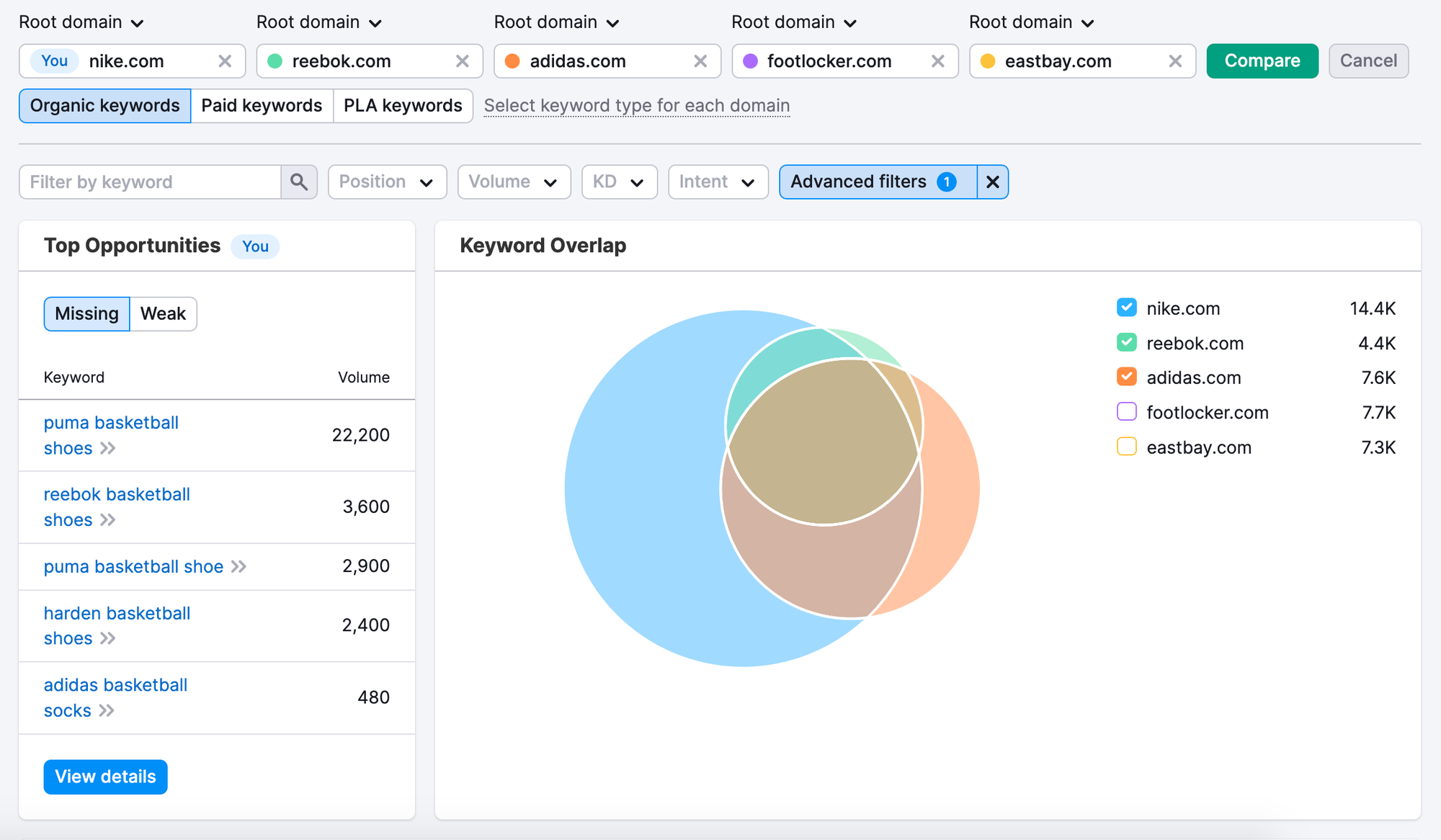
Semrush produced the broadest conventional competitor briefing in our test. Its strongest outputs combined keyword gaps, paid-search activity, traffic context and AI visibility rather than leaving each source as an isolated report.
Its seven unique findings included two paid-and-organic keyword overlaps, one competitor whose estimated traffic mix did not match its search visibility, two AI-visibility gaps, one emerging competitor appearing across multiple channels and one high-traffic page cluster that was not prominent in the backlink-led research.
What Semrush Found That Others Missed
One of the most useful findings was a set of commercial queries where the challenger appeared in both paid and organic results while also attracting traffic to the same product category.
A keyword gap alone would have been interesting. Seeing paid investment, organic visibility and traffic evidence point toward the same commercial topic made the opportunity more decision-ready.
Semrush’s main weakness was cost and verification. Ten of its 32 useful findings still required a direct check, particularly traffic estimates, apparent advertising patterns and AI-visibility interpretations. Full traffic intelligence also requires the separate Traffic & Market product rather than the base SEO subscription.
Choose if: your competitor analysis regularly spans SEO, paid search, content, traffic and wider digital visibility.
Skip if: you need only one specialist intelligence type and can obtain it substantially cheaper elsewhere.
Bottom line: Semrush ranked first because its cross-channel breadth produced the strongest overall decision-ready briefing, not because it returned the largest spreadsheet.
2. Ahrefs: Best for SEO and Backlink Competitor Analysis
Best for: SEO teams investigating search visibility, competing pages and backlinks
Starting price: $129/month for Lite
Decision-Ready Insight Score: 8.6/10
Research time: 49 minutes
Decision-ready findings: 21
Unique findings: 8
Ahrefs came within one decision-ready finding of Semrush while requiring fewer verification checks.
Its strength was showing how competitors were earning organic visibility, rather than trying to explain the competitor’s entire digital business.
What Ahrefs Found That Others Missed
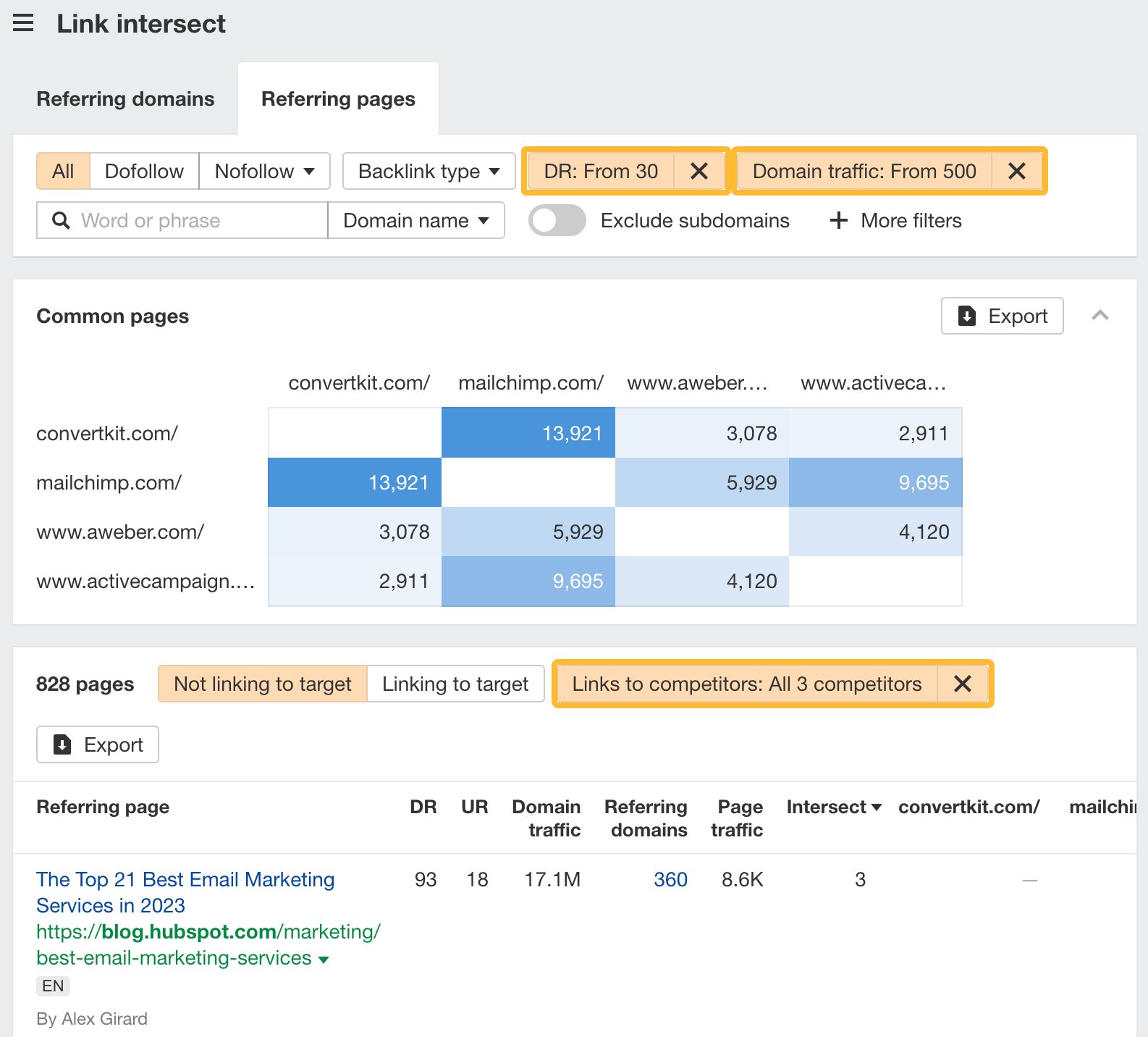
The eight unique findings included three content pages with disproportionate organic value, three manually validated referring domains that looked realistically replicable, one lost-link pattern and one search competitor that the business-led platforms did not prioritise.
The backlink test was particularly important. We did not treat every domain in a link-intersect export as an opportunity. Prospects had to remain live, be topically relevant and look realistically obtainable for the test site.
That reduced a large backlink dataset into something much closer to an actual outreach list.
Ahrefs was weaker for total digital traffic, audience demographics and continuous webpage monitoring. Its traffic figures in this test represented estimated organic search traffic, not total website visits.
Choose if: competitor analysis usually leads directly into content, search or backlink decisions.
Skip if: your main questions involve total traffic, audience composition or ongoing sales intelligence.
Bottom line: Ahrefs was the strongest organic search and backlink specialist and came closest to Semrush on decision-ready findings.
3. Similarweb: Best for Traffic and Market Intelligence
Best for: Marketers comparing traffic sources, audiences, digital market share and broader channel strategy
Starting price: $125/month annually for Competitive Intelligence
Decision-Ready Insight Score: 8.3/10
Research time: 45 minutes
Decision-ready findings: 16
Unique findings: 8
Similarweb surfaced strategic differences that the search-first platforms largely missed.
Its eight unique findings included three channel-mix differences, two audience-overlap patterns, one referral source, one geographic concentration and one category-level growth signal.
What Similarweb Found That Others Missed
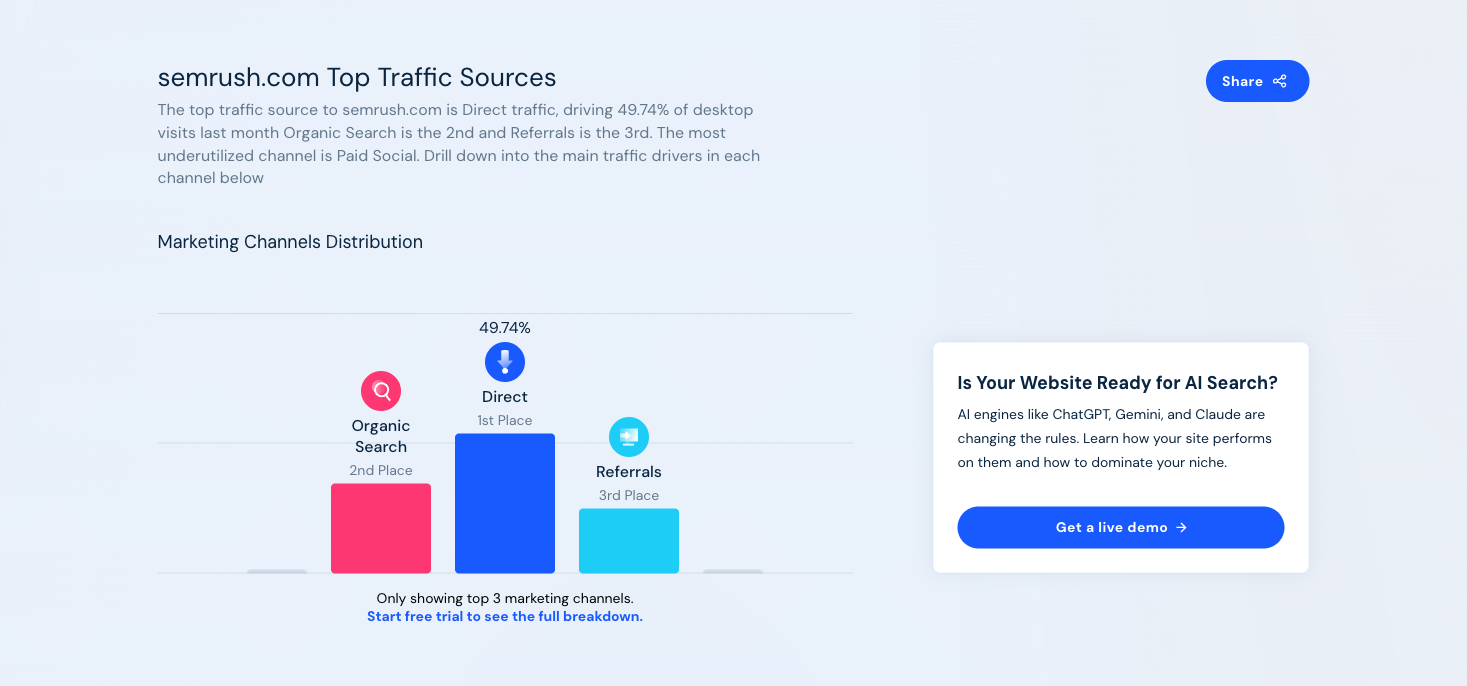
The category leader and challenger looked much closer when we viewed organic search alone than when we compared their estimated total digital visits.
Similarweb’s channel view suggested that direct and referral traffic, rather than search alone, explained a meaningful portion of the leader’s larger digital footprint.
That changes the strategy. Closing an organic keyword gap would not necessarily close the wider market gap.
The important caveat is that competitor traffic is estimated external data, not access to another company’s GA4 account. Twelve of Similarweb’s 24 useful findings required additional verification or corroboration because they depended on traffic, audience or channel estimates.
Choose if: understanding where competitors acquire attention matters as much as knowing which keywords they rank for.
Skip if: your competitor-analysis workflow is almost entirely SEO or backlink focused.
Bottom line: Similarweb owned the traffic and market-intelligence portion of our benchmark, but we would use its numbers comparatively rather than present estimates as exact competitor analytics.
4. SpyFu: Best for PPC and Historical Search Competitor Research
Best for: Teams researching competitor Google Ads, paid keywords and historical search activity
Starting price: $29/month annually for Basic
Decision-Ready Insight Score: 8.1/10
Research time: 36 minutes
Decision-ready findings: 15
Unique findings: 7
SpyFu gave us the fastest full search-research workflow in the comparison.
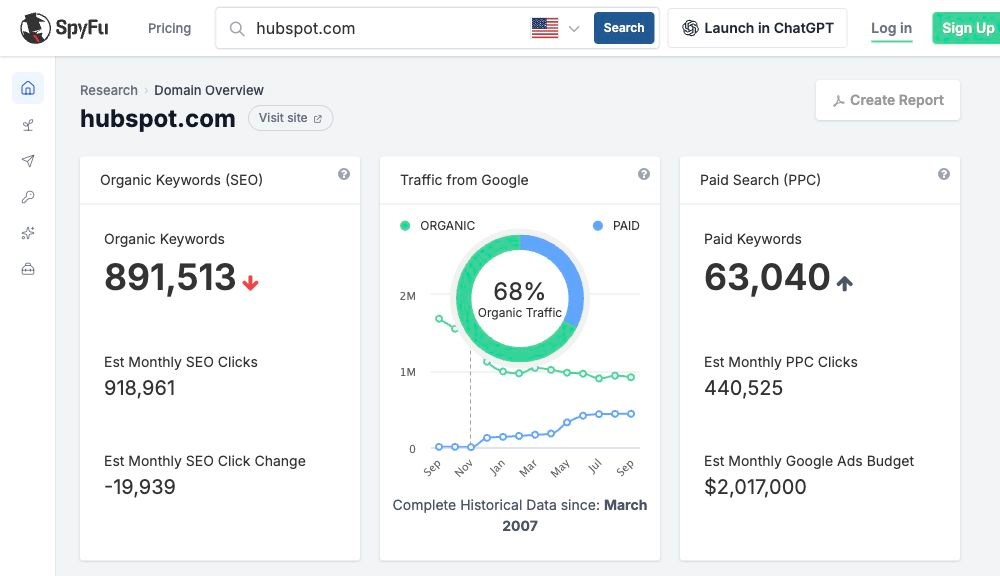
Its seven unique findings included three persistent paid keywords, two historical ad-message changes, one branded-search competitor and one landing-page pattern.
What SpyFu Found That Others Missed
Persistence was the most valuable signal.
A competitor appearing for one paid keyword in one snapshot can be incidental. Seeing the same company repeatedly buy a commercially relevant term and reuse a related offer over time gives us much stronger evidence that the query matters to its acquisition strategy.
SpyFu’s narrower focus also helped keep active research time to 36 minutes, substantially faster than Semrush, Ahrefs or Crayon.
The limitation is that search intelligence is still only one part of competitive analysis. SpyFu could not replace Similarweb for channel intelligence, Visualping for exact webpage changes or Crayon for sales enablement.
Choose if: Google Ads, paid keywords and historical competitor search activity are central to your research.
Skip if: you need broad market, traffic, audience or competitive-enablement intelligence.
Bottom line: SpyFu delivered one of the strongest specialist value propositions, particularly when the decision starts with competitor PPC.
5. Crayon: Best for Ongoing Competitive Intelligence
Best for: Product marketing, competitive-intelligence and revenue teams
Starting price: Custom quote
Decision-Ready Insight Score: 7.9/10
Research/setup time: 61 minutes
Monitoring Signal Ratio: 66.7%
Unique findings: 9
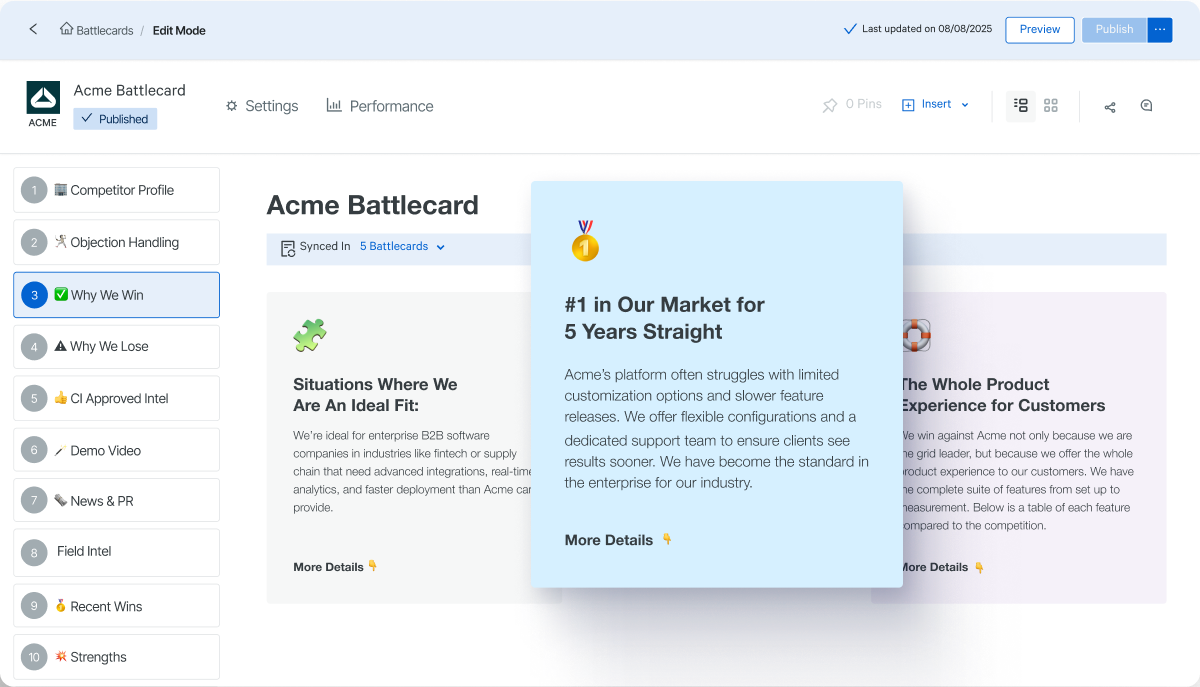
Crayon is not primarily an SEO or advertising database. Its focus is making competitive intelligence an ongoing organisational process through monitoring, synthesis, battlecards and enablement.
That distinction became clearer during the 14-day monitoring portion of our test.
What Crayon Found That Others Missed
Its nine unique findings were primarily operational: changes in positioning, product packaging, pricing language, integrations, hiring emphasis and sales-facing comparisons.
Those signals were either absent or weakly represented in the traditional search databases.
Crayon caught 10 of the 11 known meaningful changes during the test and frequently added more business context around those developments instead of returning only a raw notification.
The trade-off was setup. Configuring sources, competitors, categories and delivery workflows made Crayon the slowest initial research workflow at 61 minutes.
It also does not replace Ahrefs, Semrush or Similarweb when you need underlying keyword, backlink or total-traffic evidence.
Choose if: competitor intelligence needs to support product marketing, sales and broader revenue teams continuously.
Skip if: you mainly need a one-time SEO competitor analysis.
Bottom line: Crayon was strongest when competitive intelligence needed to become operational and distributable, rather than remain a research document.
6. Visualping: Best for Competitor Website and Pricing Changes
Best for: Monitoring pricing, product pages, positioning and other important competitor webpages
Starting price: Free; Business from $100/month annually
Decision-Ready Insight Score: 7.6/10
Setup/review time: 22 minutes
Monitoring Signal Ratio: 68.8%
Median alert speed: 12 minutes
Visualping had the narrowest scope of any product in our benchmark, and the strongest exact-page monitoring result.
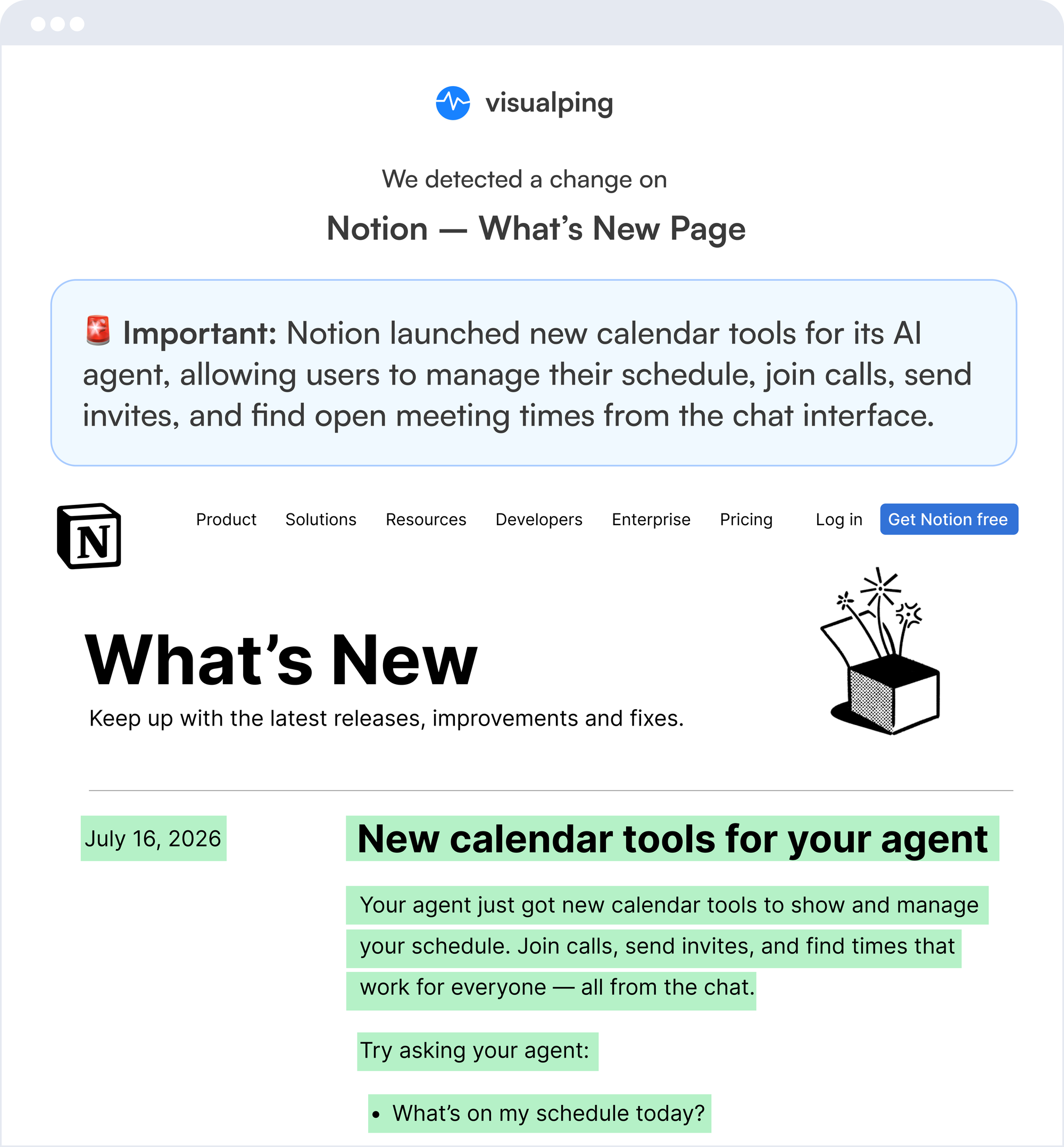
It detected all 11 manually confirmed meaningful changes across our 14-day monitoring period, including a pricing edit, new product-tier description and several positioning changes.
What Visualping Found That Others Missed
Six findings were unique: two exact copy changes, one pricing qualifier change, one removed feature claim, one new comparison-page section and one careers-page change.
There was still noise. Five of 16 alerts involved lower-value layout, timestamp or dynamic-content changes, but element-level selection and threshold tuning kept the Signal Ratio at 68.8%.
Visualping cannot tell you who links to a competitor, which keywords it owns or where its traffic comes from. That narrower coverage explains why it ranks sixth overall despite winning its specialist test.
Choose if: the important question is what changed on this page, and how quickly can we know?
Skip if: you need one platform to discover competitors and analyse their search, traffic and advertising strategy.
Bottom line: Visualping was the strongest specialist for exact competitor webpage monitoring, catching every known change with a median alert time of only 12 minutes.
7. Digimetrics: Best Integrated SEO + GEO Competitor Workflow
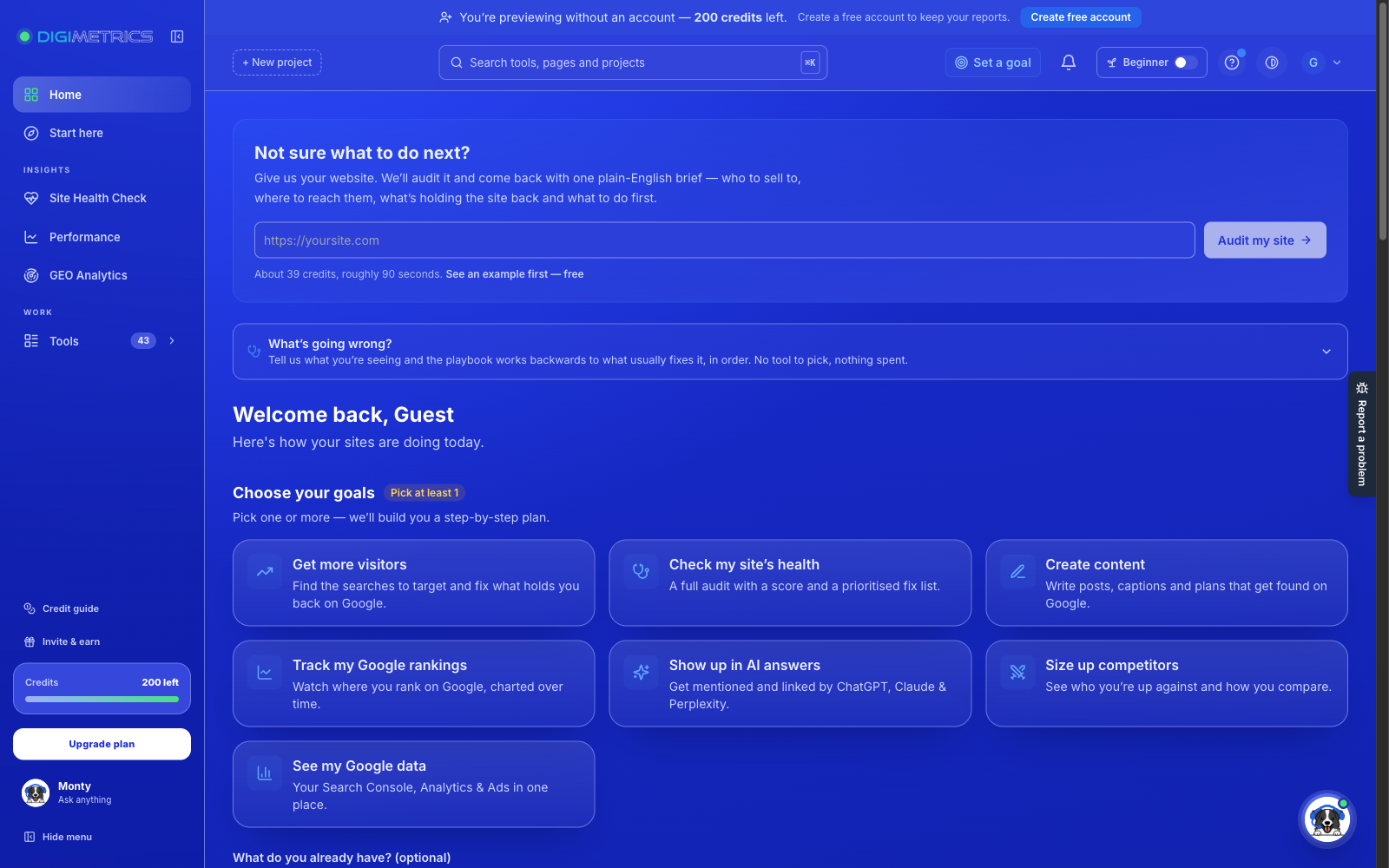
Best for: Marketers connecting competitor research to SEO diagnosis, content and AI visibility
Starting price: $39/month Starter; $109/month Pro for AI Visibility
Decision-Ready Insight Score: 7.5/10
Research time: 42 minutes
Decision-ready findings: 15
Unique findings: 5
Disclosure: Digimetrics is built by our team. We tested it against the same competitors, research questions and scoring criteria as every other platform.
Digimetrics produced 23 useful findings and 15 decision-ready findings.
Its advantage was less about owning the largest third-party competitive database and more about moving findings directly into SEO diagnosis, content optimisation, rank tracking and AI-visibility analysis.
Where the Integrated Workflow Helped
The five unique findings were mainly action combinations rather than exclusive raw data: two keyword opportunities linked to technical fixes, one competitor topic connected directly to a content workflow and two AI-visibility gaps paired with follow-up checks.
That reduced context switching, but it did not eliminate specialist gaps.
Ahrefs produced deeper backlink evidence. Similarweb was substantially stronger for total-traffic and market intelligence. SpyFu supplied deeper paid-search history, while Crayon and Visualping caught more competitor changes during the monitoring test.
Nine of Digimetrics’ 23 useful findings still needed additional verification, particularly where third-party estimates or AI-visibility interpretation were involved. We did not award extra points simply because the platform connected the finding to another workflow.
Choose if: competitor analysis primarily feeds SEO, content and GEO execution.
Skip if: you require specialist traffic intelligence, deep PPC history or enterprise competitive enablement.
Bottom line: Digimetrics offered a practical research-to-execution workflow, but the mature specialist platforms remained stronger in their core datasets.
Same Company, Different “Competitors”
One of our simplest test questions produced one of the most revealing results:
Who does each platform think the competitors are?
The labels below represent anonymised domains. Business relevance counts direct or strategically meaningful competitors; publishers and directories that only overlap in search are not treated as direct substitutes.
| Tool | #1 | #2 | #3 | #4 | #5 | Business relevance |
| Semrush | Search Specialist | Category Leader | Budget Challenger | Content Publisher | Adjacent Platform | 4/5 |
| Ahrefs | Search Specialist | Content Publisher | Category Leader | Directory/Aggregator | Budget Challenger | 3/5 |
| Similarweb | Category Leader | Enterprise Suite | Adjacent Platform | Budget Challenger | Search Specialist | 4/5 |
| SpyFu | Search Specialist | Category Leader | Budget Challenger | Content Publisher | Directory/Aggregator | 3/5 |
| Digimetrics | Search Specialist | Category Leader | Budget Challenger | Niche Vendor | Content Publisher | 4/5 |
Semrush gave us the most balanced mixed-channel competitor list. Similarweb was strongest at identifying audience and market proximity, while Ahrefs and SpyFu correctly surfaced search competitors that were not necessarily businesses a buyer would consider alternatives.
Backlink counts are a useful example of why third-party findings need verification. In our free backlink checker comparison, we examine how discovered links can differ in relevance, availability, and usefulness, even when tools appear to be answering the same question.
Business Competitors Are Not Always Search Competitors
A business competitor sells a similar product to the same customer.
A SERP competitor competes for the same search visibility.
A PPC competitor repeatedly appears in the same paid auctions.
A traffic competitor attracts a similar online audience.
A content competitor may target the same buyer without selling the same product.
An AI-visibility competitor may repeatedly be cited for the same questions even if it is not your closest commercial substitute.
Those groups overlap, but they are rarely identical.
Accepting a platform’s suggested competitor list without first identifying what type of competition it represents can lead to poor strategic decisions.
What Did Each Tool Find That the Others Missed?
| Finding type | Semrush | Ahrefs | Similarweb | SpyFu | Crayon | Visualping | Digimetrics |
| Organic keyword gaps | Strong | Strong | Limited | Useful | — | — | Useful |
| Replicable backlink opportunities | Useful | Strongest | — | Limited | — | — | Limited |
| Traffic/channel differences | Strong | Organic only | Strongest | Search only | — | — | First-party context only |
| PPC history | Strong | Limited | Useful on Ads plan | Strongest | — | — | Limited |
| Pricing/product changes | Limited | — | Limited | — | Strong | Strongest | Limited |
| Messaging changes | Limited | — | Limited | Ad copy only | Strongest context | Strong detection | Limited |
| AI visibility differences | Strong | Useful | Strong on AEO plan | Limited | Synthesis only | — | Strong on Pro |
| Prioritised next actions | Strong | Strong for SEO | Useful for channel strategy | Strong for PPC | Strong for enablement | Manual interpretation | Strong workflow integration |
No product dominated every evidence type.
Semrush came closest to broad coverage, but each specialist earned its place by answering a narrower question better.
AI search adds another competitive dimension because a brand mentioned in an AI-generated answer isn’t necessarily the company ranking highest in conventional search. Our comparison of GEO tools explains how platforms monitor competing brands, source citations, and AI search visibility across supported answer engines.
Why Competitor Traffic Estimates Disagree
A competitor-analysis platform does not have access to another company’s private GA4 property. It uses its own datasets and modelling to estimate things such as total visits, search traffic or channel share.
That is why the numbers can differ dramatically.
For one tested month:
| Competitor | Similarweb total visits | Semrush total visits | Ahrefs organic estimate | Raw spread |
| Established leader | 1.84M | 1.63M | 442K | 4.2× |
| Significant challenger | 612K | 548K | 176K | 3.5× |
| Niche competitor | 96.4K | 128K | 41.2K | 3.1× |
The wrong conclusion would be that Ahrefs severely “undercounted” the competitors.
It was measuring something different: estimated organic search traffic, while the Similarweb and Semrush figures represent estimated total visits.
Even Similarweb and Semrush should not be expected to agree exactly because their underlying datasets and estimation models differ.
For your own website, GA4 owns actual onsite behaviour and Google Search Console owns first-party Google impressions and clicks. For a competitor, third-party estimates are most useful for relative size, trends and channel comparisons, not as substitutes for its private analytics.
The Competitive Evidence Ladder
Not every competitor finding deserves the same level of confidence.
Level 1: Directly Observable Evidence
Examples include:
- competitor pricing pages;
- product pages;
- live SERPs;
- public ad libraries;
- public social profiles;
- press releases.
These are closest to the underlying source.
Level 2: Platform-Derived Evidence
Examples include:
- observed rankings;
- discovered backlinks;
- webpage changes;
- historical ads.
Collection and interpretation are still involved, but the finding remains closely tied to something observable.
Level 3: Modelled Estimates
Examples include:
- estimated competitor traffic;
- channel share;
- organic traffic estimates;
- advertising-spend estimates.
These can be useful comparatively, but they should not be treated as first-party facts.
Level 4: Interpretation
Examples include:
- “The competitor is moving upmarket.”
- “They appear to be prioritising enterprise buyers.”
- “This keyword gap should be our next growth opportunity.”
Interpretation is often where the most value appears, but consequential decisions deserve support from the evidence levels underneath.
The rule is simple:
The further a finding moves from directly observable evidence, the more verification it deserves.
What Changed? Our 14-Day Competitor Monitoring Test
We also monitored 15 competitor webpages for 14 days and manually confirmed 11 meaningful changes during the same window.
Time to alert is the median interval between the confirmed page change and the platform notification.
| Tool | Total alerts | Meaningful changes caught | Low-value alerts | Missed changes | Median alert time | Signal Ratio |
| Semrush | 9 | 4 | 5 | 7 | 19 hr | 44.4% |
| Crayon | 15 | 10 | 5 | 1 | 3 hr 18 min | 66.7% |
| Visualping | 16 | 11 | 5 | 0 | 12 min | 68.8% |
| Digimetrics | 7 | 4 | 3 | 7 | 21 hr | 57.1% |
We define:
Competitive Alert Signal Ratio = meaningful alerts ÷ total alerts
Visualping clearly won exact-page detection and speed. Crayon came close on coverage while adding more strategic context around the changes.
Semrush and Digimetrics remained useful for broader recurring competitive signals, but neither replaced a dedicated page monitor when an important pricing or product-page change needed to be detected quickly.
Can One Competitor Analysis Tool Replace the Stack?
For many teams, no.
The underlying intelligence jobs are simply too different:
- Semrush covers a large proportion of search, paid, traffic and AI visibility.
- Ahrefs goes deeper when organic search and backlink intelligence drive the decision.
- Similarweb provides a different perspective on total digital traffic, audience and market share.
- SpyFu specialises in competitor paid-search history.
- Crayon turns monitoring into ongoing competitive enablement.
- Visualping monitors exact webpages extremely efficiently.
- Digimetrics connects competitor research directly to SEO and GEO execution.
The better purchasing question is not:
“Which product has everything?”
It is:
Where does the value of another specialist subscription exceed the cost and workflow overlap it creates?
What Competitor Analysis Really Costs
Entry-level pricing does not tell the whole story, particularly once multiple users need access to traffic, SEO, monitoring and reporting capabilities.
We modelled three configurations:
| Scenario | Competitors | Users | Frequency | Requirements |
| Solo marketer | 3 | 1 | Monthly | SEO + basic competitor research |
| In-house team | 5 | 3 | Weekly | SEO + traffic + PPC + reporting |
| Agency / CI team | 25 | 5 | Weekly/daily | Multiple projects + alerts + reports |
Normalised Competitor Analysis Cost
| Tool | Solo | In-house team | Agency / CI team | Main scaling constraint |
| Semrush | $139.95 SEO only | $1,276.95 | $2,344.95 | Separate toolkits, users and plan limits |
| Ahrefs | $129 | ≈$369* | ≈$769* | Seats, plan limits; no total-traffic intelligence |
| Similarweb | $125* | From $1,626* | Custom | Packages, users, history and enterprise requirements |
| SpyFu | $29 | $187* | $187* | Search-focused rather than full-market intelligence |
| Crayon | Custom | Custom | Custom | CI programme scope |
| Visualping | Free* | $100* | $100* where capacity is sufficient | Pages, checks and workspaces |
| Digimetrics | $39 | $109* | $199* | Projects, credits and specialist-data gaps |
*The product covers only part of the complete scenario or requires assumptions around public seat/package pricing.
For Semrush, our full-access team model assumes each named researcher requires both the relevant SEO functionality and Traffic & Market access. A company could lower that cost by limiting Traffic & Market to one researcher and distributing reports, but that is a different workflow.
For Similarweb, public self-service packages include one user, while broader business configurations are customised. The multi-seat amount above is therefore a budgeting scenario rather than a negotiated quote.
The pricing exercise reinforces an important point: a great competitor-analysis platform can still be poor value for the wrong operating model.
A freelancer researching three competitors once per month and a competitive-intelligence team feeding live battlecards to dozens of salespeople should not buy the same stack.
Which Competitor Analysis Tool Should You Choose?
| If your main question is… | Start with |
| What are competitors doing across SEO, paid and digital marketing? | Semrush |
| How do competitors earn organic rankings and backlinks? | Ahrefs |
| Where does competitor traffic come from? | Similarweb |
| Which Google Ads and paid keywords have competitors used? | SpyFu |
| What changed competitively and how should sales use it? | Crayon |
| Did this specific competitor page change? | Visualping |
| How do competitor SEO findings move into SEO/GEO execution? | Digimetrics |
That is more useful than pretending one tool is universally best at every interpretation of competitor analysis.
Final Verdict: More Competitor Data Is Not the Goal
The best competitor analysis tool should help you distinguish what happened, what actually matters, how confident you should be in the evidence and what deserves action next.
In our test, Semrush ranked first at 8.9/10 because its cross-channel breadth generated the largest number of decision-ready findings. Ahrefs followed at 8.6/10 and was the strongest specialist for organic search and backlinks. Similarweb gave us the clearest traffic and market perspective, while SpyFu delivered the most efficient PPC-history workflow.
For ongoing monitoring, the specialist results were even clearer. Crayon made competitive intelligence more useful to product marketing and sales, while Visualping detected all 11 known webpage changes with a median alert time of just 12 minutes. Digimetrics connected competitor research efficiently to SEO and GEO execution but did not replace the deeper specialist datasets.
The broader lesson is that competitor analysis is not one data problem. Search rankings, backlinks, total traffic, paid-search history, webpage changes and sales intelligence all require different evidence.
The winner should therefore never be whichever platform produces the largest spreadsheet.
It should be the one that answers the competitive questions your team actually needs answered with the best combination of evidence, relevance and research effort.
Frequently Asked Questions
What Is the Best Competitor Analysis Tool in 2026?
Semrush ranked first in our test with an 8.9/10 Decision-Ready Insight Score. It generated 32 useful findings and 22 decision-ready findings while providing the strongest overall combination of SEO, paid-search, traffic and AI-visibility intelligence.
Ahrefs ranked second and was stronger for focused organic and backlink analysis, while Similarweb led the traffic and market-intelligence portion.
What Is the Best Competitor Analysis Tool for SEO?
Ahrefs and Semrush were the strongest options in our comparison.
Ahrefs excelled when competitor analysis centred on organic pages, keyword gaps and backlinks. Semrush connected strong SEO research to a broader ecosystem of paid-search, traffic and AI-visibility data.
Digimetrics is also relevant when competitor research needs to move directly into SEO diagnosis, content optimisation and GEO work, although its specialist datasets remain less deep.
What Is the Best Competitor Analysis Tool for PPC?
SpyFu was our strongest focused-value option for competitor PPC research. It surfaced persistent paid keywords, historical ad messaging and branded-search competitors while completing the search-research workflow in 36 minutes.
Semrush provides broader paid-search functionality and connects it with other channels, but at a substantially higher cost.
Can I Do Competitor Analysis for Free?
Yes, but expect more manual work.
Useful free sources include live SERPs, competitor websites, public social profiles and public advertising libraries. Some commercial products also provide limited free access; Visualping, for example, currently allows monitoring of up to five webpages on its free tier.
Free competitor research stops being inexpensive when manually collecting and maintaining the same evidence consumes more time than a suitable subscription would save.
Is Similarweb Competitor Traffic Accurate?
Similarweb provides modelled external traffic intelligence, not access to a competitor’s private GA4 account.
Its estimates are useful for comparing relative traffic, channel mix and market direction. We would not treat a single estimated visit count as known first-party traffic.
Is Semrush or Ahrefs Better for Competitor Analysis?
For broad digital competitor analysis, Semrush performed better in our test, scoring 8.9/10 versus Ahrefs’ 8.6/10 and producing one additional decision-ready finding.
For organic search and backlink investigation specifically, Ahrefs was the stronger specialist and required fewer verification steps.
What Should I Look for in a Competitor Analysis Tool?
Start with the decision you need to make.
Determine whether you need intelligence about SEO visibility, backlinks, total traffic, paid advertising, webpage changes, positioning, AI visibility or sales competition. Then evaluate whether the tool provides enough trustworthy evidence to act without requiring several additional products to verify every important conclusion.
Disclosure: digitalmarketingtools.ai is sponsored by Digimetrics.ai. Sponsored Highlights are clearly labelled advertising. Our reviews, comparisons and guides are written to be useful and fair regardless of who sponsors the site. Read the full disclosure.