What Is an AI Citation Tracking Tool? Features, Metrics, and How to Choose
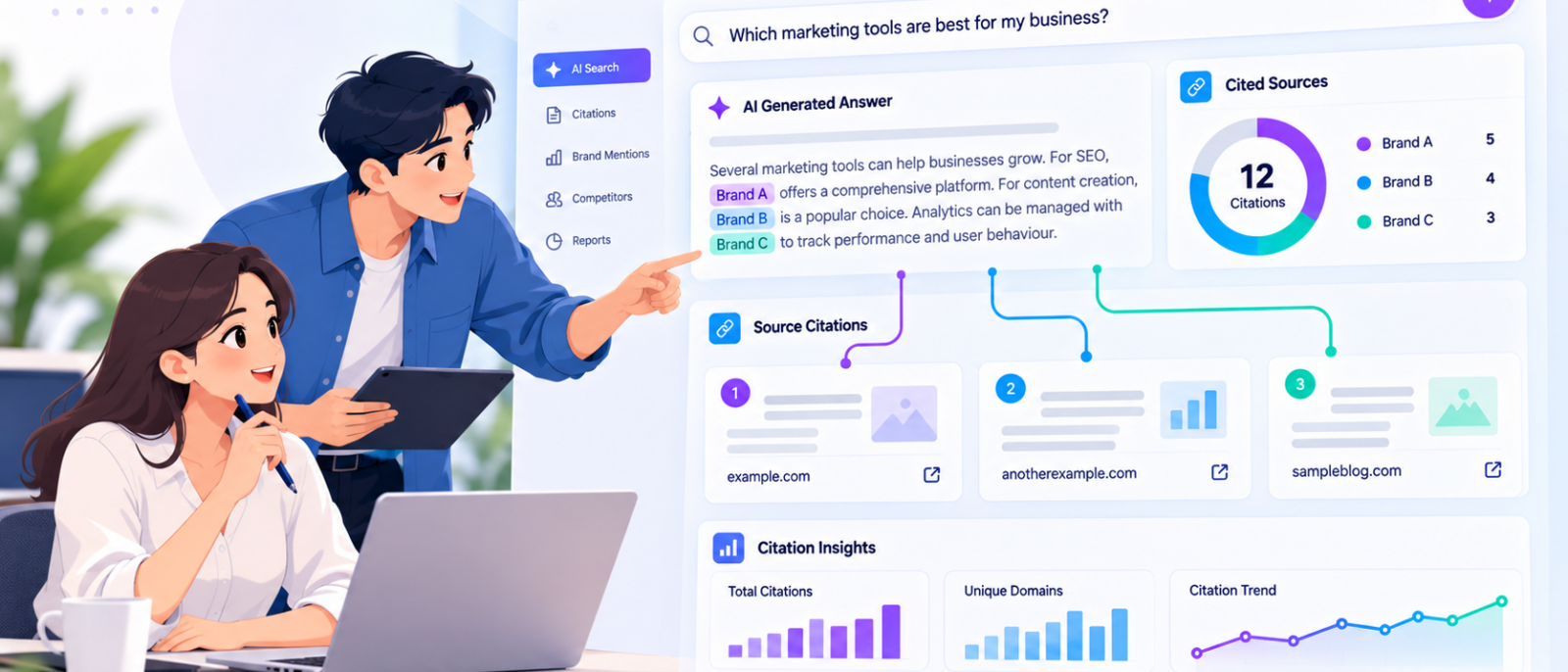
Your website might appear in an AI-generated answer even when the assistant never mentions your brand. Someone asks ChatGPT to explain a technical problem, and the response includes a link to your tutorial as a supporting source. Meanwhile, a competitor gets recommended by name without its website receiving a citation.
Traditional search rankings don’t explain this difference, and brand mention monitoring only captures part of what’s happening. To understand which websites AI systems reference, marketers need to examine the citations attached to generated answers.
An AI citation tracking tool is software that monitors which websites and pages AI-powered search systems cite when answering questions. Depending on the platform, it can identify cited URLs, record citation frequency, compare competing sources, monitor historical changes, and reveal which topics generate citations.
These capabilities are becoming more relevant as search experiences expand beyond conventional lists of links. However, a citation isn’t automatically an endorsement, a ranking position, or a website visit. Different platforms also count citations differently, which makes interpreting the data just as important as collecting it.
This guide explains how AI citation tracking works, which features matter, how current tools compare, and how to turn citation data into useful SEO and Generative Engine Optimization (GEO) research.
AI citation tracking is one part of Generative Engine Optimization (GEO). For a broader explanation of how GEO software works, including AI visibility monitoring, competitor analysis, and content optimization, see our complete guide to GEO tools.
Key Takeaways
- AI citation tracking measures source visibility. It identifies which domains and URLs appear as references in AI-generated answers.
- Citations and brand mentions are different. Your website can receive a citation without your company being recommended, and your brand can be mentioned without receiving a link.
- Citation counts depend on the measurement method. Some tools count cited responses, while others distinguish URLs, domains, and individual appearances.
- First-party reporting is available. Bing Webmaster Tools provides citation reports for supported Microsoft AI experiences, while Google Search Console offers a different, impression-based view of generative search.
- The best tools preserve the underlying evidence. You should be able to examine cited URLs, relevant prompts, collection dates, and competing sources.
- Citation tracking supports research, not guaranteed inclusion. The purpose is to identify meaningful information gaps and improve content, rather than chase arbitrary citation scores.
What Is an AI Citation in Generative Search?
An AI citation is a reference to an external source within an AI-generated response. It may appear as a clickable link, an inline reference, or an item within a dedicated sources panel, depending on the platform.
For example, someone might ask an AI assistant:
“What should small businesses consider when choosing accounting software?”
The response could compare pricing, integrations, reporting features, and ease of use. It might also link to a software company’s documentation, an independent comparison article, and a guide explaining common accounting requirements.
Those links are citations. They indicate that the AI experience has presented those pages as sources supporting its response, although they don’t prove that every statement in the answer is correct.
A citation can also appear without the source being recommended as a product or service. An independent publisher may be cited for explaining a concept, while the companies discussed in the explanation receive brand mentions.
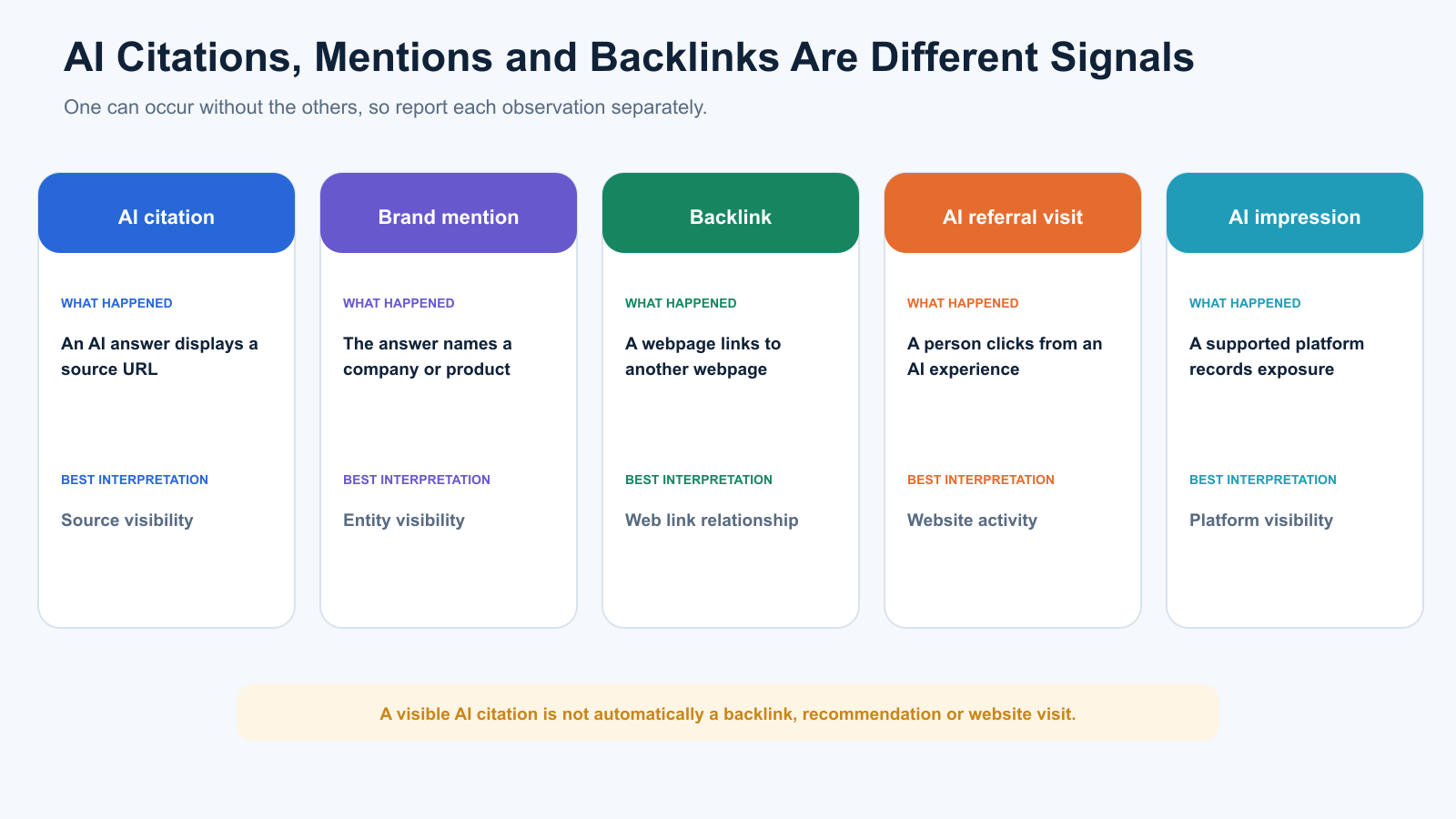
AI Citations vs Brand Mentions vs Backlinks
These terms are related, but they describe different outcomes.
| Signal | What It Means | Example |
|---|---|---|
| AI citation | An AI answer references a source URL | ChatGPT links to a technical SEO tutorial |
| Brand mention | An AI answer names a company or product | An assistant recommends Semrush |
| Traditional backlink | A webpage contains a hyperlink to another webpage | A blog links to an original research report |
| AI referral visit | Someone clicks through from an AI experience | A user visits a cited article from ChatGPT Search |
| AI impression | Content appears in a supported AI search experience | A page is shown within a Google AI search feature |
An AI citation isn’t equivalent to a traditional backlink. A link displayed inside an AI-generated answer doesn’t automatically become a conventional backlink from an independently indexed webpage, nor does it carry a guaranteed SEO ranking benefit.
Similarly, citation activity doesn’t necessarily lead to traffic. A person may read the answer, notice the source, and leave without opening the linked page.
For a broader explanation of these measurement differences, see our guide to GEO and SEO visibility signals.
How Does an AI Citation Tracking Tool Work?

Most third-party AI citation tracking tools begin with a collection of relevant questions, often called prompts. The software submits or monitors those questions across supported AI platforms, collects the generated responses, and identifies the URLs or domains presented as sources.
The captured data can then be grouped by website, page, platform, topic, competitor, or collection period. This allows marketers to investigate which information sources appear repeatedly and whether their own content is included.
For example, a cybersecurity software company might monitor questions about endpoint protection, ransomware prevention, and small-business security software. Its citation tracking tool could reveal that independent review websites are frequently cited for product comparisons, while technical documentation receives more citations for troubleshooting questions.
That distinction could inform the company’s editorial planning. However, the findings would describe the monitored prompt set rather than every question asked by actual customers.
Retrieved Sources Aren’t Always Cited Sources
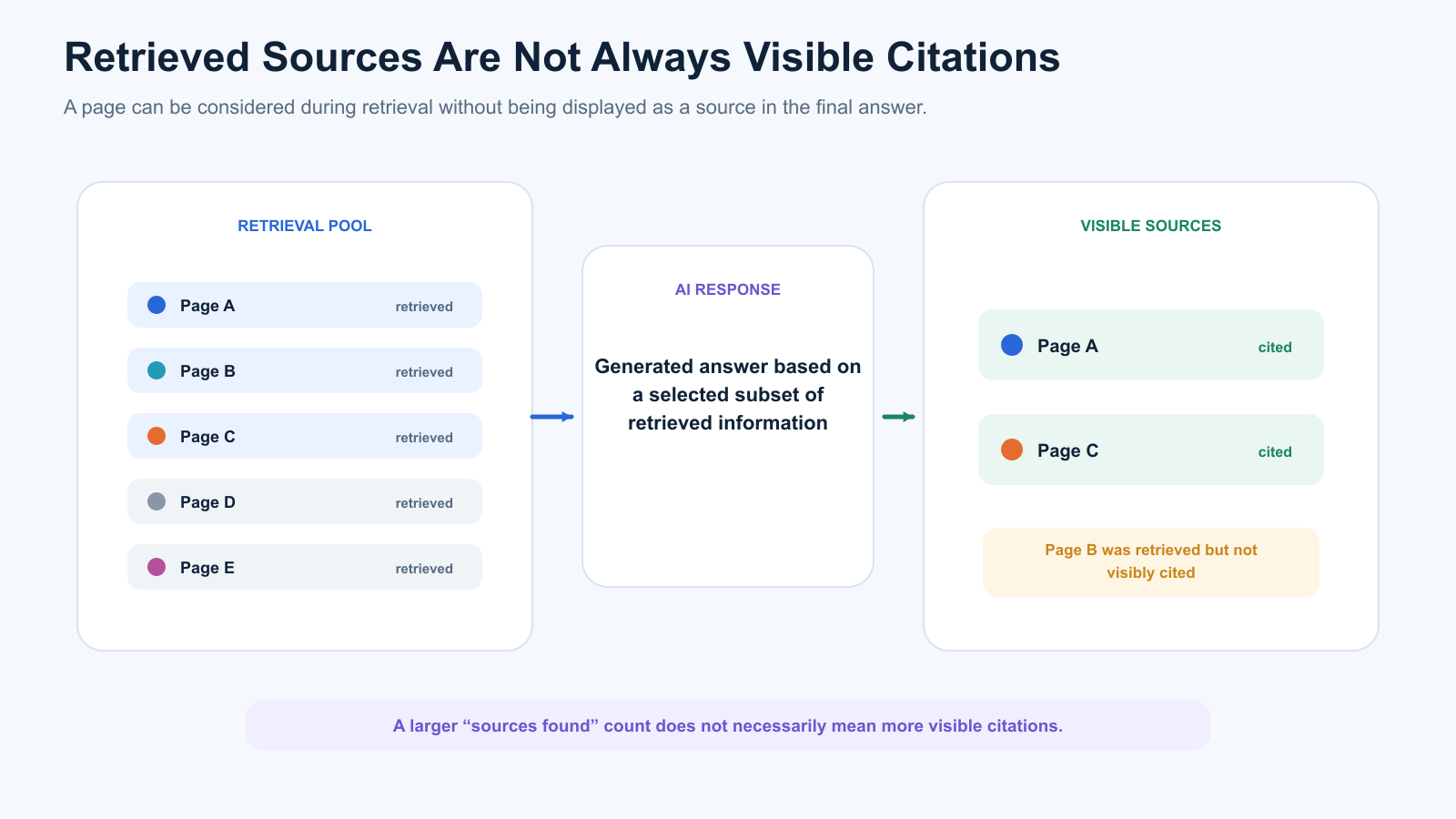
One important distinction is whether a page was retrieved during answer generation or explicitly displayed as a citation.
An AI system may retrieve several pages while researching a question but only link to some of them in its final response. A tool that tracks retrieved sources may therefore report more URLs than a platform measuring visible citations alone.
Ahrefs Brand Radar makes this distinction through its Found in and Citations measurements. Pages encountered during retrieval can be recorded even when they aren’t cited in the visible answer.
Peec AI also distinguishes retrieved sources from those used as citations in its analysis.
This difference matters when comparing tools. A larger source count doesn’t necessarily mean a website earned more visible citations.
How Citation Tracking Platforms Count URLs
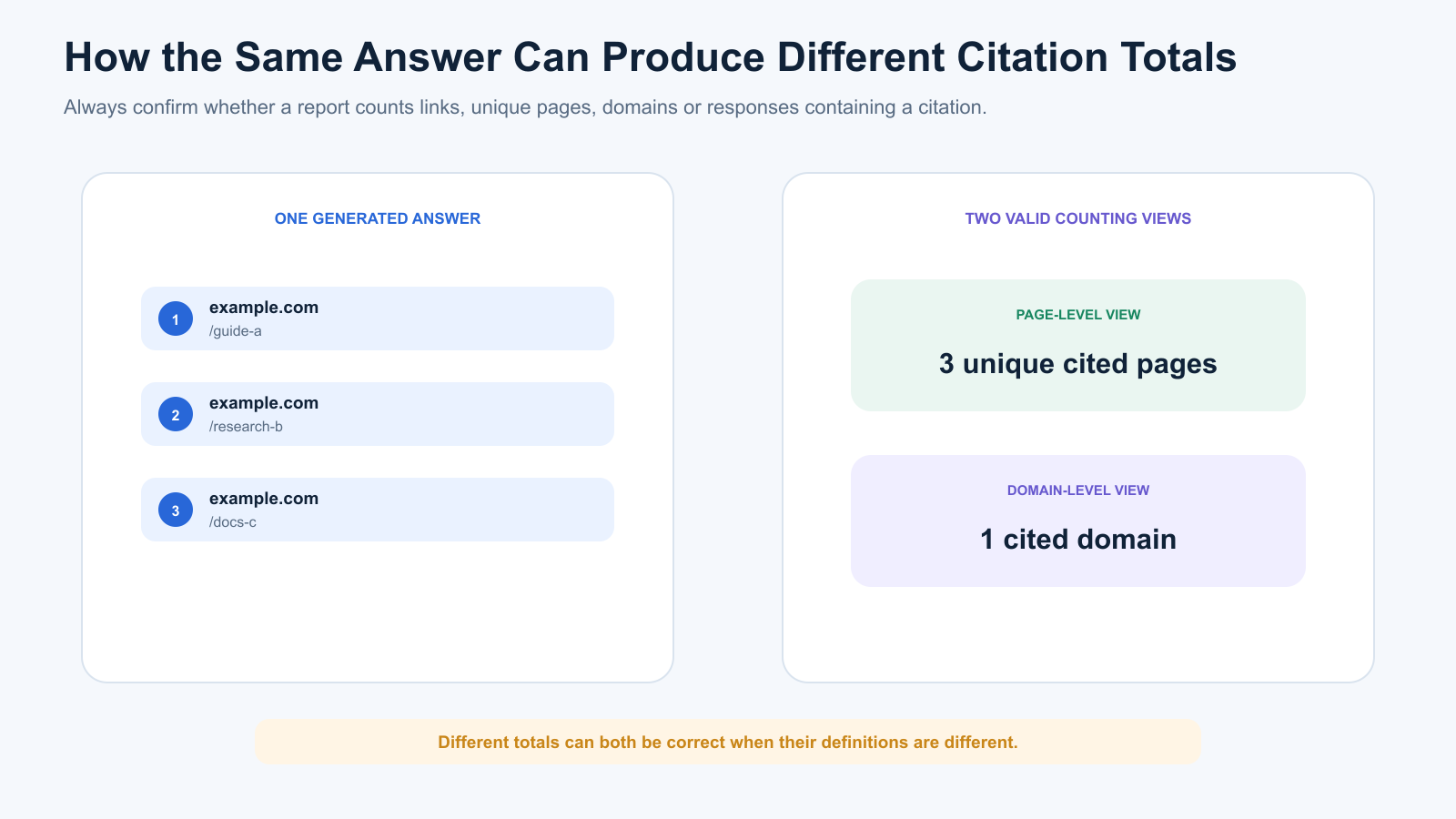
Citation counting sounds straightforward until several pages from the same website appear in one answer.
Consider a hypothetical response citing three pages from example.com.
A platform might count three cited URLs because three distinct pages appear. Another report might count one cited domain because all three URLs belong to example.com.
Ahrefs, for example, documents a counting method where a page cited at least once in a response contributes one citation for that page. At the domain level, a response citing multiple pages from the same domain contributes one domain citation.
Other platforms use their own definitions.
Before comparing citation totals, establish whether the metric represents individual links, unique pages, unique domains, or responses containing a citation.
Why Should Businesses Track AI Citations?
AI citation tracking can reveal where a website contributes information to generated answers, which competitors appear as sources, and whether existing content supports relevant research questions.
For publishers, citations can provide evidence that particular articles are appearing as references in supported AI experiences. For software companies, citation analysis may show whether their documentation, comparisons, or independent reviews are being used.
However, citations should be evaluated in context rather than treated as an independent business goal.
Understand Which Content Gets Referenced
A website may publish hundreds of pages, but only a relatively small selection might appear within the AI responses being monitored.
Citation tracking helps identify those pages.
For example, a digital marketing website might discover that its detailed tool comparisons are cited more often than general introductory articles within a particular prompt set.
That observation could suggest that the monitored questions favour specific comparisons. It wouldn’t necessarily prove that comparison articles receive more citations across every AI platform or industry.
Identify Competitor Citation Gaps
A citation gap occurs when competing websites are cited for relevant questions while your website is absent from the observed answers.
Suppose an ecommerce business sells products with complex technical specifications. Competitors might receive citations for detailed compatibility guides while its own website provides only brief product descriptions.
Citation tracking can help identify that difference.
The next step is to investigate whether the missing information would genuinely help customers. Publishing a useful compatibility guide may be worthwhile even if the business cannot guarantee that AI systems will cite it.
Discover Important Third-Party Sources
Not every citation opportunity involves your own website.
AI-generated answers may reference independent publications, research organisations, product directories, professional associations, and other third-party sources.
Understanding which publications appear in relevant answers can inform legitimate digital PR, partnerships, and outreach research.
However, being mentioned by a frequently cited publication doesn’t guarantee that an AI assistant will recommend your business. Third-party coverage should be pursued for its relevance, credibility, and audience value rather than treated as a guaranteed citation shortcut.
What Features Should an AI Citation Tracking Tool Have?
The most useful citation tracking software provides detailed evidence rather than relying entirely on an overall GEO score.
Several capabilities are particularly important when comparing platforms.
URL-Level and Domain-Level Citation Reporting
A tool should show both the websites being cited and the individual pages receiving references.
Domain-level reporting helps identify frequently cited publications, competitors, and source categories. URL-level reporting reveals which articles, product pages, documentation resources, or research reports appear in generated answers.
Ideally, users should be able to move from a domain summary to the underlying URLs and the questions associated with them.
This makes it easier to investigate whether a citation relates to product information, technical guidance, industry research, or another content type.
AI Platform Coverage
Citation patterns can differ across ChatGPT Search, Google AI Overviews, Google AI Mode, Perplexity, Gemini, and Microsoft Copilot.
A tool that monitors one experience doesn’t automatically cover the others.
For example, Google AI Overviews and AI Mode are separate experiences, and even when users ask similar questions, their generated responses may present different supporting links.
When evaluating a tool, confirm exactly which platforms it monitors and whether citation collection is supported for each one.
Also check geographic and language availability, since monitoring a particular market may be central to the research.
Prompt-Level Citation Analysis
Prompt-level reporting connects cited sources with the questions that produced them.
This is especially useful because a citation count without context provides limited information.
A product documentation page might receive repeated citations for troubleshooting questions but never appear in product recommendation prompts. Both observations are relevant, but they support different marketing decisions.
A strong tool should allow users to inspect the prompt, AI response, cited URL, monitored platform, and collection date together.
Historical Citation Tracking
AI-generated answers can change over time, even when the underlying prompt remains the same.
Historical tracking records which sources appeared during earlier collection periods and helps identify persistent or disappearing citations.
This can reveal whether a website is regularly referenced across monitored responses or appeared only occasionally.
However, historical changes should be interpreted carefully. Different source selections may reflect updates to the AI platform, competing content, retrieval methods, or the monitored question itself.
Citation Share and Competitor Comparisons
Some platforms calculate citation share to describe a website’s relative presence among cited sources.
For example, a website might appear in a certain proportion of observed answers or account for a percentage of citations within a selected dataset.
The calculation depends on the provider.
Microsoft’s Bing Webmaster Tools defines Citation Share in relation to citation activity for a grounding query, while commercial GEO platforms may calculate comparable metrics across their own monitored prompts.
These percentages shouldn’t be compared directly unless the measurement methods and datasets are compatible.
Source Classification and Exports
Source categorisation helps distinguish owned websites, competing domains, independent publishers, community discussions, and other references.
This can reveal whether AI responses rely primarily on official documentation or third-party information for a particular subject.
For teams managing ongoing GEO research, data exports and reporting integrations also matter. The ability to retain URLs, dates, prompts, and collection settings makes it easier to verify findings and compare reporting periods.
A dashboard becomes much more useful when its claims can be traced to individual observations.
Which AI Citation Metrics Actually Matter?
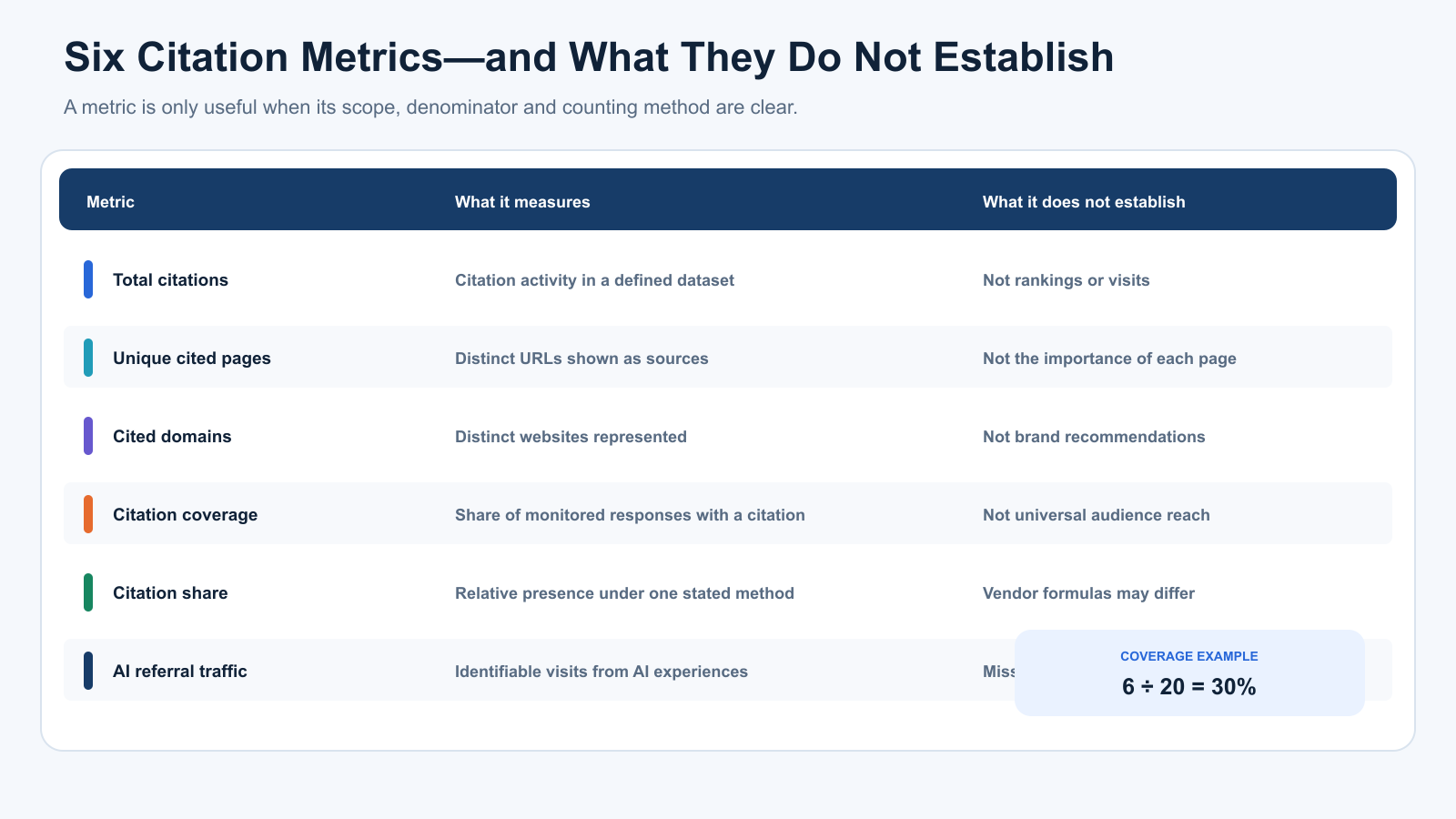
Not every metric in a GEO dashboard directly measures citations.
Some describe brand visibility, some represent potential audience exposure, and others measure website activity after a link is clicked.
The following distinctions are particularly important.
| Metric | What It Measures | What It Doesn’t Establish |
|---|---|---|
| Total citations | Citation activity within a defined dataset | Search rankings or customer visits |
| Unique cited pages | Distinct URLs referenced | The importance of each page |
| Cited domains | Distinct websites appearing as sources | Brand recommendations |
| Citation coverage | Presence across monitored responses or prompts | Visibility across every user interaction |
| Citation share | Relative citation presence using a specified method | Universal AI market share |
| Retrieved sources | Pages accessed or found during retrieval | That they were visibly cited |
| AI referral traffic | Visits attributed to AI experiences | All citation exposure |
| Brand mentions | Responses naming a company or product | That its website was cited |
Example: Calculating Citation Coverage
Suppose a fictional software company monitors twenty generated responses using a consistent set of questions.
Its website appears as a cited source in six of those responses.
For that dataset:
Citation coverage = (6 ÷ 20) × 100 = 30%
This is a hypothetical example, not a recorded result.
It means the website received a visible citation in 30% of the monitored responses. It does not mean that 30% of all AI searches cited the business.
If the prompt set, AI platform, location, or collection period changes, the result may change significantly.
This is why a useful citation report should always identify the conditions behind its figures.
Why Citation Counts Aren’t the Same as Citation Quality
A website could receive many citations from responses that have little relevance to its products or services.
Another website might receive fewer citations for commercially important questions that closely match its audience.
The higher citation count isn’t automatically more valuable.
A useful assessment considers whether the cited page answers the question accurately, whether the subject matters to the business, and whether the response represents the source appropriately.
Citation volume provides one measurement. Relevance and business value require additional interpretation.
Free AI Citation Tracking: What Can You Measure?
Businesses can begin investigating AI citation activity without immediately purchasing a commercial GEO platform.
However, first-party reporting tools provide different types of information.
Bing Webmaster Tools AI Performance
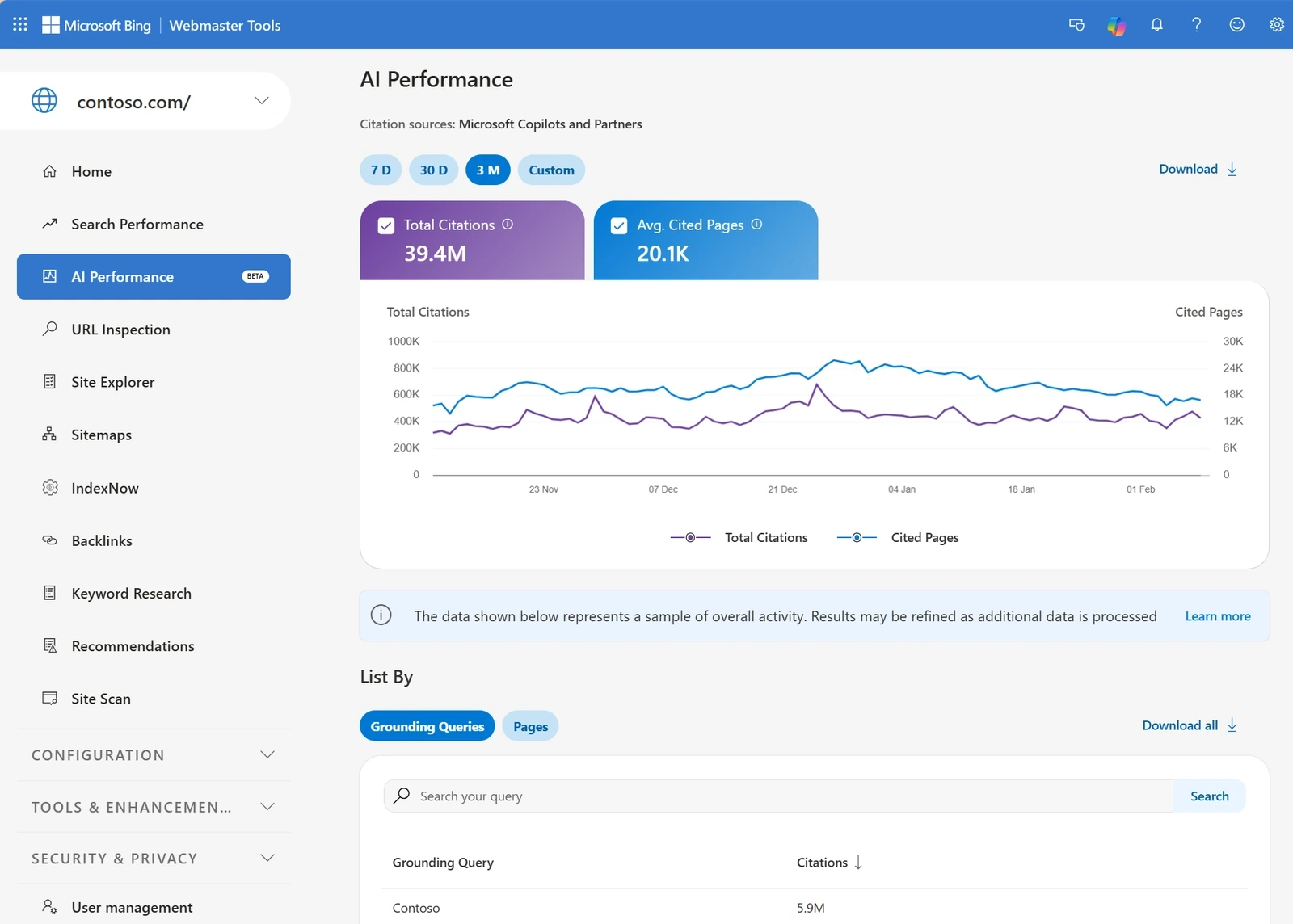
Microsoft launched its AI Performance report in February 2026.
The report shows how content from verified websites is cited across supported AI experiences, including Microsoft Copilot, AI-generated summaries in Bing, and selected partner integrations.
It includes several useful measurements:
- Total citations: How often content appears as a visible source in supported AI-generated answers.
- Cited pages: Which URLs receive citations.
- Grounding queries: Phrases associated with information retrieval and citation activity.
- Historical trends: How aggregated citation activity changes across reporting periods.
The grounding query information requires careful interpretation. Microsoft explains that these are grouped phrases connected to retrieval activity, not necessarily the exact questions entered by users.
In June 2026, Microsoft introduced additional preview features covering intents, topics, citation share, and comparative reporting.
Its October 13, 2026 Topics Portfolio beta expands those capabilities by grouping related grounding queries into broader subjects.
This can help publishers identify the topics associated with existing citations and potential gaps.
However, Microsoft’s documentation makes clear that AI Performance data is aggregated and sampled. Citation counts describe observed referencing activity, not rankings, authority, clicks, or the importance of a particular page.
Google Search Console
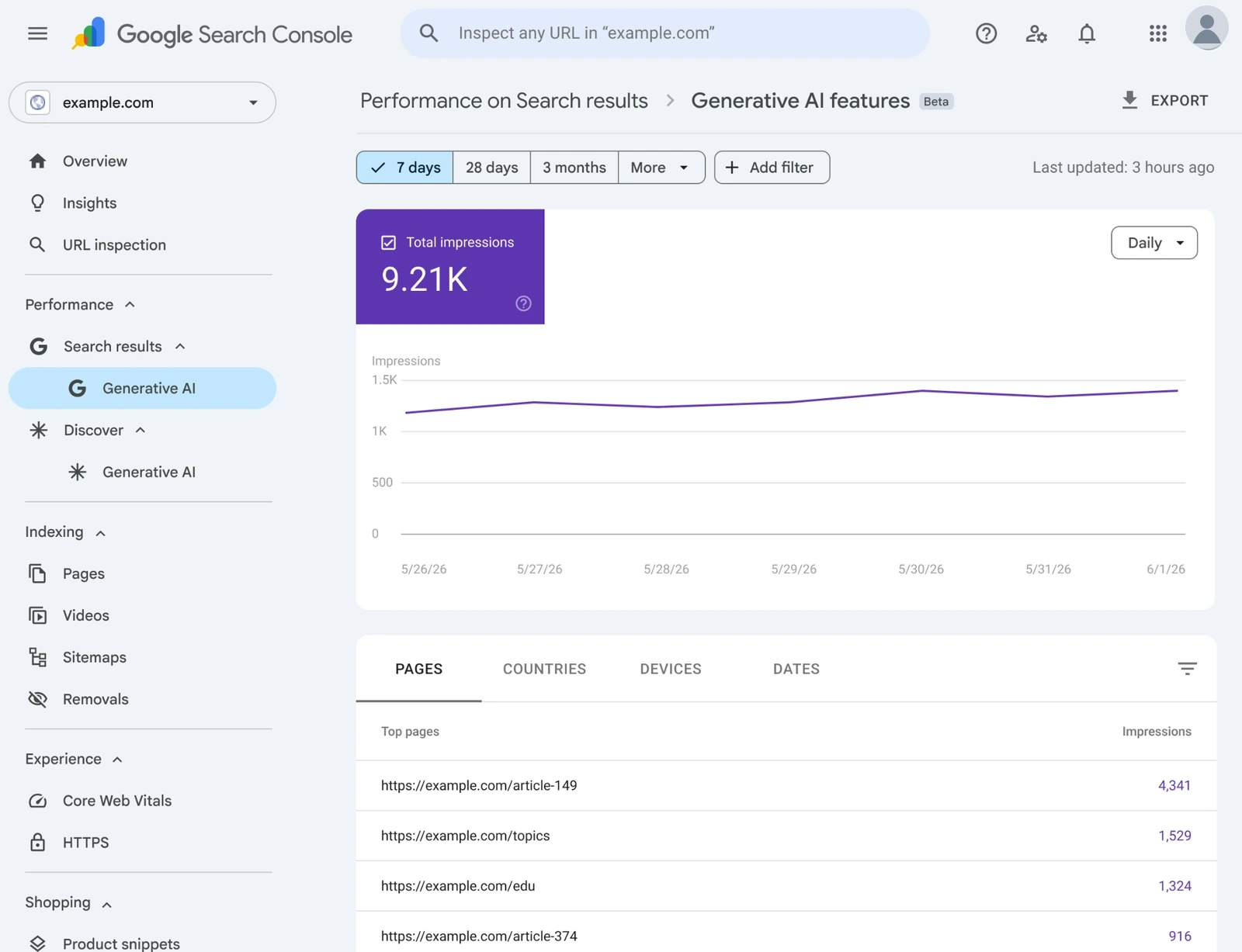
Google also introduced dedicated generative-AI performance reporting in June 2026, with worldwide rollout completed by August 31.
Its Generative AI performance report provides impression-based information for supported Google Search experiences, including AI Overviews and AI Mode.
This is useful for understanding which pages appear within Google’s generative search features.
However, it isn’t equivalent to Bing’s citation report.
Search Console’s generative-AI impressions shouldn’t automatically be treated as citation counts, and the report doesn’t provide a complete list of individual AI responses and their cited competitors.
For marketers, the two products provide complementary first-party evidence rather than interchangeable measurements.
AI Citation Tracking Tools Worth Comparing
Several SEO and GEO platforms now provide dedicated citation analysis or citation-related reporting.
The following comparison focuses on documented functionality available in October 2026. It is not a ranking based on hands-on testing of the same prompt dataset.
| Tool | Citation Tracking Approach | Useful For |
|---|---|---|
| Bing Webmaster Tools | First-party citation and grounding query reports | Owners of websites appearing in supported Microsoft AI experiences |
| Semrush AI Visibility | Cited domains, URLs, prompts, and source gaps | Teams combining SEO, prompt tracking, and citation research |
| Ahrefs Brand Radar | Cited pages, domains, and retrieved-source distinctions | Competitive source analysis and broader SEO research |
| Profound | Citation share, coverage, categories, and page-level monitoring | Organisations requiring detailed AI citation intelligence |
| Peec AI | Source and citation analysis across tracked AI responses | Marketers comparing sources, competitors, and mentions |
| Otterly.AI | Prompt-based citation monitoring and reporting | Teams monitoring selected prompts across supported AI platforms |
Semrush AI Visibility

Semrush’s Prompt Tracking includes a Sources report that identifies domains and individual pages cited across tracked prompts.
The product allows users to investigate citation activity by domain, page, source category, and relevant question. Its reporting can also identify sources that appear when competitors are mentioned but the monitored brand is absent.
Semrush’s October 7, 2026 guide explains how the Sources report can be used to investigate competitor citation gaps and third-party publishers appearing in relevant answers.
This makes Semrush worth considering for teams already using its broader SEO research platform. However, prompt allowances, platform coverage, and reporting capabilities depend on the relevant subscription.
Ahrefs Brand Radar
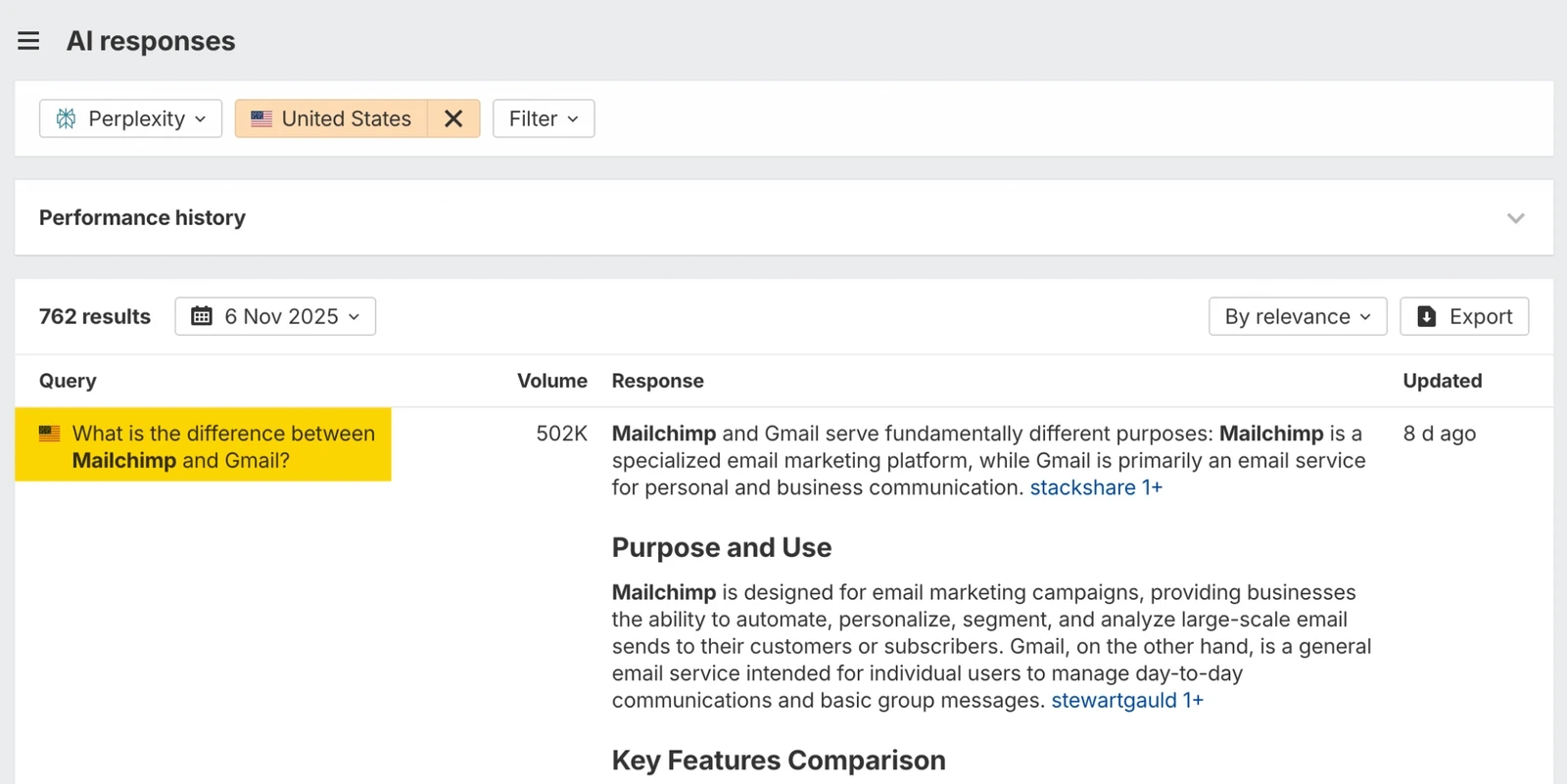
Ahrefs Brand Radar provides AI visibility research that distinguishes brand mentions, citations, and other source-related measurements.
Its September 2026 documentation explains that cited pages and domains are counted differently, while its Found inmeasurement can include pages encountered during retrieval but not visibly cited.
This distinction makes the platform particularly relevant for source research.
For example, marketers can examine whether their content is being found during AI retrieval but not appearing among the cited sources.
However, retrieval-related observations shouldn’t be interpreted as proof that a page influenced the final wording of an answer.
Profound
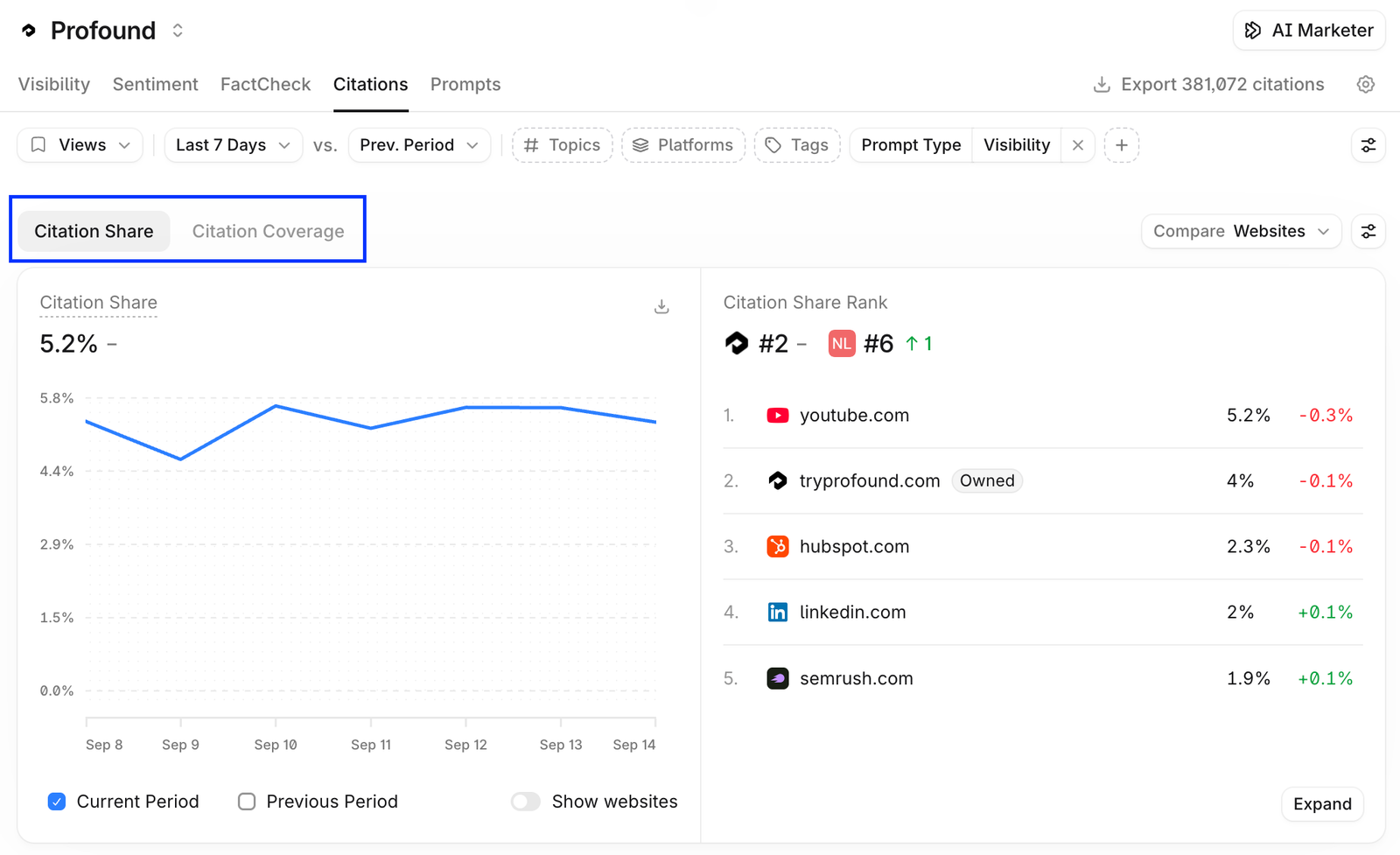
Profound provides dedicated AI citation analysis within its Answer Engine Insights product.
Its documented capabilities include Citation Share, Citation Coverage, source categories, domain comparisons, and individual page analysis.
The platform also offers a watchlist for selected URLs and a Citation Decay report that examines how citation activity changes over time.
These features make it relevant to organisations requiring detailed citation monitoring across important topics and sources.
However, advanced reporting should still be evaluated against the organisation’s actual requirements. More measurements don’t necessarily create more useful insights unless the team understands how to interpret them.
Peec AI
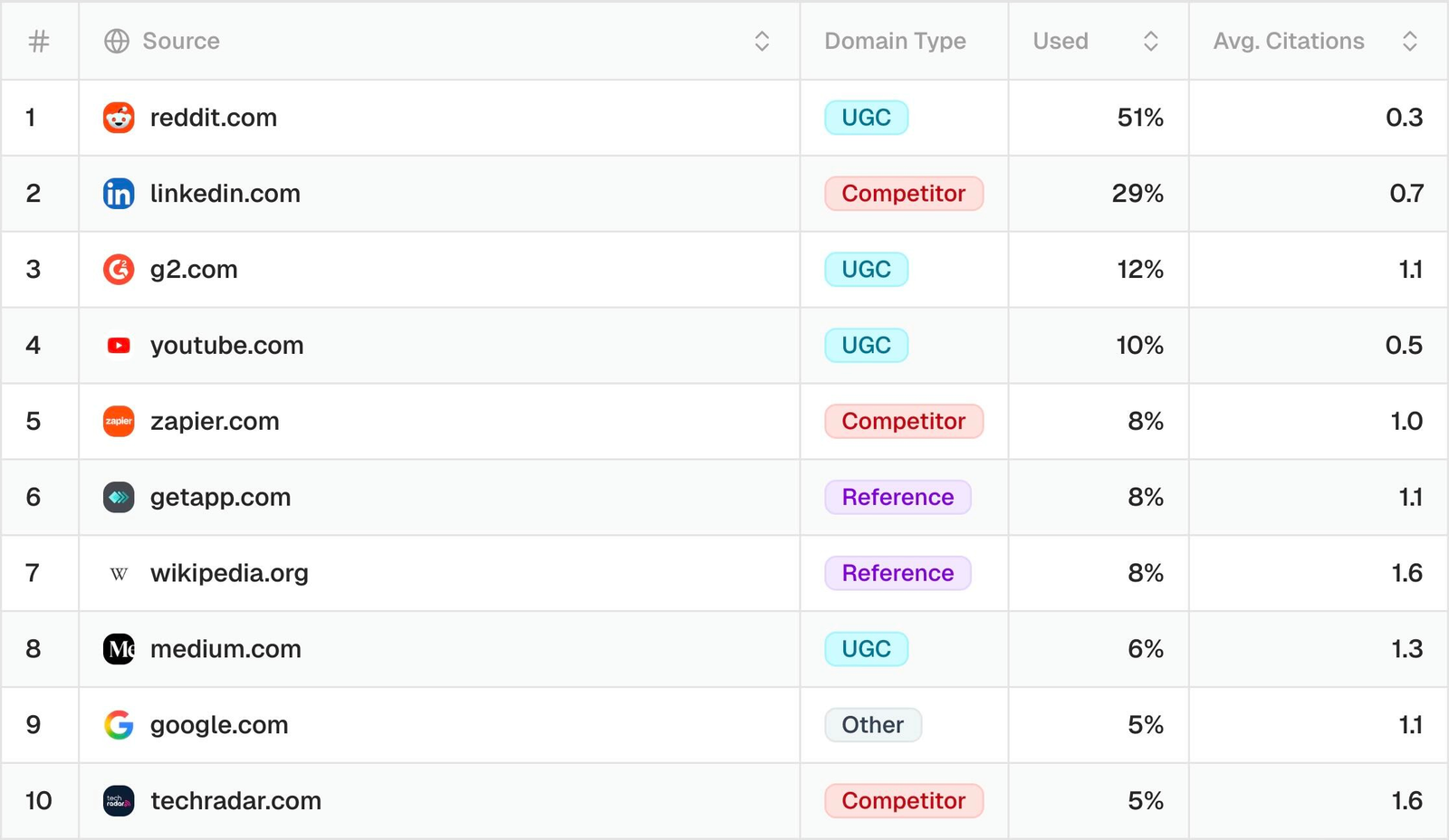
Peec AI distinguishes between retrieved sources and citations within its AI search analytics.
Its source analysis can help identify competing pages, relevant third-party publications, and differences between brand appearances and source references.
This approach may be valuable when a business wants to understand why particular publications appear in AI-generated responses while its own pages are absent.
As with other prompt-monitoring products, results depend on the monitored platforms, questions, markets, and collection settings.
Otterly.AI
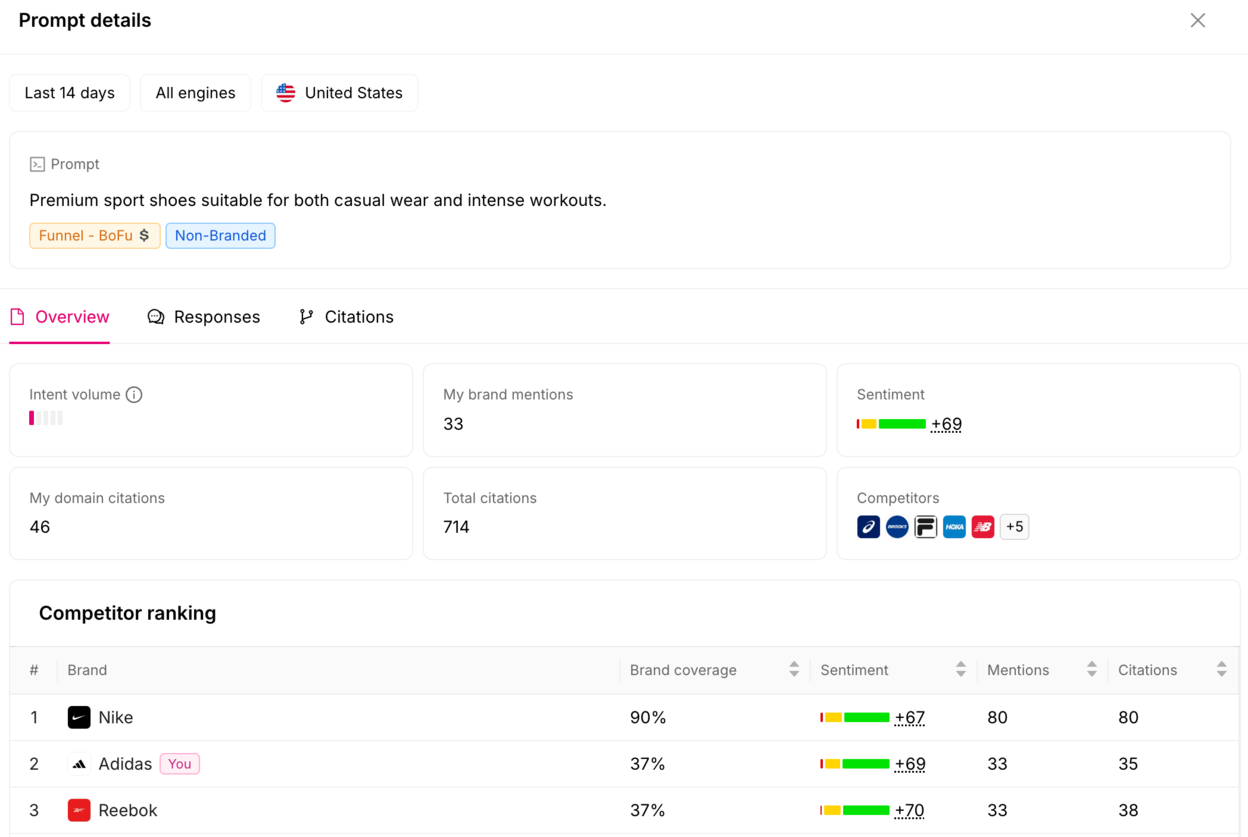
Otterly.AI provides website citation monitoring alongside brand mentions, sentiment, and competitor analysis.
Its documented capabilities include recording cited URLs, monitoring prompt responses, analysing citation activity, and exporting reports.
This can suit teams that want recurring citation monitoring based on a defined collection of customer questions.
However, platform access and some advanced features depend on subscription options, so businesses should confirm which AI experiences and reporting capabilities are included.
Digimetrics
Disclosure: DigitalMarketingTools.ai is sponsored by Digimetrics.ai, which is developed by MediaOne.
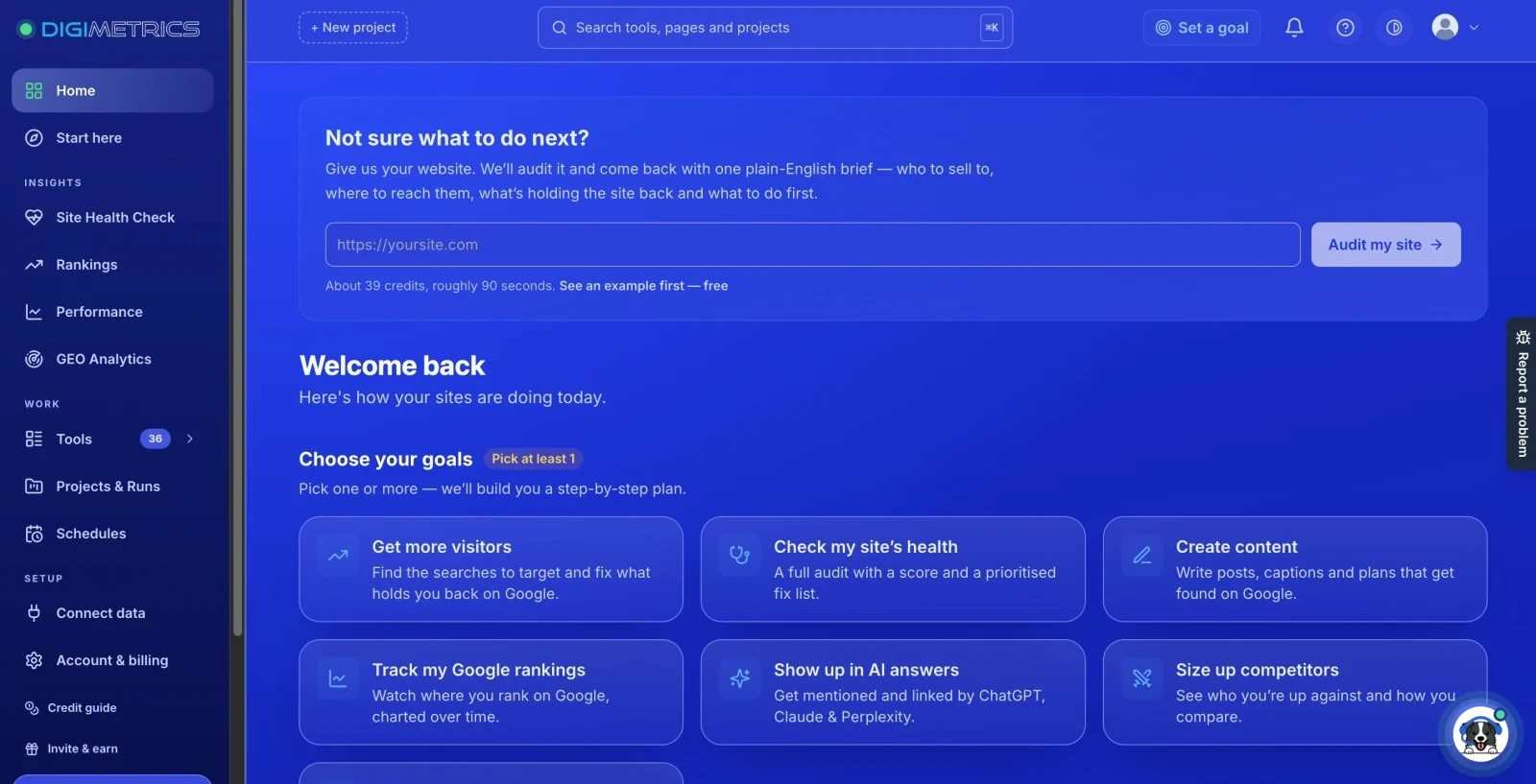
Digimetrics offers an integrated workspace combining SEO, AI visibility, technical diagnostics, and content optimisation.
Its public toolkit includes AI Mentions Tracker, AI Discovery Audit, GEO On-Page Optimisation, and GEO+SEO Forensic Audit.
These capabilities may help teams connect AI search observations with broader SEO investigations. For example, an AI visibility issue might lead to a technical accessibility check or a review of important content.
However, brand mention tracking isn’t automatically the same as URL-level citation tracking.
Before choosing Digimetrics for this specific purpose, users should verify whether the available tools provide the citation URLs, supported AI platforms, historical records, and source-level comparisons they require.
A dedicated citation product may remain preferable when detailed citation analytics are the primary requirement.
How to Choose the Best AI Citation Tracking Tool

The best AI citation tracking tool in 2026 depends on what your team needs to investigate, which AI systems matter to your audience, and whether the collected evidence can support useful decisions.
For example, a publisher may want to identify articles cited by AI assistants. A software company may be more interested in whether its documentation receives citations during product comparisons. An agency might require recurring monitoring across multiple clients.
Each situation places different demands on the software.
AI Citation Tool Evaluation Checklist
| Evaluation Area | What to Verify |
|---|---|
| Platform coverage | Does it monitor the AI experiences relevant to your audience? |
| Citation definition | What exactly counts as one citation? |
| URL-level reporting | Can you inspect individual cited pages? |
| Retrieved-source data | Does it distinguish retrieved pages from visible citations? |
| Prompt controls | Can you monitor relevant customer questions? |
| Competitor comparison | Can you compare sources under equivalent conditions? |
| Historical records | Can you review previous citations and collection dates? |
| Source classification | Can you distinguish owned, competitor, and independent sources? |
| Reporting | Can you export URLs, prompts, responses, and relevant metadata? |
| Cost and limits | How are monitored prompts, credits, projects, and users counted? |
Citation definition is especially important. Two platforms can report different totals without either necessarily being wrong, simply because they count domains, pages, or responses differently.
A useful evaluation should test whether the product explains its calculations and provides enough evidence to reproduce a sample of its findings.
How to Test an AI Citation Tracking Tool Before Buying
A citation tracking trial should examine the same business questions across the platforms being evaluated. The purpose is to determine whether the software collects useful evidence, not to manufacture an accuracy score from one set of responses.
Build a Representative Prompt Set
Choose questions related to the products, services, or topics your business cares about.
For example, a fictional ecommerce analytics provider might monitor questions about sales attribution, marketing dashboards, conversion tracking, and comparisons between analytics products.
The set should include informational, commercial, and problem-solving questions rather than only branded prompts. That creates a more balanced picture of the sources appearing across different types of answers.
Compare Equivalent Conditions
Where supported, use the same prompts, AI experiences, geographic markets, languages, and collection periods.
If one platform checks Google AI Mode while another monitors ChatGPT Search, the results shouldn’t be treated as direct measurements of the same experience.
Likewise, differences in update schedules or available source information should be documented.
The purpose is to understand what each product can reliably observe under comparable conditions.
Inspect Individual Citations
Open a sample of the recorded AI answers and check whether the tool correctly identified the cited pages.
Pay particular attention to repeated URLs, multiple pages from the same domain, redirects, and canonical variations.
For example, a platform might record two versions of one article as separate URLs if it doesn’t normalise them consistently.
A citation report should make these situations understandable instead of hiding them behind a single total.
Evaluate the Source Analysis
Once you’ve verified the citations, examine whether the software helps identify useful patterns.
Can it show which pages receive citations for product comparisons? Can it distinguish company documentation from independent reviews? Can you investigate relevant questions where competitors appear but your website doesn’t?
A strong product should turn the underlying citation records into useful research without overstating what the data proves.
Test Reporting and Workflow Fit
Finally, build the type of report your team would use.
Check whether the tool exports cited URLs, source domains, collection dates, AI platforms, and relevant prompts. If the reports require extensive manual corrections or hide important information, their operational value may be limited.
The right choice is the product that provides dependable evidence at a cost and level of complexity your team can justify.
How to Use AI Citation Data to Improve Your Content
Citation tracking becomes useful when it helps marketers understand what information is being referenced and where genuine content gaps exist.
However, missing citations don’t automatically mean that a webpage needs optimisation.
A source may be absent because the question requires different information, another publication provides stronger evidence, or the AI system selected different references during that collection.
Examine the Questions Behind Citation Gaps
Suppose your software company is rarely cited for questions about data privacy.
The first step should be to examine the monitored questions and the sources appearing in those answers.
You might discover that users need explanations of data retention, regional hosting, or compliance responsibilities that your existing documentation doesn’t address clearly.
Improving that information could make your website more helpful to customers while providing material that AI systems may find relevant.
The objective should be better information, not simply adding phrases designed to trigger citations.
Publish Verifiable, Original Information
Original research, product documentation, practical examples, and detailed comparisons can provide useful information that generic summaries lack.
For a software company, that might mean publishing accurate API documentation or explaining integration limitations.
For a marketing publication, it could involve testing products under comparable conditions and documenting the findings transparently.
However, claims about hands-on testing should only appear when those tests actually occurred.
Invented statistics, fabricated case studies, and unsupported claims may be repeated by AI systems, but that doesn’t make them trustworthy.
Check Technical Accessibility
Technical SEO still matters when investigating AI citation visibility.
Google explains that pages must satisfy relevant indexing and snippet-eligibility requirements to appear as supporting links in AI Overviews and AI Mode.
Google’s official guidance also states that special GEO schema and AI-specific markup aren’t required for inclusion.
For ChatGPT Search, OpenAI advises publishers to check whether OAI-SearchBot can access important content.
These checks establish technical eligibility and accessibility, not guaranteed citations.
A page can be fully accessible and still be absent from a particular generated response.
Use Third-Party Citation Data Responsibly
Independent websites may appear repeatedly among cited sources for a particular subject.
This can provide useful context for digital PR and partnership research, especially when relevant publications have expertise or audiences your business wants to reach.
However, marketers shouldn’t treat source lists as guaranteed placement opportunities.
Publishing inaccurate statistics, manipulating reviews, or manufacturing mentions to influence AI-generated answers undermines the credibility of the underlying information.
The more defensible strategy is to produce useful material and pursue legitimate editorial coverage.
How to Measure Whether AI Citations Deliver Business Value
Citation tracking provides visibility evidence, but it doesn’t directly establish commercial value.
A cited article may receive a website visit, influence brand familiarity, or have no measurable immediate effect on user behaviour.
For this reason, citation analytics should be evaluated alongside website and business performance data.
Connect Citations With Referral Traffic
Some AI platforms provide identifiable referral information when users click through to a website.
OpenAI, for example, documents the use of utm_source=chatgpt.com in referral URLs associated with ChatGPT Search.
Website analytics can help investigate these visits where tracking is available.
However, citation counts and referral visits shouldn’t be expected to match.
A single citation might produce several visits, one visit, or none.
Separate Visibility From Conversions
A useful reporting framework distinguishes between citation activity, website engagement, and business outcomes.
| Reporting Layer | Example Measurement | What It Helps Explain |
|---|---|---|
| Citation visibility | Cited pages, domains, citation coverage | Where content appears as a source |
| Website activity | AI referral sessions, engaged visits | Whether measurable visitors arrive |
| Business performance | Leads, purchases, enquiries | Whether activity contributes to outcomes |
These measurements answer different questions.
For example, an article could receive more AI citations during a reporting period without a corresponding increase in tracked website visits.
That wouldn’t automatically make the citations worthless, but it would limit what the business could conclude about their immediate traffic contribution.
Avoid Claiming Causation From Citation Growth
Suppose citation activity increases after you publish an updated product comparison.
That relationship is worth investigating.
However, AI systems may also have changed their retrieval methods, competitors may have updated their information, or the collection process may have produced different responses.
To make a stronger assessment, compare consistent reporting periods, document content changes, and consider additional evidence from analytics and relevant business outcomes.
Common Mistakes When Tracking AI Citations
Several mistakes can make otherwise useful GEO reports misleading.
Confusing Citations With Brand Recommendations
A website may be referenced as an information source without its owner being recommended.
Always examine the role of the citation within the response.
Treating Retrieved Pages as Visible Citations
Some products record pages retrieved during answer generation, including sources not displayed to users.
Confirm whether the report counts retrieved content, visible citations, or both.
Comparing Citation Scores Between Vendors
Citation share, coverage, and frequency may use different denominators and counting rules across platforms.
Compare definitions and underlying evidence before making performance claims.
Assuming Every Citation Creates SEO Authority
A citation inside an AI-generated answer isn’t automatically a conventional backlink or a Google ranking signal.
Its measurable value depends on the context and any resulting business activity.
Optimising for a Single AI Response
One generated answer doesn’t represent every future response to the same question.
Use a consistent monitoring process and interpret changes over time rather than reacting to individual fluctuations.
Final Verdict: What Makes an AI Citation Tracking Tool Worth Using?
An AI citation tracking tool helps marketers understand which websites and pages are referenced in generated answers, how those citations change across monitored questions, and where competing sources appear.
That information can support content planning, technical investigations, competitive research, and GEO reporting.
However, citation data is only useful when the measurement method is clear.
A good platform should distinguish brand mentions from citations, explain how it counts pages and domains, identify the AI experiences being monitored, and retain enough evidence to verify individual observations.
For businesses beginning citation research, Bing Webmaster Tools provides useful first-party reporting. Platforms such as Semrush, Ahrefs Brand Radar, Profound, Peec AI, and Otterly.AI offer different forms of broader citation analysis and competitor monitoring.
The best choice depends on the specific questions your team needs answered and whether the resulting data helps improve its work.
The goal isn’t to maximise citations at any cost. It’s to understand where your content contributes useful information, identify meaningful gaps, and evaluate whether that visibility supports your broader marketing objectives.
Frequently Asked Questions
What Is an AI Citation Tracking Tool?
An AI citation tracking tool monitors the websites and individual pages referenced in AI-generated answers. Depending on the platform, it can record citations, compare competitors, track relevant prompts, and analyse changes over time. These tools help marketers understand source visibility across supported AI search experiences.
What Is the Best AI Citation Tracking Tool in 2026?
There is no universal best option. Bing Webmaster Tools provides first-party citation reporting for supported Microsoft AI experiences, while Semrush, Ahrefs Brand Radar, Profound, Peec AI, and Otterly.AI offer different forms of cross-platform citation analysis. Compare their source-level reporting, platform coverage, historical evidence, and measurement definitions.
Can I Track ChatGPT Citations?
Yes. Several third-party GEO platforms monitor citations appearing in supported ChatGPT Search responses. OpenAI also allows users to open sources within individual search answers. However, third-party monitoring typically observes a defined collection of prompts rather than every private conversation or all possible ChatGPT responses.
Does Google Search Console Track AI Citations?
Google Search Console provides dedicated generative-AI performance reporting for supported Google Search features. However, its impression-based measurements shouldn’t be treated as equivalent to URL-level citation counts. Bing Webmaster Tools currently provides more explicit first-party citation reporting for its supported AI experiences.
What Is the Difference Between AI Citations and Brand Mentions?
An AI citation is a reference to a source page, while a brand mention occurs when the generated answer names a company or product. The two may appear together, but neither requires the other. A publication may receive a citation without being recommended, and a brand may be recommended without its website being cited.
Are AI Citations the Same as Backlinks?
No. Traditional backlinks are links contained within webpages, while AI citations appear within generated answers or their associated source interfaces. An AI citation doesn’t automatically create a conventional backlink or guarantee an improvement in search rankings. It should be measured as a separate form of visibility.
How Do AI Citation Tracking Tools Count Citations?
Counting methods vary. Some measure responses containing a cited domain, while others count individual URLs or citation instances. Ahrefs, for example, documents separate page-level and domain-level counting. Always review the vendor’s definitions before comparing totals.
Can I Track AI Citations for Free?
Yes. Bing Webmaster Tools provides first-party citation reporting for eligible verified websites within its supported AI experiences. Google Search Console provides related generative-AI visibility data, although it measures impressions rather than the same citation metrics. Manual source checks can also support limited research.
How Can I Increase AI Citations to My Website?
Start by ensuring important content is accessible, accurate, useful, and relevant to the questions your audience asks. Citation gap analysis can help identify missing information or underdeveloped topics. However, no content update, GEO score, or technical adjustment can guarantee that an AI platform will cite a particular webpage.
Do More AI Citations Mean More Website Traffic?
Not necessarily. A source may appear in an AI-generated answer without users clicking its link. Citation activity and referral visits should therefore be measured separately, while business outcomes require additional analytics and attribution data.
How Often Should I Monitor AI Citations?
The appropriate frequency depends on the business’s reporting needs and how often it acts on the findings. Daily collection may be useful for active research or competitive markets, while weekly or monthly reviews can support broader content planning. Consistent prompts, platforms, and measurement conditions matter more than collecting frequent observations without a clear purpose.
Disclosure: digitalmarketingtools.ai is sponsored by Digimetrics.ai. Sponsored Highlights are clearly labelled advertising. Our reviews, comparisons and guides are written to be useful and fair regardless of who sponsors the site. Read the full disclosure.