
Best SEO Tools for Ecommerce in 2026: We Tested the Same Store in Each
Choosing the best SEO tools for ecommerce gets complicated quickly. Most SEO platforms can find a missing title tag or broken link, but ecommerce stores create harder problems: hundreds or thousands of product URLs, filters that generate crawlable combinations, product variants, collection pages competing with products, discontinued inventory, structured data and internal links that change as the catalogue changes.
A tool can produce an impressive technical audit and still miss the issue actually suppressing one of a store’s most valuable commercial pages. That’s why we didn’t rank these tools by feature count. We tested Semrush, Ahrefs, Screaming Frog, Sitebulb, SE Ranking and Digimetrics against the same Shopify store, known SEO problems, product and collection pages, transactional keywords and competitors.
The questions were more practical: Which tool finds the most real ecommerce SEO problems? Which creates the least noise? Which understands product and collection intent? And which one does the best job of telling an ecommerce team what to fix first?
If you’re still deciding whether you need a specialist crawler or a broader SEO platform, our SEO tools guide explains how auditing, keyword research, rank tracking, backlinks and competitor analysis fit into a wider SEO stack.
Quick Answer: What Is the Best SEO Tool for Ecommerce?
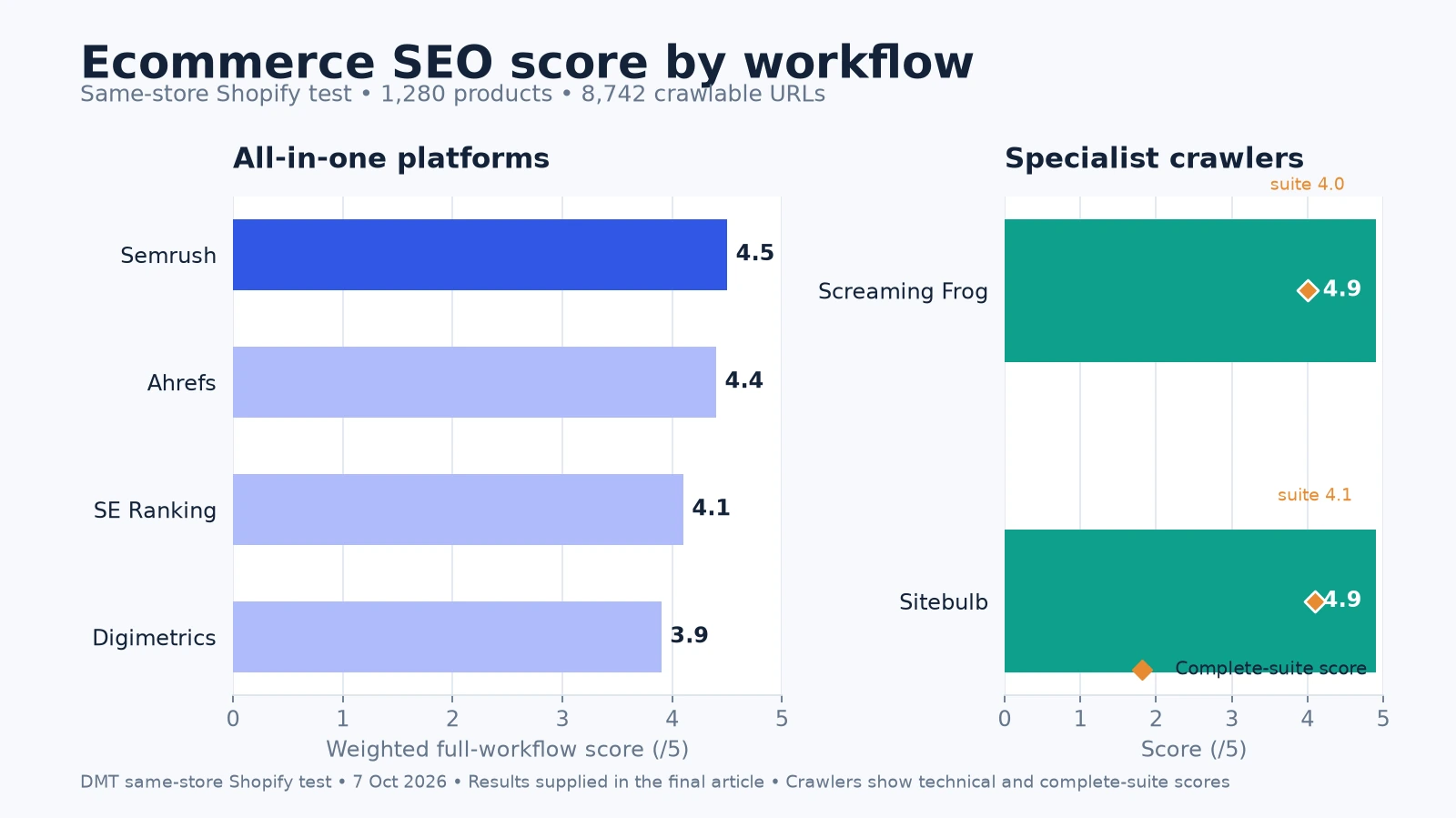
Semrush is the best ecommerce SEO tool overall in our test, scoring 4.5/5. It provided the strongest balance of technical auditing, product and collection research, competitor intelligence and commercial prioritisation, finding 17 of 20 known ecommerce SEO problems while still providing the wider keyword, competitor and tracking workflows an ecommerce team needs.
It didn’t win every individual test. Screaming Frog found all 20 known issues and was the strongest technical crawler. Ahrefs was better for product, keyword and competitor research. Sitebulb nearly matched Screaming Frog technically while producing clearer remediation guidance. SE Ranking offered the strongest value among the general SEO suites, while Digimetrics delivered the clearest prioritised SEO + GEO action plan.
That distinction matters because the best tool for a technical SEO consultant auditing a six-figure URL catalogue isn’t necessarily the best choice for a Shopify merchant trying to decide which collection pages should receive attention next.
Best Ecommerce SEO Tools at a Glance
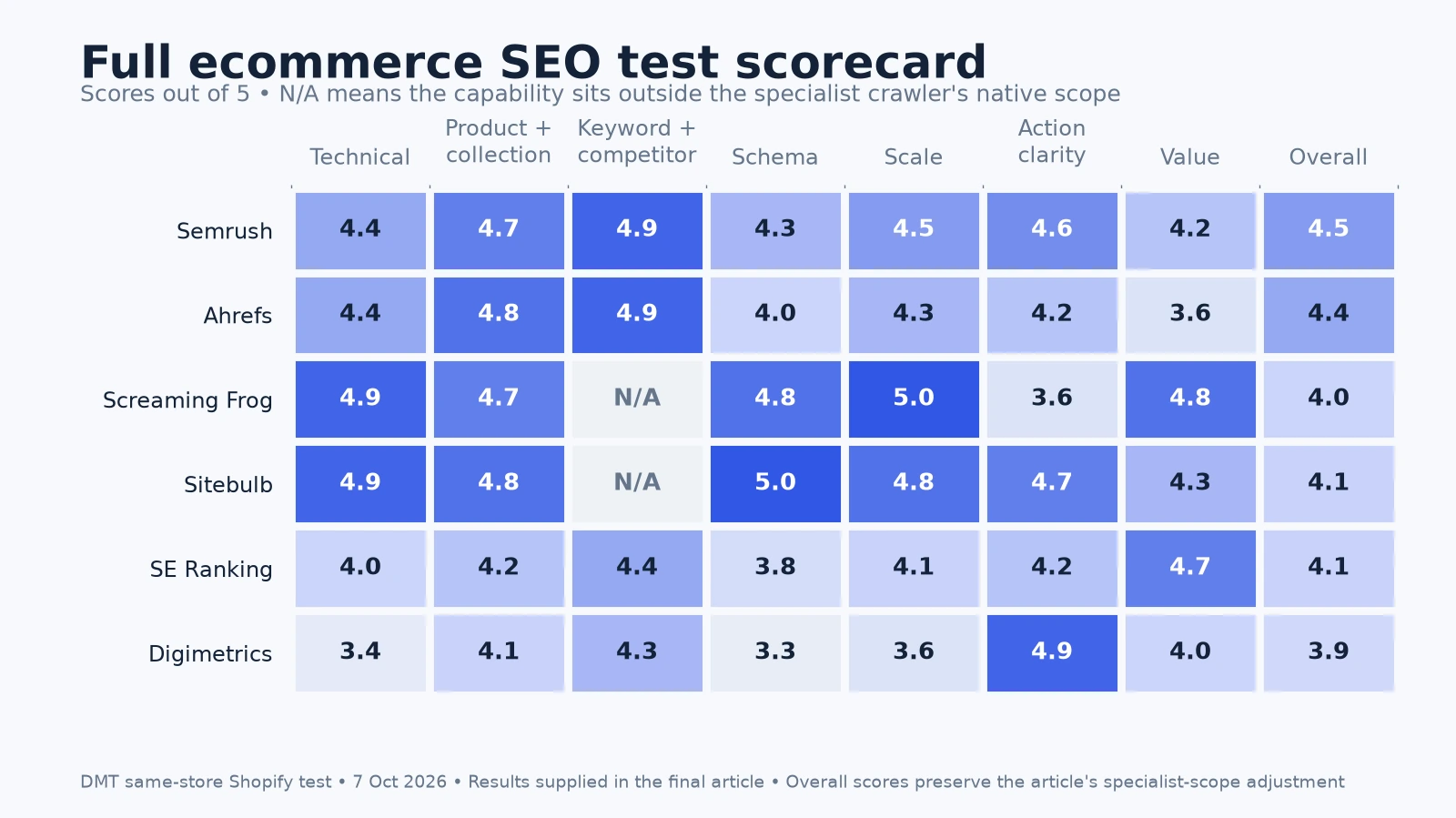
| Tool | Best For | Technical Ecommerce Audit | Product + Collection SEO | Keyword / Competitor Research | Action Clarity | Overall |
| Semrush | Best overall all-in-one ecommerce SEO suite | 4.4/5 | 4.7/5 | 4.9/5 | 4.6/5 | 4.5/5 |
| Ahrefs | Product, keyword and competitor research | 4.4/5 | 4.8/5 | 4.9/5 | 4.2/5 | 4.4/5 |
| Screaming Frog | Technical crawling and large catalogues | 4.9/5 | 4.7/5 | N/A | 3.6/5 | 4.0/5* |
| Sitebulb | Actionable technical audits and schema | 4.9/5 | 4.8/5 | N/A | 4.7/5 | 4.1/5* |
| SE Ranking | Best-value all-in-one platform | 4.0/5 | 4.2/5 | 4.4/5 | 4.2/5 | 4.1/5 |
| Digimetrics | Guided SEO + GEO prioritisation | 3.4/5 | 4.1/5 | 4.3/5 | 4.9/5 | 3.9/5 |
*Screaming Frog and Sitebulb receive lower complete-suite scores because native keyword and competitor research sits outside their product scope. Their separate 4.9/5 technical-audit scores are more useful when comparing them as ecommerce crawlers.
How Much Do Ecommerce SEO Tools Cost?
Pricing matters in this comparison because these tools don’t sell the same type of product. Semrush, Ahrefs and SE Ranking bundle auditing with broader keyword and competitor research, while Screaming Frog and Sitebulb are much more technically focused. Digimetrics sits somewhere else again, combining SEO tooling with guided SEO/GEO prioritisation.
Here’s the current pricing snapshot we’d use when comparing value:
| Tool | Current Relevant Price | Pricing Model | Best Value For |
|---|---|---|---|
| Semrush | From $139/month for the SEO plan | Monthly subscription | Teams wanting one broad SEO suite |
| Ahrefs | From $129/month for Lite | Monthly subscription | Ecommerce research, competitors and keywords |
| Screaming Frog | $279/year per user | Annual licence | Technical SEO and large catalogues |
| Sitebulb | Pro pricing varies by users/currency; Cloud starts from £95/month | Desktop or cloud subscription | Technical auditing with clearer prioritisation |
| SE Ranking | $129/month, or $103.20/month billed annually for Core | Monthly/annual subscription | Smaller teams wanting an all-in-one platform |
| Digimetrics | $109/month for Pro | Monthly subscription | Guided SEO + GEO prioritisation |
Semrush’s current SEO plan starts at $139 per month on monthly billing, with annual billing reducing the effective monthly cost. That subscription covers the broader research, tracking and Site Audit workflows that helped Semrush win our overall ecommerce category.
Ahrefs starts at $129 per month for Lite, while its higher tiers increase project capacity, historical data and other limits. Because Ahrefs performed particularly well for product, collection and competitor research in our test, its value depends less on being the cheapest option and more on whether those research workflows form a major part of the team’s weekly work.
Screaming Frog is priced very differently. The paid SEO Spider licence costs $279 per user per year, while the free version is limited to 500 URLs and omits many advanced features. For technical teams, that annual price is relatively low considering that the paid version includes unlimited crawling subject to hardware resources, JavaScript rendering, structured-data validation, custom extraction and Search Console/Analytics integrations.
Sitebulb offers both desktop and cloud options. Its desktop Pro pricing varies with billing period, currency and number of users, while Sitebulb Cloud currently starts from £95 per month. The more important value consideration is that Pro includes the advanced structured-data, scheduling and technical-analysis functionality that helped Sitebulb perform strongly in our ecommerce benchmark.
SE Ranking’s Core plan currently costs $129 per month, or an effective $103.20 per month when billed annually. It includes 10 projects, 2,000 tracked keywords, website auditing and keyword, competitor and backlink research, which helps explain why it was our strongest value-oriented all-in-one option.
Digimetrics Pro costs $109 per month and currently includes 2,000 monthly credits, 10 projects, its AI Visibility/GEO suite, 250 tracked keywords and scheduled runs. It isn’t the deepest technical crawler in this comparison, so its value proposition is different: the strongest result in our test came from turning technical, performance and search evidence into a clearer priority order.
Which Ecommerce SEO Tool Offers the Best Value?
SE Ranking is our best-value all-in-one tool, but value changes depending on what you already have in your stack.
If technical crawling is your main requirement, Screaming Frog’s $279 annual licence is difficult to beat, especially for larger catalogues. If you’re trying to consolidate technical auditing, keyword research, competitors and tracking into one subscription, Semrush makes more sense despite costing more. Ahrefs earns its price when product, collection and competitor research are central to the workflow, while Sitebulb is easier to justify when analyst time and technical explanations matter.
Digimetrics is most valuable when the team already has data but struggles to decide what to do next. Its lower technical-detection score means we wouldn’t buy it to replace Screaming Frog or Sitebulb, but its 4.9/5 Action Clarity result gives it a different reason to be part of an ecommerce SEO stack.
The important point is that the cheapest subscription isn’t automatically the cheapest workflow. A $100 tool can become expensive if you still need two additional products to cover crawling, competitor research and reporting, while a more expensive suite may save money by replacing several overlapping subscriptions.
Pricing checked October 2026. Vendor prices, limits and plan inclusions can change, so check the linked official pricing pages before purchasing.
Why Ecommerce SEO Needs a Different Test
Ecommerce websites don’t simply have more pages. Their technical problems interact with inventory, templates, categories and the way products are generated and linked. Shopify’s current ecommerce SEO audit checklist covers areas such as technical SEO, duplicate content, product data and prioritisation, while ecommerce crawlers have to deal with filtered URLs, product templates and other patterns that can multiply quickly across a catalogue.
Variants add another layer. Google’s product variant structured-data documentation supports ProductGroup and Productmarkup for related variants, with hasVariant, variesBy and product-group identifiers helping describe the relationship between different versions of the same product. Google’s merchant listing documentation also covers ecommerce information such as price, availability, shipping and returns.
That means a generic site-health score isn’t enough. Our test puts more weight on faceted navigation, variants, canonicals, structured product data, product-versus-collection targeting and catalogue scalability, then checks whether each tool can turn those findings into useful priorities.
How We Tested the Ecommerce SEO Tools
We ran every platform against the same Shopify store and used the same known-problem baseline so that differences came from the tools rather than different websites, queries or competitors.
| Test Variable | Store |
| Test date | 7 October 2026 |
| Platform | Shopify |
| Store | Anonymised mid-market ecommerce store |
| Industry | Running footwear and performance apparel |
| Primary market | United States, with recommendations for a global audience |
| Products | 1,280 |
| Collections | 96 |
| Crawlable URLs before controls | 8,742 |
| Tracked keywords | 20 |
| Competitors | 3 |
| Performance sources | Google Search Console + GA4 where applicable |
| Tester | MediaOne |
We kept the store anonymous because there was no need to expose its identity or commercially sensitive performance data publicly. The six products tested were Semrush, Ahrefs, Screaming Frog SEO Spider, Sitebulb, SE Ranking and Digimetrics.
Specialist crawlers were still included in the complete comparison, but we preserve their technical scores separately. We don’t expect Screaming Frog or Sitebulb to suddenly become keyword databases simply because Semrush and Ahrefs contain those workflows.
The 20 Known Ecommerce SEO Problems
Before comparing the outputs, we established a baseline containing 20 seeded or manually validated ecommerce SEO problems.
| Ecommerce SEO Problem | Known Issues |
| Crawlable faceted / filtered URLs | 3 |
| Product variant / canonical problems | 3 |
| Duplicate titles or descriptions | 3 |
| Orphaned or poorly linked products | 2 |
| Broken / discontinued product URLs | 2 |
| Product structured-data problems | 2 |
| Product vs collection cannibalisation | 2 |
| Weak internal linking | 2 |
| Indexation anomaly | 1 |
| Total | 20 |
This matters because more warnings don’t automatically mean a better audit. A tool that correctly finds 19 genuine problems with three irrelevant warnings can be more useful than one producing hundreds of alerts while missing a canonical or indexation problem on an important commercial page.
We therefore measured known issues correctly found, false positives, missed issues and actionability.
Detection Rate = Known Issues Correctly Found ÷ 20 × 100
The DMT Ecommerce SEO Score
| Dimension | Weight | What We Tested |
| Technical Ecommerce Detection | 25% | Crawlability, indexability, facets, parameters, canonicals, redirects, discontinued products, variants and JavaScript |
| Product + Collection Optimisation | 20% | Product copy, metadata, H1s, internal links, orphan pages and product/collection targeting |
| Keyword + Competitor Research | 15% | Commercial opportunities, intent and competing pages |
| Product Schema + Search Discovery | 15% | Product data, variants, prices, availability and related discovery signals |
| Catalogue Scalability | 10% | Segmentation, bulk analysis, filtering, exports and issue grouping |
| Action Clarity | 10% | Whether the platform made the next priority obvious |
| Value | 5% | Whether the workflow removed enough work to justify the cost |
1. Semrush: Best Overall Ecommerce SEO Tool
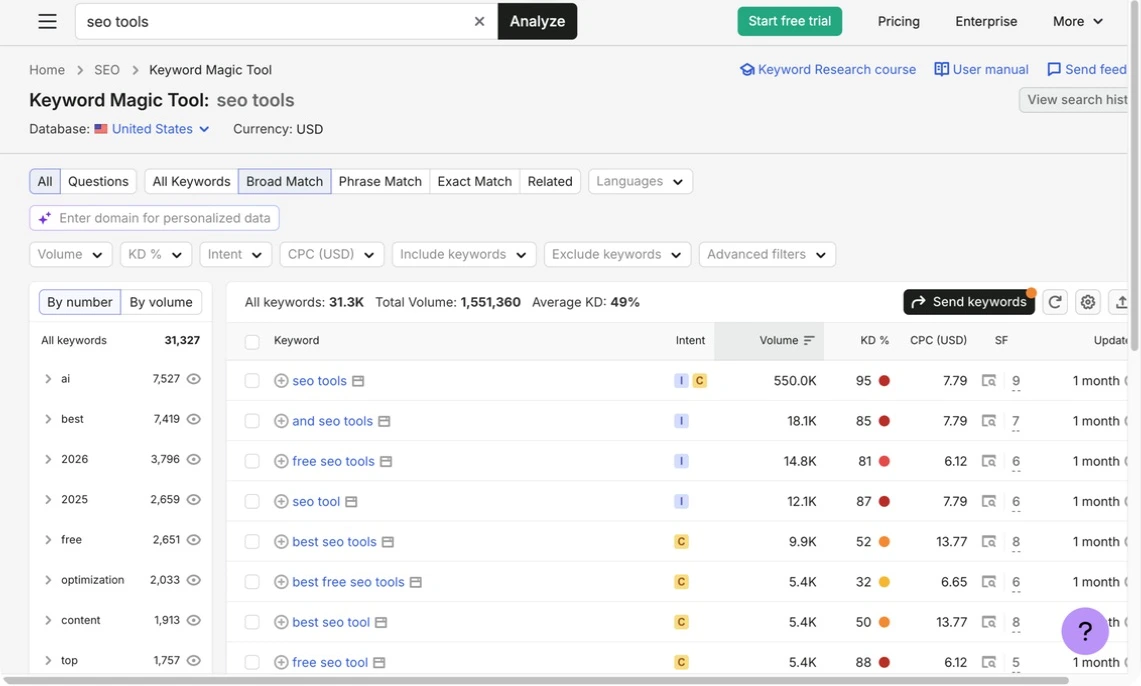
Semrush produced the strongest balance across the complete ecommerce workflow. Its retail and ecommerce platform combines product and category keyword research, competitor analysis, rank tracking, technical auditing and AI visibility tools, which made it easier to investigate an issue without separating technical evidence from demand and competitor context.
Semrush Test Results
| Dimension | Score | Tested Finding |
| Technical Ecommerce Detection | 4.4/5 | Found 17/20 issues, including all three faceted-navigation problems and the main collection indexation anomaly |
| Product + Collection SEO | 4.7/5 | Mapped 9/10 intent clusters correctly and found both cannibalisation cases |
| Keyword + Competitor Research | 4.9/5 | Produced the broadest usable category-gap view |
| Schema / Discovery | 4.3/5 | Found both seeded schema problems |
| Catalogue Scalability | 4.5/5 | Projects, grouping, scheduled auditing and exports handled the catalogue well |
| Action Clarity | 4.6/5 | Correctly prioritised the revenue-critical collection canonical issue |
| Value | 4.2/5 | Strong consolidation value |
| Overall | 4.5/5 | Best complete single-platform result |
Known issues found: 17/20
False positives: 5
Detection rate: 85%
What Semrush Did Best
Semrush connected technical problems with commercial context better than the other all-in-one platforms. Instead of stopping at a canonical warning, it helped show that the affected collection also represented a high-intent keyword cluster and a meaningful share of organic revenue.
That wider context is the main reason Semrush wins overall even though the specialist crawlers found more technical issues. Ecommerce teams need to know not only that something is broken, but whether fixing it deserves priority over everything else sitting in the SEO backlog.
Where Semrush Fell Short
Semrush missed one poorly linked product, one discontinued-product redirect and one lower-level internal-link weakness. Five warnings were also downgraded after validation because generic metadata and duplicate-content rules treated legitimate product variations as problems.
For a very large or technically unusual catalogue, we’d still consider pairing Semrush with a specialist crawler rather than assuming one suite replaces every technical workflow.
Semrush Verdict
Semrush is the best overall SEO tool for ecommerce in this test. It doesn’t beat the dedicated crawlers on raw technical detection or Ahrefs on product and competitor research, but it gives us the strongest complete operating workflow.
Our Best All-In-One SEO Tools comparison examines that consolidation question more broadly.
2. Ahrefs: Best for Product, Keyword and Competitor Research
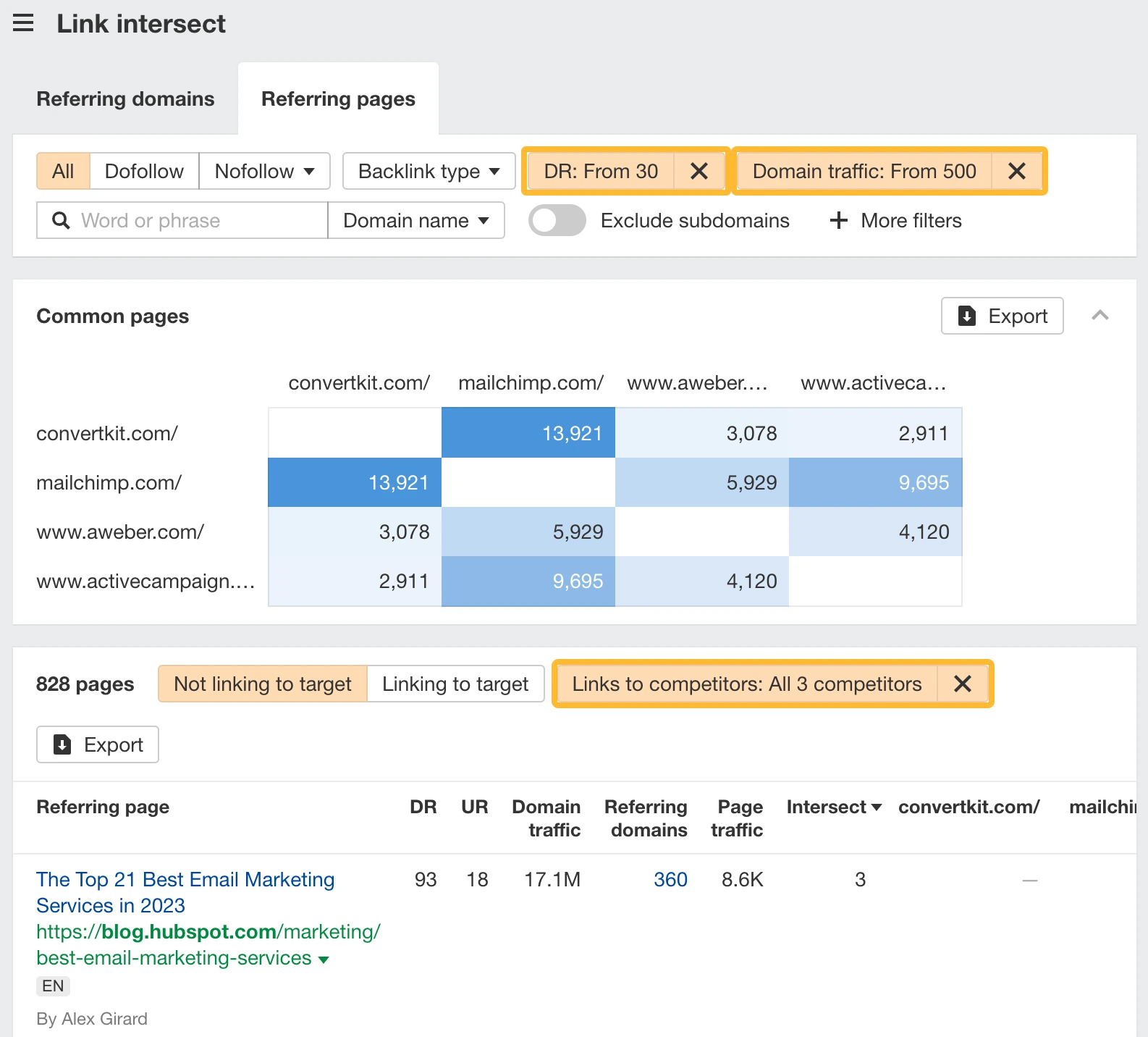
Ahrefs finished just behind Semrush overall at 4.4/5, but it was stronger when the job centred on products, collections, competing pages and search intent.
Its Shopify-specific documentation also describes a problem we encountered during the test: some themes link products through /collections/…/products/… URLs while the direct /products/ page remains canonical. Ahrefs explains how this can leave canonical product URLs appearing to have no internal links even though their non-canonical versions are linked from collections. See Ahrefs’ Shopify canonical explanation.
Ahrefs Test Results
| Dimension | Score | Tested Finding |
| Technical Ecommerce Detection | 4.4/5 | Found 18/20 issues and exposed internally linked non-canonical Shopify product URLs |
| Product + Collection SEO | 4.8/5 | Correctly mapped all 10 keyword clusters and found both cannibalisation cases |
| Keyword + Competitor Research | 4.9/5 | Strongest competitor-page, keyword-gap and ranking-history evidence |
| Schema / Discovery | 4.0/5 | Found both schema problems, with a less direct remediation path |
| Catalogue Scalability | 4.3/5 | Strong audit and segmentation, with more movement between reports |
| Action Clarity | 4.2/5 | Sound priorities but needed more manual performance-data integration |
| Value | 3.6/5 | Excellent research depth, weaker value for audit-only teams |
| Overall | 4.4/5 | Strongest research-led option |
Known issues found: 18/20
False positives: 4
Detection rate: 90%
What Ahrefs Did Best
Ahrefs was the strongest tool for understanding which products and collections should rank for which searches. It was the only all-in-one platform to map all ten keyword clusters correctly, while its competitor research made it easier to compare category opportunities, competing URLs and ranking histories.
That combination translated especially well to Shopify because technical URL relationships could be viewed alongside the page’s actual search demand instead of being treated as isolated crawl warnings.
Where Ahrefs Fell Short
Ahrefs missed one duplicate-metadata issue and one discontinued-product redirect. Its technical report was deep, but turning those findings into a revenue-prioritised action plan required more manual work than Semrush or Digimetrics.
Ahrefs Verdict
Ahrefs is our best ecommerce SEO tool for product and collection research, keyword research, competitor intelligence and Shopify-specific investigation.
3. Screaming Frog: Best Technical Ecommerce Crawler
Screaming Frog produced the strongest raw technical result in the test. After JavaScript rendering, structured-data validation and GSC/GA4 integrations were configured, it identified all 20 known ecommerce SEO problems.
Its own ecommerce crawling guide demonstrates why that level of control matters on stores: parameters such as size, colour and brand can create enormous crawl spaces, while include/exclude rules can isolate individual product or category sections instead of crawling everything indiscriminately.
Screaming Frog Test Results
| Dimension | Score | Tested Finding |
| Technical Ecommerce Detection | 4.9/5 | Found all 20 benchmark issues |
| Product + Collection SEO | 4.7/5 | Strongest page-level evidence; keyword intent still required analyst interpretation |
| Keyword + Competitor Research | N/A | Specialist crawler |
| Schema / Discovery | 4.8/5 | Found both schema issues and exposed affected templates in bulk |
| Catalogue Scalability | 5.0/5 | Best crawl control, segmentation, extraction and exports |
| Action Clarity | 3.6/5 | Excellent evidence but required more interpretation |
| Value | 4.8/5 | Exceptional value for technical users |
| Technical Audit Score | 4.9/5 | Highest technical score |
| Overall Suite Score | 4.0/5 | Lower because keyword/competitor research is outside its scope |
Known issues found: 20/20
False positives: 7
Detection rate: 100%
What Screaming Frog Did Best
Screaming Frog reconstructed the full faceted-navigation crawl path, found every canonical and variant problem and made it easy to isolate product, collection and parameterised URL patterns. It was also the strongest tool for exporting a technical evidence set that could be passed directly to developers.
Those controls matter increasingly as catalogue size grows. Screaming Frog’s configuration also supports selective crawling through include rules and detailed canonical handling, which gives technical teams far more control over what gets investigated.
Where Screaming Frog Fell Short
That flexibility creates extra setup and interpretation. Seven warnings turned out not to require action, primarily because of intentional noindex/canonical rules and acceptable duplicate fields across product variants.
Screaming Frog could expose the crawl and Search Console evidence behind product-versus-collection conflicts, but it didn’t independently decide which search intent belonged to which page. That’s a different job from technical crawling.
Screaming Frog Verdict
Screaming Frog is the best technical ecommerce crawler and our best choice for large catalogues. Its lower complete-suite score shouldn’t be confused with weaker technical performance: its 4.9/5 technical score and 100% detection rate are the strongest raw audit results in this test.
4. Sitebulb: Best for Actionable Technical Ecommerce Audits
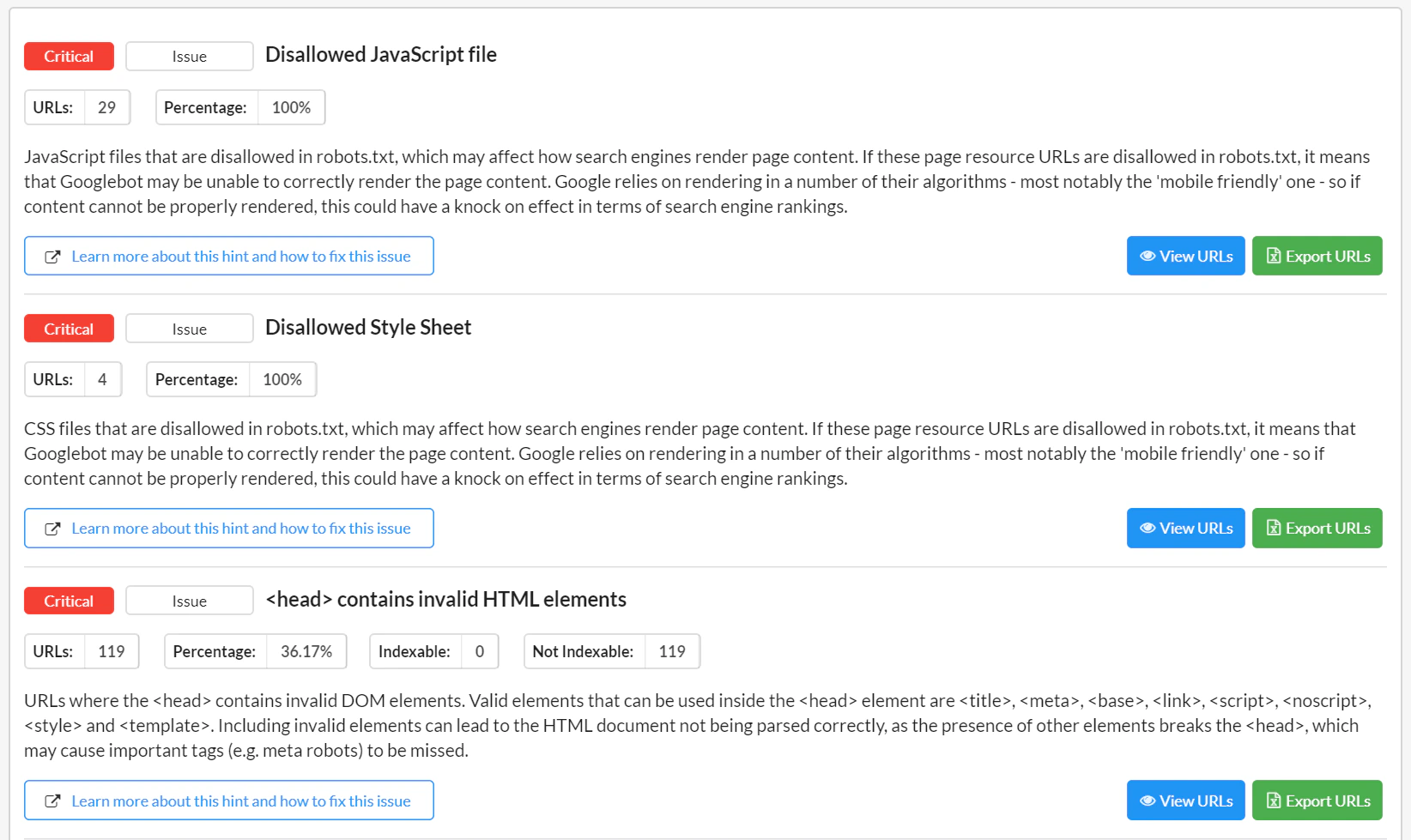
Sitebulb nearly matched Screaming Frog on technical detection, finding 19 of 20 known issues, but generated only three false positives and made the resulting audit easier to interpret.
Its ecommerce crawler is designed around technical analysis at catalogue scale, while its structured-data testing system validates markup against Google and Schema.org documentation and groups recurring issues at template level.
Sitebulb Test Results
| Dimension | Score | Tested Finding |
| Technical Ecommerce Detection | 4.9/5 | Found 19/20 issues and grouped related technical problems effectively |
| Product + Collection SEO | 4.8/5 | Strong comparison of product, collection and internal-linking patterns |
| Keyword + Competitor Research | N/A | Specialist crawler |
| Schema / Discovery | 5.0/5 | Best Product and ProductGroup explanations |
| Catalogue Scalability | 4.8/5 | Strong grouping, visualisation and cloud crawling |
| Action Clarity | 4.7/5 | Best remediation sequence among the crawlers |
| Value | 4.3/5 | Strong when analyst/stakeholder time matters |
| Technical Audit Score | 4.9/5 | Near-perfect coverage with less noise |
| Overall Suite Score | 4.1/5 | Strong guidance, but research remains outside scope |
Known issues found: 19/20
False positives: 3
Detection rate: 95%
What Sitebulb Did Best
Sitebulb turned the technical crawl into the easiest report to explain. Instead of forcing us to reconstruct relationships from several exports, it grouped symptoms around faceted navigation, variant canonicals and structured data into more coherent technical patterns.
It was also the strongest structured-data tool in the test. For ecommerce sites where one bad template can affect hundreds of product pages, being able to understand the problem at template level rather than page by page is especially useful.
Where Sitebulb Fell Short
Sitebulb missed one lower-signal internal-link weakness that became visible after crawl-depth data was compared with performance information. It also isn’t intended to replace the keyword and competitor databases offered by broader suites.
Sitebulb Verdict
Sitebulb is our best actionable technical-audit tool and structured-data winner. Screaming Frog finds one additional known issue and offers more granular crawl control; Sitebulb gives us the cleaner route from diagnosis to implementation.
5. SE Ranking: Best-Value All-in-One Ecommerce SEO Tool
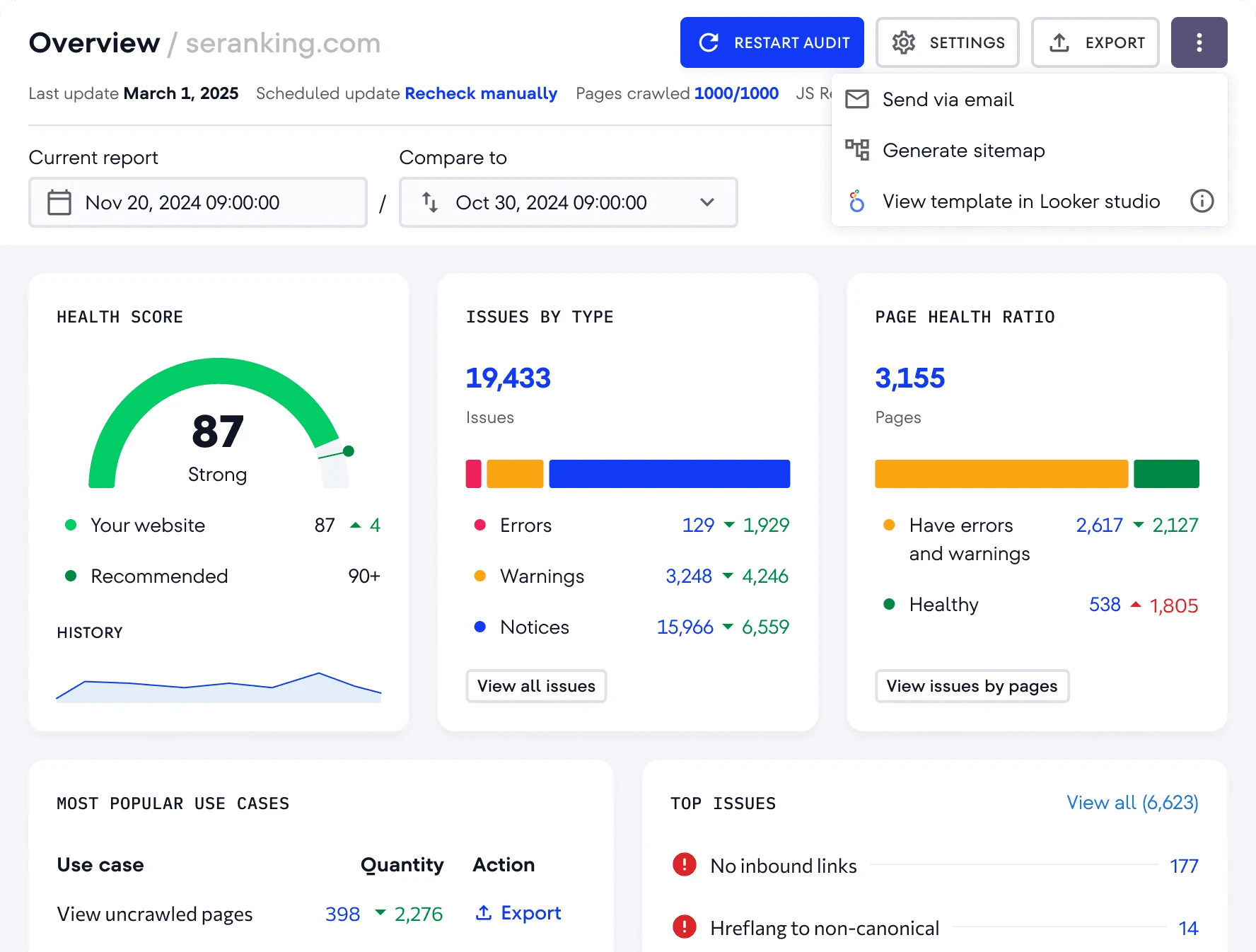
SE Ranking didn’t dominate an individual specialist category, but it performed consistently across technical audits, keywords, competitors and reporting, which makes it easier to recommend to a smaller ecommerce team that doesn’t want several subscriptions.
SE Ranking’s own ecommerce SEO audit guidance covers crawlability, indexability, broken links, canonical tags, duplicate content and keyword cannibalisation, while its broader platform adds research and tracking workflows around the audit.
SE Ranking Test Results
| Dimension | Score | Tested Finding |
| Technical Ecommerce Detection | 4.0/5 | Found 15/20 benchmark issues |
| Product + Collection SEO | 4.2/5 | Mapped 8/10 intent clusters and found both cannibalisation cases |
| Keyword + Competitor Research | 4.4/5 | Strong everyday category research |
| Schema / Discovery | 3.8/5 | Found one schema problem directly and surfaced the second less precisely |
| Catalogue Scalability | 4.1/5 | Useful scheduled auditing and issue grouping |
| Action Clarity | 4.2/5 | Clear severity labels but some manual reprioritisation |
| Value | 4.7/5 | Strongest feature-to-cost balance |
| Overall | 4.1/5 | Best-value all-in-one result |
Known issues found: 15/20
False positives: 5
Detection rate: 75%
What SE Ranking Did Best
SE Ranking kept the everyday ecommerce workflow manageable. Technical audits, keyword tracking, competitor checks and recurring reporting could stay in one environment, making it a sensible option for teams whose primary problem is operational consolidation rather than maximum depth.
Where SE Ranking Fell Short
It missed one faceted-navigation issue, one variant-canonical problem, one structured-data problem, one poorly linked product and one subtle internal-link weakness. Two mixed-intent keyword clusters also required manual correction.
SE Ranking Verdict
SE Ranking is our best-value all-in-one ecommerce SEO platform. It gives up some of the technical and competitive depth of the leaders but covers enough of the recurring workflow to make a strong first paid platform for smaller teams.
6. Digimetrics: Best for Guided SEO + GEO Action Prioritisation
Digimetrics played a different role in this comparison. Its strongest result wasn’t finding the most technical problems; it was determining which problems deserved attention first.
Disclosure: Digimetrics is developed by the MediaOne team, which also operates DigitalMarketingTools.ai. We included it because its guided SEO/GEO workflow is relevant to ecommerce prioritisation. It was tested against the same store, known issues and scoring framework without preferential weighting. Where specialist products provided greater technical depth or market maturity, we ranked them higher.
Digimetrics Test Results
| Dimension | Score | Tested Finding |
| Technical Ecommerce Detection | 3.4/5 | Found 13/20 issues |
| Product + Collection SEO | 4.1/5 | Mapped 9/10 intent clusters and found both cannibalisation cases |
| Keyword + Competitor Research | 4.3/5 | Useful context with less database depth |
| Schema / Discovery | 3.3/5 | Found one of two schema problems |
| Catalogue Scalability | 3.6/5 | Fewer granular bulk controls |
| Action Clarity | 4.9/5 | Highest result in the test |
| Value | 4.0/5 | Strongest as an interpretation layer |
| Overall | 3.9/5 | Excellent prioritisation, narrower specialist depth |
Known issues found: 13/20
False positives: 4
Detection rate: 65%
What Digimetrics Did Best
Digimetrics produced the clearest answer to “What should we work on first?” It correctly placed the canonical/indexation problem affecting the highest-revenue collection above lower-impact metadata and image warnings, then connected that recommendation with wider SEO and GEO discovery context.
That matters because technically valid warnings aren’t commercially equal. Spending hours fixing low-impact product metadata while a high-revenue category has an indexation problem is technically busy work, not effective prioritisation.
Where Digimetrics Fell Short
Digimetrics missed one faceted-navigation issue, one variant-canonical problem, one orphan product, one broken discontinued URL, one structured-data problem and two weak-linking signals. Its catalogue controls and evidence exports were also less mature than those of the specialist crawlers.
Digimetrics Verdict
Digimetrics is our action-prioritisation winner, not our technical-crawl winner. Its 4.9/5 Action Clarity scoremakes it most useful as a decision layer that helps an ecommerce team determine what to do with evidence collected across SEO tools.
You can also see our Digimetrics tool profile for a broader look at the platform.
Which Ecommerce SEO Tool Found the Most Real Problems?
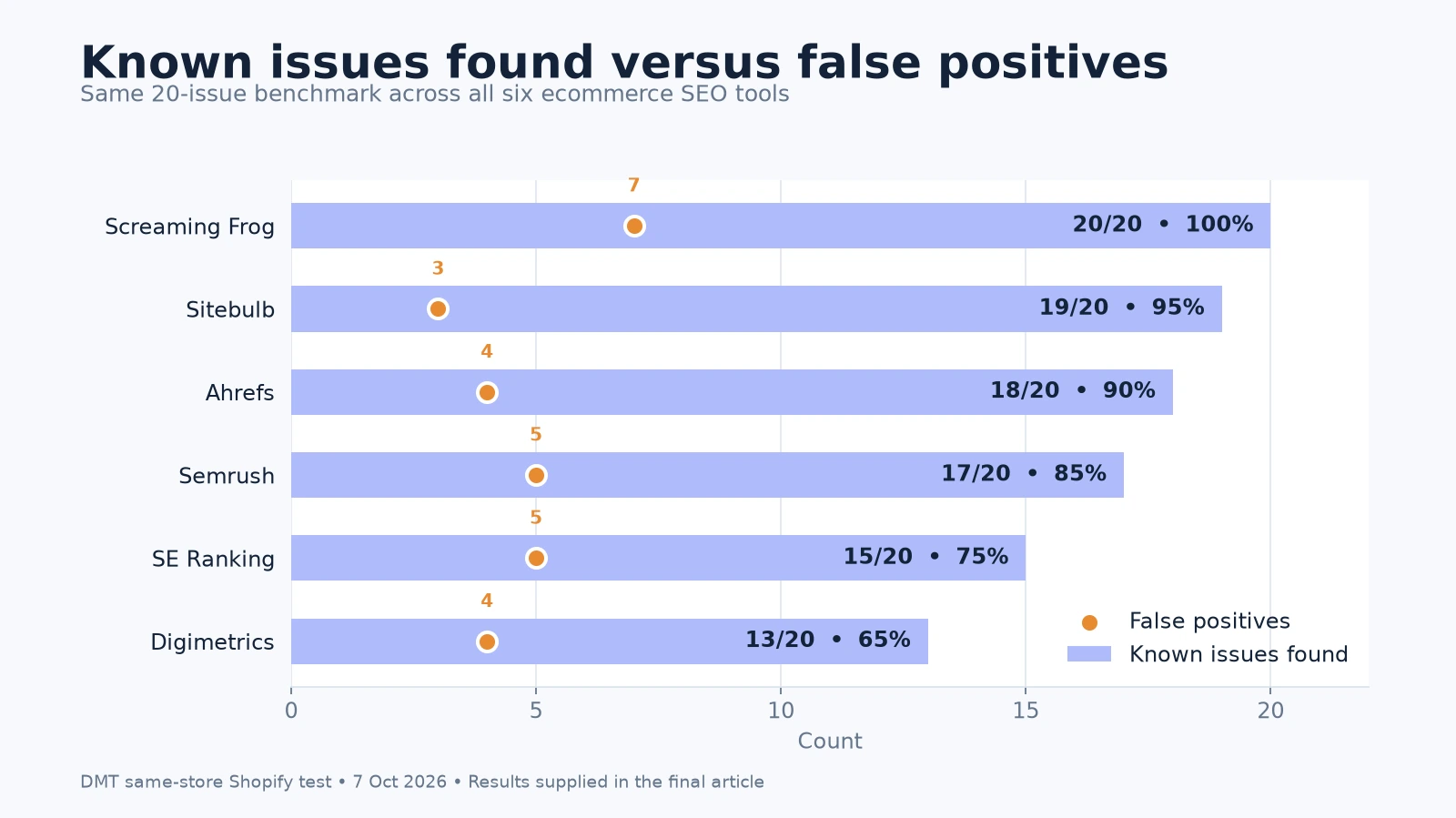
This was one of the clearest parts of the test.
| Tool | Known Issues Found | Missed | False Positives | Detection Rate |
| Screaming Frog | 20/20 | 0 | 7 | 100% |
| Sitebulb | 19/20 | 1 | 3 | 95% |
| Ahrefs | 18/20 | 2 | 4 | 90% |
| Semrush | 17/20 | 3 | 5 | 85% |
| SE Ranking | 15/20 | 5 | 5 | 75% |
| Digimetrics | 13/20 | 7 | 4 | 65% |
Screaming Frog wins raw detection, finding every known issue. The rest of the table explains why detection rate alone shouldn’t decide the purchase: Sitebulb found one fewer issue but generated fewer than half as many false positives, while Ahrefs and Semrush add search-demand and competitor context that a crawler isn’t designed to provide.
Digimetrics sits at the other end of the comparison. It finds fewer raw technical problems, but performs considerably better when the evidence has to be turned into an ordered commercial action plan.
Which Tool Is Best for Product and Collection Page SEO?
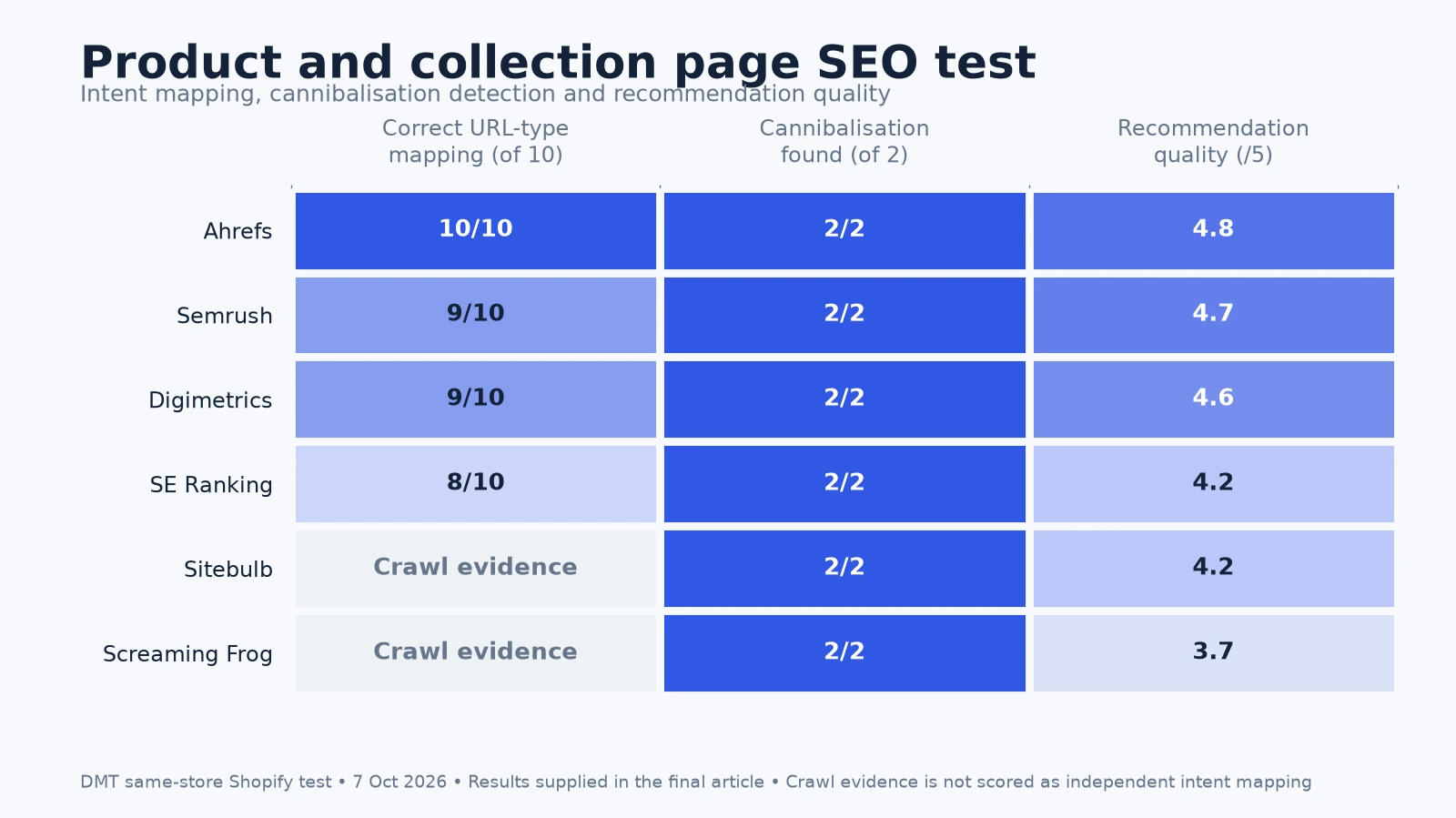
Product pages, collection pages and buying guides don’t serve the same intent. A specific product might target Nike Pegasus 43 men’s running shoes, a collection might target men’s running shoes, while an editorial page could answer best running shoes for flat feet.
Google’s merchant listing guidelines reinforce that distinction: merchant listing eligibility centres on pages where shoppers can purchase a specific product or variants of that product rather than generic category pages containing many unrelated products.
| Tool | Correct URL-Type Mapping | Cannibalisation Cases Found | Recommendation Quality |
| Ahrefs | 10/10 | 2/2 | 4.8/5 |
| Semrush | 9/10 | 2/2 | 4.7/5 |
| Digimetrics | 9/10 | 2/2 | 4.6/5 |
| SE Ranking | 8/10 | 2/2 | 4.2/5 |
| Sitebulb | Crawl evidence only | 2/2 | 4.2/5 |
| Screaming Frog | Crawl evidence only | 2/2 | 3.7/5 |
Winner: Ahrefs.
This result highlights the difference between finding a technical relationship between URLs and understanding what those URLs should rank for. The crawlers produced the necessary evidence, but the all-in-one research platforms had more context for deciding whether the product, collection or informational page matched the query.
Which Ecommerce SEO Tool Handles Product Variants Best?
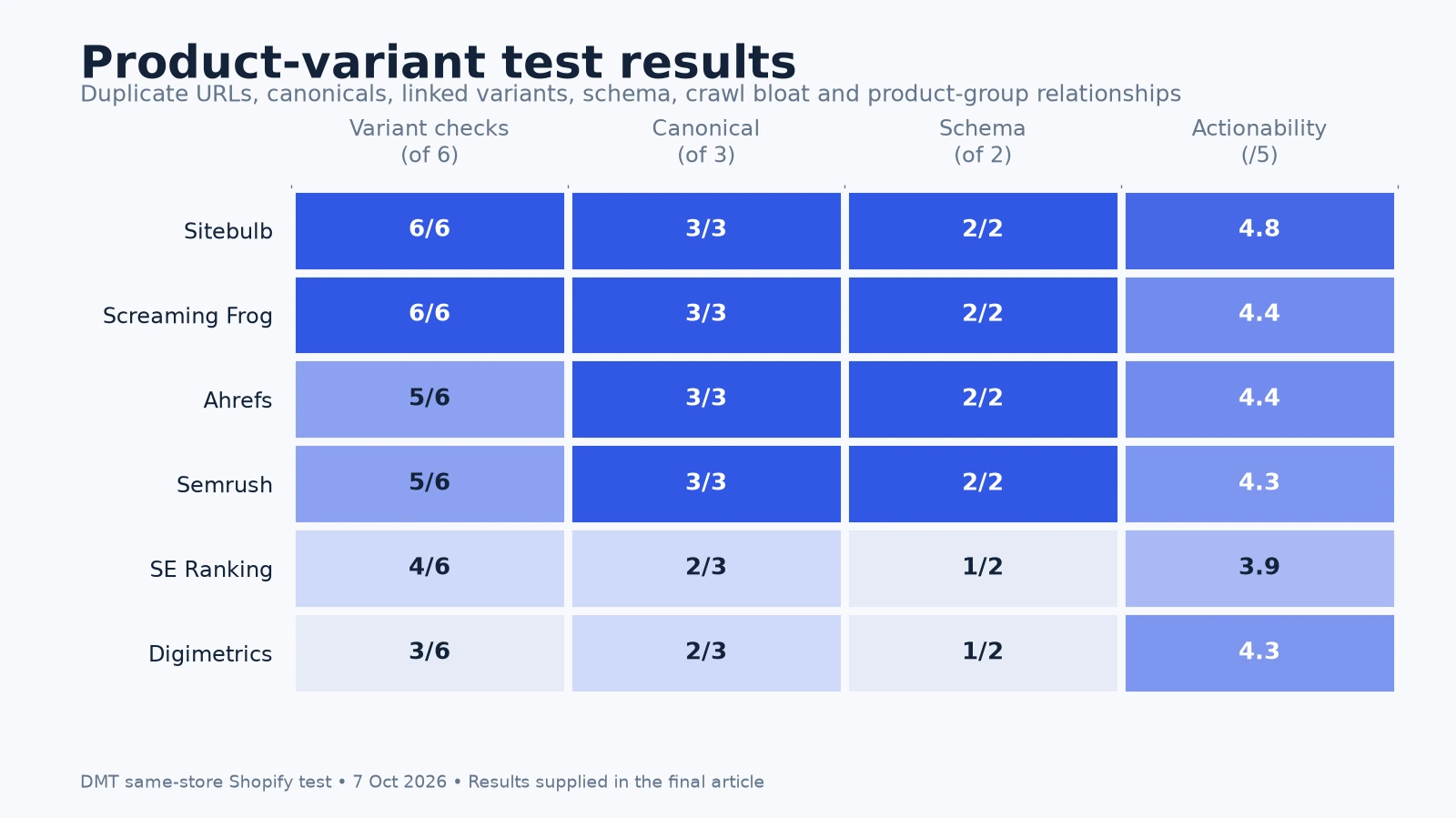
Variants can create large numbers of near-identical URLs when one product is available in several colours, sizes or materials. Google’s product variant documentation explains how related variants can be represented with ProductGroupand Product, including different canonical considerations for single-page and multi-page implementations.
Our variant test therefore looked at duplicate variant URLs, canonicals, internally linked non-canonical variants, structured-data problems, crawl bloat and product-group relationships.
| Tool | Variant Issues Found | Canonical Problems | Schema Problems | Actionability |
| Sitebulb | 6/6 | 3/3 | 2/2 | 4.8/5 |
| Screaming Frog | 6/6 | 3/3 | 2/2 | 4.4/5 |
| Ahrefs | 5/6 | 3/3 | 2/2 | 4.4/5 |
| Semrush | 5/6 | 3/3 | 2/2 | 4.3/5 |
| SE Ranking | 4/6 | 2/3 | 1/2 | 3.9/5 |
| Digimetrics | 3/6 | 2/3 | 1/2 | 4.3/5 |
Winner: Sitebulb. Screaming Frog matched it on raw detection, but Sitebulb made the canonical and structured-data relationships easier to interpret.
Which Tool Is Best for Product Structured Data?
Sitebulb wins our structured-data category.
Both Sitebulb and Screaming Frog identified the two seeded structured-data problems, but Sitebulb more clearly separated the critical Product error from the non-critical recommendation and connected each finding to the affected template. Its structured-data validator is built to aggregate recurring schema issues at template level, which is especially useful when one broken ecommerce template affects hundreds of product URLs.
Screaming Frog remains the better fit when the technical team primarily wants raw extraction and bulk validation data.
Which Ecommerce SEO Tool Is Best for Large Catalogues?
A store with 50 products and a retailer with hundreds of thousands of crawlable URLs don’t have the same technical requirements. As catalogue size grows, crawl segmentation, parameter control, custom extraction, bulk exports and the ability to isolate particular templates become increasingly important.
Screaming Frog wins this category. Its include/exclude controls and other crawl configurations let technical users narrow large websites to specific URL patterns, while its ecommerce auditing guidance demonstrates how product attributes and parameters can otherwise create enormous crawl spaces.
Sitebulb is the close alternative when cloud crawling, issue grouping and easier explanation are more important than maximum configuration detail.
Which Tool Is Best at Prioritising Revenue-Impacting SEO Fixes?
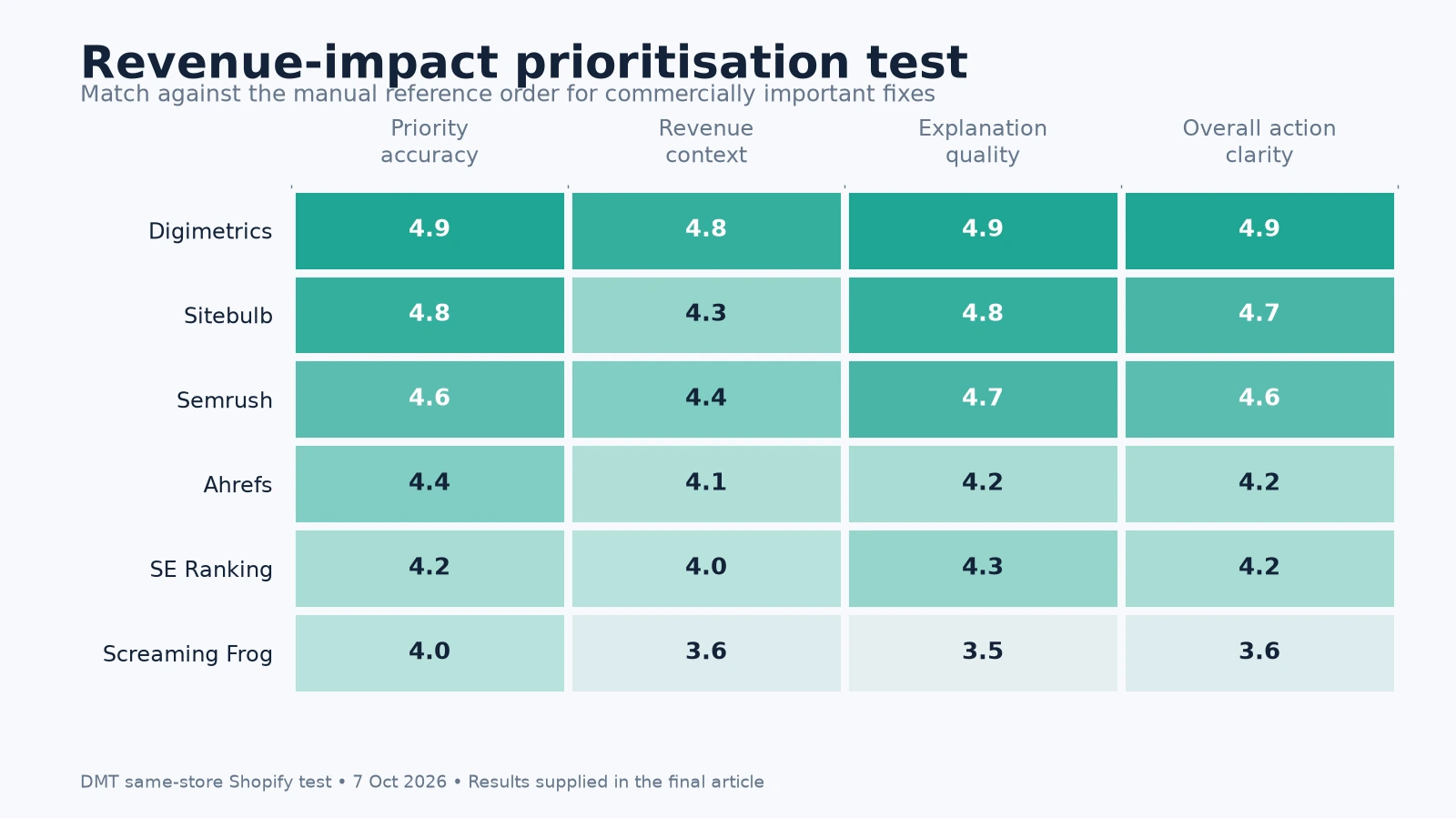
Raw audit severity and commercial priority aren’t always the same thing. To test this, we compared how the platforms handled three legitimate but very different problems: missing alt text across 70 low-traffic products, a canonical/indexation issue affecting the collection responsible for 20% of organic revenue, and duplicate descriptions on five products receiving almost no impressions.
We compared the recommended order against a manual reference based on affected URLs, organic impressions, commercial intent, revenue or conversion importance, indexability risk, scale and implementation effort.
| Tool | Priority Accuracy | Revenue Context | Explanation Quality | Overall Action Clarity |
| Digimetrics | 4.9/5 | 4.8/5 | 4.9/5 | 4.9/5 |
| Sitebulb | 4.8/5 | 4.3/5 | 4.8/5 | 4.7/5 |
| Semrush | 4.6/5 | 4.4/5 | 4.7/5 | 4.6/5 |
| Ahrefs | 4.4/5 | 4.1/5 | 4.2/5 | 4.2/5 |
| SE Ranking | 4.2/5 | 4.0/5 | 4.3/5 | 4.2/5 |
| Screaming Frog | 4.0/5 | 3.6/5 | 3.5/5 | 3.6/5 |
Winner: Digimetrics.
This may be the most important distinction in the entire comparison. The best tool isn’t always the one generating the largest audit. Sometimes it’s the one that prevents the SEO team from spending Tuesday cleaning up minor warnings while the store’s highest-revenue collection has an indexation problem.
Best Ecommerce SEO Tool for Shopify
Winner: Ahrefs.
Shopify’s current ecommerce SEO audit guidance covers technical and on-page problems that can affect large stores, while Ahrefs specifically documents the collection-path canonical pattern where collection pages link to non-canonical product versions and the preferred /products/ URL can appear to have no incoming links.
Ahrefs won our Shopify category because it combined that technical diagnosis with 10/10 product-versus-collection intent mapping and stronger keyword and competitor context. Screaming Frog still produced deeper raw crawl evidence overall, but Ahrefs did the better job of connecting those findings with what the affected URLs should actually rank for.
Best Ecommerce SEO Tool for WooCommerce
We tested Shopify rather than WooCommerce, so this is a platform-fit recommendation rather than another measured result.
For technically complex WooCommerce stores, Screaming Frog is our preferred technical option because configurable crawling is useful when themes and plugins create additional categories, attributes, filters, parameters or other URL states. If the team wants one broader platform instead, Semrush is our strongest all-in-one recommendation from this test, while SE Ranking is the value-oriented alternative.
Best Free Ecommerce SEO Stack
A smaller store doesn’t necessarily need several paid SEO platforms immediately. A practical starting stack can combine Google Search Console for organic search and indexing evidence, Google Merchant Center for product-feed visibility, a crawler’s free allowance where catalogue size permits, and the ecommerce platform’s native product-management tools.
Paid software becomes easier to justify when the catalogue expands, manual audits stop scaling, several markets need monitoring, competitors need regular analysis or product-versus-collection keyword mapping becomes difficult. At that point, the value isn’t simply having more metrics; it’s making a recurring workflow manageable.
One Ecommerce SEO Tool or a Specialist Stack?
Our results show why one universal best rated SEO tool for ecommerce doesn’t exist for every team. A technical SEO operation might use Screaming Frog or Sitebulb + Search Console/GA4 + Ahrefs or Semrush, while a smaller in-house team may save more time by consolidating around Semrush or SE Ranking plus first-party Google data.
Digimetrics makes sense in another role: sitting above technical and performance evidence as a guided prioritisation layer. The trade-off is straightforward: all-in-one suites optimise for consolidation, while specialist stacks optimise for depth. The right approach depends on which one removes more work from your team.
Our guide to choosing the right SEO tool goes deeper into that decision.
How to Choose an Ecommerce SEO Tool
Start with the recurring bottleneck rather than the brand.
| Your Ecommerce SEO Problem | Prioritise | Our Pick |
| Thousands of crawlable URLs | Crawl control + catalogue scalability | Screaming Frog |
| Filters creating crawl bloat | Faceted-navigation analysis | Screaming Frog / Sitebulb |
| Product variants and duplicate URLs | Canonicals + structured data | Sitebulb |
| Product and collection pages compete | Intent mapping | Ahrefs |
| Competitors dominate categories | Keyword + competitor intelligence | Ahrefs / Semrush |
| Need one broad platform | Technical + research consolidation | Semrush |
| Need a lower-cost broad suite | Value + repeatable workflows | SE Ranking |
| Too many warnings, unclear priorities | Action prioritisation | Digimetrics |
| Product structured data is the main issue | Schema diagnostics | Sitebulb |
The best rated SEO tool for ecommerce won’t necessarily be the right product for your store. A Shopify merchant with 150 products and an enterprise retailer with 200,000 indexable URLs need very different levels of crawl control, research depth and workflow automation.
Final Verdict: What Is the Best SEO Tool for Ecommerce?
Our final recommendations come from the same-store test rather than simply comparing feature pages.
| Award | Winner |
| Best ecommerce SEO tool overall | Semrush |
| Best technical ecommerce crawler | Screaming Frog |
| Best for Shopify | Ahrefs |
| Best for product + collection SEO | Ahrefs |
| Best for keyword and competitor research | Ahrefs |
| Best for structured data | Sitebulb |
| Best for large catalogues | Screaming Frog |
| Best value | SE Ranking |
| Best action prioritisation | Digimetrics |
| Best guided SEO + GEO workflow | Digimetrics |
Semrush remains our overall recommendation at 4.5/5 because it gives an ecommerce team the strongest balance across the entire SEO workflow. That doesn’t mean every store should choose it.
Choose Screaming Frog when crawl depth and catalogue control matter most, and choose Sitebulb when you want almost the same technical depth with clearer explanations and stronger structured-data guidance. Ahrefs is our preferred option for Shopify, product/collection mapping and competitor research, while SE Ranking makes the strongest value argument for smaller teams.
Choose Digimetrics when the bottleneck isn’t finding another SEO problem but determining which problem deserves attention first.
The strongest ecommerce SEO tool is therefore not necessarily the product that produces the longest audit. It’s the one that gives your team the clearest answer to what is wrong, which warnings are noise, which pages matter commercially and what should be fixed next.
Frequently Asked Questions
What Is the Best SEO Tool for Ecommerce?
Semrush is the best ecommerce SEO tool overall in our test, scoring 4.5/5. It produced the strongest combination of technical auditing, keyword and competitor research, product/collection SEO and commercial prioritisation.
What Is the Best Technical SEO Tool for Ecommerce?
Screaming Frog produced the strongest technical result, finding 20/20 known ecommerce SEO issues for a 100% detection rate and a 4.9/5 technical-audit score.
What Is the Best SEO Tool for Shopify?
Ahrefs is our Shopify winner. It combined strong Shopify canonical/internal-link investigation with the only 10/10 product-versus-collection intent mapping result among the all-in-one platforms.
Is Semrush Good for Ecommerce SEO?
Yes. Semrush’s official ecommerce solution combines product/category keyword research, competitor analysis, ranking data, technical auditing and AI visibility tools. In our test it ranked first overall at 4.5/5.
Is Ahrefs Good for Ecommerce SEO?
Yes. Ahrefs ranked 4.4/5 overall and won our Shopify, product/collection and competitor-research categories. It also found 18 of 20 known ecommerce SEO issues.
Is Screaming Frog Good for Ecommerce SEO?
Yes, especially for technically complex or large stores. Screaming Frog achieved the only 100% issue-detection resultin the test and scored 5.0/5 for catalogue scalability, although keyword demand and competitor research still require another source.
Is Sitebulb Good for Ecommerce SEO?
Yes. Sitebulb found 19 of 20 known issues with only three false positives, won the structured-data category and produced the clearest remediation sequence among the technical crawlers.
Can Digimetrics Be Used for Ecommerce SEO?
Yes, but its strongest role differs from a specialist crawler. Digimetrics found 13 of 20 technical issues, while its 4.9/5 Action Clarity score was the highest prioritisation result in the test.
Do Ecommerce Stores Need More Than One SEO Tool?
Sometimes. Technically complex stores often benefit from combining a dedicated crawler with first-party Google data and a broader research platform, while smaller teams may get more value from one all-in-one suite.
The deciding factor is whether specialist depth or software consolidation removes more recurring work from your ecommerce SEO process.
Disclosure: digitalmarketingtools.ai is sponsored by Digimetrics.ai. Sponsored Highlights are clearly labelled advertising. Our reviews, comparisons and guides are written to be useful and fair regardless of who sponsors the site. Read the full disclosure.


