
Best Beginner SEO Tools in 2026: We Tested the First 60 Minutes
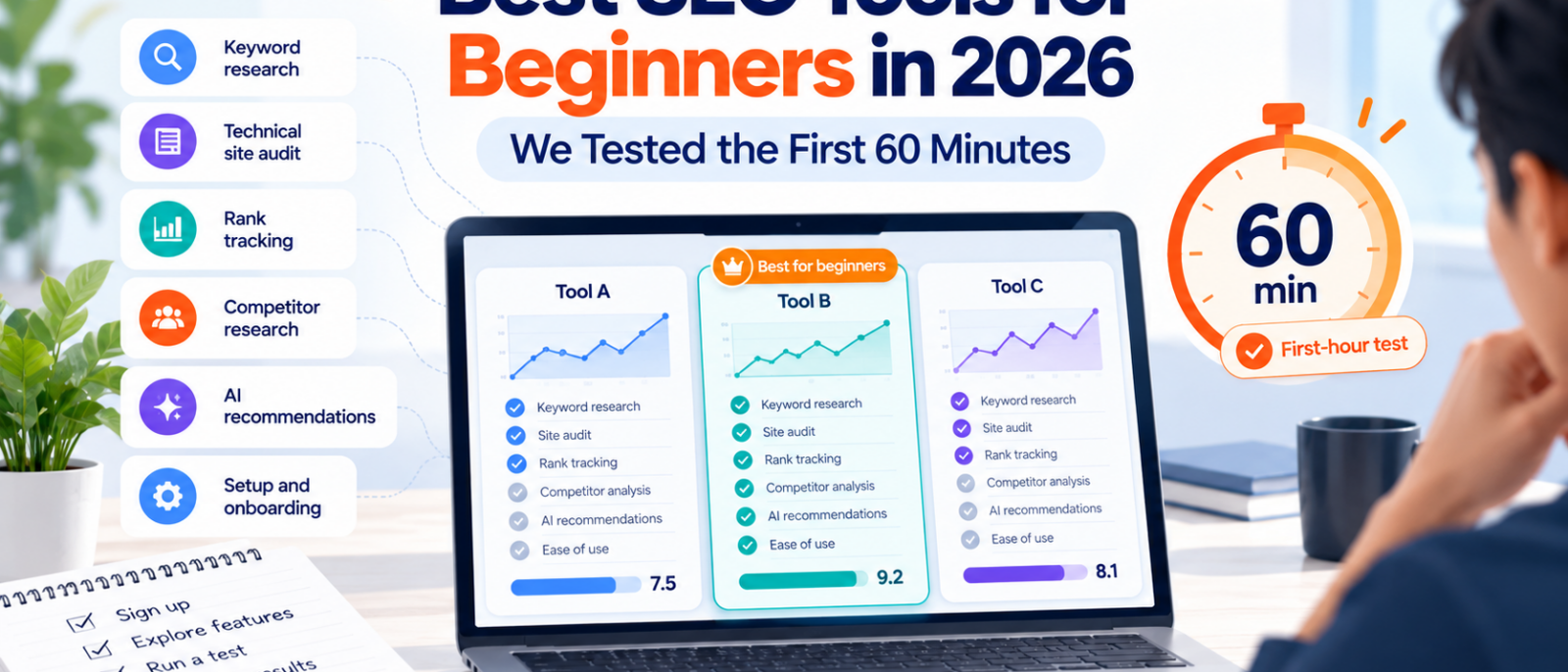
The hardest part of using a beginner SEO tool for the first time isn’t finding data. It’s figuring out which data matters and what you’re supposed to do next.
A platform can give you thousands of keywords, hundreds of technical warnings and dozens of competitor reports while still leaving a new user more confused than when they started.
So we tested beginner SEO tools differently.
Instead of counting features, we gave Semrush, SE Ranking, Ahrefs, Digimetrics and Ubersuggest the same website, seed keyword and competitor, then looked at how far a junior marketer could realistically get during the first 60 minutes.
We measured setup friction, time to the first useful finding, whether recommendations were understandable, how well each tool prioritised work and whether its AI or guided recommendations actually made the next step clearer.
If you’re still figuring out what keyword tools, crawlers, backlink platforms and rank trackers are supposed to do, our guide to the main types of SEO tools explains the different jobs before you start comparing brands.
Quick Answer: What Is the Best SEO Tool for Beginners in 2026?
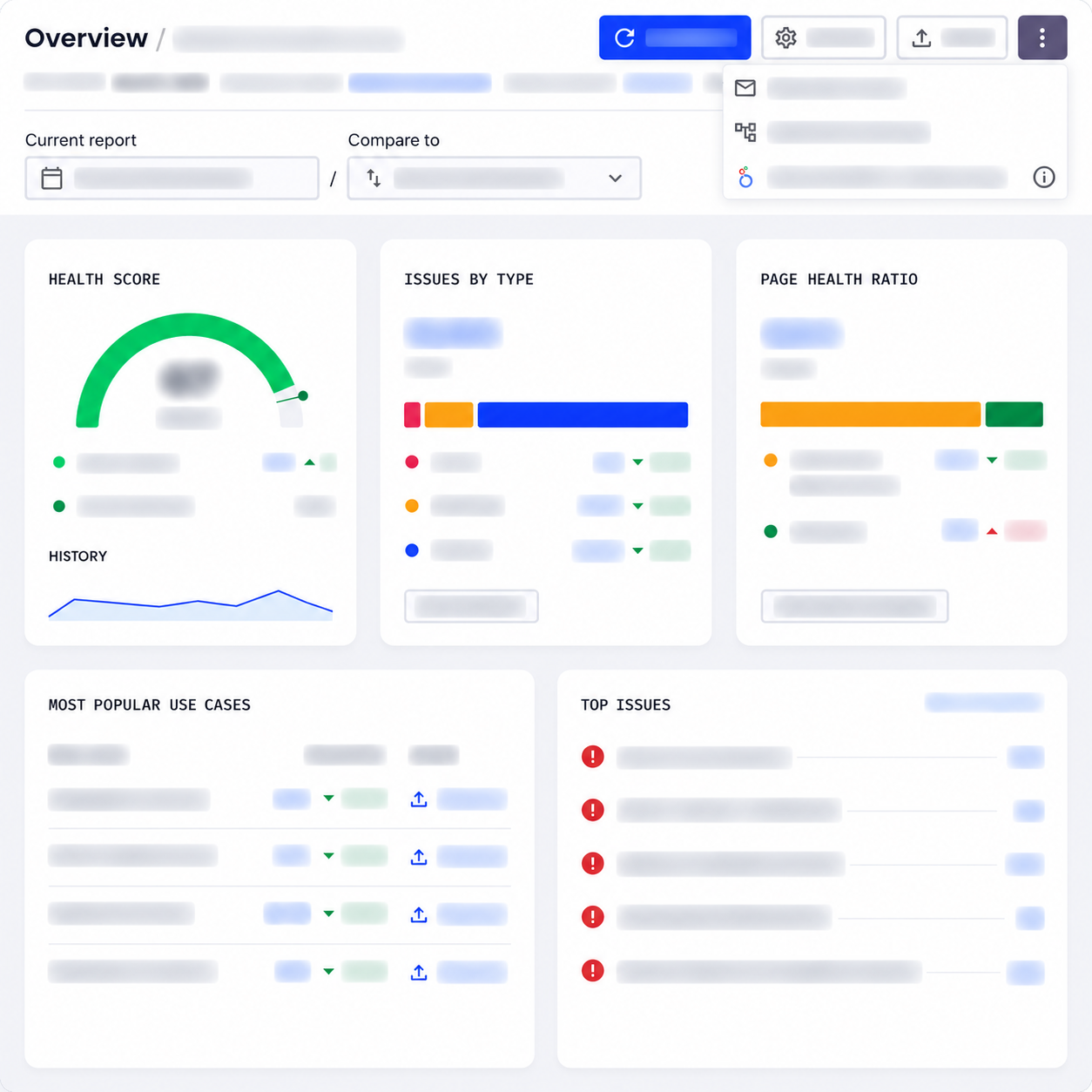
SE Ranking is our best SEO tool for beginners in 2026.
It offered the strongest balance of guided setup, understandable site-audit priorities, daily rank tracking and enough research depth for a beginner to keep using it as their SEO skills improve. It scored 4.4/5 overall and had a relatively low 12/30 Beginner Friction Score.
That doesn’t mean it won every category.
Digimetrics reached the first useful action fastest at 6 minutes 20 seconds, had the lowest friction score at 10/30 and produced the strongest AI guidance. Ubersuggest was the most accessible budget option, Semrush offered the best keyword-research workflow and the most room to grow, while Ahrefs was strongest when the beginner needed to understand competitor and backlink research.
Best Beginner SEO Tools at a Glance
| Tool | Best For | First Useful Answer | Beginner Friction | AI Guidance | Overall |
| SE Ranking | Best overall beginner workflow | 8m 40s | 12/30 | 4.1/5 | 4.4/5 |
| Digimetrics | Guided next actions and AI help | 6m 20s | 10/30 | 4.7/5 | 4.4/5 |
| Semrush | Room to grow into a larger suite | 12m 10s | 17/30 | 3.9/5 | 4.2/5 |
| Ubersuggest | Beginners on a budget | 7m 50s | 13/30 | 3.6/5 | 4.1/5 |
| Ahrefs | Competitor and backlink research | 13m 25s | 19/30 | 3.0/5 | 4.0/5 |
Lower Beginner Friction Scores are better.
SE Ranking and Digimetrics tied at one decimal place on the overall category average, but SE Ranking won our tie-break because its broader research, tracking and reporting workflow gave a beginner more room to grow while keeping the starting experience relatively clear.
What Actually Makes an SEO Tool Beginner-Friendly?
A beginner doesn’t necessarily need less data.
They need a clearer path through it.
That becomes obvious with technical audits. Finding 300 issues might sound impressive, but the useful part for a beginner is knowing which one matters first, why it matters and what they should change.
Keyword research has the same problem.
Returning 50,000 suggestions isn’t automatically more helpful than returning 2,000 if the smaller set gets the user to a realistic opportunity faster.
We therefore judge beginner-friendliness around five things:
clear starting point → understandable evidence → sensible prioritisation → actionable guidance → room to grow
A clean interface alone doesn’t guarantee any of those.
If you already understand the basics and are comparing software around team size, workflow, costs and specialist needs instead, our guide to choosing the right SEO tool for your business uses a broader buying framework.
How We Tested the SEO Tools
Most SEO-tool comparisons begin with a feature checklist.
We started with a timer.
Each platform received the same website, keyword, competitor and five basic jobs. Our tester initially worked without external tutorials so we could judge how well the software itself explained the workflow.
The DMT First-Hour Test
| Test | What the Beginner Had to Do | What We Measured |
| Setup | Add the website and find a sensible starting point | Setup time and confusion |
| Keyword research | Find three realistic keyword opportunities | Data clarity and actionability |
| Site health | Find the three issues worth fixing first | Prioritisation |
| Competitor research | Find one useful competitor opportunity | Research usability |
| Next action | Explain what should happen next | Overall workflow clarity |
We didn’t reward a platform for returning the biggest database.
We rewarded it when the information helped the beginner make the right next decision.
Test Setup
Test date: 4 October 2026
Website: An anonymised global B2B project-management software website with 118 indexable HTML pages
Audience: International English-language buyers
Standardised market: United States national data
Device: Desktop
Seed keyword: project management software
Competitor: An established global project-management platform
Tester: A junior digital marketer familiar with basic website editing and analytics but new to professional SEO suites
Plans tested: Semrush SEO Pro, SE Ranking Core trial, Ahrefs Starter, Digimetrics Starter and Ubersuggest Individual.
We checked public plan details again on 6 October 2026. Plans change regularly, so confirm current limits before subscribing. Semrush currently positions its entry SEO package toward freelancers, small businesses and SEO beginners; Ahrefs’ Starter plan is $29 per month and explicitly aimed at beginners; SE Ranking currently offers a 14-day Core trial without requiring a credit card.
Our Beginner Friction Score
We also wanted a way to distinguish power from ease of use.
Every platform received one to five friction points across six factors. Lower is better.
| Friction Factor | Semrush | SE Ranking | Ahrefs | Digimetrics | Ubersuggest |
| Setup | 3 | 2 | 3 | 1 | 2 |
| Navigation | 4 | 2 | 3 | 2 | 2 |
| Jargon | 3 | 2 | 5 | 2 | 2 |
| Prioritisation | 2 | 2 | 3 | 1 | 2 |
| AI guidance | 3 | 2 | 3 | 2 | 3 |
| Next-step clarity | 2 | 2 | 2 | 2 | 2 |
| Beginner Friction Score | 17/30 | 12/30 | 19/30 | 10/30 | 13/30 |
A theoretical 6/30 would mean almost no friction. A 30/30 would mean the beginner constantly needs outside help.
Digimetrics had the least friction, while Ahrefs required the most interpretation before the beginner became comfortable with the workflow.
1. SE Ranking — Best SEO Tool for Beginners Overall

SE Ranking covers keyword research, rank tracking, website audits, competitor research, backlinks and reporting without forcing beginners into completely separate products.
Its current Core plan includes 10 projects, daily keyword tracking, keyword/competitor/backlink research and website auditing, along with GA, GSC and Data Studio integrations. SE Ranking also offers a 14-day trial without a credit card, which makes it easier for a beginner to test the workflow before committing. Check SE Ranking’s current plans and trial.
What Happened in the First Hour
Project setup walked the tester through the website, target market, keywords and competitors in a sensible sequence.
The first genuinely useful finding appeared after 8 minutes 40 seconds, when Website Audit placed a noindexed commercial page near the top of its issue list and explained why that page couldn’t rank.
That was important because the tool didn’t just show a generic health score. The tester could see the affected URL and understand what was wrong.
Keyword and competitor research weren’t as deep as the strongest specialist platforms, but they were easier to connect back to the project.
First useful answer: 8m 40s
Beginner Friction Score: 12/30
AI Guidance Score: 4.1/5
What Beginners Will Like
The project structure reduces the number of decisions required before something useful appears.
Audit categories were understandable, rank tracking was easy to configure and the interface exposed enough underlying evidence that the beginner didn’t have to blindly trust one health score.
That balance is why SE Ranking won.
It simplifies enough of the workflow without hiding the URLs, rankings and competitor pages a learner eventually needs to understand.
Where Beginners May Get Stuck
Some deeper reports still expect you to understand concepts such as search intent, referring domains and SERP features.
Moving from a project insight into the wider research database can also feel like switching between two different layers of the platform.
Those issues added friction, but they weren’t enough to disrupt the overall workflow.
Verdict
SE Ranking is the best overall beginner SEO tool in our test.
Digimetrics got to a guided action faster and Semrush produced deeper keyword evidence, but SE Ranking was the most consistent across setup, auditing, research, tracking and reporting.
2. Digimetrics — Best Beginner-Friendly AI SEO Tool
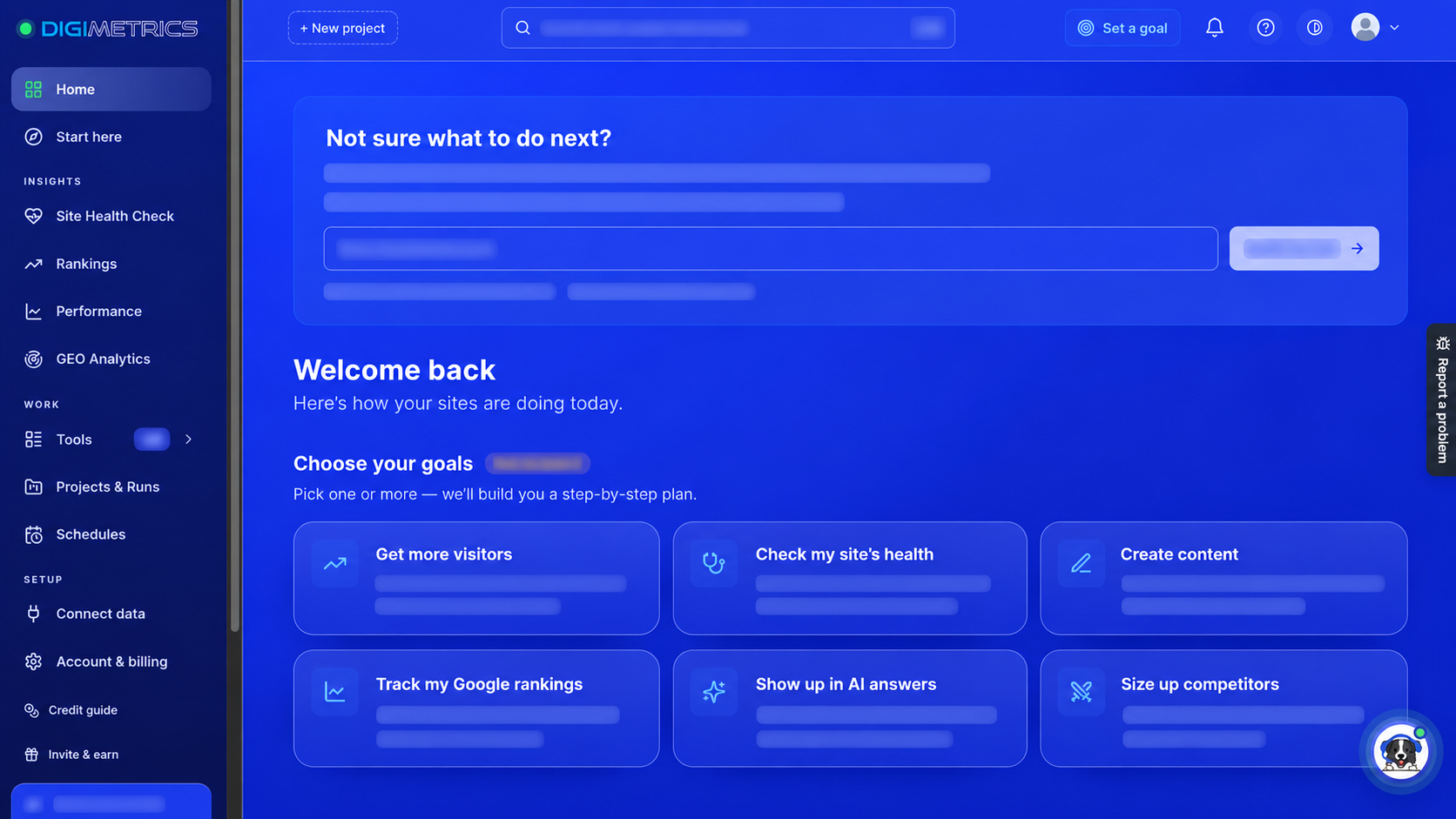
Digimetrics approaches the problem differently.
Instead of primarily giving users datasets and expecting them to interpret everything themselves, much of the product is organised around goals and prioritised actions.
Its current SEO toolkit includes Keyword Analysis, Rank Checker, Technical SEO Crawler, competitor research, on-page optimisation and other SEO/GEO workflows. Digimetrics describes the broader platform as a workspace designed to explain what matters, what to fix first and how to verify the improvement. Explore Digimetrics’ current SEO tools.
Disclosure: Digimetrics is developed by the MediaOne team, which also operates DigitalMarketingTools.ai. We included it because its guided SEO, audit and optimisation workflow is directly relevant to a beginner-focused comparison. It was tested using the same inputs and scoring criteria as every other product, without preferential weighting. Where established specialist platforms offered greater data depth, functionality or market maturity, we ranked them higher.
What Happened in the First Hour
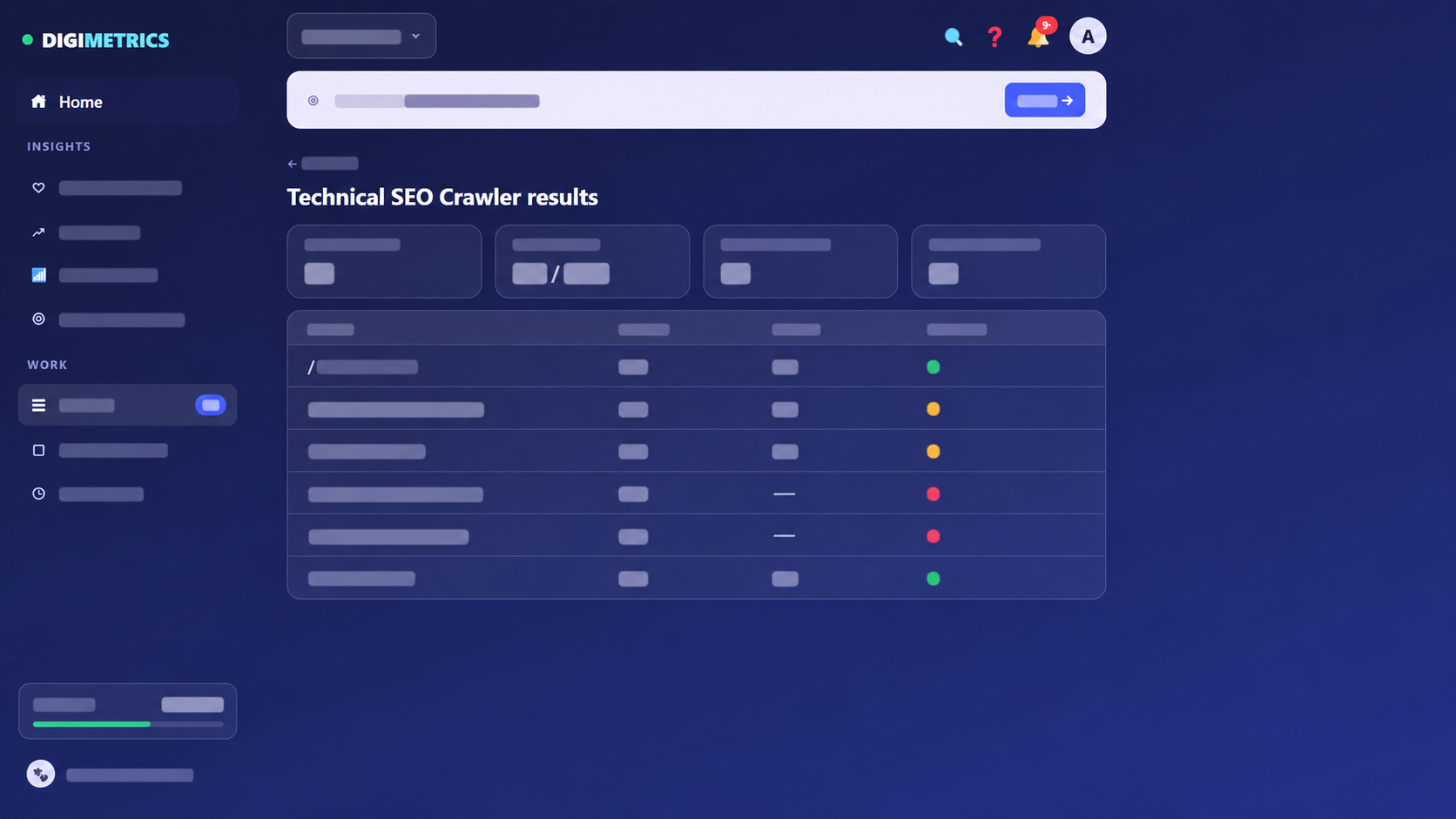
Digimetrics got to the first useful action faster than every other product.
It took 6 minutes 20 seconds to identify that the primary product page had a noindex directive, explain why that mattered, recommend removing it, request reindexing and then verify the result.
That sequence is exactly what we mean by beginner-friendly.
Instead of:
Issue → score
the workflow was closer to:
issue → why it matters → what to change → how to check the fix
First useful answer: 6m 20s
Beginner Friction Score: 10/30
AI Guidance Score: 4.7/5
What Beginners Will Like
Goal-led navigation and plain-English recommendations made the first hour straightforward.
Digimetrics was especially good at keeping recommendations attached to the site’s actual problems rather than immediately suggesting more content.
Its AI guidance correctly prioritised the indexability problem before content expansion, which mattered in our later AI test too.
Where Beginners May Get Stuck
The trade-off is research depth.
Keyword and competitor workflows returned fewer options and had less filtering depth than Semrush or Ahrefs.
That may not matter during the first few months of learning SEO, but users who quickly move into large keyword datasets, advanced link analysis or complex reporting may want a more mature specialist database.
Verdict
Digimetrics tied SE Ranking at 4.4/5 overall, had the lowest friction score and was our best beginner-friendly AI SEO tool.
SE Ranking still wins overall because its broader independent research, tracking and reporting workflow gives a learner more room to grow.
You can also see how its wider toolkit fits together in the Digimetrics tool profile.
3. Semrush — Best for Beginners Who Want Room to Grow
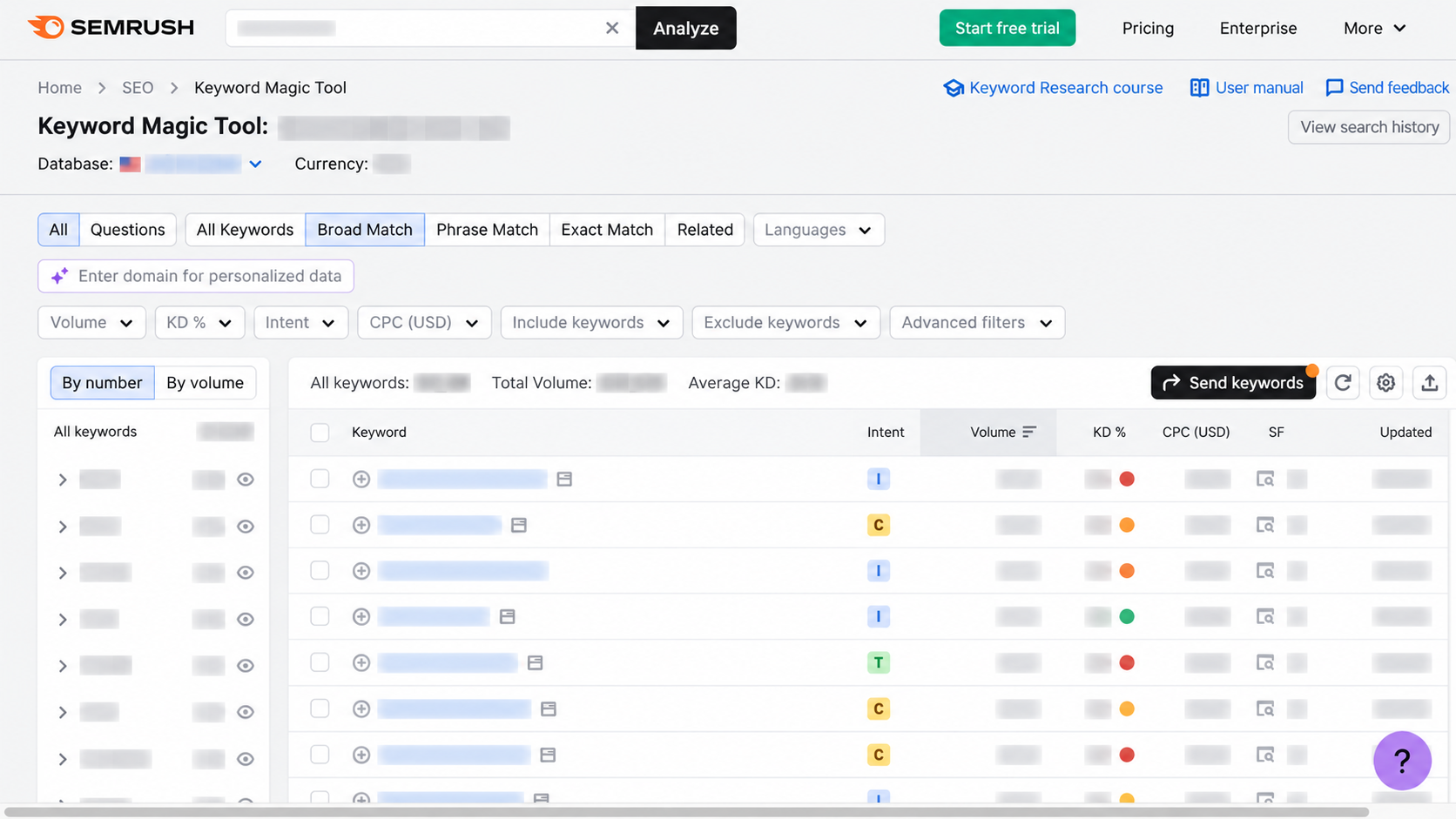
Semrush covers a huge amount of the SEO workflow: keywords, competitors, technical auditing, rank tracking and reporting.
Its current entry SEO tier is explicitly positioned toward freelancers, small businesses and SEO beginners, with five monitored websites, 500 tracked keywords and Site Audit alongside keyword and competitor research. See Semrush’s current SEO plan details.
That breadth is both its biggest advantage and the reason it wasn’t our easiest first hour.
What Happened in the First Hour
The tester found a realistic use-case keyword cluster after applying intent and difficulty filters.
The result was useful.
Getting there was the harder part.
Before reaching the answer, the beginner first had to understand which of several keyword reports was the correct starting point.
Site Audit accurately identified the tested noindex and internal-link problems, and competitor research exposed a meaningful content gap. The issue wasn’t evidence quality. It was choosing which report to use.
First useful answer: 12m 10s
Beginner Friction Score: 17/30
AI Guidance Score: 3.9/5
What Beginners Will Like
Semrush gives you room to grow.
Once the tester understood the distinction between a domain report, keyword report and project, the platform became considerably easier to navigate.
Its keyword workflow was the strongest in our test, and the combination of intent data, filters and research depth means a beginner is unlikely to outgrow it quickly.
If keyword research is your main reason for paying for software, it’s also worth comparing what you can get without another subscription in our free SEO keyword tools comparison.
Where Beginners May Get Stuck
The same breadth that gives Semrush longevity creates its learning curve.
A new user meets multiple routes toward similar questions and terms such as Keyword Difficulty, Authority Score and position distribution before necessarily understanding how much each metric should influence a decision.
Verdict
Semrush is our choice for beginners who want room to grow into a more advanced SEO suite.
It wasn’t the simplest first hour, but it provided the best keyword-research workflow and one of the strongest long-term paths.
4. Ubersuggest — Best SEO Tool for Beginners on a Budget
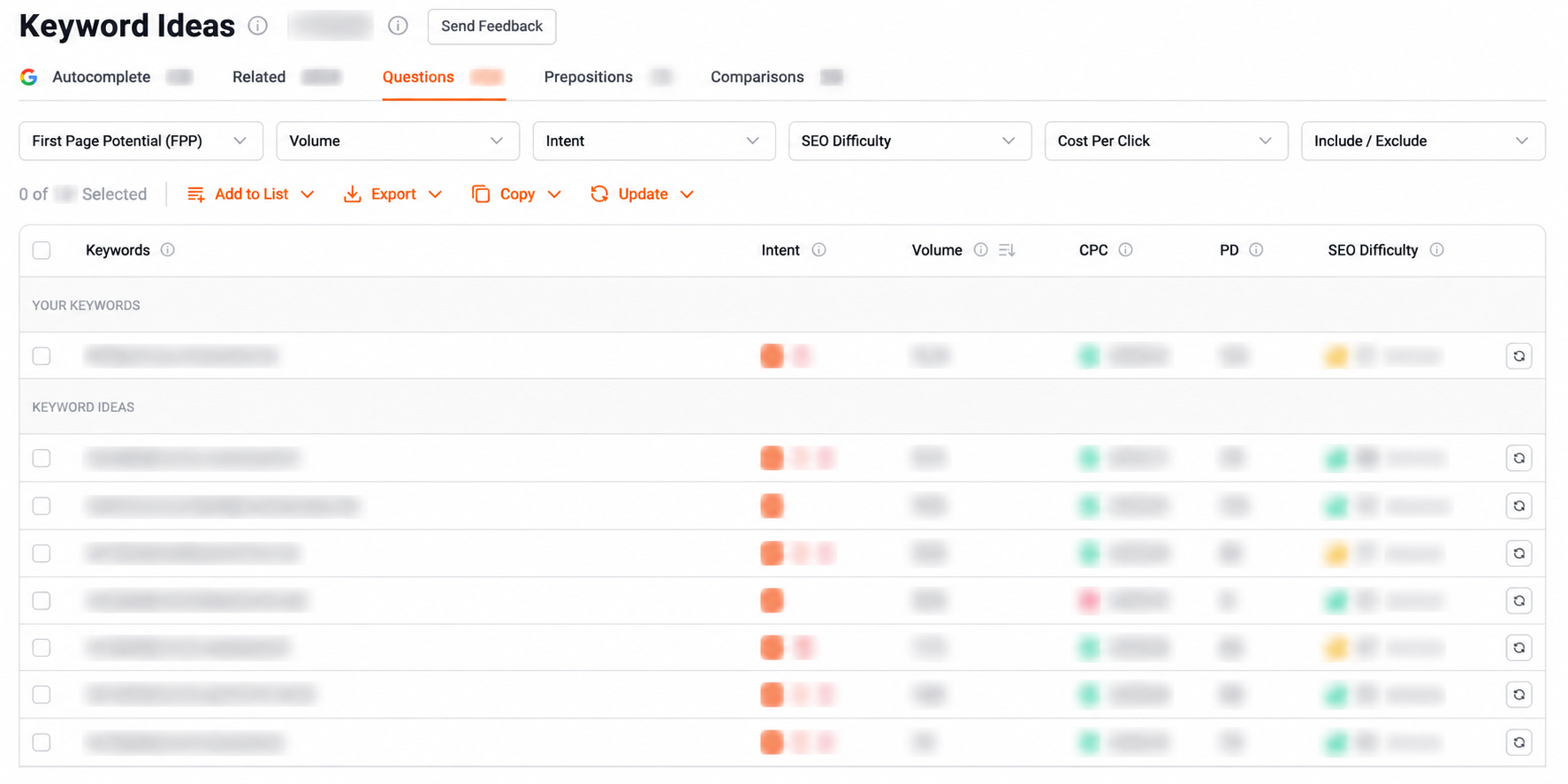
Ubersuggest is easier to approach financially than most of the larger suites.
Its Individual plan is built around one website and currently includes one project, rank tracking, competitor research, site auditing, keyword analysis and AI-assisted keyword features. Its monthly Individual plan is listed at $29, with annual and lifetime options also available. Check Ubersuggest’s current pricing.
It also includes SEO training and email support, which is genuinely relevant to a beginner rather than another box on a feature matrix.
What Happened in the First Hour
Ubersuggest’s simpler interface reduced setup and navigation time.
The tester moved from the seed keyword to three usable variations quickly, then found a broken internal link through Site Audit.
Competitor research was understandable, although the supporting evidence and filtering depth were lighter than Ahrefs and Semrush.
First useful answer: 7m 50s
Beginner Friction Score: 13/30
AI Guidance Score: 3.6/5
What Beginners Will Like
The main workflows are easy to find and the terminology is relatively approachable.
For someone running a single website, the product covers enough of the basic jobs without immediately introducing the complexity or price of a larger professional suite.
Where Beginners May Get Stuck
Simplification doesn’t always mean better prioritisation.
The recommendations occasionally treated an interesting content idea as though it deserved the same urgency as a more important technical issue.
Its AI guidance also suggested broader content work before every technical priority had been fully resolved.
Verdict
Ubersuggest is our best budget option for beginners.
It covers the basic workflow with relatively little friction, although its research depth and prioritisation weren’t strong enough to beat SE Ranking overall.
5. Ahrefs — Best for Learning Competitor and Backlink Research
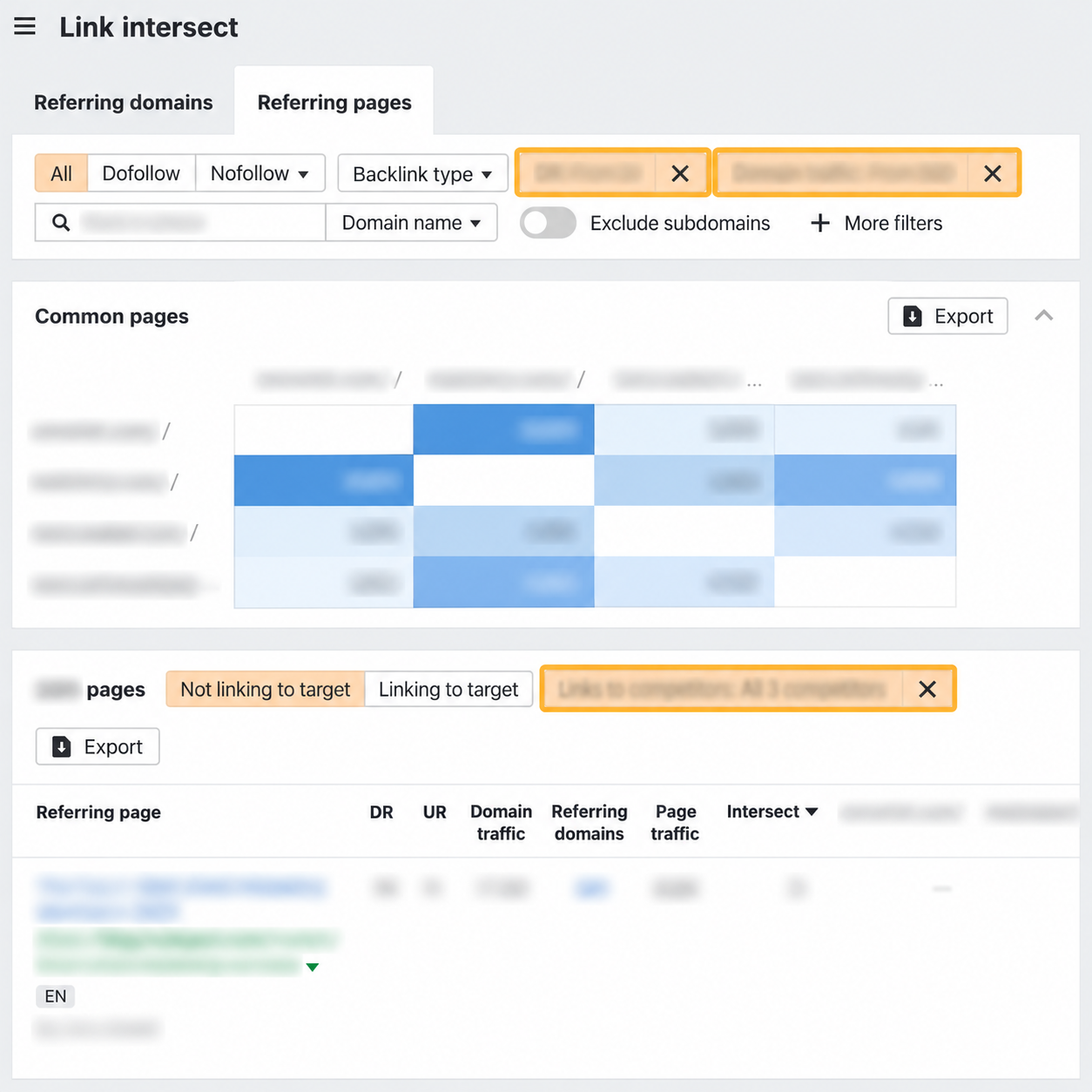
Ahrefs is almost the opposite of Digimetrics in this comparison.
Its biggest strength is the amount of evidence available for keywords, competitors, pages and backlinks.
Ahrefs’ current Starter plan costs $29 per month and the company explicitly describes it as a plan for beginners who want to move beyond the free account. It includes Site Explorer, Keywords Explorer, Site Audit and Rank Tracker.
Beginners can also use Ahrefs Free on verified websites for functions such as Site Audit and Site Explorer before paying for competitor research. See what Ahrefs Starter includes.
What Happened in the First Hour
Ahrefs took the longest to produce the first actionable result at 13 minutes 25 seconds.
The beginner first had to make sense of concepts such as Traffic Potential, Domain Rating, referring domains and the difference between Site Explorer and Keywords Explorer.
Once those ideas clicked, though, Ahrefs produced one of the strongest findings in the entire test: a Link Intersect opportunity supported by several competing websites, rather than a speculative suggestion.
First useful answer: 13m 25s
Beginner Friction Score: 19/30
AI Guidance Score: 3.0/5
What Beginners Will Like
Ahrefs is excellent for learning how the different pieces of competitor performance fit together.
You can move from a competitor’s strong page to its keywords and then into the backlinks supporting it.
That teaches a beginner why a competitor might be performing well instead of simply saying:
“Create better content.”
Once the terminology was understood, its tables and filters became much faster to use.
Where Beginners May Get Stuck
Ahrefs had our highest friction score at 19/30.
The platform presents several proprietary metrics before a beginner necessarily knows how much weight to give them, and it expects more interpretation than the more guided products.
If technical audits are the part you’re struggling to understand, our guide on what an SEO audit tool actually checks explains how to separate useful technical evidence from a long warning list.
Verdict
Ahrefs isn’t our first choice for someone who has never used professional SEO software.
It is, however, the strongest tool in this group for a beginner who specifically wants to learn competitor, content and backlink research and is willing to accept a steeper learning curve.
What Is the Best Beginner-Friendly AI SEO Tool in 2026?
Having an AI button doesn’t automatically make an SEO tool easier to use.
The more important question is whether the AI has enough context to tell a beginner what matters without confidently sending them in the wrong direction.
We therefore gave every available AI or guided recommendation system the same job:
“I’m new to SEO. Based on this website’s data, what are the three highest-priority things I should work on first? Explain why each matters and what I should do next.”
Where the tested plan didn’t provide an equivalent conversational assistant, we assessed its built-in recommendations rather than pretending every platform offered the same feature.
AI Guidance Test
| Tool | Uses Site Data | Prioritises Correctly | Explains Why | Clear Next Action | Main Limitation | Score |
| Digimetrics | Yes | Yes | Yes | Yes | No material unsupported claim | 4.7/5 |
| SE Ranking | Yes | Yes | Yes | Mostly | No material unsupported claim | 4.1/5 |
| Semrush | Yes | Mostly | Yes | Yes | One broad content recommendation came too early | 3.9/5 |
| Ubersuggest | Partial | Mostly | Mostly | Yes | One content recommendation lacked enough site context | 3.6/5 |
| Ahrefs | Partial in tested entry workflow | Mostly | Yes | Partial | Two recommendations remained generic | 3.0/5 |
Best beginner-friendly AI SEO tool in 2026: Digimetrics.
Its recommendations stayed closest to the actual project evidence. In particular, it correctly prioritised the known technical problems instead of using AI as an excuse to recommend more content.
The order matched the site’s real priorities:
fix indexability → repair the broken internal path → optimise the commercial page
That was more useful to a beginner than a longer AI answer.
What the First 60 Minutes Taught Us
The fastest first answer didn’t automatically produce the best overall platform.
Digimetrics reached a prioritised action first, but SE Ranking delivered more consistent evidence across the complete workflow.
Semrush had the strongest keyword research.
Ahrefs had the strongest competitor evidence.
And one of the clearest patterns across the entire test was that more data often increased decision time.
The beginner wasn’t struggling because the tools lacked information. The friction came from figuring out which report to open, which metric mattered and whether a warning was urgent.
Prioritisation therefore mattered more than issue count.
Every platform could identify useful site-health information. The real difference was whether an important noindex problem stayed visible among all the lower-impact warnings and whether the software explained the fix clearly enough for a beginner to repeat it.
Final First-Hour Results
| Category | Semrush | SE Ranking | Ahrefs | Digimetrics | Ubersuggest | Winner |
| Setup | 3.8 | 4.6 | 3.9 | 4.8 | 4.7 | Digimetrics |
| Keyword research | 4.8 | 4.4 | 4.6 | 3.9 | 4.2 | Semrush |
| Site health | 4.4 | 4.5 | 4.3 | 4.3 | 4.1 | SE Ranking |
| Competitor research | 4.7 | 4.2 | 4.8 | 3.7 | 3.8 | Ahrefs |
| Next-action clarity | 3.8 | 4.6 | 3.6 | 4.9 | 4.2 | Digimetrics |
| AI guidance | 3.9 | 4.1 | 3.0 | 4.7 | 3.6 | Digimetrics |
| Overall average | 4.2 | 4.4 | 4.0 | 4.4 | 4.1 | SE Ranking on tie-break |
That table also explains why there isn’t one tool we would recommend for every type of beginner.
Best overall: SE Ranking
Lowest friction: Digimetrics
Best AI guidance: Digimetrics
Best keyword research: Semrush
Best competitor research: Ahrefs
Best budget option: Ubersuggest
Do Beginners Actually Need a Paid SEO Tool?
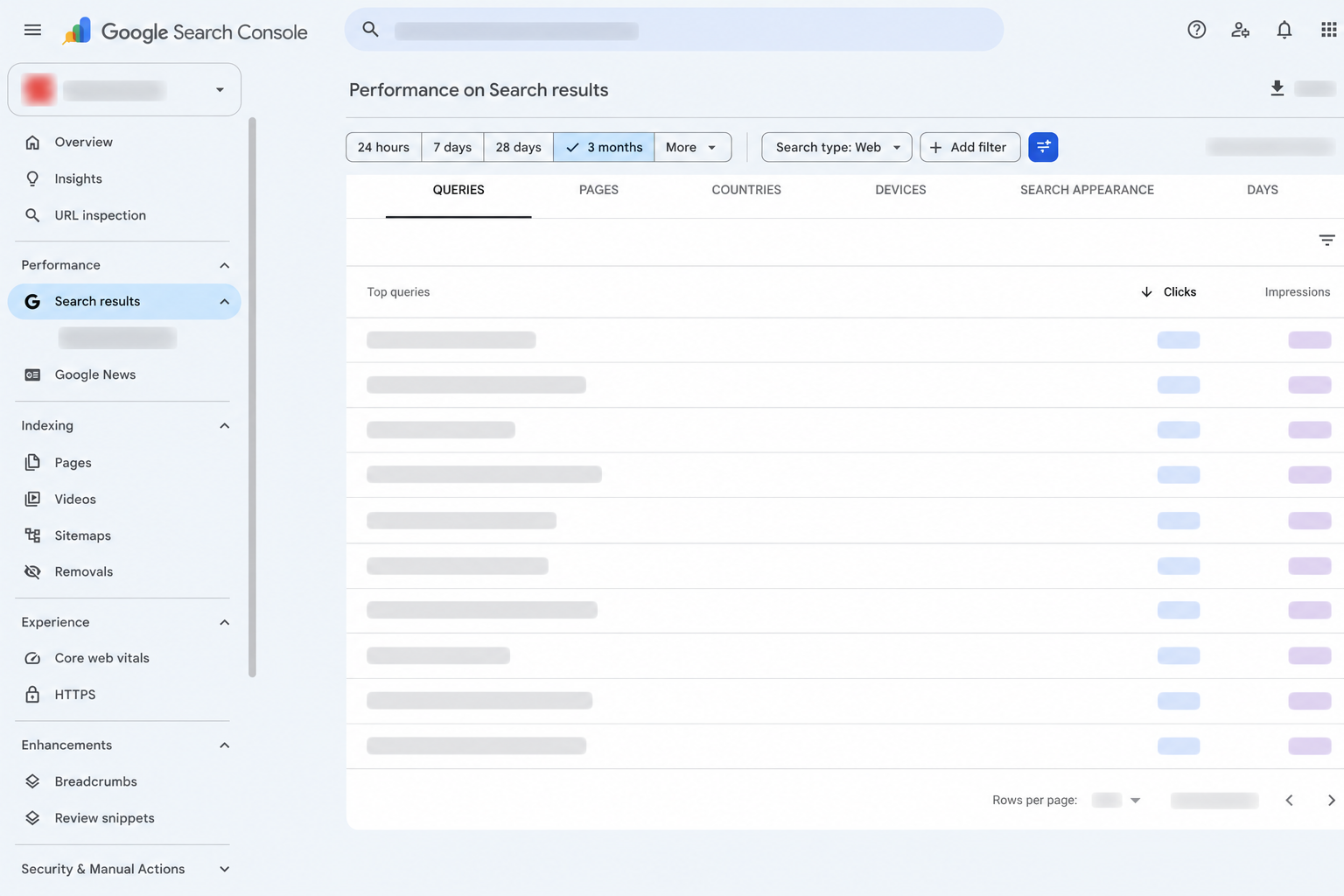
Not necessarily.
Buying a large SEO suite too early can make learning harder because the beginner ends up watching dashboards instead of understanding how search performance works.
For your own website, Google Search Console is one of the best places to start because its Performance report shows which queries and pages are actually generating impressions and clicks in Google Search. Learn how Google’s Search Console Performance report works.
From there, you can combine it with basic keyword research and a crawler.
Ahrefs offers a useful free account for verified sites, including Site Audit and Site Explorer, while limited versions of other tools can cover much of the learning stage.
Our broader SEO tools guide also explains why a smaller stack can be perfectly adequate before workflow limitations become the actual problem.
When We’d Start Paying
We would upgrade when the limitation becomes obvious.
That might be when you’re:
- manually checking too many rankings;
- running out of useful keyword data;
- unable to investigate competitors properly;
- managing more pages than your free tools handle comfortably; or
- spending more time moving between platforms than fixing SEO issues.
Don’t pay because an SEO suite has 100 features.
Pay because one of those features removes a problem you already understand.
The Beginner SEO Stack We’d Actually Recommend
A beginner doesn’t need five SEO subscriptions.
We’d use this progression:
Google Search Console → one beginner-friendly SEO platform → specialist tools only when a real limitation appears
Start by learning how your own website performs.
Then add something like SE Ranking, Digimetrics or Ubersuggest when you want help pulling research, auditing and tracking into a repeatable workflow.
Later, if backlink research becomes strategically important, a deeper specialist platform can start making sense. Our explanation of how backlink analysis tools work covers what those huge link databases are actually useful for before you start paying for one.
The same principle applies elsewhere.
Don’t build the stack first and look for reasons to use it later.
Let the SEO problems determine which tools get added.
Final Verdict: The Best Beginner SEO Tool Should Reduce Confusion
The best SEO tools for beginners aren’t necessarily the simplest or cheapest.
They’re the tools that let someone with limited experience make better SEO decisions without constantly leaving the platform to figure out what the report means.
Our first-hour test produced six practical recommendations:
Best SEO tool for beginners overall: SE Ranking
Best beginner-friendly AI SEO tool: Digimetrics
Best beginner SEO tool on a budget: Ubersuggest
Best for beginner keyword research: Semrush
Best for learning competitor and backlink research: Ahrefs
Best for beginners who want room to grow: Semrush
The winner depends on the job.
But the principle doesn’t:
The best beginner SEO tool should shorten the path from question → evidence → understanding → action.
A beginner-friendly platform should eventually make you less dependent on hand-holding, not permanently dependent on it.
That’s the real test.
Frequently Asked Questions
What Is the Best SEO Tool for a Beginner?
SE Ranking is our overall recommendation for beginners.
In our first-hour test, it combined straightforward project setup, understandable auditing, daily rank tracking and enough research depth to remain useful as the tester’s skills improved.
Digimetrics tied it on the rounded overall score and was easier to start with, but SE Ranking won the tie-break because of its broader all-round workflow.
What Should a Beginner SEO Tool Include?
At minimum, it should make keyword research, site health and ranking performance understandable.
Competitor research is useful too, but the software should explain what the evidence means rather than simply putting another set of metrics on the screen.
What Is the Best Beginner-Friendly AI SEO Tool in 2026?
Digimetrics was the best beginner-friendly AI SEO tool in our test, scoring 4.7/5 for AI guidance.
Its recommendations used the project context, correctly prioritised the known technical problem and gave the tester a practical next step without adding an unsupported content recommendation.
Is Semrush Good for SEO Beginners?
Yes, especially for someone who expects to become a more advanced SEO user.
Semrush currently markets its entry SEO package toward freelancers, small businesses and SEO beginners, with keyword research, competitor analysis, Position Tracking and Site Audit included.
Its main disadvantage in our test was not a lack of useful information. It was the amount of choice presented before a new user understood which report they needed.
Is Ahrefs Good for Beginners?
It can be, particularly if competitor and backlink research are what you want to learn.
Ahrefs’ $29 Starter plan is specifically intended for beginners moving beyond its free account and includes Site Explorer, Keywords Explorer, Site Audit and Rank Tracker.
It did, however, have our highest friction score because the beginner had to understand more terminology before the evidence became useful.
Is Ubersuggest Good for Beginners?
Yes, particularly when budget matters.
Its Individual plan is designed for one website and includes core keyword, competitor, tracking and audit functionality, while its simpler navigation reduced first-hour friction in our test.
It wasn’t our overall winner because its research depth and prioritisation were weaker than the leading tools.
Can I Learn SEO Using Only Free Tools?
Yes.
Google Search Console already gives you first-party information about queries, clicks and impressions, while free or limited keyword and audit tools can cover a lot of the basic learning workflow.
A paid platform becomes easier to justify when limits, competitor research, rank tracking or workflow fragmentation begin slowing you down.
How Long Should I Try an SEO Tool Before Paying?
Don’t judge it from the product tour.
Use your own website. Research one real keyword, inspect one real competitor, run an audit and find at least one issue you can confidently act on.
If you still can’t explain what the software is helping you accomplish after doing real work, another tool may be a better fit.
Disclosure: digitalmarketingtools.ai is sponsored by Digimetrics.ai. Sponsored Highlights are clearly labelled advertising. Our reviews, comparisons and guides are written to be useful and fair regardless of who sponsors the site. Read the full disclosure.


