Best GEO Tools for Small Businesses in 2026: A Practical Buyer’s Guide
Small businesses already have plenty of marketing tools competing for their budgets. Keyword research platforms, website analytics, technical SEO software, and content tools can quickly add up to several monthly subscriptions. Now, Generative Engine Optimization (GEO) platforms promise to show whether your business appears when people ask ChatGPT, Google AI Mode, or Perplexity for recommendations.
That sounds useful, especially when competitors appear in AI-generated answers and your business doesn’t. However, paying for another marketing dashboard only makes sense if the information helps you identify opportunities, improve your website, or make better decisions.
The challenge is that the best GEO tools for small businesses aren’t necessarily the platform with the most features or the largest AI visibility database. A local service provider might only need to monitor a handful of important customer questions, while a growing ecommerce business may benefit from competitor comparisons, citation tracking, and more detailed reporting.
Pricing also varies considerably. Some GEO tools cost less than $40 per month, while others charge several hundred dollars for broader prompt monitoring and advanced analytics. The difference often comes down to how many prompts you can monitor, which AI engines are covered, and whether the software provides capabilities beyond those already available in your SEO stack.
This guide compares GEO tools for small businesses in 2026, explains where each platform fits, and shows how to choose a practical setup without overspending.
Editorial disclosure: DigitalMarketingTools.ai is sponsored by Digimetrics.ai, developed by MediaOne. Digimetrics is included alongside competing products based on its published functionality and pricing. This comparison is based on documented features and practical selection criteria, not a completed head-to-head accuracy benchmark.
Key Takeaways
- Start with free first-party reporting. Google Search Console and Bing Webmaster Tools provide useful generative-AI visibility information without another subscription.
- Otterly.AI is an affordable starting point for dedicated GEO monitoring, with a $29 monthly entry plan covering 15 tracked prompts.
- Digimetrics starts at $39 monthly and combines GEO, SEO, content, and technical tools in one workspace, although its shared credit allowance requires planning.
- Rankscale offers flexible credit-based monitoring, including a lower-cost Essentials tier and a $99 Pro subscription for more extensive use.
- SE Visible, SE Ranking, Semrush, and Ahrefs offer broader research capabilities, but their costs and subscription limits may be unnecessary for smaller businesses.
- The right GEO tool should provide verifiable evidence, including monitored questions, brand mentions, cited sources, and collection dates—not simply a proprietary visibility score.
What Should Small Businesses Look for in a GEO Tool?
GEO tools monitor how brands, products, and websites appear in AI-generated answers. Depending on the product, they can identify brand mentions, competing businesses, cited webpages, important questions, and visibility trends across supported AI search platforms.
For small businesses, the main objective should be understanding whether relevant customers can discover accurate information about the business through AI-assisted research.
For example, a local accounting firm may want to know whether AI assistants mention it when users ask about tax preparation services in its city. An ecommerce business might investigate whether its products appear in comparisons, while a software company may care about the documentation and independent reviews cited when its product category is discussed.
These businesses have different monitoring requirements, which means a single feature-heavy GEO platform isn’t automatically the best choice for all three.
Prioritise Useful Monitoring Over Feature Count
A small business rarely needs to monitor thousands of questions immediately. Starting with a focused collection of customer queries can provide more useful information than importing a large, loosely related prompt database.
Look for a product that allows you to configure relevant questions, examine generated answers, identify competitors, and understand which URLs appear as supporting sources. Historical reporting is useful, but only when your team intends to review the information regularly.
The goal is to move from an observation to a useful next action. If the platform reports that your brand rarely appears for an important comparison question, you should be able to investigate the underlying responses and determine whether your website lacks relevant information.
Understand What GEO Software Cannot Guarantee
A high AI visibility score doesn’t guarantee more leads or sales. Similarly, a website can receive citations without generating measurable traffic, and a brand may be mentioned without its website being linked.
GEO tools are research and monitoring products, not systems that control AI recommendations.
For a detailed explanation of these distinctions, see our complete guide to GEO tools, which covers how AI visibility, citations, and traditional SEO measurements work together.
Best GEO Tools for Small Businesses: Quick Comparison
The following table compares published pricing and general product positioning as of October 16, 2026.
| Tool | Starting Price | Best Small-Business Use |
|---|---|---|
| Google Search Console + Bing Webmaster Tools | Free | First-party AI search visibility and citation reporting |
| Otterly.AI | $29/month | Affordable dedicated AI visibility monitoring |
| Digimetrics | $39/month | Integrated GEO, SEO, technical audits, and content workflows |
| Rankscale | From $20/month, annual billing only | Flexible, credit-based AI search monitoring |
| SE Visible | $99/month | Dedicated brand and competitor AI visibility analysis |
| SE Ranking | $129/month | Traditional SEO and GEO within one platform |
| Semrush AI Visibility | From $99/month on annual billing | AI brand research, prompts, and competitor intelligence |
| Ahrefs Brand Radar | AI Visibility Index from $199/month | Research into brand mentions and cited sources |
| Peec AI | Check current subscription pricing | Brand visibility, sentiment, and competitor reporting |
Prices are in USD and represent selected advertised entry points. Billing terms, included prompts, AI engines, and project allowances vary. Some products charge separately for additional models or monitoring capacity.
These recommendations describe where each product may fit, rather than claiming a verified ranking of accuracy or overall performance.
Google Search Console and Bing Webmaster Tools: Best Free Starting Point
Price: Free
Before purchasing a GEO subscription, small businesses should examine the information already available through Google Search Console and Bing Webmaster Tools.
Both platforms provide first-party reporting related to AI-assisted search, but they measure different outcomes.
What You Get From Google Search Console
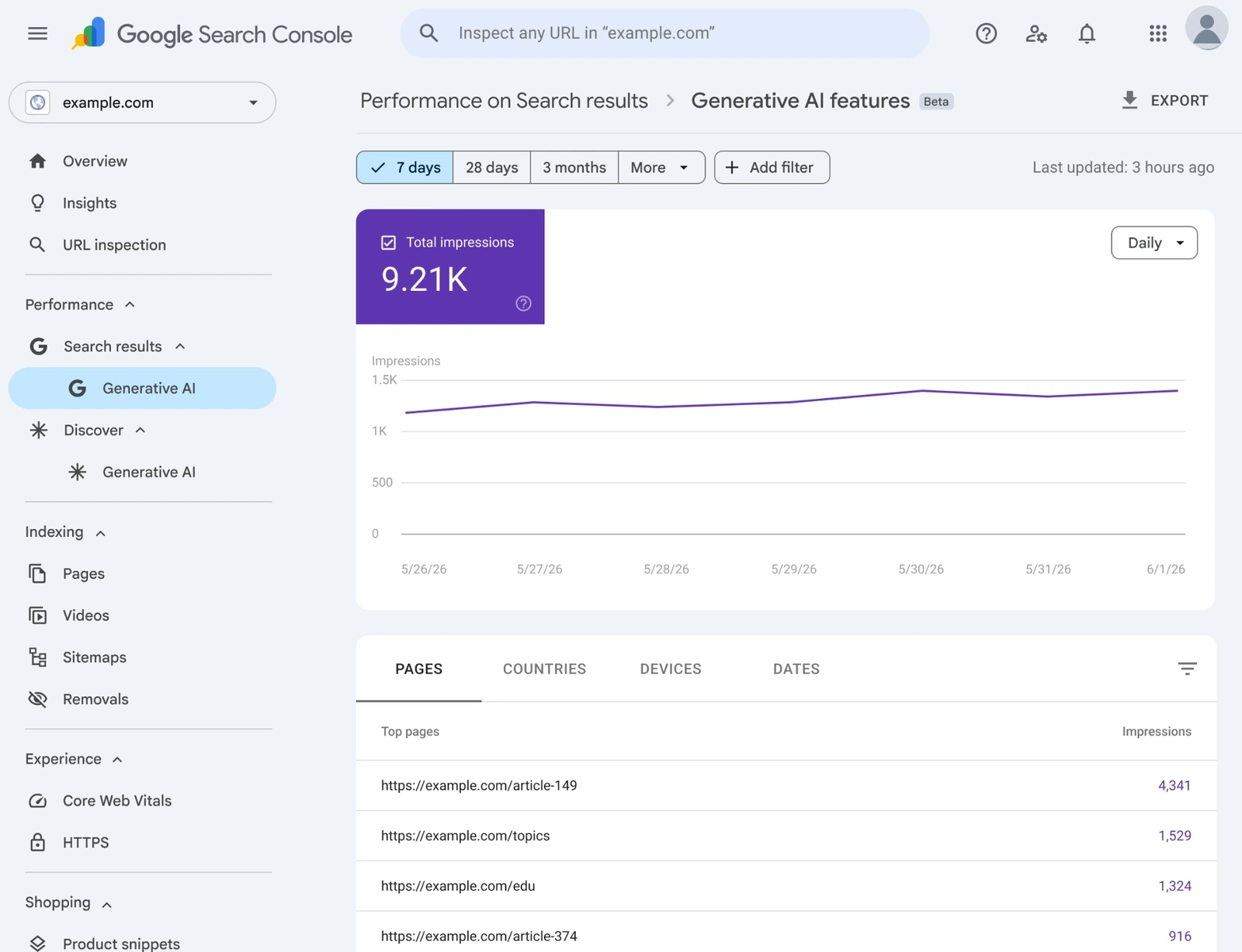
Google Search Console introduced dedicated generative-AI performance reporting in 2026, with worldwide rollout completed by August 31.
The reports provide impression-based information about how verified website content appears in supported Google generative search features, including AI Overviews and AI Mode.
Business owners can use the data to investigate which pages are receiving impressions, how visibility changes over time, and which countries or devices contribute to those impressions.
This provides a useful starting point for understanding Google’s AI-assisted search visibility without relying solely on third-party estimates.
However, Search Console doesn’t provide a complete list of competing brands appearing in AI responses or the exact wording of every user prompt.
What You Get From Bing Webmaster Tools
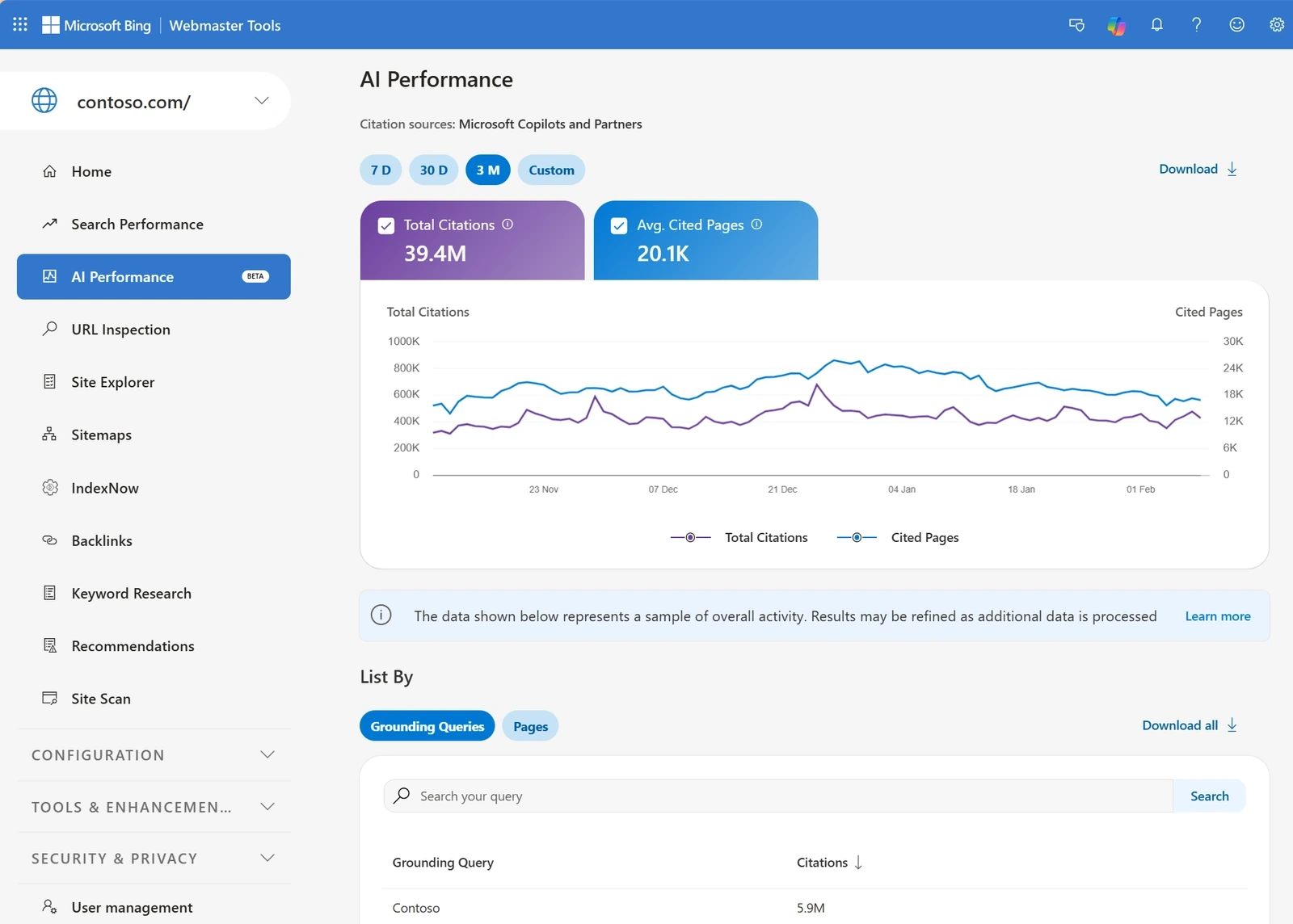
Bing Webmaster Tools introduced AI Performance reporting in February 2026, providing information about when verified website content is cited across supported Microsoft AI experiences.
The report includes total citations, cited pages, grounding queries, and historical trends. Microsoft’s October 2026 Topics Portfolio beta also adds thematic analysis of citation-related queries.
These measurements can help small businesses identify which website pages are appearing as sources in supported AI-generated answers.
However, Bing’s citation counts shouldn’t be treated as equivalent to Google’s generative-AI impressions.
Who Should Use This Setup?
These free tools are particularly useful for small businesses beginning GEO research or operating without a dedicated marketing team. They provide a baseline before the business invests in broader competitor monitoring.
The main limitation is platform coverage. Search Console and Bing Webmaster Tools don’t provide a unified dashboard showing every relevant ChatGPT, Gemini, or Perplexity response.
A paid GEO platform becomes more attractive when the business needs that additional visibility.
Otterly.AI: Best for Affordable, Dedicated GEO Monitoring
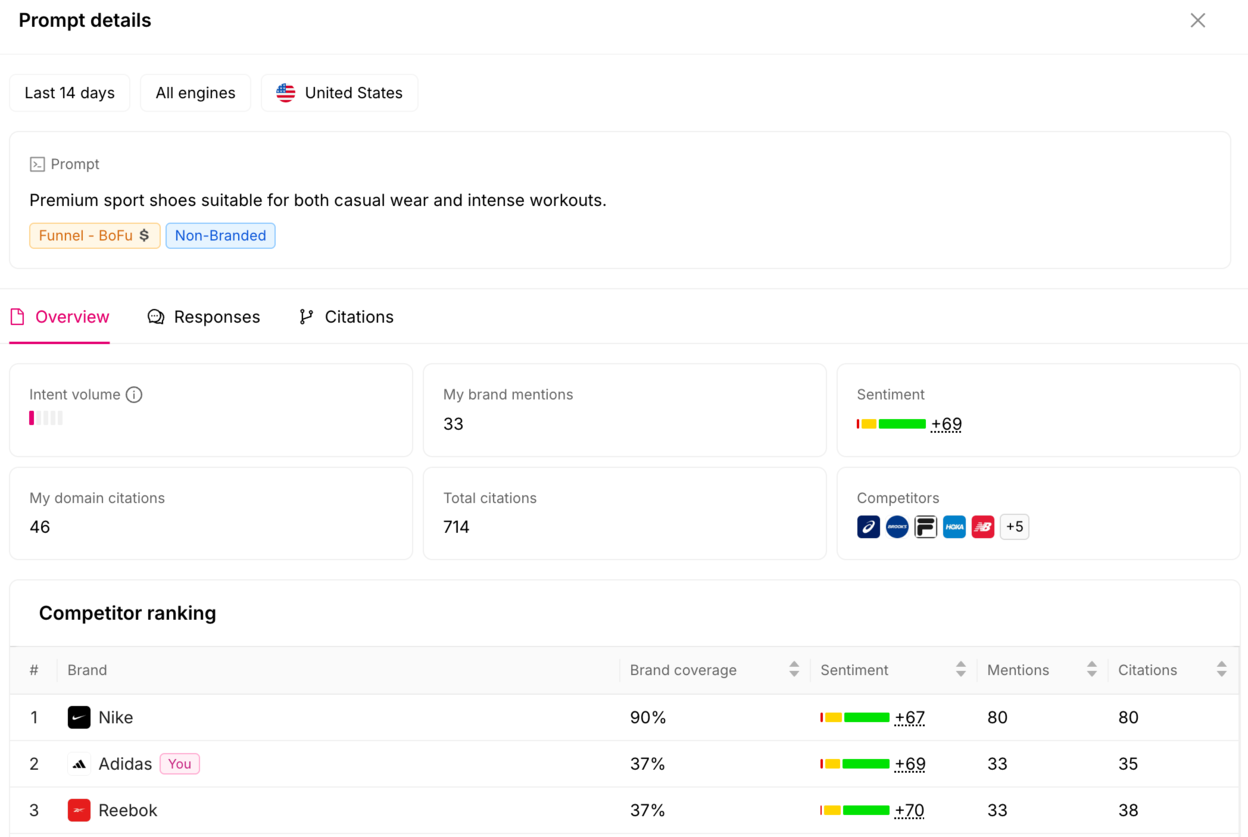
Starting price: $29/month
Otterly.AI specialises in tracking brand visibility across AI search experiences. Its platform monitors selected questions, brand mentions, source citations, competing brands, and changes in observed responses over time.
For a small business that already has an SEO workflow, this focused approach can be appealing. Rather than purchasing another comprehensive SEO suite, the business can add a dedicated layer of AI search monitoring.
The Lite subscription costs $29 per month and includes 15 tracked prompts, daily monitoring, and unlimited team members. Its standard engine coverage includes ChatGPT, Google AI Overviews, Perplexity, and Microsoft Copilot.
Other AI platforms, including Google AI Mode, Gemini, and Claude, are available as optional paid add-ons.
Where Otterly Works Well
Otterly is a practical option when the business wants to monitor a small number of important customer questions without building a complicated reporting system.
For example, a local service provider could monitor questions about its services, pricing considerations, and alternatives in its market. An ecommerce business might track a few commercial product comparisons and investigate whether its brand or competitors appear in the responses.
Otterly also offers a seven-day free trial with 50 prompts and no credit card requirement, allowing prospective users to examine the interface before purchasing.
Where Otterly Falls Short
The main limitation is the Lite plan’s small prompt allowance.
Fifteen prompts may be sufficient for a business monitoring a tightly defined niche, but companies selling several product categories could reach that limit quickly.
The next standard subscription is considerably more expensive at $189 per month for 100 prompts, and additional AI engine coverage can increase the total cost.
Best fit: Small businesses that want dedicated AI visibility monitoring for a limited set of priority questions.
Digimetrics: Best for Combining GEO With Everyday Marketing Work
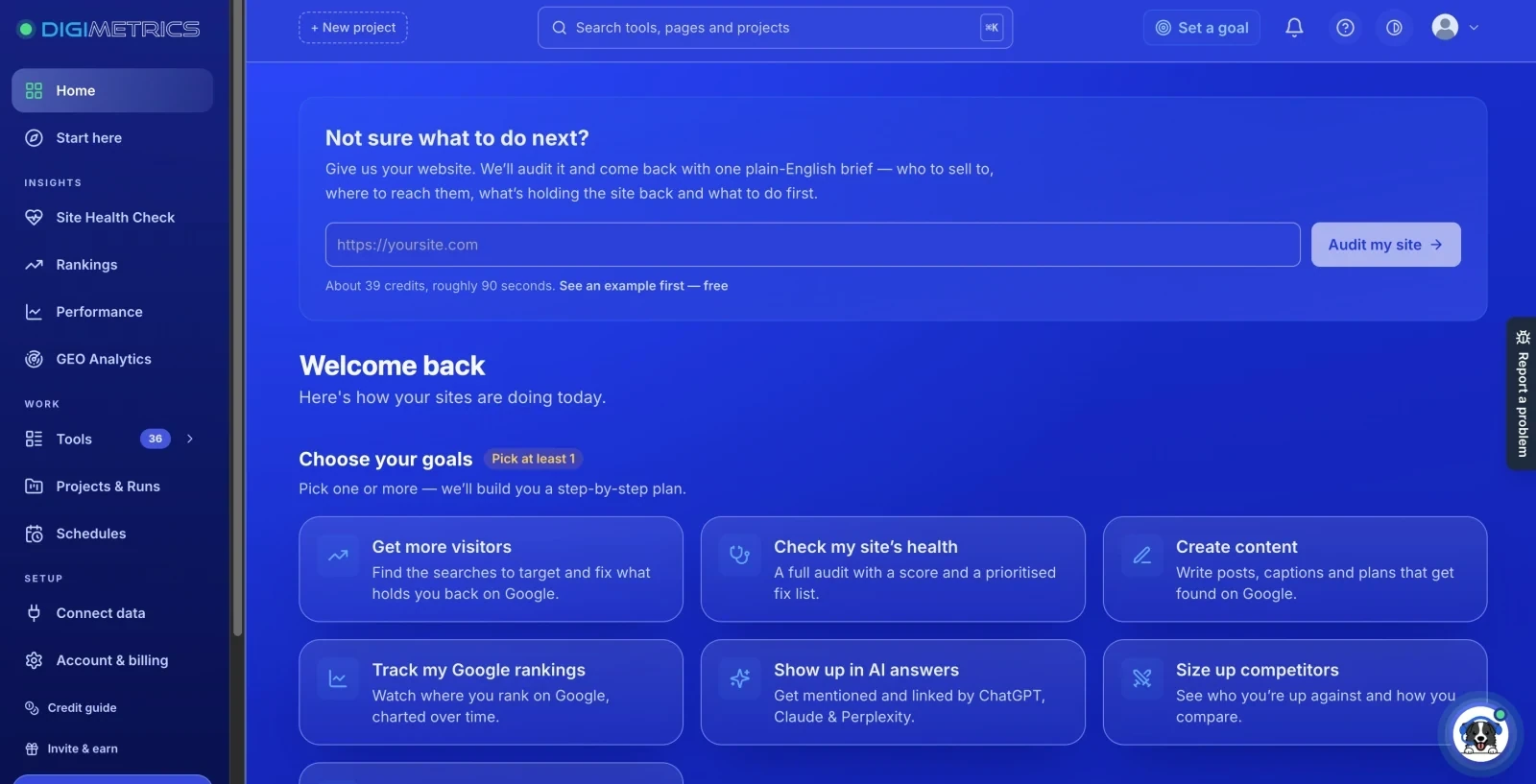
Starting price: $39/month
Digimetrics takes a broader approach than dedicated AI visibility trackers. Its platform combines GEO analysis with keyword research, technical SEO, content optimisation, rank tracking, and other digital marketing workflows.
This can be useful for small businesses that don’t already subscribe to multiple SEO products.
Instead of paying separately for keyword research, technical checks, content analysis, and AI search monitoring, users can explore these activities within one workspace.
Digimetrics currently advertises more than 36 marketing tools, including AI Discovery Audit, AI Mentions Tracker, GEO On-Page Optimisation, and GEO+SEO Forensic Audit.
Its interface also includes Monty, an AI marketing assistant designed to explain findings and help users identify possible next steps.
What Small Businesses Can Do With Digimetrics
Consider a small ecommerce business trying to understand why competitors appear in AI-generated product recommendations.
Digimetrics provides several potentially relevant workflows. The business could examine brand mentions, investigate its website’s technical accessibility, review important content pages, and use keyword research to understand related demand.
Keeping those activities within one platform may reduce the need to move between separate tools.
However, the usefulness of that approach depends on the quality and evidence provided by each analysis. A recommendation to improve a page should be evaluated against the actual problem rather than accepted solely because the platform generated it.
Digimetrics Pricing
| Plan | Monthly Price | Credits | Projects |
|---|---|---|---|
| Free Trial | $0 for 7 days | 200 one-time | 1 |
| Starter | $39 | 500/month | 3 |
| Pro | $109 | 2,000/month | 10 |
| Expert | $199 | 6,000/month | 25 |
The company advertises access to its complete tool collection across plans, although usage capacity, monitoring, exports, and other allowances differ.
Starter includes 25 tracked keywords with weekly checks and three scheduled runs. Pro expands the monitoring capacity and provides more credits for deeper or more frequent analyses.
Where Digimetrics Falls Short
The shared credit system requires budgeting.
Unlike a subscription with a fixed number of tracked AI prompts, Digimetrics deducts credits when eligible tools are run. Different analyses consume different amounts, so users should estimate how often they intend to perform GEO checks, technical audits, or content analyses.
Businesses seeking highly detailed citation monitoring should also verify that the available GEO tools expose the individual URLs, AI platforms, historical responses, and prompt-level information they need.
Best fit: Small businesses and independent marketers who want GEO functionality alongside broader SEO and content tools.
Disclosure: Digimetrics is developed by MediaOne, which sponsors DigitalMarketingTools.ai. Its placement reflects documented features and pricing, not an independently verified superiority claim.
Rankscale: Best for Flexible, Credit-Based GEO Tracking
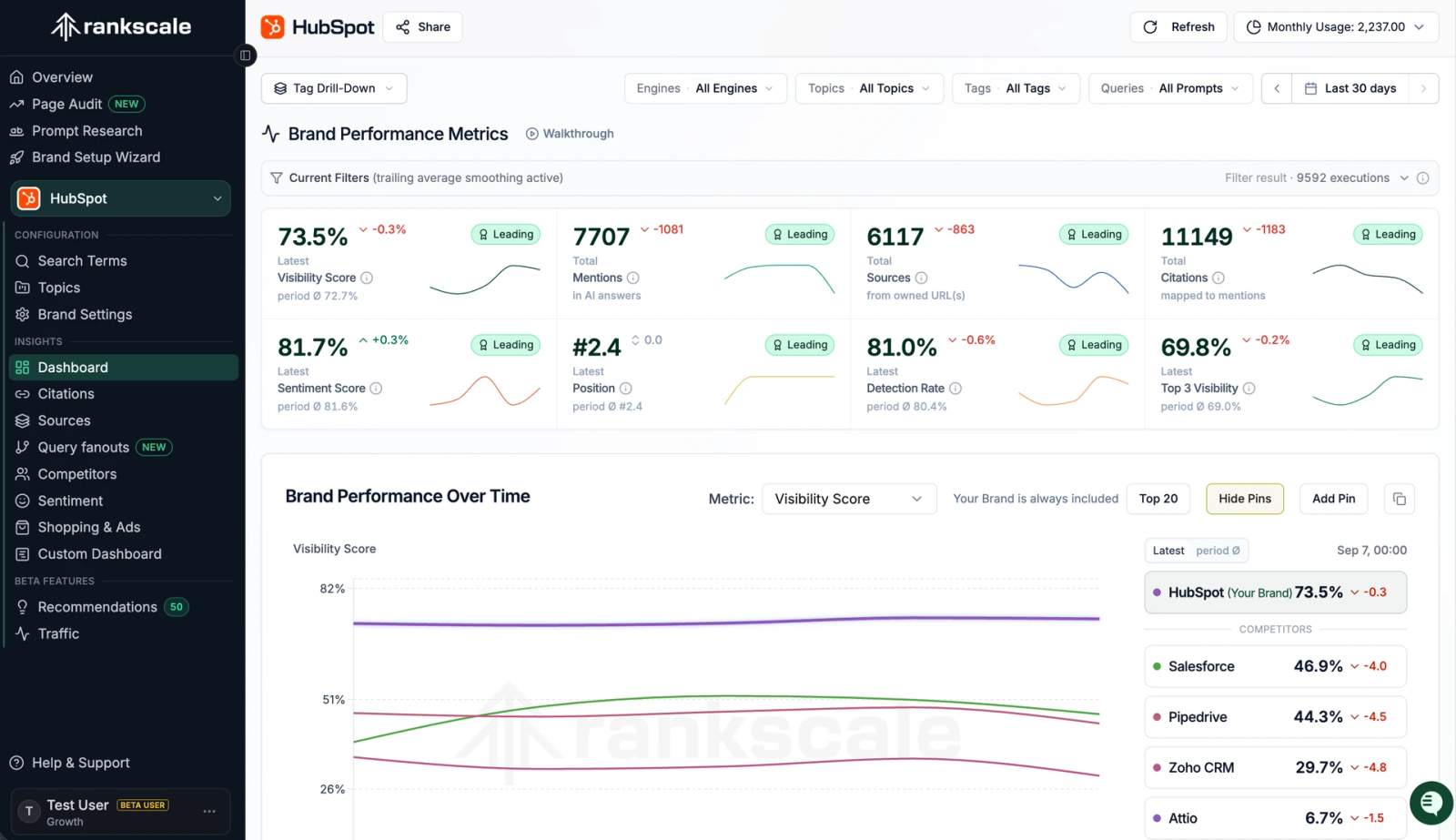
Starting price: $20/month for Essentials on annual billing; Pro at $99/month
Rankscale offers AI search monitoring using a credit-based usage model. It supports brand dashboards, configurable prompts, AI engine selection, and page-level visibility checks.
This approach differs from products that provide a fixed number of tracked prompts under each subscription.
Instead, users estimate how many checks they need across their chosen AI platforms. The platform deducts credits when those checks are performed, with costs varying by engine.
Why Rankscale May Suit Small Businesses
A small business may not need daily monitoring for every question.
For example, it could track important commercial prompts frequently while checking broader informational questions less often. A flexible monitoring schedule can help control usage.
Rankscale provides a credit calculator that allows prospective customers to estimate monitoring requirements before subscribing.
Its Pro plan costs $99 per month and includes 1,200 credits, ten brand dashboard slots, and page audit functionality. The provider also advertises a seven-day Pro trial.
Where Rankscale Falls Short
Credit-based monitoring adds a layer of complexity because users need to understand how much each configuration costs.
A subscription advertising 1,200 credits doesn’t necessarily provide the same monitoring capacity as another platform advertising 1,200 prompts.
The lower-cost Essentials tier is also tied to annual billing, so its advertised monthly equivalent shouldn’t be confused with a flexible month-to-month subscription.
Best fit: Small businesses that prefer flexible tracking schedules and are comfortable managing usage credits.
SE Visible: Best for Dedicated Brand and Competitor Analysis
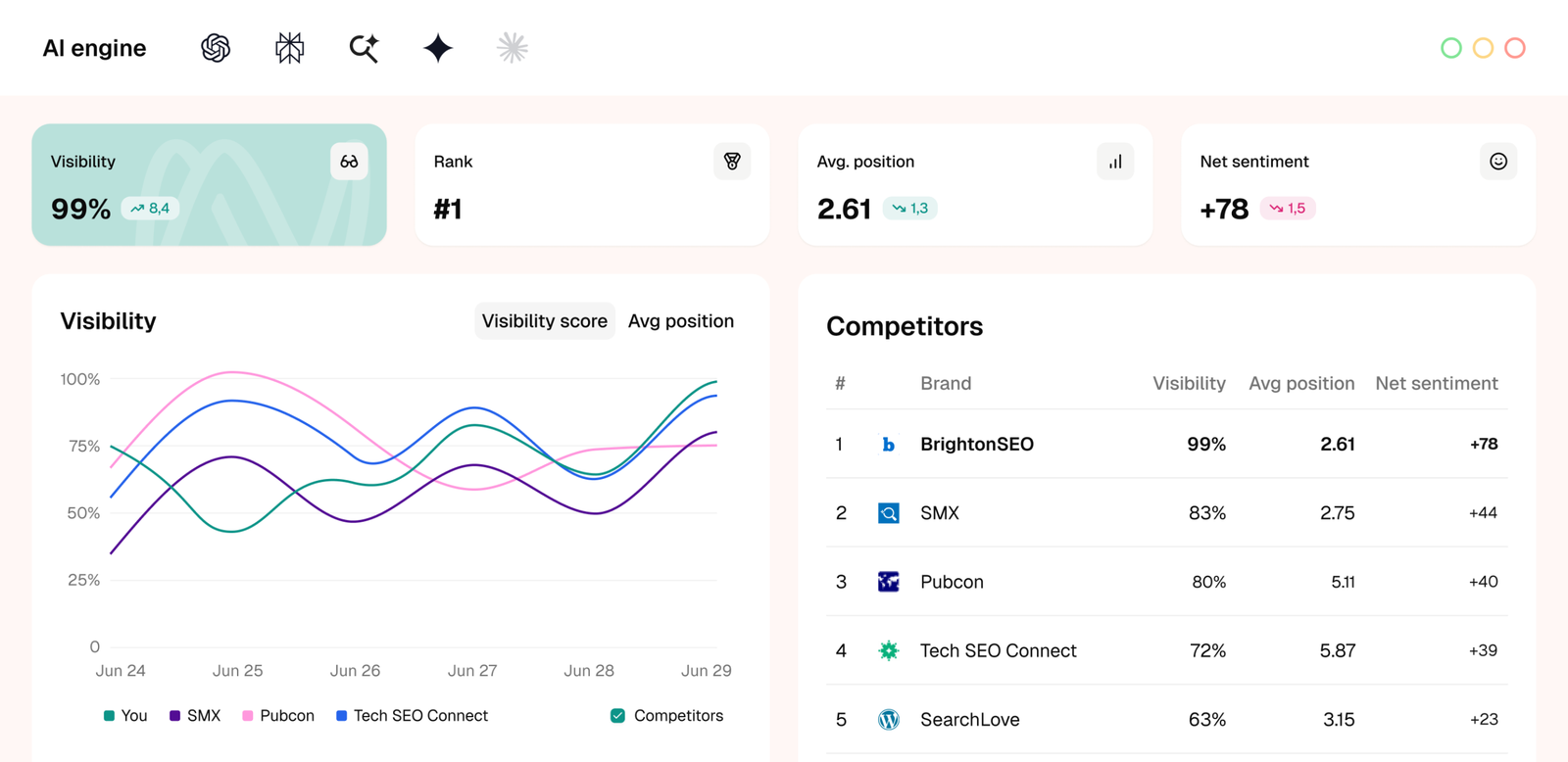
Starting price: $99/month
SE Visible is a dedicated AI search visibility platform from the SE Ranking team. It focuses on monitoring brand appearances, competitors, sources, sentiment, and relevant questions across supported AI search experiences.
Unlike broader SEO suites, SE Visible is built primarily around the GEO reporting workflow.
Its Basic plan costs $99 per month and includes 200 prompts, three projects, and access to supported engines including ChatGPT, Gemini, Google AI Overviews, Google AI Mode, and Perplexity.
The product also advertises a ten-day free trial.
Where SE Visible Works Well
SE Visible can make sense for a growing business that wants more detailed monitoring than a small entry-level GEO subscription provides.
For example, a software company could group questions by product category or purchasing stage, then compare whether its brand appears alongside competitors across several AI systems.
The platform’s source analysis and sentiment reporting may help marketers investigate how those responses are supported and what they say about the brand.
Where SE Visible Falls Short
At $99 per month, SE Visible is a significant recurring expense for a business with limited marketing resources.
Its documented regional coverage also focuses on seven countries—the United States, United Kingdom, Canada, France, Germany, the Netherlands, and Spain—with five supported languages.
Businesses targeting other markets should verify current coverage before purchasing.
Best fit: Small but growing brands that need a dedicated GEO reporting platform with broader prompt capacity and competitor analysis.
SE Ranking: Best for Businesses Already Investing in SEO
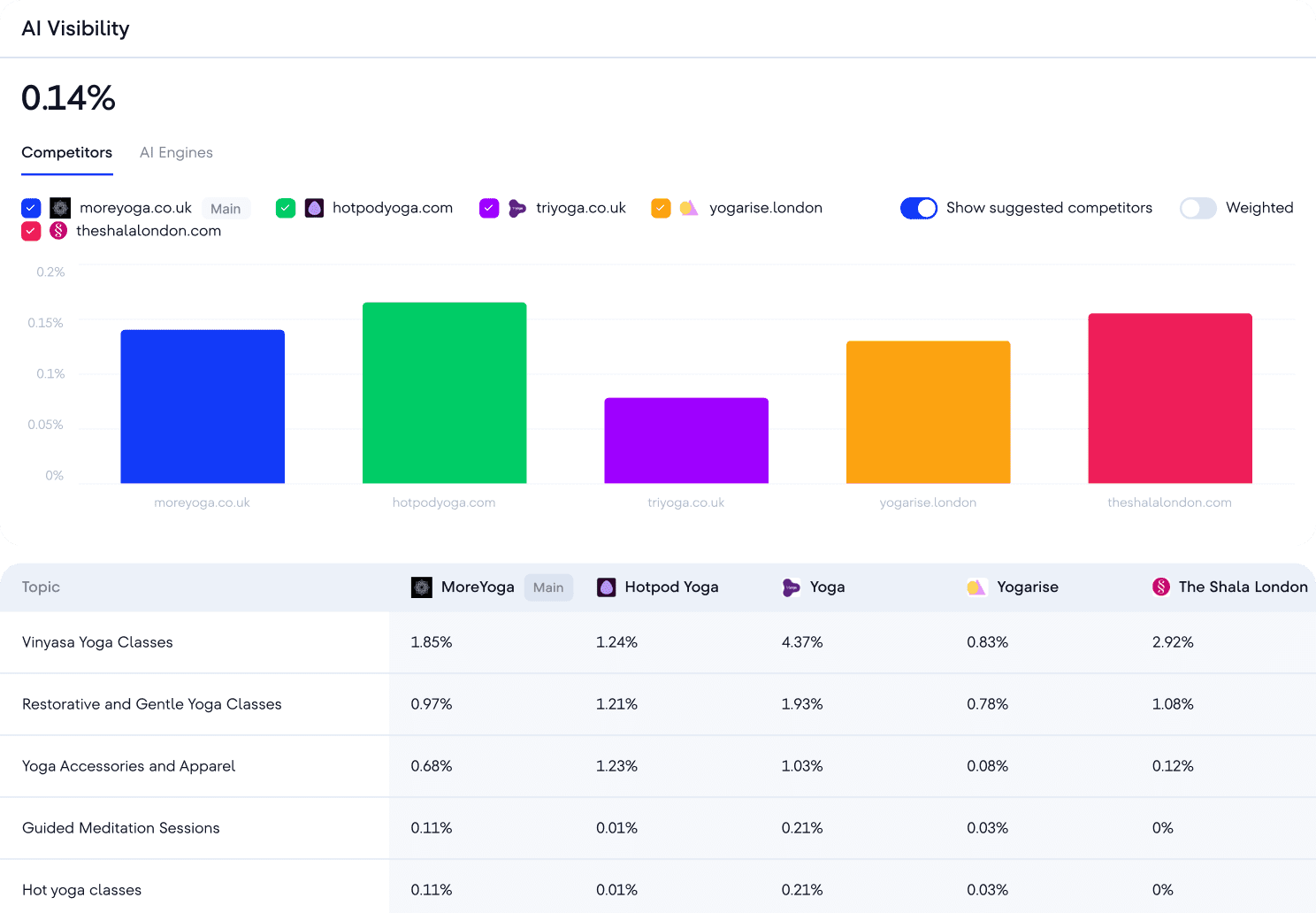
Starting price: $129/month
SE Ranking combines traditional SEO functions with AI search visibility monitoring. Its platform includes keyword research, rank tracking, technical auditing, backlink research, competitor analysis, and GEO reporting.
The Core plan costs $129 per month on monthly billing and includes ten projects, 2,000 daily tracked keywords, and 100 daily tracked GEO prompts.
SE Ranking also provides a 14-day trial without requiring a credit card, although trial monitoring limits are lower than the paid subscription allowances.
When Does SE Ranking Make Sense?
SE Ranking is worth considering when a small business already requires a substantial SEO toolkit.
For example, an ecommerce business managing several product categories may need recurring keyword research, technical audits, competitor monitoring, and traditional ranking reports.
Adding GEO analysis within the same platform could be simpler than maintaining separate subscriptions.
The value comes from the combined workflow rather than treating every individual feature as automatically better than a specialist alternative.
Where SE Ranking Falls Short
For a small business interested only in AI brand monitoring, the Core subscription may provide more software than it needs.
Many of the plan’s allowances are designed for teams managing several projects or substantial SEO workloads. A smaller dedicated GEO product may be more economical if traditional SEO functions are already covered.
Best fit: Businesses that need a complete SEO platform and want GEO reporting as part of the same subscription.
Semrush AI Visibility: Best for Broader Competitive Research
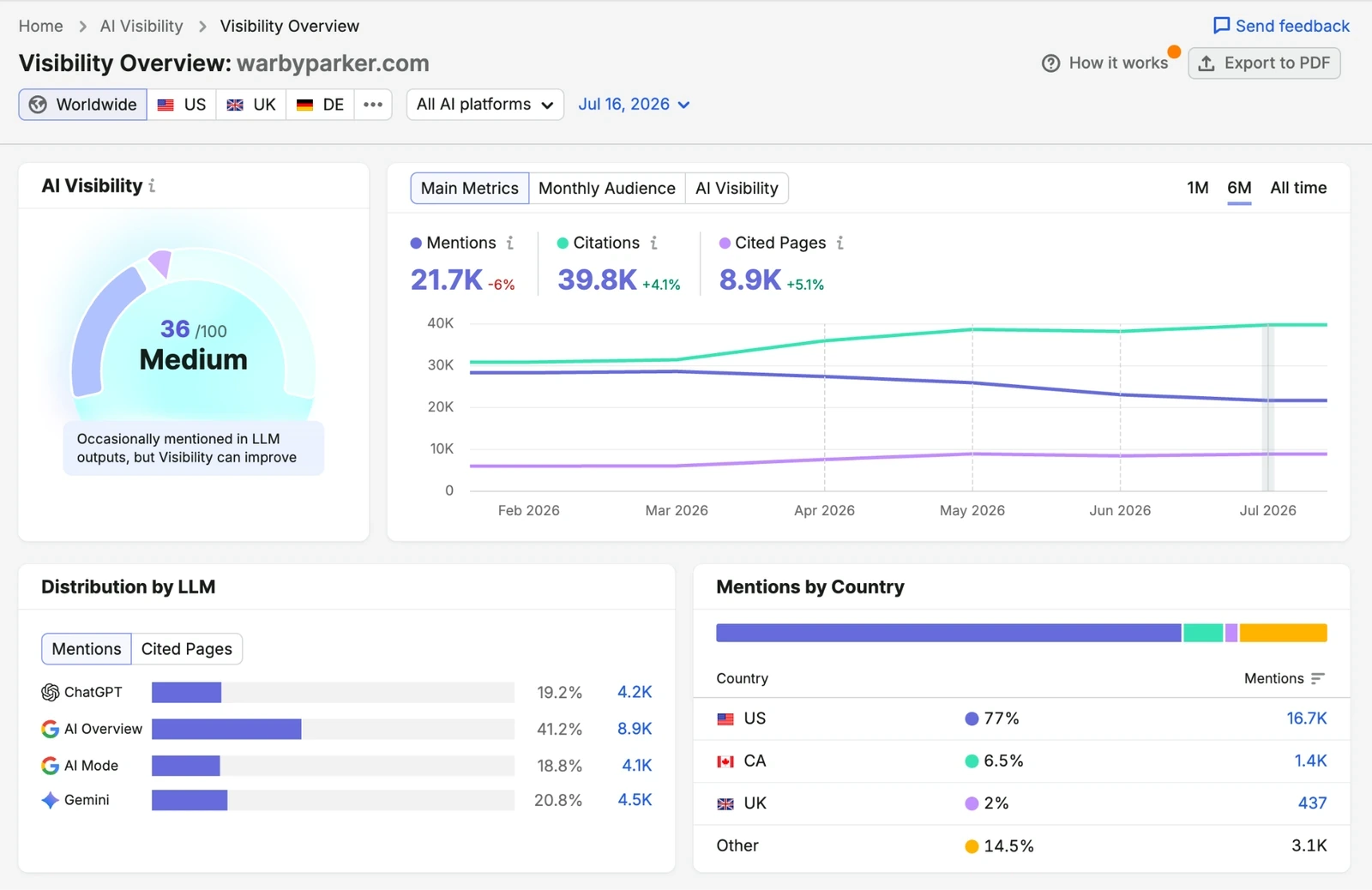
Starting price: $99/month per domain on annual billing
Semrush AI Visibility provides brand monitoring, prompt research, competitor analysis, citation information, and AI search visibility reporting.
Its Base subscription is advertised at $99 per month per domain when billed annually. It includes 25 tracked custom prompts, AI competitor analysis, and brand performance reporting for one domain.
Semrush also offers SEO subscriptions with AI visibility features and higher-tier packages that combine conventional and generative search research.
Where Semrush Works Well
Semrush can be useful for businesses that want to investigate their market beyond a small custom prompt list.
For example, a company launching a new product may want to understand which competing brands appear in relevant AI-generated comparisons and what topics those responses cover.
Its wider SEO platform can also help connect that research with keyword demand, competing pages, and technical website issues.
Where Semrush Falls Short
The subscription structure needs careful attention.
The standalone AI Visibility Toolkit doesn’t offer its own free trial, although Semrush’s broader SEO and AI search packages advertise separate trial access.
The $99 rate also reflects annual billing, and the entry allowance of 25 custom prompts may not suit businesses requiring many topics or markets.
Additional users, reporting features, or monitoring requirements can increase the total cost.
Best fit: Small businesses with an established SEO budget that need broader AI competitor research and market intelligence.
Ahrefs Brand Radar: Best for Businesses Already Using Ahrefs
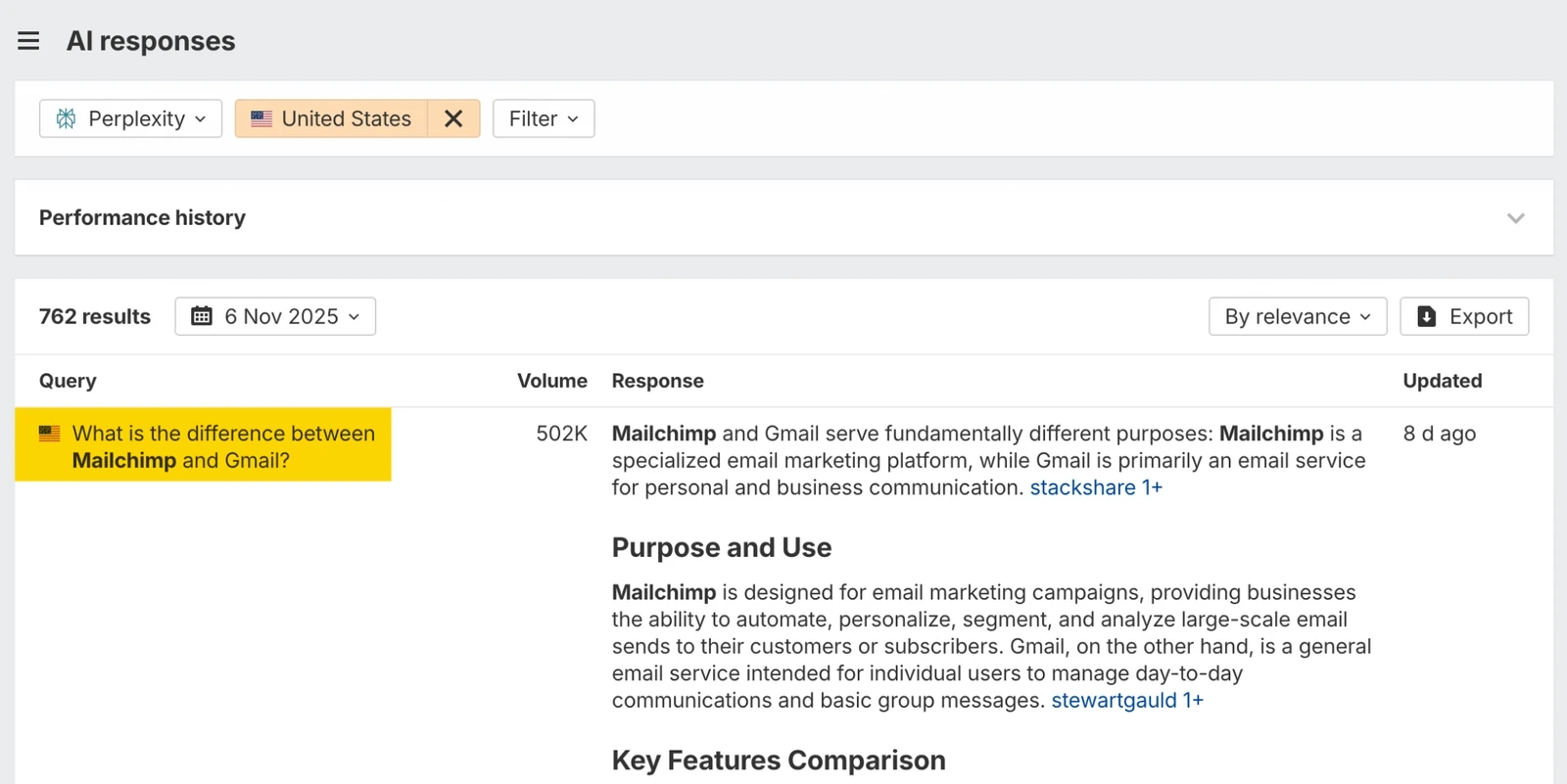
AI Visibility Index: from $199/month; custom prompt packages from $50/month
Ahrefs Brand Radar provides information about brand mentions, citations, competitors, and AI search visibility across supported platforms.
It offers two related approaches: a broader AI Visibility Index for researching brand visibility across its database, and custom prompt monitoring for questions selected by the user.
Ahrefs also includes limited daily custom prompt tracking within its existing paid SEO plans. Its Lite subscription currently includes five tracked AI prompts alongside broader SEO functionality.
When Should Small Businesses Consider It?
Ahrefs is a relevant choice when the business already uses its tools for keyword research, backlink analysis, auditing, and competitive intelligence.
Rather than introducing an entirely separate software ecosystem, the team can investigate AI visibility alongside existing search research.
Brand Radar may also be useful when broader market research is more important than monitoring only a handful of manually selected questions.
Where Ahrefs Falls Short
The broader AI Visibility Index is relatively expensive for a small business.
Custom prompt tracking can be purchased separately, but pricing depends on the number of checks, AI platforms, and monitoring requirements.
For businesses primarily interested in occasional GEO monitoring, a lower-cost specialist product may be more appropriate.
Best fit: Businesses already using Ahrefs or requiring more substantial competitive and source research.
Peec AI: Best for Brand-Focused GEO Reporting
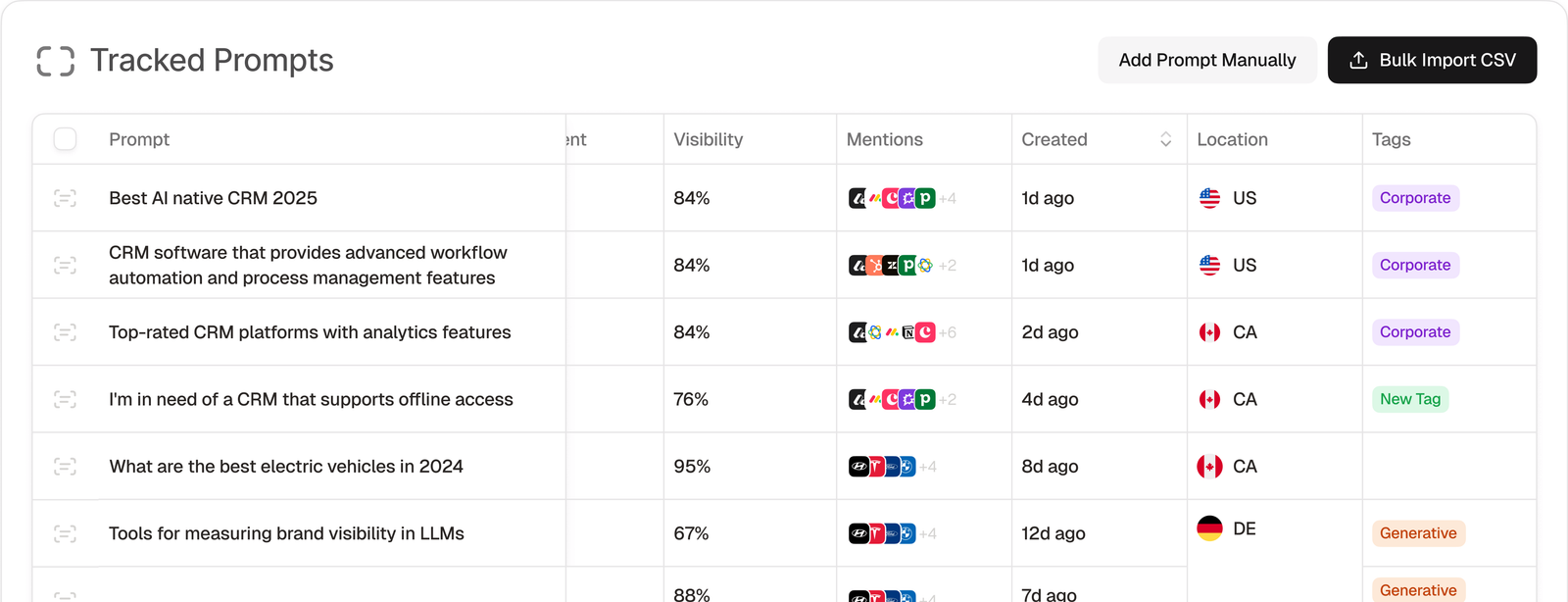
Pricing: Confirm the current self-service subscription rate
Peec AI specialises in monitoring brand visibility across AI-generated answers. Its features include prompt tracking, source analysis, competitor comparisons, sentiment, and share-of-voice reporting.
The Starter plan currently advertises 50 prompts, a choice of three AI models, daily tracking, one project, and unlimited users.
This makes it a potentially useful option for marketing teams interested in how AI systems describe their business and competitors.
Where Peec Works Well
Peec’s focus on brands, competitors, and answer-level analysis can help smaller teams investigate their visibility within a particular product category.
For example, a business might examine whether competing products appear more frequently in commercial questions and which sources support those responses.
However, the value depends on whether the monitored prompt set reflects the questions that matter to the business.
Where Peec Falls Short
The current publicly accessible pricing information doesn’t clearly expose the subscription amount in a way that can be verified consistently, so buyers should confirm the total cost during signup.
The entry plan also limits the number of active AI models, making platform selection important for businesses monitoring several services.
Best fit: Small marketing teams that prioritise brand perception, competitor comparisons, and regular AI response analysis.
Which GEO Tool Is Best for Your Type of Small Business?
The right product depends on the business model, existing SEO subscriptions, and the questions being monitored.
| Business Type | Main GEO Requirement | Recommended Starting Approach |
|---|---|---|
| Local service business | Local recommendations and accurate business information | Free Google/Bing reporting, then limited prompt monitoring |
| Small ecommerce store | Product comparisons and citations | Otterly.AI or Digimetrics |
| Independent consultant | Professional visibility and service-related prompts | Free tools, then a low-cost specialist |
| Content publisher | Identifying articles used as AI sources | Bing Webmaster Tools and citation-focused reporting |
| Small SaaS business | Brand mentions and competitor comparisons | Otterly.AI, SE Visible, or Peec AI |
| Small in-house marketing team | SEO, content, technical, and GEO tasks | Digimetrics or SE Ranking |
| Growing multi-brand business | Higher prompt capacity and competitor research | SE Visible, Semrush, or Ahrefs |
These are suggested starting points rather than fixed product rankings.
A local business may need only a few important location-specific questions, while a small SaaS company could require more extensive competitor monitoring.
The important step is to identify the measurement problem before choosing a subscription.
How Much Should a Small Business Spend on GEO Tools?
There isn’t a universal GEO software budget that works for every small business.
A company that hasn’t established any relevant AI visibility monitoring may be better served by free reporting and a limited manual research process.
Another business that regularly publishes content, operates in a competitive product category, and already invests in SEO may justify a dedicated subscription.
The relevant question is whether the software provides information that supports useful work.
Budget-Based Starting Points
| Monthly GEO Budget | Practical Approach |
|---|---|
| $0 | Google Search Console, Bing Webmaster Tools, manual prompt research |
| Under $40 | Entry-level specialist monitoring or an integrated starter workspace |
| $40–$100 | Additional prompt capacity, credit-based monitoring, or specialist reporting |
| $100–$200 | More comprehensive GEO or combined SEO platforms |
| Above $200 | Broader research, multi-project reporting, and advanced monitoring |
These ranges are purchasing categories, not evidence of what most businesses spend.
The cheapest subscription isn’t always the least expensive workflow. A $29 platform may be economical when fifteen prompts cover your needs, but less attractive if you must upgrade to monitor several product categories.
Likewise, a $39 integrated subscription could be cost-effective when the business uses its SEO and GEO functions, but unnecessary if it only needs occasional brand checks.
Calculate the Real Monitoring Requirement
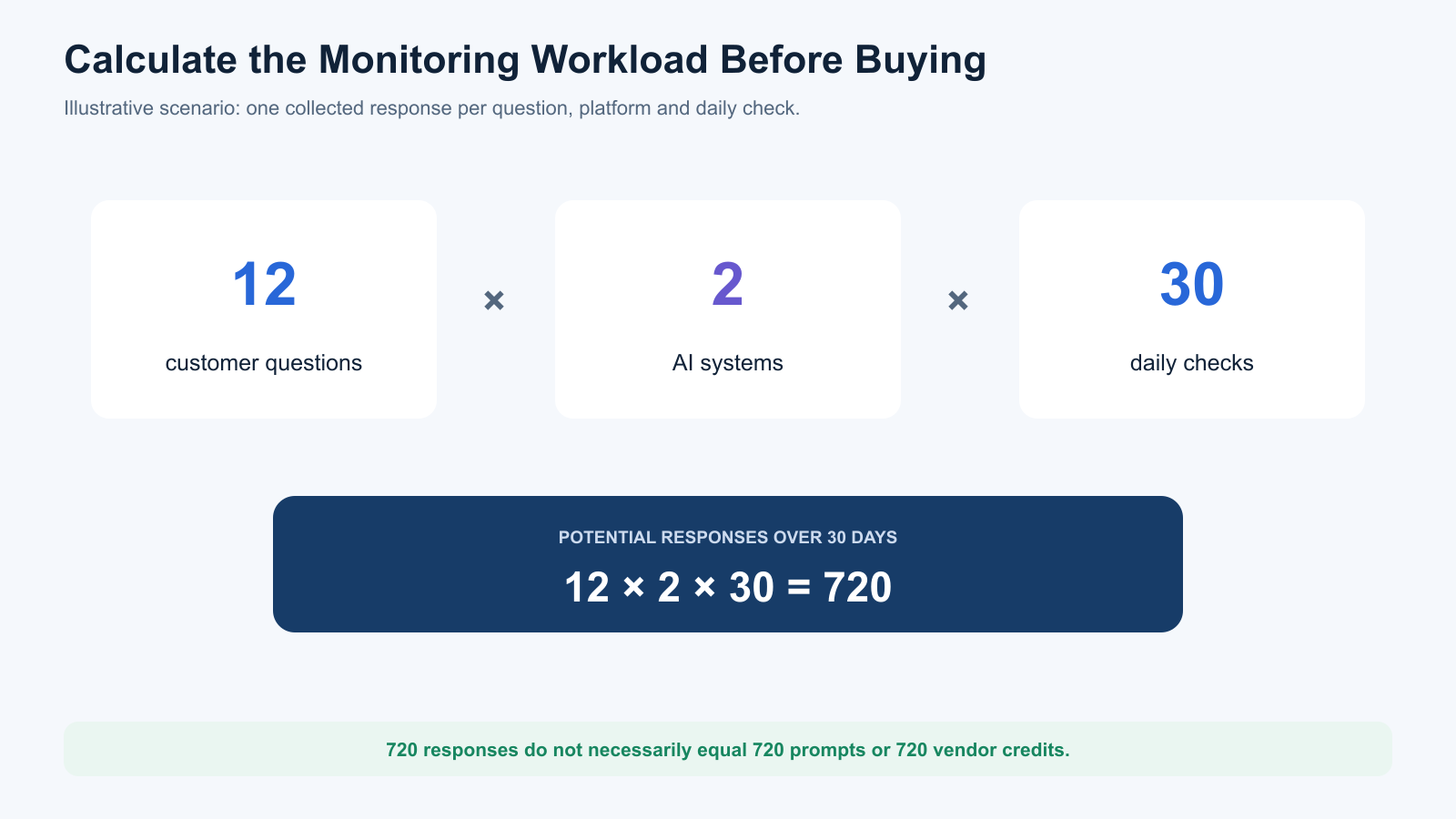
Consider a hypothetical business wanting to monitor twelve customer questions across two AI systems every day.
That could create approximately 720 collected responses over a 30-day period, assuming each question is checked once per system per day.
Different vendors count this usage differently.
Otterly uses tracked-prompt allowances, Digimetrics operates through credits, and Rankscale calculates usage based on engine checks. Other platforms have their own prompt and response limits.
Compare the actual cost of your intended monitoring setup rather than dividing the subscription price by an unrelated feature count.
What GEO Features Are Actually Necessary for Small Businesses?
Small businesses should focus on capabilities that directly support their research and marketing decisions.
Advanced dashboards, proprietary visibility scores, and extensive automation can be useful, but they aren’t always necessary.
Relevant AI Platform Coverage
Choose the AI experiences relevant to your customers.
If your main concern is Google Search visibility, start with Search Console and consider tools that monitor AI Overviews or AI Mode.
If potential buyers regularly compare products using ChatGPT or Perplexity, those systems may deserve additional attention.
However, don’t assume that monitoring one AI interface represents every interaction within the wider product ecosystem.
Brand Mentions and Source Evidence
A useful GEO report should show whether your business appeared in a monitored response and where the information came from.
Citation data is particularly valuable when it identifies individual pages rather than only displaying a domain-level score.
These distinctions matter because a brand can be mentioned without receiving a source citation, while its website can be cited without the business itself being recommended.
For a deeper explanation, see our AI citation tracking tools guide.
Competitor Monitoring
Small businesses don’t need to monitor every competitor in their industry.
Start with businesses that serve the same customers, offer similar products, or consistently appear in relevant comparisons.
The purpose is to investigate what information those competitors provide and whether your own website is missing important details.
A competitor’s appearance in an AI-generated answer isn’t automatic proof that its content is better.
Historical Data and Reporting
Repeated observations can help identify whether brand appearances are consistent or occasional.
However, the measurement process should record the monitored question, platform, collection date, and relevant settings.
A visibility percentage without that context may be difficult to interpret.
Our article on AI search visibility tools explains the broader measurement features worth considering.
How to Test a GEO Tool Before Buying
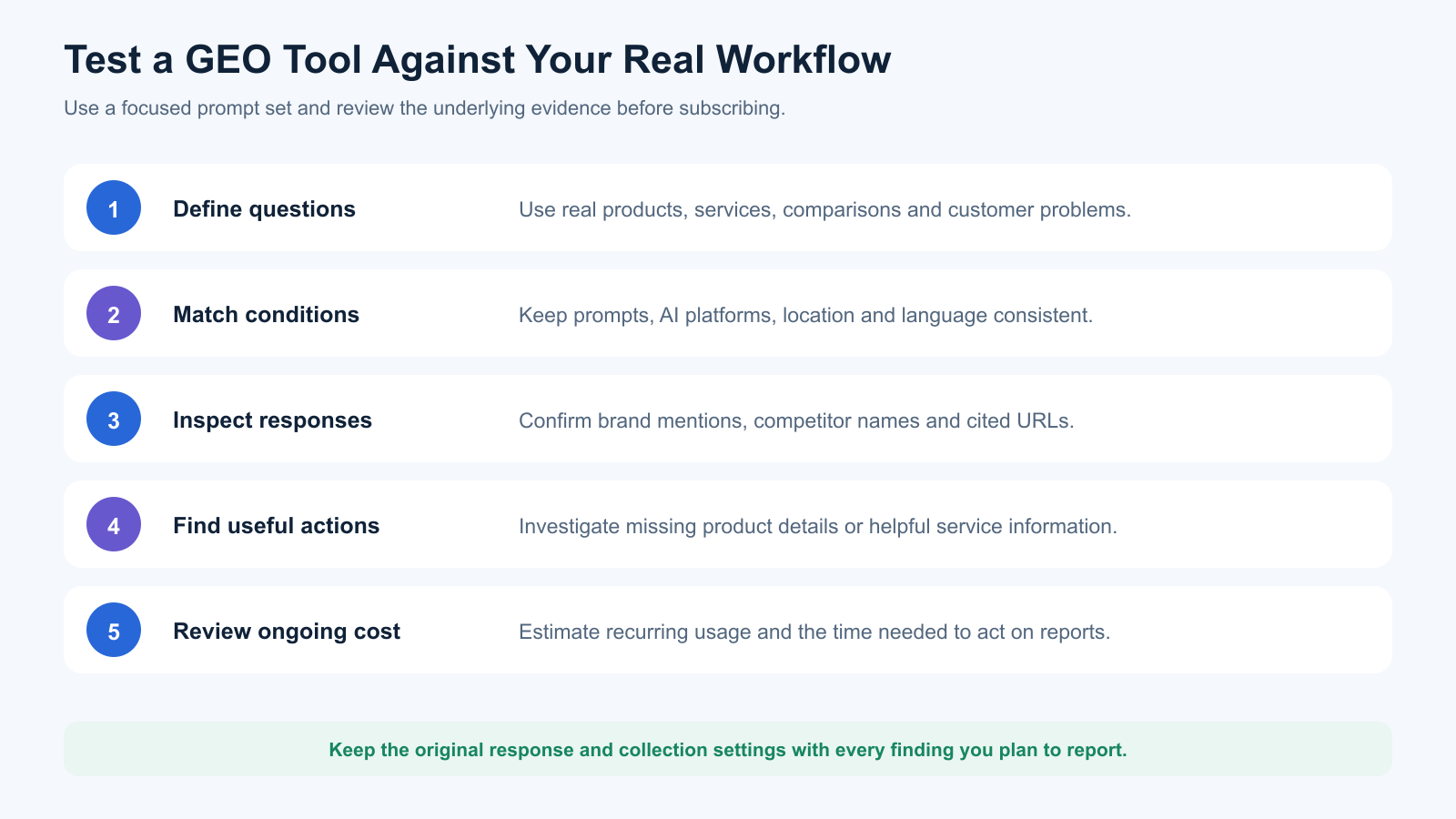
A free trial is useful only when it allows you to evaluate tasks that matter to your business.
The following process can help small businesses avoid purchasing software based solely on promotional claims or dashboard design.
Define the Questions You Need Answered
Begin with a small set of prompts covering important products, services, comparisons, and customer problems.
For a local home renovation company, that might include questions about renovation costs, choosing reliable contractors, and comparing different materials.
Include the appropriate city or service area where relevant.
These questions should represent actual research needs rather than being constructed merely to force the business name into an AI response.
Compare the Same Monitoring Conditions
Use equivalent prompts and AI platforms when evaluating different products.
If location, language, and collection settings are available, keep them consistent.
A ChatGPT response collected today shouldn’t be treated as directly comparable with a Gemini response captured under different conditions.
Record any unavoidable differences so they don’t distort the results.
Examine the Underlying Evidence
Don’t judge a tool solely by its AI Visibility Score.
Open the collected responses and investigate whether the software correctly identifies brand mentions, competitors, and cited URLs.
For example, a brand could appear in a negative comparison, while the dashboard still counts it as a mention.
The count may be technically correct, but the context affects how the business should interpret the result.
Determine Whether the Tool Helps You Take Action
A GEO report becomes useful when it identifies a meaningful content or information gap.
If competing businesses appear in answers about product compatibility, investigate whether your website explains that subject adequately.
If customers need clearer service details, improving those pages may be worthwhile regardless of whether the AI system subsequently cites them.
The software should support better information and decision-making rather than encourage unnecessary content production.
Review Ongoing Costs
Before subscribing, calculate the prompts, projects, AI platforms, and monitoring frequency required after the trial ends.
Also consider whether your team will use the tool regularly enough to justify the expense.
A small business that only reviews GEO data once a month may not need the same subscription as a team monitoring competitive questions every day.
Local Businesses: Does GEO Replace Google Business Profile?
No. Generative Engine Optimization doesn’t replace the local search foundations that businesses already need.
A business serving customers in a particular area should continue maintaining accurate contact information, business descriptions, service pages, and relevant local listings.
Google Business Profile remains important for eligible businesses appearing in Google Search and Maps.
GEO adds another research layer by helping businesses investigate how AI systems answer local questions.
For example, a restaurant might monitor questions about dining options in its neighbourhood, while a plumbing company may investigate local service recommendations.
However, a GEO platform cannot guarantee that the business will appear in those answers.
It is also important to distinguish GEO as Generative Engine Optimization from geographic targeting. The two are different concepts, although location-specific prompts can be part of a GEO monitoring strategy.
For small local businesses, accurate information and a useful website usually deserve attention before extensive AI prompt monitoring.
Can GEO Tools Actually Improve Leads and Sales?
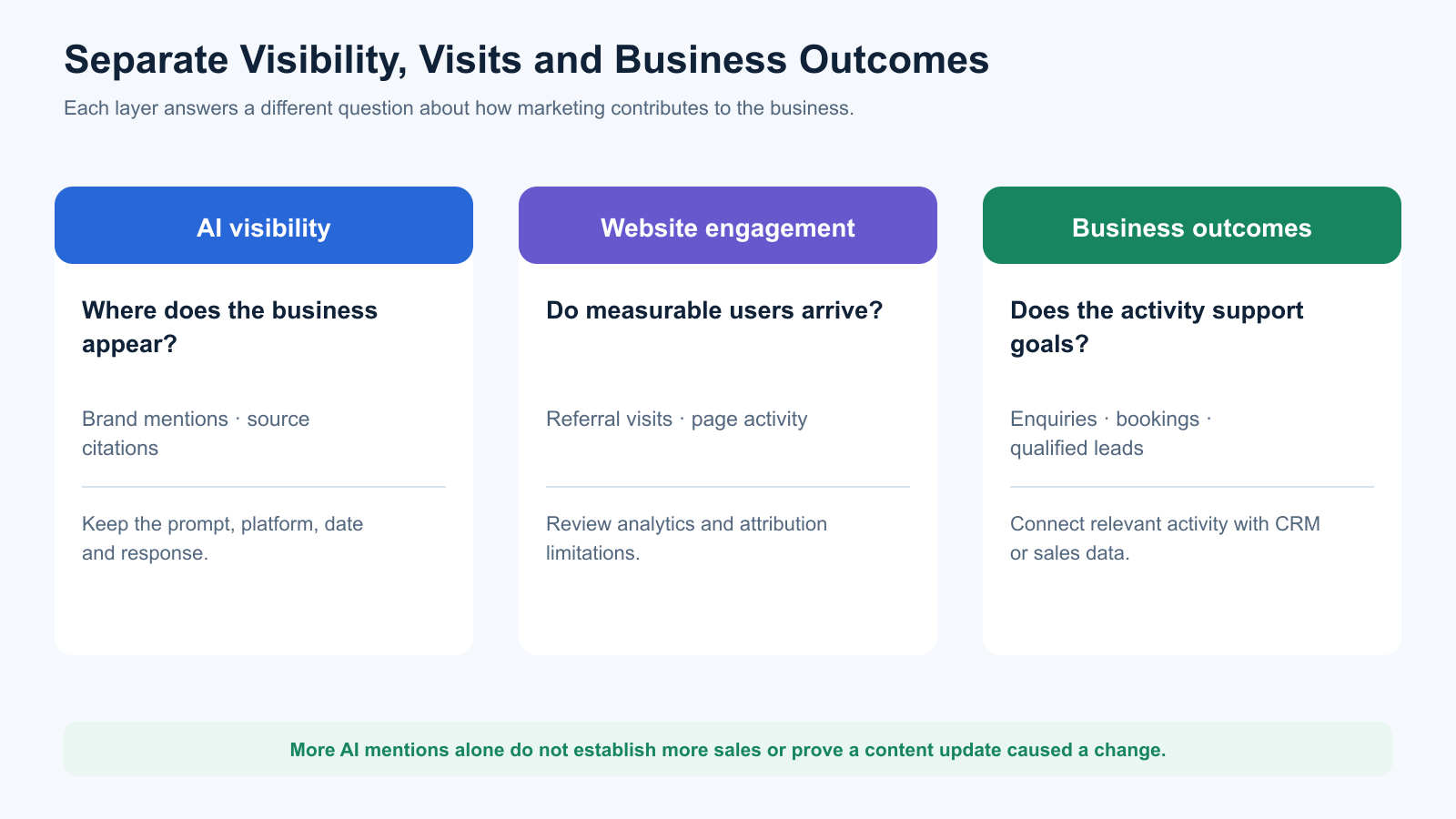
GEO tools can help businesses discover visibility gaps, but using one doesn’t automatically increase leads or revenue.
A company might receive more AI citations without generating additional measurable visits. Another business may be mentioned in recommendations even when no direct link appears.
This creates an attribution challenge.
The most useful reporting approach separates three types of evidence.
| Measurement | Example | What It Tells You |
|---|---|---|
| AI visibility | Brand mentions and citations | Where the business appears in monitored AI answers |
| Website engagement | Referral visits and relevant page activity | Whether measurable users arrive and interact |
| Business outcomes | Enquiries, bookings, sales, qualified leads | Whether marketing activity contributes to business goals |
Google Analytics 4 and other analytics systems can help measure attributable website activity, while CRM or sales data can provide additional context.
However, an increase in AI mentions following a content update doesn’t automatically prove that the update caused the change.
Competing sources, AI retrieval behaviour, and platform systems may also have changed.
The goal of GEO reporting should be better business decisions, not simply higher visibility scores.
Final Verdict: Which GEO Tool Should a Small Business Choose?
The best GEO tool for a small business depends on its existing marketing setup, budget, and the information it actually needs.
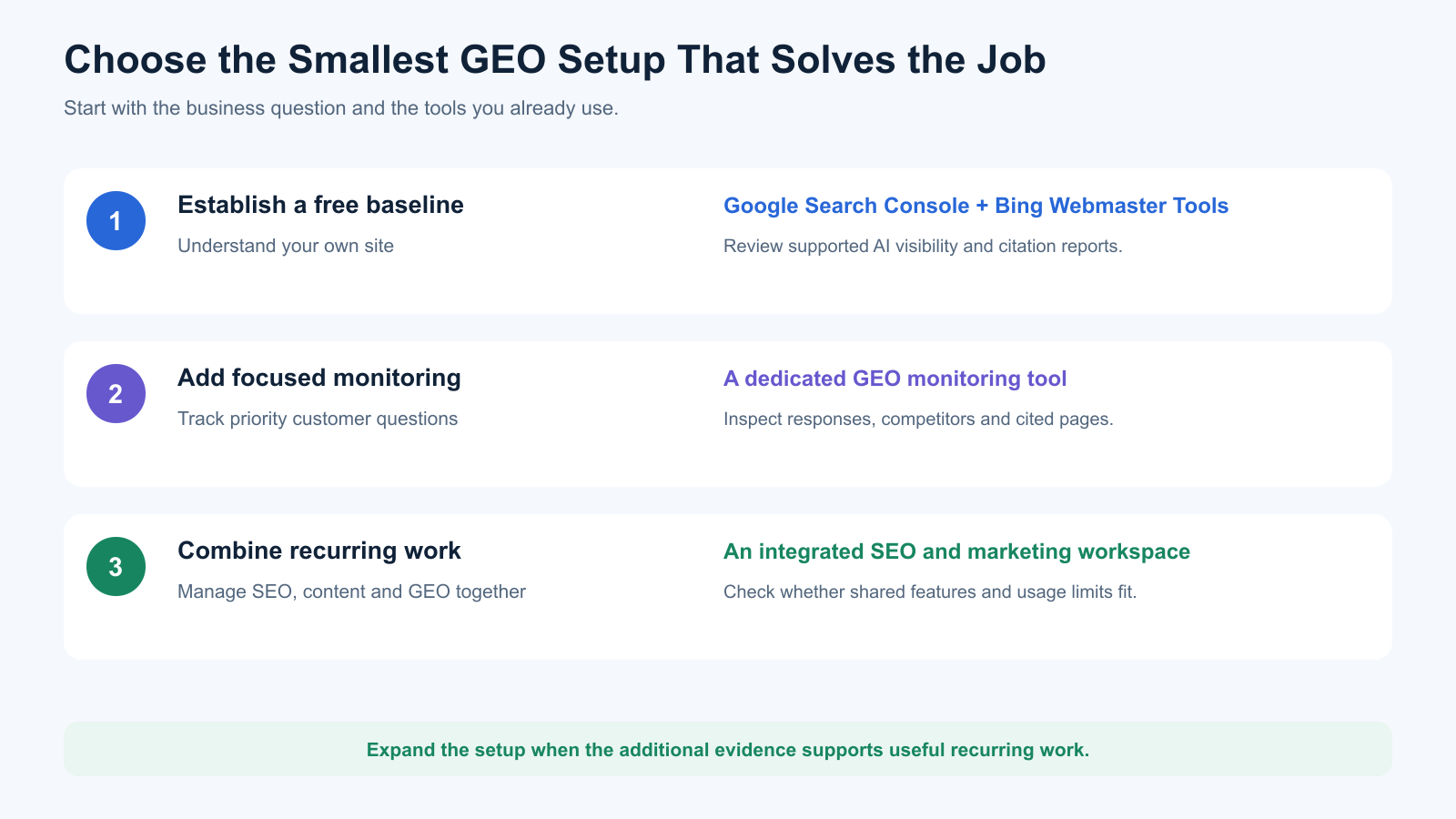
If you’re just beginning to investigate AI search visibility, Google Search Console and Bing Webmaster Tools are sensible free starting points. They provide first-party information without adding another subscription.
For dedicated AI search monitoring on a limited budget, Otterly.AI is worth considering because of its accessible entry price and focused prompt-tracking workflow. However, its lower-tier prompt allowance may be restrictive as monitoring needs grow.
Digimetrics offers a different value proposition: combining GEO with SEO, technical analysis, and content tools. It may be more practical for a small business that wants a broader marketing workspace rather than a standalone GEO dashboard, provided the credit allowances fit its workload.
Rankscale is an option for businesses comfortable with usage-based monitoring, while SE Visible offers more extensive dedicated reporting. SE Ranking, Semrush, and Ahrefs become more relevant when GEO needs to operate alongside a substantial existing SEO workflow.
No single platform should be treated as universally superior without testing comparable questions, monitoring settings, and outputs.
The practical recommendation is to start with the smallest setup that addresses a clear business need. Add a paid GEO tool when it provides useful evidence you cannot obtain efficiently from your current stack.
A good GEO tool should help you understand how your business appears in AI-assisted discovery and what information deserves improvement—not merely provide another score to monitor.
Frequently Asked Questions
What Is the Best GEO Tool for Small Businesses in 2026?
The best option depends on your budget and monitoring requirements. Otterly.AI is worth considering for affordable dedicated GEO monitoring, while Digimetrics combines GEO with broader SEO and marketing tools. Google Search Console and Bing Webmaster Tools provide useful free first-party reporting. Businesses needing more extensive competitor analysis may prefer SE Visible, Semrush, or Ahrefs.
How Much Does GEO Software Cost for a Small Business?
GEO software ranges from free webmaster reporting to subscriptions costing several hundred dollars per month. Otterly.AI starts at $29 monthly, Digimetrics at $39, SE Visible at $99, and SE Ranking at $129. Actual costs depend on prompt allowances, platform coverage, usage credits, and billing terms.
Are There Free GEO Tools for Small Businesses?
Yes. Google Search Console provides generative-AI performance reporting for supported Google Search features, while Bing Webmaster Tools reports citation activity across supported Microsoft AI experiences. Some commercial vendors also provide free trials or limited introductory access, although these may not include ongoing monitoring.
Does a Small Business Really Need a GEO Tool?
Not necessarily. A business with limited marketing resources may be better served by improving its website, maintaining accurate business information, and using free reporting first. Dedicated GEO software becomes more useful when the business needs recurring prompt monitoring, competitor research, or detailed citation analysis.
What Is the Difference Between GEO and SEO Tools?
SEO tools traditionally focus on keyword research, rankings, technical auditing, backlinks, and organic performance. GEO tools investigate brand mentions, citations, and visibility within AI-generated answers. The categories overlap, and some platforms combine both. GEO should generally extend existing SEO work rather than replace it.
Is Digimetrics a GEO Tool?
Yes. Digimetrics includes GEO-related functionality such as AI Mentions Tracker, AI Discovery Audit, GEO On-Page Optimisation, and GEO+SEO Forensic Audit. It also provides traditional SEO, content, and marketing tools. Its suitability depends on whether those functions match your workflow and whether its credit allowances support the analyses you need.
Which GEO Tool Is Best for a Local Business?
A local business should start with accurate website and Google Business Profile information, along with relevant first-party reporting. If additional monitoring is required, a tool supporting relevant location-specific prompts can help investigate AI-generated recommendations. The best choice depends on geographic coverage, prompt limits, and available budget.
Can GEO Tools Help My Business Appear in ChatGPT?
GEO tools can help investigate whether your business appears in monitored ChatGPT responses and identify relevant content or technical issues. However, no third-party GEO platform can guarantee that ChatGPT will recommend or cite your business. Monitoring provides evidence for research, not direct control over generated answers.
Is Otterly.AI Better Than Digimetrics?
The products serve different needs. Otterly.AI focuses on AI visibility monitoring, while Digimetrics combines GEO with broader SEO, technical auditing, and content tools. A business primarily requiring prompt tracking may prefer the specialist approach, while one managing several marketing responsibilities may benefit from an integrated workspace. A direct performance comparison would require controlled testing.
How Often Should Small Businesses Monitor AI Search Visibility?
The appropriate frequency depends on the business and its reporting needs. Weekly or monthly reviews may be sufficient for smaller organisations, while more frequent monitoring can help businesses in competitive markets. Consistent prompts and clear interpretation are generally more valuable than collecting daily data without a plan to use it.
Disclosure: digitalmarketingtools.ai is sponsored by Digimetrics.ai. Sponsored Highlights are clearly labelled advertising. Our reviews, comparisons and guides are written to be useful and fair regardless of who sponsors the site. Read the full disclosure.