9 Best Free GEO Tools in 2026: What You Can Actually Use for $0
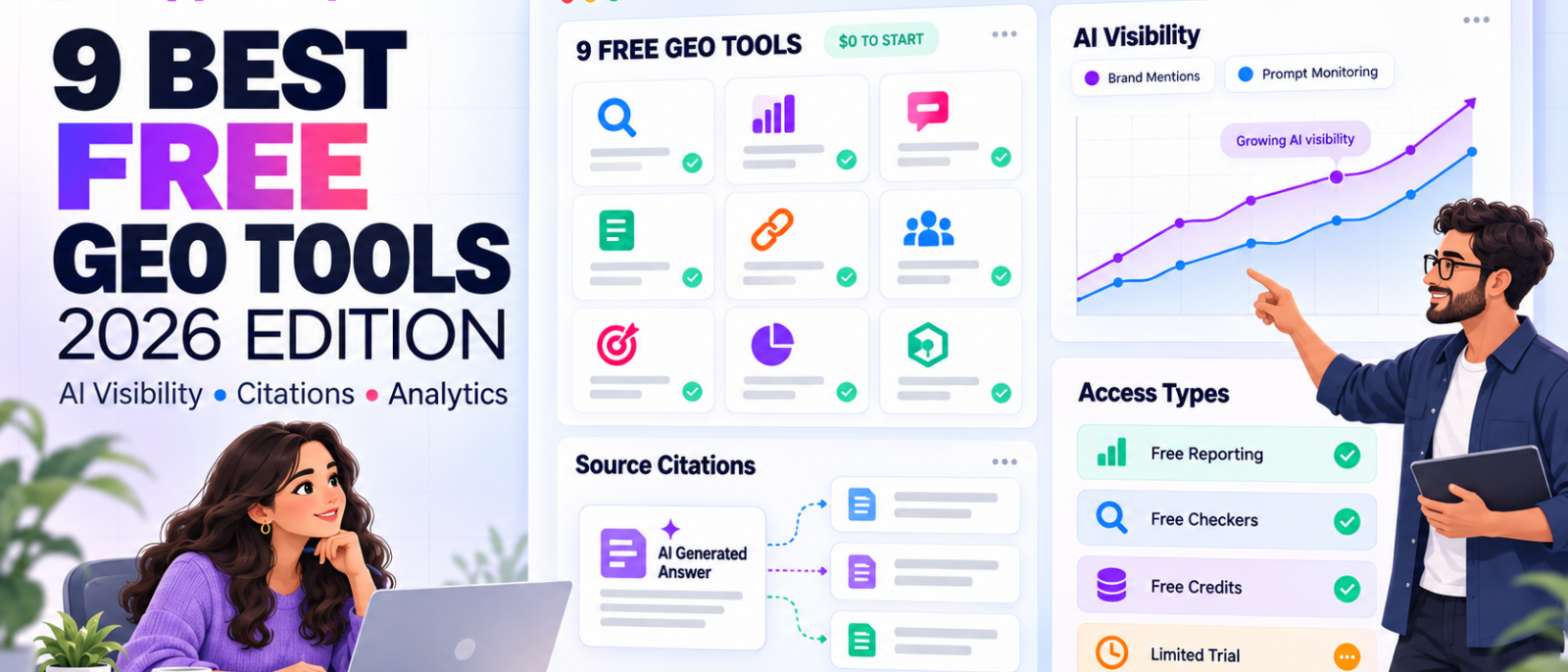
You don’t necessarily need another monthly subscription to find out whether your website appears in AI-generated search results. Several free GEO tools can now show how your content performs in Google AI Overviews, which pages Microsoft Copilot cites, and whether platforms such as ChatGPT or Perplexity mention your brand.
The challenge is that free Generative Engine Optimization (GEO) tools don’t all provide the same information. Some offer first-party reporting for your verified website, while others generate a one-time AI visibility report based on selected questions. A few provide introductory credits or temporary access to a paid platform.
These differences matter when you’re trying to understand whether a free GEO tool can support ongoing marketing work. A one-off brand visibility score might reveal an interesting opportunity, but it won’t necessarily tell you whether an update improved your website’s visibility six weeks later.
The good news is that free GEO reporting has improved considerably in 2026. Google Search Console now provides dedicated generative-AI impression reporting, Bing Webmaster Tools offers AI citation data, and providers such as Ahrefs, Semrush, HubSpot, Mangools, and Frase have introduced free AI search analysis tools.
This guide compares nine free GEO tools in 2026, explains exactly what each option provides, and shows how to combine them into a practical workflow without immediately purchasing specialist software.
Editorial disclosure: DigitalMarketingTools.ai is sponsored by Digimetrics.ai, which is developed by MediaOne. Digimetrics is included because it offers a documented no-cost trial. It is clearly identified as a time-limited option rather than a permanently free tool. This article compares publicly documented features and access terms; it does not claim that DMT conducted a controlled accuracy benchmark.
Key Takeaways
- Google Search Console is the best starting point for first-party Google AI search reporting, providing impressions for supported AI Overviews and AI Mode experiences.
- Bing Webmaster Tools offers free AI citation reporting, including cited pages, grounding queries, and historical trends across supported Microsoft AI experiences.
- Ahrefs and Semrush provide free AI visibility checkers that examine brand mentions and related source information without requiring a paid subscription.
- HubSpot and Mangools offer free AI brand assessment tools, although their scores use vendor-specific methodologies.
- Frase provides free GEO and AI visibility checks, including a ChatGPT citation snapshot and page-level GEO analysis.
- AthenaHQ offers 300 starting credits, which can be used to explore supported AI visibility and source analysis features.
- Digimetrics provides a seven-day trial with 200 credits and no credit card requirement, allowing users to explore GEO alongside SEO, technical auditing, and content tools.
- Free doesn’t mean comprehensive. No single tool in this comparison provides unrestricted, ongoing monitoring across every AI platform.
What Counts as a Free GEO Tool?
A free GEO tool allows marketers to investigate some aspect of their visibility in AI-generated answers without paying upfront.
That might involve checking whether a brand is mentioned, identifying websites cited by AI systems, examining a webpage’s technical accessibility, or reviewing first-party AI search performance.
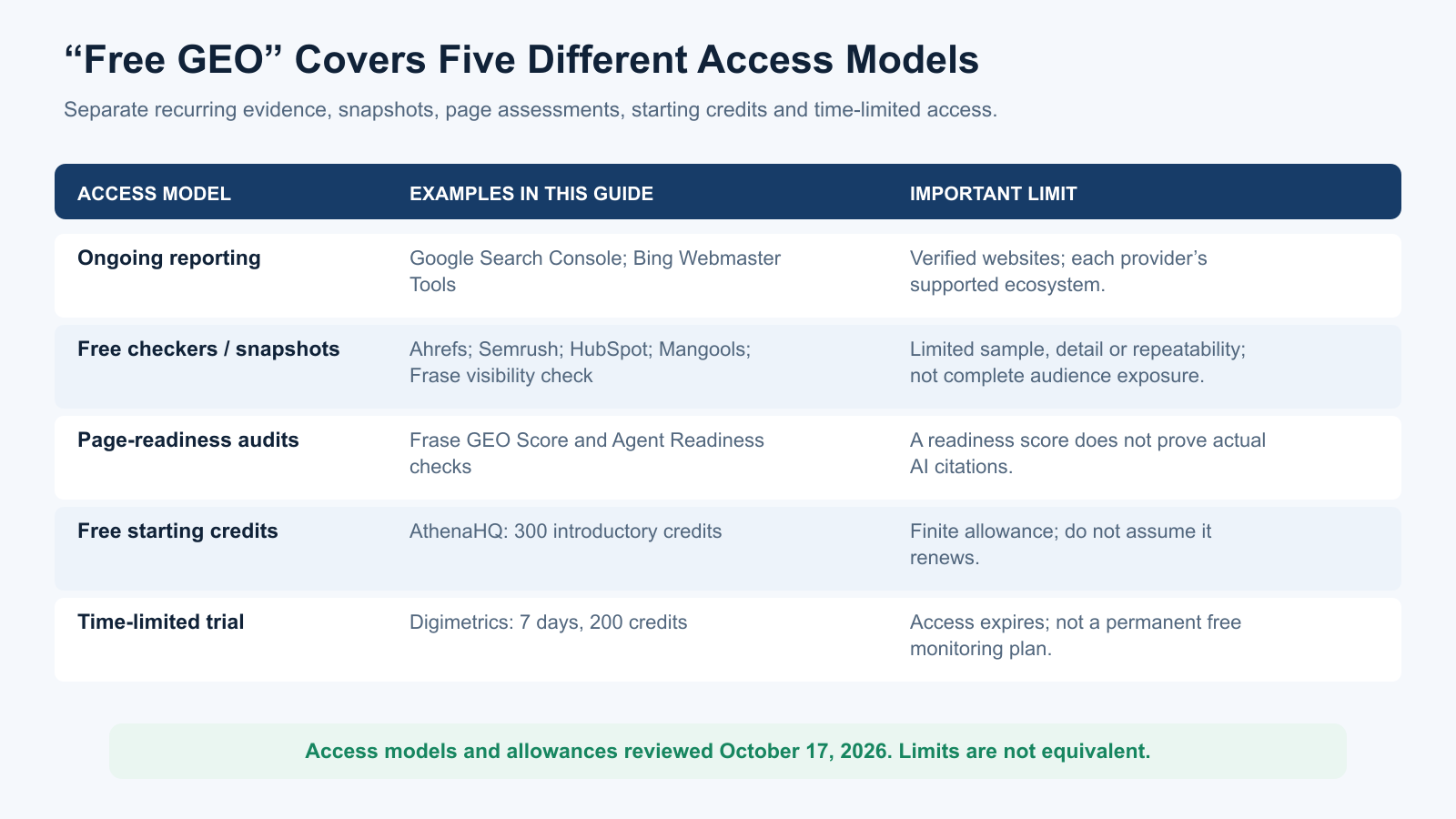
However, the word free can describe several different access models.
| Free Access Type | What It Provides | Main Limitation |
|---|---|---|
| Ongoing free reporting | Recurring data for verified websites | Coverage limited to the provider’s ecosystem |
| Free AI visibility checker | A snapshot of brand appearances or citations | Limited prompts, depth, or historical tracking |
| Free GEO audit | Page-level analysis or readiness recommendations | Doesn’t establish actual AI visibility |
| Free starting credits | Access to selected software functions | Credits can run out or expire |
| Free trial | Temporary access to a commercial platform | Ends after a specified period |
This article separates those models rather than treating every free offer as a permanent subscription.
The first seven options provide free reporting or checker functionality. AthenaHQ supplies a limited starting allowance, while Digimetrics provides a clearly time-limited trial.
For a broader explanation of GEO software and its relationship with traditional SEO, see our complete guide to GEO tools.
9 Best Free GEO Tools in 2026: Quick Comparison
The following comparison reflects publicly documented functionality and access conditions reviewed on October 17, 2026.
| Tool | Free Access | Best For | Main Restriction |
|---|---|---|---|
| 1. Google Search Console | Ongoing free reporting | Google AI search impressions | Verified website data only |
| 2. Bing Webmaster Tools | Ongoing free reporting | AI citations and cited URLs | Microsoft-supported AI experiences |
| 3. Ahrefs AI Visibility Checker | Free snapshots, no signup | Multi-platform brand visibility | Top-five result previews |
| 4. Semrush AI Visibility Checker | 3 free checks per day | AI brand and citation snapshots | Limited detail and historical analysis |
| 5. HubSpot AI Search Grader | Free one-time assessment | Brand perception and sentiment | Not continuous monitoring |
| 6. Mangools AI Search Grader | Free assessment | AI recommendation visibility | Proprietary scores and model coverage |
| 7. Frase Free GEO Checkers | Free checks; email for extended results | Citation checks and page readiness | Limited prompts and recurring tracking |
| 8. AthenaHQ | 300 starting credits | Exploring AI visibility analytics | Finite credit allowance |
| 9. Digimetrics | 7 days, 200 credits | Testing an integrated SEO/GEO workspace | Trial expires after seven days |
The numbering organises tools by access type and use case, not measured performance. First-party reports, sampled AI answers, and automated page assessments measure different things and should not be compared as identical datasets.
1. Google Search Console: Best Free Tool for Google AI Search Impressions
Free access: Ongoing, for verified website properties
Google Search Console is one of the most useful free starting points for GEO because its data comes directly from Google.
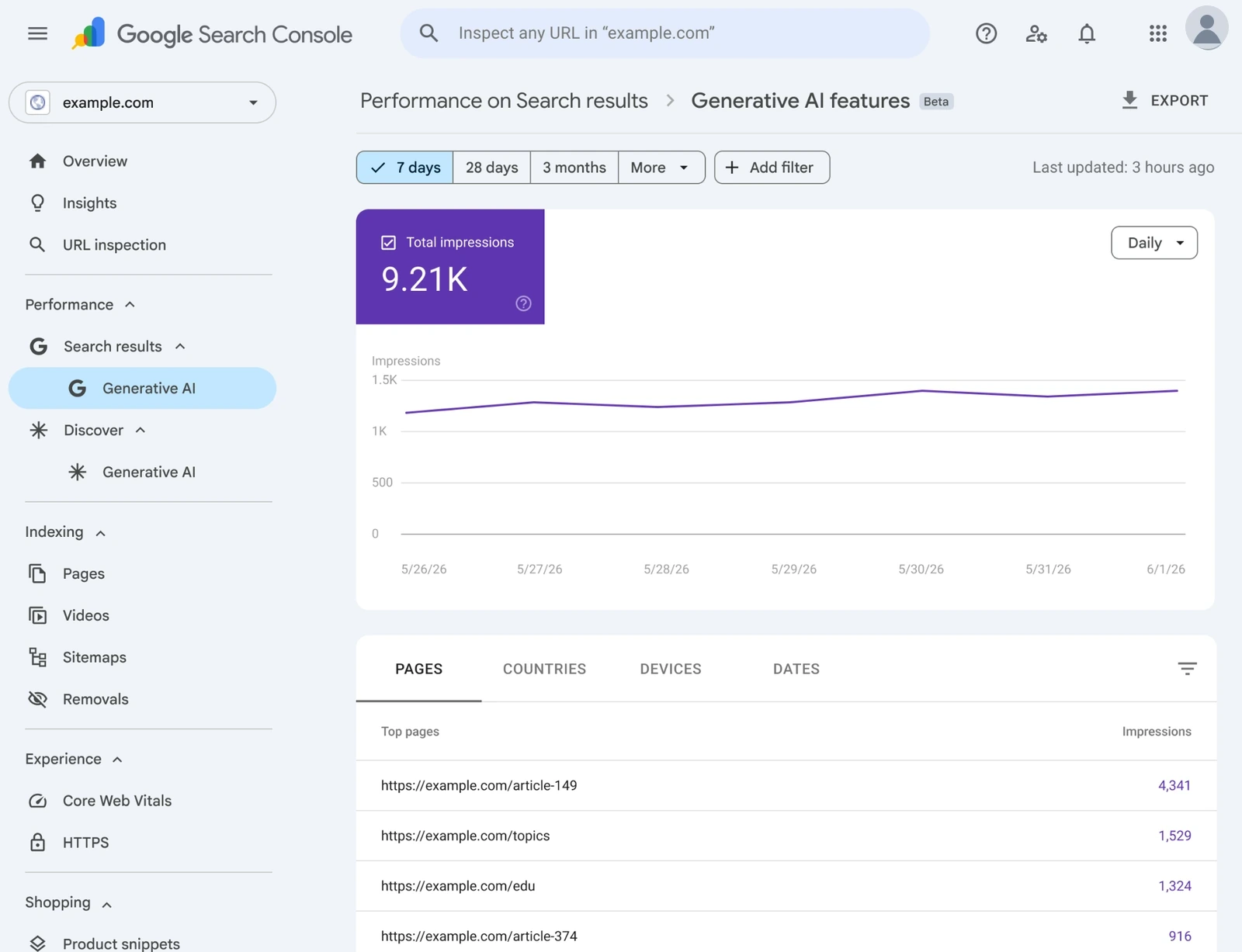
In 2026, Google introduced dedicated generative-AI performance reporting. The feature launched in June, with worldwide rollout completed by August 31.
The Generative AI performance report measures impressions for website links appearing within supported Google Search features, including AI Overviews and AI Mode.
This gives website owners a way to investigate AI-assisted search visibility without relying entirely on estimates from third-party platforms.
What Can You Measure for Free?
The report shows how frequently links to your website appear in supported generative-AI search experiences.
You can examine trends over time, identify pages receiving impressions, and analyse the results by country or device.
For example, a software company might discover that an integration guide receives more generative-AI impressions than its homepage.
That observation could help identify which pages are being surfaced within Google’s supported AI search features and which subjects deserve further investigation.
Search Console also provides conventional SEO reporting, making it useful for examining traditional search alongside generative-AI visibility.
Main Limitations
Search Console doesn’t provide a complete list of competing brands mentioned in generated answers.
It also doesn’t show every individual AI response, the exact wording of all user prompts, or complete visibility across ChatGPT, Perplexity, and other external AI platforms.
The reporting is primarily impression-based rather than a comprehensive brand mention or citation-tracking system.
Some websites may not see the dedicated report if they haven’t generated sufficient activity in the supported features.
Best for: Website owners who want reliable first-party evidence of their visibility in Google’s supported generative-AI search experiences.
2. Bing Webmaster Tools: Best Free Tool for AI Citation Tracking
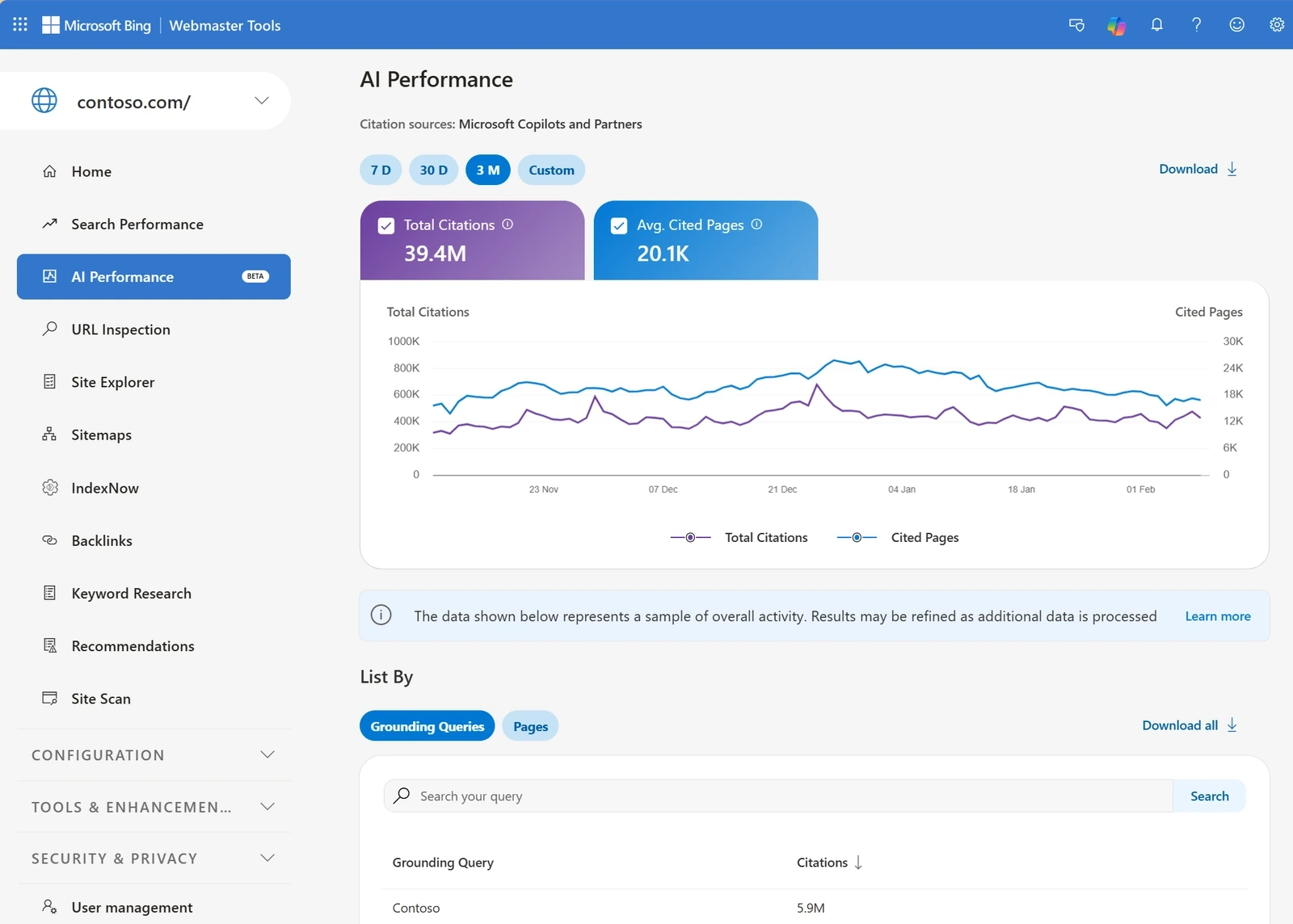
Free access: Ongoing, for verified websites
Bing Webmaster Tools provides one of the clearest free examples of AI citation reporting.
Microsoft introduced its AI Performance report in February 2026, allowing website owners to investigate how their content appears as a source across supported AI experiences.
The report covers Microsoft Copilot, AI-generated summaries in Bing, and selected partner integrations.
Unlike Search Console’s generative-AI impression report, Bing’s AI Performance focuses specifically on citation activity.
What Can You Measure for Free?
The AI Performance report provides several useful measurements.
| Metric | What It Shows |
|---|---|
| Total citations | Recorded source references within supported AI answers |
| Cited pages | Website URLs appearing as cited sources |
| Average cited pages | Average number of unique cited pages per day |
| Grounding queries | Grouped phrases associated with cited content |
| Historical trends | Changes in aggregated citation activity |
| Citation share | Relative source presence for supported queries, where available |
For example, a publisher might discover that its detailed software comparisons receive citations associated with certain technical topics, while broader introductory articles receive fewer.
This can inform editorial research without requiring the publisher to buy a specialised citation monitoring platform.
Microsoft also expanded its reporting in 2026 with preview features for query intent, topic analysis, comparative reporting, and citation share.
Its October 13 Topics Portfolio beta groups related grounding queries into broader subjects and highlights potential opportunities where other sources appear.
Main Limitations
The data is aggregated and sampled. It shouldn’t be treated as a complete log of every answer generated by Microsoft AI experiences.
Grounding queries are grouped phrases associated with retrieval and citation activity, not necessarily the exact questions entered by users.
Citation counts also don’t represent website clicks, ranking positions, or content authority.
Best for: Publishers, SEO teams, and website owners who want free first-party evidence about cited pages and the topics associated with those citations.
3. Ahrefs AI Visibility Checker: Best Free Multi-Platform Brand Snapshot
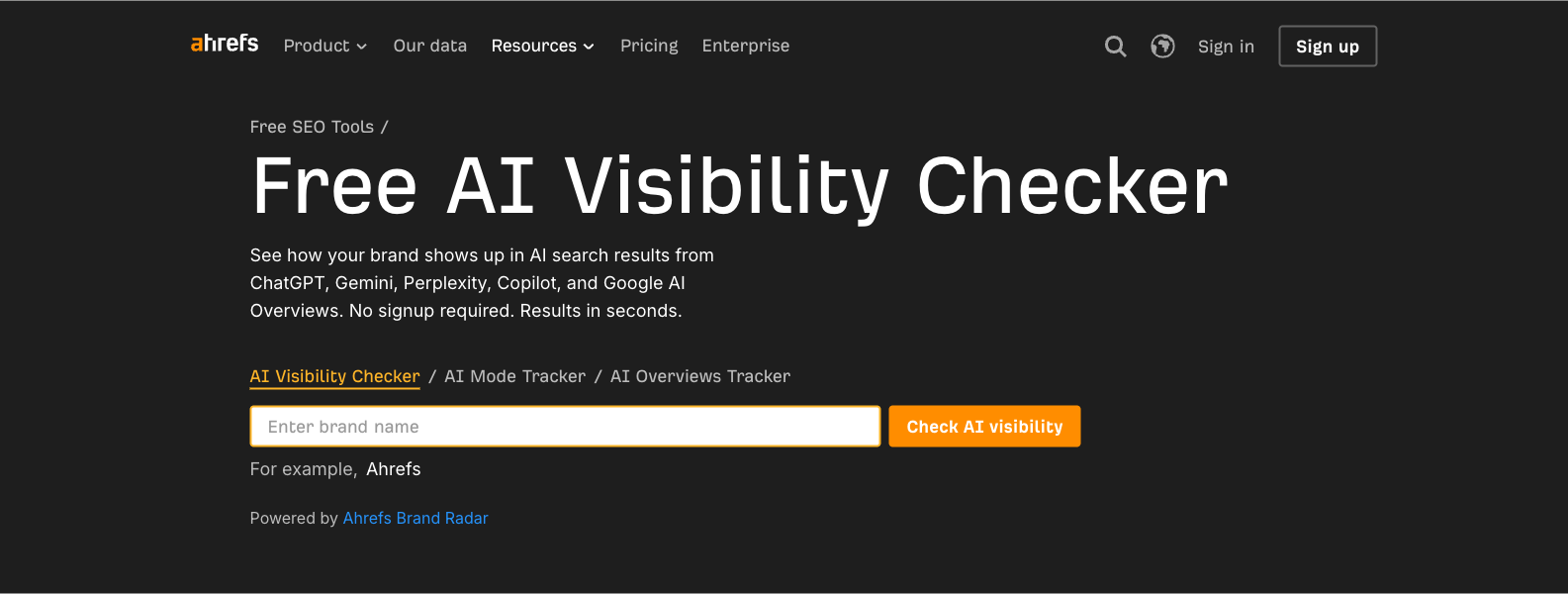
Free access: No signup or credit card; limited report previews
Ahrefs AI Visibility Checker provides a free snapshot of how a brand appears across supported AI search experiences.
It draws on Ahrefs Brand Radar’s AI visibility dataset rather than requiring the user to configure a long-term monitoring project.
According to Ahrefs, the checker covers ChatGPT, Gemini, Perplexity, Microsoft Copilot, Google AI Overviews, and Google AI Mode.
The process is straightforward: enter a brand name and review the available AI visibility information.
What Can You Measure for Free?
The free report provides total brand mentions, a breakdown by AI platform, and a preview of the topics associated with those appearances.
It also displays up to five cited domains and five cited pages, helping users investigate which websites appear alongside their brand.
This can be useful when a business wants to know whether its name appears in relevant AI search datasets before purchasing an advanced monitoring subscription.
For example, a digital marketing agency could check its own name and several competing agencies to identify differences in the available reports.
However, the results would reflect Ahrefs’ data collection methodology rather than every AI-generated answer encountered by actual customers.
Main Limitations
The free checker restricts the depth of its reports, with top-five previews in several sections.
It doesn’t provide the complete historical reporting, competitive analysis, and configurable prompt monitoring available through paid Brand Radar access.
Users should also distinguish a snapshot derived from a vendor’s collected data from a repeatable test of specific questions.
Best for: Marketers who want a quick, no-signup look at multi-platform AI brand visibility and related source information.
4. Semrush AI Visibility Checker: Best Free Tool for Brand Visibility Research
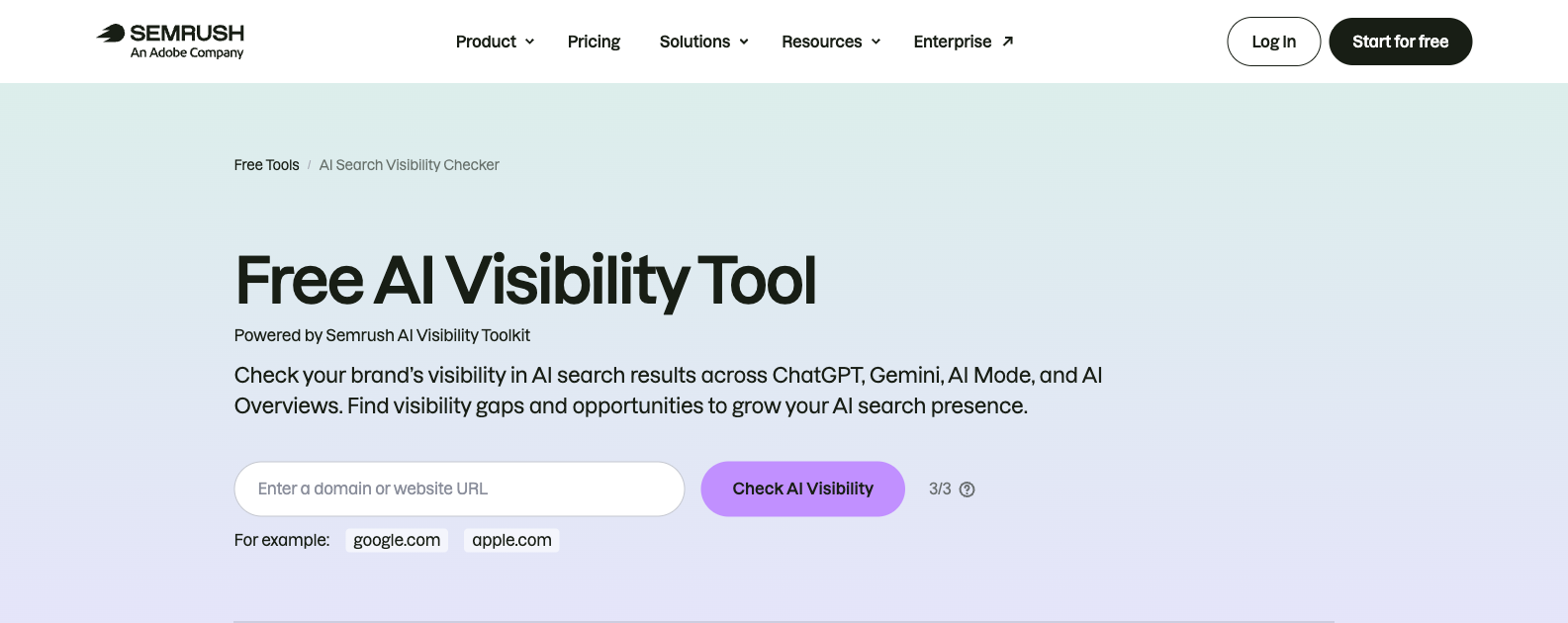
Free access: Three checks per day without registration
Semrush’s Free AI Visibility Checker allows users to enter a domain and generate a snapshot of its visibility across supported AI search experiences.
The tool draws from Semrush’s AI visibility data and provides selected metrics related to brand mentions, cited pages, and topics.
Its documented coverage includes ChatGPT, Gemini, Google AI Mode, and Google AI Overviews.
What Can You Measure for Free?
The report includes an AI Visibility Score, total brand mentions, platform-specific mention information, and pages associated with AI citations.
It also highlights topics and prompts linked to the brand’s appearances within the available dataset.
For businesses already familiar with Semrush, this can be a convenient introduction to GEO reporting.
A company could use the free checker to investigate whether its existing brand visibility extends into AI-generated recommendations and identify subjects that warrant additional research.
The checker may also reveal cited pages worth reviewing for accuracy, relevance, or content quality.
Main Limitations
Semrush allows three free checks per day without requiring an account, but the free experience isn’t equivalent to a full AI Visibility Toolkit subscription.
Advanced prompt tracking, competitor analysis, historical reporting, and broader research require paid access.
The proprietary AI Visibility Score also shouldn’t be directly compared with percentages or scores produced by other vendors using different datasets.
Best for: SEO teams seeking a quick AI visibility assessment that can complement existing Semrush or keyword research workflows.
5. HubSpot AI Search Grader: Best Free Tool for AI Brand Perception
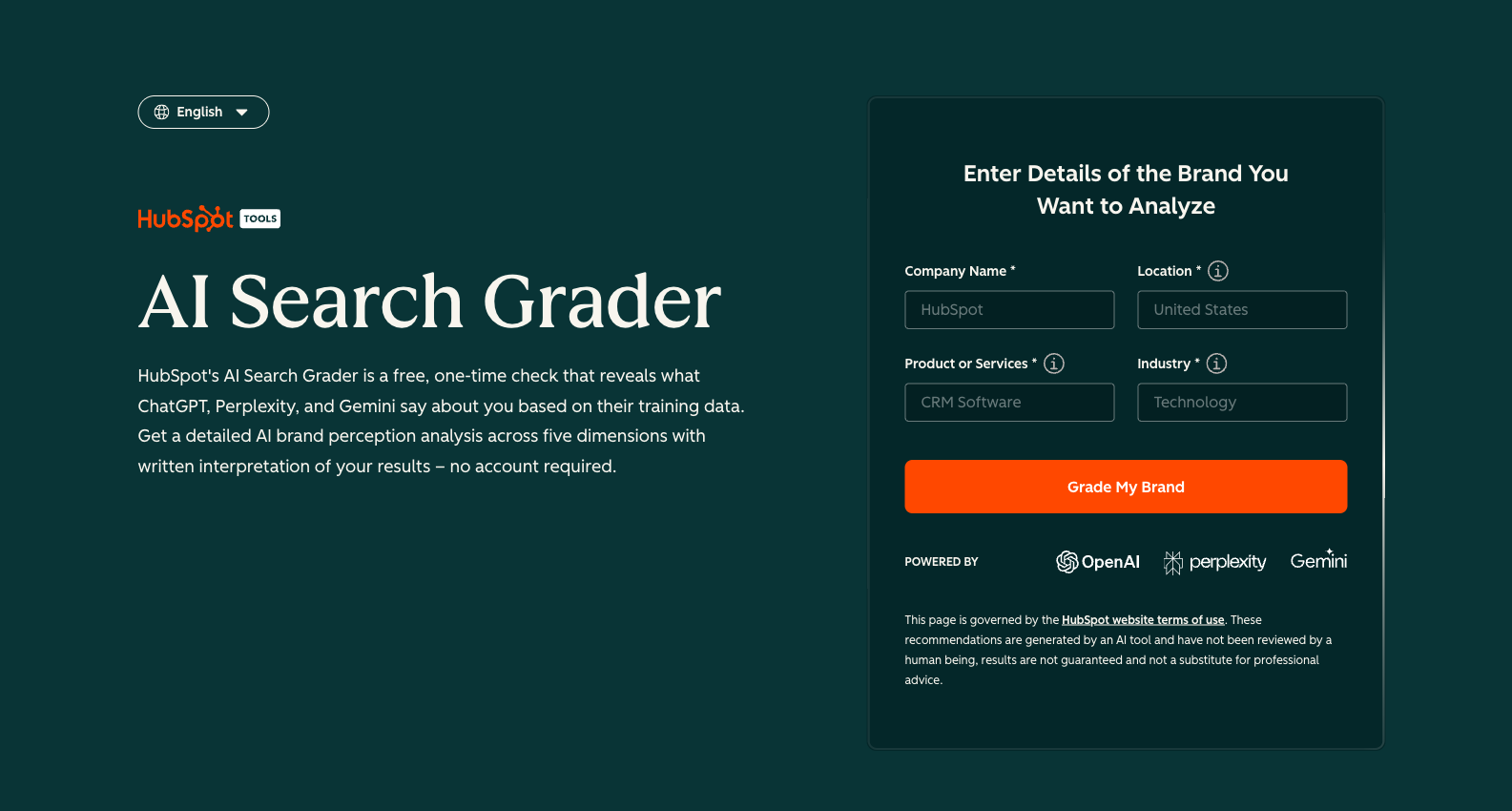
Free access: One-time brand assessment without a paid subscription
HubSpot AI Search Grader evaluates how AI systems represent a brand.
Its focus is slightly different from tools that primarily count citations or measure website impressions.
Instead, the grader looks at several aspects of brand perception, including recognition, sentiment, market competition, and relative visibility.
HubSpot currently documents analysis using an OpenAI model, Perplexity, and Gemini.
What Can You Measure for Free?
The tool provides a composite score based on five weighted categories.
| Assessment Area | Maximum Points |
|---|---|
| Brand sentiment | 40 |
| Presence quality | 20 |
| Brand recognition | 20 |
| AI share of voice | 10 |
| Market competition | 10 |
| Total | 100 |
Users provide their brand, market, industry, and products or services. HubSpot then generates an assessment of how the brand is represented within the selected AI systems.
A complete report may require entering additional information into a short form, but a paid HubSpot subscription isn’t required.
This can be useful for businesses investigating whether AI answers describe their services accurately or associate their brand with the right product category.
Main Limitations
HubSpot AI Search Grader is a one-time diagnostic rather than a full monitoring platform.
Its score reflects HubSpot’s weighting system, which places substantial emphasis on sentiment. A higher grade doesn’t automatically mean the business receives more actual AI impressions, citations, or customer visits.
The selected models and prompts also shouldn’t be treated as a complete representation of every ChatGPT or Gemini interaction.
Best for: Businesses wanting a free introductory assessment of AI brand perception rather than a dedicated citation report.
6. Mangools AI Search Grader: Best Free Tool for AI Recommendation Comparisons
Free access: Free AI search assessment
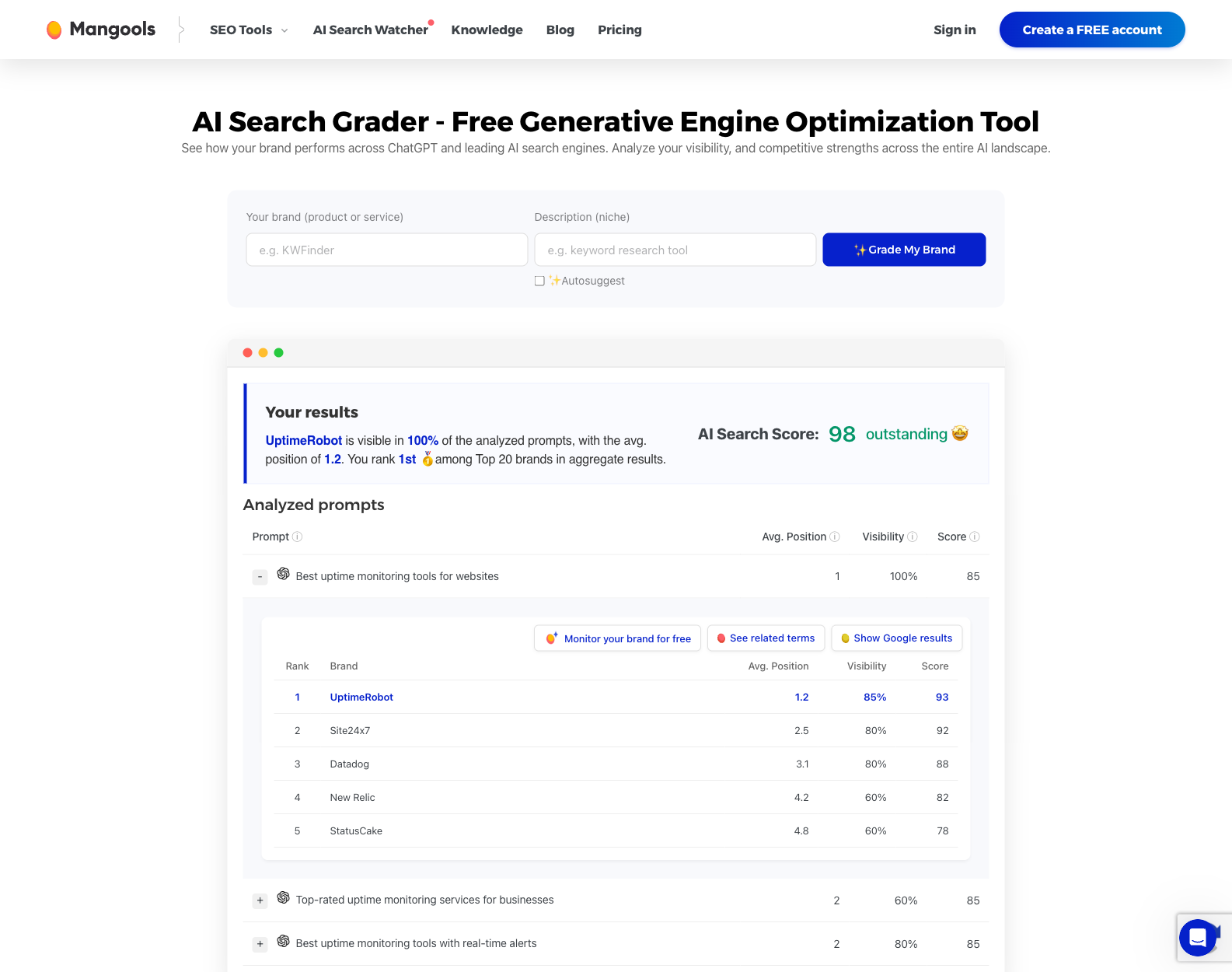
Mangools AI Search Grader evaluates how brands appear within selected AI-generated recommendations.
Its documented approach examines brand visibility and average positioning across several AI models, alongside competitor comparisons.
The tool also creates a combined AI Search Score intended to summarise brand performance within its evaluation method.
What Can You Measure for Free?
Mangools describes three main measurements: visibility, average ranking within the generated recommendations, and a combined AI Search Score.
The platform evaluates how often brands appear within its monitored results and where they are positioned relative to other recommendations.
This may help marketers identify competing brands that repeatedly appear in category-related questions.
For example, an ecommerce software company could investigate whether similar products appear in AI-generated recommendation lists and compare the resulting scores.
However, these scores describe the tool’s configured evaluation environment rather than a universal AI ranking system.
Main Limitations
The AI Search Score is proprietary, and model-specific results should be interpreted using Mangools’ current methodology.
An average position in an AI-generated list isn’t equivalent to a Google organic ranking position.
It’s also important to verify which models are currently supported, since an AI model’s general text generation and its ability to retrieve live web information are different capabilities.
Best for: Marketers who want a free initial comparison of brand appearances within AI-generated product or service recommendations.
7. Frase Free GEO Checkers: Best for Citation Checks and Page Readiness
Free access: Initial checks without signup; extended results may require an email address
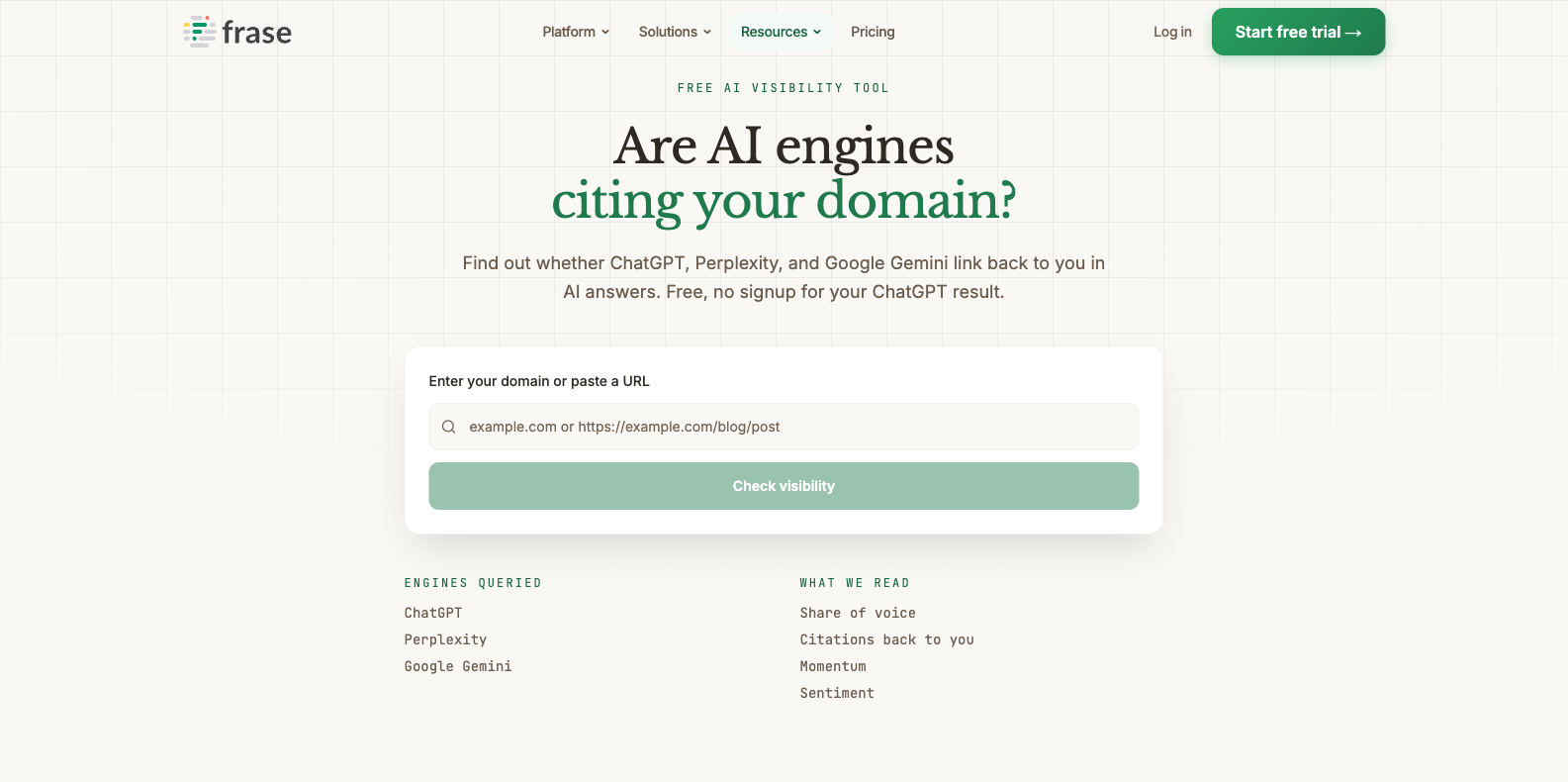
Frase offers several free utilities related to GEO and AI search.
Unlike a single brand visibility grader, its free tool collection covers different questions about a website’s readiness and actual source visibility.
This includes an AI Visibility Checker, a GEO Score Checker, and an Agent Readiness Checker.
These tools can provide a useful starting point for businesses investigating whether their website is being cited and whether individual pages deserve a closer technical or editorial review.
What Can You Measure for Free?
The AI Visibility Checker evaluates a domain using a small set of AI-search-style questions.
Its initial ChatGPT result is available without signup. Providing an email address unlocks additional Perplexity and Gemini reporting without payment.
Frase states that each free visibility probe uses three AI-search-style phrases, making the results a limited snapshot rather than a broad market benchmark.
The GEO Score Checker serves a different purpose. It evaluates a webpage’s readiness using the provider’s scoring criteria and highlights potential areas for improvement.
The Agent Readiness Checker focuses on whether AI-related systems can access or read the website.
Main Limitations
A GEO readiness score isn’t the same as proof that an AI assistant cited a page.
Similarly, a small collection of sampled AI responses can’t establish that a website is consistently visible across all customer questions.
The free tools don’t replace the recurring monitoring and wider optimisation workflows available through Frase’s paid platform.
Best for: Content marketers who want free citation checks alongside page-level GEO and technical accessibility diagnostics.
8. AthenaHQ: Best for Exploring GEO Analytics With Free Credits
Free access: 300 starting credits
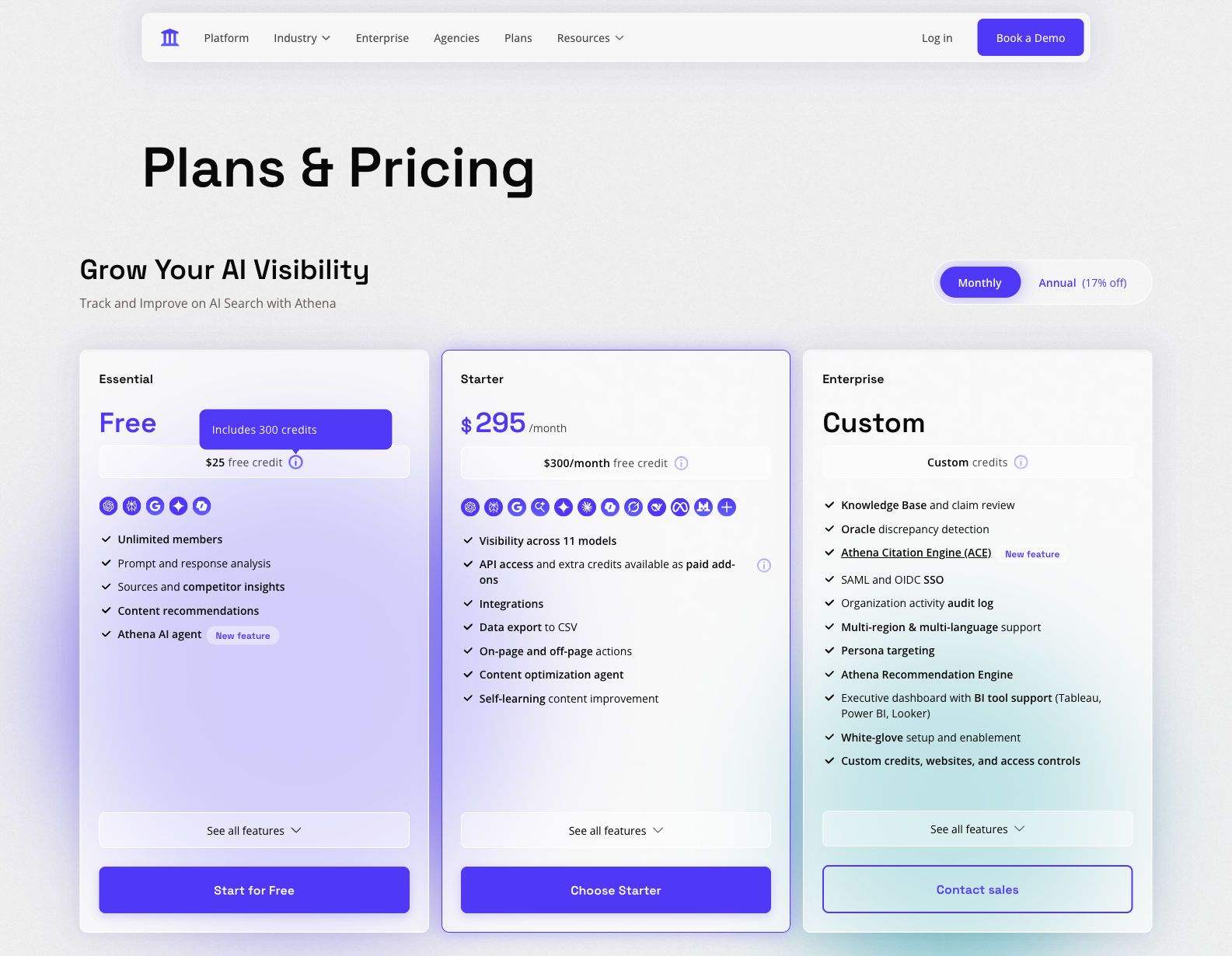
AthenaHQ provides a free Essential option containing 300 introductory credits.
Unlike a single-use visibility checker, Athena offers access to a wider GEO analytics environment, subject to the available allowance and feature restrictions.
Its documented capabilities include AI prompt and response analysis, competitor insights, source research, and content recommendations.
Supported experiences under the free entry option include ChatGPT, Perplexity, Google AI Overviews, Gemini, and Microsoft Copilot.
What Can You Test With the Free Credits?
The 300-credit starting allocation allows users to explore how Athena organises AI search information and whether its reporting is useful for their business.
For example, a software company might examine several product comparison topics, inspect competing brands, and review the sources associated with those answers.
Athena’s credit model defines one credit as one AI response, although additional plan restrictions and supported features should be checked before relying on that allowance.
This provides a more interactive evaluation than a static brand snapshot, particularly when users want to explore multiple questions.
Main Limitations
The free credits are a limited introductory allowance, not a promise of unrestricted recurring monitoring.
Once the allocation is exhausted, users may need a paid subscription to continue their workflow.
The paid Starter plan is currently advertised at $295 per month, making the ongoing cost an important consideration for small businesses.
Best for: Marketers who want to explore a more comprehensive GEO analytics interface using a finite free allowance.
9. Digimetrics: Best Free Trial for Integrated GEO and SEO Workflows
Free access: Seven days, 200 credits, no credit card required
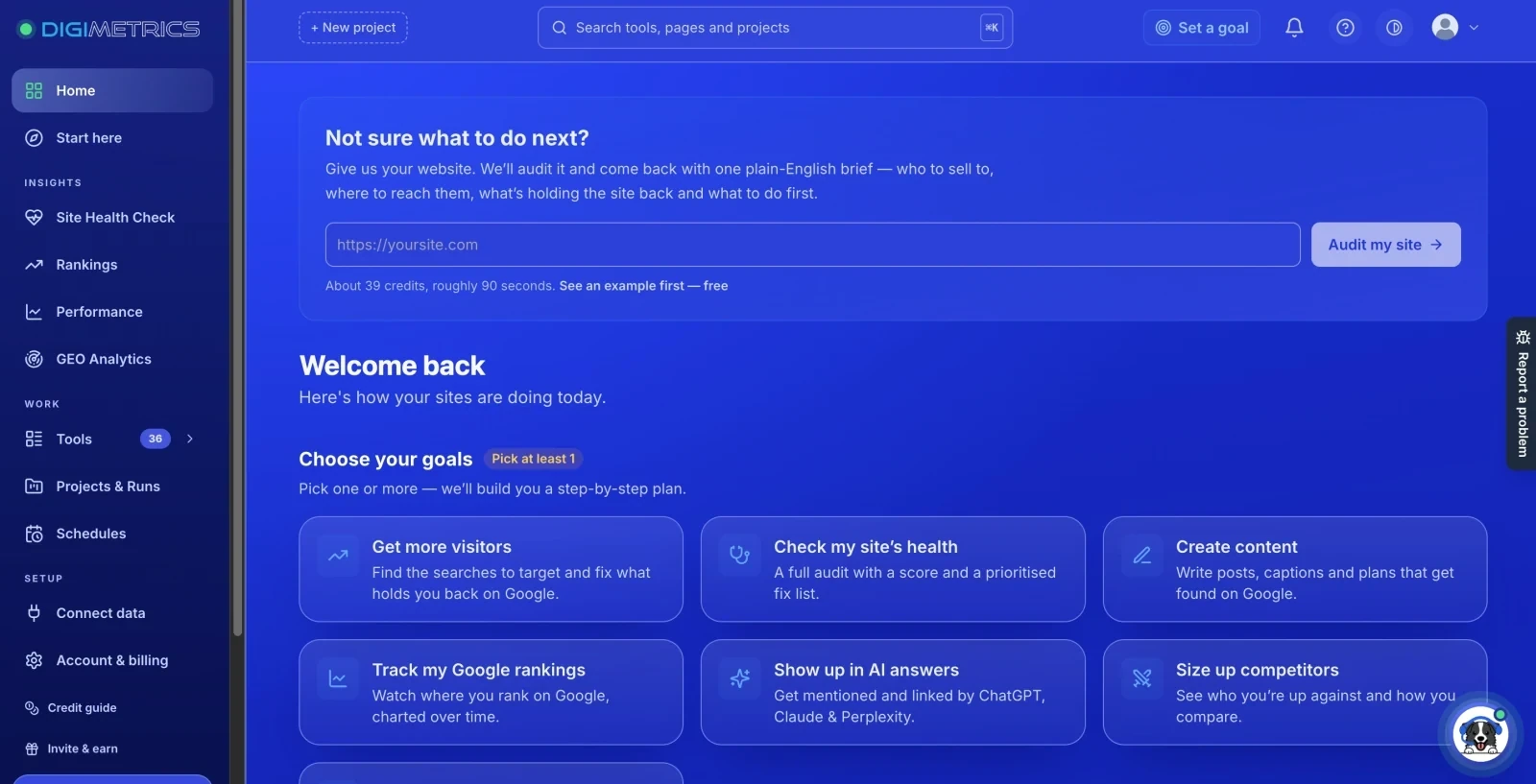
Digimetrics provides a seven-day free trial with 200 one-time credits and access to its broader digital marketing toolkit.
Unlike the permanently available free checkers above, Digimetrics’ free access is explicitly time-limited. It is included for readers who want to try active GEO and SEO workflows without an upfront charge.
Its platform combines AI visibility tools with keyword research, technical auditing, content optimisation, and other marketing capabilities.
This can be relevant when a business wants to investigate an AI search issue and continue working on related website or content problems without moving between several products.
What Can You Test for Free?
Digimetrics’ GEO-related capabilities include AI Mentions Tracker, AI Discovery Audit, GEO On-Page Optimisation, and GEO+SEO Forensic Audit.
Its seven-day trial unlocks the tool collection, subject to result caps and credit limits.
For example, a marketer could investigate how a brand appears in AI-related search experiences and then use related SEO or content tools to examine a potentially relevant webpage.
The platform also includes Monty, an AI marketing assistant designed to help users interpret findings and identify possible next steps.
This integrated approach may be convenient for marketers handling several responsibilities, particularly when they don’t already subscribe to dedicated SEO and GEO tools.
Pricing After the Trial
| Plan | Price | Credits |
|---|---|---|
| Free Trial | $0 for 7 days | 200 one-time |
| Starter | $39/month | 500/month |
| Pro | $109/month | 2,000/month |
| Expert | $199/month | 6,000/month |
Different tools consume different amounts of credits, and plan capacity also varies by projects, monitoring, and other limits.
The free trial expires after seven days, so it isn’t suitable as a permanent zero-cost monitoring solution.
Main Limitations
The 200-credit allowance needs to be managed carefully.
A business intending to run multiple deep audits or repeated GEO checks should review the cost of each task before using its credits.
Users should also confirm whether the available AI visibility tools provide the specific citation URLs, prompt history, AI engines, and comparison data required by their workflow.
Best for: Businesses wanting to evaluate GEO alongside broader SEO, content, and technical marketing functionality before choosing a paid workspace.
Sponsored product disclosure: DigitalMarketingTools.ai is sponsored by Digimetrics.ai, which is developed by MediaOne. Its inclusion is based on documented trial conditions and functionality, not an independently verified advantage over other tools.
Which Free GEO Tool Should You Choose?
The right option depends on what you’re trying to measure.
A website publisher may need first-party citation data, while a software company may care more about brand recommendations across AI systems.
A business evaluating its content may also need technical and editorial diagnostics rather than another general visibility score.
| Your Goal | Recommended Starting Tool |
|---|---|
| Measure Google AI search impressions | Google Search Console |
| See which pages Microsoft AI experiences cite | Bing Webmaster Tools |
| Check brand visibility across multiple AI platforms | Ahrefs AI Visibility Checker |
| Get a quick domain-level AI visibility snapshot | Semrush AI Visibility Checker |
| Examine AI brand perception and sentiment | HubSpot AI Search Grader |
| Compare AI-generated brand recommendations | Mangools AI Search Grader |
| Check citations and page-level GEO readiness | Frase |
| Explore a full GEO analytics environment with free credits | AthenaHQ |
| Trial an integrated GEO, SEO, and content workspace | Digimetrics |
If your primary requirement is continuous monitoring, start with Google Search Console and Bing Webmaster Tools. Their first-party reports provide recurring information without requiring a commercial GEO subscription.
Use the free brand checkers to investigate questions those reports cannot answer, such as which competing brands appear in a particular AI visibility dataset.
For a detailed comparison of longer commercial evaluations, see our guide to GEO tools with free trials.
How to Build a Free GEO Monitoring Workflow
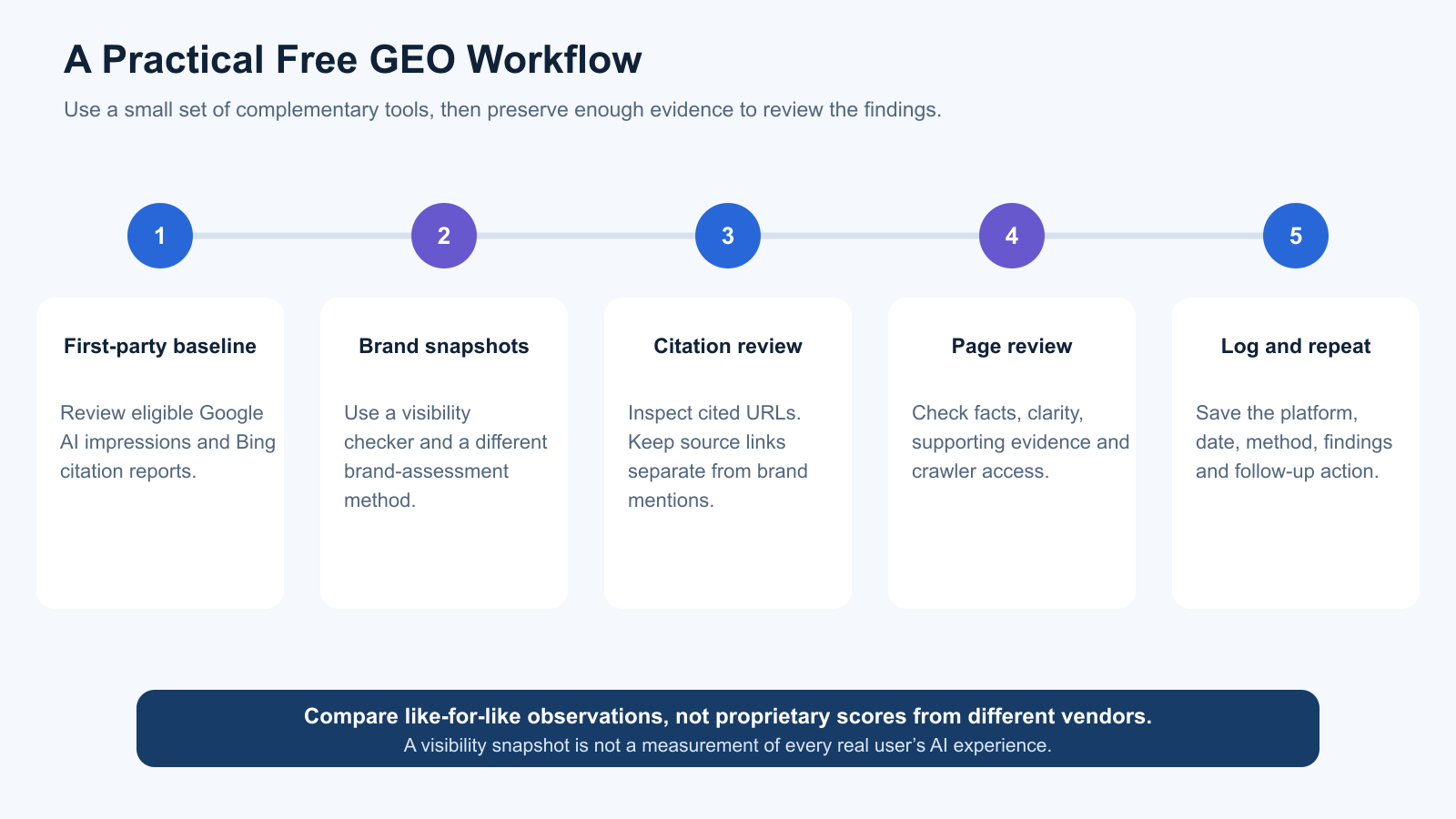
You don’t need to use all nine products to create a useful starting workflow.
A more practical approach is to select a small set of tools that answer different questions without unnecessarily duplicating work.
Step 1: Establish Your First-Party Baseline
Begin with Google Search Console and Bing Webmaster Tools.
Verify your website where necessary and review the available generative-AI impression and citation reports.
Look for pages already receiving visibility and the broad topics associated with them. Record the reporting period so you can make meaningful comparisons later.
These reports won’t explain every AI search experience, but they provide useful first-party evidence before you begin relying on third-party estimates.
Step 2: Run Two Different Brand Visibility Checks
Use a free checker from Ahrefs or Semrush to investigate your brand’s presence within its AI visibility dataset.
Then try a different type of assessment, such as HubSpot’s brand perception analysis or Mangools’ recommendation-focused report.
The purpose isn’t to see which platform gives you the highest score.
Instead, compare the observations that each tool can actually support. Do they identify the same brand? Are the monitored platforms and questions comparable? Can you inspect the underlying topics or cited webpages?
Where methods differ, treat the reports as complementary information rather than conflicting measurements of one universal metric.
Step 3: Examine Important Source Citations
Use Bing Webmaster Tools and a free citation checker such as Frase to investigate where your website appears as a source.
A citation is different from a brand mention. Your article can be cited without your business being recommended, and your brand can be mentioned without a link to its website.
If a relevant page is missing from a small citation sample, inspect the available sources before drawing conclusions.
For a deeper explanation of counting methods and source-level metrics, read our guide to AI citation tracking tools.
Step 4: Review the Website’s Actual Information
Once you’ve identified a potentially important gap, examine the relevant page.
Does it answer the question clearly? Are important product details current? Are claims supported by appropriate evidence? Can eligible crawlers access the information?
A free GEO audit may help identify issues worth investigating, but its score shouldn’t substitute for reviewing the page yourself.
Improving accurate, useful information is a more defensible goal than making changes solely to increase a proprietary GEO score.
Step 5: Record Observations and Review Again
Store the findings in a spreadsheet or another simple reporting system.
Record the question or report examined, the source platform, collection date, brand appearance, visible citation, and any follow-up action.
When comparing results later, try to retain consistent prompts and settings wherever possible.
Not every AI answer will remain identical, even when the question hasn’t changed. A small number of observations should therefore be interpreted carefully.
A Simple Free GEO Reporting Template
For a small business, a compact tracking sheet can be sufficient during the first stage of GEO research.
| Field | Example Entry |
|---|---|
| Date collected | October 17, 2026 |
| AI experience | ChatGPT Search |
| Monitored question | Best invoicing software for small teams |
| Brand mentioned? | Yes |
| Brand recommended? | Neutral comparison |
| Website cited? | No |
| Competitors mentioned | Brand A, Brand B |
| Relevant finding | Product features described incompletely |
| Possible action | Review and clarify official feature documentation |
This is a hypothetical example and not an actual observed ChatGPT response.
The important distinction is between recording what happened and claiming why it happened.
A missing brand mention might reflect the question, selected sources, location, platform behaviour, or other factors. It doesn’t automatically mean the website requires technical optimisation.
Can You Measure GEO Performance Using Only Free Tools?
You can measure several useful aspects of GEO without paying, but there are important gaps.
Google Search Console provides first-party impressions for supported Google AI search features, while Bing Webmaster Tools provides source citation reporting for supported Microsoft experiences.
Free third-party checkers can add information about brand mentions, competitors, or individual source references.
However, these tools don’t automatically create a consistent cross-platform dataset.
What Free Tools Can Measure
Free reporting can help identify whether important pages are appearing in supported AI experiences, which topics are associated with source citations, and whether selected AI datasets include a particular brand.
Some tools also help investigate potential technical accessibility issues or content gaps.
These observations can guide SEO research, content maintenance, and editorial planning.
What Free Tools Usually Cannot Measure
Most free checkers don’t provide extensive historical response storage, custom monitoring across many prompts, automated competitor reporting, or broad regional coverage.
They also cannot establish exactly how many real customers saw a brand inside private AI conversations.
Even a paid GEO platform may rely on sampled responses rather than complete audience exposure.
This is why businesses should avoid presenting an AI Visibility Score as though it represents a measured percentage of all AI users.
When a Paid GEO Tool Becomes Worth Considering
A paid product becomes easier to justify when the team repeatedly needs answers that free reporting cannot provide.
For example, an agency managing several clients might require consistent daily prompts, historical records, competitor comparisons, and exportable reports across multiple markets.
A smaller business may only need monthly reviews and a handful of important customer questions.
Before paying, identify what the free workflow cannot reliably accomplish and whether the paid platform addresses that limitation.
Our small-business GEO tools comparison explains how to evaluate affordability and monitoring capacity.
Common Mistakes When Using Free GEO Tools
Treating a Free Check as Complete AI Visibility
A one-time report represents the tool’s available questions, models, and collection methods.
It doesn’t reveal every AI answer where your brand might appear.
Comparing Scores From Different Vendors Directly
A score of 80 from one free checker doesn’t necessarily mean better visibility than a score of 60 from another.
The tools may use different scoring formulas, prompts, and platform coverage.
Confusing AI Mentions With Source Citations
A company may be recommended without its website being cited.
A publisher may receive a source link without its brand being described as a recommended product.
Track those outcomes separately.
Treating GEO Readiness Scores as Google Ranking Factors
A vendor’s page readiness score is not a confirmed Google ranking factor or a guarantee of AI citation eligibility.
Use it as an investigation aid, not proof that a technical or content change will create more AI appearances.
Forgetting About Ongoing Usage Limits
A tool may be free to access but restrict the number of checks, available results, or credits.
A seven-day trial shouldn’t be described as a permanent free plan, and introductory credits shouldn’t be assumed to renew automatically.
Ignoring Website and Business Performance
AI visibility is only one part of digital marketing performance.
Where the data is available, examine relevant website activity, enquiries, sales, or other business outcomes alongside visibility observations.
Final Verdict: What Is the Best Free GEO Tool in 2026?
Google Search Console and Bing Webmaster Tools are the strongest starting combination for businesses that want recurring GEO-related data without another subscription.
Search Console provides first-party impressions from supported Google AI search experiences, while Bing offers citation reporting that can help identify which pages appear as sources in supported Microsoft AI answers.
For broader brand research, Ahrefs and Semrush provide useful free snapshots, while HubSpot and Mangools focus more heavily on brand perception and recommendation analysis.
Frase is worth considering when you want to check individual citations and assess a page’s readiness for AI-related discovery.
AthenaHQ offers a limited way to explore more advanced GEO analytics using free credits, while Digimetrics provides a seven-day trial for evaluating a wider SEO and GEO workflow.
However, none of these options should be treated as a universal winner based on performance without testing them under comparable conditions.
The most practical free GEO setup combines reliable first-party reporting with a small number of targeted checks. Use the findings to investigate real information gaps, improve content that customers need, and identify when more extensive monitoring is genuinely worthwhile.
You don’t need to pay for GEO software to begin measuring AI search visibility. You need to understand what the free data represents—and what it doesn’t.
Frequently Asked Questions
What Is the Best Free GEO Tool in 2026?
Google Search Console and Bing Webmaster Tools are useful starting points because they provide ongoing first-party reporting for supported AI search experiences. Ahrefs, Semrush, HubSpot, Mangools, and Frase also offer free checkers that provide different types of AI visibility or GEO analysis.
Are There Completely Free GEO Tools?
Yes. Google Search Console and Bing Webmaster Tools provide ongoing free reporting for eligible verified websites. Several vendors also offer free AI visibility or GEO checkers, although the reports may have daily limits, restricted results, or no historical monitoring.
Can I Track ChatGPT Brand Mentions for Free?
You can use free tools such as Ahrefs AI Visibility Checker, Semrush AI Visibility Checker, HubSpot AI Search Grader, and other relevant products to investigate selected ChatGPT-related brand observations. However, free reports don’t provide access to every private ChatGPT interaction or guarantee comprehensive historical tracking.
Does Google Search Console Track GEO Performance?
Google Search Console provides dedicated generative-AI performance reporting for supported Google Search features, including AI Overviews and AI Mode. It measures impressions for website links appearing in those experiences, but it doesn’t provide complete brand mention and competitor reporting across all AI platforms.
Is Bing Webmaster Tools Free for AI Citation Tracking?
Yes. Bing Webmaster Tools provides AI Performance reporting for eligible verified websites. Its reports include citations, cited pages, grounding queries, and historical trends across supported Microsoft AI experiences. The underlying data is aggregated and sampled.
Is Digimetrics a Free GEO Tool?
Digimetrics offers a seven-day free trial with 200 credits and no credit card requirement. Its GEO features can be explored during the trial, subject to credit and result limits. It is not a permanently free, unlimited GEO monitoring platform.
Does Ahrefs Offer a Free AI Visibility Tool?
Yes. Ahrefs provides a free AI Visibility Checker that doesn’t require signup or a credit card. It offers a limited snapshot of brand mentions and related source information across supported AI platforms. Full historical monitoring and broader competitive analysis require paid Brand Radar access.
Is a Free GEO Checker Accurate?
Accuracy depends on the tool’s collection method, brand matching, prompt selection, and supported AI systems. A free checker can provide useful observations, but its score may not represent all possible AI responses. Important findings should be verified against the available source evidence rather than accepted solely from a dashboard score.
What Is the Difference Between Free GEO Tools and GEO Free Trials?
Free GEO tools provide ongoing limited functionality or individual checks without payment. A free trial temporarily unlocks commercial software for a defined period. Free credits provide a finite allowance that may not renew. These access models should be compared separately.
Can Free GEO Tools Improve My AI Search Visibility?
Free GEO tools can help identify relevant content gaps, inaccurate brand descriptions, source citations, and potential accessibility problems. However, using a tool doesn’t directly control AI-generated answers or guarantee that a brand will receive more mentions, citations, or website traffic.
Disclosure: digitalmarketingtools.ai is sponsored by Digimetrics.ai. Sponsored Highlights are clearly labelled advertising. Our reviews, comparisons and guides are written to be useful and fair regardless of who sponsors the site. Read the full disclosure.