10 Best GEO Tools in 2026: Pricing, Features, and Which One to Choose
A brand can rank on Google’s first page, publish useful content, and still be missing from the AI-generated answers its customers read. Someone asks ChatGPT to compare products in your industry, Perplexity cites a competitor’s article, or Google’s AI Mode recommends several businesses without mentioning yours.
Traditional SEO tools don’t fully explain these outcomes. They can show keyword rankings, backlinks, search impressions, and organic traffic, but they may not reveal which brands an AI assistant recommends or which webpages it references when answering a particular question.
That’s where Generative Engine Optimization (GEO) tools come in. These platforms monitor brand mentions, source citations, competitors, and visibility across supported AI search experiences. Some also provide content recommendations, technical audits, or integrations with existing SEO workflows.
However, choosing the best GEO tools in 2026 isn’t straightforward. Products differ in how they collect responses, calculate visibility, count citations, and charge for monitoring. A platform offering thousands of tracked prompts isn’t necessarily better than one providing a smaller, more relevant dataset with verifiable source evidence.
This guide compares ten GEO tools, including Otterly.AI, Digimetrics, Peec AI, Profound, Ahrefs Brand Radar, Semrush, SE Visible, Rankscale, Scrunch, and AthenaHQ. We’ll examine where each platform fits, its documented features, pricing, limitations, and the questions to ask before purchasing.
Editorial disclosure: DigitalMarketingTools.ai is sponsored by Digimetrics.ai, developed by MediaOne. Digimetrics is included alongside competing products using the same editorial considerations. This is a documentation-based comparison, not a completed head-to-head benchmark of tool accuracy.
Key Takeaways
- Otterly.AI is a practical starting point for dedicated GEO monitoring, with plans beginning at $29 per month and daily tracking of selected prompts.
- Digimetrics starts at $39 per month and combines GEO functionality with technical SEO, keyword research, content optimisation, and broader marketing workflows.
- Peec AI focuses on brand and competitor visibility, offering prompt-based reporting, sentiment analysis, source research, and team collaboration.
- Profound is suited to more complex AI search operations, particularly when citation analysis, source intelligence, and automated marketing workflows matter.
- Ahrefs Brand Radar is worth considering for competitive research, with separate custom-prompt monitoring and a larger AI Visibility Index.
- Semrush offers GEO functionality alongside established SEO research, although its standalone AI Visibility Toolkit has different access terms from Semrush One.
- SE Visible, Rankscale, Scrunch, and AthenaHQ provide different monitoring models, from fixed prompt allowances to credits, website audits, and advanced analytics.
- No GEO tool can guarantee AI recommendations or citations. The most useful platforms show enough underlying evidence to help businesses investigate visibility gaps.
What Makes a GEO Tool Worth Using?

GEO tools investigate how websites, companies, and products appear within AI-generated answers.
Most platforms do this by collecting responses to selected questions and analysing which brands and sources appear. Depending on the product, they can monitor ChatGPT, Perplexity, Google AI Overviews, Google AI Mode, Gemini, Microsoft Copilot, and other supported experiences.
However, collecting responses is only the beginning.
A useful GEO tool should help marketers understand which questions produced a brand mention, whether a company was recommended or criticised, which webpages were cited, and how results changed over time.
It should also identify its collection methods and measurement limitations. A visibility percentage based on fifty monitored questions doesn’t necessarily describe how a brand appears across every question asked by real AI users.
The Main GEO Features to Compare
| Feature | What It Helps You Understand | Why It Matters |
|---|---|---|
| Brand mention tracking | When a company or product appears in generated answers | Identifies observed brand visibility |
| Citation tracking | Which webpages and domains appear as sources | Reveals source-level visibility |
| Competitor monitoring | Which competing brands appear for relevant questions | Supports market and positioning research |
| Prompt tracking | How AI systems respond to selected customer questions | Provides repeatable observations |
| Share of voice | Relative brand presence under a vendor’s methodology | Helps compare performance within one dataset |
| Sentiment analysis | How AI answers describe a brand | Reveals potentially important context |
| Historical reporting | How observed responses change over time | Supports trend investigations |
| Content and technical analysis | Potential information or accessibility gaps | Helps translate research into improvements |
| Reporting and integrations | How findings connect with other marketing information | Reduces manual analysis and reporting work |
Not every business needs all these capabilities.
A small software company may only want to monitor twenty commercial questions, while an agency managing multiple clients may need several markets, recurring reports, and access to detailed response histories.
Our complete guide to GEO tools explains the broader category and how GEO relates to traditional SEO.
10 Best GEO Tools in 2026: Quick Comparison
The following table summarises documented product positioning and advertised pricing reviewed in October 2026. The numbered order groups useful alternatives; it is not an experimentally established performance ranking.
| GEO Tool | Best Suited For | Published Starting Price |
|---|---|---|
| 1. Otterly.AI | Dedicated prompt-based GEO monitoring | $29/month |
| 2. Digimetrics | Integrated SEO, GEO, and marketing workflows | $39/month |
| 3. Peec AI | Brand visibility and competitor analytics | From $95/month in vendor’s July pricing reference; confirm checkout |
| 4. Profound | Advanced citation intelligence and marketing workflows | Free trial; enterprise custom pricing |
| 5. Ahrefs Brand Radar | Broad competitive visibility and source research | Custom prompts from $50/month; AI Visibility Index from $199/month |
| 6. Semrush AI Visibility | GEO research alongside established SEO intelligence | $99/month per domain, billed annually |
| 7. SE Visible | Dedicated multi-platform AI visibility reporting | $99/month |
| 8. Rankscale | Flexible credit-based monitoring | From $20/month on annual billing; Pro $99/month |
| 9. Scrunch | GEO monitoring with website audits and agent-traffic analysis | $300/month, or $250/month billed annually |
| 10. AthenaHQ | Multi-platform GEO analytics and content workflows | 300 free starting credits; paid Starter $295/month |
All prices are in USD unless otherwise noted. The published rates don’t represent equivalent allowances, and some require annual billing. Verify the current checkout details, platform add-ons, and usage limits before purchasing.
1. Otterly.AI: Best for Straightforward GEO Monitoring
Starting price: $29/month
Free trial: 7 days, no credit card required
Otterly.AI is a dedicated AI search monitoring platform designed to track brands across selected questions and supported AI experiences.
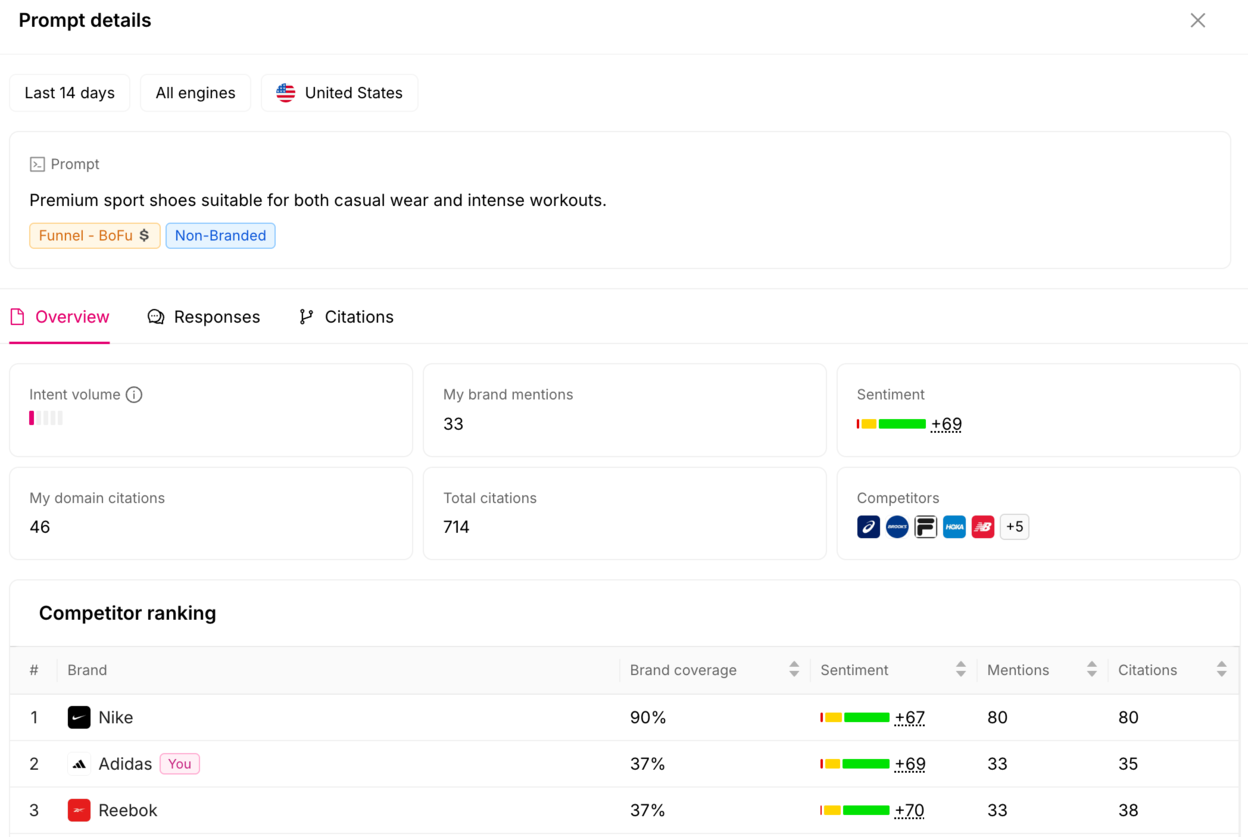
Its reporting covers brand mentions, source citations, competitor appearances, AI visibility trends, and related metrics. Users can configure prompts relevant to their business and review how those answers change over time.
The main appeal is that Otterly concentrates on GEO monitoring without requiring businesses to adopt another comprehensive SEO suite. For a marketing team already using Search Console, GA4, and an SEO research platform, that focused approach can be practical.
Standout Features
Otterly’s Lite plan includes 15 tracked prompts with daily monitoring across ChatGPT, Google AI Overviews, Perplexity, and Microsoft Copilot.
The platform also provides brand reports, prompt research, citation analysis, GEO auditing, and reporting exports.
Google AI Mode, Gemini, and Claude are available as optional paid add-ons rather than automatically included in every standard subscription.
Its Standard plan increases capacity to 100 prompts for $189 per month, while Premium provides 400 prompts for $489 per month.
Where Otterly Works Best
Otterly is particularly suitable for small businesses, independent marketers, and teams monitoring a defined group of customer questions.
For example, a software business could monitor a selection of product comparison prompts and investigate whether the same competitors appear repeatedly.
The platform’s focused interface can help the business collect relevant observations without maintaining an unnecessarily large software stack.
Limitations
The main drawback is the gap between the entry-level and Standard plans.
Fifteen prompts may be sufficient for a tightly defined niche, but a business monitoring several product categories can reach that limit quickly.
Additional AI engines also increase costs. Buyers should calculate the total price of their intended platform coverage rather than assuming the $29 Lite plan includes every AI search experience.
Verdict: A sensible first option for businesses that mainly need recurring AI visibility monitoring and don’t require an entire SEO platform.
2. Digimetrics: Best for Combining GEO With SEO and Marketing Tools
Starting price: $39/month
Free trial: 7 days, 200 credits, no credit card required
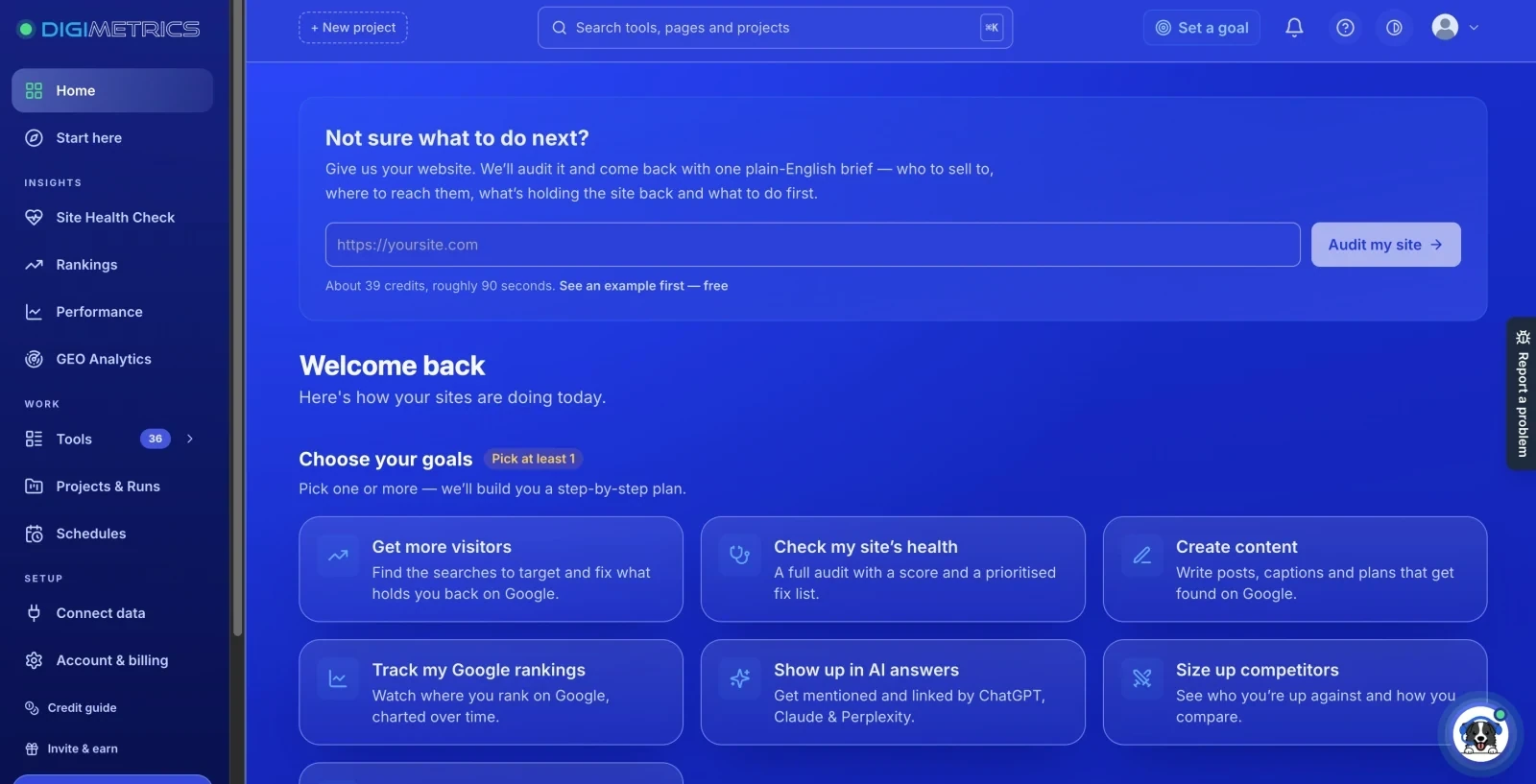
Digimetrics combines SEO, GEO, content optimisation, technical auditing, and other digital marketing functions within a single workspace.
Its approach differs from products focused almost entirely on monitoring AI responses. Digimetrics also provides tools for investigating website problems and identifying practical next steps.
The platform currently advertises more than 36 marketing tools covering search, AI visibility, content, paid media, social media, and technical analysis.
For a business managing several marketing responsibilities, this broader approach may reduce the need to switch between multiple applications.
Standout Features
Digimetrics’ GEO-related tools include AI Discovery Audit, AI Mentions Tracker, GEO On-Page Optimisation, and GEO+SEO Forensic Audit.
These tools are intended to help marketers investigate brand visibility, website accessibility, content opportunities, and related SEO issues.
The platform also provides keyword research, technical SEO crawling, page analysis, content optimisation, and scheduled monitoring. Its AI assistant, Monty, helps explain findings and prioritise recommended actions.
This means a team can investigate an AI visibility issue and then move into related technical or editorial analysis within the same product.
Digimetrics Pricing
| Plan | Monthly Price | Included Credits | Projects |
|---|---|---|---|
| Free Trial | $0 for 7 days | 200 one-time | 1 |
| Starter | $39 | 500/month | 3 |
| Pro | $109 | 2,000/month | 10 |
| Expert | $199 | 6,000/month | 25 |
All plans advertise access to the complete tool collection, although monitoring limits, credits, exports, projects, and reporting capabilities differ.
Starter provides 25 tracked keywords checked weekly and three scheduled runs, while Pro and Expert offer higher capacity.
Where Digimetrics Works Best
Digimetrics is relevant to small businesses, independent marketers, and agencies that want GEO insights to connect with existing SEO work.
For example, a content publisher might investigate an AI visibility gap, review whether the relevant article is technically accessible, and examine its structure and keyword coverage.
The value comes from connecting those activities rather than treating GEO as a standalone dashboard.
Limitations
Digimetrics uses credits across its tools, which means the number of analyses available depends on the selected workflow.
The $39 subscription doesn’t translate into a fixed number of monitored AI responses equivalent to another vendor’s prompt allowance.
Businesses requiring extensive daily prompt monitoring, large response datasets, or detailed citation intelligence should verify that the platform provides the necessary collection frequency, source evidence, and usage capacity.
Verdict: Worth evaluating when GEO is one part of a broader SEO and marketing workflow, particularly if consolidating tools could save time or subscription costs.
Sponsored product disclosure: Digimetrics is developed by MediaOne, which sponsors DigitalMarketingTools.ai. This assessment uses its public documentation and does not claim that Digimetrics outperformed competing products in independent testing.
3. Peec AI: Best for Brand and Competitor Visibility Analysis
Starting price: Vendor’s July 2026 pricing reference lists Starter at $95/month; verify the current checkout rate.
Peec AI specialises in monitoring how brands appear across AI-generated answers.
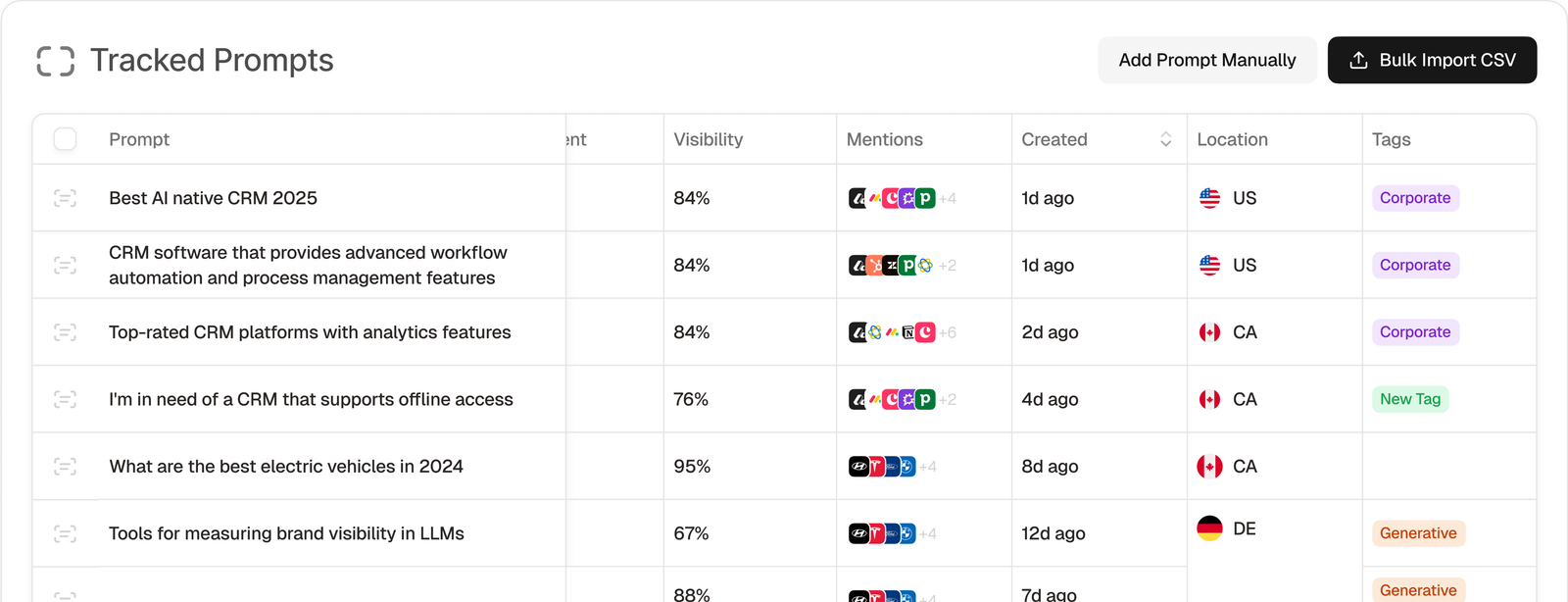
The platform focuses on visibility, share of voice, sentiment, average appearance position, competing brands, and cited sources. It can help teams investigate how AI systems describe products and which competitors appear in relevant comparisons.
Peec also provides prompt discovery and topic suggestions, helping marketers identify questions they may want to monitor.
Standout Features
Its Starter plan includes 50 prompts, three selected models, daily monitoring, unlimited users, and one project.
The Pro plan expands capacity to 150 prompts and two projects, while Advanced includes 350 prompts, five projects, and additional reporting features.
Peec also offers an agency-focused pricing model and optional AI model additions.
The distinction between prompts and AI responses is important. Peec explains that monitoring 25 prompts across three models daily for thirty days produces 2,250 collected answers.
Where Peec Works Best
Peec is especially relevant for brand, SEO, and content teams comparing product visibility across several AI systems.
A SaaS company might use it to investigate whether competing platforms appear in questions about specific features, integrations, or pricing requirements.
Its source analysis can help identify which websites are referenced within those answers.
Limitations
Peec’s current pricing page does not consistently expose every subscription amount in accessible page text. Buyers should confirm the amount displayed at checkout rather than rely on older third-party pricing tables.
The entry plans also limit how many AI models can be monitored simultaneously, and adding more models can affect the total cost.
Verdict: A strong candidate for businesses that prioritise brand perception, competitive visibility, and prompt-level reporting rather than traditional SEO auditing.
4. Profound: Best for Advanced Citation Intelligence and Enterprise GEO
Starting price: Free seven-day trial; ongoing Enterprise pricing is customised.
Profound combines AI search monitoring with citation intelligence, content workflows, agent-based marketing capabilities, and broader research tools.
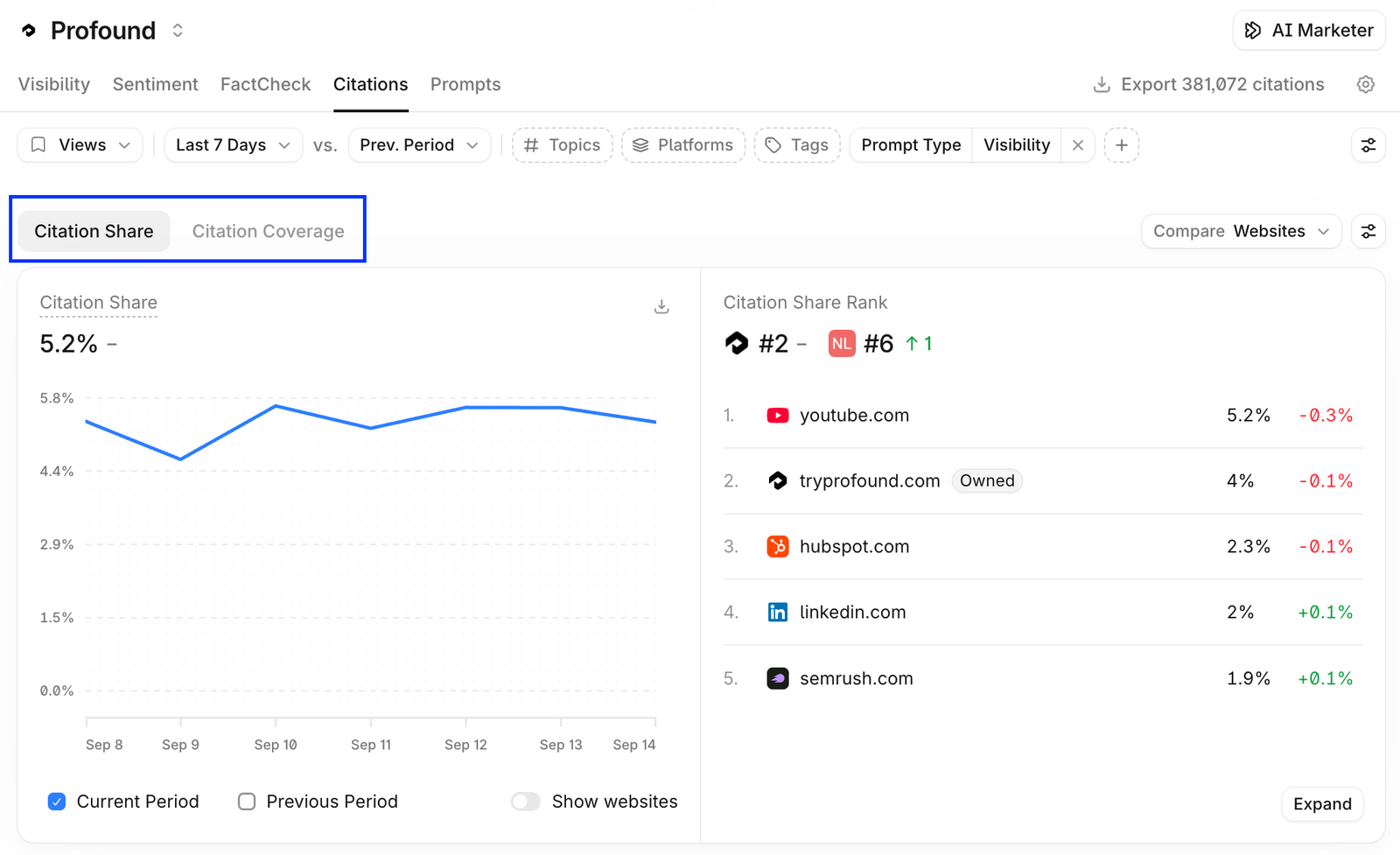
Its Answer Engine Insights product examines how brands, competitors, and source webpages appear in AI-generated answers.
Profound also focuses on turning those findings into work. Its wider platform includes AI-powered workflows intended to help marketing teams investigate opportunities, draft content, and manage related tasks.
Standout Features
Profound’s citation analytics support source categorisation, citation share analysis, competitive comparisons, and individual page monitoring.
The platform can classify references into categories such as owned websites, competitors, earned media, social platforms, and institutions.
That distinction may be useful when a brand wants to understand whether AI systems rely on its own documentation, independent publications, or competing websites.
Profound also provides integrations and export capabilities under its enterprise offering.
Free Trial and Pricing
Profound’s current pricing page advertises a self-service seven-day trial with 50 prompts monitored daily across ChatGPT, Gemini, and Google AI Overviews.
However, the trial uses a recommended prompt set rather than allowing unrestricted custom-prompt selection. It also has limited historical data and export functionality.
Its Enterprise subscription uses custom pricing and supports broader AI platform coverage, tailored tracking, additional integrations, and reporting capabilities.
Where Profound Works Best
Profound may be particularly relevant to established brands, larger agencies, and organisations managing extensive AI search research.
A publisher could investigate which articles receive citations, while a brand team might examine the independent publications frequently used as sources within its product category.
Its more advanced content and agent workflows may appeal to organisations ready to operationalise those findings.
Limitations
The platform’s more extensive capabilities are associated with enterprise packages, making the purchasing process less straightforward than a low-cost self-service subscription.
The trial’s predefined prompts also limit its usefulness for directly comparing custom monitoring questions with other tools.
Verdict: Worth considering when detailed citation research, competitive intelligence, and repeatable marketing workflows justify a more substantial GEO investment.
5. Ahrefs Brand Radar: Best for Broad Competitive Research
Starting price: Custom prompts from $50/month; AI Visibility Index from $199/month
Ahrefs Brand Radar offers two different approaches to AI visibility research.
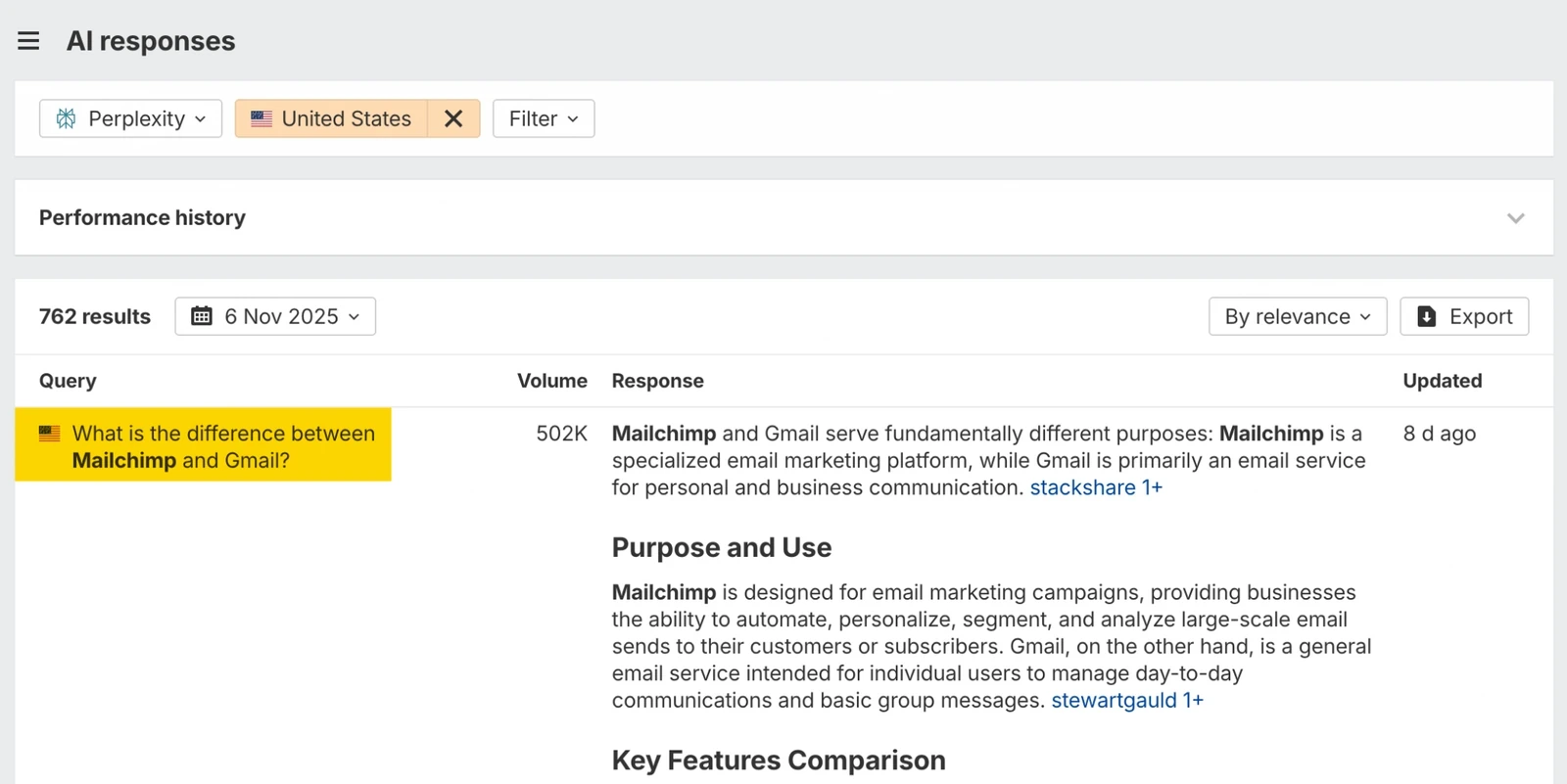
Its Custom Prompts functionality monitors selected questions, while its AI Visibility Index provides access to a much larger dataset of collected AI responses.
This makes it relevant both for businesses tracking their own customer questions and for marketers conducting broader competitive research.
Ahrefs also connects AI visibility analysis with its established SEO research ecosystem.
Standout Features
Brand Radar reports brand mentions, source citations, competitor visibility, and related AI search information.
Its AI Visibility Index uses prompts modelled from real search behaviour represented within Ahrefs’ keyword database. This provides broader market context, but it shouldn’t be described as a complete collection of private user prompts submitted directly to AI assistants.
The platform also distinguishes citations from sources encountered during retrieval, helping users understand whether a webpage was visibly referenced in the final answer.
Custom Prompts provides configurable monitoring for selected AI engines, locations, and reporting frequencies.
Pricing and Access
Ahrefs advertises Custom Prompts from $50 per month and AI Visibility Index access from $199 per month.
Existing paid Ahrefs customers also receive some custom prompt checks within their subscriptions. The current Lite allowance is five prompts, with larger allowances on higher plans.
However, monitoring additional engines and collecting more frequent responses can affect credit usage and overall cost.
Where Ahrefs Works Best
Ahrefs is especially relevant for SEO teams that already use its backlink, keyword, and competitor research tools.
For example, a business could investigate which competitor pages appear in AI-generated answers and then examine those pages using traditional SEO research.
The combination may be helpful when AI citation analysis needs to connect with content and link research.
Limitations
The broader AI Visibility Index can be expensive for smaller teams.
Its estimated impression figures are also modelled measurements, not direct first-party records of how many users saw a particular AI-generated answer.
Users should review the differences between index-based research and their own monitored prompts before comparing results.
Verdict: A valuable option for competitive intelligence, particularly when the business already relies on Ahrefs for traditional SEO research.
6. Semrush AI Visibility: Best for GEO Research Within an SEO Ecosystem
Starting price: $99/month per domain, billed annually
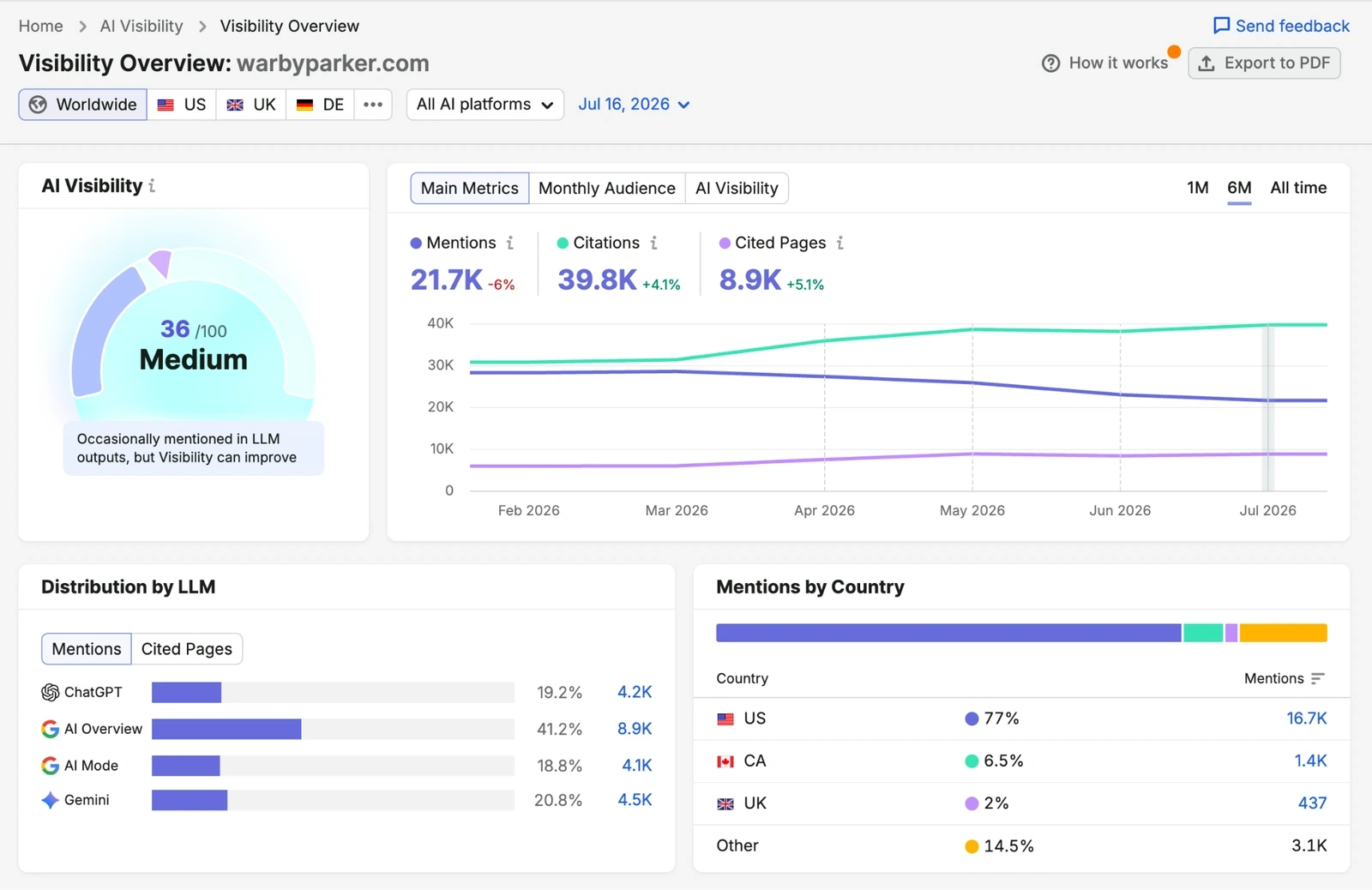
Semrush provides AI search visibility reporting covering brand performance, prompt research, competitors, citations, and sentiment.
Its AI Visibility Toolkit is particularly relevant to marketers already familiar with Semrush’s SEO research environment.
The platform provides several ways to investigate how AI systems describe a company and which competing brands appear within related answers.
Standout Features
The Base AI Visibility subscription includes brand performance analysis for one domain, 25 custom tracked prompts, competitor research, and related visibility reporting.
Semrush also provides AI readiness auditing and prompt research features.
Its Brand Performance reporting helps investigate how AI platforms describe a business, while Prompt Tracking supports monitoring selected questions over time.
These capabilities may complement the company’s conventional keyword, competitor, and technical SEO products.
Where Semrush Works Best
Semrush is a practical candidate for established marketing teams already using the platform for SEO.
For example, an agency could combine competitor keyword research with GEO prompt monitoring to investigate where a client appears in organic search and where it is mentioned in AI-generated comparisons.
This doesn’t mean that rankings and AI mentions should be interpreted as identical metrics, but the research can support related editorial decisions.
Limitations
The advertised $99 rate requires annual billing, and the Base package is priced per domain.
Its 25 custom-prompt allowance may also be restrictive for organisations monitoring several products or geographic markets.
Another important distinction is that the standalone AI Visibility Toolkit does not offer its own free trial. Semrush One advertises separate trial access to a broader suite that includes AI visibility functionality.
Verdict: Well suited to teams already invested in Semrush or looking for a combination of SEO intelligence and AI brand research.
7. SE Visible: Best for Dedicated Multi-Platform AI Visibility Reporting
Starting price: $99/month
Free trial: 10 days
SE Visible is a dedicated AI visibility product developed by the SE Ranking team.
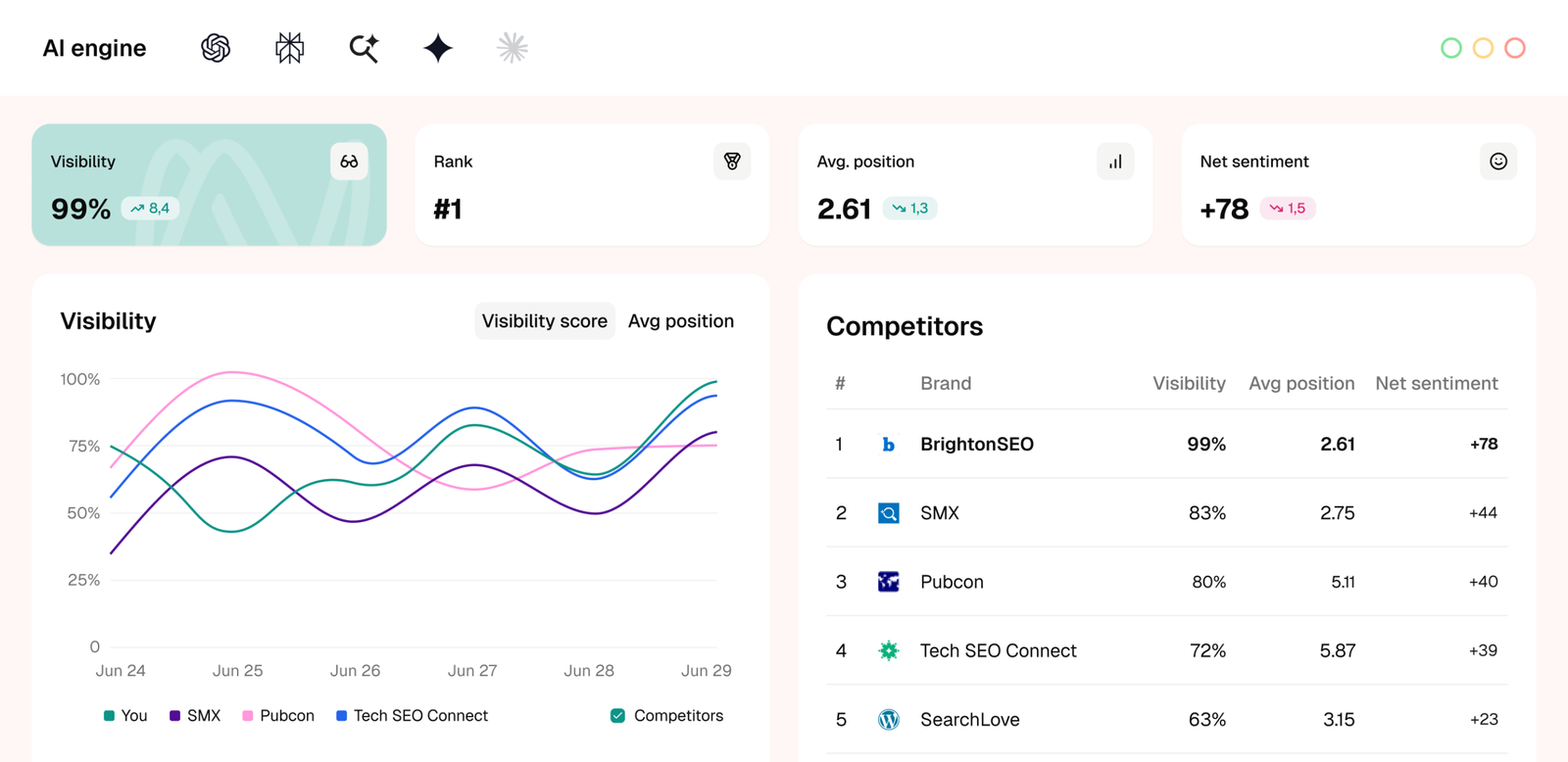
It concentrates on brand appearances, competitor comparisons, sentiment, source analysis, and historical monitoring across supported AI experiences.
Unlike SE Ranking’s wider SEO suite, SE Visible focuses specifically on AI search analytics.
Standout Features
The Basic plan includes 200 prompts, three projects, and monitoring across ChatGPT, Gemini, Google AI Mode, Google AI Overviews, and Perplexity.
SE Visible advertises approximately 30,000 analysed AI answers per month under this plan, using its supported collection configuration.
The interface includes reporting for visibility trends, competing brands, sentiment, relevant prompts, and cited sources.
Higher subscriptions increase prompt and project capacity, with Core listed at $189 per month.
Where SE Visible Works Best
SE Visible can suit businesses that need more monitoring capacity than an entry-level GEO tracker provides.
For example, a growing ecommerce business could divide prompts into several product categories, compare the brands appearing in generated answers, and investigate which sources support those recommendations.
Its separate GEO-focused interface may also be attractive when a company already uses another product for traditional SEO.
Limitations
Geographic and language coverage should be checked before purchasing, particularly for businesses outside the platform’s currently supported markets.
The advertised monthly answer count also doesn’t mean the platform directly observes that many real customer conversations. It represents responses collected under the provider’s monitoring process.
Verdict: A useful candidate for dedicated AI visibility monitoring when several projects, multiple AI platforms, and broader prompt coverage are required.
8. Rankscale: Best for Flexible, Credit-Based GEO Monitoring
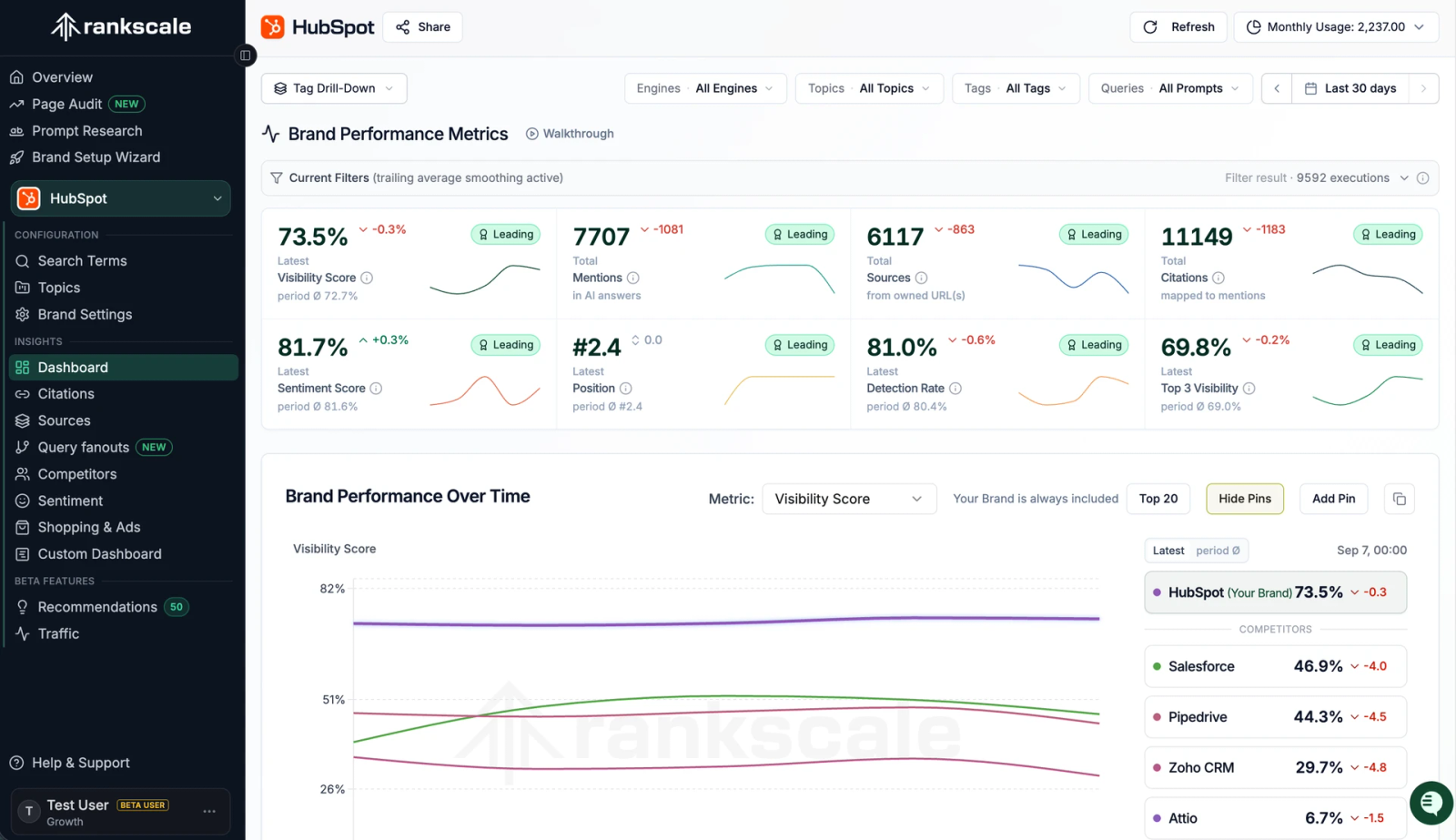
Starting price: Essentials from $20/month on annual billing; Pro at $99/month
Rankscale takes a credit-based approach to AI search monitoring.
Rather than offering only a fixed number of prompts, the platform allows users to configure monitoring frequency, AI engines, and related collection settings.
Its credit system can make it attractive to businesses that want different levels of monitoring for different questions.
Standout Features
Rankscale supports prompt monitoring, brand dashboards, page audits, source analysis, and configurable collection schedules.
The Pro subscription includes 1,200 monthly credits, ten brand dashboard slots, and 50 page-level AI visibility checks.
Its pricing calculator helps estimate how many AI responses can be collected using a proposed monitoring setup.
The platform also advertises a seven-day trial of Pro.
Where Rankscale Works Best
Rankscale may suit agencies or marketers who want to manage monitoring frequency according to topic importance.
For example, a software company could check commercial product comparison questions every day while monitoring less important informational prompts weekly.
This flexibility may reduce unnecessary collection costs, depending on the selected configuration.
Limitations
Credits aren’t directly comparable with another platform’s prompt allowance.
Different AI engines can consume different amounts of credit, and actual capacity depends on the selected configuration.
The lower-cost Essentials plan also uses annual billing, making its advertised monthly equivalent different from a month-to-month subscription.
Verdict: Worth evaluating when monitoring flexibility and controllable usage matter more than having a fixed prompt allowance.
9. Scrunch: Best for GEO Monitoring With Website and Agent-Traffic Analysis
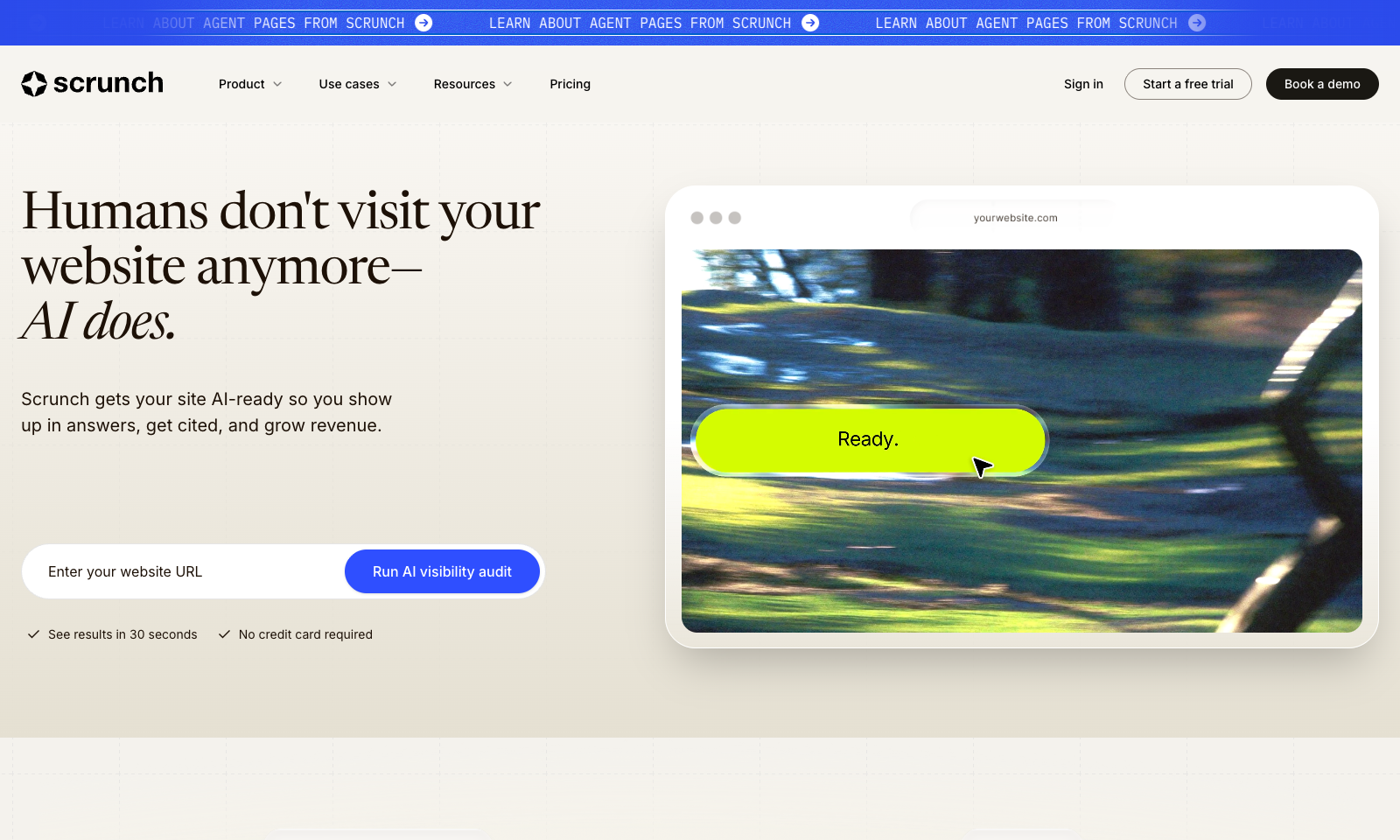
Starting price: $300/month, or $250/month when billed annually
Free trial: 7 days without a credit card
Scrunch combines AI visibility monitoring with website auditing, citation research, and analysis of traffic associated with AI agents.
Its approach extends beyond observing which brands appear in generated answers.
The product also provides features intended to help businesses investigate content and website accessibility issues that may influence how information is discovered and used.
Standout Features
Scrunch’s current Starter plan advertises 350 custom prompts, 1,000 industry prompts, three personas, five page audits, and three user licences.
Its supported AI platforms include ChatGPT, Claude, Gemini, Perplexity, Google AI Mode, Google AI Overviews, and Meta-related AI experiences.
The product includes prompt management, citation tracking, visibility reports, and agent-traffic analysis.
Scrunch also offers an Agent Experience Platform (AXP), which is intended to support AI-friendly website experiences. Its functionality and suitability should be evaluated independently from the visibility reports.
Where Scrunch Works Best
Scrunch may suit established marketing teams that want to investigate both AI search visibility and the technical or content conditions surrounding it.
For example, a business might identify a topic where competing webpages receive more citations and then use the platform’s page auditing functions to examine its own content.
The additional agent-traffic reporting may also help teams investigate how AI-related systems access their websites.
Limitations
Scrunch is more expensive than several entry-level GEO trackers.
Its more advanced enterprise features, integrations, and security capabilities also require higher-tier arrangements.
Although the current Starter trial offers self-service access, businesses should confirm whether the included page audits and monitoring capacity are sufficient for a meaningful evaluation.
Verdict: Relevant to businesses that need more than prompt monitoring and are prepared to invest in deeper website and agent-related analysis.
10. AthenaHQ: Best for GEO Analytics With Integrated Content Workflows
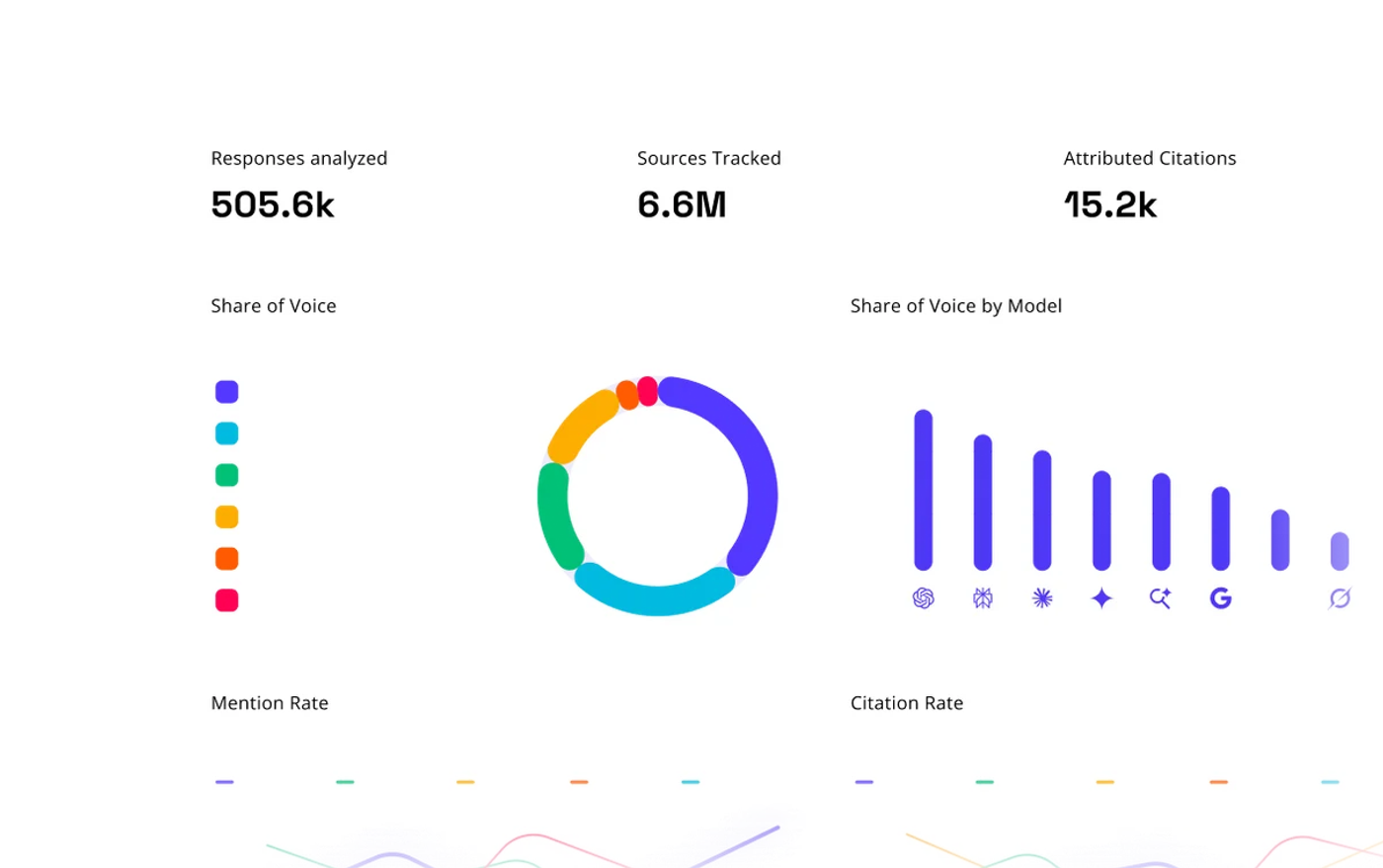
Starting price: 300 free credits; paid Starter at $295/month
AthenaHQ combines AI search visibility monitoring with source intelligence, competitor analysis, content recommendations, and workflow automation.
The platform provides a free Essential option with 300 starting credits, allowing users to explore selected AI analytics capabilities before subscribing.
Its paid products expand supported AI platforms, reporting capacity, and content-related functionality.
Standout Features
Athena supports prompt analysis, cited source research, competitor insights, and brand visibility reporting.
Its Starter subscription includes 3,600 monthly credits, access to a wider selection of AI models, CSV exports, integrations, and additional content optimisation capabilities.
The platform also provides AI-powered recommendations and workflow tools intended to connect visibility findings with content improvements.
Its credit model defines one credit as one AI response, although other operational restrictions and feature allowances may still apply.
Where AthenaHQ Works Best
Athena may be suitable for marketing teams that want to connect monitoring with broader content analysis and campaign workflows.
For example, a SaaS company could investigate which competitors appear in relevant AI answers, review the sources supporting those responses, and identify topics needing clearer product information.
The integrated approach may appeal to teams ready to act on recurring GEO research rather than simply collect visibility figures.
Limitations
The paid Starter price is relatively high compared with entry-level monitoring products.
Not every feature is included at the same subscription level. API access and extra credits may involve additional charges, while some advanced capabilities are reserved for Enterprise.
Its free Essential allowance also shouldn’t be treated as an unlimited recurring subscription.
Verdict: A candidate for teams requiring deeper GEO analytics and content workflows, provided the budget and credits match the intended workload.
Which GEO Tool Should You Choose?
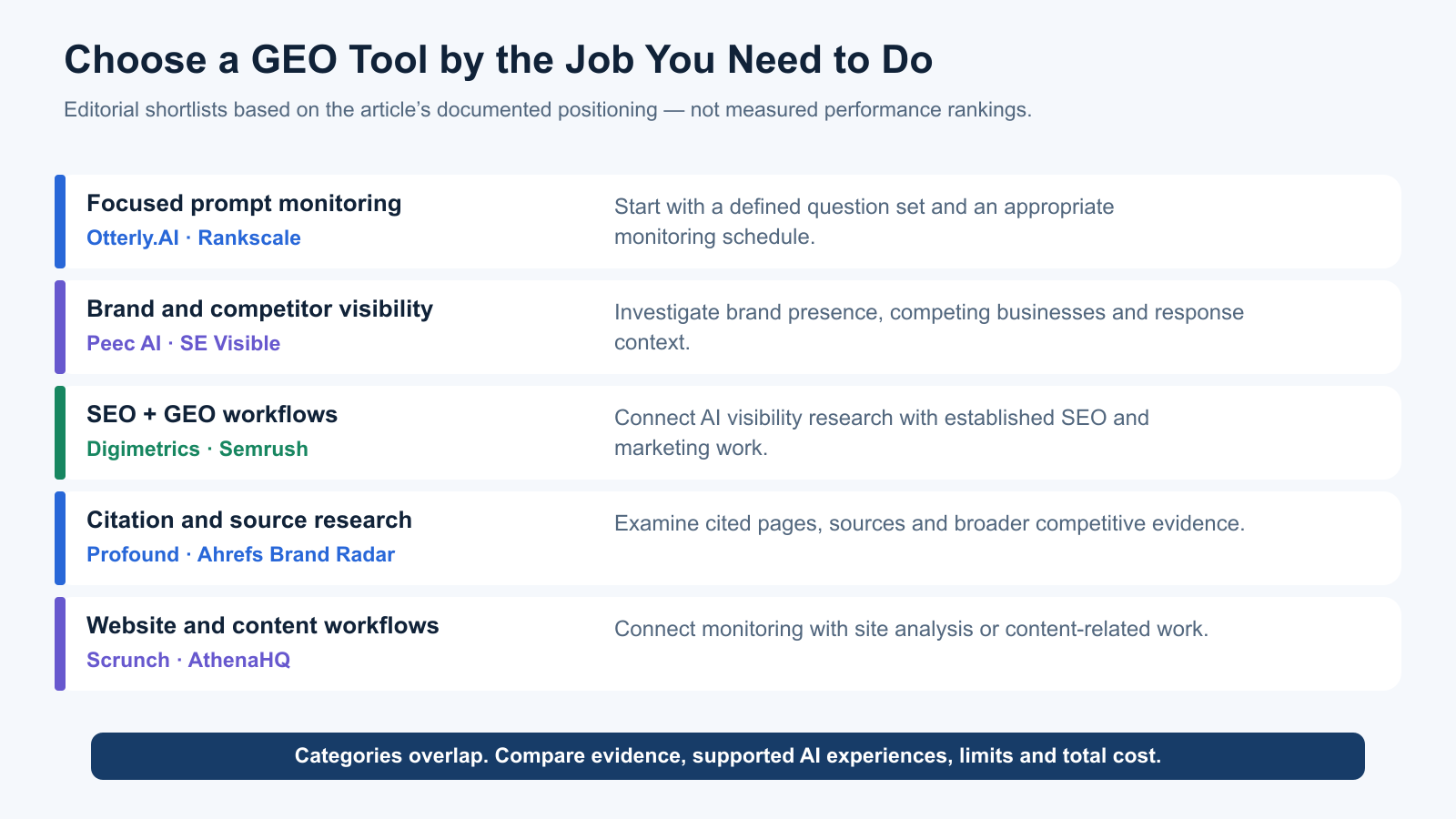
A numbered comparison can make tools easier to explore, but the right decision depends on the task rather than the number beside a product.
The following recommendations summarise where each platform’s documented functionality may fit.
| Your Main Requirement | Tools Worth Evaluating |
|---|---|
| Affordable dedicated GEO monitoring | Otterly.AI, Rankscale |
| Integrated SEO and GEO workflows | Digimetrics, Semrush |
| Brand and competitor visibility | Peec AI, SE Visible |
| Broad AI visibility and source research | Ahrefs Brand Radar |
| Detailed citation intelligence | Profound, Ahrefs Brand Radar |
| Monitoring combined with website audits | Scrunch, Digimetrics |
| Advanced GEO analytics and content workflows | AthenaHQ, Profound |
| GEO access before purchasing | Otterly.AI, Digimetrics, SE Visible, Rankscale, Profound, Scrunch |
These are feature-based recommendations. They don’t establish that one platform performs better than another on the same question set.
Businesses with limited budgets should also consider whether they need a paid GEO platform immediately. Our comparison of GEO tools with free trials explains how to evaluate available offers before committing.
How We Recommend Comparing GEO Tools
A useful GEO comparison should involve more than checking whether a platform supports ChatGPT or displays an AI Visibility Score.
The most important question is whether the product produces relevant, verifiable evidence under conditions that reflect your business.
For a controlled evaluation, we recommend testing a consistent prompt set across comparable AI experiences and recording both the observations and the time needed to interpret them.
Start With the Same Business Questions
Choose prompts that reflect real customer research needs.
For example, a fictional accounting software provider might investigate questions about small-business bookkeeping, invoicing, integrations, pricing, and alternatives to popular products.
Include informational questions, commercial comparisons, and product-specific requirements. Avoid creating a sample consisting entirely of prompts that already contain the company’s name.
A pilot using twenty to thirty relevant questions may be manageable for initial evaluation, although it won’t represent every question users ask AI systems.
Compare Equivalent AI Experiences
Where possible, monitor the same prompts, geographic markets, languages, and collection periods.
A response collected from ChatGPT Search shouldn’t be treated as directly interchangeable with a Google AI Mode response.
Likewise, a tool that collects answers daily may produce different results from a product that relies on a large historical database.
Document these differences instead of assuming the platforms are directly comparable.
Inspect the Underlying Responses
Check whether each tool correctly identifies brand mentions, competitors, and cited URLs.
For example, a product might be mentioned in a negative comparison. Counting that appearance as a mention may be valid, but interpreting it as a positive recommendation would be misleading.
Citation reporting also requires careful interpretation. Some platforms count individual URLs, while others count cited domains or responses containing a citation.
Our AI citation tracking guide explains how these counting methods affect results.
Measure Time to a Useful Decision
The fastest onboarding process doesn’t necessarily produce the most useful workflow.
Track how long it takes to configure the monitoring, verify important results, investigate a relevant competitor or citation gap, and identify a defensible next action.
A product with an attractive dashboard may still require extensive manual work if it doesn’t provide the original answers or exportable evidence.
The better tool is the one that helps your team investigate important questions without introducing unnecessary reporting complexity.
Use Consistent Evaluation Criteria
A practical assessment can apply the same criteria to each product:
| Evaluation Criterion | Suggested Weight | What to Examine |
|---|---|---|
| Evidence quality and transparency | 25% | Original responses, URLs, collection dates, metric definitions |
| AI platform and market coverage | 20% | Relevant engines, languages, locations |
| Brand and competitor analysis | 15% | Entity recognition, co-mentions, context |
| Citation and source analysis | 15% | URL-level evidence, source classification |
| Workflow and reporting | 15% | Exports, integrations, time to useful action |
| Cost and usage flexibility | 10% | Prompt, model, project, and credit allowances |
This is a proposed evaluation rubric, not a set of scores assigned to the ten tools in this article.
The weighting should be adjusted to the organisation’s needs. A publisher investigating cited articles may assign greater weight to source reporting, while a local service business may prioritise geographic coverage.
Publishing numerical product scores without completing the underlying evaluation would create a false impression of testing.
How Much Should You Spend on a GEO Tool?
GEO subscriptions range from low-cost specialist monitoring to enterprise research platforms with custom pricing.
However, comparing headline subscription prices doesn’t always reveal the true cost.
A $29 product with fifteen tracked prompts may be sufficient for one business but too restrictive for another. A credit-based platform may offer greater flexibility while requiring the team to calculate usage carefully.
Similarly, an integrated SEO and GEO platform may provide more overall value when it replaces existing subscriptions, but less value when most of its features duplicate software the business already owns.
Budget-Based Starting Points
| GEO Software Budget | Practical Starting Approach |
|---|---|
| $0/month | Google Search Console, Bing Webmaster Tools, limited manual research |
| Under $50/month | Focused prompt monitoring or an integrated entry-level platform |
| $50–$150/month | Broader prompt tracking, selected engines, or integrated research |
| $150–$300/month | Higher monitoring capacity and more advanced analysis |
| Above $300/month | Multi-project, enterprise-oriented, or specialised workflows |
These are planning categories, not estimates of what most businesses spend.
The more useful calculation is the monthly cost of the monitoring workflow you actually need.
Example: Estimating Monitoring Volume
Suppose a business wants to monitor thirty questions across three AI experiences every day.
Over a 30-day month, that could produce:
30 prompts × 3 AI experiences × 30 days = 2,700 collected responses
This is a hypothetical monitoring plan, not an actual GEO benchmark.
Different products would count and bill for this volume differently. One vendor may charge based on tracked prompts and models, while another consumes credits for each engine check.
The same subscription can therefore provide different levels of practical monitoring capacity depending on the configuration.
For smaller businesses, our guide to GEO tools for small businesses examines how to balance affordability, monitoring needs, and existing SEO subscriptions.
Can You Do GEO Without a Paid Tool?
Yes. A dedicated GEO subscription isn’t necessary for every business.
Several free platforms provide useful evidence about AI-assisted search, although they don’t replace specialist brand and competitor monitoring.
Google Search Console
Google introduced dedicated generative-AI performance reporting in June 2026, with worldwide rollout completed by August 31.
The reports provide first-party impression measurements for supported generative AI features in Search, including AI Overviews and AI Mode.
This can help website owners investigate which pages appear within Google’s generative search experiences.
However, Search Console doesn’t provide a complete database of brand mentions or competitor appearances across every AI platform.
Bing Webmaster Tools
Microsoft’s AI Performance reporting provides citation-related information for verified websites across supported Microsoft AI experiences.
The report includes cited pages, grounding queries, and historical trends.
In October 2026, Microsoft also introduced Topics Portfolio beta, which groups related grounding queries and highlights potential source visibility opportunities.
This can support content research, particularly for publishers.
However, Microsoft’s own documentation cautions that some topic and ecosystem measurements are directional estimates rather than precise counts.
Manual AI Response Research
Businesses can also collect a small sample of AI-generated answers manually.
For example, an organisation could document the responses to ten important product comparison questions across two supported AI experiences.
The resulting sample would not establish total AI visibility, but it could reveal inaccurate product descriptions, relevant competitors, or useful content gaps worth investigating.
The limitation is that manual checks are difficult to standardise and repeat at scale.
A paid GEO tool becomes easier to justify when the business needs recurring collection, historical reporting, or broader competitor and citation analysis.
Common Mistakes When Choosing GEO Software
Treating AI Visibility Scores as Universal Metrics
GEO platforms use different prompt datasets and visibility calculations.
A 70% visibility score from one product isn’t necessarily comparable with a 40% score from another.
Always examine the original observations and the vendor’s methodology.
Confusing Brand Mentions With Citations
A brand mention occurs when a company is named in an AI answer.
A citation occurs when the answer presents a webpage as a supporting source.
A company can receive a mention without a link, while an independent publisher may receive a citation without being recommended as a business.
These metrics should be analysed separately.
Ignoring AI Platform Coverage
A subscription that covers ChatGPT and Perplexity may not include Google AI Mode or Gemini under the same plan.
Check which experiences are included, whether they require add-ons, and how often they are monitored.
Buying More Prompts Than You Need
A large prompt allowance may look attractive, but it has limited value if the questions are poorly selected or the team never investigates the results.
Begin with a representative set of business questions and expand only when additional monitoring supports useful decisions.
Assuming More AI Mentions Mean More Revenue
Increased brand mentions or citations don’t automatically create website visits, leads, or sales.
Where possible, combine GEO monitoring with website analytics and relevant business outcomes.
Our guide to GEO and SEO measurement explains why different discovery signals shouldn’t be combined into one misleading performance score.
Final Verdict: What Is the Best GEO Tool in 2026?
There isn’t one GEO tool that offers the best value for every business.
Otterly.AI is a practical starting point for dedicated AI search monitoring, particularly when a small prompt allowance covers the business’s most important questions.
Digimetrics may offer broader workflow value for teams that need GEO functionality alongside SEO research, technical auditing, and content tools.
Peec AI and SE Visible are relevant to teams prioritising brand visibility and competitive comparisons, while Ahrefs Brand Radar and Semrush provide additional research context for established SEO operations.
Profound is worth considering for deeper citation intelligence and enterprise workflows. Rankscale offers flexibility through credit-based monitoring, Scrunch combines AI visibility with website and agent-related analysis, and AthenaHQ provides a broader analytics and content workflow.
The strongest choice depends on three things: the questions your customers ask, the quality of evidence the software collects, and whether your team can turn the findings into worthwhile work.
Before subscribing, test a representative set of prompts, inspect the actual AI responses, verify the reporting definitions, and calculate the ongoing cost.
The best GEO tool isn’t the one that promises the highest visibility score. It’s the one that helps you understand where your brand appears, why the findings matter, and what you should improve next.
Frequently Asked Questions
What Is the Best GEO Tool in 2026?
The best GEO tool depends on the business’s requirements. Otterly.AI is worth considering for focused prompt monitoring, Digimetrics for integrated SEO and GEO workflows, Peec AI for brand reporting, and Ahrefs Brand Radar for broad competitive research. Profound, Semrush, SE Visible, Rankscale, Scrunch, and AthenaHQ offer additional specialised capabilities.
What Are GEO Tools?
GEO tools are software platforms that help businesses monitor and investigate their visibility within AI-generated search experiences. Depending on the product, they can track brand mentions, citations, competing businesses, relevant questions, historical trends, and content or technical opportunities.
How Much Do GEO Tools Cost?
GEO tools range from free reporting and limited introductory credits to subscriptions costing several hundred dollars per month. Otterly.AI starts at $29 monthly, Digimetrics at $39, SE Visible at $99, and Semrush AI Visibility from $99 per domain when billed annually. Enterprise platforms may use customised pricing.
Is There a Free GEO Tool?
Google Search Console and Bing Webmaster Tools provide free first-party reporting related to AI-assisted search. Some commercial GEO platforms also offer introductory trials or credits, including Digimetrics, Otterly.AI, Profound, and AthenaHQ. However, free access typically has usage, feature, or duration limits.
Are GEO Tools Different From SEO Tools?
Traditional SEO tools concentrate on keyword research, organic rankings, backlinks, technical auditing, and search performance. GEO tools focus on how brands and content appear within AI-generated answers. The two categories overlap, and some platforms combine them. GEO should generally complement rather than replace established SEO practices.
Can GEO Tools Track ChatGPT Mentions?
Yes. Several third-party platforms monitor whether brands appear in selected ChatGPT-related responses. However, these observations don’t represent every private ChatGPT conversation or the total number of users who encountered a brand. Reporting depends on each provider’s collection method.
Do GEO Tools Improve Google Rankings?
GEO tools don’t directly control Google rankings. Their findings may reveal useful content gaps, technical issues, or opportunities to improve information that customers need. However, no visibility score or optimisation recommendation guarantees changes in organic rankings or AI-generated citations.
Which GEO Tool Is Best for Small Businesses?
Businesses with a limited budget may find Otterly.AI or Digimetrics relevant, depending on whether they need dedicated monitoring or broader SEO functionality. Free first-party reporting can also provide a starting point before adding another subscription. The appropriate choice depends on prompt requirements, usage limits, and existing tools.
Which GEO Tool Is Best for Agencies?
Agencies should evaluate multi-project capacity, supported geographic markets, client reporting, exports, user access, and total monitoring costs. Products such as SE Visible, Peec AI, Profound, Semrush, Ahrefs, and Scrunch may fit different agency requirements. A controlled trial is necessary to determine which workflow is most efficient.
Are AI Citations the Same as Backlinks?
No. An AI citation is a source reference presented within an AI-generated answer, while a conventional backlink is a hyperlink within a webpage. An AI citation doesn’t automatically establish the same SEO relationship or ranking effects as a traditional backlink.
How Often Should I Monitor GEO Performance?
The appropriate frequency depends on the business and its reporting needs. Daily monitoring may support competitive research, while weekly or monthly reviews may be sufficient for smaller teams. Consistent prompts, supported AI experiences, and reliable historical evidence matter more than collecting frequent observations without a clear purpose.
Can GEO Tools Tell Me How Much Revenue AI Search Generates?
Some platforms combine AI visibility information with website analytics or referral reporting. However, a brand mention or citation doesn’t automatically produce a measurable visit or sale. Revenue analysis should use attributable website activity and business outcomes while acknowledging the limits of tracking zero-click exposure.
Disclosure: digitalmarketingtools.ai is sponsored by Digimetrics.ai. Sponsored Highlights are clearly labelled advertising. Our reviews, comparisons and guides are written to be useful and fair regardless of who sponsors the site. Read the full disclosure.