9 Best Paid GEO Tools in 2026: Pricing, Limits & Value
Free GEO tools can help you check whether your website appears in AI-generated answers, identify pages cited by Microsoft Copilot, or examine your brand’s visibility within a limited dataset. What they rarely provide is a complete, repeatable workflow for monitoring important questions, comparing competitors, and investigating changes over time.
That’s the main reason businesses consider paid Generative Engine Optimization (GEO) software.
A subscription can provide historical response tracking, more AI platform coverage, detailed citation research, automated reporting, and tools for connecting visibility findings with content or technical improvements. However, those capabilities come with different pricing models, and a higher monthly fee doesn’t necessarily mean better or more complete data.
For example, a $29 GEO subscription might be sufficient for a small company monitoring fifteen customer questions. An agency managing multiple brands could need hundreds of prompts, several geographic markets, and exportable client reports. Meanwhile, a business already paying for traditional SEO software may be better served by an integrated product rather than another standalone monitoring platform.
The best paid GEO tools in 2026 are the one that provides useful, verifiable AI search data at a cost your team can justify. That means comparing more than advertised features or a proprietary visibility score.
This guide examines nine paid GEO platforms, their published prices and allowances, where each subscription offers value, and the limitations to consider before committing.
Editorial disclosure: DigitalMarketingTools.ai is sponsored by Digimetrics.ai, which is developed by MediaOne. Digimetrics is included alongside competing products based on published features, pricing, and suitability for specific workflows. This is a documentation-based comparison, not an independently completed head-to-head accuracy benchmark.
Key Takeaways
- Otterly.AI starts at $29 per month for dedicated GEO monitoring, but its Lite plan includes only 15 tracked prompts.
- Digimetrics starts at $39 per month and provides GEO alongside SEO, technical audits, content optimisation, and other marketing tools using a shared credit allowance.
- Rankscale Pro costs $99 per month with 1,200 monitoring credits, offering flexible scheduling and AI engine selection.
- SE Visible starts at $99 per month and includes 200 tracked prompts across five supported AI search experiences.
- Peec AI focuses on brand and competitor analytics, with unlimited users and daily tracking across selected models, although current subscription prices should be confirmed at checkout.
- Ahrefs Brand Radar offers custom-prompt packages from $50 per month, while its broader AI Visibility Index starts at $199 per month.
- Semrush AI Visibility starts at $99 per month per domain with annual billing, providing brand research, competitor intelligence, and 25 custom prompts.
- Scrunch and Profound target more extensive GEO workflows, including citation intelligence, website analysis, and enterprise-oriented reporting.
- The value of paid GEO software depends on usable evidence, monitoring capacity, and the cost of turning findings into worthwhile actions.
What Do Paid GEO Tools Offer That Free Tools Don’t?

Free GEO reporting has improved considerably. Google Search Console provides generative-AI performance data for supported Google Search features, while Bing Webmaster Tools reports citation activity across supported Microsoft AI experiences.
Free brand checkers from vendors such as Ahrefs and Semrush can also provide useful snapshots.
However, those products don’t necessarily monitor the same questions across multiple AI platforms every day or preserve the response histories needed for recurring competitor analysis.
Paid GEO tools generally offer greater control over what gets monitored, how often the information is collected, and how the findings are reported.
| Capability | Typical Free Access | Paid GEO Software |
|---|---|---|
| AI visibility checks | Limited or one-off | Recurring monitoring |
| Custom prompts | Often restricted | Larger configurable prompt sets |
| AI platform coverage | Selected experiences | Multiple supported platforms, sometimes with add-ons |
| Competitor monitoring | Limited previews | Broader brand comparisons |
| Citation reporting | Platform-specific or sampled | Cross-platform source analysis |
| Historical observations | Restricted | Stored responses and trends |
| Geographic targeting | Limited | Additional supported markets and languages |
| Reporting | Basic dashboards | Exports, integrations, and client reports |
| Workflow automation | Minimal | Scheduling, APIs, or connected analysis |
These are general differences, not features guaranteed under every paid subscription. Entry-level products can still impose substantial limits, and some advanced reporting features require higher tiers.
For a broader explanation of GEO software, see our complete guide to GEO tools.
9 Best Paid GEO Tools in 2026: Quick Comparison
The following comparison uses publicly documented subscription information reviewed on October 17, 2026.
| GEO Tool | Paid Starting Point | Best Suited For | Main Buying Consideration |
|---|---|---|---|
| 1. Otterly.AI | $29/month | Focused AI visibility tracking | Small entry-level prompt allowance |
| 2. Digimetrics | $39/month | Integrated SEO and GEO workflows | Shared tool credits |
| 3. Rankscale | $99/month for Pro | Flexible monitoring schedules | Engine-specific credit consumption |
| 4. SE Visible | $99/month | Dedicated brand and competitor monitoring | Geographic coverage and project limits |
| 5. Peec AI | Confirm current checkout price | Brand analytics and collaboration | Model and prompt allowances |
| 6. Ahrefs Brand Radar | $50/month for Custom Prompts | Competitive and source research | Separate prompt and index products |
| 7. Semrush AI Visibility | $99/month per domain, annually | GEO plus competitive SEO research | Domain and prompt limits |
| 8. Scrunch | $300/month, or $250 annually | GEO plus site and agent-traffic analysis | Higher subscription commitment |
| 9. Profound | Custom enterprise pricing | Advanced citation and marketing operations | Tailored contract and scope |
Prices are in USD. Where annual billing applies, the displayed monthly equivalent is not necessarily available as a month-to-month subscription. The numbering groups products by practical buying considerations rather than claiming a measured accuracy ranking.
1. Otterly.AI: Best for Focused Paid GEO Monitoring
Starting price: $29/month
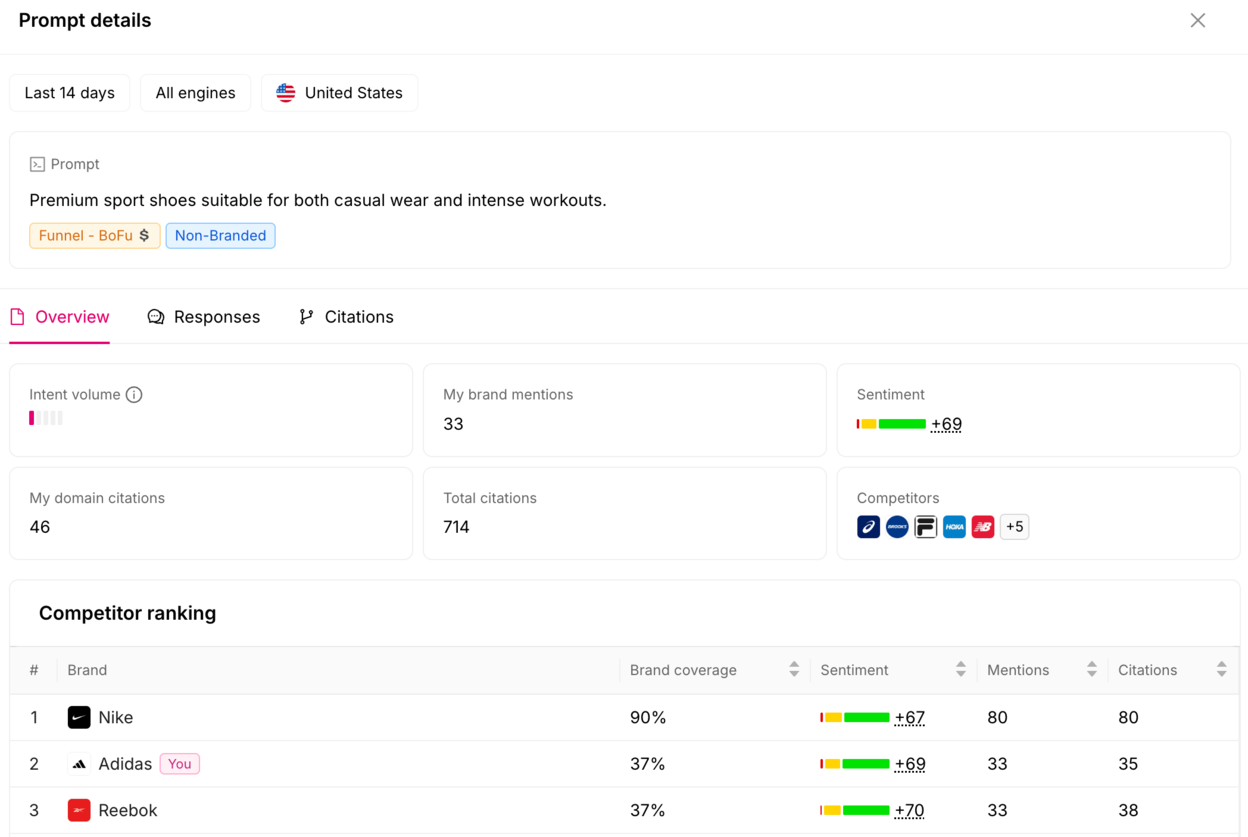
Otterly.AI is a dedicated GEO monitoring platform that tracks how brands appear across selected questions and supported AI search experiences.
Its functionality includes brand mentions, source citations, competitor comparisons, sentiment analysis, prompt research, and historical visibility reporting.
The main advantage of Otterly is its relatively focused approach. Businesses that already have keyword research, auditing, and website analytics covered can use it as an additional AI visibility layer without purchasing another comprehensive SEO suite.
What Do You Get for the Price?
| Plan | Monthly Price | Tracked Prompts |
|---|---|---|
| Lite | $29 | 15 |
| Standard | $189 | 100 |
| Premium | $489 | 400 |
All three plans advertise daily tracking across four standard AI search experiences: ChatGPT, Google AI Overviews, Perplexity, and Microsoft Copilot.
Google AI Mode, Gemini, and Claude are optional paid add-ons. Higher plans also include broader API, agent analytics, and reporting capabilities.
Otterly’s Lite plan may be sufficient for a small business monitoring its most important customer questions. For example, a local professional services company could track a handful of non-branded service recommendations and comparisons.
When Is Otterly Worth Paying For?
Otterly makes sense when GEO monitoring is a recurring task and the business doesn’t need additional SEO functions from the same subscription.
Its main limitation is the transition between plans. The jump from 15 to 100 tracked prompts comes with a substantial increase in monthly cost, and businesses requiring several additional AI engines may face further charges.
Before subscribing, determine whether fifteen prompts cover your most important topics. A small allowance can be useful when the monitored questions are carefully chosen, but restrictive when multiple products, markets, or customer journeys need coverage.
Verdict: Worth considering for a business that wants a dedicated GEO tracker with straightforward reporting and a limited set of important prompts.
2. Digimetrics: Best for Combining Paid GEO With SEO and Content Tools
Starting price: $39/month
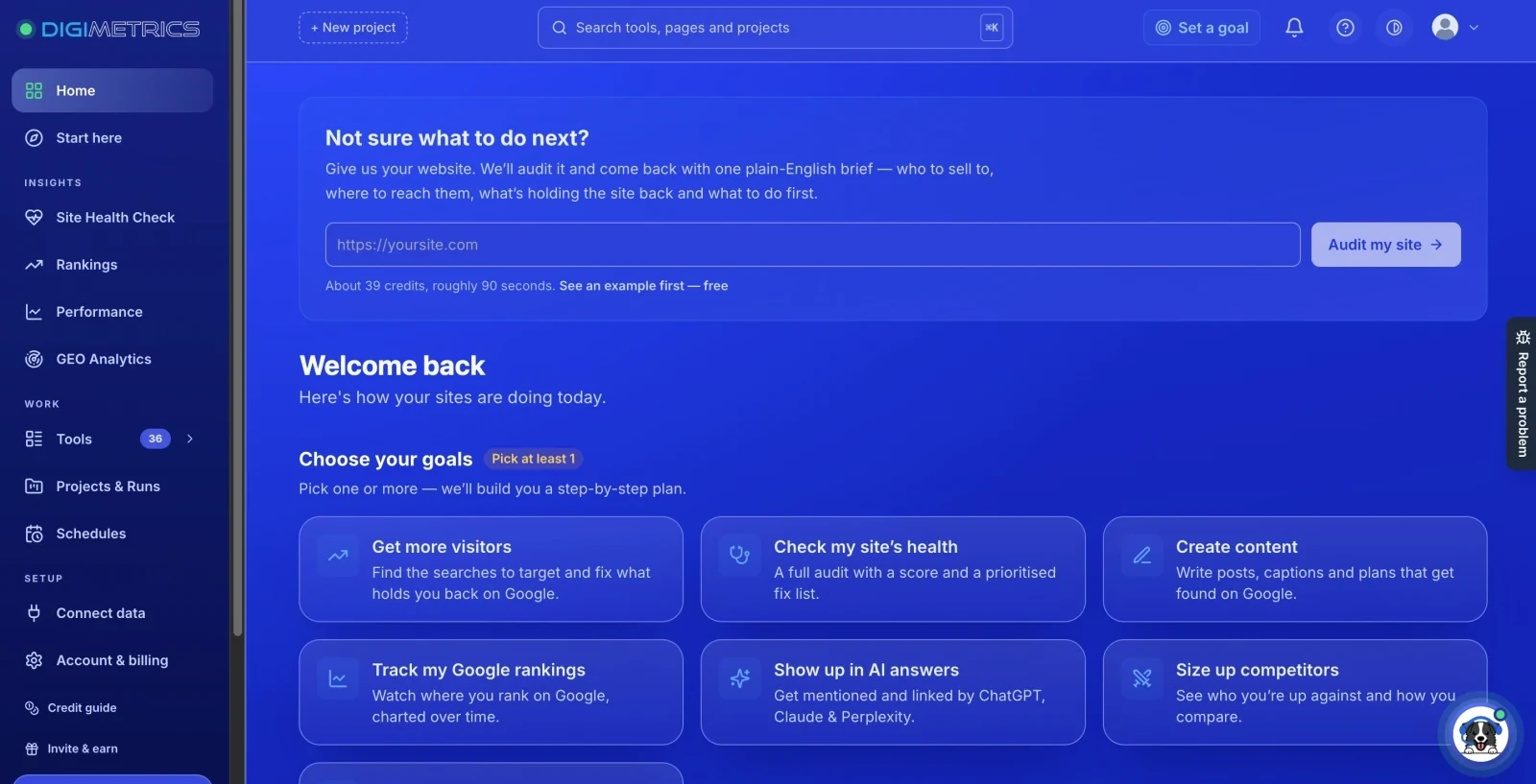
Digimetrics offers a broader digital marketing workspace combining GEO analysis, technical SEO, keyword research, content optimisation, rank monitoring, and other marketing functions.
Rather than concentrating only on brand visibility dashboards, the platform is designed to connect marketing observations with investigations and recommended actions.
Its GEO-related toolkit includes AI Discovery Audit, AI Mentions Tracker, GEO On-Page Optimisation, and GEO+SEO Forensic Audit. Related tools cover technical crawling, keyword research, content analysis, backlink research, and other SEO functions.
This makes Digimetrics relevant when a business wants to investigate AI visibility problems without maintaining several separate subscriptions.
What Do You Get for the Price?
| Plan | Monthly Price | Credits | Projects |
|---|---|---|---|
| Starter | $39 | 500/month | 3 |
| Pro | $109 | 2,000/month | 10 |
| Expert | $199 | 6,000/month | 25 |
The platform advertises access to its complete tool collection across plans, with differences in capacity, scheduled runs, monitoring, and reporting.
Starter includes 25 tracked keywords checked weekly and three scheduled runs. Pro expands the tracked keyword allowance to 250 and provides fifteen scheduled runs, while Expert includes additional project capacity, white-label PDF reporting, and API access.
Digimetrics also offers a seven-day trial with 200 introductory credits and no credit card requirement.
When Is Digimetrics Worth Paying For?
The strongest argument for Digimetrics is tool consolidation.
For example, a content-focused business could investigate where its brand appears in AI search, run a technical assessment of relevant pages, and use related content tools to examine potential improvements.
If those are all recurring responsibilities, an integrated platform may be more practical than separate subscriptions.
However, this depends on actual usage. A team that only needs prompt-level brand monitoring may prefer a specialist tracker, particularly if it requires extensive response histories or citation analysis.
What Are the Limitations?
Digimetrics uses a shared credit system. Different tools consume different amounts of credits, and the cost of an analysis is displayed before it runs.
That means 500 monthly credits aren’t equivalent to 500 tracked prompts or 500 AI-generated responses.
Businesses should estimate how many GEO checks, technical audits, content analyses, and other tool runs they need each month.
They should also verify the available AI platforms, source-level evidence, and reporting depth for their particular GEO workflow.
Verdict: Worth evaluating when GEO is part of a broader SEO and digital marketing workload, rather than the only capability the business needs.
Sponsored product disclosure: Digimetrics is developed by MediaOne, which sponsors DigitalMarketingTools.ai. This assessment reflects its documented capabilities and pricing, not independently verified superiority over competing platforms.
3. Rankscale: Best for Flexible, Credit-Based Monitoring
Starting point for recurring monitoring: Pro at $99/month
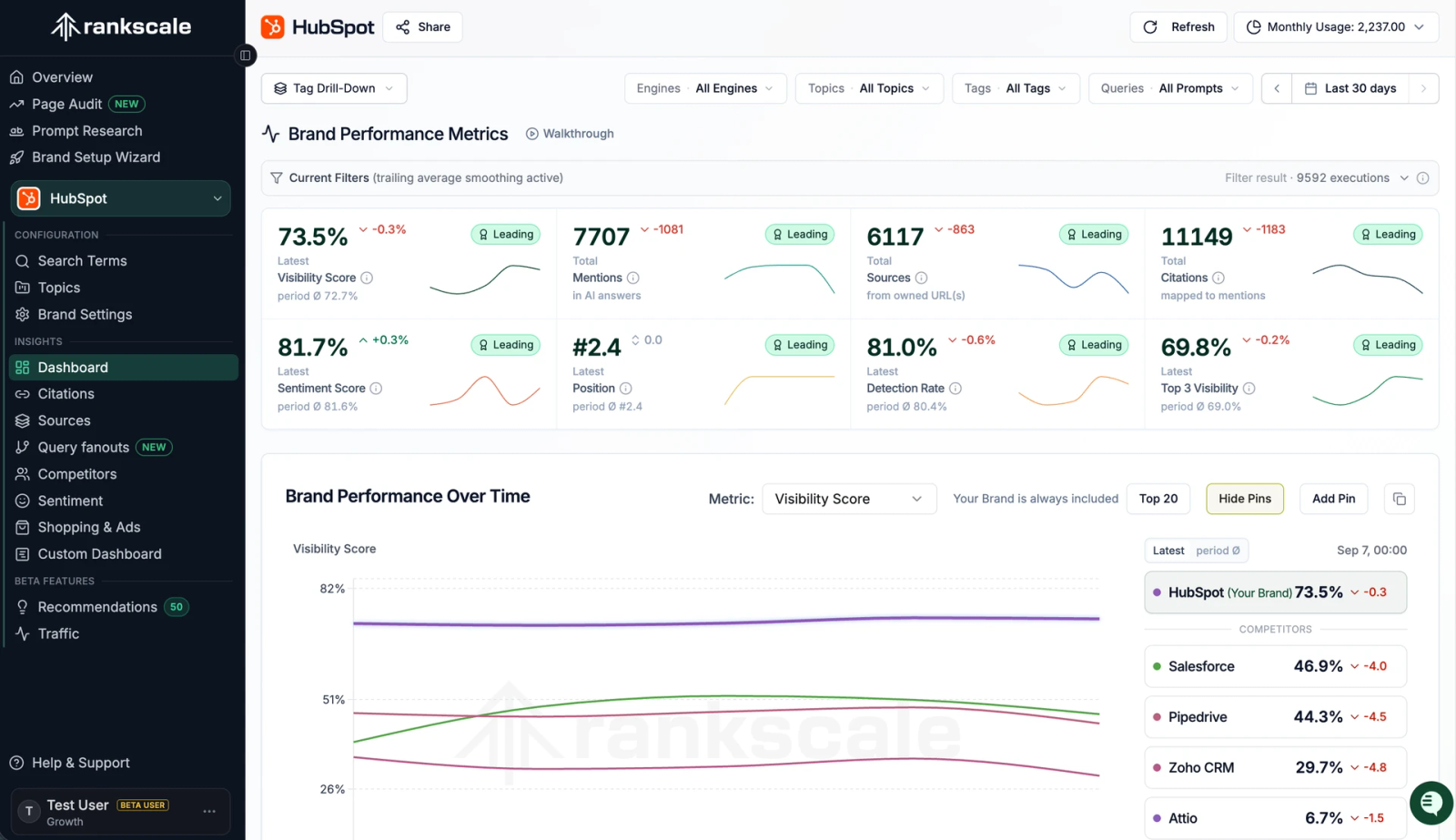
Rankscale offers AI visibility monitoring through a configurable credit system.
Users can select relevant questions, AI engines, geographic markets, and monitoring frequencies, then allocate credits toward collecting responses.
This differs from products that provide a fixed number of tracked prompts under a subscription.
For businesses that want daily monitoring of important questions but less frequent checks for secondary topics, that flexibility may be useful.
What Do You Get for the Price?
Rankscale’s Pro plan costs $99 per month and includes 1,200 monitoring credits.
The provider advertises capacity for up to 4,800 collected AI answers under configurations that consume approximately 0.25 credits per answer.
Pro also includes ten brand dashboard slots, fifty page audits, unlimited creation of search terms, and configurable monitoring across supported engines.
Higher subscriptions increase the allowance:
| Plan | Monthly Price | Credits |
|---|---|---|
| Pro | $99 | 1,200 |
| Pro+ | $229 | 3,000 |
| Growth | $385 | 5,500 |
| Enterprise | $780 | 12,000 |
Rankscale also advertises a lower-cost, annually billed Essentials tier. However, its current pricing comparison indicates that Essentials doesn’t bundle monthly monitoring credits, making it a different purchase from Pro. Buyers should calculate the required top-ups before treating it as the cheapest recurring monitoring option.
When Is Rankscale Worth Paying For?
Rankscale is relevant when a business needs control over collection frequency and AI engine selection.
For example, an agency might monitor commercially important product comparisons daily while collecting broader informational responses weekly.
However, this approach requires some planning. Different AI engines can consume different numbers of credits, so the number of answers available depends on the chosen configuration.
Rankscale’s credit calculator is particularly useful for estimating those requirements before subscribing.
Verdict: A suitable candidate for teams comfortable managing monitoring volume and costs through credits rather than fixed prompt packages.
4. SE Visible: Best for Dedicated Brand and Competitor Monitoring
Starting price: $99/month
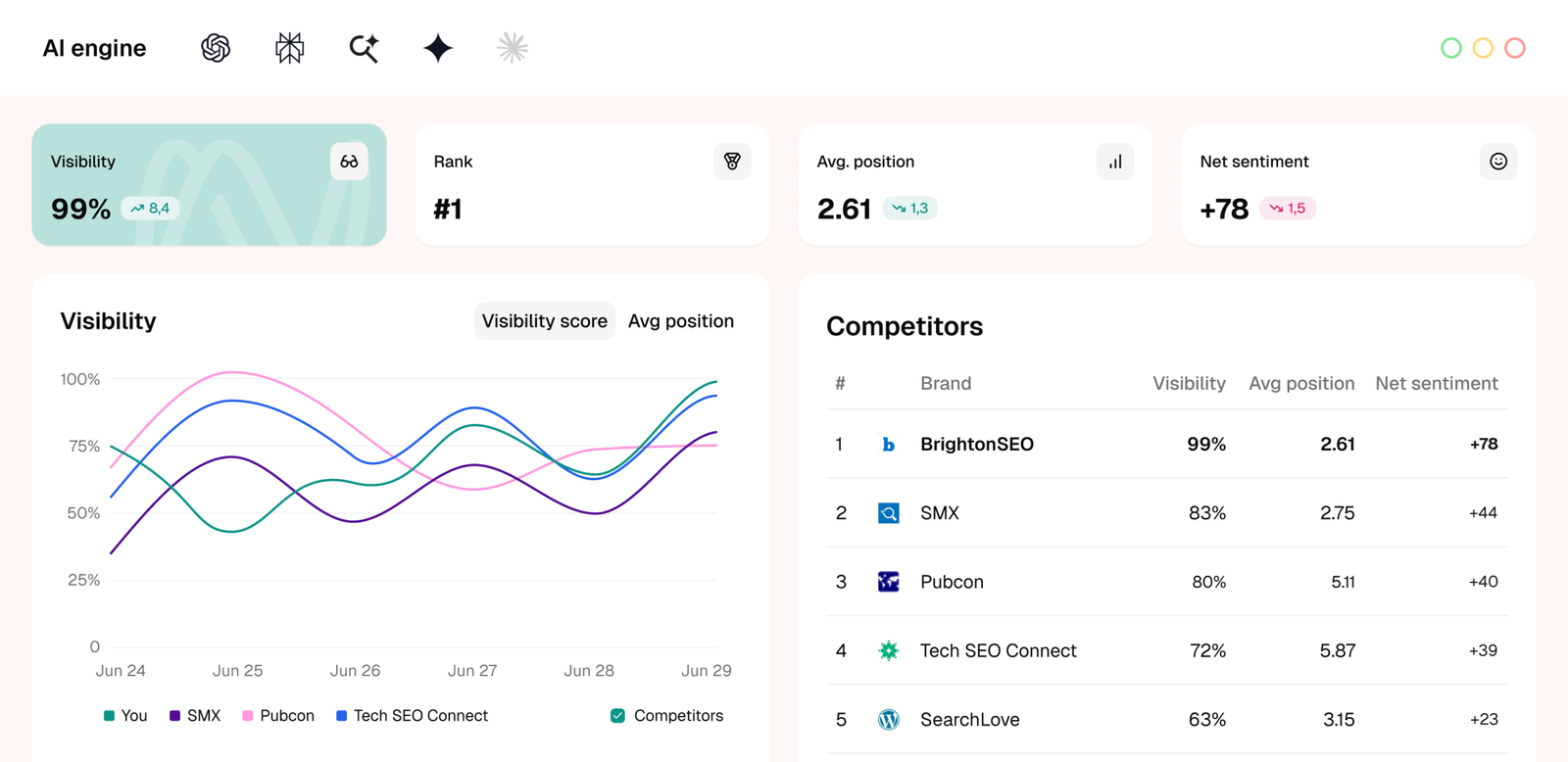
SE Visible is a dedicated AI visibility platform developed by the SE Ranking team.
It focuses on brand appearances, competitor comparisons, cited sources, sentiment, and historical trends across supported AI-generated search experiences.
Unlike SE Ranking’s broader SEO suite, SE Visible is designed primarily for GEO measurement and reporting.
This distinction can make it useful for businesses already using traditional SEO software but needing more detailed AI visibility monitoring.
What Do You Get for the Price?
| Plan | Monthly Price | Prompts | Projects |
|---|---|---|---|
| Basic | $99 | 200 | 3 |
| Core | $189 | 450 | 5 |
| Plus | $355 | 1,000 | 10 |
The Basic plan advertises analysis of approximately 30,000 AI answers per month across ChatGPT, Gemini, Google AI Mode, Google AI Overviews, and Perplexity.
Higher plans increase prompt and project capacity.
The platform also offers reporting for brand visibility, competing businesses, topics, and cited sources, alongside a ten-day trial.
When Is SE Visible Worth Paying For?
SE Visible may provide better workflow coverage than a smaller prompt tracker when a business needs to monitor several topics or projects.
For example, an ecommerce brand managing different product categories could group questions by purchasing intent, compare competitors, and investigate source citations without configuring a separate monitoring project for every individual product.
However, the advertised answer count reflects the provider’s collection process, not the number of actual customers who encountered the brand.
What Are the Limitations?
Geographic coverage matters. SE Visible currently emphasises support for selected countries and languages, so companies operating outside those markets should verify availability.
The platform also concentrates on AI visibility rather than delivering the full range of technical SEO and content tools found in broader suites.
Verdict: Worth considering for teams that want a dedicated GEO reporting platform with greater prompt capacity and structured competitor analysis.
5. Peec AI: Best for Collaborative Brand Visibility Analysis
Starting price: Confirm the current subscription amount at checkout
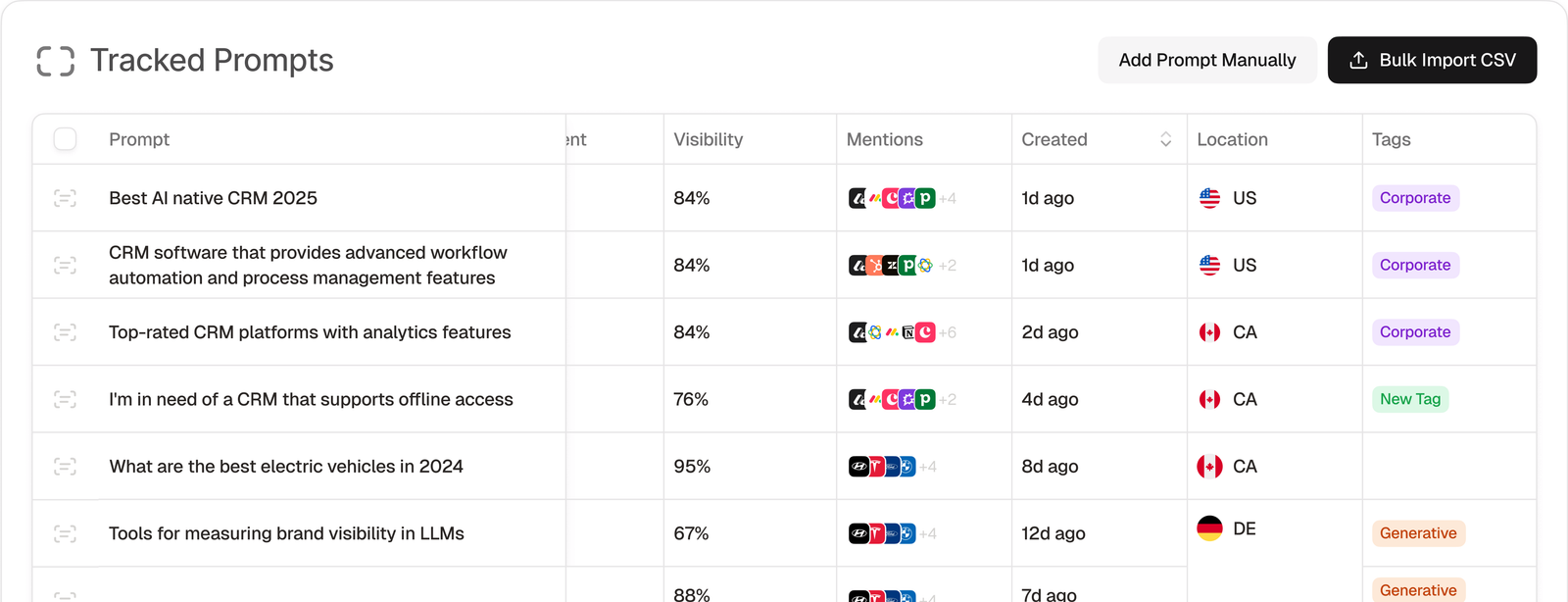
Peec AI focuses on how brands appear in AI-generated answers.
Its reporting includes brand visibility, share of voice, sentiment, competitor comparisons, source analysis, and prompt-level observations.
Peec also emphasises collaboration, with unlimited users included across its self-service plans.
That can be useful for in-house marketing teams that want SEO specialists, brand managers, and content editors reviewing the same GEO data.
What Do You Get for the Price?
Peec currently documents three main self-service tiers.
| Plan | Prompts | Selected Models | Projects |
|---|---|---|---|
| Starter | 50 | 3 | 1 |
| Pro | 150 | 3 | 2 |
| Advanced | 350 | 3 | 5 |
All three advertise daily tracking and unlimited users.
Advanced also includes broader reporting capabilities, multi-country support, and Looker Studio integration. Additional AI models can be purchased separately, while Enterprise supports customised monitoring and a wider selection of models.
The current publicly accessible pricing page doesn’t consistently expose the subscription amounts. For that reason, readers should verify the current checkout price rather than rely on an older quoted figure.
When Is Peec Worth Paying For?
Peec may be particularly relevant to businesses where competitive positioning and brand perception are the primary concerns.
For example, a SaaS company could examine how AI assistants compare its product with competing platforms, investigate which features appear in those answers, and identify the sources associated with relevant recommendations.
However, a large volume of brand mentions doesn’t automatically represent positive product recommendations.
Users should examine the underlying responses and confirm how Peec calculates its visibility and share-of-voice metrics.
What Are the Limitations?
The three-model allowance means businesses requiring broad platform coverage may need additional purchases.
Buyers should also review reporting requirements before choosing a tier, particularly when they need multiple projects, countries, or automated reporting.
Verdict: A relevant option for collaborative marketing teams prioritising AI brand monitoring and competitor research.
6. Ahrefs Brand Radar: Best for Competitive and Source Intelligence
Starting price: $50/month for Custom Prompts; $199/month for the AI Visibility Index
Ahrefs Brand Radar offers two distinct forms of GEO research.
Custom Prompts monitors specific questions that a business wants to track, while the AI Visibility Index provides access to a much larger dataset of collected responses.
The distinction matters because businesses may need different kinds of evidence.
A company launching a niche product may want to monitor a small group of commercial questions. An established brand might instead want to understand the broader topics and competitor patterns associated with AI search visibility.
What Do You Get for the Price?
Ahrefs advertises Custom Prompt packages beginning at $50 per month, with 2,500 checks included in its entry package.
Additional options provide higher checking allowances. The broader AI Visibility Index starts at $199 per month.
Existing paid Ahrefs subscriptions also include limited Custom Prompt monitoring. For example, Lite currently includes five daily prompts, while Standard and Advanced have larger allowances.
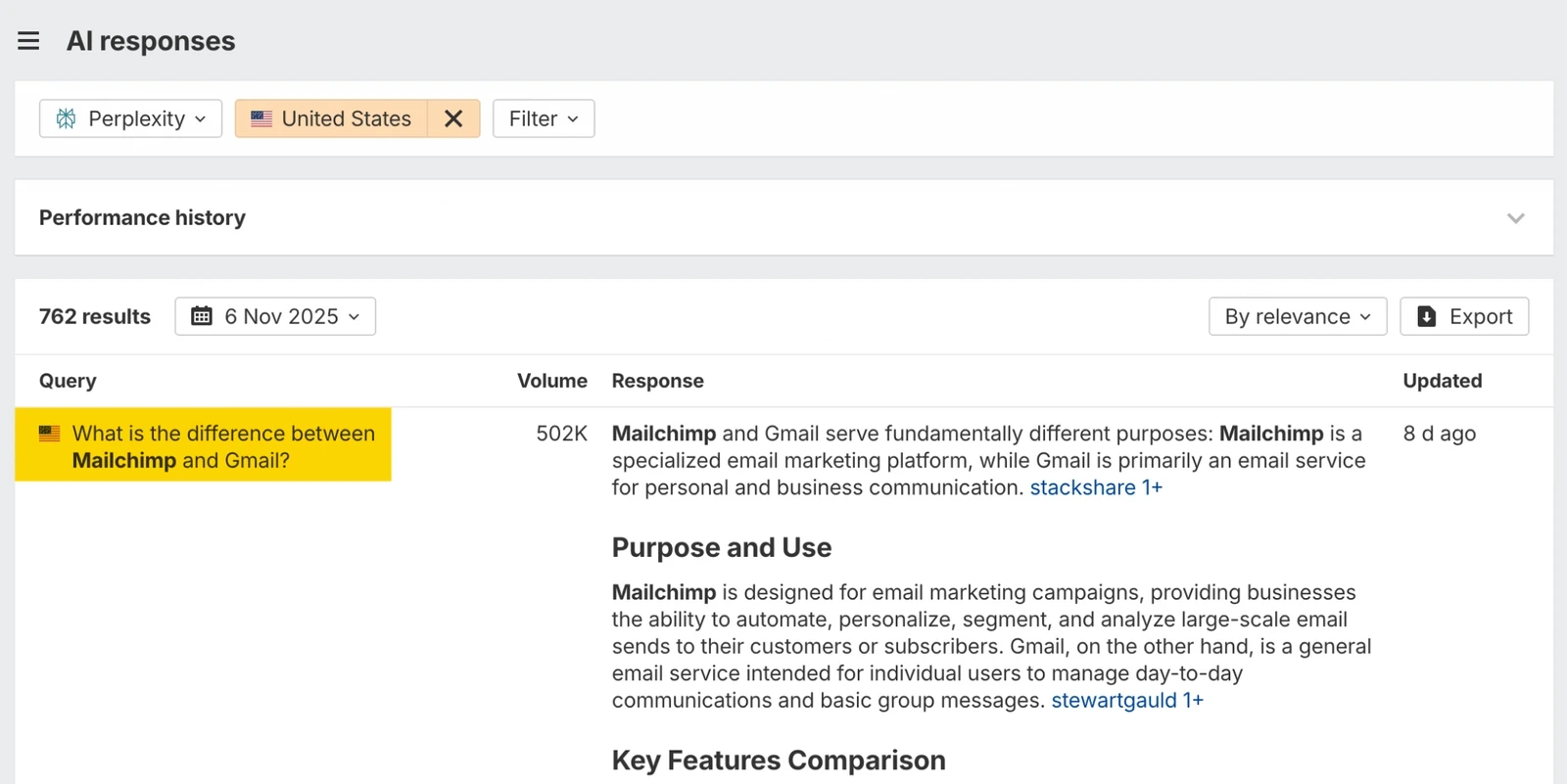
Brand Radar’s documented features include brand mentions, source citations, historical responses, competitor analysis, and distinctions between visibly cited sources and pages encountered during retrieval.
When Is Ahrefs Worth Paying For?
Ahrefs can be especially useful when GEO research needs to connect with existing keyword, backlink, and competitive SEO analysis.
For example, a content publisher could identify which competing domains appear as AI sources and then investigate their articles, backlink profiles, and relevant search topics.
The wider AI Visibility Index may also provide useful market context without requiring the team to configure every question manually.
However, the Index’s estimated impressions are modelled figures derived from Ahrefs’ methodology, not direct first-party records of how many real AI users saw a response.
What Are the Limitations?
Custom Prompts and the AI Visibility Index serve different purposes and are priced separately.
Businesses should avoid comparing the $50 Custom Prompt package directly with a competitor’s full multi-platform analytics subscription without checking the included platforms, response volumes, and reporting access.
Verdict: Worth evaluating for established SEO teams that need AI visibility research alongside broader competitive and source analysis.
7. Semrush AI Visibility: Best for GEO Within an Existing SEO Stack
Starting price: $99/month per domain with annual billing
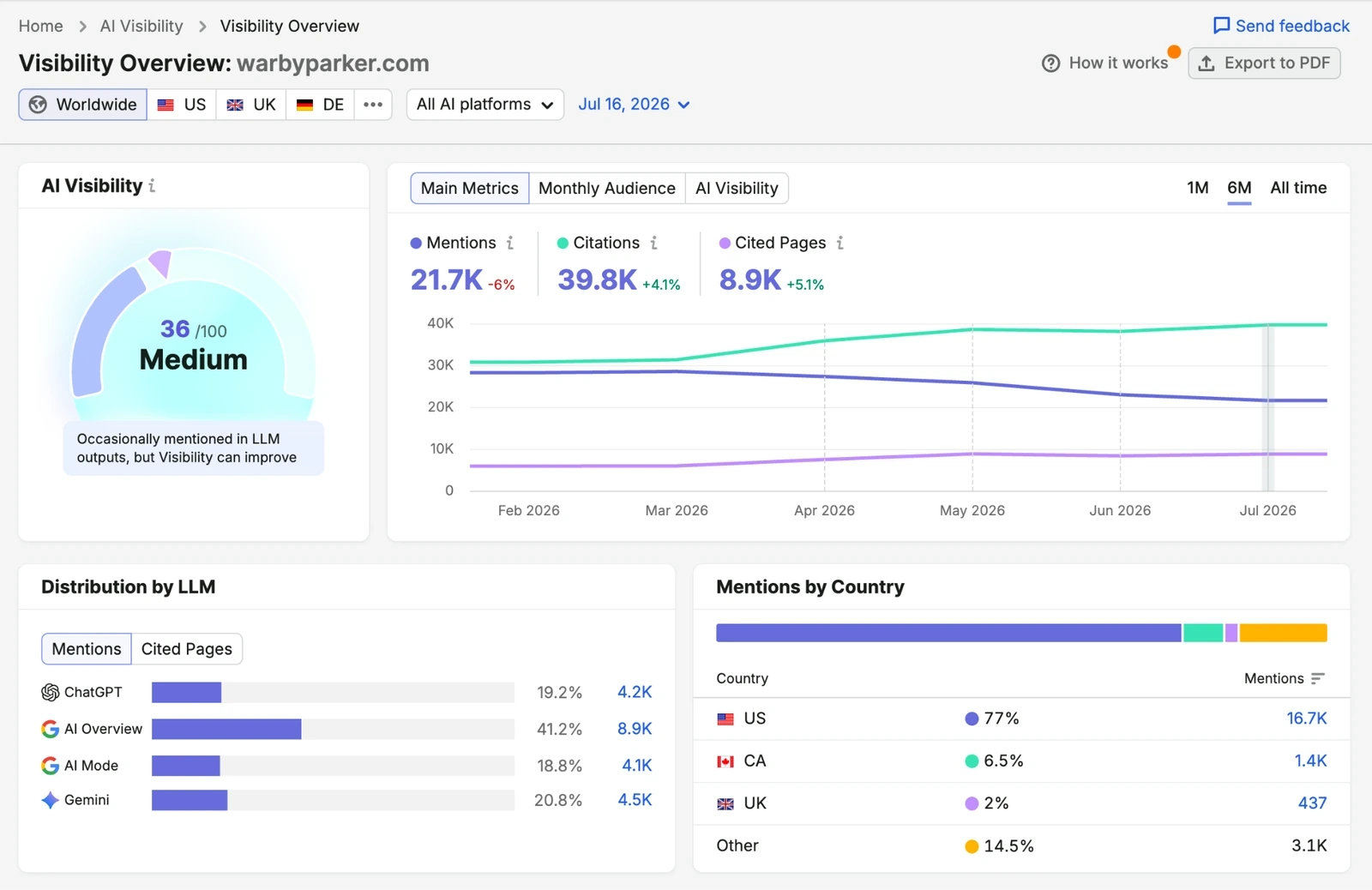
Semrush AI Visibility monitors brand mentions, competitors, sentiment, prompts, and related AI search visibility information.
Its main advantage is its connection with Semrush’s established SEO and competitive intelligence ecosystem.
For agencies or in-house teams already using Semrush, adding GEO functionality may be simpler than adopting a separate reporting environment.
However, its pricing and feature limits need to be considered carefully.
What Do You Get for the Price?
The Base AI Visibility subscription is advertised at $99 per month per domain when billed annually.
It includes 25 custom tracked prompts, AI visibility and competitor research, Brand Performance analysis for one domain, prompt research, and AI-related site auditing.
Semrush also offers broader SEO and AI search packages with different monitoring limits.
These should not be confused with the standalone AI Visibility Toolkit, which has its own subscription conditions.
When Is Semrush Worth Paying For?
Semrush may provide value when a business already relies on its research environment for keyword analysis, competitor studies, and technical SEO.
A marketing team could investigate the prompts associated with a competitor’s AI visibility and then use existing SEO research to evaluate related pages and topics.
This workflow may reduce the need to maintain separate research systems.
What Are the Limitations?
The advertised starting price requires annual billing, and the Base subscription covers one domain for Brand Performance.
Its 25-prompt allowance may be restrictive for businesses with several products or target markets. Additional domains or prompt capacity can increase the total cost.
Another important distinction is that the standalone AI Visibility Toolkit doesn’t currently offer its own free trial. Other Semrush packages, including Semrush One, may have different trial conditions.
Verdict: Worth considering when GEO reporting fits naturally into an established Semrush workflow and its subscription structure matches the business’s needs.
8. Scrunch: Best for GEO Monitoring With Website and Agent-Traffic Analysis
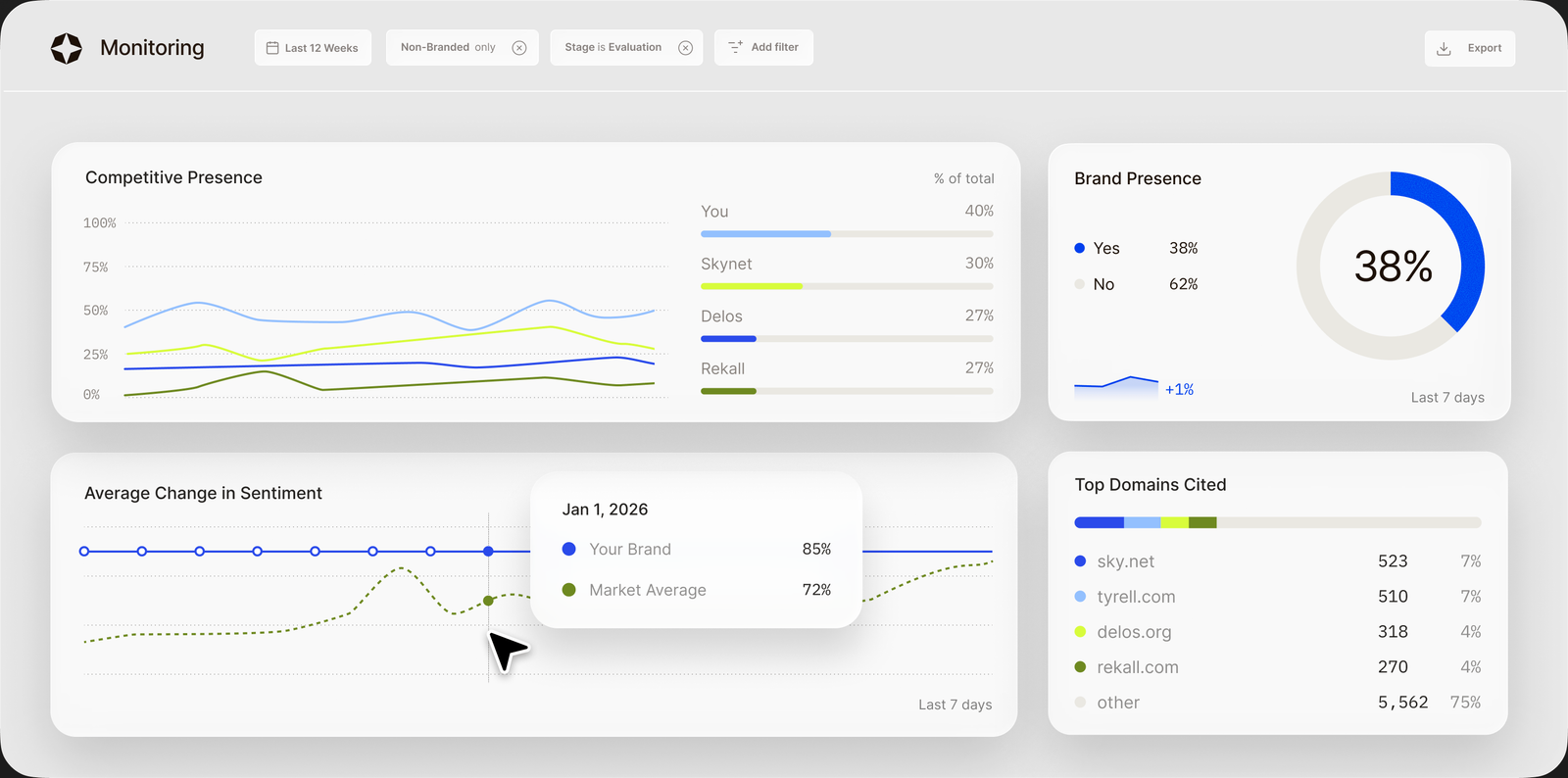
Starting price: $300/month, or $250/month with annual billing
Scrunch combines AI search visibility monitoring with citation research, website analysis, and tools for investigating AI-agent activity.
Its approach extends beyond tracking whether a brand appears in generated answers.
For example, a business may want to investigate how AI systems reference its webpages and whether technical accessibility or content issues deserve attention.
Scrunch provides monitoring and auditing features that can support those investigations within one platform.
What Do You Get for the Price?
| Plan | Monthly Billing | Annual-Billed Monthly Equivalent |
|---|---|---|
| Starter | $300/month | $250/month |
| Growth | $500/month | $417/month |
| Enterprise | Custom | Custom |
Starter includes 350 custom prompts, 1,000 industry prompts, three personas, five page audits, and three user licences.
Growth expands those allowances and adds additional reporting and support capabilities.
The platform supports several AI experiences, including ChatGPT, Claude, Gemini, Perplexity, Google AI Mode, and Google AI Overviews.
Scrunch also advertises a seven-day trial of Starter without requiring a credit card.
When Is Scrunch Worth Paying For?
Scrunch is relevant when a business needs structured AI visibility monitoring alongside technical and website-level investigation.
For example, an established ecommerce company could monitor how competitors appear within relevant AI answers and investigate whether its own product pages provide the necessary information.
Its agent-traffic functionality may also offer useful context about certain AI-related requests and visits to the website.
However, those observations should not be treated as proof that a specific AI-generated answer produced a sale.
What Are the Limitations?
Scrunch is considerably more expensive than entry-level GEO monitoring products.
The value depends on whether the organisation actually uses its auditing, reporting, and agent-related functionality.
Businesses seeking only a small number of recurring brand checks may find a specialist lower-cost product more appropriate.
Verdict: Worth considering for teams that want a more comprehensive AI search monitoring and website investigation workflow.
9. Profound: Best for Enterprise GEO and Citation Intelligence
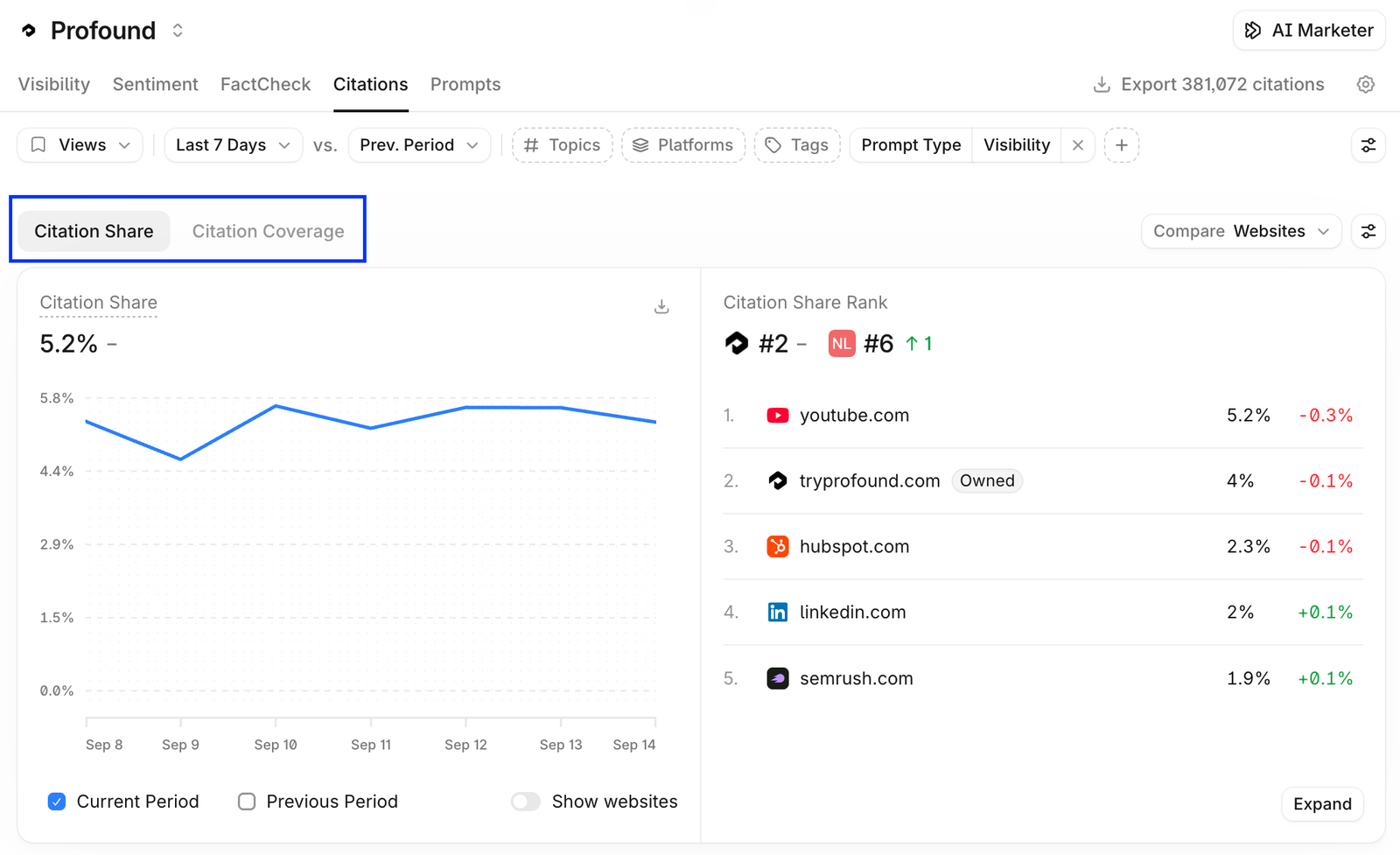
Starting price: Custom enterprise pricing
Profound offers AI search monitoring, source citation intelligence, competitive research, and AI-powered marketing workflows.
Its Answer Engine Insights product examines how brands and websites appear across supported AI experiences.
Profound also provides broader AI marketing functions, including agents and reusable workflows designed to help teams work with their visibility findings.
This makes it different from products that primarily collect prompts and display charts.
What Do You Get for the Price?
Profound currently advertises a seven-day trial with fifty monitored prompts collected daily across ChatGPT, Gemini, and Google AI Overviews.
However, its trial uses a recommended prompt set rather than unrestricted custom-prompt configuration.
Paid Enterprise subscriptions use customised pricing. They can include tailored monitoring, broader answer-engine coverage, dedicated support, additional agent credits, and enterprise security capabilities.
The specific commercial arrangement depends on the organisation’s requirements.
When Is Profound Worth Paying For?
Profound is relevant to established brands that need detailed source analysis, competitive research, and workflows connecting AI visibility observations with recurring marketing work.
For example, a publisher may want to examine citation patterns across its content portfolio, while an enterprise brand may need to investigate how its products are described across several markets.
The ability to organise those findings and connect them with marketing operations can be valuable when the organisation has the resources to act on the information.
What Are the Limitations?
Enterprise pricing makes it difficult to compare Profound’s cost directly with fixed-price GEO tools without obtaining a quote.
Businesses should establish the required prompt capacity, platforms, reporting features, integration needs, and agent usage before evaluating the commercial offer.
The trial’s predefined prompts also limit how closely its initial observations can be compared with products that allow fully customised testing.
Verdict: A relevant option for enterprise teams requiring extensive citation intelligence and operational GEO workflows rather than a basic visibility dashboard.
Which Paid GEO Tool Is Actually Worth the Money?
The right subscription depends on what your team expects to do with the data.
A product that provides thousands of responses may offer little value if those observations concern irrelevant questions. Conversely, a small prompt allowance can be useful when it covers the decisions customers make before buying.
The following distinctions are more important than choosing a product solely by its position in a numbered list.
| Buying Priority | Tools Worth Evaluating | Main Consideration |
|---|---|---|
| Lowest-cost focused monitoring | Otterly.AI | Can 15 prompts cover your needs? |
| Integrated marketing tools | Digimetrics | Are shared credits sufficient? |
| Configurable monitoring frequency | Rankscale | What will the required engine checks cost? |
| Dedicated brand and competitor analytics | SE Visible, Peec AI | Are markets, models, and projects covered? |
| Broader AI source and competitor research | Ahrefs Brand Radar | Do you need Custom Prompts or the Index? |
| Existing Semrush-based SEO workflow | Semrush AI Visibility | Are domain and prompt allowances sufficient? |
| AI visibility with website audits | Scrunch | Will the additional capabilities be used? |
| Enterprise citation intelligence | Profound | What is included in the custom contract? |
These recommendations concern documented product positioning rather than independently verified accuracy rankings.
For businesses with smaller budgets, our GEO tools for small businesses comparison examines affordability and practical monitoring requirements in more detail.
How to Calculate the Real Cost of Paid GEO Software
The subscription price is only one part of the purchasing decision.
A GEO platform may advertise hundreds of prompts, thousands of credits, or a large AI visibility database. However, those allowances are not interchangeable.
To compare costs fairly, calculate how much monitoring your team actually needs and how much work is required to turn the results into useful decisions.
Compare Monitoring Capacity, Not Just Advertised Prices
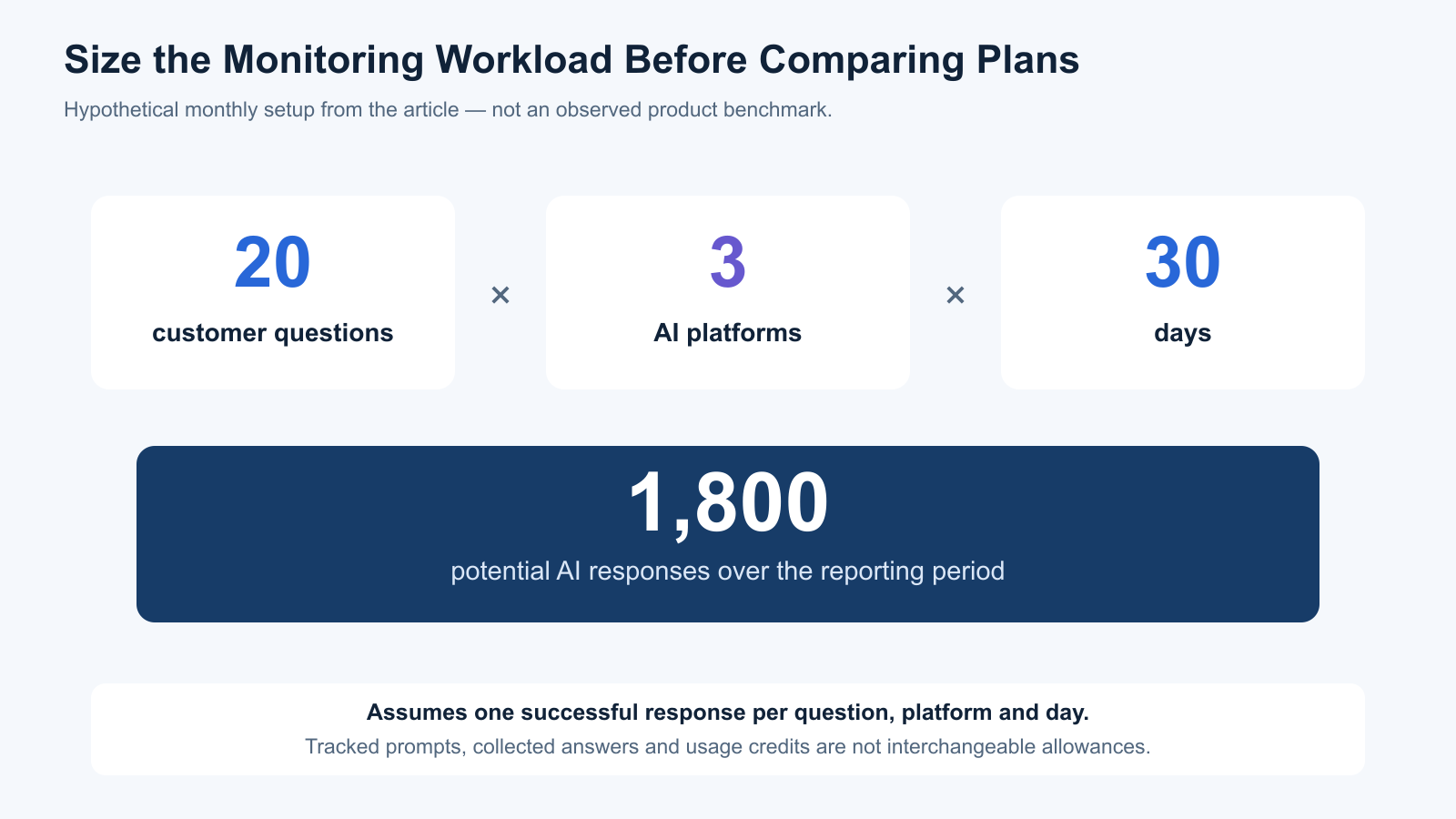
Consider a hypothetical software company monitoring twenty questions across three AI platforms every day.
Over a thirty-day reporting period, that creates:
20 prompts × 3 AI platforms × 30 days = 1,800 potential AI responses
Different vendors may charge for this workload in different ways.
Some count tracked prompts with selected platform bundles. Others deduct credits for every response collected, with costs varying by AI engine. Certain plans also restrict projects, markets, or reporting frequency.
A subscription offering 200 prompts doesn’t necessarily provide the same collection volume as another offering 1,200 credits.
Always calculate the expected usage under the vendor’s actual billing model.
Include Add-Ons and Plan Restrictions
The published starting price may not include everything the team needs.
Additional costs can arise from extra AI engines, monitored domains, users, countries, historical data, exports, or higher usage limits.
For example, a business monitoring Google AI Mode should confirm whether that experience is included in its selected plan rather than assuming that Google AI Overviews coverage also includes AI Mode.
Similarly, an agency should verify whether every client requires a separate project, workspace, or subscription.
These restrictions can make a seemingly affordable entry plan less economical as the workload grows.
Calculate Cost per Useful Finding
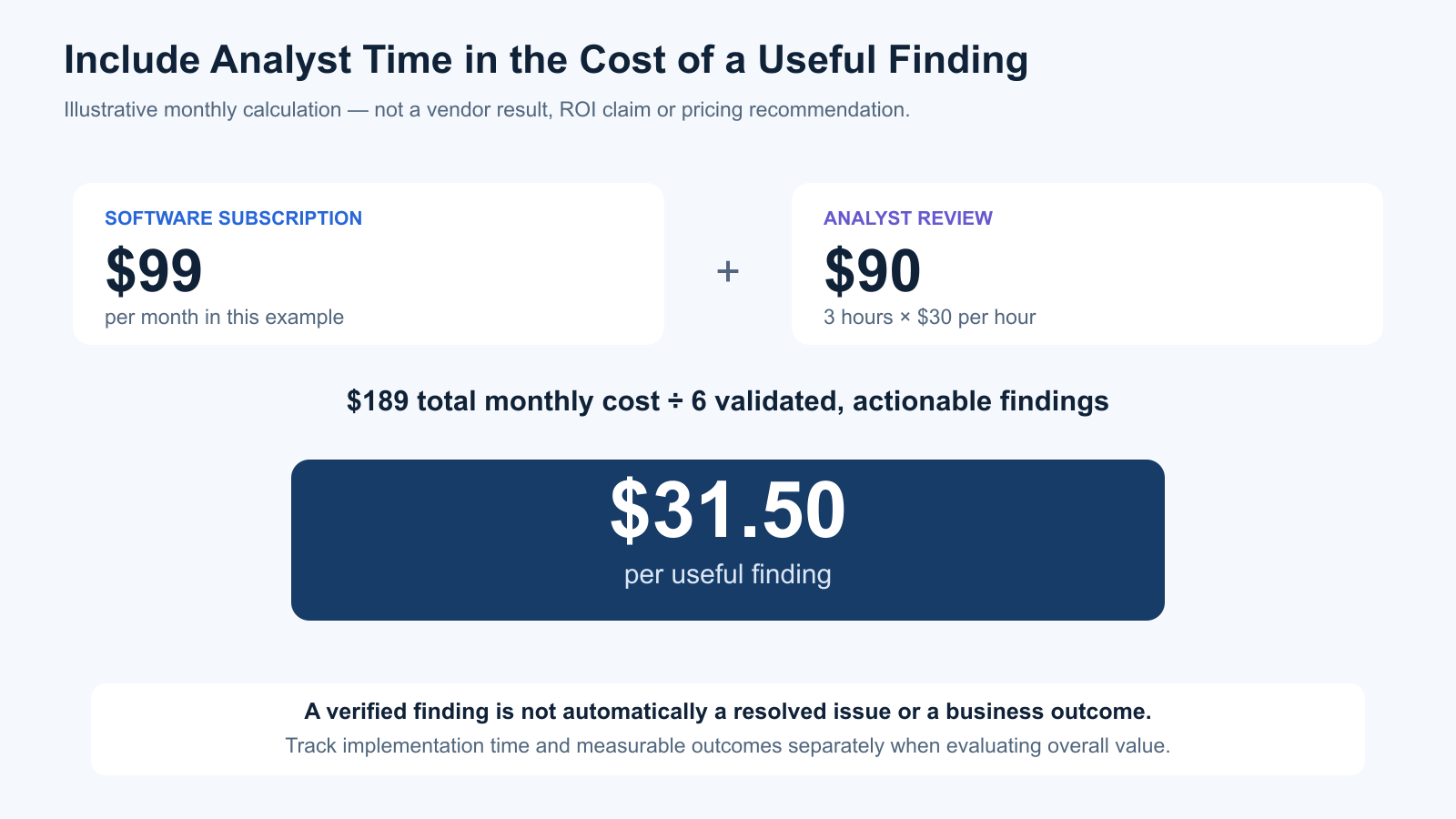
A helpful purchasing metric is the cost of producing a finding your team can verify and act on.
Consider this hypothetical monthly workflow:
| Cost or Outcome | Illustrative Amount |
|---|---|
| GEO software subscription | $99 |
| Analyst review time | 3 hours |
| Analyst hourly cost | $30 |
| Total monthly cost | $189 |
| Validated, actionable findings | 6 |
| Cost per useful finding | $31.50 |
This is an illustrative calculation, not an observed benchmark or result from a particular vendor.
The objective isn’t to maximise the number of issues a platform flags.
A report listing fifty generic suggestions may be less valuable than one identifying five meaningful content, technical, or positioning problems that the team can verify.
However, even a verified finding isn’t automatically a resolved issue. Implementation time and business outcomes should be tracked separately when evaluating a platform’s overall return on investment.
How We Recommend Testing Paid GEO Tools
A useful evaluation should determine whether the software produces dependable evidence under conditions relevant to the business.
The following process can support a purchasing decision without pretending that one short trial reveals universal accuracy.
Prepare a Consistent Set of Customer Questions
Before opening a trial account, identify questions associated with your products, services, and customers.
For a fictional ecommerce software company, this might include product comparison questions, integration requirements, troubleshooting topics, and general purchasing considerations.
Include branded and non-branded prompts. Monitoring only questions that explicitly name your business can produce misleadingly high brand visibility.
A pilot using twenty to thirty questions can provide an initial assessment, although it isn’t a statistically representative sample of all AI searches.
Keep Platforms and Collection Settings Comparable
Where supported, use the same questions, AI experiences, markets, languages, and collection periods across the tools being evaluated.
A response from ChatGPT Search shouldn’t automatically be treated as directly equivalent to one collected from Gemini or Google AI Mode.
Products may also use different collection methods, which can affect the resulting answers.
Record these differences rather than presenting every dashboard percentage as though it measures the same thing.
Verify Brand Mentions and Citations
Open a sample of actual responses and check whether each tool identifies brands and sources correctly.
A company might be mentioned as an unsuitable option, for example. That may count as a brand mention but shouldn’t automatically be interpreted as a positive recommendation.
Citation analysis requires similar care. Some tools record visible source links, while others distinguish retrieved pages from those actually cited.
For a deeper explanation, see our guide to AI citation tracking tools.
Test the Reporting Workflow
Create the type of report your business would use after purchasing.
Can you investigate competitor appearances, examine cited URLs, export relevant information, and explain the findings without extensive manual corrections?
The ability to inspect source evidence and maintain consistent historical records is often more useful than another proprietary score.
Also measure how long the evaluation takes, since a platform that requires several hours of manual work each week may be less practical than its subscription price initially suggests.
Assess Ongoing Costs Before Buying
Use the trial to estimate the monitoring volume and reporting capacity required over a normal month.
Review plan restrictions carefully, including prompt allowances, engine coverage, usage credits, and additional fees.
If the trial’s limits differ from the paid plan, calculate the purchasing decision using the paid configuration rather than assuming the trial allowance will continue unchanged.
Our comparison of GEO tools with free trials provides more detail on trial availability and access conditions.
Do You Really Need a Paid GEO Tool?
Not every business needs a dedicated GEO subscription immediately.
Google Search Console now provides dedicated generative-AI performance reporting for supported Google Search experiences, while Bing Webmaster Tools offers first-party AI citation data for eligible verified websites.
These reports provide valuable information without another subscription.
However, they don’t replace cross-platform brand monitoring.
A company wanting to compare its products against competitors in ChatGPT, Perplexity, and Google AI Mode may still need a specialist monitoring system.
When Free GEO Tools Are Enough
Free reporting may be sufficient when a business is beginning to investigate AI search, has limited content production, or only needs occasional checks.
A smaller website might review first-party reports monthly and manually examine a few important customer questions.
If the team cannot identify a recurring decision that requires more detailed monitoring, a paid platform may introduce unnecessary cost.
When a Paid Subscription Makes Sense
Paid GEO software becomes more useful when the business needs recurring response collection, larger prompt sets, historical data, competitor comparisons, client reporting, or workflow integrations.
For an agency, automatic reports and multi-project monitoring may save enough manual effort to justify the expense.
For an established ecommerce or software business, detailed brand and citation research may support decisions involving important product categories.
However, the data should lead to useful work. More monitoring is not automatically better when the organisation lacks the resources to act on the findings.
For businesses still evaluating no-cost options, see our guide to free GEO tools. Verify that the linked article is published before adding the internal link.
What Makes a Paid GEO Tool Good Value?
The strongest paid GEO platforms make their measurements understandable.
A dashboard can display an impressive visibility percentage, but that number provides limited information if the user cannot inspect the original questions, generated answers, citations, or collection dates.
Similarly, monitoring more AI platforms isn’t automatically more useful if the business’s audience primarily relies on a smaller set of experiences.
Clear Measurement Definitions
A tool should explain how it counts brand mentions, source citations, competitor appearances, and share of voice.
Different products use different denominators and weighting systems, so their scores may not be directly comparable.
For example, a brand’s appearance in thirty percent of monitored responses doesn’t mean thirty percent of all AI users encountered that brand.
The result describes the monitored dataset.
Relevant AI Search Coverage
The selected AI platforms should reflect the business’s actual research needs.
A publisher may care about source citations across Google AI experiences, while a SaaS company may focus on product recommendations in ChatGPT and Perplexity.
Geographic market and language support can also be critical.
Don’t pay for broad coverage simply because the subscription advertises a large number of supported models.
Evidence Behind Recommendations
GEO tools may suggest content updates, technical improvements, or new topic opportunities.
Those suggestions should be checked against the original evidence and the business’s actual priorities.
A missing citation doesn’t automatically mean a page has a technical problem. Likewise, a competitor appearing in one response isn’t proof that its website provides better information overall.
The most valuable tools help marketers investigate those possibilities rather than presenting guesses as confirmed explanations.
Reporting That Supports Business Outcomes
A GEO report should ideally connect visibility observations with meaningful follow-up work.
Where attribution is available, website analytics can also provide information about identifiable AI-related referral visits and conversions.
However, citations and mentions shouldn’t be treated as revenue measurements.
A business may gain source visibility without receiving a click, while a later purchase may not be directly attributable to a particular AI answer.
Our SEO tools guide explains how AI visibility reporting fits alongside conventional keyword research, technical SEO, and first-party website performance.
Final Verdict: Which Paid GEO Tool Should You Choose?
The best paid GEO tool in 2026 depends on the work your business actually needs to perform.
Otterly.AI is worth considering when the main requirement is straightforward, dedicated monitoring of a small prompt set. Digimetrics may provide broader value when GEO needs to connect with SEO, technical auditing, and content workflows.
Rankscale offers flexibility for teams comfortable managing credits and monitoring schedules, while SE Visible and Peec AI focus on structured brand visibility and competitor reporting.
Ahrefs Brand Radar is relevant when GEO research needs to connect with broader competitive intelligence. Semrush AI Visibility may suit teams already invested in its SEO ecosystem.
For organisations requiring more extensive workflows, Scrunch combines monitoring with website and agent-related analysis, while Profound provides enterprise-oriented citation intelligence and marketing operations.
However, there is no defensible basis for declaring one product universally more accurate without a controlled comparison using equivalent prompts, platforms, collection periods, and scoring methods.
Before subscribing, define the information your team needs, estimate the actual monitoring workload, test the response evidence, and compare the total monthly cost.
The best paid GEO software isn’t necessarily the product with the most features or the highest price. It’s the one that provides useful evidence, saves worthwhile time, and helps your team make better marketing decisions.
Frequently Asked Questions
What Is the Best Paid GEO Tool in 2026?
The best choice depends on your requirements. Otterly.AI offers focused GEO monitoring, Digimetrics combines GEO with broader marketing tools, and Rankscale provides flexible credit-based tracking. SE Visible and Peec AI focus on brand visibility, while Ahrefs, Semrush, Scrunch, and Profound serve different competitive research and enterprise needs.
How Much Does a Paid GEO Tool Cost?
Paid GEO software ranges from entry-level subscriptions under $50 per month to enterprise platforms with customised pricing. Otterly.AI starts at $29 monthly, Digimetrics at $39, SE Visible at $99, and Rankscale Pro at $99. Actual costs depend on monitoring limits, billing terms, models, markets, and additional features.
Are Paid GEO Tools Better Than Free GEO Tools?
Paid tools usually offer more recurring monitoring, historical records, competitor research, and reporting flexibility. However, free first-party tools such as Google Search Console and Bing Webmaster Tools provide different evidence that commercial monitoring platforms don’t automatically replace. A paid subscription is worthwhile when its additional capabilities support a recurring business need.
What Is the Cheapest Paid GEO Tool?
Otterly.AI currently advertises a $29 monthly Lite plan with 15 tracked prompts, while Digimetrics offers a $39 monthly Starter plan using shared credits across its toolkit. Rankscale advertises a lower-priced annually billed Essentials tier, but the monitoring-credit arrangements must be checked separately before comparing its actual operating cost.
Is Digimetrics Worth Paying For?
Digimetrics may be worth considering when a business wants GEO analysis alongside technical SEO, keyword research, content optimisation, and other marketing tools. Its Starter plan costs $39 monthly with 500 credits. However, the value depends on how many tools the business actually uses and whether its credit allowance supports the required workflow.
Can Paid GEO Tools Track ChatGPT Brand Mentions?
Yes. Several paid GEO platforms monitor selected ChatGPT-related responses and record whether brands or competing products appear. However, they generally analyse configured prompts or collected datasets rather than every private ChatGPT conversation. Reported visibility should therefore be interpreted within the monitoring methodology.
Is Ahrefs Brand Radar Better Than Semrush AI Visibility?
The products serve overlapping but different research needs. Ahrefs Brand Radar separates custom prompt tracking from a broader AI Visibility Index, while Semrush offers brand performance, competitor research, and prompt monitoring within its wider SEO environment. A fair comparison requires equivalent prompts, platform coverage, and reporting conditions.
What GEO Features Are Worth Paying For?
Recurring prompt monitoring, source-level citation evidence, competitor comparisons, historical response records, and exportable reporting are among the most useful paid capabilities. The priority depends on the business. Features that aren’t regularly used or don’t support practical decisions may not justify a higher subscription cost.
How Do I Measure the ROI of Paid GEO Software?
Start by calculating subscription fees, add-ons, analyst time, and the cost of implementing recommendations. Then evaluate the validated findings and any measurable business outcomes associated with the workflow. Brand mentions and citations aren’t direct revenue measurements, so avoid attributing sales to AI visibility without supporting evidence.
Do Paid GEO Tools Guarantee Better AI Search Rankings?
No. Paid GEO tools provide research, monitoring, and optimisation guidance, but they don’t control how AI systems select brands or cite webpages. Improvements to content, technical accessibility, or product information may be worthwhile, but no GEO subscription guarantees rankings, recommendations, website traffic, or revenue.
Disclosure: digitalmarketingtools.ai is sponsored by Digimetrics.ai. Sponsored Highlights are clearly labelled advertising. Our reviews, comparisons and guides are written to be useful and fair regardless of who sponsors the site. Read the full disclosure.