9 Best GEO Tools for Enterprises in 2026: Security, Scale & AI Visibility

A marketing team notices that ChatGPT recommends a competitor instead of its product. Another discovers that Google AI Overviews consistently cites third-party publications when explaining its industry, even though the company maintains an extensive library of original research.
For a small business, investigating these results might involve monitoring twenty questions and reviewing a few competitor mentions.
For an enterprise operating across multiple brands, product lines, and geographic markets, the problem becomes considerably more complicated.
The company may need to monitor thousands of relevant questions across several AI platforms, distinguish branded mentions from genuine recommendations, investigate inaccurate product claims, and compare results across countries. Meanwhile, regional marketers, legal teams, content specialists, and executives all need different levels of access to the same information.
That’s where enterprise Generative Engine Optimization (GEO) tools become useful.
Platforms such as Profound, Conductor, BrightEdge, Peec AI, and Semrush now offer different ways to monitor how brands appear in AI-generated answers. Some focus on source citations and brand perception, while others integrate GEO with technical SEO, content workflows, web analytics, or AI-agent activity.
However, the best GEO tools for enterprises in 2026 isn’t simply the platform that tracks the most prompts. It should provide dependable evidence, accommodate enterprise security requirements, support multiple business units, and make the findings useful to the teams responsible for improving performance.
This guide compares nine relevant platforms, their documented enterprise capabilities, commercial considerations, and limitations. We’ll also explain how to evaluate security, reporting quality, data coverage, and total operating costs before signing a contract.
Editorial disclosure: DigitalMarketingTools.ai is sponsored by Digimetrics.ai, developed by MediaOne. Digimetrics is included as a lower-cost supplementary option rather than presented as a proven replacement for established enterprise GEO platforms. This is a documentation-based comparison, not a completed controlled benchmark of the nine vendors.
Key Takeaways
- Profound is a strong starting point for enterprises prioritising dedicated AI search intelligence, brand accuracy, and governance. Its enterprise offering documents SOC 2 Type II compliance, SSO, role-based access control, and API integration.
- Conductor is particularly relevant when GEO needs to work alongside an existing enterprise SEO and content programme. Its platform connects AI visibility reporting with search intelligence, website performance, and content workflows.
- BrightEdge is worth evaluating for organisations interested in AI search intelligence and AI-agent interactions. Its AI Hyper Cube and AI Agent Insights products address brand visibility and how automated agents access website content.
- Semrush Enterprise AIO is suitable for established marketing organisations wanting AI search analysis within an enterprise SEO ecosystem. It offers a broader alternative to purchasing standalone GEO reporting.
- Peec AI has a particularly clear multi-brand and multi-country workflow, including project-level access, SSO, APIs, and BI integrations. However, its SOC 2 Type II audit and ISO 27001 certification were still in progress at the time of review.
- Scrunch combines AI visibility with agent experience and technical website analysis, supported by custom enterprise workspaces, SSO, and integrations.
- Ahrefs Brand Radar is useful for broad AI visibility research and source analysis, particularly where the organisation already relies on Ahrefs for traditional SEO.
- SE Ranking offers a practical route for larger SEO teams that aren’t ready for a separate enterprise GEO procurement. Its AI Results Tracker, SE Visible, and APIs connect conventional and AI search workflows.
- Digimetrics can support departmental pilots and integrated SEO/GEO analysis, but its published plans should not be confused with verified enterprise-level governance and monitoring capacity.
No vendor can guarantee that an AI assistant will recommend a specific brand or cite a particular webpage. GEO software provides evidence to investigate visibility and opportunities, not direct control over AI-generated answers.
What Makes an Enterprise GEO Tool Different?
Generative Engine Optimization tools help organisations understand whether and how their brands, websites, and content appear in AI-generated search experiences.
Depending on the product, these tools monitor selected questions, analyse collected AI responses, identify brand mentions, record citations, compare competitors, and investigate how AI systems describe products or services.
Our complete guide to GEO tools explains these core capabilities.
Enterprise buyers, however, need to consider several additional requirements that may not matter to an individual marketer.
Multi-Brand and Multi-Market Management
An enterprise might manage several consumer brands, regional websites, product divisions, or subsidiaries.
Each business unit may serve a different audience and compete with different companies.
For example, a global software company may need separate GEO monitoring for its US, Singapore, German, and Japanese markets. Comparing these regions requires more than adding another country filter.
The company may need separate prompt sets, local competitors, languages, product names, and reporting responsibilities.
A suitable platform should support this complexity without requiring marketers to combine dozens of disconnected spreadsheets.
Security and Access Controls
Enterprise GEO software may process commercially sensitive information, including planned products, internal marketing strategies, unpublished content, or proprietary customer research.
Security and procurement teams therefore need to understand how the vendor stores data, controls access, manages integrations, and handles deletion requests.
Features such as SSO, role-based access control, audit logs, documented retention policies, and independent security assessments can become purchasing requirements rather than optional conveniences.
A vendor’s marketing description of “enterprise-grade security” is not sufficient evidence by itself.
Reporting Across Departments
GEO performance can involve SEO, communications, content, product marketing, regional teams, and executive leadership.
Each group needs different information.
An SEO specialist may investigate which webpages are cited, while a brand manager may focus on inaccurate product descriptions. An executive may only need to understand important changes, business risks, and recommended actions.
Enterprise platforms should therefore support flexible reporting, shared definitions, reliable exports, and integration with established business-intelligence tools.
Scale and Predictable Costs
A subscription that supports 100 tracked prompts may be sufficient for one brand.
An enterprise could need thousands of configured questions multiplied across AI platforms, countries, languages, and monitoring schedules.
That creates a pricing problem because vendors use different billing units.
Some charge by prompt, response, AI engine, workspace, or credit. Others negotiate contracts based on expected monitoring volume and additional enterprise services.
Comparing subscription prices without normalising the workload can produce misleading conclusions.
9 Best GEO Tools for Enterprises in 2026: Quick Comparison
The following shortlist focuses on documented capabilities and suitability for different enterprise workflows. The numbers organise the comparison rather than represent measured performance rankings.
| GEO Tool | Best Enterprise Use Case | Notable Capability | Pricing |
|---|---|---|---|
| 1. Profound | Dedicated enterprise AI search intelligence | Brand accuracy, SSO, RBAC, API, response research | Custom enterprise quote |
| 2. Conductor | Combined enterprise SEO and GEO | AI Search Performance, content and website analytics | Request quote |
| 3. BrightEdge | Enterprise AI search and agent intelligence | AI Hyper Cube, AI Catalyst, AI Agent Insights | Request quote |
| 4. Semrush Enterprise AIO | Enterprise SEO and AI visibility consolidation | AI search research, competitive intelligence, reporting | Custom enterprise quote |
| 5. Peec AI | Global multi-brand AI visibility monitoring | Multi-country projects, SSO, API, BI integrations | Custom annual quote |
| 6. Scrunch | GEO and AI-agent website analysis | Agent Experience Platform, audits, SSO, API | Custom enterprise quote |
| 7. Ahrefs Brand Radar | Broad competitive AI visibility research | Large response index, source analysis, custom prompts | AI Visibility Index from $199/mo; Enterprise requirements vary |
| 8. SE Ranking + SE Visible | Scaled SEO teams integrating GEO | AI Results Tracker, strategic brand analysis, APIs | Subscription and custom usage packages |
| 9. Digimetrics | Departmental GEO pilots and integrated marketing analysis | SEO/GEO tools, projects, exports and shared credits | Expert $199/mo; enterprise fit unverified |
Pricing and features were reviewed against available vendor documentation on October 20, 2026. Enterprise proposals may have different terms, capacity limits, and security provisions. Prices are in USD unless otherwise indicated.
How We Evaluated Enterprise GEO Tools
Our evaluation focuses on whether a product can support an enterprise GEO programme, not simply whether it provides an AI visibility score.
We examined public documentation covering monitoring capabilities, governance, reporting, integrations, and purchasing requirements.
The following weights provide a suggested framework for enterprise buyers. They are not numerical test scores assigned to these products.
| Evaluation Criterion | Suggested Weight | What to Investigate |
|---|---|---|
| Security and governance | 20% | SSO, RBAC, security evidence, data handling |
| Global and multi-brand scale | 20% | Projects, countries, languages, brand separation |
| Data quality and transparency | 20% | Source responses, methodology, historical evidence |
| Integrations and reporting | 15% | APIs, BI tools, analytics, scheduled exports |
| Monitoring economics | 10% | Usage limits, overages, contract structure |
| Investigation and optimisation | 10% | Citations, competitors, technical and content workflows |
| Support and implementation | 5% | Onboarding, training, service arrangements |
Enterprise buyers should adjust these weights according to their organisation.
For example, a regulated financial services company may assign more importance to security and contractual controls, while a global consumer brand may prioritise geographical coverage and product-level brand monitoring.
A final vendor ranking would require a controlled procurement evaluation using identical requirements, test prompts, reporting tasks, and security evidence.
For our general editorial approach, see the DigitalMarketingTools.ai Editorial Methodology.
1. Profound: Best for Enterprise AI Search Intelligence and Governance
Best for: Large organisations prioritising dedicated GEO monitoring, AI brand accuracy, and enterprise access controls.
Pricing: Custom enterprise quotation.
Profound is one of the more established enterprise-focused platforms in the AI search intelligence category.
It combines Answer Engine Insights with source and citation analysis, competitive visibility research, AI-related marketing workflows, and tools for investigating how AI systems represent brands.
Profound also introduced FactCheck in July 2026, designed to evaluate claims within AI-generated answers against brand-maintained reference information.
This is particularly relevant for enterprises where an inaccurate description could create meaningful commercial or reputational problems.
Where Profound Stands Out
The enterprise offering documents several concrete governance capabilities.
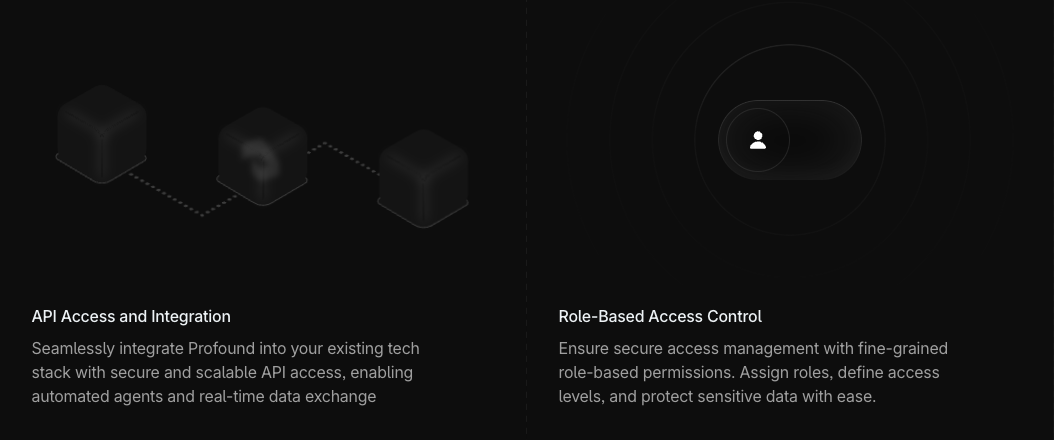
Profound states that it is SOC 2 Type II compliant and supports single sign-on through SAML or OIDC. It also documents role-based access control, API integration, automated backups, and premium support.
These capabilities help the product enter a more formal enterprise procurement process.
The platform’s broader research functionality also makes it relevant for monitoring competing products, comparing sources, and understanding which questions lead to incorrect or incomplete brand descriptions.
Profound’s FactCheck adds a separate dimension to standard mention tracking. Instead of only asking whether a brand appeared, the team can investigate whether the factual claims about the brand match its verified information.
Enterprise Limitations to Consider
Profound’s Enterprise plan uses custom pricing.
Buyers should ask how monitored prompts, answer engines, regions, historical data, seats, and automated agent workflows contribute to total cost.
Its marketing automation tools also consume credits, which should be modelled separately from ordinary AI visibility monitoring.
Organisations should evaluate whether they need the full platform or primarily require recurring response analysis.
Choose Profound if: Enterprise governance, brand accuracy, citation intelligence, and dedicated AI search research are central requirements.
Consider another platform if: You mainly need a straightforward monitoring layer within an existing enterprise SEO suite.
Bottom line: Profound deserves a place near the top of an enterprise GEO shortlist, particularly when security controls and the quality of AI-generated brand information are priorities.
2. Conductor: Best for Enterprises Integrating GEO With SEO and Content Operations
Best for: Large marketing teams that want AI visibility, traditional SEO, website performance, and content optimisation connected.
Pricing: Request an enterprise quotation.
Conductor positions itself as an enterprise platform for AI search visibility and broader organic search performance.
Its Conductor Intelligence product connects AI search monitoring with website analytics, search research, technical performance, competitive intelligence, and content planning.
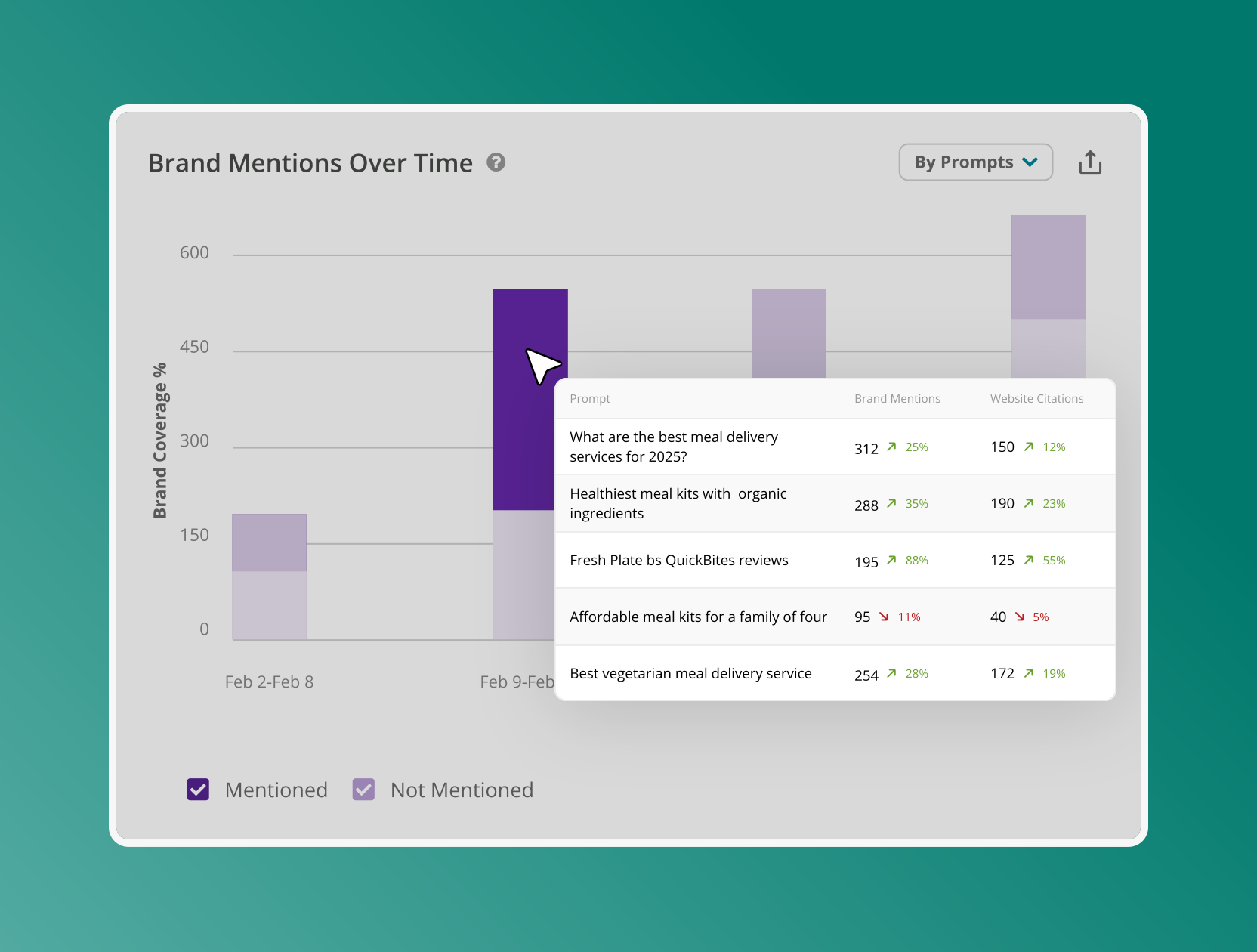
The AI Search Performance functionality focuses on brand mentions, source citations, sentiment, competitive visibility, and opportunities within supported answer engines.
The key distinction is that Conductor isn’t limited to reporting where a brand appears.
It aims to connect AI visibility information with the existing work required to maintain a large website.
Where Conductor Stands Out
Enterprises frequently have separate teams responsible for SEO, content publishing, technical development, and marketing analytics.
A standalone GEO tracker can create another reporting silo if its findings are disconnected from these teams.
Conductor addresses this problem through a wider platform.
For example, a team investigating missing AI citations can examine associated topics and content opportunities. Its website performance reporting also connects AI referral traffic with engagement and conversion measurements through analytics integrations.
Conductor also supports configurable prompts based on audiences, intent, topics, brands, and regions.
This matters when monitoring different questions across enterprise product divisions.
Enterprise Limitations to Consider
A broad platform introduces implementation decisions.
Teams need to determine which Conductor products and modules are included in their proposed contract and which features require additional access.
The organisation should also confirm monitoring coverage, API options, security documentation, and the cost of expanding into new markets.
A platform that integrates many workflows can still require substantial onboarding and organisational coordination.
Choose Conductor if: GEO needs to operate inside a mature enterprise SEO and content management programme.
Consider another platform if: Your team already has enterprise SEO operations covered and only needs specialist AI response monitoring.
Bottom line: Conductor is particularly relevant when the business wants to connect AI visibility findings with established search, website, and content operations.
3. BrightEdge: Best for Enterprise AI Search and AI-Agent Intelligence
Best for: Enterprises investigating how their brands appear in AI-generated answers and how AI agents interact with their websites.
Pricing: Request a quotation.
BrightEdge combines enterprise SEO intelligence with AI search capabilities.
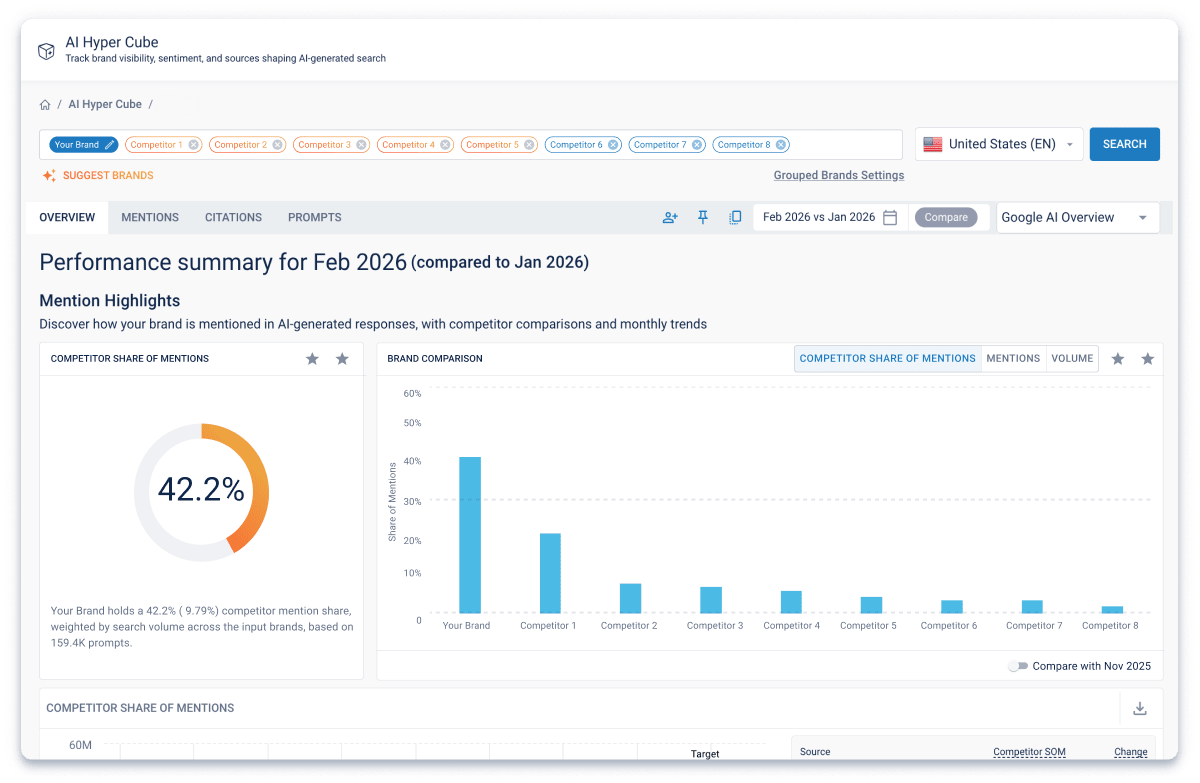
In March 2026, BrightEdge announced AI Hyper Cube, designed to analyse brand presence across AI-generated search experiences.
It also introduced AI Agent Insights to examine how automated AI systems interact with websites.
These products address two connected but different questions.
The first is whether a business appears in AI-generated responses. The second is whether automated agents can access the content that might inform those responses.
Where BrightEdge Stands Out
BrightEdge’s AI Hyper Cube focuses on prompts, citations, competing brands, and opportunities within AI search experiences.
AI Catalyst adds analysis of how AI systems describe brands, including sentiment and positioning.
AI Agent Insights examines automated access to websites, including technical barriers that could prevent agents from reaching relevant content.
For enterprises operating complicated websites, this distinction matters.
A product page may contain useful information, but its accessibility could be affected by technical restrictions, blocked paths, or other implementation problems.
BrightEdge provides a workflow for examining those issues alongside AI search visibility.
Enterprise Limitations to Consider
AI-agent access and AI citations are related but not interchangeable.
A crawler reaching a webpage doesn’t establish that the page will be used in an answer. Likewise, increased crawler activity does not automatically translate into higher brand visibility or revenue.
Enterprises should evaluate these datasets separately.
BrightEdge’s commercial terms are also generally sales-led, so buyers need to confirm the monitoring scope, modules, support arrangements, and implementation costs.
Choose BrightEdge if: Your organisation wants enterprise SEO intelligence alongside AI search monitoring and agent-access analysis.
Consider another platform if: You only require a focused view of tracked prompts, mentions, and citations.
Bottom line: BrightEdge is a relevant enterprise option when GEO investigations need to extend into technical site accessibility and broader search intelligence.
4. Semrush Enterprise AIO: Best for Enterprises Consolidating SEO and GEO
Best for: Organisations already using Semrush or seeking one wider platform for traditional SEO and AI visibility.
Pricing: Custom enterprise quotation.
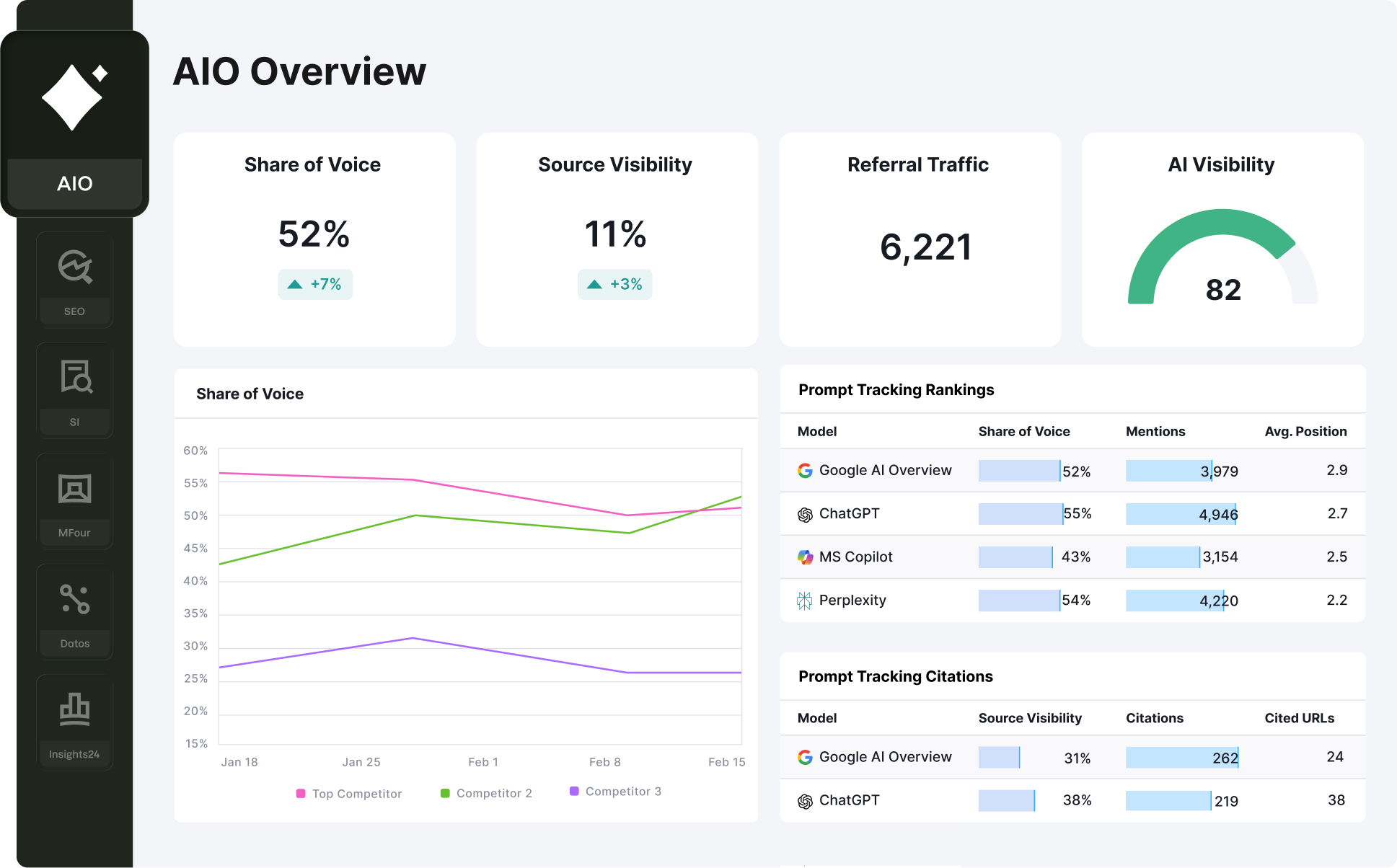
Semrush for Enterprise provides enterprise search intelligence, including its Enterprise AIO offering for AI search optimisation.
The platform combines AI brand visibility analysis with competitive intelligence, content opportunities, and broader search data.
Semrush’s established SEO ecosystem is particularly relevant for organisations already using its tools for keyword research, auditing, backlinks, and search reporting.
Where Semrush Enterprise Stands Out
Many enterprises don’t want their GEO programme to operate independently from the rest of their organic search strategy.
They may need to understand whether a competitor is gaining AI search visibility while also investigating changes in conventional rankings, content coverage, or website performance.
Semrush Enterprise AIO is designed to support this connected research.
Its enterprise positioning also includes centralised reporting across regions and teams, while its AI visibility offering supports investigation of brand representation and competitive performance.
These capabilities can reduce duplication when SEO and GEO are managed by the same organisational teams.
Enterprise Limitations to Consider
Semrush offers several different products under its wider AI visibility and enterprise portfolio.
A self-service AI Visibility Toolkit subscription should not be treated as equivalent to a custom Enterprise AIO contract.
Buyers should confirm which AI engines, integrations, security features, reporting capabilities, and user permissions are covered by the proposed enterprise package.
Also evaluate whether the platform provides enough specialised response-level evidence for the organisation’s GEO requirements.
Choose Semrush Enterprise AIO if: You want AI search monitoring connected to existing enterprise SEO intelligence and reporting.
Consider another platform if: Your primary requirement is specialised AI response analysis rather than a wider search platform.
Bottom line: Semrush Enterprise AIO is a logical option for companies seeking GEO within an established enterprise marketing ecosystem.
5. Peec AI: Best for Global Multi-Brand AI Visibility Monitoring
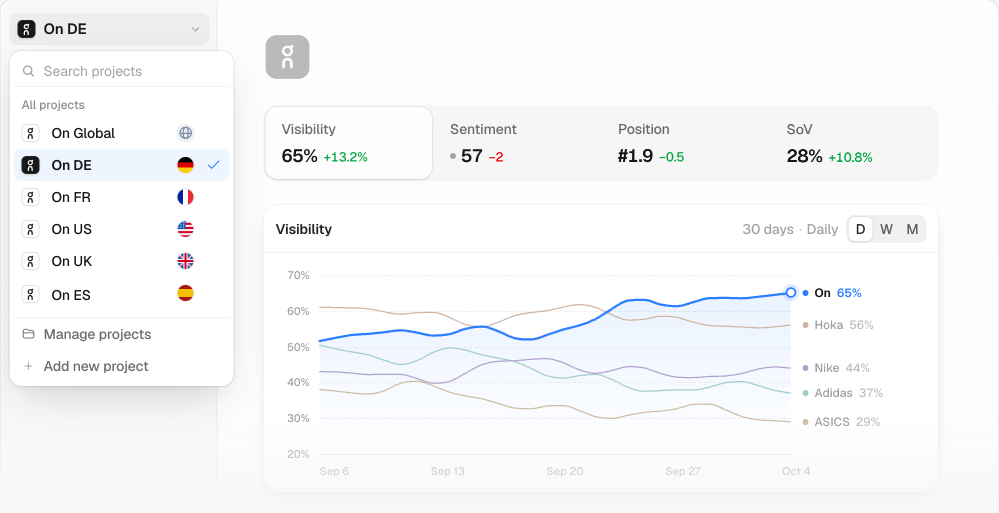
Best for: Enterprises managing multiple brands, countries, teams, and reporting systems.
Pricing: Custom annual enterprise pricing.
Peec AI has a clearly documented enterprise workflow built around separate projects, brand-level monitoring, international comparisons, and reporting integrations.
Its platform tracks brand visibility across supported AI systems, including mentions, sentiment, citations, sources, and competitor performance.
The Enterprise plan supports custom prompt configurations, unlimited projects, API access, SSO, and tracking schedules that can be configured hourly, daily, or weekly.
Peec advertises support for up to eleven AI models on its enterprise offering.
Where Peec AI Stands Out
Peec’s project structure is particularly relevant to global organisations.
A business can assign separate projects to brands, countries, or internal teams, keeping each project’s prompts and competitors organised.
Its enterprise documentation also describes project-level access control and API keys scoped to individual projects or the wider organisation.
For reporting, Peec supports Looker Studio integration and API-based data access for use with established BI systems.
That allows organisations to combine AI visibility data with other information rather than asking every executive to use a new reporting interface.
Important Security Qualification
Peec lists SSO as an enterprise capability.
However, its public enterprise security page currently describes its SOC 2 Type II audit and ISO 27001 certification as in progress.
That is not the same as having completed those assessments.
If your organisation requires current independent certification, request the latest documents and confirm their status during procurement.
Enterprise Limitations to Consider
Peec uses custom enterprise pricing based on prompt volume, projects, and markets.
Organisations should verify how international monitoring affects usage and whether all selected AI models support the required countries and languages.
They should also review which historical responses, raw datasets, and reporting fields are available through the API.
Choose Peec AI if: Multi-brand project management, international monitoring, and integration with existing BI systems are your priorities.
Consider another platform if: Your procurement policy requires already completed security certifications that the vendor cannot yet supply.
Bottom line: Peec offers one of the clearest documented workflows for global multi-brand GEO monitoring, but security documentation should be evaluated carefully.
6. Scrunch: Best for AI Visibility and Agent Experience Analysis
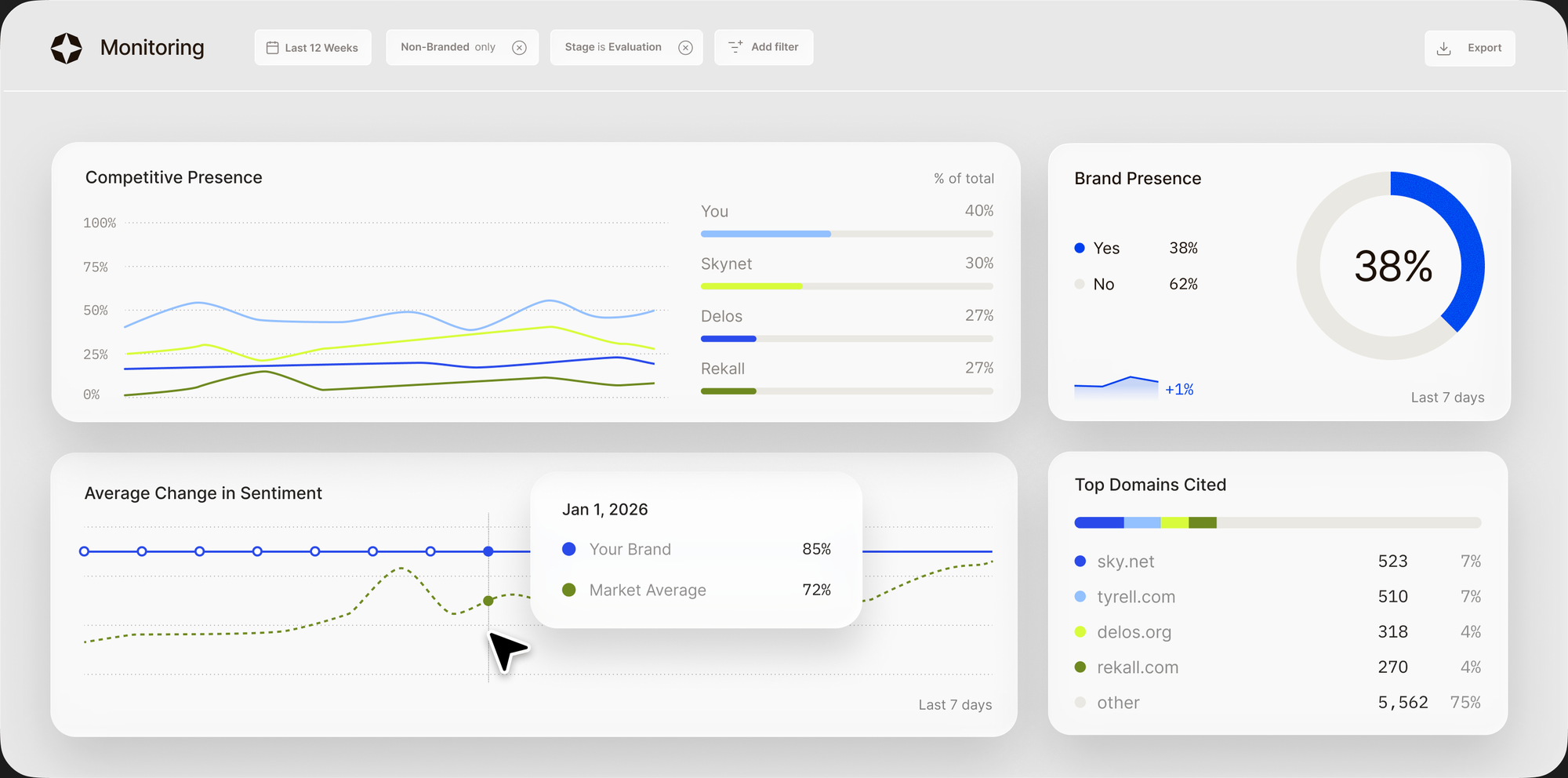
Best for: Enterprises combining GEO monitoring with technical website analysis and AI-agent access investigation.
Pricing: Custom enterprise quotation.
Scrunch combines AI visibility monitoring with website analysis and its Agent Experience Platform.
Its enterprise offering includes custom prompt and response allowances, configurable brand workspaces, additional AI models, API integrations, SSO, and a dedicated account team.
The public enterprise plan also expands model coverage beyond the four systems included in its lower-priced Core offering.
Where Scrunch Stands Out
Scrunch approaches GEO as more than a brand mention problem.
Its wider offering examines how AI systems interact with websites, which content is accessible, and whether technical issues could affect the information available to automated systems.
That can be useful for organisations managing complex product catalogues, documentation systems, or large publishing environments.
Scrunch also offers broader site auditing and enterprise support for organisations needing to coordinate AI search monitoring with technical investigations.
Enterprise Limitations to Consider
Monitoring AI-generated responses and optimising how agents access website content are different technical activities.
Enterprises should assess the value of each separately.
A company mainly interested in monthly brand reporting may not need the full technical platform.
It is also important to confirm the available response limits, supported AI models, workspace structure, and specific requirements for enabling agent-related functionality.
Choose Scrunch if: Your GEO programme includes technical website investigation and AI-agent accessibility.
Consider another platform if: Your priority is simpler multi-market visibility reporting with fewer technical workflows.
Bottom line: Scrunch is particularly relevant when enterprise GEO spans both answer visibility and how AI systems interact with the organisation’s website.
7. Ahrefs Brand Radar: Best for Large-Scale AI Visibility Research
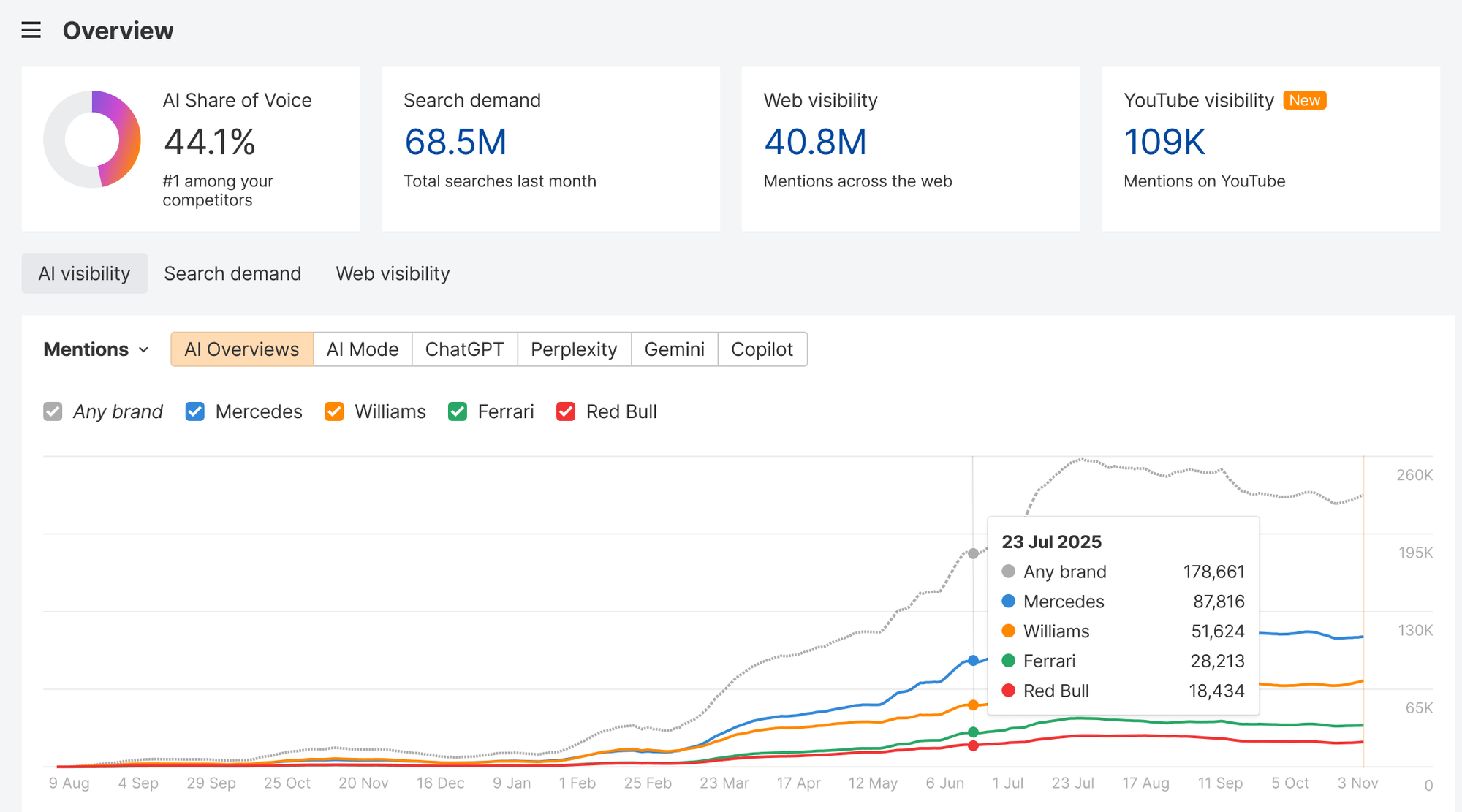
Best for: Enterprise SEO teams investigating broad competitive visibility, cited sources, and AI search topics.
Published entry pricing: AI Visibility Index from $199/month; custom prompt monitoring has separate allowances.
Ahrefs Brand Radar provides two complementary approaches to AI search research.
Its AI Visibility Index uses a large database of collected AI prompts and responses to examine brand appearances, competitors, and cited sources.
Custom Prompts allows organisations to monitor specific questions relevant to their business.
This distinction is important for enterprises.
The large index can help identify questions and competitors the marketing team hasn’t considered, while custom monitoring supports a consistent set of strategically important prompts.
Where Ahrefs Stands Out
Ahrefs already supports many enterprise SEO workflows through its backlink, competitor, keyword, and search visibility products.
Brand Radar adds another dimension to that research.
For example, a brand could investigate why a competitor receives citations for a commercial topic, identify the relevant webpages, and continue into backlink or content research using other Ahrefs functionality.
Ahrefs has also expanded Brand Radar with AI visibility metrics, entity matching, cited-page analysis, and API-accessible reporting.
Entity matching is particularly relevant when brands or products have ambiguous names.
Enterprise Limitations to Consider
Custom monitoring has usage limits that differ from broad indexed research.
Check consumption depends on the AI platform, monitoring schedule, and location configuration. Some AI engines have higher per-update check costs.
Enterprises should also confirm the available data access, user permissions, security documentation, and service arrangements under their selected Ahrefs contract.
A paid Ahrefs subscription doesn’t automatically include unlimited Brand Radar monitoring.
Choose Ahrefs Brand Radar if: Broad competitive and source research is central to your enterprise GEO strategy.
Consider another platform if: You primarily need dedicated multi-brand governance and a turnkey executive reporting system.
Bottom line: Ahrefs Brand Radar is a strong research-oriented complement to established SEO operations, particularly for identifying source and competitor opportunities.
8. SE Ranking and SE Visible: Best for Scaled SEO Teams Adding GEO
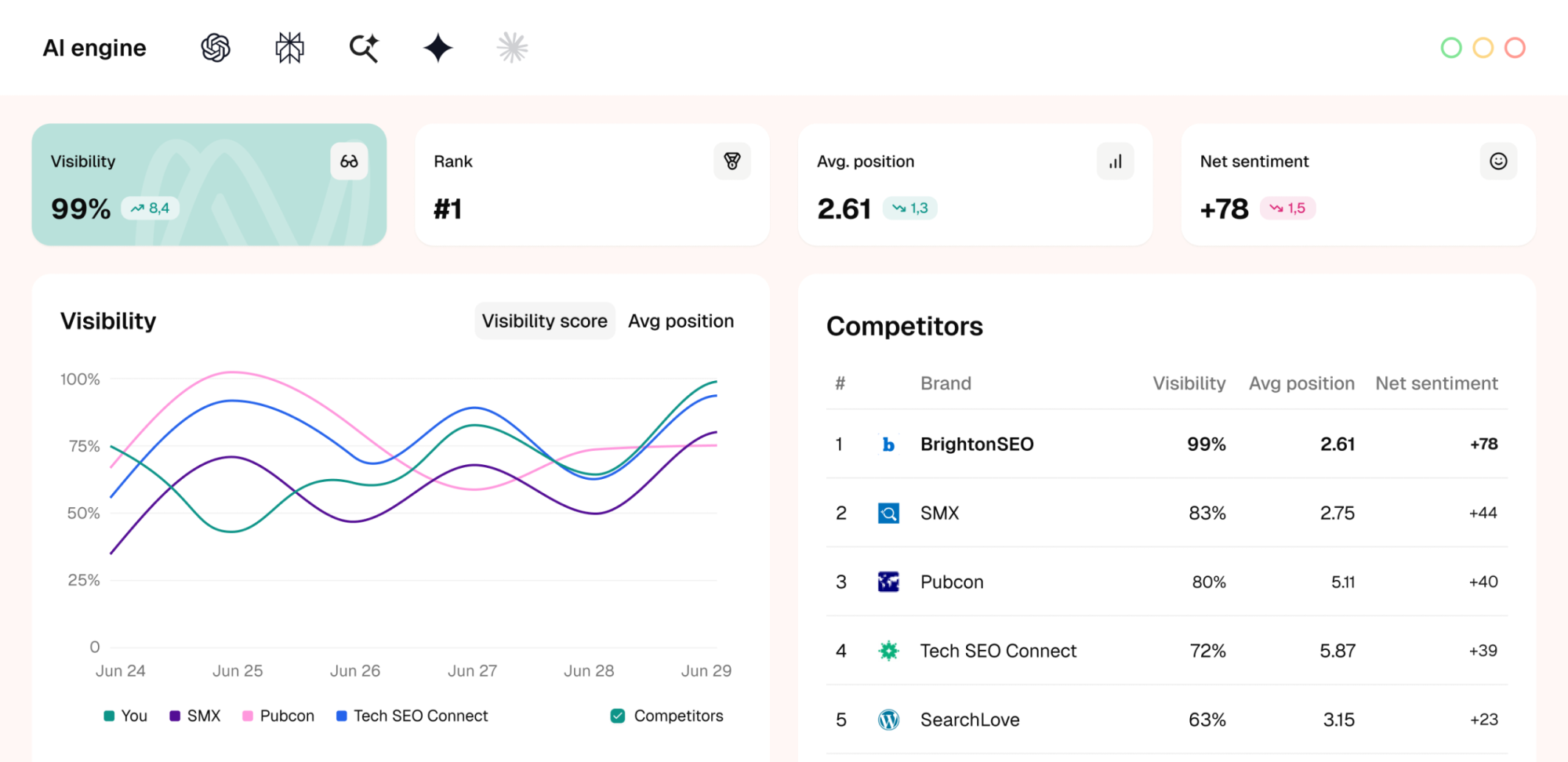
Best for: Larger SEO teams that want AI search monitoring without immediately purchasing a separate specialist enterprise platform.
Pricing: Plan-dependent, with additional AI Search usage packages and custom volumes available.
SE Ranking combines conventional SEO with AI search functionality, while its related SE Visible product focuses on strategic brand visibility within AI-generated answers.
The AI Results Tracker supports questions monitored across selected platforms such as Google AI Overviews, AI Mode, ChatGPT, Gemini, and Perplexity.
Organisations can configure platforms, countries, tracked prompts, and competitors within project workflows.
SE Ranking also offers API access and reporting integrations.
Where SE Ranking Stands Out
The practical advantage is the connection between traditional SEO and AI search analysis.
When a brand’s AI visibility changes, marketers can investigate other search signals without leaving the wider product ecosystem.
The AI Search Add-on provides extended check allowances and access to SE Visible.
Its published billing method treats one prompt monitored on one AI platform as one check, making it possible to calculate usage against a proposed workload.
Higher monitoring volumes can be discussed with the vendor.
Enterprise Limitations to Consider
SE Ranking offers an Enterprise subscription, but buyers should verify how its governance and security provisions compare with more specialised enterprise software.
An Enterprise plan name alone doesn’t establish the presence of every procurement feature a large organisation may require.
The AI Search Add-on also has separate usage economics that must be calculated alongside the main subscription.
Choose SE Ranking if: Your company already operates an SEO programme and needs a practical way to introduce GEO monitoring into those workflows.
Consider another platform if: Your organisation needs extensive enterprise-specific security controls, multi-brand governance, or dedicated AI brand-risk management.
Bottom line: SE Ranking is worth evaluating as a transitional or integrated option for larger SEO teams, particularly when a full enterprise GEO rollout isn’t yet justified.
9. Digimetrics: Best for Enterprise Departmental Pilots and Integrated SEO/GEO Analysis
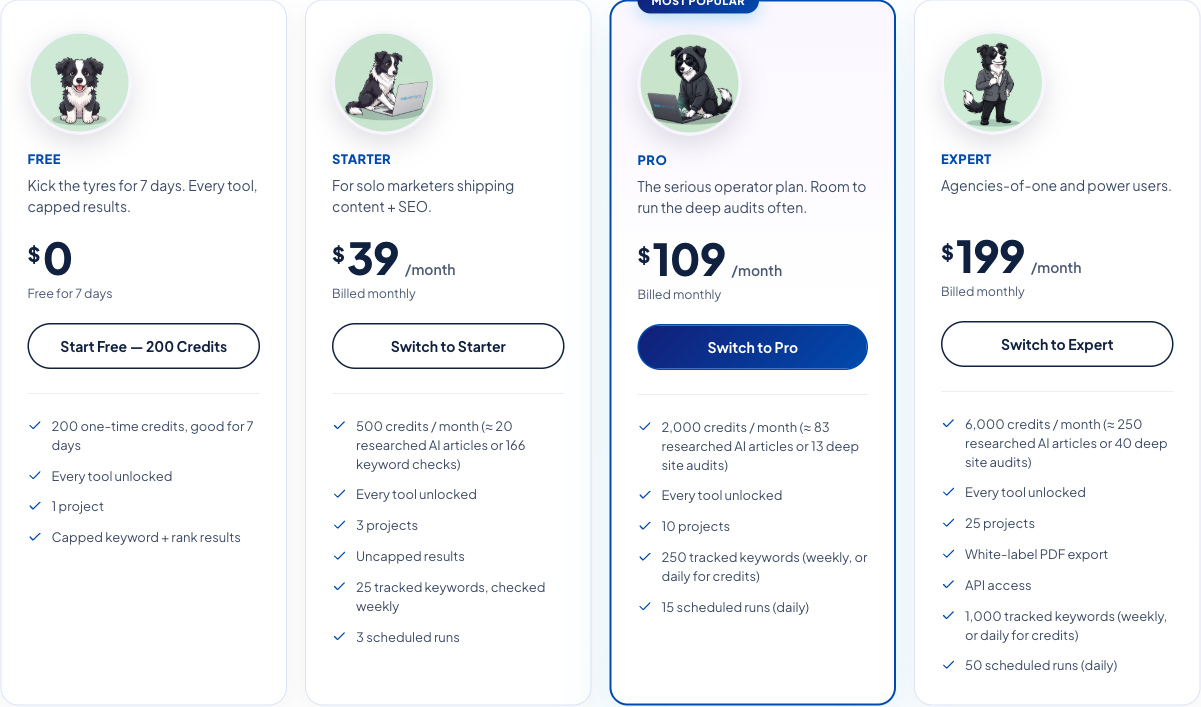
Best for: Smaller internal teams within large organisations testing GEO alongside existing SEO and content workflows.
Published pricing: Starter $39/month, Pro $109/month, and Expert $199/month.
Sponsored-product disclosure: DigitalMarketingTools.ai is sponsored by Digimetrics.ai, developed by MediaOne.
Digimetrics combines SEO, GEO, content, technical auditing, and marketing tools in one workspace.
Its feature set includes AI Mentions Tracker, AI Discovery Audit, SEO Diagnostics, keyword tools, and content optimisation functionality.
The platform uses a shared-credit model across its tools.
Its published Expert plan includes 25 projects, 6,000 monthly credits, white-label PDF exports, and API access.
Where Digimetrics Can Be Useful
A large business may want one regional SEO team to test whether GEO reporting adds useful information before expanding it into a formal corporate programme.
For that purpose, an accessible subscription with SEO and GEO features can be useful.
The team can investigate brand mentions, examine technical or content issues, and experiment with reporting workflows without immediately committing to a complex enterprise procurement.
Digimetrics may also provide operational value when the same users need several different marketing tools.
Why It’s Not a Direct Enterprise Replacement
The published Digimetrics plans do not establish the enterprise security, access control, global monitoring scale, and support commitments discussed elsewhere in this comparison.
Its Expert plan supports only 25 projects, while credits are shared across different activities.
Those limits could be restrictive for a multinational organisation with many websites and a substantial recurring monitoring programme.
Enterprises should also request direct confirmation of SSO availability, role-based permissions, audit logs, data retention, and contractual security provisions rather than assuming they exist.
Choose Digimetrics if: A department wants an affordable GEO pilot connected to wider SEO and content tasks.
Consider another platform if: You need a verified organisation-wide enterprise GEO system with centralised security governance and substantial international monitoring capacity.
Bottom line: Digimetrics is more appropriately treated as a pilot or supplementary marketing workspace than a proven enterprise-wide GEO platform.
Enterprise GEO Security: What Should Procurement Teams Verify?
Security can eliminate an otherwise attractive vendor from an enterprise shortlist.
A product may provide useful AI visibility reporting but still fail the organisation’s access control, data retention, or contractual requirements.
Before signing a contract, request evidence covering the following areas.
| Security Requirement | Questions for the Vendor |
|---|---|
| SSO | Is SAML or OIDC supported with our identity provider? |
| Role-based access | Can permissions be restricted by business unit, brand, or project? |
| Security assessments | Is a current SOC 2 Type II report or ISO 27001 certificate available? |
| Data retention | How long are prompts, responses, logs, and uploaded documents stored? |
| Data deletion | Can information be removed upon request or contract termination? |
| Data processing | Which subprocessors process customer information, and in which regions? |
| API security | Can keys be scoped, rotated, and revoked? |
| Auditability | Are administrative actions and user access events logged? |
| Incident response | What are the vendor’s notification and escalation commitments? |
| Contractual controls | Are appropriate DPAs and service commitments available? |
The vendor’s answers should be supported by current documentation.
For example, Profound publishes its SOC 2 Type II and SSO status, while Peec currently identifies its SOC 2 Type II and ISO 27001 assessments as in progress.
Other platforms may have suitable controls, but these should be verified directly rather than assumed from general enterprise marketing materials.
Also remember that a security certificate doesn’t automatically establish compliance with every law or contractual obligation affecting your organisation.
Why Enterprise GEO Metrics Need Stronger Definitions
Enterprise marketing dashboards often consolidate information from many teams.
That makes metric consistency especially important.
If one regional team uses brand mentions as its visibility score and another uses citation frequency, combining the results into one global percentage can be misleading.
Several common GEO signals measure different events.
| Metric | What It Actually Measures | What It Doesn’t Prove |
|---|---|---|
| Brand mentions | Responses naming a brand or product | Total audience reach |
| Source citations | URLs referenced by AI-generated answers | Brand recommendation or endorsement |
| Sampled share of voice | Relative visibility under a defined vendor methodology | Universal AI search market share |
| Sentiment | Estimated tone of a brand reference | Factual accuracy |
| AI crawler visits | Automated requests reaching website resources | That content was cited or recommended |
| AI referral sessions | Visits attributed to identifiable AI sources | Every user influenced by AI search |
| Conversions | Recorded business actions under an attribution method | That GEO activity caused the outcome |
Our guide to GEO analytics tools explains how these measurements work together.
Brand Mentions and Citations Need Separate Reporting
An AI answer might recommend a company’s software without linking to its website.
Another answer could cite an independent publisher’s technical article without recommending that publisher’s products.
These are different visibility events.
Enterprise reports should distinguish them and preserve the original response whenever possible.
For a more detailed explanation, see our AI citation tracking guide.
Visibility Scores Depend on the Monitored Sample
Suppose a company appears in 30 of 100 monitored AI responses.
That produces a 30% mention rate within the defined sample.
It does not mean that 30% of all AI search users saw the company.
The observed rate depends on which prompts were selected, which AI platforms were included, and when the responses were collected.
A company can increase its sampled mention rate simply by changing the questions it tracks.
For consistent reporting, enterprises should maintain stable benchmark prompt sets and report changes to the monitoring methodology.
Sentiment Is Not the Same as Factual Accuracy
An AI answer can describe a brand positively while providing incorrect information about its product.
For example, it might recommend an enterprise software platform but incorrectly claim that the platform offers a certain security certification or integration.
That could create a serious commercial problem even when the sentiment score is positive.
Enterprises should monitor factual claims and important product descriptions separately from general tone.
How Much Does Enterprise GEO Monitoring Actually Cost?
Enterprise pricing is difficult to compare because public self-service plans often don’t represent the features or scale required by multinational organisations.
A meaningful calculation starts with the monitoring workload.
Example: Global Business With 20 Brand-Market Projects
Consider an enterprise with twenty distinct brand-market projects.
Each project requires 30 important prompts monitored across four AI platforms and two relevant geographic configurations.
The company wants daily observations.
| Monitoring Variable | Requirement |
|---|---|
| Brand-market projects | 20 |
| Prompts per project | 30 |
| AI platforms | 4 |
| Geographical configurations | 2 |
| Monitoring frequency | Daily |
| Illustrative month | 30 days |
Under a model charging for individual prompt-platform-location executions:
20 × 30 × 4 × 2 × 30 = 144,000 AI response checks per month
This is an illustrative capacity requirement, not the expected invoice from any particular vendor.
Some platforms charge for configured prompts, some use credits, some use domain or workspace allowances, and others negotiate enterprise monitoring capacity.
The calculation becomes useful when it is translated into each vendor’s actual billing units.
Why the Cheapest Monthly Rate Can Be Misleading
A lower-cost subscription might allow the organisation to create multiple projects but lack enough monitoring capacity.
A more expensive enterprise contract might include the required data volume while adding SSO, administration, security reviews, and integrations that otherwise need separate work.
The complete cost should therefore include:
- Platform subscription and monitoring consumption.
- Additional brands, countries, and AI engines.
- Seats and permission requirements.
- API access and data integration.
- Implementation, training, and maintenance.
- Reporting work that remains manual.
- Security and procurement obligations.
- Contractual support and any usage overages.
For global teams, the cost of maintaining the reporting system can be as important as the subscription itself.
How to Run a 30-Day Enterprise GEO Pilot
A demonstration can explain the interface, but it cannot establish whether a platform meets the organisation’s data, security, and operational requirements.
Before signing a long-term contract, run a pilot with a controlled set of requirements.
Week 1: Establish the Monitoring Baseline
Select two or three representative brands, products, or countries.
Choose a mixture of branded, unbranded, comparison, purchase-consideration, and support-related questions.
Where possible, use the same prompt wording across the vendors.
Document the selected AI engines, geographical settings, collection intervals, competitors, and reporting definitions.
The purpose is to give every platform a comparable task instead of evaluating different vendor demonstrations.
Week 2: Verify AI Response Evidence
Inspect a sample of the collected responses.
Check whether the tool correctly identifies the brand, distinguishes recommendations from neutral mentions, and records citations accurately.
Pay attention to product names shared with unrelated businesses, regional subsidiaries, and translated brand names.
Also inspect the original answer and collection timestamp.
A dashboard score with no accessible underlying evidence is difficult to audit.
Week 3: Test Enterprise Workflows
Invite users from different teams.
Ask a regional SEO specialist, central marketing analyst, and reporting manager to complete defined tasks.
Test project separation, user permissions, reporting exports, integrations, and the process for investigating a visibility change.
If the platform supports an API, send a representative dataset into the company’s intended BI environment.
Record how much manual preparation remains necessary.
Week 4: Evaluate Cost, Governance, and Decisions
Compare the platforms using the same procurement scorecard.
Request the complete commercial proposal, including monitoring capacity, support, security documents, and contract conditions.
The final decision should consider more than whether a vendor produces attractive reports.
Ask whether the platform reduces the time between identifying a meaningful GEO issue and determining an appropriate next step.
Recommended Enterprise GEO Procurement Scorecard
Use the following framework during a vendor evaluation.
| Category | Weight | Example Acceptance Test |
|---|---|---|
| Security and procurement | 20% | Meets mandatory security, legal, and access requirements |
| Global monitoring | 20% | Supports required brands, countries, engines, and languages |
| Response evidence | 20% | Provides verifiable prompts, answers, mentions, and citations |
| Reporting and integration | 15% | Exports required data into the organisation’s BI workflow |
| Monitoring cost | 10% | Supports forecast workload within approved budget |
| Operational usefulness | 10% | Helps analysts investigate and prioritise actual issues |
| Vendor support | 5% | Meets onboarding, training, and support expectations |
Apply mandatory requirements separately from the weighted score.
If SOC 2 evidence, a DPA, or SSO is compulsory, a platform shouldn’t pass simply because its other features are strong.
For vendors that meet the mandatory requirements, the weighted comparison can then help distinguish their practical advantages.
What Should an Enterprise GEO Dashboard Include?
An enterprise GEO dashboard should support both detailed investigation and concise reporting to leadership.
At executive level, the aim is to explain what changed, why it deserves attention, and what the organisation intends to do about it.
At operational level, specialists need enough detail to investigate individual prompts, citations, pages, countries, and competitors.
| Dashboard Section | Recommended Information |
|---|---|
| Executive overview | Important visibility trends, business risks, proposed actions |
| Global coverage | Brands, markets, languages, platforms, reporting periods |
| Brand presence | Mentions, contextual recommendations, competitor comparisons |
| Citation intelligence | Cited domains, pages, source trends, relevant topics |
| Brand accuracy | Verified incorrect claims and priority corrections |
| Market-level analysis | Regional differences and local competitors |
| Technical investigation | Site accessibility and AI-agent activity, if supported |
| Business context | AI referral traffic, engagement, conversions, analytics |
| Methodology | Prompt scope, collection frequency, scoring definitions |
| Work tracking | Owners, priorities, investigation status, completed changes |
Avoid mixing fundamentally different signals into one proprietary global visibility number without explaining the calculation.
A useful dashboard should make it possible to move from a high-level finding into its supporting evidence.
Which Enterprise GEO Tool Should You Choose?
Different organisations should begin with different shortlists.
| Enterprise Requirement | Start With |
|---|---|
| Dedicated AI search intelligence and verified governance features | Profound |
| GEO integrated with enterprise SEO and content operations | Conductor |
| AI search intelligence and AI-agent accessibility | BrightEdge |
| Enterprise SEO and AI visibility consolidation | Semrush Enterprise AIO |
| International multi-brand monitoring and BI integration | Peec AI |
| AI response monitoring and technical agent experience | Scrunch |
| Large-scale competitive research and source discovery | Ahrefs Brand Radar |
| Enterprise SEO teams gradually expanding into GEO | SE Ranking + SE Visible |
| Lower-cost internal pilot or supplementary analysis | Digimetrics |
These recommendations describe documented use cases rather than a measured ranking of response accuracy.
Organisations considering several vendors should test them using the same prompt set and procurement requirements.
For general feature comparisons outside the enterprise segment, see our 10 Best GEO Tools in 2026 and Best Paid GEO Tools in 2026.
Final Verdict: Enterprise GEO Requires More Than Brand Monitoring
The best GEO tool for enterprises in 2026 needs to support more than checking whether ChatGPT mentions a company.
Large organisations must manage several brands, international markets, complex access permissions, source evidence, internal reporting systems, and substantial monitoring workloads.
Profound deserves serious consideration when specialised AI search intelligence, brand accuracy, and enterprise governance are top priorities.
Conductor is particularly relevant when GEO needs to connect with an existing enterprise SEO and content programme, while BrightEdge stands out for combining AI search research with AI-agent access analysis.
Semrush Enterprise AIO offers another integrated approach for companies consolidating search intelligence.
Peec AI provides a strong documented multi-brand and international workflow, although buyers should verify the status of its security certifications. Scrunch is useful when technical AI-agent experience forms part of the GEO programme.
Ahrefs Brand Radar remains a compelling source of broad AI visibility research, while SE Ranking offers a more gradual route for teams extending traditional SEO into GEO.
Digimetrics can support smaller internal pilots and integrated marketing analysis but should not be treated as a verified substitute for an organisation-wide enterprise GEO solution.
Before purchasing, focus on four questions:
- Does the vendor provide enough reliable, inspectable AI search evidence?
- Can it meet the organisation’s security, access, and reporting requirements?
- Does the monitoring scope cover the brands, markets, and platforms that matter?
- Can the teams responsible for SEO, content, brand, and analytics turn its findings into useful work?
The best enterprise GEO platform isn’t the one that promises the biggest visibility score. It’s the one that helps a large organisation understand its AI search presence, verify the evidence, and act consistently across teams.
Frequently Asked Questions
What Is the Best GEO Tool for Enterprises in 2026?
Profound, Conductor, BrightEdge, Semrush Enterprise AIO, Peec AI, and Scrunch are among the most relevant enterprise GEO platforms to evaluate. Profound offers documented security controls and specialised AI search intelligence, while Conductor and BrightEdge connect AI visibility with wider search and website workflows.
The best choice depends on required markets, governance, integrations, and monitoring capacity.
How Is Enterprise GEO Software Different From Regular GEO Tools?
Enterprise GEO software needs to support multiple brands, countries, teams, integrations, and security requirements.
Features such as SSO, role-based permissions, APIs, data retention controls, and custom support arrangements may become necessary.
A regular monitoring tool may provide accurate observations but lack the governance and scale required for an organisation-wide deployment.
Which GEO Tools Support SSO?
Profound, Peec AI, and Scrunch publicly document SSO in their enterprise offerings.
Other vendors may provide equivalent capabilities under particular contracts, but buyers should confirm the available authentication methods directly.
SSO availability does not automatically verify every other security control.
Which Enterprise GEO Tool Is Best for Multiple Countries?
Peec AI is worth evaluating because its enterprise offering explicitly supports separate projects, multi-country monitoring, and global reporting integrations.
Conductor and other enterprise platforms also provide regional monitoring functionality.
However, the organisation should verify supported languages, geographic settings, and AI engines for its specific markets.
Can Enterprise GEO Tools Measure AI Search ROI?
They can contribute to ROI analysis, particularly when connected to first-party analytics and conversion data.
However, AI mentions and citations do not automatically translate into visitors, leads, or revenue.
Organisations should distinguish observed AI visibility from measurable referral activity and downstream business outcomes.
Do Enterprise GEO Tools Have Access to Private ChatGPT Conversations?
Businesses should not assume that third-party GEO monitoring products can access every private conversation occurring on ChatGPT or another AI platform.
Their datasets typically reflect monitored prompts, collected responses, vendor indexes, or related research methodologies.
Vendors should clearly explain how their data is collected and what population the resulting metrics represent.
How Many Prompts Does an Enterprise Need to Track?
There is no universal number.
The correct monitoring scope depends on the organisation’s brands, products, markets, audiences, and commercial topics.
A pilot might begin with dozens of relevant prompts per business unit, while a global programme may require thousands of configured prompt-market-platform combinations.
Relevance and consistency matter more than monitoring volume alone.
Is GEO More Important Than SEO for Enterprises?
GEO and SEO measure related but different forms of discovery.
Traditional SEO remains important for website accessibility, rankings, search traffic, and content performance.
GEO adds evidence about how brands and sources appear inside AI-generated answers.
Enterprises should generally connect the two rather than treat them as competing disciplines.
Can AI Visibility Tools Guarantee That ChatGPT Recommends Our Brand?
No.
GEO tools can identify where a brand is missing, examine citations, reveal inaccurate information, and support content or technical improvements.
They cannot guarantee inclusion in future AI-generated responses.
AI systems may produce different answers depending on the model, question, retrieval conditions, location, and other factors.
Should Enterprises Build Their Own GEO Monitoring System?
A custom solution can be appropriate when the organisation has specialised data requirements and sufficient engineering resources.
However, operating a reliable system requires response collection, storage, entity matching, citation parsing, monitoring schedules, security controls, and ongoing maintenance.
Before building one, compare the full internal development and operating cost with enterprise software contracts.
A commercial platform may be economical when it removes work that the company would otherwise maintain indefinitely.
Editorial Methodology and Disclosure
This article compares publicly documented product capabilities, enterprise offerings, and procurement considerations reviewed on October 20, 2026.
It does not claim that DigitalMarketingTools.ai conducted an identical head-to-head benchmark of AI response accuracy, enterprise implementation time, or total cost across all nine products.
Enterprise pricing, monitoring allowances, security arrangements, and contractual terms may vary. Buyers should request current documentation and written quotations.
DigitalMarketingTools.ai is sponsored by Digimetrics.ai, which is developed by MediaOne. Digimetrics is included with explicit limitations and is not presented as the leading enterprise option because of that relationship.
Additional editorial principles are explained in our Editorial Methodology.
Disclosure: digitalmarketingtools.ai is sponsored by Digimetrics.ai. Sponsored Highlights are clearly labelled advertising. Our reviews, comparisons and guides are written to be useful and fair regardless of who sponsors the site. Read the full disclosure.