9 Best GEO Tools for Agencies in 2026: Pricing, Reporting & Multi-Client Management

A client asks why ChatGPT keeps recommending a competitor. Another wants monthly reports showing whether their business appears in Google AI Overviews. A third wants proof that the content your agency published is gaining visibility across AI search platforms.
Traditional SEO reporting doesn’t answer all these questions. Keyword rankings, organic traffic, and backlinks remain important, but they don’t necessarily show when an AI assistant mentions a client’s brand, recommends its competitors, or cites its website.
That’s why agencies are adding Generative Engine Optimization (GEO) tools to their reporting and research workflows.
However, choosing the best GEO tool for an agency is different from choosing one for an individual website. A subscription that works well for one brand may become expensive or difficult to manage when you’re monitoring ten clients, several AI platforms, and hundreds of commercial questions.
Some vendors charge for each client domain. Others provide shared prompt allowances, separate brand workspaces, or credit-based monitoring. White-label reporting, client permissions, geographical coverage, and export capabilities can also make a substantial difference to the amount of work your team performs each month.
This guide compares nine best GEO tools for agencies in 2026, focusing on the features that matter when GEO becomes a recurring client service rather than an occasional visibility check.
We’ll examine each platform’s documented capabilities, pricing structure, agency limitations, and best-fit use cases. We’ll also model a realistic monitoring workload to show why the lowest advertised subscription isn’t always the most economical choice.
Editorial disclosure: DigitalMarketingTools.ai is sponsored by Digimetrics.ai, which is developed by MediaOne. Digimetrics is included alongside independent competing products, with its limitations discussed under the same evaluation criteria. This comparison is based on publicly documented features and pricing reviewed on October 20, 2026, rather than a completed controlled head-to-head accuracy benchmark.
Key Takeaways
- Otterly.AI is a strong starting point for agencies prioritising dedicated GEO monitoring. Standard includes 100 tracked prompts, unlimited workspaces, and Looker Studio connectivity, with additional benefits available to approved agency partners.
- SE Ranking is worth considering when an agency wants traditional SEO and GEO in the same subscription. Its Core and Growth plans include AI prompt tracking, while a separate Agency Pack adds white-label reporting and client-facing features.
- Rankscale offers one of the clearer usage-based approaches. Agencies can choose monthly monitoring credits and brand dashboards, with higher tiers adding agency-specific reporting and integration features.
- Peec AI suits collaborative AI visibility research. Its brand plans include unlimited users and daily tracking, although smaller plans have project limits and agencies should check dedicated agency pricing.
- Profound is relevant for agencies serving larger brands that require more advanced AI search intelligence.Its agency model supports client and prospect workspaces, but commercial terms need to be confirmed for the intended scale.
- Scrunch combines AI visibility tracking with agent-traffic and website analysis, making it useful when the agency’s service extends beyond producing monthly visibility reports.
- Ahrefs Brand Radar and Semrush AI Visibility are attractive to agencies already using those SEO ecosystems, but monitoring checks, domains, and additional users can affect total cost.
- Digimetrics offers GEO alongside technical SEO, content, and broader marketing tools, with project capacity and white-label PDF exports on higher plans. Its shared-credit model requires careful workload planning.
The best option depends on whether your agency sells standalone GEO reporting, broader SEO and GEO retainers, enterprise consulting, or a combination of measurement and content optimisation.
What Makes a GEO Tool Suitable for Agencies?
A GEO tool helps marketers understand how brands, products, and websites appear in AI-generated search experiences.
Depending on the platform, it may monitor selected prompts across ChatGPT, Google AI Overviews, Google AI Mode, Gemini, Perplexity, Copilot, Claude, or other supported AI systems.
Common measurements include brand mentions, competitor appearances, cited URLs, sentiment, response history, and visibility across a defined set of questions.
Our complete guide to GEO tools covers these concepts in greater detail.
For an agency, however, producing an interesting visibility score is only the beginning. The software also needs to support a repeatable workflow across different businesses, markets, and reporting schedules.
Separate Client Workspaces
Each client should have a clearly separated project, brand, or workspace.
At minimum, the system should let your team organise each client’s tracked prompts, competitors, target countries, reporting periods, and relevant websites without confusing their data.
For agencies, it’s also worth checking what happens when a client leaves. Can you export the historical data? Can you remove access without disrupting another client’s project? Can the client retain a record of the work?
Unlimited brands are useful, but unlimited brands don’t necessarily mean unlimited monitoring capacity. A vendor may allow hundreds of workspaces while giving the account only enough prompts to monitor a handful of questions for each client.
Client-Ready Reporting
Agencies need to communicate findings to people who may not understand GEO terminology.
A report should explain which relevant questions mention the client’s brand, which sources receive citations, where competitors appear, and what deserves investigation.
White-label PDFs, Looker Studio connectors, scheduled reports, export functions, and view-only client access can reduce reporting work. But these are different features: an agency-branded PDF doesn’t necessarily mean the client can log in to a fully white-labelled platform.
For related reporting considerations, see our comparison of marketing dashboards.
Coverage Across Relevant AI Platforms
An agency working with a regional retailer may need Google AI Overviews and ChatGPT monitoring in a specific country. A B2B software client may also care about Perplexity, Claude, Gemini, or Copilot.
The important question is whether the tool covers the platforms, locations, and languages your clients actually need.
More engines aren’t automatically better when the additional platforms provide little useful information for the client’s audience. Prioritise relevant monitoring, and confirm whether each engine is included or requires an add-on.
Transparent Monitoring Limits
GEO vendors don’t use one consistent billing unit.
A plan might include 100 configured prompts, 2,000 response checks, 5,000 credits, or a fixed number of client workspaces. Those allowances cannot be compared directly without understanding how each product processes them.
Before buying, ask whether monitoring consumption increases with the number of AI engines, countries, devices, refreshes, or repeated tests.
Evidence That Leads to Action
A GEO dashboard might show that a client’s visibility increased. That observation is useful, but it doesn’t automatically explain what caused the increase.
Agencies should prefer systems that preserve source URLs, historical responses, competitor information, and other evidence needed to investigate changes.
A credible GEO service also needs to distinguish measurement from optimisation. Monitoring software can identify potential opportunities, but it cannot guarantee that an AI assistant will cite or recommend a business after an update.
Best GEO Tools for Agencies in 2026: Quick Comparison
The following tools represent different approaches to agency GEO services. The order is based on useful agency workflows and does not claim a measured accuracy ranking.
| GEO Tool | Best Agency Use Case | Published Pricing Reference | Main Agency Consideration |
|---|---|---|---|
| 1. Otterly.AI | Dedicated multi-client GEO reporting | Standard $189/mo; Premium $489/mo | Unlimited workspaces on Standard; agency partner benefits |
| 2. SE Ranking | Combined SEO and GEO retainers | Core $103.20/mo annually; Growth $223.20/mo annually | Multi-project tracking; Agency Pack costs extra |
| 3. Rankscale | Flexible credit-based multi-client monitoring | Pro $99/mo; Growth $385/mo | Brand dashboards, pooled credits, agency features |
| 4. Peec AI | Collaborative AI visibility and competitor research | Agency pricing: enquire | Unlimited users; project and model limits vary |
| 5. Profound | Enterprise GEO consulting and prospecting | Agency/workspace pricing: confirm quote | Client workspaces, pitch audits, deeper analysis |
| 6. Scrunch | GEO monitoring and AI-agent website analysis | From $250/mo billed annually | Agency partnership benefits; broader technical workflow |
| 7. Ahrefs Brand Radar | AI visibility research within an SEO agency | Custom Prompts from $50/mo; AI Visibility Index from $199/mo | Checks vary by engine, location, and frequency |
| 8. Semrush AI Visibility | GEO within a Semrush-based agency | From $99/mo per domain annually | Domain-based scaling and reporting add-ons |
| 9. Digimetrics | Integrated SEO, GEO, and content audits | Starter $39/mo; Expert $199/mo | Shared credits, project caps, white-label exports on Expert |
Prices are selected publicly documented rates as of October 20, 2026, in USD. Annual billing requirements, additional engines, workspaces, seats, and usage charges may apply.
How We Evaluated These GEO Tools for Agency Use
Rather than relying on vendor statements such as “most accurate” or “number one AI visibility platform,” we evaluated the purchasing considerations that affect agency delivery.
Our framework prioritises documented functionality, usage transparency, and the ability to build repeatable client workflows.
| Evaluation Criterion | Weight | What We Look For |
|---|---|---|
| Multi-client management | 20% | Separate projects, brands, permissions, and scalable workspaces |
| Reporting and exports | 20% | Client-ready outputs, white-label options, integrations |
| Monitoring capacity and pricing | 20% | Clear limits and predictable costs across several clients |
| AI visibility evidence | 15% | Mentions, citations, source URLs, history, competitor context |
| Geographical and engine coverage | 10% | Relevant AI platforms, markets, and languages |
| Operational workflow | 10% | Onboarding, prompt organisation, actionable recommendations |
| Integration flexibility | 5% | APIs, analytics connections, and external reporting tools |
These are recommended purchasing weights, not measured vendor scores. Assigning a numerical rating to each platform would require identical hands-on evaluations of the same client dataset, reporting tasks, and monitoring schedule.
For more information about our editorial approach, see the DigitalMarketingTools.ai Editorial Methodology.
1. Otterly.AI: Best for Dedicated Multi-Client GEO Monitoring
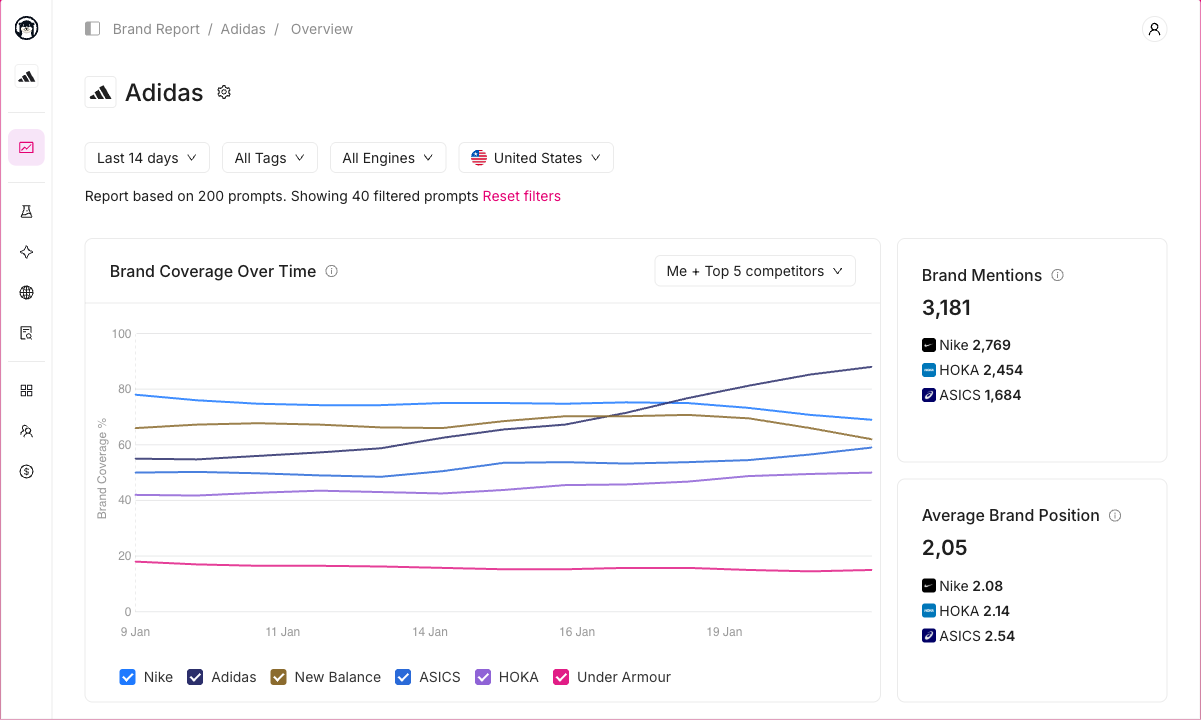
Best for: Small and medium-sized agencies delivering recurring AI search visibility reports.
Published pricing: $189/month for Standard and $489/month for Premium.
Otterly.AI is one of the more straightforward choices for agencies that want a dedicated AI visibility product without committing to a large enterprise software stack.
Its core workflow focuses on monitoring predefined questions across AI platforms and reviewing brand mentions, source citations, competitor visibility, and historical changes.
The feature that makes it particularly relevant to agencies is workspace management.
The Standard plan includes unlimited workspaces and team members, allowing agencies to organise client projects without treating each workspace as a separately priced subscription.
That doesn’t make monitoring unlimited. Standard includes 100 tracked search prompts, while Premium includes 400. The base coverage includes ChatGPT, Google AI Overviews, Perplexity, and Microsoft Copilot, with Gemini, Claude, and Google AI Mode offered as additional paid options.
What Makes Otterly Useful for Agencies?
Otterly’s Agency Partner Programme adds another layer of functionality for approved partners.
According to its published terms, qualifying partners receive 150 prompts on Standard instead of 100, or 500 prompts on Premium instead of 400.
Other benefits include pitch workspaces for prospects, consolidated billing, and reporting through Google Looker Studio.
That distinction matters. An agency might want to review a prospect’s AI visibility before signing a contract without reducing the prompt capacity already allocated to paying clients.
Looker Studio also provides a way to create branded client reports, although this should not be confused with native white-label access to the Otterly software itself.
The Main Limitation
A shared prompt allowance becomes restrictive when an agency promises extensive monitoring to every client.
For example, 100 prompts divided equally among ten clients leaves ten configured prompts per client. That may be useful for monitoring selected commercial topics, but it won’t cover every service, product, audience segment, and location.
Additional prompts and engines increase the subscription cost, so agencies should estimate the complete monitoring requirement before choosing Standard or Premium.
Choose Otterly if: You want clear GEO monitoring, separate client workspaces, and a repeatable reporting process.
Consider an alternative if: Your agency requires very large prompt datasets, extensive enterprise analysis, or broader SEO and content optimisation capabilities within the same platform.
Bottom line: Otterly is a strong first platform to evaluate when your agency primarily sells ongoing GEO measurement and reporting.
2. SE Ranking: Best for Agencies Combining SEO and GEO

Best for: Agencies delivering traditional SEO and GEO under one monthly retainer.
Published pricing: Core starts at $103.20/month on annual billing, while Growth starts at $223.20/month annually.
SE Ranking is useful when GEO is being added to an established SEO service rather than sold as a completely separate product.
Its current Core plan combines traditional SEO features with AI search functionality, including daily tracking for up to 100 prompts, 10 projects, and five domains for GEO research.
Growth increases capacity to 250 daily prompts, 30 projects, and 15 GEO research domains. Both plans support multiple AI systems within their published tracking configuration.
These allowances create a different proposition from buying one GEO subscription and maintaining an unrelated rank tracker, audit platform, and competitor research tool.
What Makes SE Ranking Useful for Agencies?
Its main advantage is workflow consolidation.
If a client loses visibility for an important topic, the agency can investigate conventional rankings, competitor pages, backlinks, technical problems, and AI-generated answers within one broader SEO environment.
SE Ranking also offers an Agency Pack, adding white-label reporting, client-facing access, and automated reports.
The Agency Pack is a separate purchase, starting from $69/month on qualifying annual subscriptions.
This means an agency should not assume that all white-label features are included in the advertised Core or Growth price.
The Main Limitation
SEO and GEO capacity must be planned together.
The number of projects, tracked keywords, AI prompts, GEO research domains, and team members varies by subscription.
An agency handling several clients may also need additional manager seats or a higher plan, even when the raw number of tracked prompts appears sufficient.
Choose SE Ranking if: Your team already provides SEO and wants to add AI visibility without operating another standalone platform.
Consider an alternative if: GEO is your primary service and you need highly specialised AI response research beyond the broader SEO workflow.
Bottom line: SE Ranking is one of the more practical options for agencies that need GEO integrated with everyday SEO operations.
3. Rankscale: Best for Flexible Credit-Based GEO Monitoring
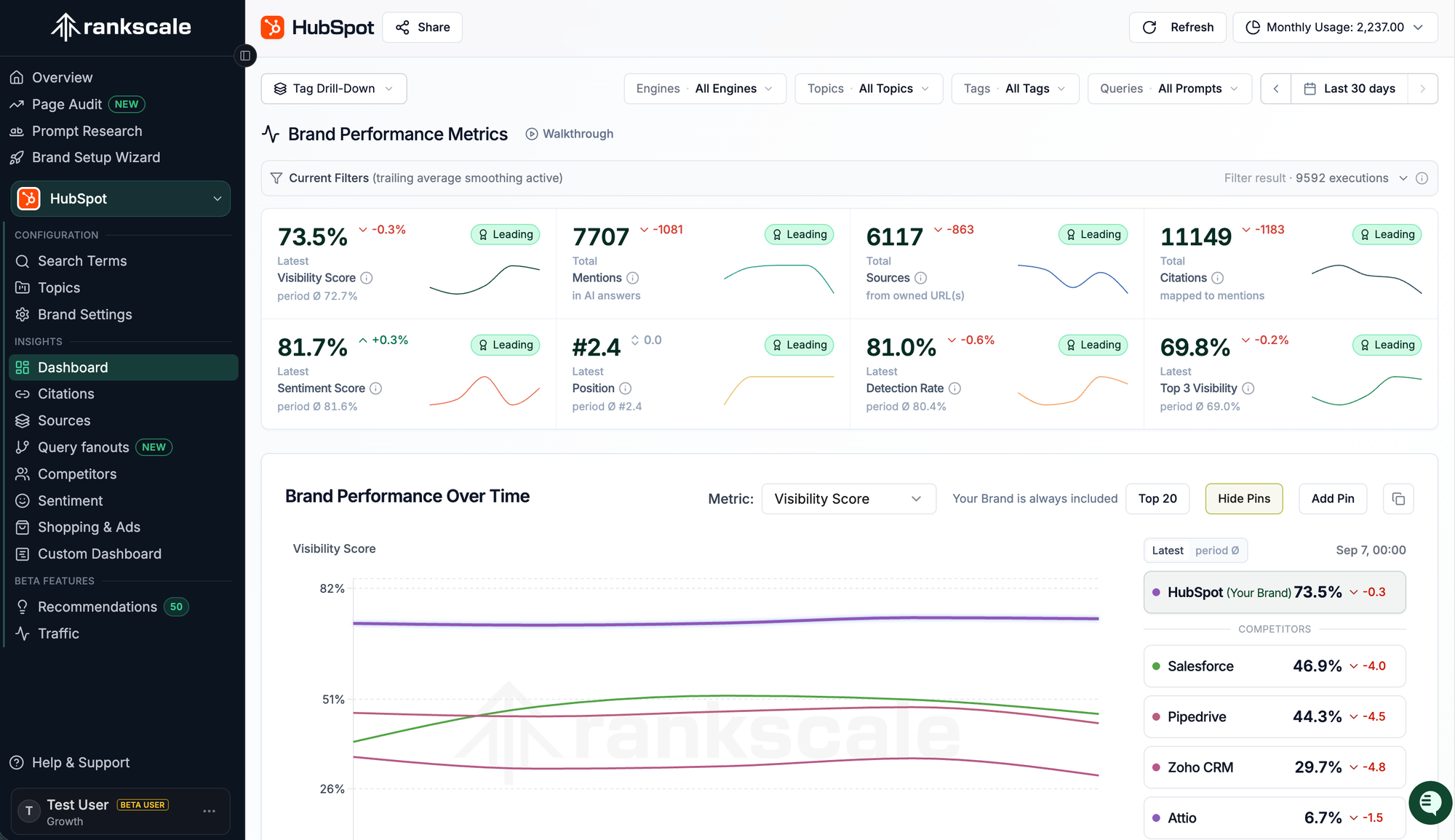
Best for: Agencies managing several brands with varying AI monitoring requirements.
Published pricing: Pro $99/month, Pro+ $229/month, Growth $385/month.
Rankscale approaches AI visibility monitoring through monthly credits and separate brand dashboards.
Its Pro plan includes 1,200 monthly credits and up to 10 brand dashboards. Pro+ expands the allocation to 3,000 credits and 25 dashboards, while Growth includes 5,500 credits and up to 50 dashboards.
The platform supports prompt monitoring, citation and source analysis, geographical reporting, and dashboard-based presentation.
Its higher-tier functionality also includes reporting integrations and agency-specific benefits.
What Makes Rankscale Useful for Agencies?
The main attraction is flexibility.
An agency could theoretically allocate more monitoring resources to a large ecommerce client while giving smaller local businesses a lighter monitoring package.
That is useful when clients have different budgets, service scopes, and reporting expectations.
Rankscale’s Growth plan is explicitly positioned for agencies and includes additional white-label options and API capabilities.
The platform also provides a credit calculator to help estimate how many AI responses a proposed monitoring configuration would consume.
The Main Limitation
Credits are not equivalent to prompts.
Rankscale states that a typical AI engine query can consume approximately 0.25 credits, but the actual cost depends on the engine and configuration.
More demanding models or additional monitoring settings may consume credits differently.
An agency should therefore test the specific engines, regions, and schedules it plans to use rather than simply dividing the monthly credit total by the number of clients.
Choose Rankscale if: You want pooled usage capacity and the flexibility to provide different monitoring packages to different clients.
Consider an alternative if: Your agency prefers a fixed prompt allowance with minimal usage calculations.
Bottom line: Rankscale deserves consideration when monitoring volume varies significantly across an agency’s client portfolio.
4. Peec AI: Best for Collaborative Brand and Competitor Research
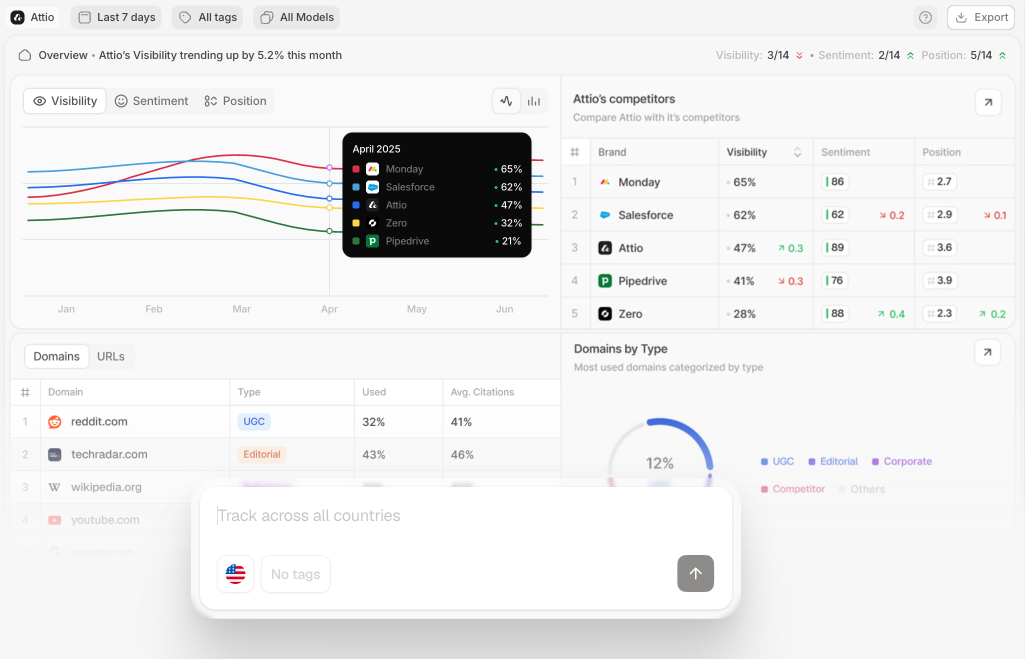
Best for: GEO and content teams collaborating on AI visibility analysis across several brands.
Pricing: Confirm current agency pricing directly with Peec AI.
Peec AI focuses on monitoring brand visibility within AI-generated answers and comparing that visibility with competitors.
Its product includes prompt discovery, competitor analysis, source insights, brand-level reporting, and analysis across supported AI platforms.
Peec’s published brand plans include unlimited team users and daily tracking.
The Starter configuration lists 50 prompts, three models, and one project. Pro includes 150 prompts and two projects, while Advanced lists 350 prompts and five projects.
Advanced also includes multi-country support and Looker Studio integration.
What Makes Peec AI Useful for Agencies?
Unlimited team users can be valuable when several strategists, account managers, and content specialists need access to the same research.
The ability to examine mentions, citations, competitor positioning, and AI-generated recommendations can also help connect monthly reporting with content and digital PR planning.
Peec separately advertises agency pricing, making it worth enquiring about arrangements beyond its standard brand subscriptions.
The Main Limitation
Project limits on standard plans can become restrictive for agencies.
Although the team-user allowance is generous, a brand plan with two projects does not automatically support a portfolio of fifteen paying clients.
The standard plans also restrict the number of selected AI models. Supporting additional platforms may require another plan or commercial arrangement.
Before signing up, request a clear quotation covering your expected number of clients, countries, engines, and monthly reports.
Choose Peec AI if: Your agency prioritises brand discovery, competitor analysis, and collaboration around GEO strategy.
Consider an alternative if: You need publicly predictable per-client pricing without requesting an agency quote.
Bottom line: Peec is a compelling research-oriented option, but agencies should evaluate its dedicated commercial terms rather than assuming the standard brand plans scale appropriately.
5. Profound: Best for Enterprise GEO Consulting and Client Prospecting
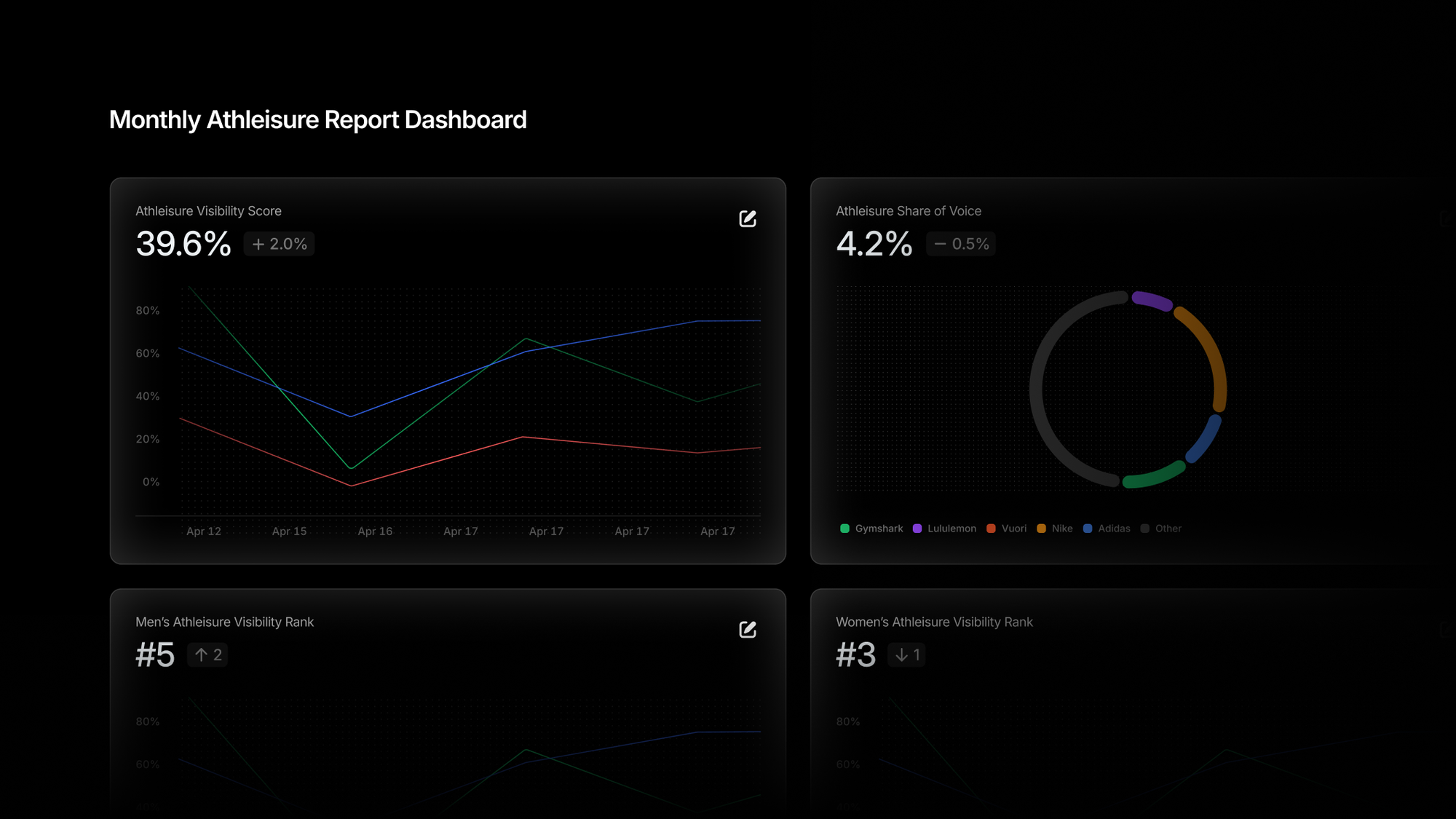
Best for: Agencies serving enterprise clients that need detailed AI search intelligence and structured research workflows.
Pricing: Request a current agency quotation.
Profound positions itself as a broader AI marketing platform, combining AI search visibility intelligence with analysis, research, and agent-assisted marketing workflows.
For agency use, one of its notable capabilities is the separation between prospecting and ongoing client work.
Profound has documented an Agency Growth model involving pitch workspaces and client workspaces.
A pitch workspace allows an agency to produce an initial visibility assessment for a prospective client, while a client workspace supports more extensive monitoring after the relationship begins.
What Makes Profound Useful for Agencies?
This structure addresses a practical agency problem: GEO audits can be expensive to prepare before a prospect has committed to a retainer.
Having designated prospecting and active-client workflows makes it easier to standardise sales demonstrations, maintain project boundaries, and continue monitoring after onboarding.
Profound also offers deeper analysis of AI answers, competitors, citations, and associated marketing opportunities.
Its broader enterprise platform includes additional controls, integrations, and customisation options for more complex organisations.
The Main Limitation
Profound is not necessarily the most economical choice for a small agency monitoring a limited number of questions.
Historically, its Agency Growth offer used a per-client-workspace commercial model. Agencies should request current pricing and confirm how workspaces, supported engines, prompts, agents, and reporting capacity are billed.
The latest published product structure emphasises trials and enterprise arrangements, so older self-serve prices should not be treated as a guaranteed current agency quote.
Choose Profound if: Your agency works with enterprise clients and needs extensive AI visibility research, structured prospecting, and deeper analytical workflows.
Consider an alternative if: You mainly need affordable monitoring and monthly PDFs for a small client portfolio.
Bottom line: Profound is worth evaluating for higher-value consulting engagements where the depth of research justifies a more involved platform and commercial arrangement.
6. Scrunch: Best for GEO Monitoring and AI-Agent Website Analysis
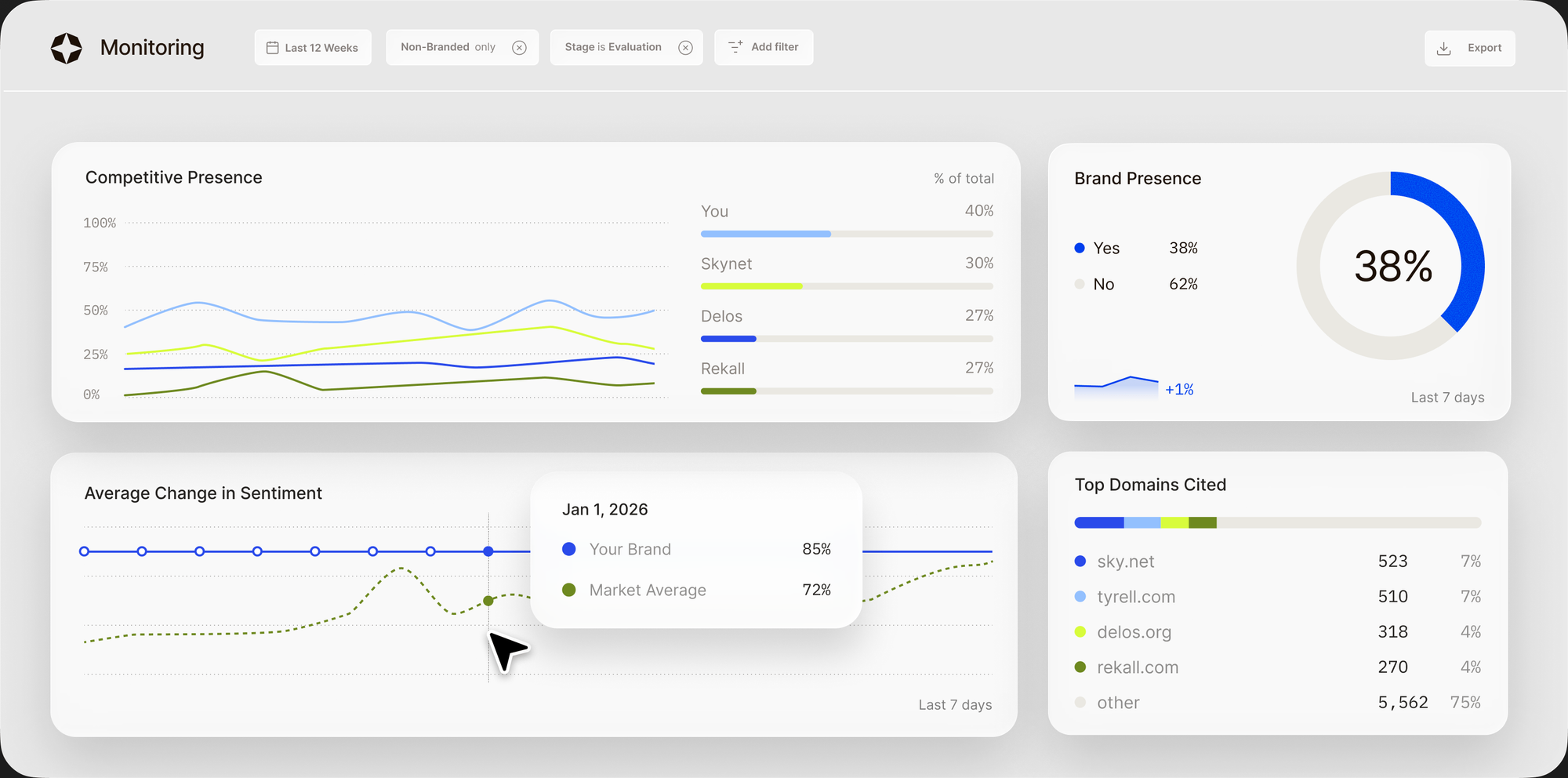
Best for: Agencies connecting AI visibility monitoring with content, technical optimisation, and agent-traffic analysis.
Published pricing: From $250/month on annual billing, or $300 month-to-month.
Scrunch focuses on AI search visibility and how websites are experienced by AI agents.
Its offering includes prompt monitoring, competitor analysis, citation tracking, page auditing, and tools for examining interactions between AI systems and websites.
The published Starter plan includes 350 custom prompts, three user licences, and five page audits. Growth increases those allowances and adds broader support.
What Makes Scrunch Useful for Agencies?
Scrunch is particularly interesting when clients want more than a monthly answer-visibility report.
An agency may also need to investigate whether important pages are accessible to AI systems, which sources are influencing recommendations, and whether AI-sourced visits lead to meaningful website activity.
Scrunch’s Agent Experience Platform extends the product beyond conventional brand mention monitoring.
Its Agency Partner Programme also advertises special agency pricing, prospecting licences, and partnership benefits.
The Main Limitation
The broader platform may be more than an agency needs when GEO reporting is still a small add-on service.
Published plans have user limits and other feature allowances, while agency-specific pricing requires additional confirmation.
Features related to delivering content to AI agents should also be evaluated separately from independent visibility measurement. A technical implementation feature is not evidence that a particular visibility improvement will occur.
Choose Scrunch if: Your agency combines GEO reporting with technical investigation and more advanced website optimisation.
Consider an alternative if: You only need straightforward brand monitoring at the lowest possible subscription cost.
Bottom line: Scrunch has a distinct role for agencies building more technically involved GEO services.
7. Ahrefs Brand Radar: Best for GEO Research Inside an Existing Ahrefs Workflow
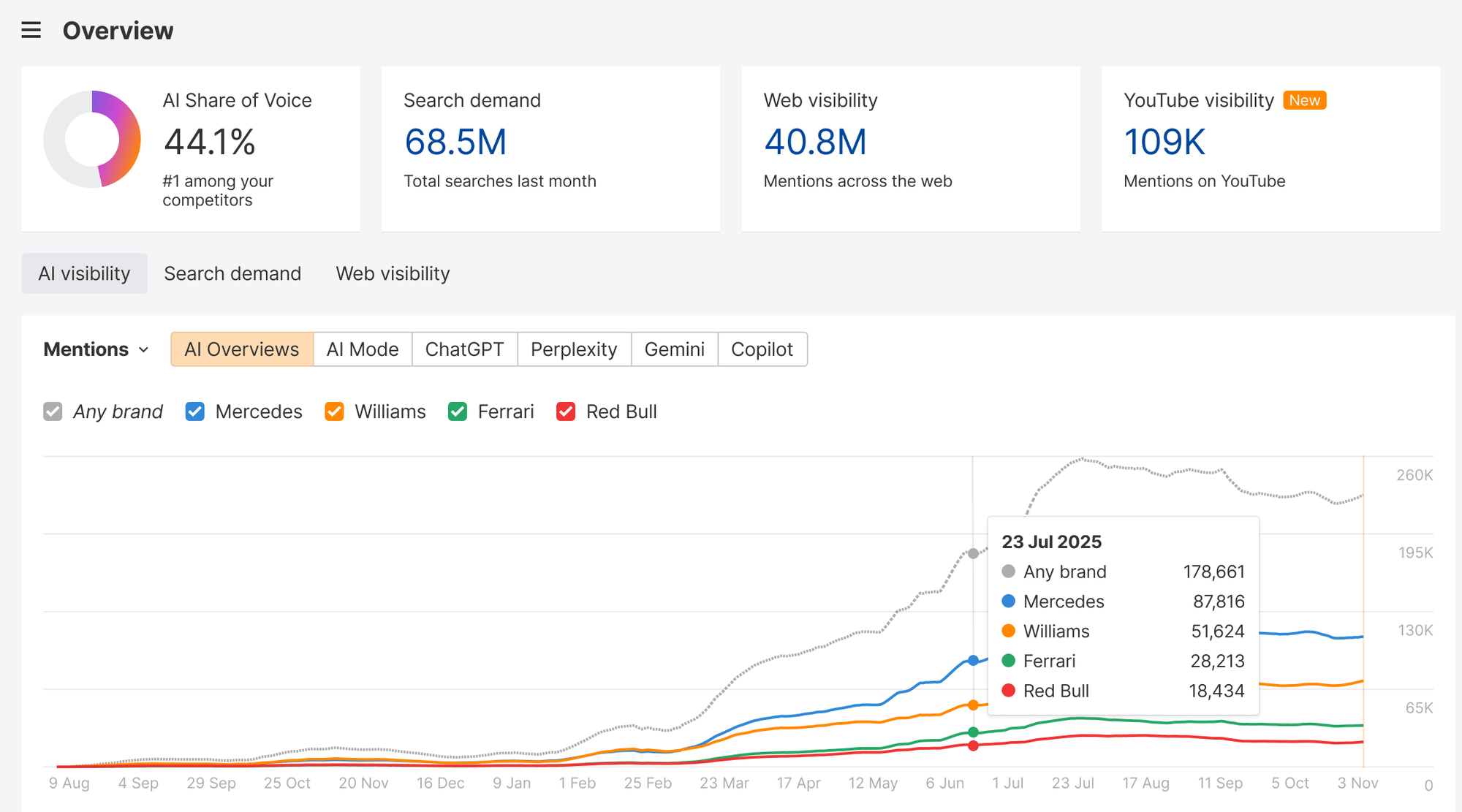
Best for: Established SEO agencies already using Ahrefs for backlinks, keyword research, and competitive intelligence.
Published pricing: Custom Prompt packages start at $50/month; AI Visibility Index access starts at $199/month.
Ahrefs Brand Radar provides two related approaches to AI visibility.
Custom Prompts lets users monitor specific questions across selected AI platforms, locations, and refresh schedules.
AI Visibility Index is designed for broader discovery across Ahrefs’ database of sampled AI-search questions, brands, citations, and competitors.
These products serve different purposes.
Custom prompt tracking is generally more suitable for contractual monitoring commitments, while the wider index can help an agency research new client markets and find visibility opportunities before defining a tracked prompt set.
What Makes Ahrefs Useful for Agencies?
Many agencies already rely on Ahrefs for competitor and backlink research.
Brand Radar extends that workflow into AI search without requiring marketers to abandon the platform they use for traditional SEO analysis.
It is particularly useful when an AI visibility question leads into content gaps, source research, or competitor backlinks.
Ahrefs also publishes clear usage rules for custom checks.
One check generally means one prompt executed on one AI platform in one location during one scheduled run. Certain engines may have different check consumption.
The Main Limitation
Monitoring costs can increase rapidly when agencies multiply prompts by engines, locations, and refresh frequency.
The $50 Basic Custom Prompts package includes 2,500 checks per month. Larger packages provide 7,000 or 25,000 checks.
The separate AI Visibility Index is not interchangeable with custom tracked-prompt monitoring, and agency teams should confirm the pricing of both if they need both forms of research.
Choose Ahrefs if: Your existing SEO workflow is already centred on Ahrefs and you want to extend competitive research into AI search.
Consider an alternative if: You primarily need multi-client GEO workspaces, automated branded reports, and agency-specific delivery features.
Bottom line: Ahrefs Brand Radar is particularly attractive for research-led SEO agencies, provided they model custom-check consumption carefully.
8. Semrush AI Visibility: Best for Agencies Already Using Semrush
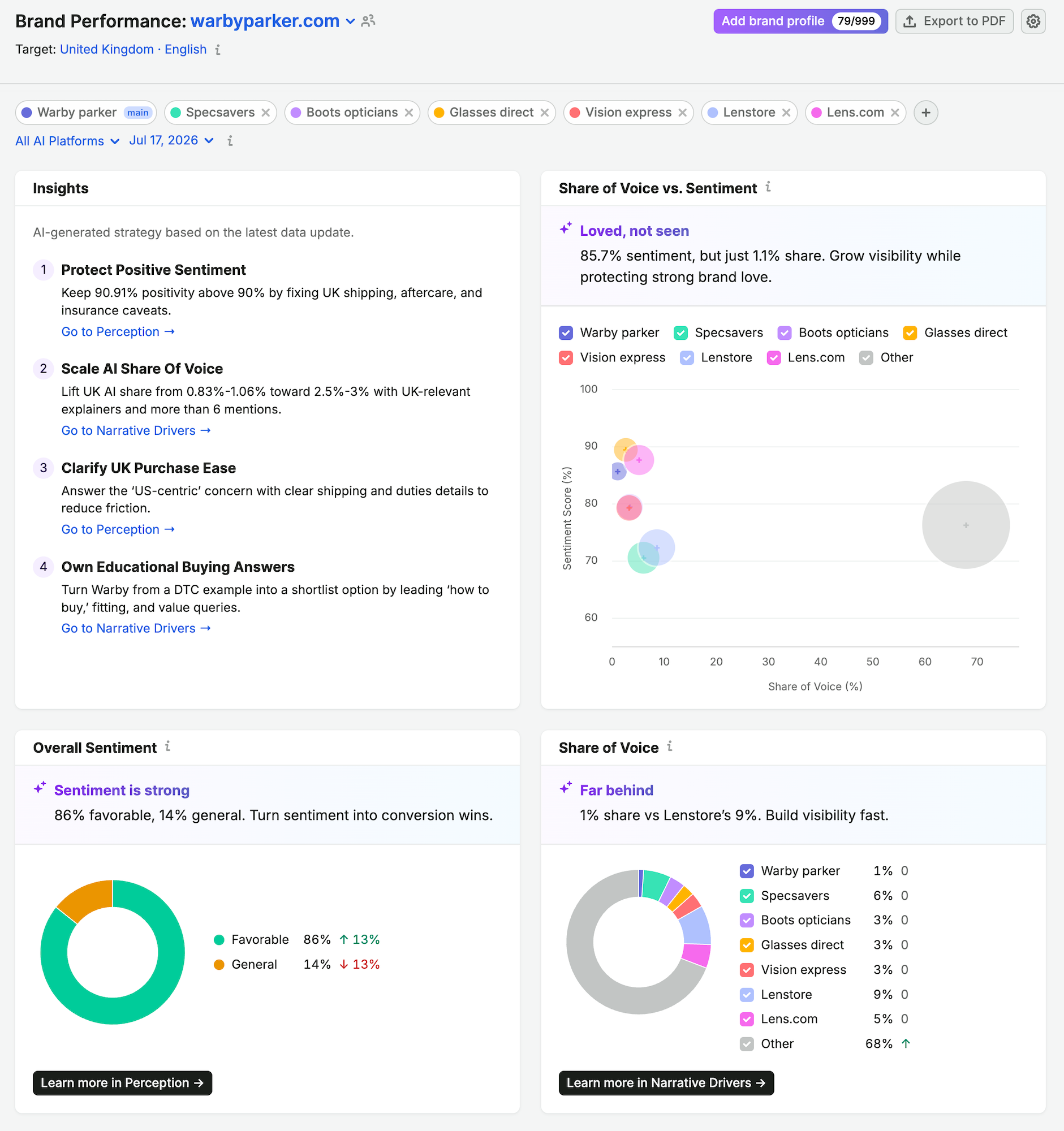
Best for: SEO agencies adding AI visibility analysis to existing Semrush-led client workflows.
Published pricing: From $99/month per domain on annual billing.
Semrush AI Visibility combines AI search brand research with prompt tracking and competitor analysis.
Its published Base configuration includes one domain for Brand Performance analysis, 25 tracked prompts, and coverage of selected AI platforms such as ChatGPT, Google’s AI experiences, Gemini, and Perplexity.
The platform is particularly relevant when an agency already uses Semrush for keyword research, technical audits, backlinks, and campaign reporting.
What Makes Semrush Useful for Agencies?
Consolidating GEO and SEO work can simplify investigation.
When a client appears less frequently in AI-generated answers, an agency can consider the issue alongside existing search visibility, competitor research, and content performance.
Semrush also offers reporting products with additional integrations, scheduled delivery, and white-label capabilities.
However, these reporting features may involve separate charges.
The Main Limitation
Per-domain pricing becomes important as the client list grows.
At $99 per domain, monitoring five client domains would represent $495 per month before any separately billed reporting products, seats, or additional requirements.
That may be reasonable for established retainers but expensive for a small agency selling an introductory GEO monitoring service.
The published Base tracking allocation is also 25 prompts per domain, so agencies should confirm whether that depth meets each client’s needs.
Choose Semrush if: Your agency already uses Semrush and values maintaining its SEO and GEO research in a connected environment.
Consider an alternative if: You want a single pooled monitoring subscription across many low-budget client accounts.
Bottom line: Semrush works best when the value comes from integrating AI visibility into an existing Semrush operation.
9. Digimetrics: Best for Combining GEO With SEO and Content Audits
Best for: Agencies that want AI visibility checks to feed into technical SEO, content, and broader marketing investigations.
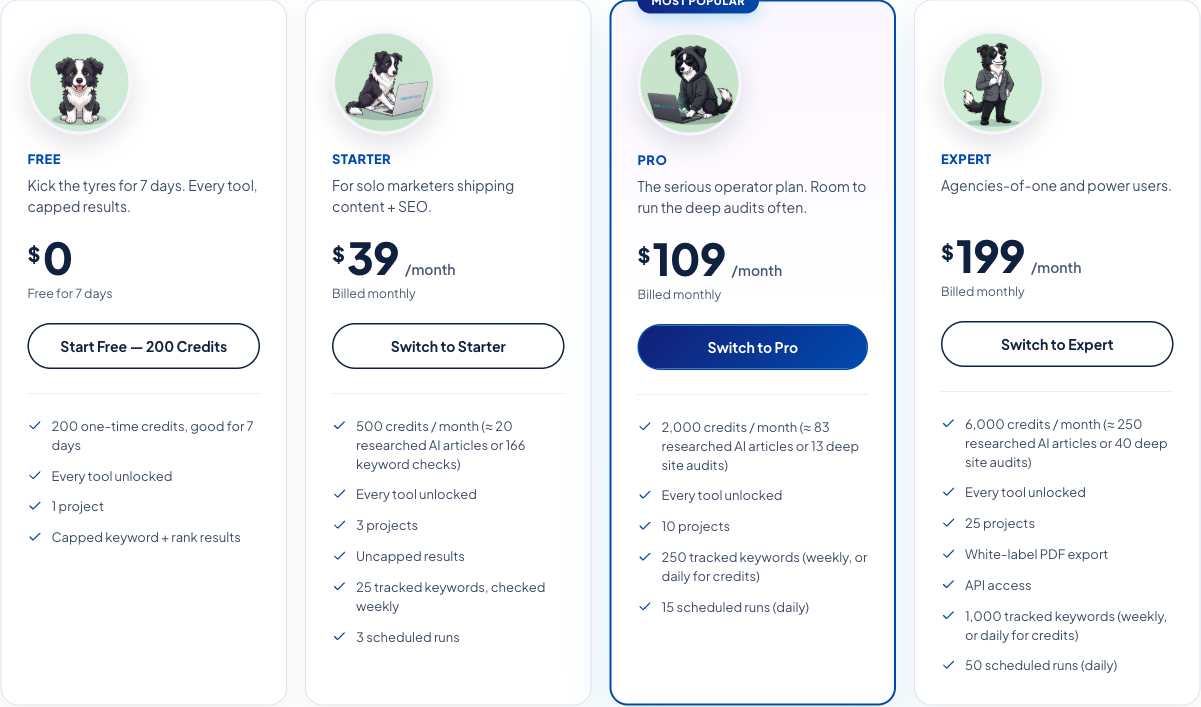
Published pricing: Starter $39/month, Pro $109/month, and Expert $199/month.
Disclosure: DigitalMarketingTools.ai is sponsored by Digimetrics.ai, which is developed by MediaOne.
Digimetrics combines AI visibility functionality with a wider set of SEO, content, website auditing, and marketing analysis tools.
Its GEO-related features include AI Mentions Tracker, AI Discovery Audit, GEO On-Page Optimisation, and integrated SEO/GEO diagnostic workflows.
For agencies, the broader proposition is the ability to investigate several aspects of a client’s website without immediately switching between separate tools.
The platform also uses projects to organise client websites.
Starter includes three projects and 500 monthly credits. Pro expands this to ten projects and 2,000 credits, while Expert includes 25 projects and 6,000 credits.
The Expert plan also advertises white-label PDF export and API access.
What Makes Digimetrics Useful for Agencies?
Digimetrics can help when a client report raises a question that goes beyond AI search visibility.
For example, an agency might discover that an AI-generated answer frequently cites a competitor’s guide.
The next step could involve examining the client’s content, technical health, competitor positioning, or search performance.
Having multiple diagnostic functions in one workspace can reduce the need to piece together several unrelated reports.
The Main Limitation
Digimetrics should not be treated as a direct substitute for every dedicated GEO monitoring platform.
Its subscription credits are shared across different tools and analyses, meaning the number of projects does not establish how many recurring AI visibility checks the agency can perform.
An Expert subscription may support 25 projects, but that does not mean all 25 clients can receive unrestricted daily tracking across every AI platform.
Agencies should verify the credit cost of their planned recurring checks, the reporting workflow, and the available GEO monitoring detail before making contractual promises.
Choose Digimetrics if: GEO is part of a broader SEO, content, technical auditing, and marketing service.
Consider an alternative if: Your main requirement is high-volume, specialist AI response monitoring across many clients.
Bottom line: Digimetrics is an option for integrated agency workflows, but its monitoring economics and dedicated GEO reporting capabilities should be tested against specialist alternatives.
How Much Do GEO Tools Cost for Agencies?
The biggest pricing mistake is comparing monthly subscription fees without accounting for the monitoring workload.
A plan offering 100 tracked prompts isn’t necessarily smaller than one providing 2,000 response checks. The calculation depends on how many engines, locations, and refreshes are included.
Example: An Agency With Five GEO Clients
Consider an agency managing five clients, each requiring 20 commercially relevant questions monitored across three AI platforms.
The agency wants daily tracking and a monthly report.
| Workload Variable | Requirement |
|---|---|
| Paying clients | 5 |
| Tracked prompts per client | 20 |
| Total configured prompts | 100 |
| AI platforms | 3 |
| Locations | 1 per client |
| Monitoring frequency | Daily |
| Illustrative monitoring period | 30 days |
For a billing model that charges for each individual prompt execution, the monthly workload is:
5 clients × 20 prompts × 3 platforms × 30 days = 9,000 AI answer checks
That does not mean every GEO vendor will charge for 9,000 individual units.
For example, Otterly may sell an allowance of configured prompts that are monitored across its included engines, while Ahrefs meters individual platform-location executions. Rankscale uses credits that vary according to the engine.
The calculation is useful precisely because it highlights why agency pricing needs to be normalised.
How Selected Pricing Models Handle the Workload
| Platform | Pricing Implication for Five Clients |
|---|---|
| Otterly.AI | Standard’s 100 prompts may cover the configured prompt count across included engines; verify location and add-on needs |
| SE Ranking | Core provides 100 daily prompts and 10 projects; confirm exact engine allocation and reporting requirements |
| Rankscale | 9,000 responses at an illustrative 0.25 credits each would consume 2,250 credits; higher-cost engines change the result |
| Peec AI | Multiple clients require an agency arrangement or sufficient projects and prompt capacity |
| Profound | Model the agency’s required client workspaces and request a quote |
| Scrunch | Check the number of permitted brands, users, tracked prompts, and applicable agency terms |
| Ahrefs Brand Radar | 9,000 standard checks exceed the 2,500- and 7,000-check packages; review larger packages and engine-specific rates |
| Semrush | Five domains at $99 each represent $495/month on the stated annual-billing terms |
| Digimetrics | Project capacity may be sufficient on Pro, but GEO check consumption must be calculated from shared credits |
This is an illustrative workload comparison, not a measured head-to-head billing experiment. Vendors define prompts, responses, credits, and supported locations differently.
The useful figure is the cost of meeting a defined monitoring commitment, not the cheapest number displayed on the pricing page.
Cost Per Client
Once the total tool expenditure is known, agencies can estimate how much of the subscription each client needs to cover.
For example, an agency spending $300 per month on relevant GEO software across five equally demanding clients has an allocated software cost of:
$300 ÷ 5 clients = $60 per client per month
However, that’s only the software component.
A complete delivery-cost calculation also needs to account for prompt research, onboarding, quality checks, report preparation, strategy meetings, and implementation work.
If one account consistently requires more markets, prompts, or investigation time, equal cost allocation can obscure the actual economics.
The Five Agency Features Worth Paying More For
1. Real Client Separation
Client separation reduces operational risk.
An agency should be able to keep one client’s data, competitors, prompts, and reporting configuration distinct from another’s.
A tool with unlimited brands but shared global settings may still create unnecessary administrative work.
Before buying, test whether team members can access the correct client information without exposing unrelated projects.
2. Repeatable Reporting
A good client report should answer the same core questions every month, while allowing the agency to investigate new developments.
Useful recurring sections include AI platform coverage, monitored topics, brand mentions, citations, competitive comparisons, important changes, and recommended next actions.
Branded exports are helpful, but agencies should also inspect whether data can be validated against individual source responses.
3. Historical Response Evidence
A single AI-generated answer is not enough to establish a consistent visibility trend.
Models can generate different responses to similar questions or repeat the same prompt differently over time.
Historical response records help an agency distinguish between persistent patterns and isolated observations.
For more detail, our AI citation tracking guide explains the difference between a brand appearing in an answer and a source URL being cited.
4. Local and International Coverage
Location matters for agencies serving clients in multiple markets.
A monitoring setup configured for the United States may not adequately represent a client operating in Singapore, Australia, or the Philippines.
Test whether the platform actually supports the client’s target market and language, rather than relying on the number of countries advertised.
Also clarify whether local settings affect generated responses, the underlying search retrieval, or both.
5. Exports and Integrations
Agencies frequently combine GEO data with Google Analytics, Search Console, rank tracking, client CRM information, and internal reporting systems.
Looker Studio connectors, API access, scheduled exports, and reliable CSV files can reduce the time required to assemble reports.
However, every additional integration needs maintenance.
A feature is valuable only when it saves more work than it introduces.
How to Evaluate a GEO Tool Before Rolling It Out Across Clients
A short agency pilot should use the same monitoring brief across competing tools wherever possible.
Testing one platform with ten branded questions and another with fifty commercial discovery questions won’t reveal which is more useful for your service.
Step 1: Select Three Representative Clients
Choose a small cross-section of your portfolio.
For example, use a local service business, a B2B software company, and an ecommerce brand.
These clients should differ enough to reveal whether the platform supports multiple industries, regions, and reporting requirements.
Avoid using only the easiest client as the test case.
Step 2: Build a Consistent Prompt Set
For each client, choose questions that reflect identifiable commercial or informational needs.
A balanced pilot might include product discovery, service comparisons, purchase considerations, troubleshooting, and branded questions.
Avoid relying entirely on prompts that already contain the client’s brand name. These often measure recognition rather than whether the business is being discovered as an option.
Keep wording consistent across the tools being evaluated.
Step 3: Match Engines, Countries, and Monitoring Frequency
Set up equivalent AI platforms and countries whenever supported.
Record any differences that cannot be matched, such as an unavailable engine, additional paid model, or restricted market.
Some tools provide continuously tracked data, while others offer snapshots based on their own prompt datasets.
Treat those as distinct kinds of evidence.
Step 4: Verify the Underlying Responses
Choose a sample of recorded observations and inspect what the AI actually returned.
Check whether the brand was mentioned, whether a URL was visibly cited, and whether the result supports the platform’s reported classification.
Also look for incorrect brand matches or situations where an unrelated business has a similar name.
A tool that produces a polished chart but makes it difficult to inspect the underlying evidence can create additional reporting risk.
Step 5: Produce a Client-Ready Report
Give the analyst a consistent task: explain the client’s current AI visibility, identify two meaningful competitive gaps, and recommend three defensible next steps.
Record how long it takes to complete this assignment.
Include any manual spreadsheet work, formatting, source checks, or extra software required.
This reveals a tool’s operational usefulness more clearly than counting dashboard widgets.
Step 6: Repeat the Test Over Time
Run the same monitored prompt set again after an appropriate interval.
Check whether results are retained, whether historical comparisons are clear, and whether the tool distinguishes brand mentions from citations and other AI search measurements.
Don’t infer a marketing improvement from one fluctuating response.
Step 7: Model the Full Client Portfolio
Before selecting a plan, calculate the projected workload for five, ten, and twenty clients.
Include the target AI platforms, regions, monitoring frequency, report delivery requirements, and expected team members.
A platform that is inexpensive for three clients may require a significantly larger subscription or custom contract at twenty.
What Should Agencies Include in Monthly GEO Reports?
An effective agency report should explain visibility, evidence, progress, and proposed action.
It should not treat a proprietary vendor score as a direct measure of how many real people saw the client’s business.
A practical monthly report can use the following structure.
| Report Section | What to Show | Why It Matters |
|---|---|---|
| Executive summary | Important developments and decisions | Gives the client a clear overview |
| Monitoring coverage | Engines, prompts, countries, reporting dates | Defines the measurement scope |
| Brand mentions | Share of monitored responses mentioning the client | Shows visibility within the sample |
| Source citations | Pages and domains referenced in answers | Identifies content discovery and source opportunities |
| Competitor comparison | Relevant competing brands appearing in monitored answers | Reveals competitive gaps |
| Historical changes | Differences within a consistent prompt set | Helps identify persistent changes |
| Investigation findings | Pages, topics, and possible causes worth reviewing | Connects reporting with action |
| Recommended next steps | Prioritised content, SEO, technical, or PR tasks | Makes the report operationally useful |
| Business context | AI referrals, engagement, and conversions where available | Connects visibility to wider outcomes |
Avoid Presenting GEO Scores as Market Share
Suppose a client’s brand appears in 12 of 40 monitored AI answers.
That gives a 30% mention rate within the tracked sample.
It does not prove that 30% of all AI search users encountered the brand, nor does it establish a 30% share of the total AI search market.
Prompt selection, answer-engine coverage, timing, and methodology all affect the result.
Our guide to GEO analytics explains these distinctions and why AI visibility, organic search, citations, and website conversions need separate interpretation.
Separate Mentions From Citations
An AI assistant might recommend a client by name without linking to their website.
It might also cite the client’s article while discussing a broader subject without recommending the client’s business.
Both are useful observations, but they reflect different forms of visibility.
Where possible, agency reports should record the two separately and preserve the underlying responses.
Include Actions, Not Just Observations
A useful recommendation should identify a specific next step supported by the available evidence.
For example, an agency might identify a service-comparison topic where competitors consistently appear and the client’s site lacks a useful, up-to-date comparison page.
That could justify investigating a new content asset.
However, the agency should not promise that publishing the page will guarantee an AI citation.
GEO findings should guide prioritisation and experimentation rather than become guarantees of model behaviour.
How Agencies Can Package GEO Services
GEO software creates opportunities for additional services, but not every client needs the same package.
A practical agency offering can be divided into three levels.
GEO Visibility Audit
Suitable for: Prospects, new clients, and businesses exploring AI search.
A one-off audit can establish which important questions mention the brand, identify competitors appearing in the same topics, and inspect cited sources.
It should also include clear limitations: the results represent a defined sample of AI-generated answers, not exhaustive AI search exposure.
This service can help an agency introduce GEO without immediately committing the client to recurring monitoring.
Monthly GEO Monitoring
Suitable for: Businesses that need ongoing visibility and competitor reporting.
This package can include a fixed prompt set, supported AI platforms, agreed geographical coverage, monthly reporting, and a strategy call.
The service agreement should specify the number of monitored questions, supported engines, and reporting frequency.
That protects both the agency and the client from vague promises about unrestricted AI visibility tracking.
GEO Optimisation and Content Strategy
Suitable for: Clients investing in sustained organic search and AI discovery.
This broader service combines visibility reporting with competitor analysis, content planning, technical SEO, digital PR, and conversion measurement.
It is often easier to justify commercially when GEO is integrated with existing marketing work rather than treated as a standalone monthly score.
For an explanation of how conventional SEO and GEO measurements complement each other, see GEO and SEO Measure Different Signals, Not Better Ones.
Common Mistakes Agencies Make When Choosing GEO Software
Buying Based on the Cheapest Advertised Price
An entry-level subscription may cover only one project, a limited number of prompts, or one AI platform.
That may be sufficient for a demonstration but not for ongoing client delivery.
Compare the cost of the actual workload instead of the starting price.
Assuming Unlimited Workspaces Means Unlimited Checks
Workspace capacity and monitoring capacity are separate.
An agency might be allowed to create twenty client projects but have insufficient credits to monitor all twenty daily.
Always calculate both constraints.
Promising White-Label Reports Without Checking the Feature
Some tools offer branded PDFs, others provide Looker Studio integrations, and some support white-labelled client portals.
These are different capabilities.
Confirm what clients will actually receive and whether extra subscriptions or setup work are required.
Tracking Irrelevant Prompts
High monitoring volume doesn’t automatically produce useful GEO insights.
A report containing hundreds of questions unrelated to the client’s products or services may look comprehensive while offering little commercial value.
Start with relevant discovery and purchase-consideration questions, then expand only when the additional coverage supports a decision.
Reporting Every Visibility Change as a Win or Loss
AI-generated answers vary across prompts, models, locations, and time.
A month-to-month movement may reflect ordinary output variability, model changes, or alterations to the monitoring sample.
Agencies should preserve methodology and avoid claiming causation without supporting evidence.
Ignoring Traditional SEO and Business Outcomes
AI visibility isn’t a replacement for Search Console, analytics, technical SEO, or business performance reporting.
Monitor AI referrals and conversions where possible, while recognising that many AI-generated exposures may not result in a directly attributable website visit.
A good GEO report provides additional evidence rather than pretending to replace established marketing measurements.
Which GEO Tool Should Your Agency Choose?
| Agency Priority | Start By Evaluating |
|---|---|
| Dedicated GEO reporting for several small clients | Otterly.AI |
| SEO and GEO within one established workflow | SE Ranking |
| Flexible monitoring across different client budgets | Rankscale |
| Collaborative brand and competitor visibility research | Peec AI |
| Enterprise client research and GEO consulting | Profound |
| AI-agent behaviour and website optimisation | Scrunch |
| GEO research alongside Ahrefs-based SEO work | Ahrefs Brand Radar |
| GEO within an established Semrush operation | Semrush AI Visibility |
| Integrated SEO, content, technical audits, and GEO | Digimetrics |
The right platform also depends on your agency’s current software stack.
If you already pay for a platform that provides relevant AI visibility monitoring, adding a dedicated GEO subscription may only be justified when it delivers materially better data, client reporting, or operational efficiency.
For a broader market comparison, see our 10 Best GEO Tools in 2026 and Best Paid GEO Tools.
Final Verdict: The Best Agency GEO Tool Is the One You Can Deliver With Consistently
For agencies, the best GEO tool isn’t necessarily the product with the largest prompt database or most sophisticated visibility score.
It’s the platform that lets your team manage client data reliably, investigate meaningful AI search changes, produce understandable reports, and maintain a profitable delivery workflow.
Otterly.AI is a strong first option for dedicated multi-client GEO monitoring, particularly when its workspace and agency partner capabilities match the agency’s reporting needs.
SE Ranking is attractive for agencies adding GEO to existing SEO retainers, while Rankscale provides a flexible approach to allocating monitoring resources across different client accounts.
Peec AI and Profound deserve consideration for more research-intensive consulting work. Scrunch offers a different proposition when AI-agent behaviour and website optimisation form part of the service.
Ahrefs Brand Radar and Semrush AI Visibility make the most sense when their wider SEO ecosystems are already central to the agency’s operations.
Digimetrics can support agencies that want GEO findings connected to technical SEO and content workflows, although its credit-based monitoring capacity and specialised reporting depth require evaluation.
Before committing, run a pilot using your actual client requirements. Compare supported AI platforms, source evidence, reporting time, monitoring capacity, and the cost of delivering a realistic monthly service.
The tool that gives your agency a repeatable path from AI visibility evidence to useful client action will generally be more valuable than one that merely produces an impressive-looking dashboard.
Frequently Asked Questions
What Is the Best GEO Tool for Agencies in 2026?
Otterly.AI is a strong option for agencies focused on dedicated multi-client GEO monitoring and reporting. SE Ranking is worth considering for combined SEO and GEO services, while Rankscale offers flexible credit-based monitoring. Enterprise agencies may prefer to evaluate Profound or Peec AI depending on their research requirements.
The right choice depends on client volume, reporting features, monitored prompts, engines, and total operating cost.
Can Agencies White-Label GEO Reports?
Yes, but support varies by platform and plan.
Some products offer branded PDFs or Looker Studio connectors, while others provide white-labelled interfaces or client portals. Check whether these capabilities require an agency partnership, enterprise contract, or separate reporting add-on.
How Much Does a GEO Tool Cost for an Agency?
Costs range from relatively inexpensive introductory subscriptions to hundreds or thousands of dollars monthly for larger monitoring workloads.
The main variables include client domains, workspaces, tracked prompts, AI platforms, refresh frequency, locations, users, and reporting requirements.
Evaluate the cost of meeting a defined client commitment rather than relying on the vendor’s advertised starting price.
Do Agencies Need a Separate GEO Tool if They Already Use Semrush or Ahrefs?
Not necessarily.
Semrush and Ahrefs offer AI visibility functionality that may meet an agency’s needs, especially when GEO is an extension of existing SEO work.
A specialist GEO product becomes more attractive when the existing platform lacks the monitoring capacity, source evidence, workspaces, or client reporting required by the service.
How Many Prompts Should an Agency Track Per Client?
There is no universally correct number.
A focused pilot might begin with 15–30 carefully selected questions per client, covering important commercial and informational topics.
Larger clients with multiple product categories, countries, or audience segments may need substantially more.
The key is to choose prompts that reflect meaningful customer questions, not simply maximise the number of tracked entries.
Is GEO Reporting Accurate?
GEO tools can provide useful observations from selected AI platforms and prompts, but they don’t observe every private conversation or every possible generated answer.
Results also depend on the vendor’s sampling, response collection, brand matching, and citation classification methods.
Agencies should verify a sample of underlying responses and report monitoring limitations transparently.
Can GEO Tools Measure ROI?
They can contribute to ROI analysis, but visibility metrics alone do not establish financial return.
Where possible, combine AI visibility observations with first-party analytics, AI referral traffic, conversions, leads, and sales outcomes.
Be careful not to equate a higher sampled mention rate with a proven increase in revenue.
Can One GEO Subscription Manage Multiple Clients?
Yes, many products support multiple projects, brands, or workspaces.
However, monitoring allowances may be shared across the subscription, and some vendors charge separately for client domains or additional workspaces.
Check project capacity and usage capacity independently.
Should Agencies Sell GEO as a Separate Service?
That depends on client demand and the agency’s existing offering.
Standalone GEO audits and monitoring reports can be useful for businesses specifically interested in AI search visibility.
For many clients, GEO is more actionable when combined with content strategy, technical SEO, competitor research, and established performance measurement.
Are There Free GEO Tools Agencies Can Use?
Yes. Google Search Console and Bing Webmaster Tools provide valuable first-party reporting for supported AI search experiences, while other vendors offer limited free checks or time-restricted trials.
However, these options don’t necessarily provide the multi-client workspaces, historical monitoring, and automated reporting required for a recurring agency service.
See our best free GEO tools comparison for available no-cost options and limitations.
Editorial Methodology and Disclosure
This article compares publicly documented GEO features, pricing, and agency workflows reviewed on October 20, 2026.
The recommendations reflect product suitability for different agency requirements, not a controlled accuracy test or measured return-on-investment ranking.
Prices, feature limits, AI platform coverage, and partner programmes can change. Verify all commercial terms before purchasing.
DigitalMarketingTools.ai is sponsored by Digimetrics.ai, developed by MediaOne. The sponsorship is disclosed because Digimetrics is included in the comparison. No additional ranking credit has been assigned because of that relationship.
Our review and disclosure principles are available in the Editorial Methodology.
Disclosure: digitalmarketingtools.ai is sponsored by Digimetrics.ai. Sponsored Highlights are clearly labelled advertising. Our reviews, comparisons and guides are written to be useful and fair regardless of who sponsors the site. Read the full disclosure.