
How to Choose the Best AI Search Visibility Tool in 2026
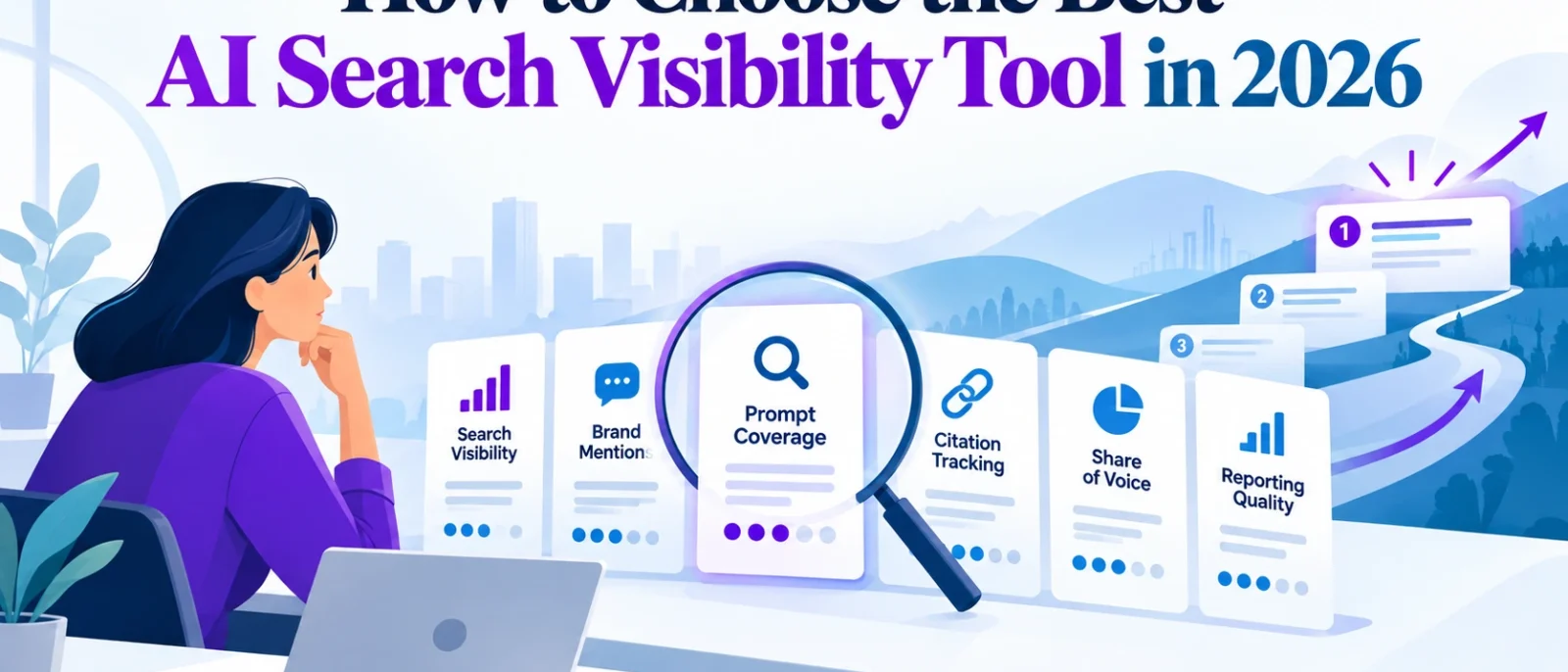
You’ve probably seen AI visibility tools promising to show how often ChatGPT, Google AI Overviews, Perplexity, and other AI platforms mention your brand. Some even give you a visibility score, compare competitors, and recommend what to improve.
Sounds useful, right? The problem is that two tools can give you completely different visibility scores for the same business, even when both are working as designed.
One might analyse thousands of preselected prompts, while another monitors only 20 questions you’ve entered manually. One might track ChatGPT Search, while another uses an API-based model response. They aren’t necessarily measuring the same thing.
That makes choosing the best AI search visibility tool a little more complicated than comparing dashboards and subscription prices.
Before paying for a tool, you need to understand what it actually tracks, how it collects responses, whether the prompts reflect your customers, and what you can do with the results.
In this guide, we’ll walk through the features worth paying for, how current platforms differ, and a practical testing process you can use before committing to a subscription.
The goal isn’t to find the tool with the highest visibility score. It’s to find one that gives you reliable enough evidence to make better marketing decisions.
What Is an AI Search Visibility Tool?
An AI search visibility tool is software that monitors how your business, products, or website appear in AI-generated answers.
Instead of checking where your website ranks for a keyword on a traditional search results page, it examines how AI platforms respond to questions relevant to your business.
For example, imagine you sell accounting software in Singapore. A potential customer might ask ChatGPT:
“What are the best accounting software options for a small business in Singapore?”
A conventional rank tracker might tell you whether your website appears in Google’s organic results for a related keyword.
An AI search visibility tool may instead tell you whether your brand appeared in the AI-generated response, which competitors were recommended, and whether the answer linked to your website or another source.
That distinction matters because being mentioned in an AI answer isn’t the same as being cited as a source.
A brand can appear in a recommendation without receiving a link. Meanwhile, an AI answer might cite an article from your website without explicitly recommending your business.
Good AI visibility software should help you distinguish those situations.
If you’re unfamiliar with the broader category, our complete guide to GEO tools explains how AI visibility monitoring fits alongside technical SEO, content optimisation, and generative engine optimisation.
What Should an AI Visibility Tracking Tool Actually Measure?
Before comparing products, it’s worth understanding the main metrics. They’re related, but they don’t all describe the same outcome.
| Metric | What It Measures | Why It Matters |
|---|---|---|
| Brand mentions | How often your business appears in monitored AI responses | Shows whether AI assistants are bringing your brand into relevant conversations |
| Source citations | How often AI responses link to or reference your website | Helps identify which pages are being used as sources |
| AI share of voice | Your visibility relative to selected competitors under the tool’s calculation method | Helps compare performance within a defined market or prompt set |
| Prompt-level visibility | Whether your brand appears for specific questions | Shows which customer questions you appear for and which you’re missing |
| Brand context or sentiment | How your business is described in AI responses | Helps identify inaccurate information and recurring perceptions |
| Visibility trends | How monitored appearances change over time | Helps distinguish recurring visibility from isolated mentions |
| AI referral traffic | Visits attributed to supported AI sources | Provides a separate signal of website visits, though it doesn’t capture every AI-influenced journey |
Why Brand Mentions and Citations Should Be Separate
Imagine an AI-generated answer recommends three software companies.
Your business appears as the second recommendation, but the response links only to a competitor’s comparison article.
You have a brand mention, but not necessarily a citation to your website.
Now imagine the answer references a guide published on your website without mentioning your company in its recommendations.
You may receive a source citation, but your brand isn’t necessarily being recommended.
A tool that combines both outcomes into one unexplained score makes it harder to understand what actually happened.
For more detail, our guides to AI brand mention tracking and AI citation tracking explain how those measurements differ.
How to Choose the Best AI Search Visibility Tool
1. Start With the AI Platforms Your Customers Actually Use
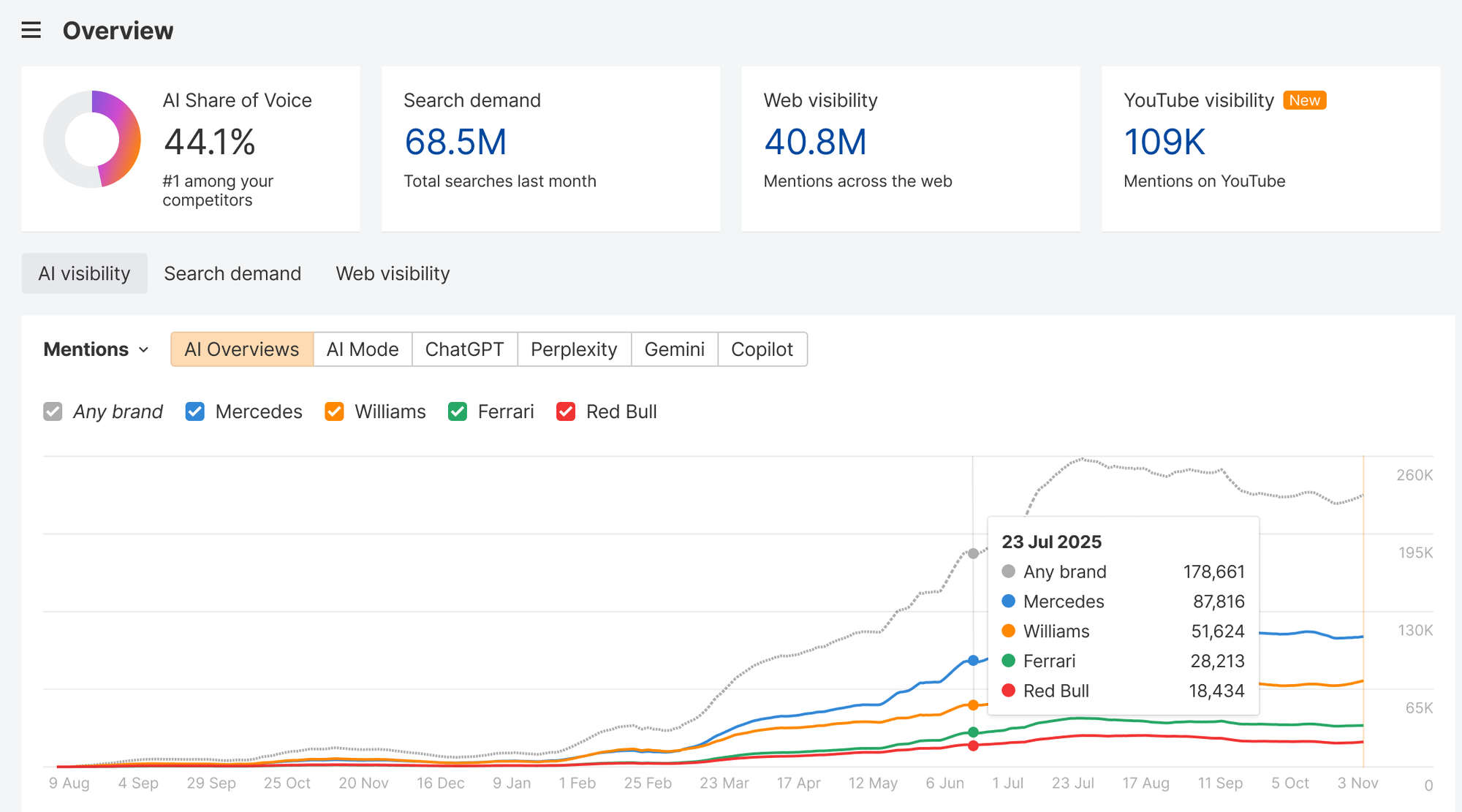
More platform coverage sounds better, but it isn’t automatically more useful.
A tool might advertise monitoring across eight or ten AI engines. However, if your potential customers mainly use ChatGPT Search and Google AI Overviews, those platforms should receive most of your attention.
Start by identifying which AI experiences matter to your business.
| AI Platform | What You May Want to Track | What to Verify |
|---|---|---|
| ChatGPT Search | Brand recommendations, mentions, and linked sources | Whether the tool monitors search-enabled responses or a different model/API setup |
| Google AI Overviews | Visibility and citations in Google’s generated search summaries | Supported countries, languages, keywords, and collection method |
| Google AI Mode | Brand presence in conversational Google Search experiences | Whether AI Mode is monitored separately from AI Overviews |
| Perplexity | Brand mentions, source links, and competing domains | Prompt coverage, location handling, and retained response evidence |
| Gemini | Brand recommendations and references in Gemini responses | Which Gemini experience, model, and tracking method are used |
| Microsoft Copilot | Brand and website appearances in supported Microsoft AI experiences | Whether data covers consumer Copilot, Bing experiences, or another surface |
The distinction between platforms matters more than it first appears.
For example, ChatGPT Search can retrieve current web information and provide citations. A tool querying a language model without the same search configuration may receive a different response.
Similarly, Google’s AI Overviews and AI Mode are related but distinct experiences. You shouldn’t assume a tracker covers both just because it advertises “Google AI visibility.”
What I’d look for: Clearly identified AI platforms, supported locations, transparent collection methods, and the ability to view results separately instead of combining everything into one score.
2. Check How the Tool Selects and Tracks Prompts
This is one of the most important parts of evaluating AI visibility software.
An AI visibility score is only as useful as the questions behind it.
Let’s say you’re evaluating two tracking tools for a project-management software company.
Tool A monitors these prompts:
- What is Acme Project Manager?
- Is Acme Project Manager good?
- What features does Acme Project Manager offer?
Tool B monitors:
- Best project management software for remote teams
- Affordable project management tools for small businesses
- Asana alternatives for growing teams
Tool A is mostly checking questions that already contain your brand name. Tool B is checking questions where someone might discover your business for the first time.
A high visibility score from Tool A could look impressive without telling you much about your visibility in competitive recommendations.
That’s why non-branded prompts should usually form the core of your discovery tracking, while branded prompts should be reported separately.
Build a Prompt List Around Customer Intent
A useful starting set includes different types of questions.
| Prompt Category | Example | What You Learn |
|---|---|---|
| Problem-solving | How can a small business manage projects across remote teams? | Whether your brand appears when someone is researching a problem |
| Category discovery | What are the best project management tools for small businesses? | Whether you’re considered alongside competitors |
| Comparison | What are good alternatives to Asana for a growing team? | Which brands appear during product evaluation |
| Brand-specific | Is Acme Project Manager suitable for a remote team? | How AI describes your brand when asked directly |
| Purchase-focused | Which project management software is affordable for a team of 20? | Whether your business appears in a commercially relevant answer |
You don’t need hundreds of prompts to begin. A carefully selected group of 10–20 questions can help establish an initial baseline.
For example, you might begin with four problem-solving prompts, four category-discovery prompts, four comparison prompts, and four branded questions.
Keep branded and non-branded results separate. Otherwise, simply adding more questions that mention your company could artificially improve your apparent visibility.
As your monitoring expands, prioritise prompts based on customer relevance rather than generating hundreds of minor variations just to increase the tracking count.
3. Find Out Where the Visibility Data Comes From

This is the question I’d ask every AI visibility software provider before subscribing:
“Can you show me the actual AI responses behind your visibility score?”
Different tools collect and model AI visibility differently.
Some monitor a predefined database of prompts derived from search-related information. Others track custom questions supplied by customers. Some use browser-based collection, while others may use APIs or other integrations.
These differences aren’t automatically good or bad, but they affect what the results represent.
For example, Ahrefs Brand Radar combines a large search-backed prompt database with custom prompt tracking. Semrush’s AI Visibility Toolkit also distinguishes between its wider prompt database and custom prompt-monitoring features.
Those two approaches can be valuable for different purposes.
A large dataset can help with market discovery. Custom tracking is useful when you already know which questions matter to your business.
The problem arises when someone treats both as equivalent measurements.
What Good Data Transparency Looks Like
For a prompt-monitoring tool, look for access to:
- The exact question that was monitored.
- The AI platform or model used.
- The location and language settings.
- The date and time of the response.
- The response text or a reliable captured record.
- The brand mentions and citations identified.
- The calculation method behind aggregated scores.
If a tool tells you that your visibility increased from 35% to 60%, you should be able to investigate what contributed to that change.
Did your brand appear in more relevant answers? Did the prompt set change? Did the platform start producing different recommendations? Or did the tool alter its measurement process?
Without that context, a visibility trend can look more definitive than it really is.
4. Look for Competitor and Citation Analysis
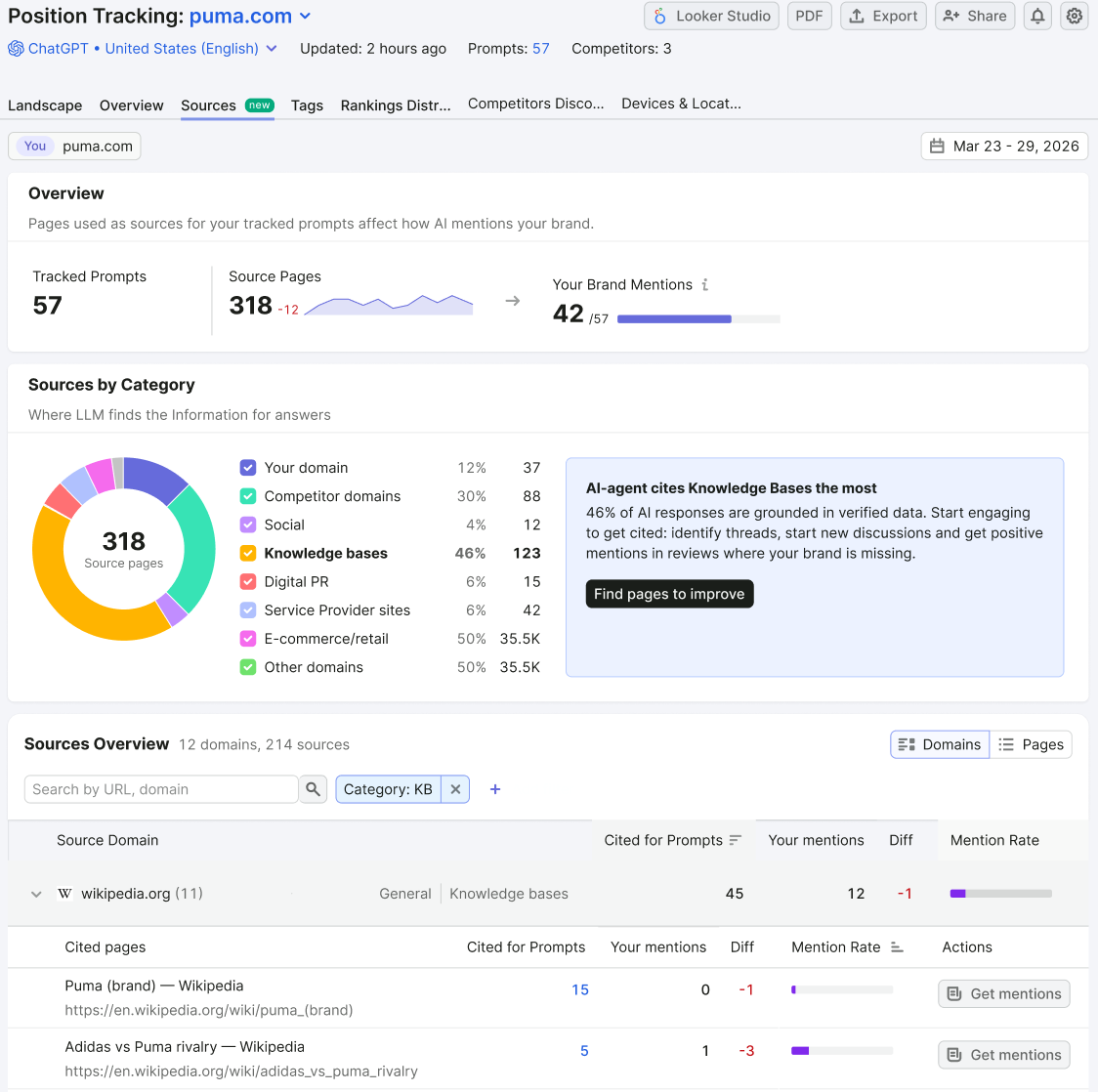
Knowing that your brand isn’t appearing is useful. Understanding who appears instead, and which sources AI uses, is more actionable.
Imagine your company sells payroll software.
You’ve tracked the prompt:
“What’s the best payroll software for a small Singapore business?”
Your brand doesn’t appear, but three competitors do.
A basic visibility tracker tells you that your company was absent.
A more useful tracker also shows which competitors appeared, which websites were cited, and whether the sources were official product pages, software directories, comparison articles, or other third-party content.
Now you have something to investigate.
Perhaps your website doesn’t explain a feature customers frequently ask about. Maybe competitor comparison pages are easier to find and understand. Or perhaps AI answers are relying on an independent review website that doesn’t include your company.
None of those findings automatically tells you how to gain a citation. But they help you decide where to investigate.
A good competitor-analysis feature should let you examine competing brands and cited domains at the individual prompt level, not just display an overall percentage.
5. Check Whether the Tool Handles Repeated Answers Properly
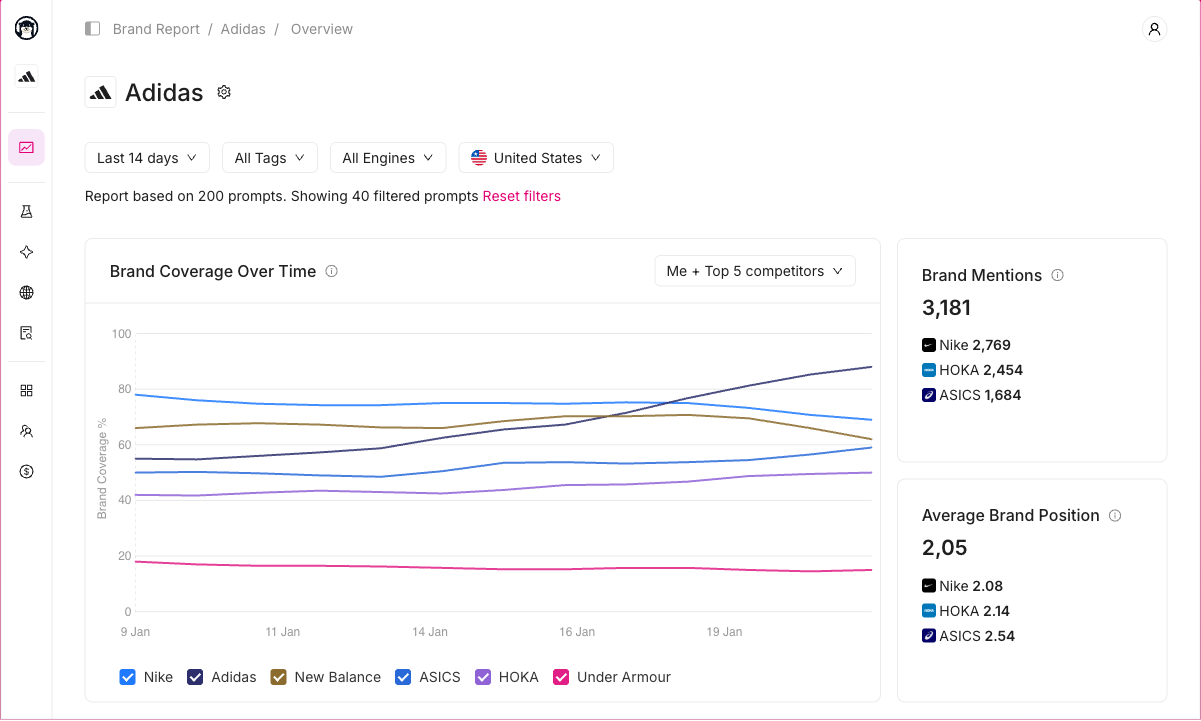
AI-generated answers can change even when you ask the same question.
A response might recommend your brand today, omit it tomorrow, and mention it again during a later check.
Location, language, search availability, model updates, response generation, and prompt wording can all contribute to these differences.
That makes single-response screenshots a weak basis for deciding whether your visibility has improved.
A better tool should support repeated monitoring and show changes over a consistent period.
For example, consider a set of 20 prompts checked across one AI platform.
| Monitoring Period | Prompts With Brand Mention | Observed Mention Rate |
|---|---|---|
| First check | 6 of 20 | 30% |
| Second check | 8 of 20 | 40% |
| Third check | 5 of 20 | 25% |
Illustrative example only; these are not results from a real software test.
If you looked only at the second check, you might conclude your visibility improved significantly.
But the third check tells a different story.
Neither result is necessarily a software error. AI responses are variable, and one run may not represent the broader pattern.
When evaluating tools, check whether they preserve historical results, report update frequency, and make it possible to compare consistent prompt sets.
For important prompts, repeated observations can help you assess how stable an apparent change really is.
6. Make Sure the Tool Explains What to Improve
Monitoring is useful, but the next question is what you’ll do with the information.
Imagine your brand appears in AI answers for questions about affordable accounting software but rarely appears when users ask about software for growing companies.
A visibility tracker might reveal that gap.
A more useful workflow would help you investigate whether your website lacks relevant product information, whether competitors provide more detailed comparison content, or whether third-party sources are influencing the answers.
Depending on the platform, GEO tools may offer content analysis, citation-source research, competitor comparisons, technical diagnostics, or recommended actions.
However, don’t assume that an AI-generated recommendation is automatically correct.
For example, creating another generic article about “the best accounting software” may not solve the issue if customers actually need pricing details, integration documentation, product comparisons, or updated feature information.
Choose a tool that helps you investigate the cause of a visibility gap, not one that simply produces more content recommendations.
7. Review Reporting, Exports, and Team Workflows
This part becomes more important if you’re managing multiple brands, clients, or markets.
A freelancer tracking one website may only need a simple dashboard and occasional exports. An agency handling 20 clients may need separate workspaces, permissions, branded reporting and reliable data exports.
Look beyond the dashboard during a trial.
Can you export the underlying prompt results? Can you filter by brand, platform, country, or date? Can you share reports without giving every stakeholder full account access?
If your team already uses analytics or SEO platforms, check whether the tool can fit into that workflow.
For example, a team may want to combine AI visibility observations with Google Search Console data, website analytics and content performance.
That can provide a more complete picture than AI mentions alone.
Our guide to GEO analytics tools explains how these measurements fit together.
8. Understand How Prompt Limits Affect the Real Price
A low starting price can be appealing, but AI visibility pricing often depends on what you’re allowed to monitor.
Some products charge according to the number of prompts, markets, platforms, workspaces, or monthly credits.
Others include broad research datasets separately from custom prompt monitoring.
For example, let’s say you want to track:
- 20 questions
- Two countries
- Three AI platforms
Depending on the software’s billing rules, that configuration could count as 20 prompt slots, 40 location-specific prompts, 60 platform-specific checks, or another usage amount.
You cannot calculate the subscription cost accurately until you understand how that particular provider counts usage.
Before choosing a plan, ask:
- How many custom prompts can I monitor?
- Are different countries counted separately?
- Does each AI platform consume an additional allowance?
- How often are prompts checked?
- Can I export full results on my chosen plan?
- Are extra brands or projects billed separately?
- Will historical data remain available if I downgrade?
It’s also worth checking whether the subscription includes a trial or whether you need to book a demonstration first.
Our GEO tools with free trials comparison covers options for evaluating platforms before purchasing.
Which AI Visibility Tracking Tools Should You Shortlist?
There isn’t one best AI visibility tool for every situation. The right shortlist depends on whether you’re prioritising broad research, ongoing custom prompts, citation analysis, or integrated SEO and GEO work.
Here’s how several established options differ based on their publicly documented features.
| Tool | Main Reason to Consider It | Important Buying Check |
|---|---|---|
| Ahrefs Brand Radar | Broad AI visibility research, brand mentions, citations, competitor comparisons and custom prompt tracking | Separate large prompt-database insights from your own tracked prompts; check allowances |
| Semrush AI Visibility Toolkit | AI visibility analysis alongside existing SEO research, custom prompt tracking and competitor insights | Confirm the AI platforms and custom prompt limits included in the selected plan |
| Otterly.AI | Dedicated AI prompt monitoring, citations and recurring visibility reporting | Check prompt allowances, supported engines, countries and add-on costs |
| Peec AI | Prompt-level AI visibility, competitor tracking, source analysis and exports | Evaluate whether its reports and platform coverage fit your monitoring workflow |
| Profound | Extensive AI visibility research, citation analysis and enterprise-oriented monitoring | Confirm the required package, integration needs and total cost |
| SE Visible | AI brand visibility monitoring across several major AI search experiences | Check supported engines, reporting methods and project allowances |
| Digimetrics | Integrated SEO, GEO, content and technical optimisation workflows | Verify the exact AI visibility features, tracking limits and exports available in your plan |
This is a feature-based shortlist, not a ranking derived from independent same-task testing. Availability, platform coverage, pricing and plan limits can change, so confirm them before subscribing.
What About Google Search Console and Bing Webmaster Tools?
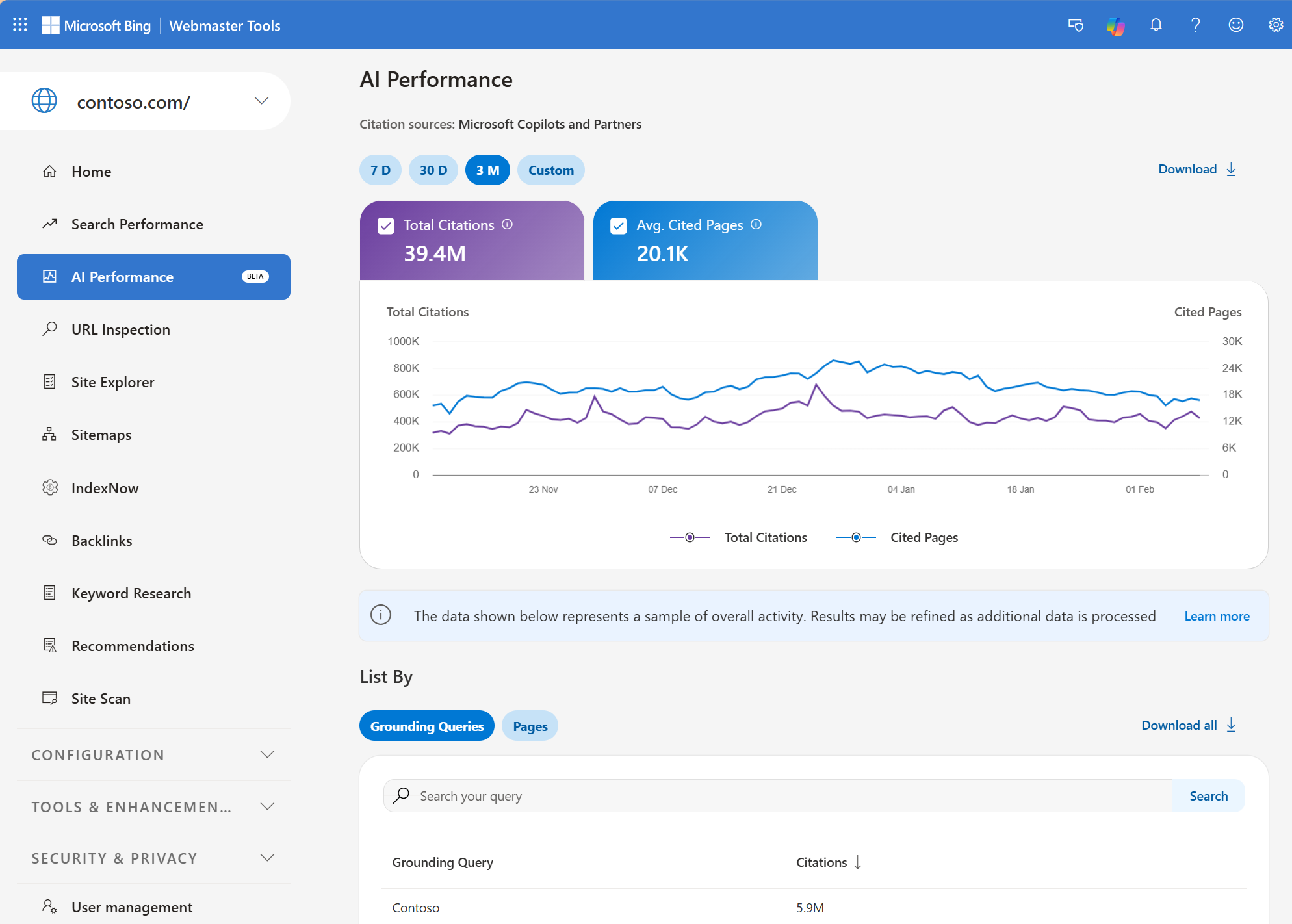
You should also consider first-party tools before paying for another subscription.
In 2026, Google introduced dedicated generative AI performance reporting in Search Console, giving verified site owners additional visibility into supported Google AI search features.
Microsoft also introduced AI Performance reporting in Bing Webmaster Tools, followed by additional topic, citation, and comparison insights.
These tools are valuable because they provide information from the relevant platform operators rather than relying solely on external monitoring.
However, they don’t replace every use case for a third-party AI visibility tracker.
Search Console reports on your verified property’s visibility in supported Google experiences. It isn’t a comprehensive record of how every competitor appears in ChatGPT, Perplexity, Gemini, and other systems.
Similarly, Bing Webmaster Tools focuses on supported Microsoft AI and search experiences.
For many businesses, the practical starting point is to use first-party reporting alongside a carefully selected third-party monitoring tool.
A Practical Two-Week Test Before Choosing an AI Visibility Tool
You don’t need to commit to a large subscription to learn whether a tracker suits your business.
A small, controlled test can reveal much more than a polished product demonstration.
Here’s a testing framework I recommend using with two or three shortlisted tools. It is a proposed evaluation method, not a claim that we’ve run this experiment across every vendor.
Days 1–2: Set Up the Same Prompts
Create a list of 12 questions relevant to your customers.
For example:
- Four problem-solving questions
- Four category-discovery or comparison questions
- Two purchase-focused questions
- Two branded questions
Use the same wording across every platform you’re testing, and record which AI engines, countries and languages you’ve selected.
Don’t compare one tool’s suggested prompts against another tool’s entirely different database and treat the scores as directly equivalent.
Days 3–6: Check the Actual Answers
Examine the results for a few important prompts.
Does the tool identify your brand correctly? Are the cited links accurate? Can you inspect the source response?
Also check whether it confuses businesses with similar names or treats a mention of a third-party article as a direct citation to your company.
Those errors can make the dashboard less useful, even if its overall design looks impressive.
Days 7–10: Test Consistency
Repeat selected prompts while keeping the relevant platform and location settings consistent.
Look for changes in brand mentions, competitor presence and citation sources.
You don’t need to demand identical answers every time. Instead, evaluate whether the software documents changes clearly enough for you to understand them.
If the trial is shorter than two weeks, compress the evaluation and prioritise evidence quality over historical trend analysis.
Days 11–14: Test the Reporting Workflow
Export the results, review the reports and try to turn the findings into a practical marketing decision.
For example, can you identify a relevant topic where competitors appear and your company does not? Can you find the sources influencing those answers? Does the tool help you investigate whether you need clearer product information or a better comparison page?
If the dashboard tells you your visibility is low but doesn’t help you understand where or why, it may not be the right tool for your workflow.
The AI Visibility Tool Evaluation Scorecard
Rather than choosing based on the biggest feature list, I’d score each shortlisted tool against the requirements that matter most.
The following framework uses a total of 100 points.
| Evaluation Category | Maximum Points | What You’re Assessing |
|---|---|---|
| AI platform and location coverage | 20 | Does it monitor the platforms, countries and languages that matter to your business? |
| Prompt relevance and flexibility | 20 | Can you track meaningful non-branded, branded and purchase-focused questions? |
| Data transparency and verifiability | 20 | Can you inspect answers, citations, settings and timestamps behind the metrics? |
| Competitor and citation analysis | 15 | Can you identify other brands and influential sources at the prompt level? |
| Reporting and actionable workflows | 15 | Can you export results, interpret trends and investigate meaningful gaps? |
| Pricing and usage limits | 10 | Can you afford the actual monitoring configuration you need? |
| Total | 100 |
For each category, award points based on what you actually verified during the trial, not simply what appears on the pricing page.
For example, a tool might advertise extensive AI platform support but provide limited country targeting. Another might offer excellent custom prompt tracking but no way to export individual citation records on its entry plan.
Those differences should affect your score.
How to Interpret Your Results
I’d use the scores to compare the two or three options you tested—not as a universal ranking of the entire market.
A tool scoring 85 in your evaluation might be a strong fit for your business but an unsuitable choice for another company with different needs.
A small local business may care most about affordability, ChatGPT visibility and understandable reporting.
An international brand may care more about multilingual coverage, multiple locations, permissions, exports and consistent monitoring at scale.
The point of the scorecard is to make your buying decision explainable.
If two tools receive similar scores, choose the one whose underlying results are easier to verify and whose workflow you’re more likely to use consistently.
Five Mistakes to Avoid When Choosing an AI Visibility Tracker
Mistake 1: Buying Based on the Visibility Score Alone
A score such as 75/100 may look impressive, but it has limited meaning without knowing the prompts, platforms, locations and calculation method involved.
Always ask to see the underlying evidence.
Mistake 2: Tracking Mostly Branded Questions
If every prompt already contains your company name, your brand may appear frequently without gaining visibility among customers who haven’t heard of you.
Keep discovery and branded monitoring separate.
Mistake 3: Assuming All AI Search Platforms Behave the Same Way
ChatGPT Search, Google AI Overviews, Google AI Mode, Perplexity and Gemini have different interfaces, retrieval methods and response behaviours.
Platform-specific reporting is more useful than treating them as interchangeable.
Mistake 4: Confusing More Mentions With More Customers
An increase in AI visibility does not automatically mean higher website traffic, qualified leads or sales.
Use AI visibility alongside analytics, Search Console, referral reporting and business performance indicators.
Mistake 5: Paying for Features You Won’t Use
A complex enterprise platform may offer extensive datasets, integrations and monitoring controls.
But if you only need to track 15 prompts for one website, a simpler product may give you more practical value for your budget.
Start with the work you need to accomplish.
Which AI Visibility Tool Is Best for Your Business?
The best choice depends on your existing marketing setup.
If you’re already using a large SEO platform, investigating the AI visibility features available in Ahrefs or Semrushmay be a convenient starting point.
If you primarily need recurring prompt monitoring and citation analysis, a dedicated platform such as Otterly.AI or Peec AI may be worth trialling.
For organisations requiring extensive monitoring, source analysis and enterprise workflows, Profound is another option to investigate.
And if you prefer an integrated environment combining SEO, GEO, content optimisation and technical diagnostics, Digimetrics is worth comparing—provided its current tracking capabilities and allowances meet your needs.
None of those choices should be made solely because a product advertises the most AI engines or the largest prompt database.
My recommendation is to shortlist two or three tools, monitor the same relevant prompts, inspect their underlying evidence, and compare the reports before subscribing.
That’s a much more reliable buying process than choosing whichever dashboard displays the highest AI visibility score.
Frequently Asked Questions
What Is the Best AI Visibility Tracking Tool in 2026?
There’s no single best option for every business. Ahrefs Brand Radar, Semrush AI Visibility Toolkit, Otterly.AI, Peec AI, Profound, SE Visible, and Digimetrics offer different combinations of monitoring, research and workflows. The right tool depends on platform coverage, prompt relevance, data transparency and budget.
Can AI Visibility Tools Track ChatGPT Mentions?
Yes. Several tools monitor how brands appear in selected ChatGPT responses or search-enabled experiences. However, they do not provide a complete record of every private ChatGPT conversation involving your company.
How Accurate Are AI Search Visibility Tools?
Accuracy depends on what is being measured and how. A tool may correctly report the answers it observed without those answers representing every user’s experience. Evaluate response evidence, sampling methods, repeatability and false-positive detection before relying on its scores.
How Many Prompts Should I Track?
A small business can begin with around 10–20 carefully selected prompts covering customer problems, category discovery, comparisons and branded questions. Larger businesses may need more prompts, countries and products. Relevance matters more than quantity.
What’s the Difference Between AI Visibility and SEO Rank Tracking?
SEO rank tracking monitors positions in traditional search results. AI visibility tracking examines how businesses and websites appear within selected AI-generated answers, including mentions, citations and competitor recommendations. Both can contribute to a broader search measurement strategy.
Can I Track AI Search Visibility for Free?
You can begin with Google Search Console, Bing Webmaster Tools and limited free visibility checkers. These provide useful starting information, but the available metrics and supported platforms differ. See our free GEO tools comparison for additional options.
Does a Higher AI Visibility Score Mean More Sales?
Not necessarily. A visibility score reflects a tool’s particular measurement process. Increased mentions may support brand discovery, but you still need to evaluate website visits, leads, conversions and other business results.
Should I Replace My SEO Tools With an AI Visibility Tracker?
Usually not. SEO tools and AI visibility software measure overlapping but different aspects of search performance. Traditional SEO data, technical diagnostics, content quality and website analytics remain important even when you’re monitoring AI-generated answers.
Final Verdict: Choose the Evidence, Not the Dashboard
Finding the best AI search visibility tool isn’t about choosing the platform with the most features.
It’s about understanding whether the software monitors the AI experiences your customers use, tracks meaningful prompts, preserves trustworthy evidence and helps you make better decisions.
Start with a small set of relevant questions. Compare the actual AI responses, inspect mentions and citations separately, and check whether the tool can support your reporting workflow.
Most importantly, remember that AI visibility is a measurement of observed appearances, not a guarantee of customer demand or revenue.
Choose the software that makes those observations understandable, repeatable and useful—and you’ll be in a much better position to decide what to improve next.
Disclosure: digitalmarketingtools.ai is sponsored by Digimetrics.ai. Sponsored Highlights are clearly labelled advertising. Our reviews, comparisons and guides are written to be useful and fair regardless of who sponsors the site. Read the full disclosure.


