
How We Review GEO Tools: Our Testing and Evaluation Methodology
Two GEO tools analyse the same brand. One says its AI visibility score is 75, while another reports 42. A third claims the brand appears in 30% of AI-generated answers.
Which result should you trust? The answer isn’t necessarily the highest score, the biggest dataset, or the platform with the most impressive dashboard.
GEO tools don’t all measure the same thing. Some track brand mentions in ChatGPT and Perplexity. Others monitor website citations, analyse competitor visibility, inspect technical accessibility, or recommend content improvements. Even tools offering similar features may use completely different prompts, data sources, and collection methods.
That creates a challenge for anyone comparing Generative Engine Optimization (GEO) software. A product can produce useful data without that data being directly comparable to another platform’s results.
It’s also easy to mistake an impressive-looking visibility score for evidence that a business is reaching more customers.
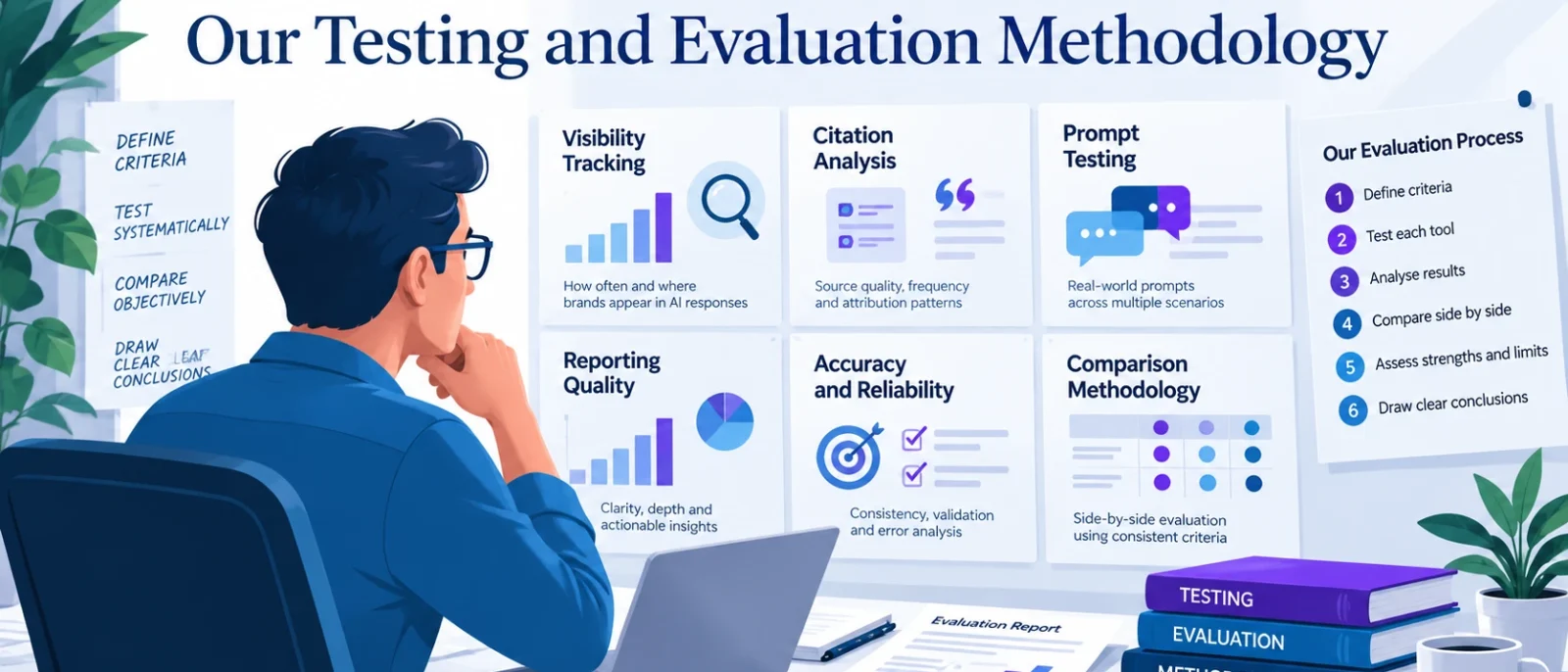
At DigitalMarketingTools.ai, we believe a useful GEO tool review should explain what a product actually does, what evidence supports its claims, where the findings are limited, and whether the software helps users make better decisions.
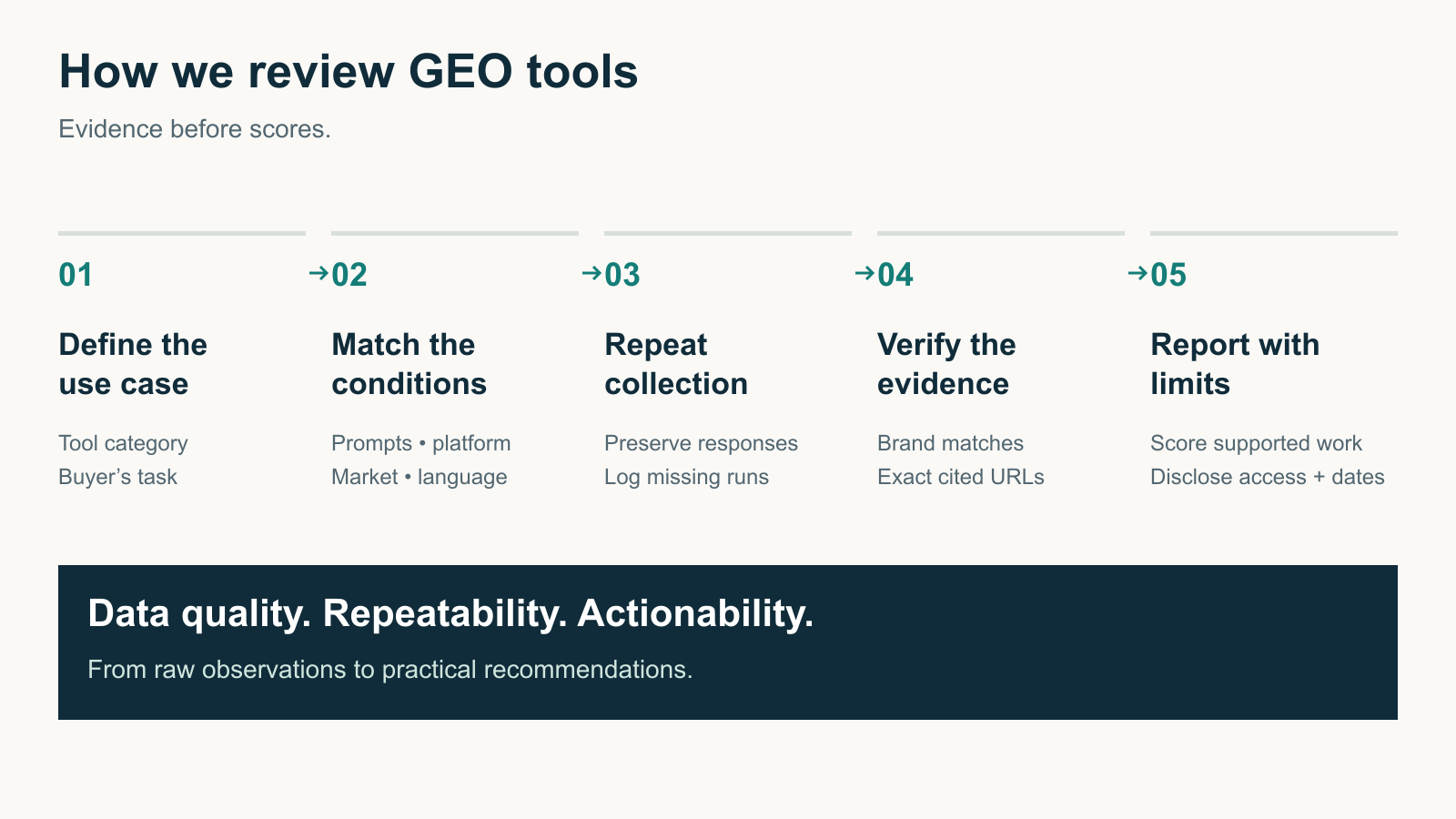
This article outlines our GEO-specific evaluation framework, including the tests we use as editorial standards, the metrics that require verification, how we review GEO tools and the factors we consider when recommending software.
Methodology note: This article documents our proposed testing and evaluation standards. It does not represent a completed benchmark of every GEO platform. Individual reviews must identify which tests were actually performed, when they occurred, and what supporting evidence is available. We do not present hypothetical tests as completed research.
Why Reviewing GEO Tools Is Different From Reviewing Traditional SEO Software
Traditional SEO tools have their own measurement challenges, but many of their outputs are relatively familiar.
A rank tracker monitors where a webpage appears for selected keywords. A technical crawler reports issues involving URLs, redirects, canonical tags, or indexing directives. A backlink tool collects information about links between websites.
Different SEO platforms may disagree, but reviewers can often investigate those differences through search results, website responses, and other supporting evidence.
GEO adds a less predictable measurement environment.
AI-generated answers can change when the same question is asked again. Results may differ depending on the platform, model, location, language, search configuration, or date.
For example, ChatGPT Search may recommend one group of software products while Perplexity provides a different shortlist. Another response to the same question may include different sources.
Neither result automatically proves that one GEO tool is inaccurate.
The tools may be monitoring different AI experiences, using different collections of prompts, or observing responses at different times.
Research into generative search measurement has also highlighted substantial variability between repeated AI-generated responses. The paper Don’t Measure Once: Measuring Visibility in AI Search examines why relying on isolated observations can create misleading conclusions.
This is why our methodology focuses on data transparency, repeatability, and practical usefulness, rather than comparing visibility scores without context.
For a broader explanation of the category, see our complete guide to GEO tools.
What Types of GEO Tools Do We Evaluate?
GEO software covers several overlapping product categories.
Before comparing tools, we identify the primary problem each product is designed to solve.
A dedicated AI citation tracker shouldn’t be judged using exactly the same expectations as a technical crawler or a content optimisation platform.
Here’s how we separate the main categories.
| GEO Tool Category | Main Function | What Our Evaluation Focuses On |
|---|---|---|
| AI visibility tracking | Monitors brand appearances in AI-generated responses | Prompt coverage, brand detection, repeatability, and response evidence |
| AI citation tracking | Identifies websites and pages cited in AI answers | Citation detection, URL accuracy, source attribution, and historical records |
| Competitor monitoring | Compares brands across selected AI answers | Competitor identification, prompt relevance, and transparent comparison methods |
| GEO analytics | Combines visibility, citations, trends, or performance information | Metric definitions, data sources, reporting accuracy, and actionable insights |
| GEO content optimisation | Recommends improvements to website content | Factual accuracy, search-intent relevance, originality, and editing effort |
| Technical GEO auditing | Checks website accessibility and technical conditions affecting search systems | Detection accuracy, issue validation, prioritisation, and implementation guidance |
| Integrated SEO and GEO platforms | Combines traditional SEO with AI-search monitoring or optimisation | Quality of core functions, integration, usability, and overall value |
Some products belong to more than one category.
For example, an integrated platform might offer traditional keyword tracking, AI brand monitoring, technical auditing, and content optimisation.
That breadth can be valuable, but it also means the product needs to be evaluated across several different workflows.
We don’t consider a larger feature list automatic evidence of a better tool.
How We Select GEO Tools for Review
Our starting point is the reader’s actual problem, not the number of products a vendor claims to compete against.
For example, someone looking for a ChatGPT visibility tracker may need recurring prompt monitoring, historical responses, and competitor comparisons.
A business looking to improve technical accessibility may instead need crawler diagnostics and implementation guidance.
These are different purchasing decisions.
We use the following considerations when building a review shortlist.
Relevance to the Search Intent
The first question is whether the product addresses the problem described in the article.
A tool that only generates AI-friendly content shouldn’t automatically appear in a comparison of software designed to monitor ChatGPT brand mentions.
Likewise, a traditional SEO platform shouldn’t be described as providing comprehensive GEO monitoring simply because it has added a basic AI-related metric.
If a product has only partial relevance, we explain what it covers and what it doesn’t.
Market Availability and Accessibility
We check whether the product is available to the intended audience.
This includes its supported locations, languages, subscription arrangements, and access restrictions.
For example, a feature available only to enterprise customers shouldn’t be presented as a standard feature of an entry-level subscription.
We also distinguish between software that can be trialled directly and products requiring a demonstration or custom agreement.
Publicly Verifiable Capabilities
A product’s official website, documentation, pricing information, and changelog can help establish what it claims to offer.
However, vendor documentation is not the same as independent testing.
If a platform advertises citation tracking but we haven’t verified its actual detection results, the article should make that distinction clear.
Similarly, the absence of a publicly advertised feature doesn’t necessarily prove the product lacks it.
Suitability for the Intended Buyer
A product can be excellent for an enterprise but unnecessarily expensive or complex for a freelancer.
That’s why our recommendations consider the reader’s budget, business size, technical requirements, and available resources.
Our GEO tools for small businesses and GEO tools for agencies comparisons illustrate why different buyers need different shortlists.
Our Seven GEO Tool Evaluation Criteria
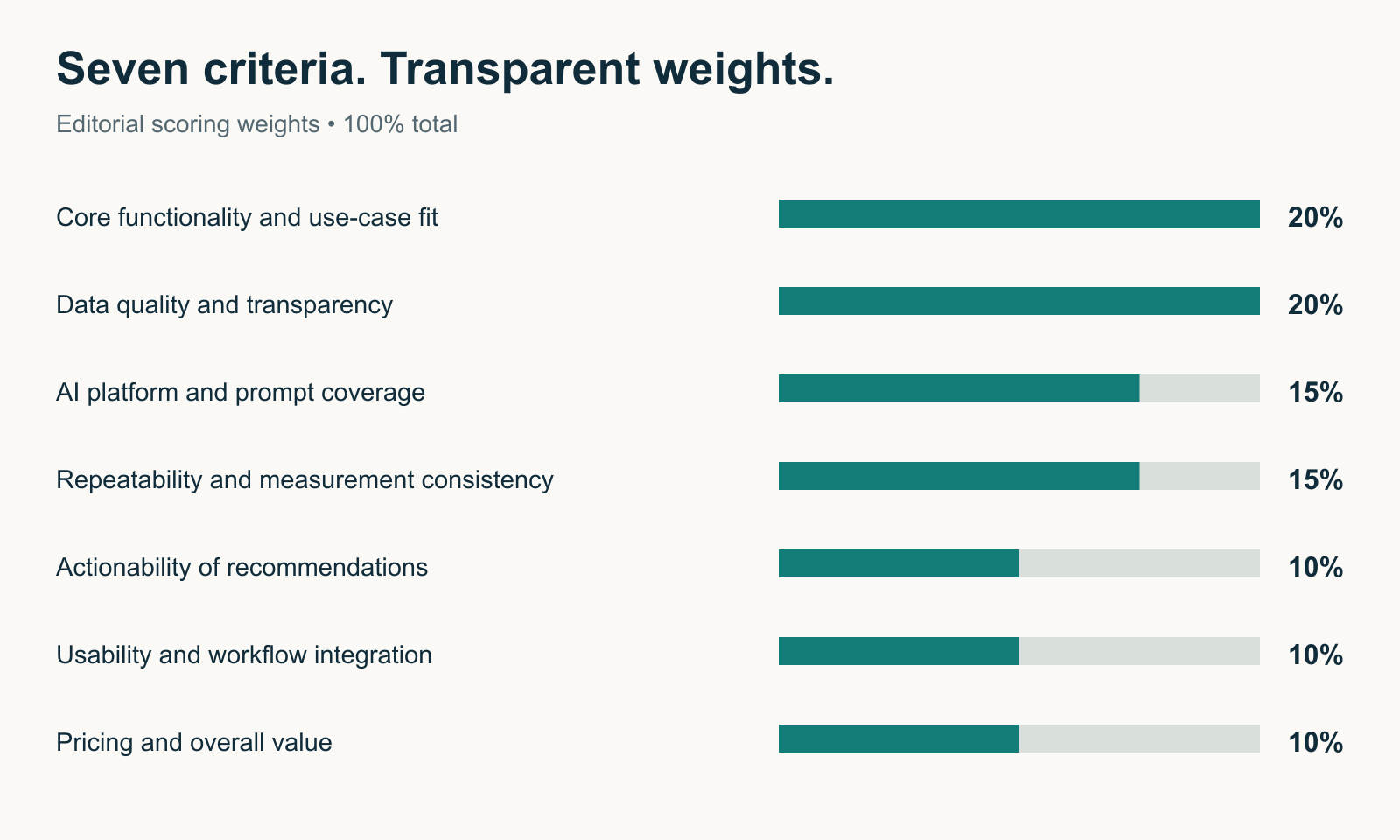
A useful GEO review needs consistent evaluation criteria, but those criteria should also reflect the tool’s intended purpose.
We use the following seven areas as a proposed general-purpose framework.
| Evaluation Criterion | Suggested Weight | What It Measures |
|---|---|---|
| Core functionality and use-case fit | 20% | Whether the tool solves the specific GEO problem being evaluated |
| Data quality and transparency | 20% | Whether its observations, calculations, and source evidence can be examined |
| AI platform and prompt coverage | 15% | Whether monitoring reflects the relevant engines, questions, markets, and languages |
| Repeatability and measurement consistency | 15% | Whether observations can be compared under documented conditions |
| Actionability of recommendations | 10% | Whether findings help users identify meaningful next steps |
| Usability and workflow integration | 10% | How efficiently users can investigate, export, and act on the information |
| Pricing and overall value | 10% | Whether the useful capabilities justify the total subscription and operational costs |
| Total | 100% |
These are proposed editorial weights, not an industry-standard scoring system.
A specialist category may require a different allocation.
For example, data quality and citation accuracy may deserve greater emphasis when reviewing a dedicated citation tracker. A GEO content optimisation platform may require more attention to factual accuracy, originality, and editing effort.
Any category-specific changes should be decided and documented before comparing the products.
1. Core Functionality and Use-Case Fit
The first question is straightforward: does the GEO tool solve the problem it promises to solve?
For an AI visibility tracker, that means determining whether it can monitor relevant AI-generated responses and identify brand appearances.
For a citation tracker, the focus shifts to correctly identifying referenced domains and pages.
For a technical GEO tool, we examine whether its diagnostics reveal meaningful accessibility or indexing problems.
Feature quantity alone doesn’t answer this question.
A tool with 40 features may be less useful for a specific task than a focused product that handles three important functions particularly well.
We therefore evaluate functionality against a defined task rather than rewarding the longest feature list.
2. Data Quality and Transparency
A GEO tool should make it possible to understand where its results come from.
For example, imagine a dashboard reports that your brand’s AI visibility increased from 25% to 40%.
That sounds promising, but it raises several questions.
Which AI platforms were monitored? How many prompts were included? Did the prompt collection change? Were brand mentions and citations treated separately?
A review should investigate these questions before interpreting the result.
For prompt-monitoring tools, we look for access to the underlying observations, including the prompt, platform, collection date, response, and cited sources.
For analytics products using proprietary scores, we investigate whether the provider explains the relevant inputs and calculations.
We also distinguish between first-party reporting, directly observed AI responses, vendor estimates, and modelled metrics.
These are different kinds of evidence and should not be treated as interchangeable.
3. AI Platform and Prompt Coverage
A tool advertising support for several AI platforms may seem more comprehensive than one covering only a few.
However, coverage matters only when it reflects the experiences relevant to the intended buyer.
For example, a Singapore business might prioritise ChatGPT Search, Google AI Overviews, Google AI Mode, and Perplexity.
An enterprise operating across several countries may need additional languages, locations, and monitoring environments.
Our evaluation therefore checks which AI experiences are supported and what limitations apply.
We also consider how the tool collects prompts.
Some products allow users to enter custom questions. Others provide a large predefined database. Certain platforms offer both.
These approaches answer different research needs.
A broad dataset may help discover market trends, while a fixed custom prompt set may be better suited to tracking particular customer questions over time.
Neither should automatically be considered more accurate without examining the data.
4. Repeatability and Measurement Consistency
AI-generated answers are variable.
A response can change because of platform updates, retrieval behaviour, wording differences, or the conditions under which the question was asked.
This means a single screenshot shouldn’t be treated as a definitive measurement of brand visibility.
Our evaluation framework prioritises tools that preserve monitoring conditions, maintain historical observations, and make changes understandable.
Where controlled testing is available, repeated observations help us investigate whether a finding is consistent or dependent on one particular response.
We also record failed or missing observations rather than treating them as proof that a brand was absent.
Repeatability doesn’t require identical AI answers every time. It requires a documented process that allows results to be interpreted appropriately.
5. Actionability of Recommendations
Collecting data isn’t the same as helping someone improve a website.
A GEO tool may correctly identify that a competitor appears more frequently in certain AI answers.
The next question is whether the product helps the user investigate why.
Can the user identify the relevant prompts, cited sources, competitor pages, or content gaps? Does the tool provide enough information to guide a useful change?
For GEO content optimisation software, we also examine whether recommendations are relevant and factually supported.
A suggestion to publish more articles isn’t automatically useful.
A recommendation becomes more meaningful when it identifies a genuine information gap or a technical problem that can be investigated.
6. Usability and Workflow Integration
A powerful tool can still be difficult to justify if routine tasks take too long.
We consider the steps required to configure monitoring, examine results, investigate sources, and export findings.
For example, a tool might offer extensive citation data but require users to open dozens of separate screens to understand one visibility change.
Another might provide fewer metrics but make the underlying evidence much easier to examine.
We also consider integrations and team requirements.
Agencies may need separate client workspaces, scheduled reports, permissions, and exports. Smaller businesses may only need a straightforward dashboard.
Usability should be judged against the intended workflow rather than the interface’s visual appearance alone.
7. Pricing and Overall Value
A GEO tool’s advertised monthly price doesn’t always reveal its total cost.
Some platforms charge according to custom prompts, AI engines, monitoring frequency, projects, locations, or usage credits.
Other products package AI visibility as an add-on to a wider SEO subscription.
We therefore look beyond the headline price.
For example, tracking 20 prompts across three AI platforms may count differently depending on the vendor’s allowance system.
A seemingly inexpensive package could become less attractive if the required monitoring configuration exceeds its limits.
Our evaluation considers the cost of the actual workflow, the capabilities available at that price, and whether the product reduces meaningful research or reporting work.
For more buying guidance, see our best paid GEO tools comparison.
How We Test AI Visibility Tracking Tools
This is where GEO reviews need particularly careful methodology.
A platform that monitors AI answers cannot be evaluated fairly by comparing only its overall visibility score with another product.
Instead, we recommend using a controlled set of relevant prompts and examining the underlying responses.
The following protocol describes how a comparable test can be conducted. The numbers are recommended parameters for a manageable pilot, not evidence that this exact test has already been run across every product.
Step 1: Create a Representative Prompt Set
Start with 20 questions relevant to a real business and its potential customers.
Include different stages of the buying journey.
For example, a project-management software company could use the following structure.
| Prompt Category | Number of Prompts | Example |
|---|---|---|
| Problem-solving questions | 4 | How can a small team manage projects across different time zones? |
| Product category questions | 6 | What are good project management tools for remote businesses? |
| Comparison questions | 6 | What are alternatives to Asana for growing teams? |
| Branded questions | 4 | Is Acme Project Manager suitable for small businesses? |
| Total | 20 |
These questions are illustrative.
For a real test, prompts should reflect the intended audience and ideally be informed by customer research, search behaviour, and the problems users are trying to solve.
We keep branded and non-branded questions separate because they measure different things.
A company appearing in an answer to a question that already names the company is not equivalent to being discovered in a broader product recommendation.
Step 2: Match the Testing Conditions
Use the same prompt wording and comparable settings wherever the products allow.
Relevant settings include the AI platform, market, language, collection dates, and whether search-enabled responses are being monitored.
This last distinction is particularly important.
For example, monitoring ChatGPT Search is not automatically equivalent to querying a model through an API without the same search configuration.
The results may differ because the underlying experience is different.
If a GEO platform doesn’t expose certain settings, we document that limitation rather than implying the conditions were identical.
Step 3: Repeat the Monitoring
A useful test shouldn’t depend entirely on one run.
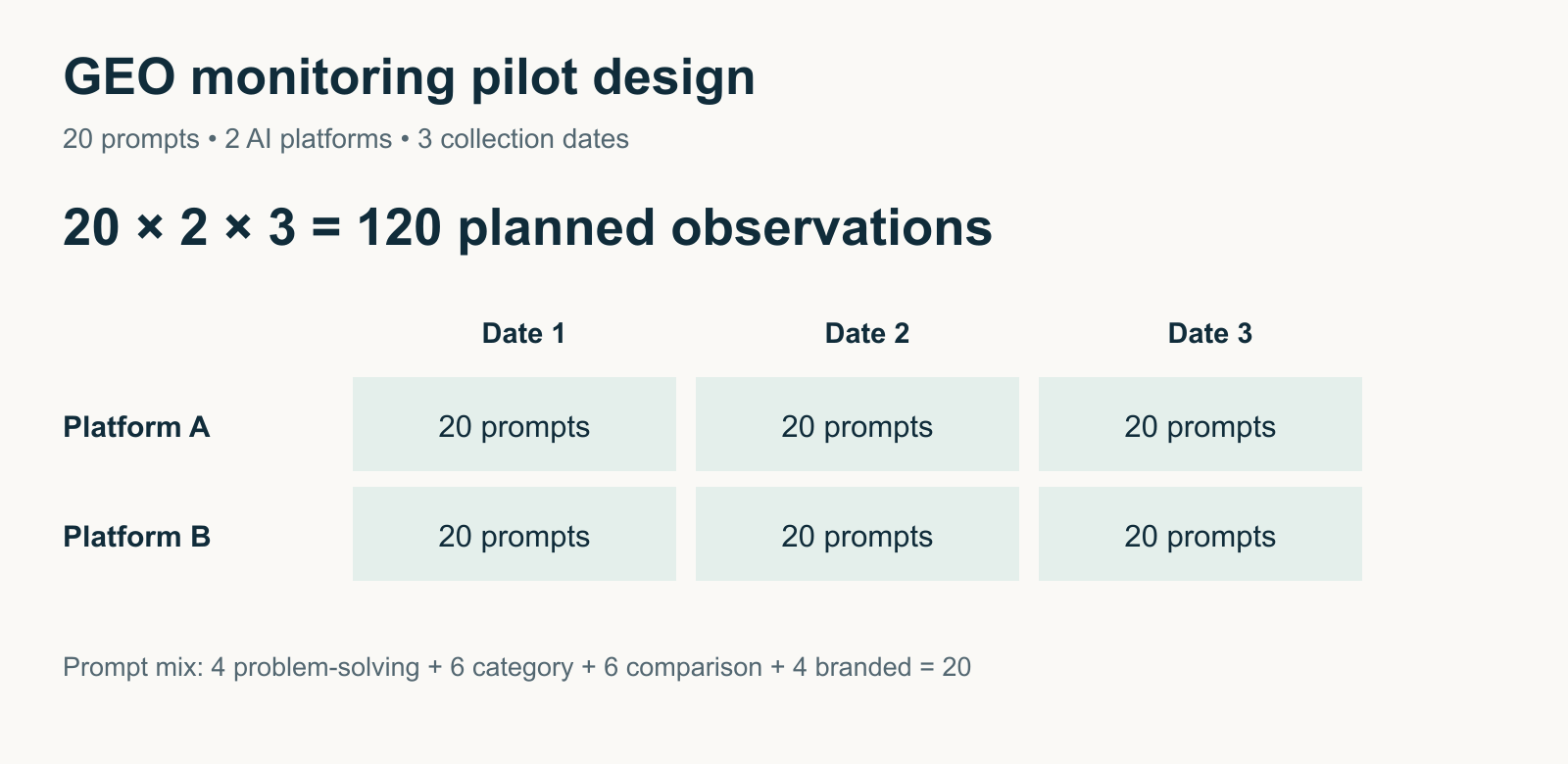
For a manageable pilot, we recommend collecting the same 20 prompts across two supported AI platforms on three separate dates.
That creates up to 120 planned prompt-platform observations per monitoring tool:
20 prompts × 2 platforms × 3 collection dates = 120 observations.
The actual completed count may be lower if a product fails to return a response or doesn’t support a required configuration.
This sample does not represent 120 unique users or a statistically representative measurement of the entire AI-search market.
Its purpose is narrower: to evaluate whether the software can collect, preserve, and report a consistent group of observations.
Step 4: Inspect the Underlying Evidence
Next, examine the data supporting the reported results.
For each sampled observation, look at whether the tool correctly identifies the brand, its competitors, and any cited URLs.
We also check whether the software can distinguish an actual brand mention from a similar name or unrelated reference.
For example, a company named Mercury shouldn’t necessarily receive credit every time an AI response mentions the planet Mercury or a different company with the same name.
Likewise, a page citation should not be assigned to the wrong domain because of an inaccurate URL match.
These checks help reveal false positives and reporting limitations that may be hidden behind a summary score.
Step 5: Compare the Reports and Actions
Finally, evaluate whether the tool helps users interpret the findings.
Can you see which prompts produced mentions? Can you identify changes over time? Does the software explain which websites were cited?
Can you export the relevant data?
The objective isn’t simply to identify the platform with the most positive result for the example brand.
It’s to determine which product provides trustworthy, understandable information for the intended workflow.
How We Verify Brand Mentions, Citations, and GEO Metrics
Not every GEO measurement should be evaluated in the same way.
Brand mentions, source citations, share of voice, and traffic data answer different questions.
We examine them separately.
Brand Mention Detection
A brand mention occurs when an AI-generated answer identifies a company, product, or brand.
During manual verification, we check whether the product correctly identifies the mention and handles relevant name variations.
We also look for false positives involving similarly named organisations or unrelated terms.
A tool that records every occurrence of a common word as a brand mention may inflate visibility.
Citation Detection
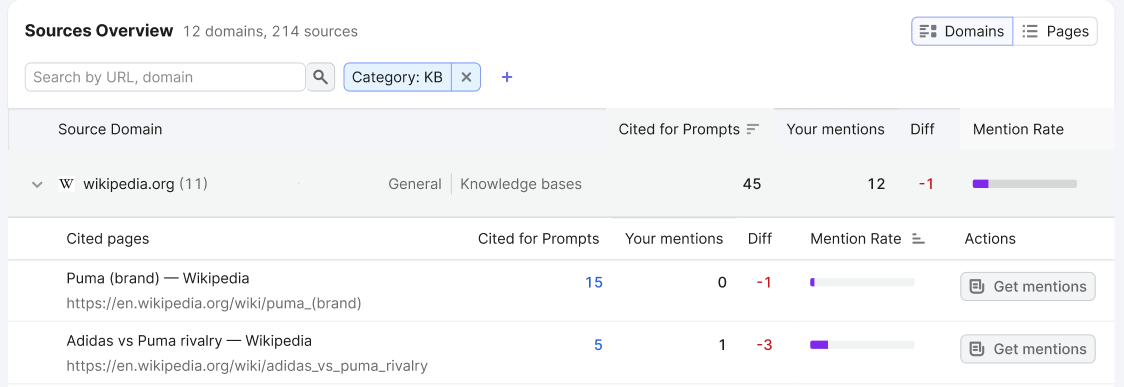
A citation identifies a source referenced or linked within an AI-generated answer.
For citation-focused software, we check whether the reported domain and URL correspond to the observed response.
We distinguish between a brand being recommended and its website being cited.
For example, an AI answer could recommend a software company while citing an independent review website.
The brand received a mention, but the company’s domain didn’t necessarily receive a citation.
Our AI citation tracking guide explores these differences in more detail.
AI Share of Voice
AI share of voice is generally a vendor-defined measure of relative visibility within a selected dataset.
However, no single calculation is used by every GEO platform.
Some products calculate it using brand appearances. Others incorporate estimated impressions, citations, placement, or proprietary weighting.
We therefore investigate the definition of the metric rather than assuming scores from different tools are directly comparable.
A score of 30% in one platform doesn’t necessarily describe the same measurement as 30% in another.
First-Party AI Search Reporting
First-party search platform data requires different treatment.
Google introduced dedicated generative-AI performance reports in Search Console in June 2026, with worldwide availability by the end of August.
These reports provide impression information for supported Google AI search features, including AI Overviews and AI Mode, with breakdowns such as pages, countries, and dates.
See Google’s official announcement.
Microsoft also introduced AI Performance reporting in Bing Webmaster Tools in February 2026, followed by additional citation and topic-related capabilities.
These sources offer valuable first-party information, but their metrics aren’t identical.
A Google generative-AI impression shouldn’t be counted as equivalent to a Bing citation or a third-party ChatGPT brand mention.
Our evaluation framework keeps these measurements separate and assesses each product according to the data it actually provides.
How We Evaluate GEO Content Optimisation Tools
Some GEO platforms focus less on monitoring and more on improving content.
They may analyse pages, suggest missing topics, recommend formatting changes, or generate rewritten content intended to improve AI-search visibility.
These features need a different testing process.
A higher content score is not enough to establish that the recommendations are useful.
Search Intent and Content Relevance
We first evaluate whether the suggested changes address the purpose of the page.
For example, an article about choosing accounting software should help readers compare relevant features, costs, integrations, and suitability.
A tool that recommends adding unrelated keywords merely because competitors mention them may increase the word count without improving the article.
We look for recommendations that resolve meaningful content gaps rather than encourage unnecessary expansion.
Factual Accuracy
AI-assisted content tools can introduce outdated features, incorrect prices, unsupported statements, or references to sources that don’t substantiate the claim.
For that reason, factual recommendations should be checked against appropriate primary sources.
If a GEO tool recommends saying that a software product supports a particular integration, the reviewer should confirm that claim using current product documentation.
An impressive-looking paragraph isn’t evidence of factual accuracy.
Originality and Evidence
Another consideration is whether the tool helps produce useful original information.
A platform may generate a lengthy article that looks professional but largely repeats material already available online.
That isn’t the same as producing an original comparison, documenting a test, or explaining firsthand observations.
Google’s guidance on generative AI content emphasises adding value for users rather than mass-producing low-value pages.
We therefore consider whether a tool supports original analysis or encourages generic content production.
Editing Effort
Finally, we evaluate how much work is required to turn the output into something publishable.
A tool that generates an 8,000-word draft in minutes may appear efficient, but it can create substantial additional work if the article contains repeated sections, outdated facts, unsupported recommendations, or incomplete links.
Useful content software should reduce the total effort required to produce accurate and relevant content.
That means evaluating research, fact-checking, restructuring, editing, and implementation together—not only initial generation speed.
How We Evaluate Technical GEO Tools
Technical GEO auditing is closely related to traditional technical SEO.
Some tools examine whether AI-related crawlers can access website content, whether pages return expected responses, or whether important information is discoverable.
These checks can be useful, but the findings need validation.
| Technical Area | What We Examine | Important Limitation |
|---|---|---|
| Crawler access | Robots rules and relevant crawler access conditions | Allowing access doesn’t guarantee an AI citation |
| HTTP responses | Errors, redirects, and inaccessible pages | An error may depend on the request conditions |
| Indexing directives | Robots directives and canonical signals | Not every AI platform uses the same search infrastructure |
| Internal linking | Whether important pages are discoverable through website links | More links don’t automatically create AI visibility |
| Structured data | Whether relevant markup is present and technically valid | Markup doesn’t guarantee AI recommendations |
| Rendered content | Whether important information is available in the rendered page | Different crawlers may process content differently |
Google’s guidance for generative AI features continues to emphasise established SEO practices.
For this reason, we don’t award a GEO tool extra credit simply because it rebrands ordinary technical SEO checks as proprietary AI optimisation.
The question is whether it identifies a meaningful condition, explains the evidence, and helps the user make an appropriate change.
How We Calculate GEO Tool Review Scores
A numerical rating can help readers compare tools, but only when the underlying evaluation is documented.
Our proposed framework uses a five-point rating for each applicable criterion.
The weighted score is calculated as:
Weighted Score = Σ (Criterion Rating ÷ 5 × Criterion Weight)
For example, if a product receives 4 out of 5 for a criterion worth 20%, it earns 16 points toward its overall score.
The final result is the sum of all applicable weighted criteria.
However, an overall score should only be published when enough evidence exists to evaluate those criteria meaningfully.
Why We Don’t Invent Missing Scores
Suppose a tool offers enterprise reporting, but the reviewer only has access to a free trial without those capabilities.
It wouldn’t be reasonable to award a high enterprise-reporting score based solely on promotional material.
It would also be misleading to give the feature a low score simply because it couldn’t be accessed.
The appropriate response is to mark the capability as not evaluated, explain the access limitation, and avoid creating a supposedly complete score from missing evidence.
The same principle applies to GEO accuracy.
A reviewer shouldn’t assign an “AI visibility accuracy” percentage without documenting the reference observations, sample size, and validation method.
When the evidence doesn’t support a numerical rating, a clear qualitative assessment is more useful than false precision.
How We Classify Evidence in Our GEO Reviews
Transparency matters as much as the testing criteria.
Readers should understand whether a statement comes from hands-on observation, official documentation, a vendor claim, or an illustrative example.
We use the following evidence classifications as our editorial standard.
| Evidence Classification | What It Means | How It Should Be Presented |
|---|---|---|
| Hands-on tested | The reviewer used the product and retained records of the relevant test | Describe the task, plan, dates, conditions, and observed result |
| Documentation verified | The capability was checked through official product materials | Attribute the feature to its source without implying firsthand testing |
| Vendor-reported | A result or claim was published by the provider | Clearly identify it as the provider’s claim |
| Illustrative example | Hypothetical data or a proposed testing scenario | Label it as illustrative, not observed |
| Not evaluated | Insufficient access or evidence for a reliable judgement | Explain the limitation and avoid assigning an unsupported score |
A screenshot of a product’s promotional dashboard isn’t the same as a screenshot captured during a completed test.
Similarly, a vendor’s case study may provide useful context without independently proving that the reported outcome was caused by the product.
Our reviews should maintain those distinctions.
What a Completed GEO Test Record Should Contain
For tests described as hands-on, the supporting record should identify the product, subscription or trial plan, testing dates, reviewer, relevant configurations, prompts, completed tasks, observations, and limitations.
Where possible, it should also retain the raw responses, exports, or screenshots supporting material findings.
Sensitive account information and customer data should be excluded from published evidence unless proper permission exists.
A documented test record makes it easier to revisit the findings when a product changes.
How Sponsorship and Commercial Relationships Affect Our Reviews
DigitalMarketingTools.ai is sponsored by Digimetrics.ai, developed by MediaOne.
That relationship is relevant because Digimetrics operates in categories we cover, including SEO, GEO, and digital marketing software.
Readers should be able to recognise this relationship when Digimetrics is included in a comparison.
Our editorial standard is that a commercial relationship must not be treated as proof of product quality.
A sponsored product should be assessed against criteria relevant to the article, and any conclusion should be supported by the same kind of evidence required for comparable products.
If Digimetrics hasn’t undergone the same hands-on test as another platform, the article shouldn’t imply that an equivalent test took place.
Sponsored Highlights or other paid promotional placements should be labelled separately from editorial evaluation.
For additional background, see our How We Review SEO Tools article, which explains the corresponding methodology for traditional SEO software.
How We Handle Product Updates, Errors, and Corrections
GEO software changes quickly.
A tool might add a new AI platform, change its monitoring limits, introduce citation analysis, or restructure its subscription plans.
A review that accurately described a product in July may no longer reflect its features in October.
This makes maintenance an important part of the evaluation process.
Pricing and Feature Changes
When revisiting a review, we check material claims against current official information.
That includes starting prices, plan limitations, supported platforms, and features that may affect a purchasing decision.
We distinguish between a newly verified price and a price observed during an earlier test.
A change in public pricing doesn’t automatically invalidate older test observations, but the article should make the different dates clear.
Significant Product Changes
If a major update affects a previously evaluated capability, the relevant test may need to be repeated.
For example, a tool changing its underlying AI response collection method could affect the comparability of historical visibility data.
In that situation, a simple wording update may not be enough.
Corrections
Material factual errors should be corrected clearly.
This includes incorrect pricing, unsupported testing claims, mislabelled screenshots, or inaccurate descriptions of how a platform collects data.
A correction should distinguish the original mistake from the updated information, particularly when the error affects a review conclusion.
We don’t consider silently rewriting an unsupported performance claim an adequate substitute for acknowledging an important correction.
What Readers Should Look for in Any GEO Tool Review
Even if a GEO review follows a detailed methodology, readers should still ask whether its conclusions are relevant to their situation.
Before relying on a product recommendation, consider these questions:
- Was the product actually tested, or were its features reviewed through documentation?
- Which AI platforms and monitoring conditions were included?
- Were the prompts relevant to the intended audience?
- Could the reviewer inspect the actual AI responses and citations?
- Were repeated observations used to investigate response variability?
- Were prices and usage limits checked against official sources?
- Are limitations, sponsorships, and missing evidence disclosed?
A review that answers these questions is more useful than one built around unexplained ratings.
For buyers comparing products directly, our guide to choosing the right GEO tool provides a practical selection process.
Frequently Asked Questions
How Do You Review GEO Tools?
GEO tools can be evaluated by identifying their intended function, testing relevant workflows, examining underlying data, and checking whether the findings are accurate and actionable.
A credible review also documents supported AI platforms, prompt samples, testing conditions, pricing, and limitations.
What Is the Most Important Criterion When Reviewing a GEO Tool?
The most important criterion depends on the tool’s purpose.
For AI visibility trackers, data transparency and relevant prompt coverage are particularly important. For citation tracking software, correct source identification matters. Content optimisation tools require closer examination of factual accuracy, relevance, and editing effort.
How Can You Test the Accuracy of an AI Visibility Tool?
A practical approach is to monitor a fixed set of relevant prompts, retain the AI responses, and manually verify a sample of brand mentions and citations.
Repeated monitoring helps reveal response variability, while documented settings make results easier to interpret.
A small test can identify reporting problems, but it cannot establish universal accuracy across every AI platform or user.
Why Do GEO Tools Show Different Visibility Scores?
GEO platforms may use different prompt collections, AI engines, locations, response samples, and calculation methods.
Some report brand mention rates, while others incorporate citations, weighted impressions, or proprietary visibility models.
Their scores should not automatically be compared as equivalent measurements.
Do GEO Tools Have Access to Every ChatGPT Conversation?
No. Third-party GEO monitoring tools generally observe selected AI-generated responses, supported integrations, or collected datasets.
They do not have a complete record of every private user conversation involving a brand.
Are GEO Tool Review Scores Reliable?
Scores can be useful when the criteria, weights, test conditions, and evidence are transparent.
However, a numerical rating without documented testing can create false precision.
We recommend treating unsupported rankings cautiously, especially when reviewers don’t explain the observations behind them.
Can GEO Tools Guarantee AI Citations or Recommendations?
No. AI-generated answers are variable, and no third-party GEO tool can guarantee that a brand or website will appear in a specific response.
Tools can help monitor visibility, diagnose potential problems, and support improvements, but observed results are not guaranteed future outcomes.
How Often Should GEO Tool Reviews Be Updated?
Reviews should be revisited when significant changes affect product capabilities, pricing, platform support, or testing conclusions.
The appropriate frequency depends on how quickly the product changes and whether its earlier evaluation remains representative.
Are All GEO Tools Reviewed With the Same Tests?
Not exactly.
We use consistent principles for evidence, transparency, and practical usefulness, but different categories require different tasks.
A citation tracker needs citation verification, while a technical GEO tool needs diagnostic validation. A content optimiser requires checks for factual accuracy and editing effort.
Any category-specific testing methods should be explained in the relevant review.
Final Thoughts: A GEO Tool Review Should Show Its Evidence
GEO software is developing quickly, and the market is full of products promising better visibility across AI-powered search.
Some of these tools provide genuinely useful information. Others may offer impressive-looking dashboards without explaining what their scores represent.
That’s why our evaluation framework focuses on more than feature lists.
We look at whether a product solves a meaningful problem, how it collects and reports data, whether observations are repeatable, and what users can actually do with its findings.
Equally importantly, we distinguish between tested capabilities, documented features, vendor claims, and examples created to explain a methodology.
A useful GEO tool review shouldn’t simply tell readers which product received the highest score. It should give them enough evidence to understand why a tool may or may not be right for their needs.
That’s the standard we want our GEO comparisons to meet.
Disclosure: digitalmarketingtools.ai is sponsored by Digimetrics.ai. Sponsored Highlights are clearly labelled advertising. Our reviews, comparisons and guides are written to be useful and fair regardless of who sponsors the site. Read the full disclosure.


